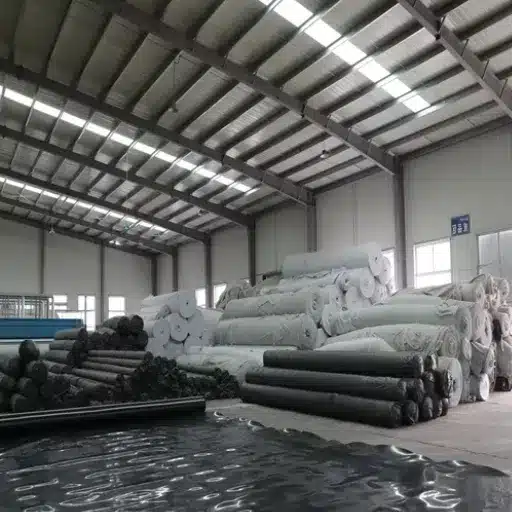
Using the right construction mat can really transform how well one can be able to support their heavy machinery, conserve the environment, and navigate hard terrains. In the past, the use of hardwoods has solved such issues in a vast number of cases, although with the massive growth in innovation and materials science, the option of composite construction mats came into the picture. The paper intends to demonstrate the exceptional impact of the composite mat on the industry and also to promote the use of these mats for better durability, safety, and ecofriendliness. In case the walls are falling because everyone wants to make work processes lighter, cheaper, and healthier, seek no other answer than why composite mats are more and more applied in construction and industry nowadays.
Understanding Composite Construction Mats
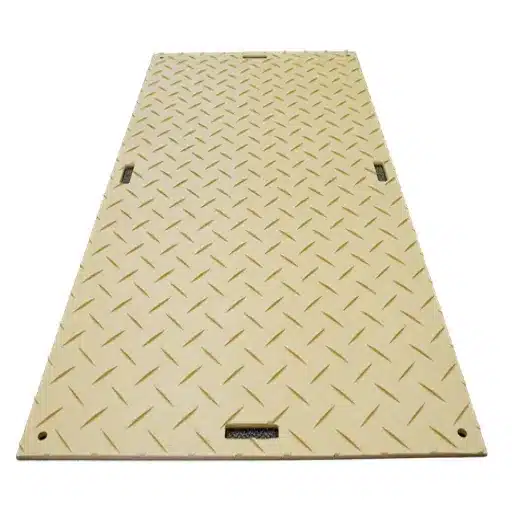
What are Composite Mats?
Composite mats are a type of modern construction mats which utilizes synthetic materials of construction, such as HDPE or thermoplastic sheets in their make. Unlike the wooden or even steel mats, composite construction mats are much stronger, more durable, and usable in many environments and applications. This mat can be used in construction, oil and gas exploration and production, power generation repetition and distribution, alternative energy, and many more purposes, such as creating platforms, gaining clear access, or ground protection in inaccessible places.
According to the updated information in the building sector, construction mats made of composite materials can endure an added period of life by up to five times more than those made of wood materials due to their rot, warp, and insect-resistant qualities. In addition, they are tough enough to handle heavy loads, mainly because some of them are able to take up more than six hundred psi; therefore, they are appropriate for use in heavy tools and equipment. In addition, if the weight of composite construction mats is considered as compared to that of the steel construction mats, composite construction mats are light enough to reduce their delivery and installation costs by almost forty percent.
One more advantage is that they are more environmentally friendly. The majority of composite mats and other similar materials are designed to be made without wastage; most trimmings are used in the process, and they also protect well when installed, hence it minimizes repair ratio and therefore replacement. The benefits are that less has to be done, thus conserving more. For example, composites in the construction industry could help limit the carbon emissions of a project to up to 30 percent compared with the prior usage of wood materials. Since it does not allow penetration of water, oil or any other chemicals, this component also helps to keep the surfaces and areas around it safe from possible leakages.
Ladies and gentlemen, in conclusion, one can say that composite construction mats are an improvement of current construction solutions used in the traditional context; they always cut costs in the long run, make the work more efficient, and provide eco-friendly solutions to contemporary advancement.
Key Features of Composite Mats
- Superior Durability
Enhanced working performance by introducing more durable composite construction mats. Construction, drilling, or any civil infrastructure activity may benefit from these since they say that these construction mats are capable of withstanding the action of hostile climate changes and bearing extended weight limits. They use sheets of high-density polyethylene (HDPE) or, even, advanced composite materials that perform better due to their structural properties rather than conventional wooden mats. Practically, most of composite construction mats can even survive a 600 psi per square inch load without giving way, making the use of heavy machinery possible. - Lightweight and Easy Installation
Composite construction mats are lightweight and come at a lot lesser compared to wooden or steel ones, making it is cheaper and easier to move around. They have a distinct containment system capable of easy fixing and release when handling, with almost a forty percent saving in time quantitatively compared with conventional cutting implements. In case you did not know, even mattresses that are lightweight require less fuel for shipment and therefore, in a way, promote green transport. - Green Utilities
The manufacture of composite construction mats is notable due to their environmental friendliness in that they can be recycled and used again instead of felling more trees to make wooden mats and timber, as is the case with the traditional mats. They are completely water, oil or any other foreign contaminants proof, therefore there is a lesser probability of ground or water pollution. Composite mats also have the added advantage of a30% reduction in carbon emissions since they are not only reusable but transporting them is also easier to transport. - Safety Increment and Durability Enhancements
For example, when it comes to composite panels, they have an antislip surface to allow for a safer turn of people or equipment, even in cases where mud, sand or snow is the surrounding environment. It is worth noting that since they are not affected by moisture, warping, or breaking, the lifespan of these materials can often be as high as three times that of wooden panels. This attribute of high tenacity counteracts the need, e.g., frequent scheduled service and refurbishing costs, in a smarter manner. - Flexibility of Usage
Such establishments can encompass, for example, cutting and packaging edges in oil and gas, construction, utility, and renewables in general. For any underlying use, such as temporary road construction, platforms that support certain loads, or even covering some other aspects for repairs, composite construction mats do a decent job. They are, however, most suitable for these kinds of works. Particularly in the center, peripheral, and most of the works that take place at the periphery are done using these materials.
Even when integrating advanced structural approaches or ecological aspects, it is still composite construction mats that ply the trade of the building and all industrial sectors, enhancing the efficiency of doing business and reducing the environmental impact.
Comparison: Composite Mats vs. Hardwood Mats
Comparing composite construction mats and traditional wooden mats, the progress achieved in composite construction can be improved significantly, especially with the development in technology. The innovation within the composite construction is also referred to as engineered logs that have mechanical strengths which enable the utilization of a certain hardwood mat up to 5-10 years, which is about 5 times or more of the time of the standard wooden mesh. For instance, composite mats have a useful life expectancy of 10 years to 15 years. In the case of the hardwood matting, its lifespan ranges between 2 and 5 years, which minimizes the expenditure on replacement costs during its useful life.
One should also consider the environmental aspect of the issue. This is because wooden mats are derived from fully grown trees. Such a type of mat requires frequent logging of trees, which results in deforestation, loss of habitats, and so forth. However, it is worth noting that the majority of composite construction mats produced from RECYCLED materials, as well as being REPAIRED and RECYCLED at the end of their useful lives, promote sustainable user practices in construction activities or a reduction in emissions of greenhouse gases due to less deforestation.
As far as strength and effectiveness is concerned, composite mats have an edge over hardwood mats. They do not soak in moisture and are capable of resisting contact with water, oil, and chemicals, and therefore can survive in humid or even polluted environments for an extended period. However, soaking hardwood mats or keeping these under different environmental conditions for a considerable amount of time causes them to grow unpleasantly in size or disintegrate. More so, composite construction mats weigh about half as much as hardwood mats, making it less expensive and less cumbersome to transport and install.
On the most concerning health and safety issues, liberally speaking, the use of composite materials provides an anti-slip surface, which reduces the possibility of any unsafe acts occurring. Wet and destroyed wooden pathways can be very slippery and a safety concern during high foot traffic.
Ultimately, the conclusions state that composite mats are formidably strong, do not cause any harm to the surrounding environment, and also, there are no safety issues with these, respectively, incorporating these improvements and serving the growing construction and non-construction industrial needs.
Advantages of Composite Mats
Durability and Longevity
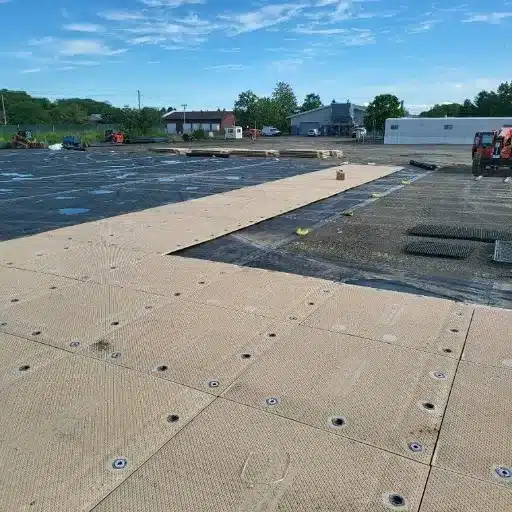
Composite mats are designed to withstand severe weather conditions and to carry heavy loads; many different applications of this type of mat are available. Early results of the experiment indicated that composite mats never exceed 600 000 pounds before breaking, which means a great enhancement in the aspect of flexibility when compared to elastic mats of hardwoods. It is a fact that they are durable, and this entitles them to be used within construction areas such as roads, oil fields and other surfaces for a longer term.
Furthermore, composite mats are water and chemical-resistant as well, so they do not warp or rot. Hardwood mats of this category need frequent replacement when rotting or wearing out; composite construction mats, on the other hand, will hold out for no less than five or ten years or longer, depending on their use. This not only cuts costs in the business but also reduces waste from such products, making the latter more environmentally friendly.
Resistance to Water and Chemicals
There is a growing trend in the use of composite construction mats, considering that they are effective for use in water and most chemical exposure, even in difficult environmental conditions. It has been established that these composite mats can be present in situations where water is present and retain their form by stopping water from entering them, effectively causing expansion or breakage. It is also noteworthy that these mats can be exposed to various chemicals, including oils, solvents, and acids, and they will remain intact for a long period, thus making them efficient in working environments where such substances are typically utilized during construction activities.
The issue is, in fact, no different than, for instance, the liberalization of composite construction mats constructed using high-density polyethylene (HDPE) materials that attenuated over 98% against a range from base to acidic solutions in the production process. Besides, integration of new composite technologies allows designing preparation mats with a revolutionized fried-square surface for incident-injury users in site slippery-greasy and wet applications. Composite construction mats that deteriorate within ten years of duration on any operational activity, such that overlaps and therefore uptake of these matting solutions in many different industries is on the rise.
Environmental Impact and Recyclability
Composite construction mats, in the present time, are preferred over normal mats for their benign environmental impacts. They too are environmentally friendly as they are easily recyclable, as shown by some recent research in the field – composites manufacturers are able to replace some of the traditional primary materials with secondary materials, thereby facilitating efficient use of raw materials. In fact, in some of the studies in some sectors, it is alleged that criminals can admit to taking up to 30%-50% of raw materials from waste of food grade or even industrial scrap materials. That is the reason why we should be practicing paper recycling not only for dumping purposes, but also to keep the consumption of raw materials minimal, thus enhancing sustainable development in the modern day.
In addition, composite mats are eco-benevolent as well as composite materials, and a used product can be remanufactured. This is made possible by advances in technology to ensure the full return of most, if not all, the materials taken out, and thus preventing the mat from being worn out from being buried. The sustenance of the construction and energy sectors makes use of these composite construction mats a lot, and understandably, they are concerned with sustainability a lot. As a result, recycling of the mats is very important to look at for the sake of meeting the laid-out environmental guidelines and avoiding excessive emissions during operations.
In addition, the aspects previously mentioned and the construction of floors out of composite construction mats rather than wood favor the possibility of reduced environmental impact, as the latter is more designed for green practices than the former. However, currently existing data show that wooden cutting boards and mats result in eventual deforestation, as well as have a short duration in use, making it necessary to replace them after a period of time. This pushes the need for more resources in very high. But a greater number of sources show these composite mats are able to be used for many years, with some types being used even for up to fifteen years, and above all, do not negatively impact the environment, such as cutting down trees. Apart from these, composite mats, since they are also very tough, recyclable, and cost-effective, also provide the best market technology ‘eco-friendly’ and industrial type.
Applications of Composite Construction Mats
Heavy Equipment and Crane Operations
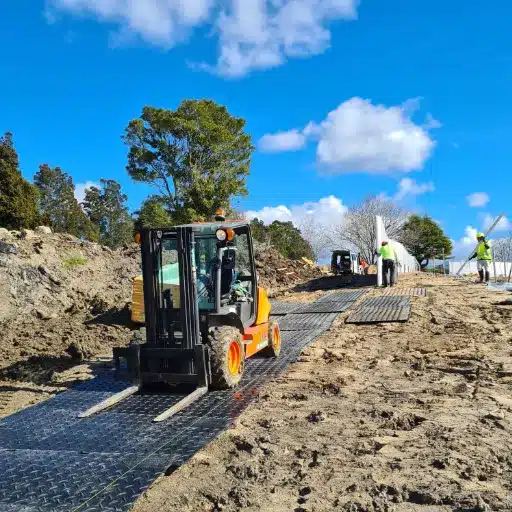
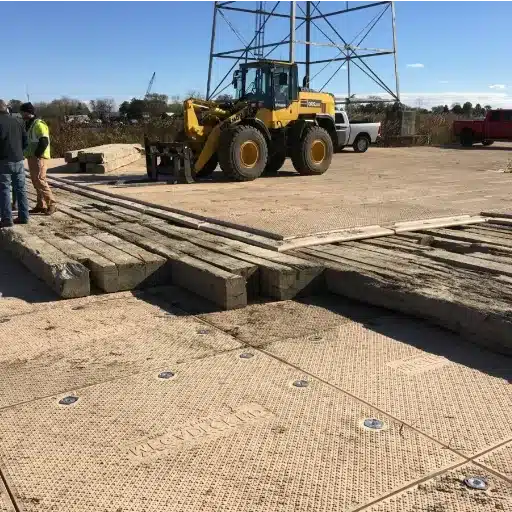
Lifting gear and cranes require stability and strength from the ground, which is enhanced by the presence of composite construction mats. These fixtures can help even the heaviest of equipment, unlike timber smoother or platform that has a weight bearing capacity of more than 600psi or pounds/square inch for the fluid screens. As a result, the composite mats are able to withstand quite a bit of weight without breaking, even for conditions that are quite tough and for operations where there is no smooth path on the ground or when it is filled with water.
In addition to this, it is noteworthy that such structures turn out to be much easier to work with and more cost-effective compared to wooden structures per unit of material transported. According to the available data, the share of transport cost in projects that used composite mats was up to 40%. It should also be remembered that these materials do not soak in water or produce chemicals that could be classified as irritants apart from aqueous medium and hence do not create leachate that can pollute the ground. This is an important consideration in cases where oil developments are very far from populated places, and those kinds of activities are prohibited.
They may also come in handy when decommissioning or rehabilitating projects to reduce incurred costs. For instance, in one of the recent instances, the application of composite mats, followed by the use of wooden mats, in three years, resulted in 25% cost reduction. It is important to note that such cranes should be supported on mats, so that, unlike using concrete, it is safe and cost-effective.
Ground Protection in Challenging Terrains
There are various points with its own advantages and disadvantages in the context of protecting the ground from damage and deterioration, especially in difficult terrain, such as swamps, slopes, and mud with soft ground. However, composite mats have come in as a game-changer, which facilitates the transport of tools and equipment, despite the terrain being tough. An additional example is that many survey reports suggest that the composite mats market is already making rounds of $1.3 billion; however, it could grow beyond that to over 6.5% CARG – compound annual growth rate – by 2030. It shows that different types of infrastructure development and construction work need composite construction mats along with other products more often.
Compared to other options available in the markets, composite construction mats are more expensive, but less time is spent on both the construction and repair because of the ease of installation and dismantling. For example, a review of the history of utilization of composite materials in several case studies reveals as much as 40% savings in expenses on environmental remediation work. Moreover, these materials are engineered in such a way that half of the weight is distributed without sacrificing strength, which reduces transport requirements during mobilization and field use. Furthermore, testing reveals that the strength of composite mats can be more than 600 psi. This makes them applicable across all fields, even in cases where heavy machinery is involved.
Such improvements are commendable since they are of practical importance, hence creating a way for their assimilation in a number of sectors such as energy, forestry, infrastructure development, and specifically dealing with remote areas with bad terrains. Due to growing concerns about environmental protection, the integration of composite construction mats in businesses helps firms to improve performance while complying with environmental regulations.
Event Management and Temporary Access
The idea of going for composite construction mats designed for outdoor events and specific activities is worth considering. In some places, some people have an urge to hold entertainment which is stage-bound – like a concert, a sporting event or any other event that calls for a multitude. In those instances, the linear attenuation mats should be used as a loud control over the devices functional and people besides abnormalities.
In specific places, ensuring mobility by external barriers is often required, and ground protection mats are used when this is impossible. Thus, this assists in the explanation of the dynamics of about 6.5% from 2023 to 2030 for the Global Composite Mats Market, which is attributed to the material lightness. Consequently, as it stands, whoever or wherever is assumed, these mats appear to be advancing in technology. For this reason, it is noted that in an “effort to expand the sections to the testing laboratories, composite construction mats which will cut down on test site reconstruction with a factor of 40% are to be applied, including the preventive application of green fences.” In addition, the outside concerning the substance is applied in such a ‘soft’ fashion, not complicating the Fixation while engaging the processes of lifting, pulling, and maintenance work.
In addition, the other side of the modern thesis is that mats that are produced with composite construction mats technology, which in this case means sound-insulating expansion joints in challenge mats, possess anti-skid surfaces with the development in recent years and breaking capacity. They also help in this sense to encourage the pop-up and use of the mats even in densely packed locations, where the pits are subjected to shoving. This is in line with the offsetting sustainable event management that the market recommends due to the increasing concern of companies to be efficient while still environmentally friendly.
Choosing the Right Composite Mat
Factors to Consider: Load-Bearing Capacity
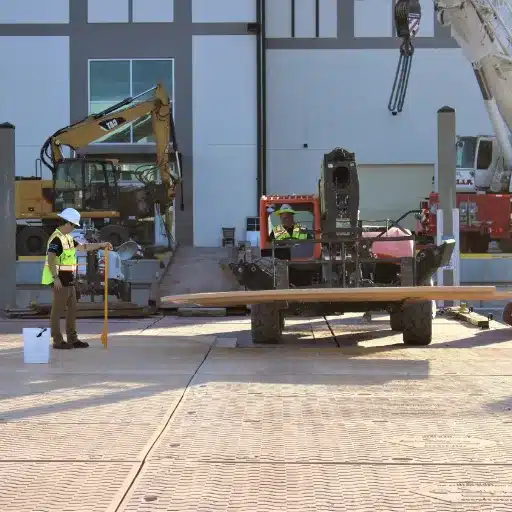
One of the most critical factors to consider when deciding on the type of composite construction mats to buy is the ability of the material to carry a certain load. Standard composite construction mats of today are designed to cater to different weights; both very small loads of below two or three tons up to more than six hundred metric tons can be supported, depending on the fortification and form. For instance, composite construction mats manufactured from HDPE (High-Density Polyethylene) or reinforcements mold constructions that employ fiberglass are used in heavy-duty operations like assisting cranes, housing construction equipment, or troopers’ vehicles. In accordance with the up-to-date developments, such composite construction mats are often applied in the construction or some other activities, for example, beams with a loading capacity from 200 to 400 tons; there is no problem employing them in a place where there is a need for overweight items.
It is also important to consider the type of surface over which the mats will be installed. Muddy, marshy or unstable ground presents problems when it comes to equal weight distribution, as these rigid interlocking composite mats escape the stress of sinking and slipping. In turn most recent changes in composite mat production have introduced weather-proof technologies, enhancing the areas in which structures can be built.
Considering the weight to be borne, the ground condition and the nature of the area, alternatives of the composite construction mats appropriate for such operations may be chosen by companies and ensure a safe, efficient, and trouble-free operation in the long run.
Possible Ground Conditions and Project Duration
Ground conditions, however, are variable depending on project site location; there may be severe limitations for composite construction mats in terms of use and selection as well. For instance, in the marshy ground, it becomes very important to raise an extensive structure to prevent the equipment from sinking. Some sources suggest that a composite matting footing can extend up to 200 sq ft, thus greatly reducing applied stresses on the subgrade even when deploying heavy equipment.
Getting the correct tools is evaluated as crucial throughout the construction project. It is clear that the majority of the composite construction mats are designed for both short-term use and long-term use, and in rare cases, they can last for a few years under the circumstances. Presently, the fabricators acknowledge that they have made composite mats much better, even for harsh environmental conditions, and in many instances, they last more than ten years, with little servicing. Because of this fitment – durability, it means that work that might span even weeks or months does not call for often changing mats due to deterioration of the substance.
There are composite construction mats for paving bumpy or rough terrain, and often, they are the heavy-duty molded types made from high-density polyethylene (HDPE) and other flexible layers that work to allow a strong cover. They can take peak pressures of over six hundred p.s.i, by the way. It is beneficial when operating on uneven ground. Also, more modern mats have incorporated advanced ribbed designs aimed at enhancing stability by at least forty percent. These concepts are particularly applicable to the enhancement of the mobility of construction works and work safety in difficult or remote places.
Rental Options for Composite Mats
One must really put to consideration the pricing of these composite material floor boards, more so if they are square foot boards or of any other pattern, and at the end of the day, it should be noted that composite hiring cannot be taken for granted, and so in sufficient amounts for every project targeted, manpower for these utility boards pertains. Cost countries leasing these composite boards would differ in most parts according to the categories and sizes of the mats. For instance, the typical HDPE composite mat costs 0.25 to 0.90 dollars per square foot per day; however, in some cases, those rented from a far distance can be offered at a discounted price.
Many studies have shown that the oil & gas construction and infrastructure sectors’ composite mat use has grown tremendously, due to the effects of the current generation mat features, which have been considered receptive to use and friendly to the environment. Some suppliers will often incorporate the rental of modules into the project because of the inclusion of effective transportation, staging, and recovery of modules for handling long-term project aspects. In addition, some of the contemporary composite construction mats are designed with some monitoring devices, and this is appreciated by the Project Managers.
Furthermore, rented composite construction mats can reduce costs at the start because this is possible when there is no need to purchase them for a longer period. From the studies that have been done in the past, it is clear that most, if not all of the customers prefer this kind of services that have deployments and setups on rentals. This speaks for the remodeling and consequently the reusable composite mats, which are more environmentally friendly than wooden ones.
Reference Sources
- An overview of composites as construction materials
This article discusses the importance and feasibility of composite materials in construction, highlighting areas for further research.
Read more here - Construction Mats Market Size, Share, Trend & Growth 2031
This market research report provides insights into the growth and trends of the construction mats market, including composite mats.
Read the report here - Construction Mats Market Analysis 2026
A detailed analysis of the global construction mats market, including market size and growth projections.
Access the analysis here
Frequently Asked Questions (FAQs)
What are composite construction mats, and how are they different from hardwood mats?
Composite construction mats refer to tough matting systems that are manufactured using composite materials. Their source is either polythene bags or any other polymer material. Composite mats, unlike the timber mats, are almost fragile yet colored in a way that they can survive in the working surfaces where strong mats are required and remain intact. They also provide very good operational services since such mats are more flexible and so do not become an inconvenience or useless by damaging the environment.
What benefits do composite mats provide in comparison to hardwood mats?
In contrast to the hardwood mats, composite mats offer more durability, fewer maintenance needs, and are not affected by water or chemicals. They can also be designed to meet particular requirements of any work site, such as the need for particular sizes or load-bearing capabilities, and they are more efficient when used with heavy wheeled machinery. Reusable composite construction mats are environmentally friendly as they save more trees, while at the same time lessening disposal problems.
How does the price of composite construction mats compare to wooden mats, which are traditional?
Yes, the cost of composite construction mats is cheaper over the operation phase. They have a huge price difference when worn-out rubber tiles are put into comparison, though in the end, you gain in terms of replacement, material, and repairs of the same tiles. This can be attributed to the material making them, which is softer and thus will be able to take beatings for a long time without wearing off and requiring replacement.
How will using composite construction mats save the environment?
It is viewed that composite mats do not create any harm to nature. Composite mats need materials that can be recycled, hence there is no exploration of natural resources. It does not involve logging or using logs, unlike in hardwood mats, which means no forest encroachment. Furthermore, the composite mats can be swept, reducing the amount of landfill waste since the mats are reusable. They are strong and durable, and therefore the low face cycled members are not replaced more frequently, thus reducing environmental degradation.
Can composite construction mats handle extreme weather and heavy equipment?
Composite construction mats are indeed highly durable in the most intense conditions: extreme cold and heavy machinery. In places subjected to snow, moisture, or heat, they will not eventually lose shape, crack or disintegrate. This certainly is why they are recommended in the building, the oil and gas, and the renewable sectors.
Are composite mats adaptable and customizable for particular project requirements?
Yes, they. Within the broad scope of such materials, composite construction mats can be fitted to anything that the client, within reason, pleases. At the user or rather project level, they can come in approximate working sizes, thicknesses, textured finishes, and relative weight limits for different equipment or terrain types. This type of tailoring becomes very practical because it not only ensures quality work throughout the various stages of construction but also reduces accidents and hazards while working on any site.