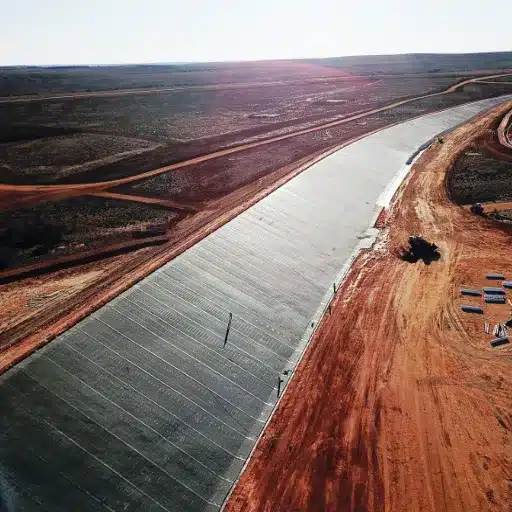
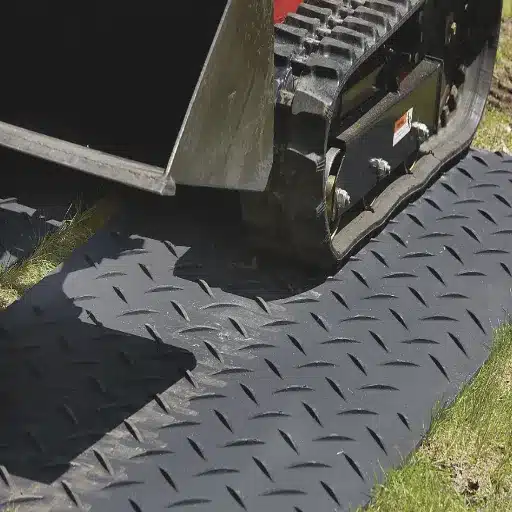
The access road you constructed yesterday will cause your project to receive a fine tomorrow. Engineering teams experience this situation more frequently than they want to accept. A crane becomes stuck because it sinks into soft clay. Heavy equipment operations result in turf damage through multiple equipment passes. Environmental violations occur at sensitive sites because soil compaction violates regulations. The problem with machinery failures begins because operators neglect to establish proper ground protection measures.
You already know that ground protection mats matter. The real challenge is choosing the correct type and thickness, and material for your design based on specific terrain and equipment needs and project schedule. Your project will experience delays, restoration expenses, and dangerous conditions when you make a mistake. Your project will succeed when you build a stable work area that keeps your equipment safe and maintains ground security.
This guide teaches you how to assess ground protection mats through engineering assessment methods. The study will examine four materials, which include HDPE, composite, timber, and rubber. The study will cover load capacity calculation methods, best installation techniques, and total ownership cost analysis. The study will demonstrate how to identify essential requirements for international infrastructure project mat sourcing.
Need a quick specification check? Explore our HDPE ground protection mats to see thickness ranges, load ratings, and export-ready options for your next project.
What Are Ground Protection Mats and Why Do Projects Need Them?
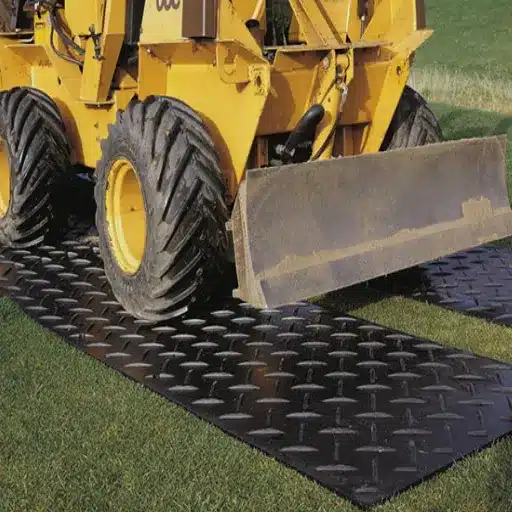
Ground protection mats function as engineered panels that construction teams use to build temporary access roads and work platforms, and protected work areas. The mats distribute vehicle and equipment, and personnel weight across a wider surface. The system protects the ground by decreasing weight concentration at specific points, which leads to rutting, soil compaction, and turf damage.
The equipment needs their presence because they function as protective barriers that separate your machinery from the ground. The tracked excavator and crane outrigger create extreme pressure, which needs this protective barrier to stop it from occurring. The force that is exerted on soft or sensitive ground directly results in damage to the subsurface.
Ground protection mats serve multiple industrial applications throughout different industrial sectors:
- Civil engineering and construction: Temporary access roads across undeveloped sites
- Utilities and energy: Work platforms for transmission-line maintenance
- Oil and gas: Drilling pads and remote-site access in marshy terrain
- Environmental remediation: Protection of sensitive turf during landfill cap installation or wetland restoration
- Events and infrastructure: Pedestrian walkways and staging areas on grass or paved surfaces
The global market for ground protection mats is projected to grow steadily at approximately 4% to 6% CAGR through the early 2030s because infrastructure expansion and stricter environmental regulations worldwide drive market demand. The growth of SelectMat demonstrates that contractors and project managers now consider ground protection equipment as essential tools for their work.
Types of Ground Protection Mats: An Engineering Comparison
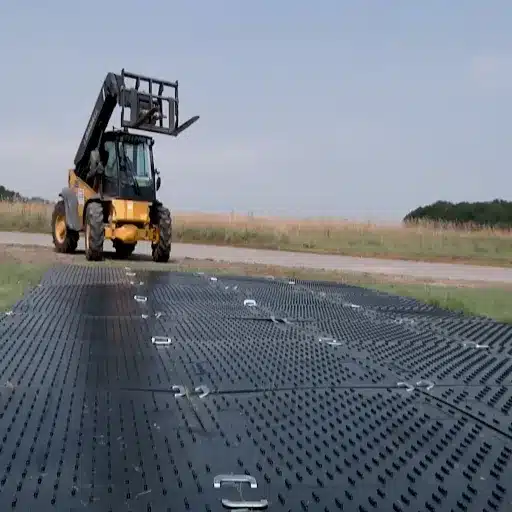
Not all ground protection mats perform the same way. Material composition determines weight, load capacity, durability, portability, and recyclability. Here is how the four main categories compare.
HDPE Ground Protection Mats
High-Density Polyethylene (HDPE) mats are the most widely used type in modern construction and civil engineering. The products are created through the process of molding solid polymer sheets, which come in standard dimensions of 4 feet by 8 feet and 2 feet by 8 feet.
Key characteristics:
- Lightweight: Most panels weigh 56–100 lbs, allowing manual carry by crews
- High load capacity: Standard mats support 60–120 tons, depending on thickness and ground firmness
- Chemical and UV resistance: HDPE does not rot, absorb moisture, or degrade under sun exposure
- Recyclability: 100% recyclable at the end of life
- Connection systems: Simple interlocking pins or bolted edges for rapid assembly and disassembly
HDPE ground protection mats function effectively in projects that require frequent mat relocation. The crew can complete the setup quickly because they can handle the installation and removal process without using equipment. The system allows operators to save transport expenses because they can fit more panels into standard shipping containers and flatbed trucks at once.
For environmental and infrastructure contractors, HDPE provides an effective solution that combines sufficient strength to support heavy wheeled equipment with the ability to be moved between different work locations and the property of being chemically stable for use in areas with sensitive ecosystems.
Multi-Material Composite Mats
Composite mats combine multiple materials, typically fiberglass-reinforced plastics, wood-plastic blends, or proprietary resin mixtures. These materials exhibit maximum stiffness while supporting extreme load limits.
Key characteristics:
- Very high load capacity: Some systems support 600+ psi, which makes them suitable for the heaviest cranes and tracked equipment
- Heavyweight: Individual panels require forklifts or cranes to achieve proper placement
- Semi-permanent installation: Best suited for long-term access roads or work platforms that require mats to remain installed for months
- Complex connections: The system uses overlapping flanges, which require heavy locking pins for secure attachment
- Variable recyclability: Mixed-material composites present recycling challenges, which make them difficult to process
Composite mats shine in oil and gas mining and heavy industrial settings where extreme point loads are common and mat movement is infrequent. However, the system remains impractical for contractors who require job site flexibility because of its high upfront cost, heavy freight requirements, and equipment-dependent installation.
Timber and Crane Mats
Wood mats in general are commonly composed of strong, dense hardwood material, such as oak or a mixture of hardwoods, used for marsh conditions, and for the sands of crane pads for many years.
Key characteristics:
- Wide Load Distribution: Timber mats are broader and heavier to spread that mon blah around very soft, unsteady lands.
- Elasticity in Nature: Wood could easily just bend slightly, fitting around an unconformable ground.
- Often prone to moisture: The fiber has some soaked and then rotted building as expected, as it also breaks into shreds under heavy loading.
- Greatly variable: Hardwood, which matters and varies a great deal among mat constructions of very different suppliers.
- Limited recyclability: They last up to a time when the items stop being true, with some warping and rot contributing to their decay when compared with some of the synthetic types.
Timber continues to be a real asset where one might need to access wetlands or have a temporary crane pad for extreme widths, well exceeding the size of long-term reusability. For the most part, however, with general construction and infrastructure projects, synthetic mats have virtually replaced wood because they are stronger and have a lower total cost of ownership.
Rubber and Specialty Mats
Specialty vinyl flooring and lighter specialty panels cater to market segments for which traction, cushioning, or pedestrian access is more important.
Key characteristics:
- Superb traction: Textured rubber surfaces diminish the chance of foot traffic slipping
- Light and extremely flexible: Can be unrolled easily for events, landscaping, and light-duty work
- Low load-bearing capability: Not designed to serve heavy construction equipment
- Porous: Some of the rubber grass-matting products allow water drainage, and grass grows through them
These products are more suited to outdoor events, residential landscaping, and pedestrian walkways for preserving surfaces rather than supporting heavy equipment.
Quick Comparison Table
| Feature | HDPE Mats | Composite Mats | Timber Mats | Rubber Mats |
|---|---|---|---|---|
| Load capacity | 60–120 tons | 600+ psi | High | Low |
| Weight | Light (56–100 lbs) | Heavy (equipment needed) | Very heavy | Light |
| Portability | Manual carry | Forklift/crane required | Equipment needed | Manual carry |
| Best use | Construction, utilities, events | Oil/gas, heavy industrial | Wetlands, crane pads | Pedestrian, events |
| Durability | 10+ years | Long | 1–3 years | 3–5 years |
| Recyclability | 100% | Limited | Limited | Moderate |
How to Choose Ground Protection Mats: 5 Technical Criteria
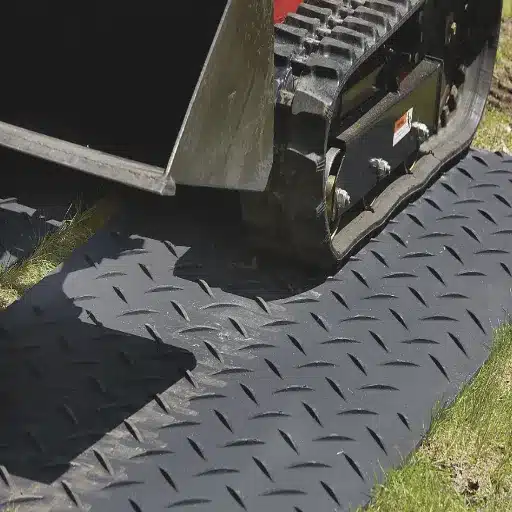
Selecting the right ground protection mats requires more than reading a product label. You need to match mat specifications to project realities. Here are the five criteria every engineering buyer should evaluate.
1. Assess Equipment Type and Load
The first question is straightforward: what will travel over these mats?
Rubber-tired equipment, such as trucks, mixers, and utility vehicles, typically uses large contact areas over which the load is placed. Most of the medium or heavy-duty mats made of HDPE will also withstand the hardest of abuse when subjected to rubber-tired traffic.
Tracked machines, such as excavators or dozers, will concentrate the load in a smaller area on the narrow track. That way, thicker, more rigid mats may be required to resist flexing and penetration.
Point loads are secret categories of problems, not just entire loads. As a tip, a crane outrigger or jack pad can create enormous pressure in a small area. Hence, in some cases, while using BAM Ground Proh, you can safely guide a 60-tonne crane atop a mat system, but application of a single outrigger pad might easily exceed the point-load capacity of a thin panel. For crane work, it is best to verify the figure frequently with the definition of the limits in a point-load rating matrix, along with the use of dedicated outrigger pads or thick composite mats.
When the construction team at a highway expansion project in Vietnam evaluated mat options for their crawler cranes, they initially selected standard ½-inch HDPE panels based on total crane weight. Their geotechnical consultant flagged the outrigger load calculation: each pad would exert over 40 tons on a roughly 2-square-foot area. The team upgraded to 1-inch heavy-duty HDPE mats with dedicated outrigger pads. The result? Zero subsidence incidents across six months of piling work.
2. Evaluate Ground Conditions
Ground protection mats are not stand-alone; they truly depend upon the presence underneath.
Firm turf or compacted soil: For light, moderately trafficked use, most traffic can be handled by light-duty and light-to-medium-duty mats.
Sandy or silty soil: Soil particles move when vibrated. Shear between mats with interlocking joints prevents differential settlement and large gaps.
Soft clay or wetland: It deforms itself. Assured thick and wide mats distribute loads as much as possible. A thick geotextile beneath the mat from a rock layer can also be applied in critical cases.
Sloped terrains: Requires staking and adding anchors to keep mats in place on slopes. A connection system involving locking pins becomes an essential element.
Environmental sensitivity: Wetlands, golf courses, and residential areas receiving top environmental protection need non-absorbent materials. HDPE mats are preferable to others as they are impervious to chemical leaching, self-falling or contamination absorption and leave no splinters behind.
3. Match Thickness to Application
Thickness is not a feature of marketing. It is an engineering parameter directly affecting load distribution and mat rigidity.
Light Duty (1/4 inches to 1/2 inch): Suitable for pedestrian use, light small vehicles, landscaping, and areas of temporary pedestrian or event mats. For example, small residential mats and rubber grass-protection panels.
Medium Duty (½ to ¾ inch): Takes the pressure of general construction traffic, rubber-tired equipment, and utility vehicles on a firm substrate. A one-half-inch-thick HDPE mat can typically hold up to a pressure of around 60 tons on stable soil.
Heavy Duty (1 inch to 2 inches or more): Required for tracked equipment, cranes, soft ground, and long-term installations. Products with capacities of 120 to 150 tons can be used for very heavy uses. With the most advanced composites, capacities can be stretched much further.
Arboricultural and environmental standards: There are minimum mulch depths and mat thicknesses in some jurisdictions to protect trees. For example, in order to prevent injury to trees from the use of heavy equipment, heavy machines may dissipate pressure over 6 inches of woodchips or sand by using heavier mats.
Make sure you do a real search of the manufacturer’s load ratings versus the maximum weight and performance conditions of your business, not just the everyday weight and weather conditions.
4. Determine Duration and Portability Needs
How long will the mats stay in place? And how often will you move them?
Short-term projects (days to a few months): Rental or maybe not a very expensive purchase would be in place. HDPE mats of the lightweight variety, which can be deployed and taken down quite fast.
Long-term or multi-year projects: Here is where ownership, including especially the total cost of ownership, takes over. Taking into account reuse for many years, the more durable HDPE or composite mats justify the initial cost.
Ongoing movement: If you have to make mats move every day or week, there will be consideration for weight since the two men carrying HDPE panels will subsequently get rid of a lot of work hours and eliminate the need to take a forklift into the construction site.
Export and logistics: Shipping volume and container efficiency have an impact on landed costs for international projects. HDPE mats create tight stacks that result in lower shipping freight costs per square foot than do thick composite or timber alternatives.
Looking for export-ready mats with flexible order volumes? Contact our engineering team for a customized quote based on your project location and timeline.
5. Connection and Layout Planning
A collection of individual mats is not a road. A properly connected system is.
Connection types:
- Simple pin or bolt systems: Common on HDPE mats. Fast to connect and disconnect. Best for general access roads.
- Interlocking tongue-and-groove edges: Provide lateral stability and reduce gap formation.
- Overlapping flanges with heavy pins: Used on composite mats for maximum rigidity across wide work platforms.
Layout considerations:
- Standard 4 ft × 8 ft panels: The industry norm for vehicle access roads. They cover ground efficiently and align with common equipment widths.
- 2 ft × 8 ft panels: Useful for pedestrian walkways, tight access paths, and side-yard utility work.
- Road width: Plan for passing lanes and turning radii if two-way traffic is expected.
- Edge overlap: Slight overlap between panels reduces gap formation as the ground settles.
At a solar farm installation in Kenya, the EPC contractor mapped out a full matting plan before equipment arrived. They used 4×8 ft HDPE mats for main haul roads and 2×8 ft mats for narrow inverter-access paths. Locking pins connected every panel. The pre-planned layout cut installation time by 40% and eliminated the need for on-site cutting or reconfiguration.
Installation Best Practices for Maximum Performance
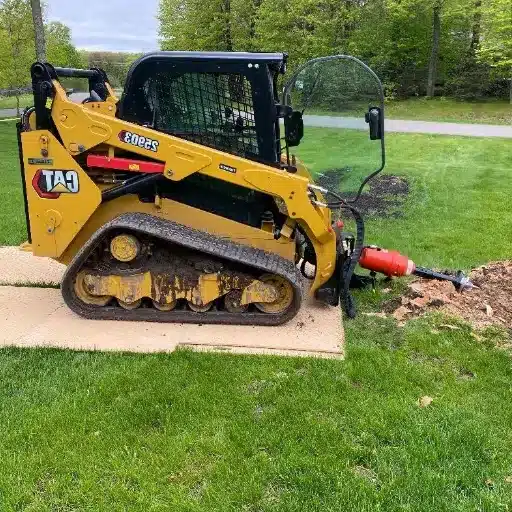
Even the best ground protection mats underperform if installed poorly. Follow these practices to ensure safety, stability, and ground preservation.
Pre-Installation Site Assessment
Walk the site before the mats arrive. Identify:
- Soft spots, drainage channels, and slope gradients
- Underground utilities that could affect anchoring
- Trees, roots, or obstacles requiring layout adjustments
- Soil types that may need a separation geotextile beneath the mats
Remove rocks, debris, and vegetation that could create high points under the mats. A relatively smooth subgrade distributes load more evenly.
Layout and Placement
Lay mats in sequential straight rows following traffic flow. Offset panel joints as they occur in adjacent rows, as in brick-laying, to provide greater defense linearity. On the slopes, place the mats perpendicular to the grade and anchor these securely with stakes or anchors.
Be sure the panels fit flawlessly because raised edges make tripping hazards and partial pressure points that can lead to the cracking of the mats under heavy loads.
Connection and Securing
Connect every panel that will receive vehicle traffic. Unconnected mats can shift, creating gaps where tires or tracks catch. On slopes or in wet conditions, use additional anchoring to prevent panel migration.
Cleaning, Maintenance, and Storage
Clean your mats as often as necessary while in use. Soil and debris accumulate in the tread of the mat and reduce the mat’s traction qualities. Use a hose to wash off the panel, then completely dry the flat before storing it. If mats are stored dripping-wet, they present the risk of developing various molds in the timber and warping in performance of lesser-quality synthetic items. It is unsafe to store the mats because of the musty smell it emits.
Inspect mats for any damage before reuse. Cracks or worn bolt holes or even surface blemishes can severely impair the mats under normal use.
Global Sourcing and Quality Assurance Considerations
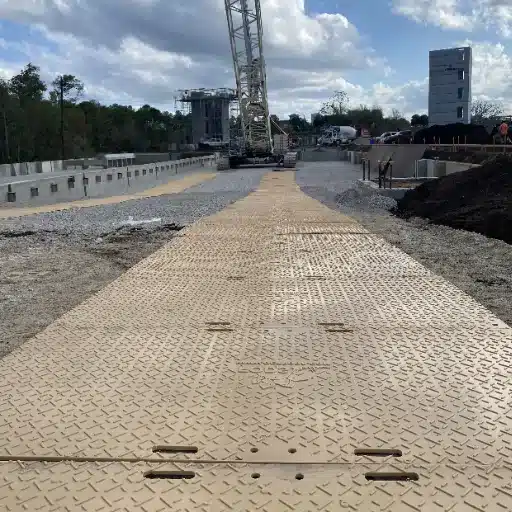
For international infrastructure and environmental contractors, the mat itself is only part of the equation. How it is manufactured, tested, packaged, and shipped matters just as much.
What to Look for in an International Supplier
Breaking down sourcing ground protection mats from international suppliers for our projects, it makes sense to try suppliers based on four criteria, not including price:
1. Quality management system: Defined control measures indicate that this manufacturer is placing its clues from even documents, such as processes for corporate documentation and training, to control the mistakes of the workers. It is important to look for manufacturers with well-defined and documented quality control measures. An advantage in such circumstances is ISO9001blitpunkt certification, which certifies an approach that is systematic towards materials consistency, dimensional tolerance, and performance verification.
2. Product testing and sample holding: Faithful suppliers will keep to the previous numbers of production with the necessary records. It is very much into traceability, which is necessary when field testing finds batch performance as not at all conventional and needs to be investigated.
3. Export logistic capability: Can this supplier efficiently pack mats for container shipping? Can he handle export documentation, customer support, and make promises about tracked deliveries being on time? Container space is always expensive. A supplier who knows how to stack folding of munitions and optimize load space per unit will reduce your freight cost per mat.
4. Technical consultation: Does the supplier offer technical advice for a suitable project? Although they have material values for purchase, will the supplier interfere in thickness selection, load calculation, and connection systems at all? Rather, do they have to provide a lot of project-specific guidance coupled with the sales of pre-made panel systems?
At Shanxi Shengxing, we produce HDPE ground protection mats in our factory, with systems of control that are very well managed and correspond to an ISO9001 standard. We keep samples for five years just to make sure of batch consistency. And we provide technical consultancy and tailor our product recommendations to nice people-to-people relations with the client, who will be managing other global infrastructure and environmental projects.
Regulatory and Environmental Alignment
Different regions have different requirements. European projects may emphasize recyclability and REACH chemical compliance. North American projects often reference OSHA safety standards for temporary work surfaces. Environmental projects in the Asia-Pacific region may require documentation proving that mats will not leach contaminants into sensitive soils.
A supplier with international export experience understands these variations. They can provide certificates, test reports, and material safety data in the formats your project auditors expect.
Total Cost of Ownership: Beyond the Purchase Price
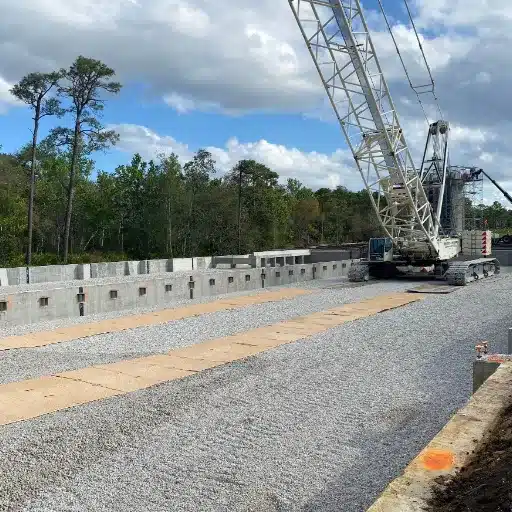
The sticker price of a ground protection mat tells only part of the financial story. Smart buyers evaluate the total cost of ownership over the full project lifecycle.
Upfront Cost vs. Cost-Per-Use
Plywood or low-grade timber: Lowest upfront cost, but frequent replacement, moisture damage, and limited reusability push the cost-per-use upward rapidly. A timber mat that warps after one wet season may cost more per month of use than a synthetic mat that lasts a decade.
HDPE mats: Moderate upfront cost. Minimal maintenance. Low freight because of light weight. High reusability. For contractors who deploy mats across multiple projects, HDPE typically delivers the lowest cost-per-use.
Composite mats: Highest upfront cost plus highest handling costs. Freight is expensive because of weight. Installation requires equipment rentals. These costs are justified for heavy industrial projects with extreme loads, but they rarely make sense for general construction or utility work.
Hidden Costs to Calculate
- Freight and logistics: Weight and stackability determine shipping cost
- Labor for installation and removal: Heavy mats require more crew time or machinery
- Storage: Damaged mats take up space and may require replacement inventory
- Site restoration: Inadequate mats that allow soil damage trigger expensive remediation
- Project delays: A stuck crane or collapsed access road costs far more than the mat that could have prevented it
A civil engineering firm in Southeast Asia initially rented timber mats for a series of landfill capping projects to save on capital expense. After 18 months, they had replaced 30% of their rental inventory due to rot and breakage. Freight for the replacements added up. They switched to purchasing HDPE ground protection mats. Over the following three years, their matting cost per project dropped by 35%, and site restoration complaints fell to zero.
Conclusion
Not just any purchase, ground protection mats are an engineering decision: they determine the level of safety on site, environmental compliance, equipment performance, and ultimately the economics of a project.
Here are the key takeaways:
- Match the mat to the load: Consider total weight, tracked equipment, and point loads like crane outriggers
- Evaluate the ground: Firm turf, soft clay, and sensitive wetlands each demand different mat thickness and rigidity
- Choose material strategically: HDPE offers the best balance of portability, durability, and cost for most construction and infrastructure projects; composites excel in extreme heavy-industrial applications
- Plan the layout: Connection systems, panel size, and road width affect both safety and installation efficiency
- Calculate total cost of ownership: Acquisition cost is less relevant compared to cost-per-use across the project lifecycle.
- Source with global logistics in mind: Quality systems, export packaging, and technical support separate reliable suppliers from product-only vendors
Effective ground protection matting keeps your project up and running, your equipment secure, and your site in control.
Frequently Asked Questions
What thickness of ground protection mats is used?
The thickness of personnel matting depends on the weight carried and the ground condition. Light-duty applications are pedestrian walkways usually standing 10 mm to 1/2 inch. While construction cars, being medium-duty, will need thicknesses of about 1/2 inch to 3/4 inch. Heavy machinery, cranes, and soft land types generally require 1 inch to 2 inches or more.
Do ground mats save ground?
Yes, they do in many cases. Given that the load match is good and the mat is sufficient, mapped ground protection mats allow matting through a constructed carrier to distribute weight over a broader surface. Such events allow pressure points to be reduced and ground compaction, rutting, and grass tearing to be prevented.
Which one is better among HDPE ground protection mats and composite mats?
On the whole, HDPE mats are better as they are portable, cheaper in freight, easy to install, and totally recyclable for most construction, utility, and event applications. They are only light in portability for extremely heavy industrial loads, where maximum stiffness and not having to transport them locked solid is a must.
How long do ground protection mats last?
If properly maintained and stored, an HDPE mat can last more than a decade. There is also quite a lengthy life span for composite mats if some hardware in the connection area is replaced. Timber mats get damaged more quickly when exposed to moisture for 1–3 years.
Can ground protection mats be shipped overseas?
Yes. They are inexpensive for export since they stack well and come out of the container so easily. Make sure you find suppliers who offer documented export experience, quality certifications, and flexible logistics support.