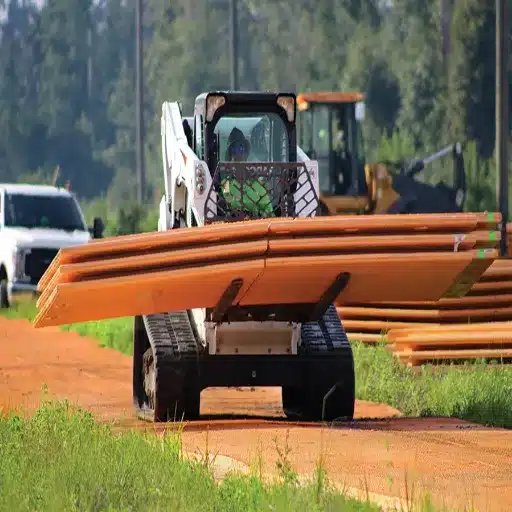
An incident occurred where a mobile crane punched through the soft subgrade by sinking 6 inches while critical lifting steps were underway. Work stopped. Costs involved in recovery may potentially exceed $15,000. This might cascade into any construction delays involving the contractor.
This scenario must happen everywhere across the site where ground protection is slotted in as an afterthought, not as a designed solution. Good ground protection not only prevents damage and loss of your reputation but also ensures operational continuity and provides direct value in terms of your investment.
From an engineering viewpoint, the composite mats are what we will discuss in this guide: how they work, when to specify them, and how they will differ from other types of competitive ground protection measures. They will learn how to choose and apply composite mats confidently, whether managing infrastructure projects, oil and gas operations, or heavy civil construction.
What Are Composite Mats?
Definition and Material Composition
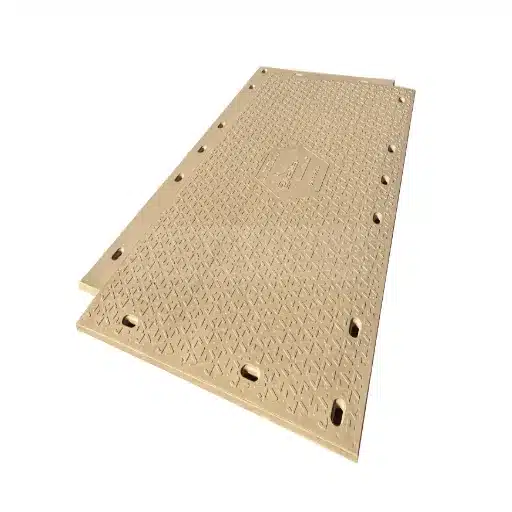
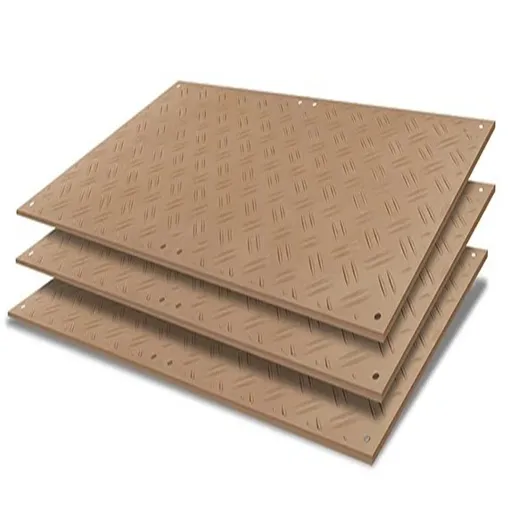
Composite Mats are protective mats made of multiple layers of High-Density Polyethylene (HDPE), mixed with fiberglass, mineral additives, and special resins. Unlike other ground protection mats made of a single material, the composite mats have multiple layers or reinforcement, which enable them to enhance the load distribution and improve durability, among other things.
Key material components include:
- HDPE base polymer: Provides resistance to chemicals and damage by UV radiation
- Fiberglass reinforcement: Provides the fibrous structure with additional strength
- Mineral additives: Distribute the weight and reduce static
- UV stabilizers: Help maintain the integrity of this product upon high sun exposure
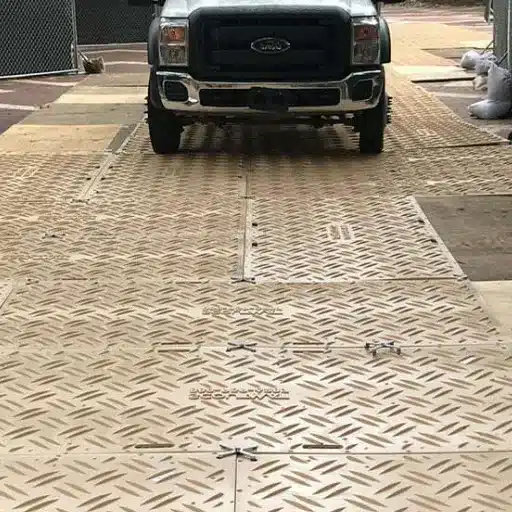
The present invention is a single-piece molded mat that does not have any fasteners, bolts, or joints that can be subjected to load. The asymmetrical rib pattern within the panel assists in carrying the load by dividing the panel surface into segments.
How Composite Mats Function
When heavy equipment traverses soft or sensitive ground, concentrated point loads create bearing capacity failures. Composite mats work through three primary mechanisms:
1. Load Distribution
The large surface area of composite mats (typically 7.5′ × 14′ or 4′ × 8′) spreads concentrated equipment loads over broader subgrade areas. A crawler crane exerting 80 tons may apply only 50-75 psi at the mat surface—well within safe bearing capacity for most soils.
2. Interlocking Stability
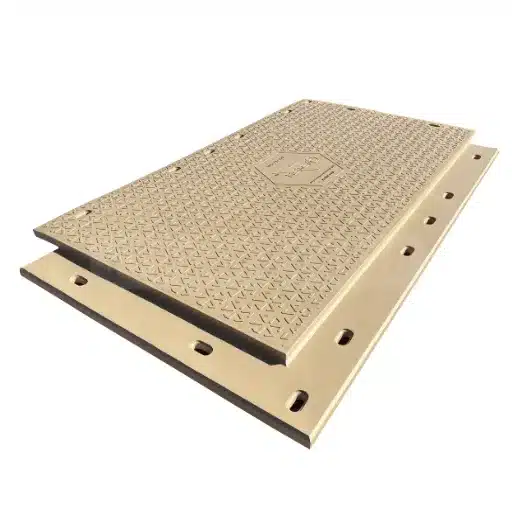
Advanced flange systems connect adjacent mats into continuous work surfaces. The 12-degree overlapping flange design prevents differential settlement, eliminates trip hazards, and maintains structural continuity across the entire platform.
3. Subgrade Protection
By creating a semi-rigid barrier between equipment and ground, composite mats prevent soil compaction, rutting, and contamination. This proves especially critical when working over geosynthetic liners, where puncture protection is paramount.
Types of Composite Mats: Technical Specifications
Heavy-Duty Composite Mats
When specifications demand maximum load capacity, heavy-duty composite mats deliver performance that timber and standard HDPE alternatives cannot match.
Typical Specifications:
| Parameter | MegaDeck HD+ | Dura-Base Style |
|---|---|---|
| Dimensions | 7.5′ × 14′ (usable: 7′ × 13′) | 8′ × 14′ × 4″ |
| Thickness | 4.0″ – 4.25″ | 4.0″ |
| Weight | 1,000 – 1,046 lbs | ~1,100 lbs |
| Load Rating | 600 psi | 600 psi |
| Weight Capacity | Up to 150 tons | Tested to 3,000-ton draglines |
| Connection | MDX pin system | T-Bar compatible |
The 600-psi rating makes it capable of supporting up to 600 pounds of weight spread across every square inch of surface. This provides a reasonable perspective, as a typical concrete truck would have only around 100 to 150 psi at the tire contact patch, which falls firmly within the safety margin of heavy-duty composite systems.
Best applications include:
- Crane work platforms and outrigger pads
- Drilling rig foundations
- Heavy haul roadways over soft ground
- Long-term installations (6+ months)
Medium-Duty Composite Systems
Not every project requires the highest load level. Middleweight composite work mats provide an adequate level of general construction-type service.
SignaRoad Specifications:
- Dimensions: 6.8′ × 10′
- Thickness: 2.5″
- Weight: 496 lbs
- Load capacity: 400 psi (up to 80 tons)
- Ideal for: Aerial lifts, boom trucks, concrete pumpers
The weight reduction (50% lighter compared to heavy-duty options) would facilitate manual handling of just two work persons, thereby accelerating its positioning and saving labour costs. However, only in a few scenarios or the extreme cases typical in a general construction setting could ambient lower absolute load capacities materialize.
Light-Duty and Specialty Options
For pedestrian access, landscaping protection, or light vehicle traffic, lighter composite configurations provide cost-effective solutions:
- Standard 4′ × 8′ mats: 0.5″ thickness, 80-95 ton capacity
- Connection compatibility: Interlocking with major systems
- Applications: Event flooring, turf protection, utility maintenance
Need guidance selecting the right mat specification for your equipment? Contact our engineering team for load calculations based on your specific machinery and ground conditions.
Composite Mats vs. Alternative Ground Protection Solutions
Composite vs. Timber Mats: Engineering Comparison
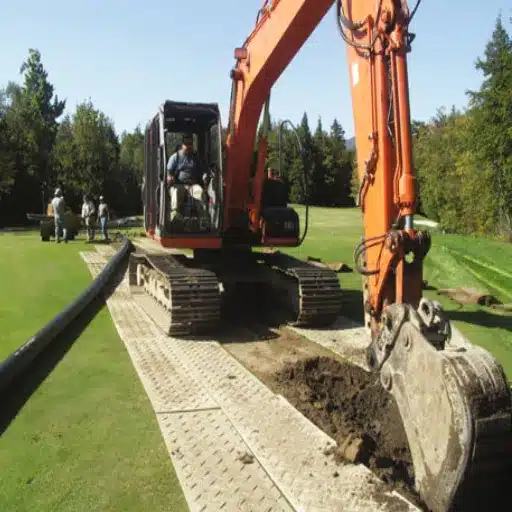
Timber mats have helped construction works for the past decades, but composite technology has revolutionized the matrix of costs and benefits. Here is a comparison of the same across key performance criteria:
Weight and Handling
Composite mats come in at roughly 50% lighter compared to timber. For the standard 7.5′ × 14′ composite mat, for instance, the weight would be approximately 1,000-1,100 lbs, while the equivalent size for timber mats is more than 2,000 lbs. In fact, this difference reflects quite directly on operational efficiency:
- Labor requirements: For the same purpose as stocking, two workers for the composite mat, whereas equipment would be needed for timber
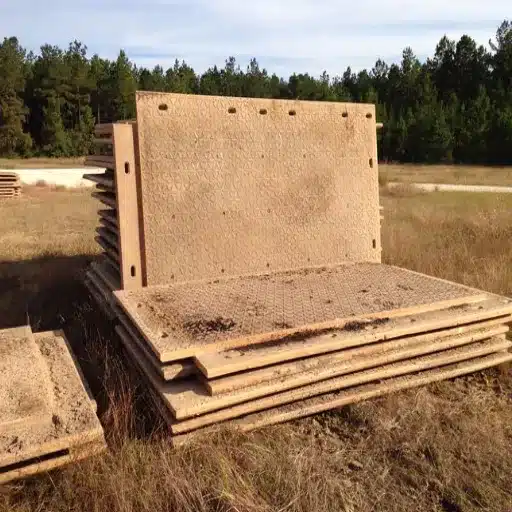
- Transport efficiency: 40-45 composite mats may be loaded on a flatbed truck against 25-30 timber planks
- Freight costs: Per mat, the cost for shipping is the overall logistics cost of the project
Durability and Service Life
When timber is saturated, it offers its high permeability, which promotes decay. The same also fosters perfect nesting conditions for fungi, mold, and insects. The wet condition also doubles the weight of the timber, making its handling all the more complicated. Composite mats are considered incapable of absorbing water and are also inert chemically.
- Composite Service Life: 10-15 years with a proper level of maintenance
- Wood Service Life: In the typical range, 1-3 years
- Weather Resistance: From -40°F to 120°F, Composite Performed Exceptionally
Environmental and Safety Factors
Composites offer some of several advantages for environmentally sensitive projects:
- Non-Conductive: Safe for Transmission and Distribution Electrical Work
- Chemical Resistant: No degradation when fuel, hydraulic fluids, or site contaminants are present
- Cleanability: Non-porous surfaces prevent cross-contamination between job sites
- Recyclability: HDPE construction of 100% recyclability at end-of-service life
Composite vs. Standard HDPE Mats
While both utilize HDPE as the base material, composite and standard HDPE mats serve different applications. Understanding these distinctions ensures proper specification:
| Factor | Standard HDPE Mats | Composite Mats |
|---|---|---|
| Weight (4′ × 8′) | 50-80 lbs | 88-110 lbs |
| Load capacity | Up to 80 tons | Up to 150 tons |
| Material | Pure HDPE | HDPE + fiberglass + additives |
| Best for | General construction, events | Heavy industrial, cranes, extreme loads |
| Cost | Lower upfront | Higher initial investment |
| Portability | Excellent (1-2 person lift) | Requires equipment for large sizes |
When Chen Wei, a project manager for a Guangdong infrastructure contractor, faced a decision between HDPE and composite mats for a bridge construction project, load requirements drove the specification. The 120-ton crawler crane demanded composite’s 600-psi rating—standard HDPE’s 200-400 psi capacity would have created unacceptable safety margins. The higher upfront cost was justified by eliminating the risk of mat failure during critical lifts.
Selection Decision Framework
Use this decision matrix to guide specification:
Choose Composite Mats When:
- Equipment loads exceed 80 tons
- Ground conditions are extremely soft (marsh, muskeg, permafrost)
- Project duration exceeds 6 months
- Long-term reuse is planned across multiple projects
- Electrical non-conductivity is required
Choose Standard HDPE Mats When:
- Equipment loads are under 80 tons
- Frequent repositioning is necessary
- Budget constraints favor lower upfront costs
- Weight and manual handling are priorities
- Project duration is short-term
Choose Timber Mats When:
- Maximum load capacity is needed for extreme equipment (200+ tons)
- Single-use, short-term deployment is acceptable
- Local timber availability reduces transport costs
- Traditional specification requirements exist
Load Capacity and Engineering Specifications
Understanding PSI, Static Load, and Dynamic Load
Load capacity ratings require careful interpretation. Three distinct metrics apply to composite mat applications:
PSI (Pounds per Square Inch)
This measures pressure at the mat surface. Standard composite mats rate 600 psi, meaning they can support 600 pounds on each square inch without structural failure. Heavy-duty systems achieve 650 psi.
Static Load Capacity
The maximum weight the mat supports when the equipment is stationary. For heavy-duty composite mats, this typically reaches 150 tons distributed across the mat surface.
Dynamic Load Capacity
The weight tolerance during equipment movement. Dynamic loads create stress concentrations as weight shifts—ratings are typically 30-50% lower than static capacity.
Point Load Considerations
The most common specification error involves misunderstanding point loads. Crane outriggers exemplify this challenge:
A 100-ton crawler crane may distribute load evenly across tracks during travel (low psi). But when deployed on outriggers for lifting, the same crane concentrates force on four small pads—potentially exceeding 1,000 psi at the contact points.
Engineering best practice: Calculate maximum point loads for all equipment, then specify mats with at least 2x safety factor. For outrigger operations, supplemental crane pads may be required regardless of mat selection.
Real-World Load Scenarios
Construction Equipment Reference:
| Equipment Type | Typical Weight | Load Concentration | Recommended Mat |
|---|---|---|---|
| Concrete truck | 33 tons | 100-150 psi (tires) | Medium-duty composite or HDPE |
| Crawler crane (small) | 50-80 tons | 75-120 psi (tracks) | Heavy-duty composite |
| Crawler crane (large) | 100-200 tons | 150-300 psi (tracks) | Heavy-duty composite + outrigger pads |
| Excavator (large) | 40-60 tons | 50-80 psi (tracks) | Medium-duty composite |
| Heavy haul truck | 40-80 tons | 100-200 psi (tires) | Heavy-duty composite |
Key Applications by Industry
Construction and Infrastructure
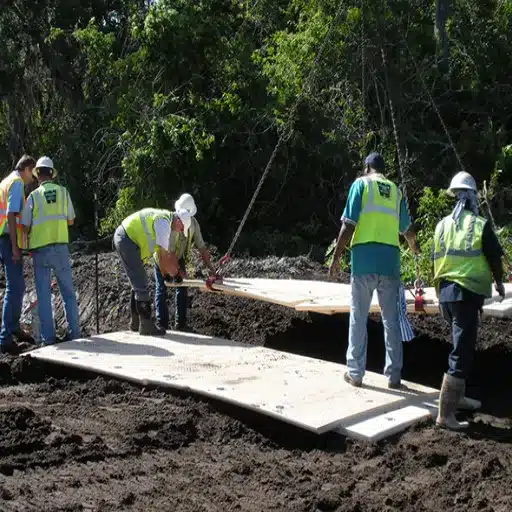
Composite mats form solid work platforms in challenging terrain.
Temporary Access Roads
These are indispensable when the weather throws up its wet mud, and you need roads instantly. The partially buoyant design also works in standing water and soft subgrade, where conventional methods are of no value at all. With one crew, the deployment rate is over 500 feet of road per day.
Crane and Heavy Equipment Platforms
For safe crane operations, a flat, even surface is needed. Composite wood mats create engineered platforms which:
- Eliminate the need for extensive grading and fill
- Provide uniform load distribution across variable ground
- Allow rapid repositioning as lifts progress
- Protect underlying utilities and geosynthetic liners
Staging and Laydown Yards
Material storage areas require an extremely solid surface to bear repeated abuse by traffic. These mats level off the depressions and potholes while maintaining the ability for good drainage and keeping things orderly.
Oil and Gas Operations
Remote locations often present the most challenging ground conditions. Composite mats enable operations where conventional access is impossible:
- Drilling rig mats: Support 1,000+ ton drilling packages on unprepared ground
- Pipeline construction: Create access corridors across wetlands and agricultural land
- Workover rig platforms: Provide stable foundations for maintenance operations
The chemical resistance of HDPE composite construction proves essential in oilfield environments where hydrocarbon exposure is inevitable.
Power Transmission and Distribution
Electrical utility applications demand non-conductive matting solutions. Composite mats meet this requirement while providing:
- Safe work platforms for substation maintenance
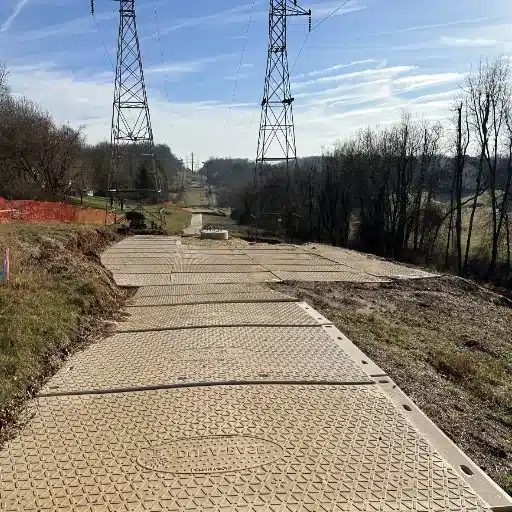
- Access roads for transmission line construction
- Crane support for tower erection
- Equipment staging for emergency restoration
The non-conductive properties eliminate the risk of electrical hazards during live-line work, while the semi-buoyant design enables wetland crossings without environmental disturbance.
Renewable Energy Construction
Wind farm and solar installation projects require extensive ground protection:
- Wind farms: Support 600-ton cranes for turbine erection; create access roads across farmland
- Solar installations: Protect agricultural land during panel installation; provide maintenance access
The 2024 launch of Solmax’s GEOLUX system specifically addresses solar ground protection, reflecting growing demand in this sector.
Installation Best Practices
Site Preparation
Proper preparation maximizes mat performance and longevity:
1. Ground Assessment
Evaluate subgrade bearing capacity using standard geotechnical methods. Soft soils (CBR <3) may require geotextile underlayment to prevent mat settlement.
2. Debris Removal
Clear rocks, stumps, and sharp objects that could puncture mats or create uneven bearing surfaces.
3. Surface Preparation
Grade to reasonable levelness (±6 inches). Extreme slopes require anchoring systems to prevent mat migration.
Deployment Guidelines
Overlap Requirements
Adjacent mats require 6-12 inch overlap at flange connections. This ensures continuous load transfer and prevents differential settlement at panel joints.
Connection Methods
Different systems employ various connection technologies:
- MDX pins: Secure MegaDeck systems against lateral movement
- T-Bar tools: Connect mats in various orientations
- Rotary connectors: Create customizable layouts for irregular areas
Slope Considerations
For grades exceeding 5%, implement additional safety measures:
- Ground anchors at uphill edges
- Cable restraint systems for large mats
- Regular inspection for displacement
Safety Protocols
- Traction verification: Ensure tread patterns face upward; wet conditions may require additional traction measures
- Edge protection: Install barricades at mat edges to prevent equipment overhang
- Load testing: Verify mat performance with lighter equipment before committing maximum loads
Need technical consultation for your specific installation conditions? Request engineering support for site-specific recommendations and load calculations.
Cost Analysis and Return on Investment
Upfront Investment Comparison
| Mat Type | Unit Cost (USD) | Capacity | Lifespan |
|---|---|---|---|
| Timber (oak) | 500−500−2,000 | Very high | 1-3 years |
| Heavy-duty composite | 2,500−2,500−3,500 | 600+ psi | 10-15 years |
| Standard HDPE | 150−150−400 | 200-400 psi | 5-10 years |
While composite mats require a higher initial investment than HDPE alternatives, the total cost of ownership often favors composite for long-term or multi-project applications.
Total Cost of Ownership Analysis
Consider all cost factors over the project lifecycle:
Transportation Costs
Composite mats achieve 40% more linear coverage per truckload compared to timber, reducing freight expenses. For international shipments, container loading efficiency (40-45 mats per 40′ container) optimizes ocean freight economics.
Labor Efficiency
The 50% weight reduction versus timber translates to faster installation and repositioning. On a typical 500-mat deployment, composite systems save 20-30% in labor hours.
Reuse and Residual Value
Composite mats maintain structural integrity across multiple projects. After 5 years of service, quality systems retain 60-70% of their original value in secondary markets.
Break-Even Calculation
The crossover point where composite mats become more economical than timber typically occurs after:
- 2-3 project uses for heavy civil applications
- 6+ months of continuous deployment
- 1-2 years when considering total lifecycle costs
For contractors maintaining mat inventories for recurring work, composite systems deliver superior ROI within 18-24 months.
Global Supply and Export Considerations
Container Loading and Shipping Logistics
Shanxi Shengxing’s export-ready production supports international project requirements:
Container Loading Specifications:
- 40′ standard container: 40-45 heavy-duty composite mats
- 40′ high-cube container: 50-55 medium-duty mats
- Weight capacity: 26-28 metric tons per container
- Loading pattern: Interlocked stacking with corner protectors
Proper containerization prevents transit damage and maximizes shipping efficiency. Pre-shipment inspection protocols verify mat integrity before export documentation.
Quality Assurance for International Buyers
ISO9001 Quality Management
A significantly uniform product from batch to batch is produced under the certification of a quality system. It is documented that:
- Material test reports
- Dimensional Analyses
- Load testing certificates
Sample Retention Policy
Five years’ retention of good samples for production is generally used to trace and verify quality as well as performance. They are invaluable as documentation resources, should there be any instances of warranty claims or technical disputes.
Customs and Documentation
The shipment is accompanied by a complete set of documents:
- Commercial invoice and package list
- Certificate of Origin
- Material Safety Data Sheets
- Certificates of Inspections (if needed)
To make sure that the traces of local support and suboptimal lead times have completely ceased, partnerships that distribute regionally to African, Southeast Asian, and Latin American buyers have been constructed.
Conclusion
Composite mats are actually a structural engineering solution for all those types of problematic issues that real wood and basic HDPE never would be able to solve, like even more robust timber alternatives. On different project sites where there are very heavy, complex, or permanent equipment conditions, composite technology possesses several such performance edges:
- Superior load capacity: Supports more than 600 psi per rating, giving extra oomph to heavy-weight construction equipment.
- Extended service life: As opposed to timber’s 1-3 years of lifespan, nearly a decade to one and a half years should make them last longer.
- Operational efficiency: Nearly 50% lighter in weight, reducing handling-related expenses, particularly in heavy lifting and handling.
- Environmental compatibility: Nonconductive, chemically resistant, with an added benefit, users no longer know what to do with their used ones.
Keep in mind what specific load your project really needs, exactly how deep and difficult the ground conditions are, and for how long. Decide from this guide on Mat Systems if you want to be appropriate to apply the decision trees and the actual loading table for grasping the most suitable type of mat system suitable to your conference, while in critical lifts and single point loads, adequate safety factors will be included.
For projects requiring integrated geosynthetic solutions—including geomembrane liners for containment, geotextiles for subgrade stabilization, or composite mats for ground protection—coordinated material selection ensures optimal performance across the entire system.