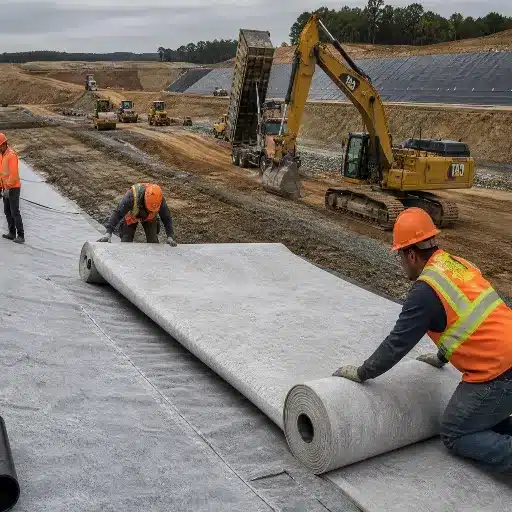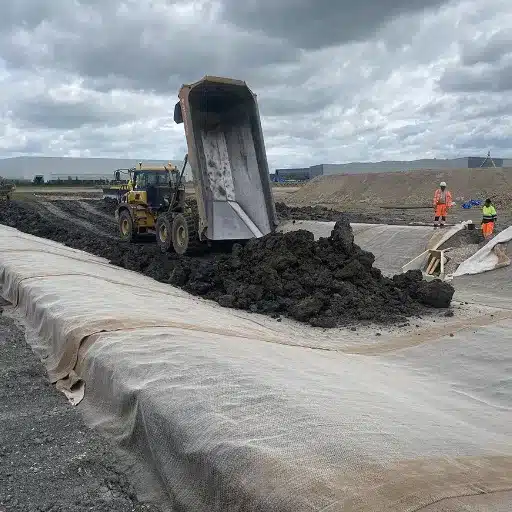
Woven geotextiles are engineered for high-tensile strength and load-bearing reinforcement, while nonwoven geotextiles prioritize filtration, drainage, and hydraulic performance. The best choice depends entirely on your project’s primary function, not on which material is universally “better.”
Marcus Chen learned this the hard way. In 2024, his Jakarta-based contracting firm specified a 200 gsm nonwoven geotextile for a heavy-haul access road over soft subgrade. Within three weeks, the fabric stretched, rutted, and failed under truck loads. The project stalled for 11 days, racking up $34,000 in liquidated damages. The correct specification? A high-tensile woven geotextile with grab tensile strength above 1,100 N. Marcus’s mistake was common: he assumed all geotextile fabric performs the same role.
This guide dismantles that assumption. You will learn exactly how woven and nonwoven geotextiles differ in manufacturing, mechanical behavior, and ideal applications. You will see side-by-side ASTM specification data, a decision framework for selecting the right type, and real project outcomes that show what happens when the choice is right and when it goes wrong.
Key Takeaways
- Woven geotextiles deliver 700-2,500 N grab tensile strength and 10-30% elongation, making them ideal for soil reinforcement and aggregate separation under load.
- Nonwoven geotextiles provide 400-1,400 N grab tensile strength and 30-80% elongation, with high permittivity for filtration and drainage applications.
- Approximately 80% of geotextile failures result from improper selection or installation, not material defects.
- High-performance woven fabrics cost $1.50-3.00/m², while nonwoven fabrics range from $0.20-2.00/m² depending on weight and manufacturing method.
- Composite systems using both fabric types together solve multi-function challenges in roads, landfills, and coastal protection.
What Is Woven Geotextile?
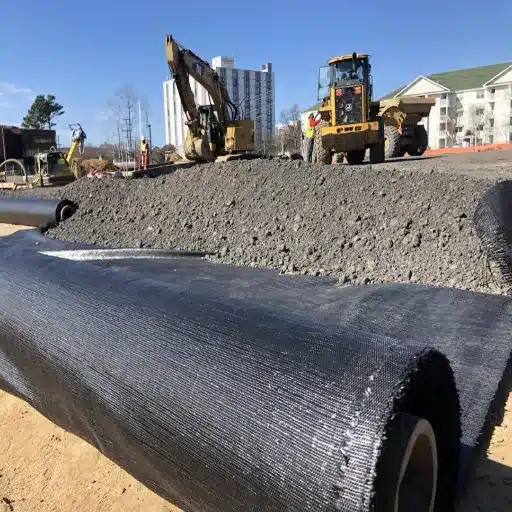
A woven geotextile is a planar textile structure produced by interlacing two sets of yarns, called warp and weft, on a loom. This manufacturing method creates a fabric with predictable, directional strength and relatively low elongation under stress.
Manufacturing Process
Woven geotextiles begin as polypropylene (PP) or polyester (PET) yarns. These yarns are arranged in perpendicular directions on a loom. The warp yarns run lengthwise, while the weft yarns run crosswise. The loom interlaces these yarns in a repeating pattern, creating a stable grid structure.
Not all woven geotextiles use the same yarn type. Three distinct constructions dominate the market:
- Slit-film yarn: A flat tape produced by slitting an extruded polymer sheet. Slit-film woven geotextiles offer high tensile strength at low cost but limited opening size consistency.
- Monofilament yarn: A single, round, continuous filament. Monofilament woven geotextiles provide excellent permeability and consistent apparent opening size (AOS), making them suitable for filtration applications within the woven category.
- Multifilament yarn: Multiple fine filaments twisted together. Multifilament woven geotextiles combine high strength with improved flexibility and fabric integrity compared to slit-film alternatives.
The weaving process gives woven geotextiles their characteristic anisotropic properties. Tensile strength is typically higher in the warp direction than the weft direction, a factor engineers must account for during installation orientation.
Key Mechanical Properties
Woven geotextiles are valued for their load-bearing capacity. Typical mechanical properties include:
- Grab tensile strength: 700-2,500 N (ASTM D4632)
- Elongation at break: 10-30%
- CBR puncture resistance: 1,500-4,500 N (ASTM D6241)
- Trapezoidal tear strength: 250-750 N (ASTM D4533)
These values vary significantly based on yarn type and weight. A slit-film woven geotextile at 140 gsm might achieve 700-900 N grab tensile, while a multifilament woven fabric at 230 gsm can exceed 2,000 N.
Permeability in woven geotextiles is generally lower than in nonwoven alternatives. Permittivity values typically range from 0.05 to 0.5 sec⁻¹ (ASTM D4491), with monofilament constructions achieving the higher end of this range.
Primary Functions
Woven geotextiles excel in three core functions:
- Reinforcement: Distributing loads across soft subgrades and reducing aggregate base thickness by 25-40%.
- Separation: Preventing intermixing of dissimilar soil layers, such as subgrade soil and aggregate base.
- Stabilization: Confining soil particles and improving the effective bearing capacity of weak foundations.
For projects requiring high-tensile performance, material selection should prioritize yarn type and ASTM test values over weight alone. See our high-tensile woven geotextile products for specification details.
What Is Nonwoven Geotextile?
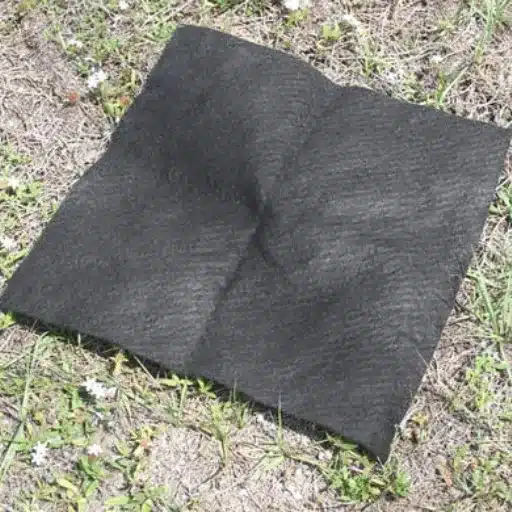
A nonwoven geotextile is a fabric manufactured from randomly oriented fibers bonded together by mechanical, thermal, or chemical means. Unlike woven fabrics, nonwoven geotextiles have no yarn interlacing and exhibit more isotropic strength characteristics.
Manufacturing Process
Nonwoven geotextile production follows a different path from weaving:
- Fiber preparation: Polypropylene or polyester fibers are carded into a loose web with random orientation.
- Bonding: The web is consolidated using one or more methods:
- Needle-punching: Barbed needles mechanically entangle fibers, creating a thick, porous felt-like structure. This is the most common method for civil engineering applications.
- Heat-bonding: Calendering or through-air heating partially melts fiber surfaces to fuse them. Heat-bonded nonwovens are thinner and stiffer.
- Chemical bonding: Adhesives or resin binders hold fibers together. This method is less common for geotechnical grades.
Needle-punched nonwoven geotextiles dominate the market for filtration and drainage because their entangled fiber matrix creates a tortuous flow path with high void content.
Key Mechanical Properties
Nonwoven geotextiles trade some tensile strength for flexibility and hydraulic performance:
- Grab tensile strength: 400-1,400 N (ASTM D4632)
- Elongation at break: 30-80%
- CBR puncture resistance: 1,200-3,500 N (ASTM D6241)
- Trapezoidal tear strength: 150-500 N (ASTM D4533)
The higher elongation is not a weakness. In many applications, the ability to deform without rupturing allows nonwoven geotextiles to conform to irregular subgrades and absorb settlement stresses.
Hydraulic performance is where nonwoven geotextiles distinguish themselves. Permittivity values typically range from 0.5 to 5.0 sec⁻¹ (ASTM D4491), roughly 5-10 times higher than most woven fabrics. Apparent opening size (AOS) ranges from 0.05 mm to 0.30 mm (ASTM D4751), enabling effective filtration across a broad spectrum of soil gradations.
Primary Functions
Nonwoven geotextiles are specified for four primary functions:
- Filtration: Allowing water to pass while retaining soil particles, critical in French drains, retaining wall drainage, and coastal protection.
- Drainage: Providing a lateral flow path for water collection and discharge.
- Erosion control: Protecting soil surfaces from scour and washout beneath rip rap or armor stone.
- Protection: Cushioning geomembranes in landfill and containment applications against puncture from subgrade aggregates.
For detailed design guidance on separation and filtration mechanics, see our geotextile separation and filtration guide.
When drainage and filtration drive your design, a nonwoven drainage geotextile fabric is typically the correct starting point. Browse nonwoven geotextile specifications →
Woven vs Nonwoven Geotextile Specification Comparison
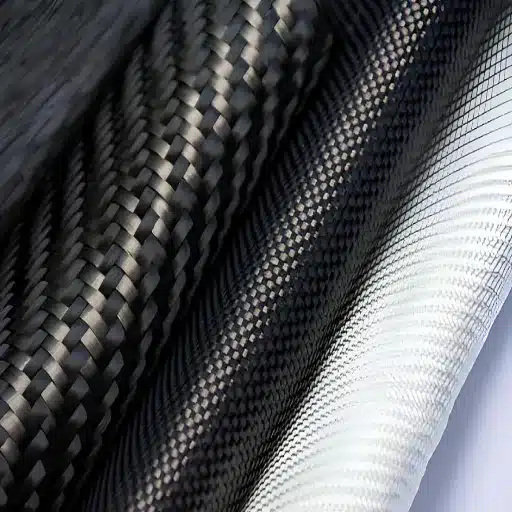
The following table summarizes the critical engineering differences between woven and nonwoven geotextile fabrics. Values represent typical ranges for standard civil engineering grades.
| Property | Woven Geotextile | Nonwoven Geotextile | ASTM Test Method |
|---|---|---|---|
| Manufacturing | Warp/weft yarn interlacing | Needle-punched or heat-bonded fiber web | — |
| Grab tensile strength | 700-2,500 N | 400-1,400 N | D4632 |
| Elongation at break | 10-30% | 30-80% | D4632 |
| CBR puncture resistance | 1,500-4,500 N | 1,200-3,500 N | D6241 |
| Trapezoidal tear | 250-750 N | 150-500 N | D4533 |
| Permittivity | 0.05-0.5 sec⁻¹ | 0.5-5.0 sec⁻¹ | D4491 |
| Apparent opening size (AOS) | 0.10-0.60 mm | 0.05-0.30 mm | D4751 |
| ** UV resistance** | Good to excellent (additives dependent) | Moderate to good | D4355 |
| Isotropic strength | Anisotropic (warp > weft) | Isotropic or near-isotropic | — |
| Typical weight range | 90-270 gsm | 100-600 gsm | D5261 |
Cost per square meter (2026 pricing, FOB basis, bulk orders):
| Fabric Type | Weight Range | Cost per m² |
|---|---|---|
| Slit-film woven | 90-140 gsm | $0.40-0.90 |
| Monofilament woven | 130-200 gsm | $0.80-1.80 |
| Multifilament woven | 180-270 gsm | $1.50-3.00 |
| Light nonwoven (needle-punched) | 100-150 gsm | $0.20-0.60 |
| Medium nonwoven (needle-punched) | 150-300 gsm | $0.40-1.20 |
| Heavy nonwoven (needle-punched) | 300-600 gsm | $0.80-2.00 |
UV resistance deserves special attention. Both fabric types can incorporate UV stabilizers, but woven geotextiles generally expose less polymer surface area per unit volume due to their dense yarn structure. This gives woven fabrics a slight edge in prolonged sun exposure. However, any geotextile left exposed for more than 14-30 days should be covered or specified with enhanced UV protection per ASTM D4355 testing.
How to Choose: Engineering Decision Framework
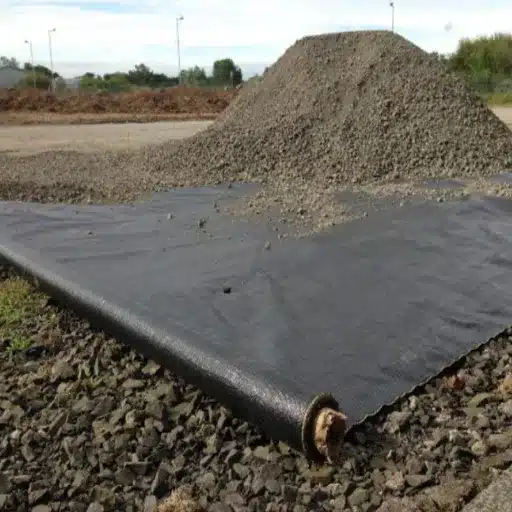
Selecting between woven and nonwoven geotextile begins with one question: what is the primary function the fabric must perform?
Choose Woven When…
Your project requires load-bearing performance. Specify woven geotextile fabric when:
- The design calls for soil reinforcement or subgrade stabilization
- Aggregate base thickness reduction is a project goal
- The fabric must bridge over soft spots with minimal elongation
- Tensile strength above 1,000 N is required by design
- The application is for road construction, railway embankments, or working platforms over weak soils
Decision check: If your engineer is calculating tensile modulus or strain compatibility with fill materials, you are in woven territory.
For woven applications, also consider yarn type. Slit-film is economical for separation. Monofilament addresses filtration needs within reinforced systems. Multifilament delivers the highest strength-to-weight ratio for demanding stabilization projects.
Choose Nonwoven When…
Hydraulic performance governs the design. Specify nonwoven geotextile fabric when:
- Filtration and drainage are the primary functions
- The fabric must conform to irregular or variable subgrades
- Protection of an underlying geomembrane or liner is required
- Erosion control beneath rip rap or articulated concrete blocks is the goal
- High permittivity and controlled AOS are specified
Decision check: If your design references AOS, permittivity, or flow rate per unit width, nonwoven is the logical starting point.
AASHTO M288 provides survivability classes that map directly to fabric selection. Class 1 survivability (highest) typically requires woven geotextiles or heavy nonwovens above 400 gsm. Class 2 and 3 survivability often aligns with medium-weight nonwoven fabrics for less severe installation conditions.
Choose Both When…
Some projects demand multi-function performance that neither fabric type delivers alone. Composite systems layer woven and nonwoven geotextiles to achieve both reinforcement and drainage.
Common composite configurations include:
- Road over soft soil: Woven geotextile at the subgrade interface for stabilization, with a nonwoven layer above for separation and lateral drainage.
- Landfill liner protection: Heavy nonwoven geotextile directly over the geomembrane for puncture protection, with a woven layer above for structural support during waste placement.
- Coastal revetment: Woven monofilament geotextile as a structural filter beneath armor stone, combining the strength of woven construction with the permeability of monofilament yarns.
Woven monofilament geotextiles represent a hybrid category. They deliver tensile strength approaching multifilament wovens with permittivity comparable to nonwovens, making them suitable for reinforced filtration applications like coastal embankments and reservoir slopes.
For a deeper dive into high-strength applications, see our woven geotextile applications and selection guide. For drainage-specific design, review our nonwoven geotextile drainage guide.
Common Selection Mistakes
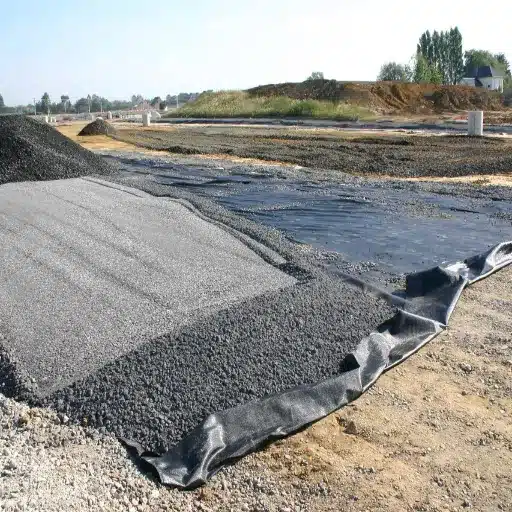
Even experienced engineers occasionally specify the wrong fabric type. Here are the four most costly errors and how to avoid them.
Mistake 1: Using nonwoven geotextile for heavy-load reinforcement
A 250 gsm needle-punched nonwoven may feel substantial, but its grab tensile strength of 600-800 N is insufficient for heavy haul roads or railway embankments. The high elongation that makes nonwovens excellent filters becomes a liability under cyclic loading. The fabric stretches, ruts form, and the subgrade loses confinement. Always verify that the grab tensile exceeds the design requirement.
Mistake 2: Using woven geotextile for fine-grained soil filtration
A standard slit-film woven geotextile with an AOS of 0.25 mm will not retain silts and fine sands. Water passes through, but so does soil. Over time, the drainage layer clogs with migrating fines. For soils with d₈₅ below 0.075 mm, nonwoven geotextiles with AOS below 0.15 mm are typically required.
Mistake 3: Ignoring yarn type within the woven category
Not all woven geotextiles behave the same. A slit-film woven fabric has permittivity roughly one-tenth that of a monofilament woven fabric at a similar weight. If your woven specification includes a drainage or filtration function, the yarn type determines whether the fabric can actually perform that role.
Mistake 4: Selecting by cost instead of function
Nonwoven geotextiles at $0.40/m² look attractive compared to woven multifilament at $2.00/m². But using the cheaper fabric in a load-bearing application invites failure economics. Marcus Chen’s $34,000 penalty cost roughly 850 times more than the price difference between the nonwoven he specified and the woven geotextile he should have used.
Real Project Outcomes
Theory matters, but field performance confirms the engineering. The following cases illustrate what correct and incorrect selection looks like in practice.
Case A: Southeast Asia Highway Stabilization
Engineers working on a provincial highway in Southeast Asia encountered a subgrade with a California Bearing Ratio (CBR) of 0.8. Without treatment, the design required 450 mm of aggregate base. By placing a 1,500 N grab tensile woven geotextile directly on the prepared subgrade, the team reduced aggregate thickness to 300 mm. Three monsoon seasons later, the road remains serviceable with no measurable rutting. The woven geotextile paid for itself through material savings alone.
Case B: Texas French Drain Recovery
A residential developer in Austin installed a perimeter French drain system without a geotextile wrap. Within 18 months, clay fines infiltrated the drain rock and sealed the system. Standing water returned to the foundation line. The remediation team excavated the failed drain, wrapped the replacement rock in a 250 gsm nonwoven geotextile with AOS of 0.15 mm, and restored free flow within hours. The nonwoven fabric cost $0.55/m². The excavation and rebuild cost $12,000. The math is simple.
Case C: Jakarta Heavy-Haul Failure
Marcus Chen’s project, referenced earlier, is worth examining in detail. The specification called for a geotextile to stabilize a temporary haul road over marshy subgrade. Procurement selected a 200 gsm nonwoven based on availability and low unit cost. The fabric achieved only 550 N grab tensile. Under the first fully loaded dump truck, the fabric elongated beyond recovery, allowing aggregate punch-through into the soft subgrade. The 11-day delay triggered liquidated damages of $34,000. Retrospective analysis showed that a 1,200 N woven slit-film geotextile at $0.85/m² would have prevented the failure entirely.
Cost Comparison
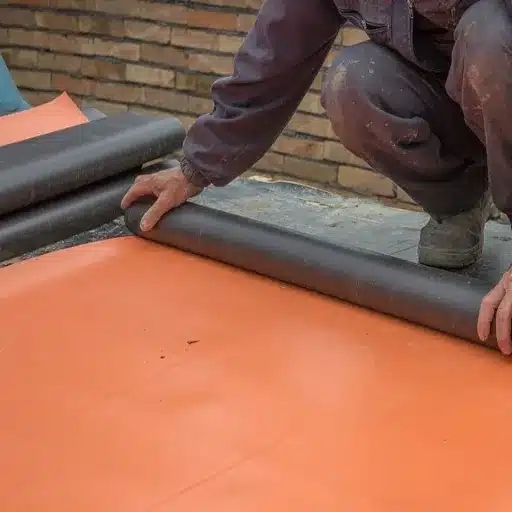
Price should never drive specification, but budget reality matters. Understanding cost structures helps justify the right material to the project stakeholders.
Price per m² by type and weight (2026 estimates, bulk FOB):
- Light nonwoven (100-150 gsm): $0.20-0.60
- Slit-film woven (90-140 gsm): $0.40-0.90
- Medium nonwoven (150-300 gsm): $0.40-1.20
- Monofilament woven (130-200 gsm): $0.80-1.80
- Heavy nonwoven (300-600 gsm): $0.80-2.00
- Multifilament woven (180-270 gsm): $1.50-3.00
Lifecycle value analysis reveals the true cost picture. A woven geotextile that reduces aggregate base by 30% often saves $3-8/m² in material and haul costs, far exceeding the fabric premium. A nonwoven geotextile that prevents drain failure avoids remediation costs 50-100 times the initial fabric expense.
When cheaper upfront costs are more long-term, the specification was wrong. The correct approach is function-first selection, followed by value engineering within the correct fabric category.
For detailed ASTM standard requirements that inform specification, refer to the ASTM D4632, D4491, and D4751 test method pages.
Conclusion
The woven vs nonwoven geotextile decision is not about finding the “better” fabric. It is about matching material properties to project function. Woven geotextiles deliver strength, low elongation, and load-bearing capacity. Nonwoven geotextiles deliver permeability, filtration precision, and subgrade conformity.
Use the specification comparison table to benchmark your design requirements against fabric capabilities. Apply the engineering decision framework to confirm whether your project needs reinforcement, drainage, or both. And remember Marcus Chen’s $34,000 lesson: the cost of wrong selection dwarfs the cost of the right material.
If you are specifying geotextile for an upcoming project, our engineering team can review your subgrade data, design loads, and hydraulic requirements to recommend the optimal fabric type, weight, and yarn construction. Request a technical quote today →
For material-specific guidance, explore our polypropylene vs polyester material guide or return to the complete geotextile fabric engineering guide.