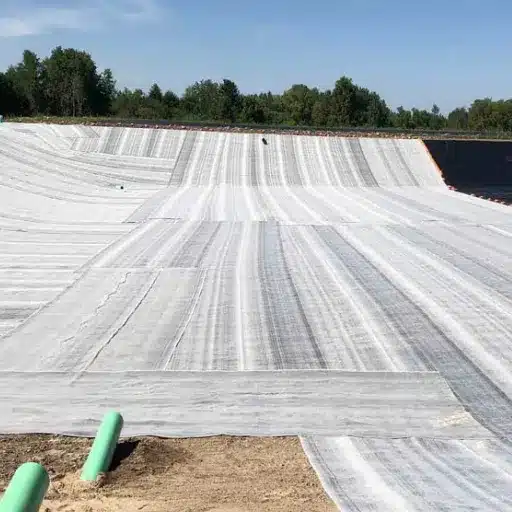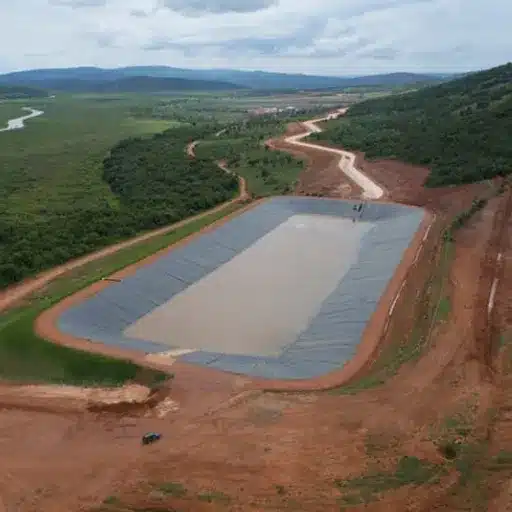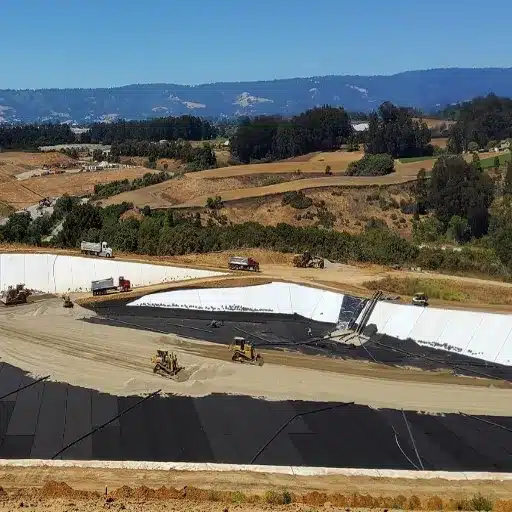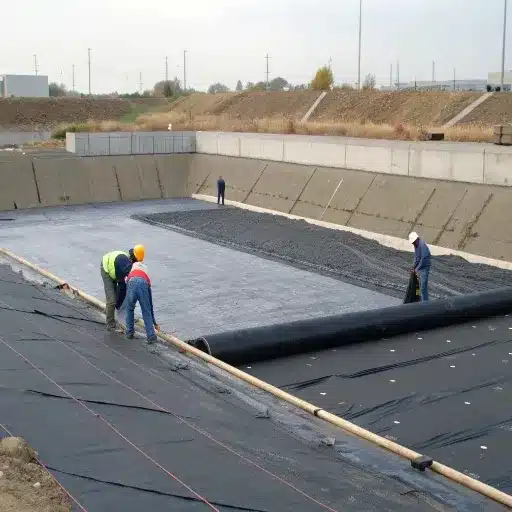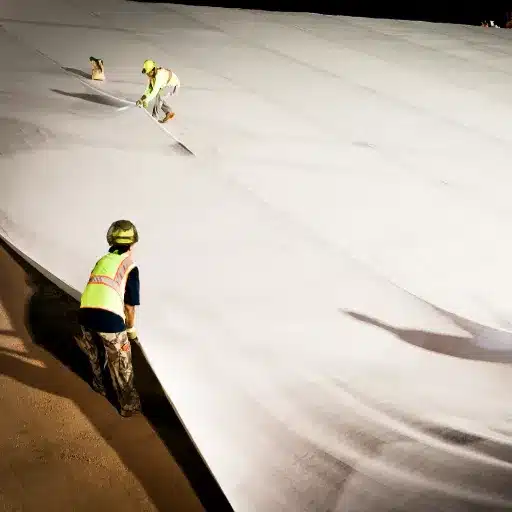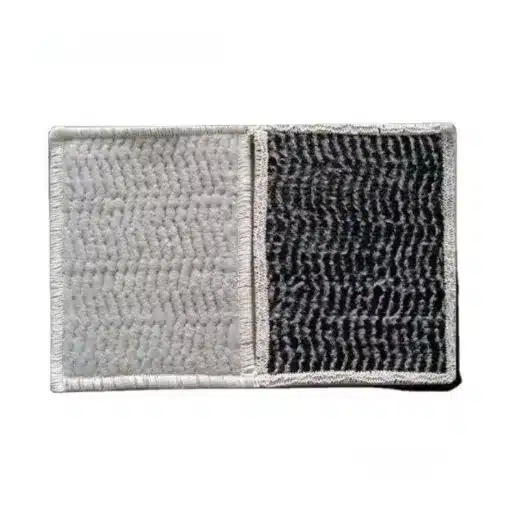
Woven geotextile applications center on projects that need high tensile strength, low elongation, and dimensional stability under load. They are the fabric of choice for road subgrades, railway trackbeds, retaining walls, steep slopes, and riprap underlayment where separation and reinforcement matter more than filtration alone.
Many buyers treat geotextile fabric as a single commodity. In practice, woven and nonwoven geotextiles behave differently. Choosing the wrong type—or specifying the right type at the wrong strength class—leads to rutting, wall bulging, seam failure, or riprap settlement. This guide explains where woven geotextiles perform best, how to match the fabric to the application, and which AASHTO M288 class to specify.
Key Takeaways
- Woven geotextiles excel where strength, separation, and reinforcement under load are required.
- Common applications include roads, railways, retaining walls, steep slopes, and riprap underlayment.
- Tensile strength, CBR puncture resistance, and AASHTO M288 survivability class should match the project load and soil conditions.
- Monofilament woven geotextiles filter better than slit-film wovens and are preferred beneath riprap.
- Sewn seams retain 70–90% of parent fabric strength, while overlaps transfer little load in reinforcement applications.
What Is Woven Geotextile Fabric?
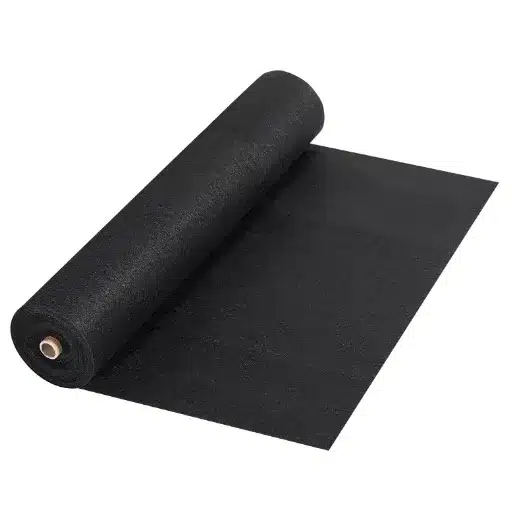
To understand where woven geotextile applications fit, it helps to start with how the fabric is made. Woven geotextile fabric is a synthetic textile made by interlacing polypropylene (PP) or polyester (PET) yarns on a loom. The weave structure gives the fabric high tensile strength in both the machine direction (MD) and cross direction (CD), low elongation at break, and high modulus. These properties make woven geotextiles very different from nonwoven needle-punched fabrics, which are softer, thicker, and more permeable.
The three main weave categories are:
- Slit-film woven: Made from flattened tapes. High strength, low cost, but limited filtration performance because of a low percent open area.
- Monofilament woven: Made from single round filaments. Better filtration and flow characteristics while retaining good strength.
- Multifilament woven: Made from bundles of fine filaments. High strength with better flexibility and soil contact than slit-film.
For a broader overview of geotextile types and functions, see our geotextile fabric guide.
Why Strength and Stiffness Matter
In reinforced soil applications, the geotextile must resist tensile strain without stretching excessively. This is why woven geotextile tensile strength is the first property engineers check when matching a fabric to its load requirements. A fabric that elongates under load will not stiffen the soil mass effectively. Woven geotextiles typically elongate 5–25% at break, compared with 50% or more for nonwoven fabrics. That difference makes woven fabrics the logical choice when the design relies on the fabric to carry part of the load.
Woven vs Nonwoven Geotextile: Application Perspective
Once you understand the weave structure, the next decision is choosing between woven and nonwoven construction. The decision is not about which is better overall. It is about which functions dominate the project. Our woven vs nonwoven geotextile guide covers the full comparison; the table below summarizes the application perspective.
| Factor | Woven Geotextile | Nonwoven Geotextile |
|---|---|---|
| Tensile strength | High | Moderate |
| Elongation | Low | High |
| Permeability | Moderate to good | Higher |
| Filtration efficiency | Good (monofilament) to limited (slit-film) | Excellent |
| Puncture resistance | Moderate | High |
| Best functions | Separation, reinforcement | Filtration, drainage, protection |
| Best applications | Roads, railways, walls, slopes, riprap | French drains, vegetated slopes, landfill filters |
Use woven geotextiles when the design requires the fabric to resist tensile stress, keep layers separated under load, or stabilize soil over weak subgrades. By contrast, use nonwoven geotextiles when water must move freely through the fabric and soil retention is the primary concern.
Woven Geotextile Applications by Project Type
Road and Highway Subgrade Stabilization
Woven geotextile road stabilization is one of the most common applications. The fabric is placed between the subgrade and the aggregate base course. It performs two functions at once: separation and reinforcement. Separation keeps fine subgrade soil from pumping up into the base. Reinforcement stiffens the pavement system and reduces rutting.
The benefits are most obvious on weak subgrades, especially where the California Bearing Ratio (CBR) is below 3%. On these soils, a high-strength woven geotextile can reduce aggregate thickness, extend pavement life, and lower maintenance costs.
For deeper coverage of road-specific stabilization design, see our geotextile soil stabilization guide.
Railway Ballast Separation and Trackbed Stabilization
Railway ballast sits directly on the subgrade or sub-ballast layer. Under repeated wheel loads, fine soil can migrate upward into the ballast, contaminating it and reducing drainage. A woven geotextile separation layer prevents this migration while providing tensile support to the trackbed.
Railway applications typically demand high grab tensile strength and good puncture resistance because ballast consists of angular stone. The fabric must survive placement and decades of dynamic loading.
Retaining Walls and MSE Walls
Woven geotextile retaining wall designs rely on the fabric as a primary soil reinforcement element. In mechanically stabilized earth (MSE) walls, layers of woven geotextile are placed within the backfill at regular vertical intervals. The friction between the fabric and the soil resists lateral earth pressure, allowing steeper or even near-vertical walls.
This application requires high tensile strength, low creep, and good pullout resistance. Polyester (PET) woven geotextiles are often preferred over polypropylene (PP) for permanent walls because PET has better long-term creep behavior.
Steep Slopes and Embankments
Woven geotextiles reinforce embankments and steep slopes by distributing stresses and increasing the factor of safety against sliding. They are especially useful for embankments built over soft ground, where the fabric acts as a basal reinforcement layer spanning weaker soils.
For slopes steeper than 3:1, engineers often combine woven geotextiles with other stabilization measures such as terraces, geogrids, or slope armor. The fabric selection must match the slope geometry, soil strength, and expected surcharge loads.
Riprap, Gabions, and Shoreline Revetment
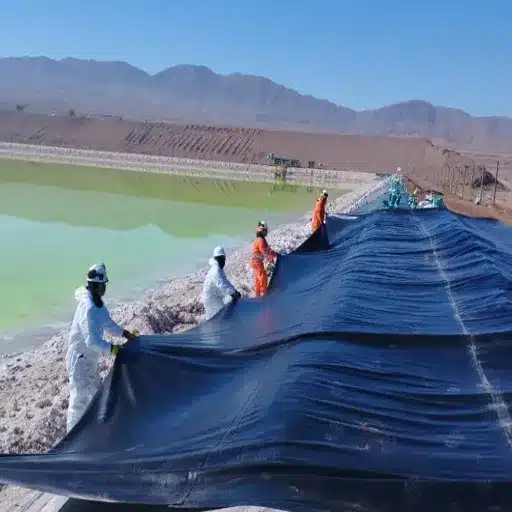
Woven geotextile riprap underlayment is one of the most common shoreline protection applications. Woven geotextiles are widely used beneath riprap, gabions, and concrete armor on shorelines, riverbanks, and coastal revetments. In this role, the fabric separates the armor stone from the underlying soil while allowing water to drain through. A monofilament woven geotextile is usually the better choice here because it offers better filtration and less risk of clogging than a slit-film woven fabric.
High-energy shorelines with large armor stone require Class 1 woven geotextiles with high CBR puncture resistance.
Construction Platforms and Haul Roads
Temporary and permanent construction platforms often sit on soft or variable soils. A woven geotextile layer distributes heavy equipment loads, reduces rutting, and allows construction to proceed in wet or marginal conditions. As a result, haul roads, crane pads, and work platforms all benefit from a high-strength woven separation and reinforcement layer.
Key Specifications for Woven Geotextile Applications
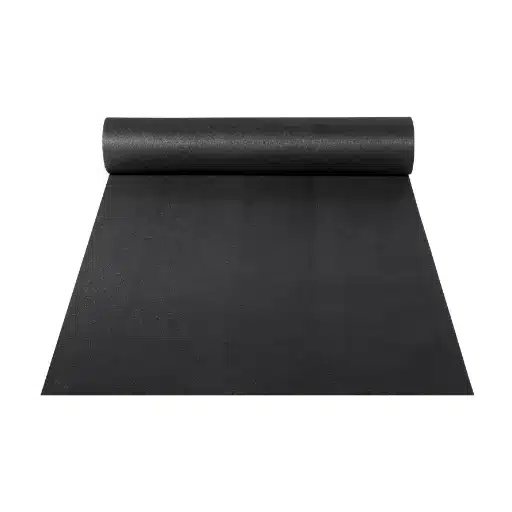
Understanding woven geotextile tensile strength is the first step in matching a fabric to its load requirements. Engineering buyers should evaluate woven geotextiles against the project requirements, not just unit price. The most important properties include:
- Grab tensile strength (ASTM D4632): Resistance to localized stress during handling and installation. Typical woven values range from 1,100 N to 4,000 N.
- Wide-width tensile strength (ASTM D4595 / ISO 10319): More representative of in-soil performance. Common values range from 20 kN/m to 200 kN/m.
- Trapezoidal tear strength (ASTM D4533): Resistance to tear propagation after minor damage.
- CBR puncture resistance (ASTM D6241): Resistance to concentrated loads from sharp aggregate or armor stone.
- UV resistance (ASTM D4355): Strength retained after sun exposure during construction.
- Apparent opening size (ASTM D4751): Soil retention versus permeability.
- Mass per unit area: Usually 200–800 g/m² for heavy-duty woven fabrics.
Always request MARV (Minimum Average Roll Value) values rather than average values. MARV provides a conservative design basis and reduces the risk of underperformance. At Shanxi Shengxing, woven geotextiles are supplied with certified test reports showing MARV values for grab tensile, tear, CBR puncture, and UV resistance so engineers can verify compliance against AASHTO M288 or project specifications.
AASHTO M288 Woven Geotextile Classes
With the mechanical properties in mind, the next step is matching the fabric to the installation stress. AASHTO M288 is the standard specification referenced by most U.S. state DOTs for highway geotextiles. It assigns survivability classes based on installation stress and service conditions.
| Property | Class 1 (min) | Class 2 (min) | Class 3 (min) |
|---|---|---|---|
| Grab tensile strength | 1,400 N | 1,100 N | 800 N |
| Tear strength | 500 N | 400 N | 300 N |
| CBR puncture | 3,500 N | 2,700 N | 1,900 N |
| UV resistance retained | 50% | 50% | 50% |
- Class 1: Severe conditions. Heavy riprap, sharp aggregate, high loads, steep slopes.
- Class 2: Moderate conditions. Typical road and railway separation and light reinforcement.
- Class 3: Mild conditions. Protected slopes with light cover and minimal construction stress.
For heavy-duty woven geotextile road stabilization, retaining wall reinforcement, and riprap underlayment, Class 1 is usually the appropriate starting point.
How to Select Woven Geotextile by Application
The selection process links the project type to the primary geotextile function, the required strength, and the AASHTO class. Therefore, the matrix below provides a starting framework for matching woven geotextile applications to the right fabric specification.
| Application | Primary function | Recommended woven type | Typical wide-width tensile | AASHTO class |
|---|---|---|---|---|
| Road/highway subgrade | Separation + reinforcement | Slit-film or multifilament | 50–100 kN/m | Class 1 or 2 |
| Railway ballast | Separation + stabilization | High-strength woven | 80–200 kN/m | Class 1 |
| Retaining wall / MSE | Reinforcement | High-strength PET woven | 100–200+ kN/m | Class 1 |
| Steep slope/embankment | Reinforcement + separation | Multifilament woven | 80–150 kN/m | Class 1 |
| Riprap/shoreline | Separation + filtration | Monofilament woven | 50–100 kN/m | Class 1 |
| Haul road/platform | Separation + load distribution | Heavy-duty woven | 80–150 kN/m | Class 1 |
In addition to the matrix, consider these factors:
- Subgrade CBR: Soils below 3% CBR need higher tensile strength and wider overlaps.
- Aggregate size and angularity: A larger, sharper stone requires higher CBR puncture resistance.
- Load type: Static loads allow lower strength; dynamic or heavy traffic loads require higher strength.
- UV exposure: Long construction schedules or exposed applications require UV-stabilized PP or PET.
- Design life: Permanent structures need fabrics with verified creep resistance and polymer durability.
If you have matched your project type to a class in the matrix, the next step is confirming roll widths, quantities, and seam requirements for your site.
Installation Best Practices for Woven Geotextiles
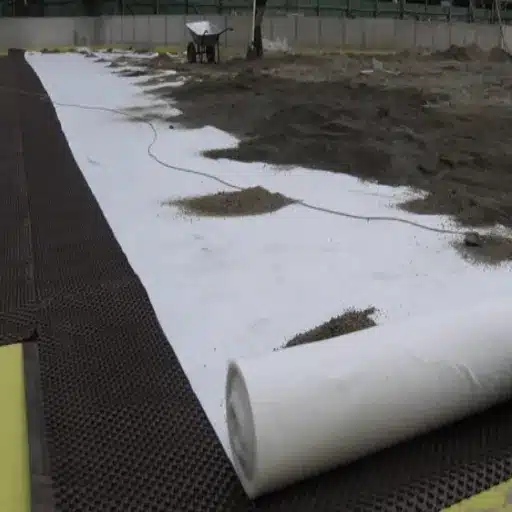
Even a correctly specified woven geotextile will underperform if it is installed poorly. Follow these field practices:
- Prepare the subgrade. Remove sharp objects, vegetation, and loose material. Compact soft areas before placing the fabric.
- Orient the roll correctly. Unroll the fabric so the machine direction aligns with the principal stress direction when possible.
- Provide adequate overlap. Use 18–36 inches for separation applications. On soft soils or slopes, increase overlap to 36 inches or more.
- Use sewn seams for reinforcement. Overlaps do not transfer tensile load effectively. Sewn seams can retain 70–90% of the parent fabric strength.
- Cover promptly. Limit UV exposure. Cover the fabric with fill or aggregate as soon as inspection is complete.
- Avoid wrinkles and folds. The fabric should lie flat and in continuous contact with the subgrade.
Follow the project specifications for overlap, seams, and covering schedules.
Common Mistakes When Specifying Woven Geotextiles
Mini-story: A contractor in Thailand selected a lightweight slit-film woven geotextile for a marina revetment. The goal was to reduce material cost. The fabric had adequate tensile strength but poor filtration characteristics. Within one monsoon season, fines from the sandy subgrade clogged the fabric surface. Water pressure built up behind the riprap, and sections of the armor layer displaced. The repair required removing the riprap, replacing the fabric with a monofilament woven geotextile, and reinstalling the stone. The savings from the cheaper fabric were erased several times over.
This example illustrates a common mistake: selecting a woven geotextile based on tensile strength alone without considering filtration requirements. In addition, other frequent errors include:
- Using slit-film woven where filtration matters. Monofilament or nonwoven fabrics are better choices.
- Underspecifying tensile strength. Heavy loads and steep slopes demand Class 1 fabrics.
- Ignoring the MD/CD strength difference. Quality products keep the difference below 20%.
- Relying on overlap for reinforcement load transfer. Sewn seams are required for reinforced structures.
- Confusing woven with nonwoven for drainage-only applications. Nonwoven geotextiles generally offer higher permittivity.
Woven Geotextile Procurement Checklist
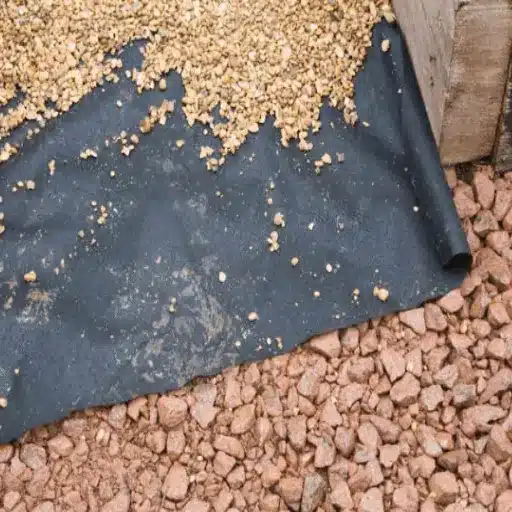
Use this checklist to ensure the woven geotextile you order matches the project requirements.
Define Site and Load Conditions
- Identify the subgrade soil type and CBR
- Estimate design traffic or equipment loads
- Determine slope gradient or wall height
- Identify aggregate or armor type and maximum stone size
- Assess UV exposure during construction
Select the Right Fabric
- Confirm primary function: separation, reinforcement, or filtration
- Choose slit-film, monofilament, or multifilament based on function
- Match the wide-width tensile strength to the project loads
- Confirm AASHTO M288, survivability class
- Verify AOS and permittivity match soil conditions
Verify Quality and Documentation
- Request MARV values for mechanical properties
- Confirm ASTM or ISO test methods in certified reports
- Check UV resistance ratings
- Verify polymer type and creep data for permanent structures
- Confirm ISO 9001 quality management system
Plan Installation
- Specify overlap width and seam requirements
- Plan roll orientation relative to principal stress
- Arrange for prompt covering to limit UV exposure
- Schedule inspection before backfill or armor placement
Frequently Asked Questions
What are the main woven geotextile applications?
Woven geotextile applications include road and highway subgrade stabilization, railway ballast separation, retaining wall and MSE wall reinforcement, steep slope and embankment stabilization, riprap and shoreline revetment underlayment, and construction platforms or haul roads.
When should I use woven geotextile instead of nonwoven?
Use woven geotextile when the project requires high tensile strength, low elongation, separation under load, or soil reinforcement. Use nonwoven geotextile when filtration, drainage, and close soil contact are the primary requirements.
What AASHTO M288 class is needed for woven geotextile road stabilization?
Class 1 is recommended for heavy traffic, weak subgrades, sharp aggregate, or steep slopes. Class 2 is acceptable for moderate conditions with lighter loads and well-prepared subgrades. Class 3 is generally limited to protected, low-stress applications.
What tensile strength should a woven geotextile have for retaining walls?
Retaining wall and MSE applications typically require high-strength woven geotextiles with wide-width tensile strength in the range of 100–200 kN/m or higher, depending on wall height, backfill properties, and surcharge loads. Creep resistance and pullout behavior are also critical.
Can woven geotextile be used under riprap?
Yes. Woven geotextiles, especially monofilament woven fabrics, are commonly used beneath riprap to separate the armor stone from the subgrade and provide filtration. High-energy applications with large stones require Class 1 woven geotextiles with high CBR puncture resistance.
Conclusion: Specify Woven Geotextiles for Strength and Stability
Woven geotextile applications are defined by load. Where the fabric must separate layers under stress, reinforce soil, or stabilize a structure over weak ground, woven geotextiles outperform nonwoven alternatives. Roads, railways, retaining walls, steep slopes, and riprap underlayment are all natural applications for high-strength woven fabrics.
The key to success is matching the fabric specification to the project conditions. Tensile strength, CBR puncture resistance, AASHTO M288 class, and weave type all matter. Slit-film wovens provide economical strength for separation. Monofilament wovens provide better filtration under armor. High-strength PET wovens provide the creep resistance needed for permanent retaining structures.
If you are specifying woven geotextiles for road stabilization, railway trackbeds, retaining walls, or erosion control, Shanxi Shengxing can supply tested Class 1 and Class 2 woven geotextiles with certified MARV values, ISO 9001 quality management, and export packaging to your port. Request a tailored quote or technical consultation today.