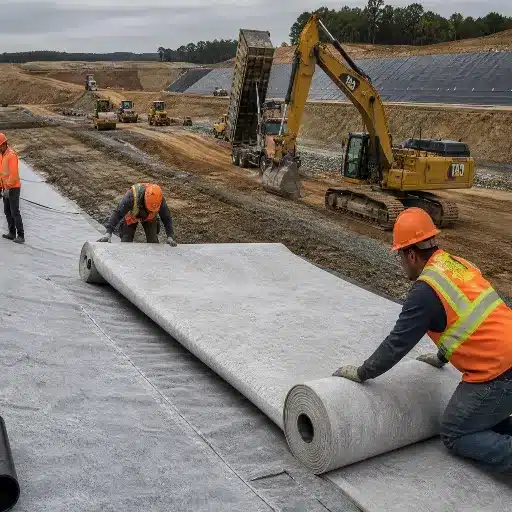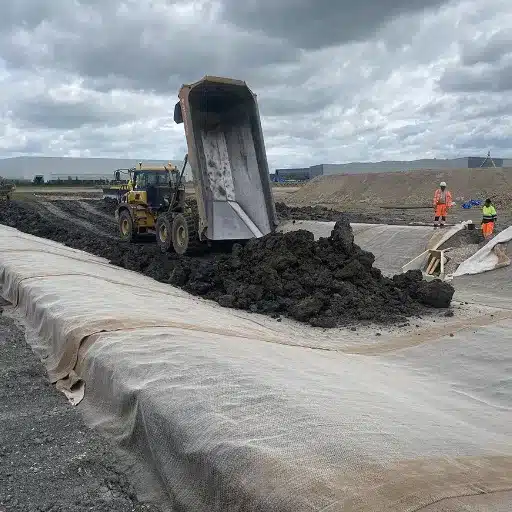
A geomembrane and a geosynthetic clay liner (GCL) are not interchangeable. A geomembrane is an impermeable polymer sheet that serves as the primary barrier, while a GCL is a bentonite-filled composite that self-heals and works best as a secondary or backup barrier. For the highest level of containment, engineers specify both together as a composite geomembrane-over-GCL liner.
This guide compares geomembrane vs GCL across barrier mechanism, permeability, self-healing, cost, installation, and applications, so you can specify the right liner system with confidence. We also cover the composite liner option that most high-risk projects rely on.
Choosing between these two materials is one of the most consequential decisions in containment design. Get it right and your structure protects the environment for decades. Get it wrong, and the consequences can include groundwater contamination, regulatory penalties, and remediation costs that dwarf the original budget.
Too often, buyers ask “which is better?” when the real question is “which is right for my project’s risk, chemistry, terrain, and budget?” By the end of this guide, you will know how to answer that question for your specific site. For a broader look at the full product family, start with our complete geomembrane selection guide.
Key Takeaways
- A geomembrane is an impermeable polymer sheet (the primary barrier); a GCL is a self-healing bentonite composite (best as a secondary or backup barrier).
- Published leakage rates: standalone geomembrane roughly 100-1,000 L/ha/day, standalone GCL roughly 860 L/ha/day, and composite geomembrane-over-GCL roughly 0-4 L/ha/day.
- Geomembranes win on chemical resistance, longevity (50-100+ years), and near-zero permeability; GCLs win on ease of installation, terrain conformance, and self-sealing.
- GCL performance depends on hydration and chemistry: high-salt or divalent-cation environments can raise permeability by 1-3 orders of magnitude.
- For landfills and other high-risk containment, the composite liner system (geomembrane over GCL) delivers the best measured performance.
What Is a Geomembrane?
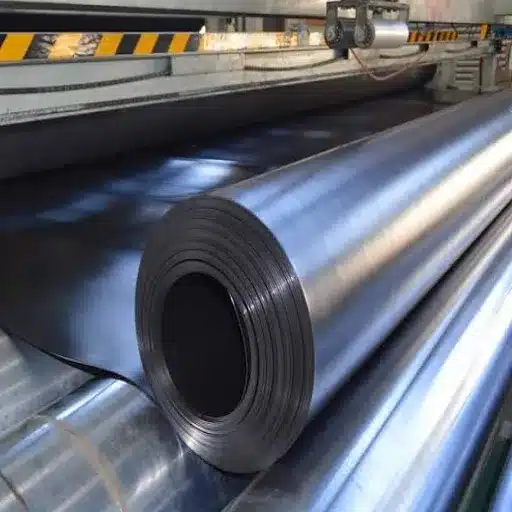
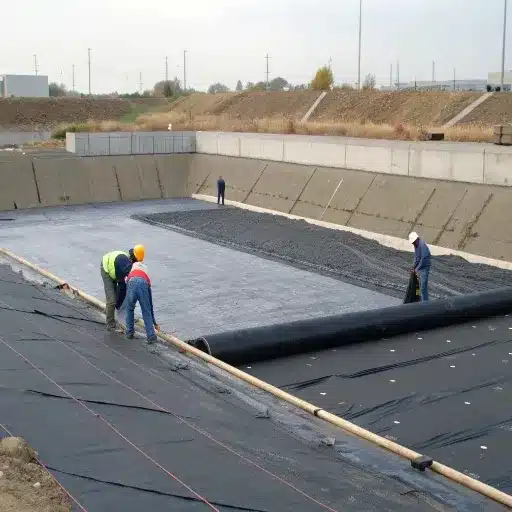
A geomembrane is a continuous synthetic sheet made from polymers such as high-density polyethylene (HDPE), linear low-density polyethylene (LLDPE), polyvinyl chloride (PVC), or EPDM. Typical thicknesses range from 0.2 mm to 3.0 mm.
Its barrier mechanism is simple: the material itself is essentially impermeable. HDPE geomembranes have a permeability coefficient down to about 10⁻¹³ cm/s, several orders of magnitude lower than a hydrated GCL. The sheet blocks liquid and gas migration without any chemical reaction or swelling.
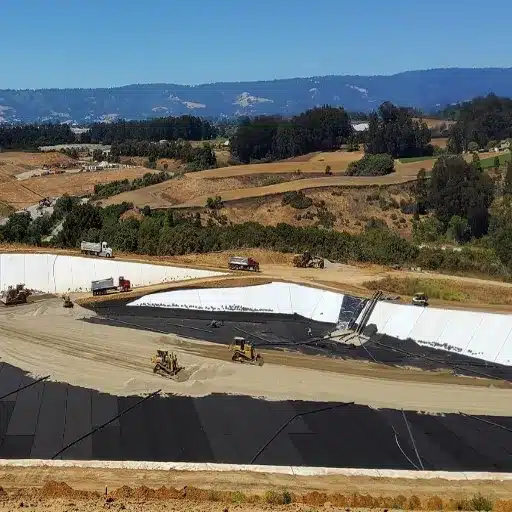
Geomembranes are used where maximum containment matters: landfills, mining heap leach pads, tailings ponds, chemical containment ponds, reservoirs, and canals. High-quality HDPE is certified to GRI-GM13, which sets minimum values for density, tensile yield, elongation, puncture resistance, and stress crack resistance. For a deeper look at materials, see our HDPE geomembrane product page.
The main limitation is that a geomembrane does not self-heal. Any hole, puncture, or weld defect must be found and repaired manually, which is why installation quality control is so important.
What Is a Geosynthetic Clay Liner (GCL)?
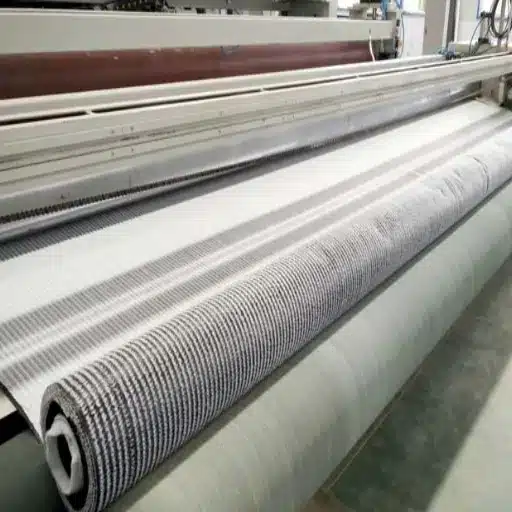
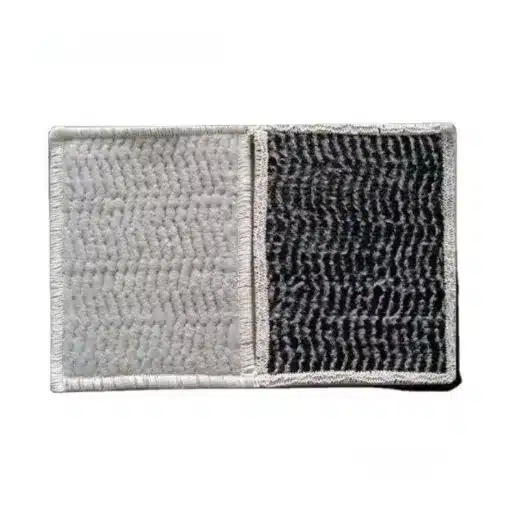
A geosynthetic clay liner is a composite material: a thin layer of natural sodium bentonite clay sandwiched between two geotextile layers, held together by needle punching or bonding. A typical GCL is 6 mm to 12 mm thick.
The barrier mechanism is fundamentally different from a geomembrane. When water contacts the bentonite, the clay swells and forms a low-permeability gel that blocks fluid migration. Saturated bentonite typically reaches a hydraulic conductivity in the range of 10⁻⁹ to 10⁻¹¹ m/s.
GCLs are manufactured under quality control standards such as GRI-GCL-3, which sets a maximum index flux of 1×10⁻⁸ m³/m²/s and a maximum permeability of 5×10⁻⁹ cm/s. Standard test methods include ASTM D5887 for index flux and ASTM D6766 for chemical compatibility with potentially incompatible liquids.
The signature advantage of a GCL is self-healing. If the liner is punctured, the bentonite swells around the hole and reseals it. This makes GCLs forgiving during installation and valuable as a backup layer beneath a geomembrane.
The trade-off is chemistry sensitivity. Sodium bentonite is vulnerable to environments with high salt or divalent cations such as calcium (Ca²⁺) and magnesium (Mg²⁺). In those conditions, bentonite swelling can be inhibited, and permeability can rise by one to three orders of magnitude. GCLs can also dry out and lose effectiveness in arid climates or where wet-dry cycling is severe.
Geomembrane vs GCL: The Key Differences
The comparison table below summarizes how a geomembrane and a GCL differ across the factors that matter most in engineering selection.
| Feature | Geomembrane | Geosynthetic Clay Liner (GCL) |
|---|---|---|
| Material | Polymer sheet (HDPE, LLDPE, PVC, EPDM) | Sodium bentonite between two geotextiles |
| Thickness | 0.2-3.0 mm | 6-12 mm |
| Barrier mechanism | Inherent material impermeability | Bentonite swelling on hydration |
| Permeability | ~10⁻¹³ cm/s (HDPE) | ~10⁻⁹-10⁻¹¹ cm/s (hydrated) |
| Self-healing | No, damage must be repaired | Yes, bentonite seals minor punctures |
| Chemical resistance | High, especially HDPE | Moderate, sensitive to salts and strong acids/alkalis |
| Installation | Welded seams, smooth subgrade, skilled labor | Unroll and overlap, tolerates uneven terrain |
| Service life | 50-100+ years with UV protection | ~50+ years, sensitive to wet-dry cycling |
| Transport | Lightweight, compact rolls | Heavier and bulkier, higher freight cost |
| Typical cost profile | Higher upfront material and installation | Lower material and installation cost |
Barrier Mechanism
The simplest way to frame the difference: a geomembrane is a physical shield, and a GCL is a chemical seal. A geomembrane blocks migration through the material itself. A GCL relies on the clay swelling into a gel when hydrated. This is why a GCL is far more tolerant of minor damage during installation, and why a geomembrane offers much lower intrinsic permeability.
Self-Healing
Self-healing is the most common reason engineers choose a GCL. Minor punctures reseal as bentonite expands. That property makes GCLs ideal as a second line of defense.
A geomembrane, by contrast, offers no self-healing at all. That is why seam testing and spark testing are standard practice during installation.
Geomembrane vs GCL: What the Performance Data Shows
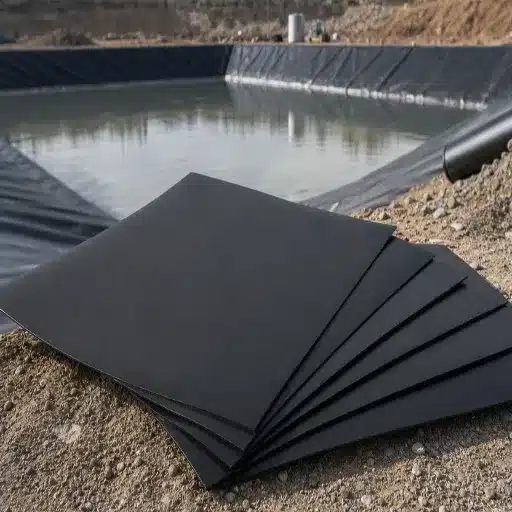
Numbers matter more than adjectives when you are specifying a containment system. Published leakage data from landfill research shows how sharply performance changes with liner configuration.
According to Dr. Robert Koerner of the Geosynthetic Institute, when cost is ranked from lowest to highest, the order is HDPE geomembrane alone, then geomembrane over GCL, then geomembrane over compacted clay liner. When performance is ranked by leakage rate, the order reverses: the composite geomembrane-over-GCL system is best, a geomembrane by itself is the poorest, and geomembrane over compacted clay sits in between. Field data from 279 landfill cells corroborates that composite GM/GCL liners are preferred for containment systems of all types.
Typical leakage figures illustrate the point:
- Standalone geomembrane: roughly 100-1,000 L/ha/day, depending on holes and weld defects
- Standalone GCL: roughly 860 L/ha/day
- Membrane-laminated GCL: roughly 8.6 L/ha/day
- Composite geomembrane installed directly over GCL: roughly 0-4 L/ha/day
The composite system outperforms either material alone by two to three orders of magnitude. Placing a GCL beneath a geomembrane can reduce leakage by up to 99% when the GCL is properly hydrated and confined.
There is an important caveat from recent field research. A 2023 study of 240 cells at 54 U.S. landfills found that adding a GCL beneath the primary geomembrane may not always reduce leakage through the primary liner. The reason is poor contact between the two layers, often caused by wrinkles in the geomembrane.
Installation quality and interface contact are just as important as material selection. This is why pairing the right liner with disciplined installation is essential. For the decision framework that connects materials to landfill design, see our geomembrane for landfill liner guide.
Cost and Installation: Where the Two Materials Diverge
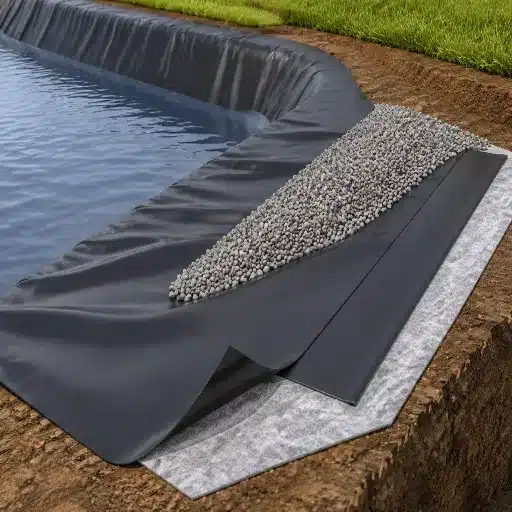
The cost comparison is more nuanced than “GCL is cheaper.” Material cost, freight, and installation labor all behave differently for each product.
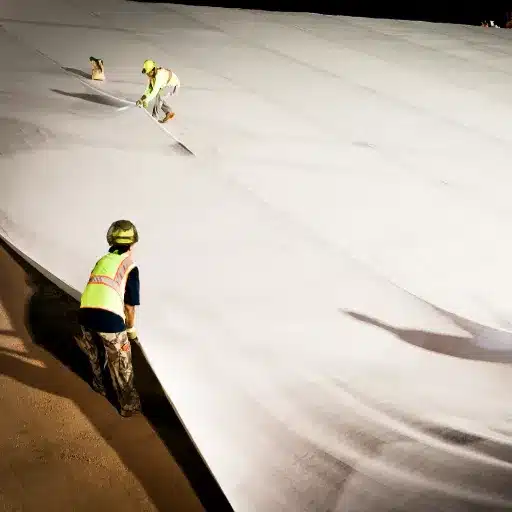
GCLs are generally less expensive per square meter than geomembranes, and installation is faster because panels are unrolled and overlapped rather than welded. Overlaps of at least 30 cm are typical, and the material conforms to slopes and uneven terrain without special preparation. Less skilled labor is required, and quality control is simpler.
Geomembranes require a smooth, compacted subgrade, professional welding equipment, and rigorous seam testing. This drives up both labor and QA/QC costs. However, geomembrane rolls are lightweight and compact, which lowers freight cost, especially for international projects. A GCL is heavier and bulkier because of the clay content, so shipping can be significantly more expensive.
When the two are combined in a composite liner, the cost is higher than either alone. For high-risk applications such as landfills and hazardous waste facilities, that added cost buys redundancy: a primary geomembrane barrier plus a self-healing secondary GCL barrier.
Real-World Scenario: Slope Conformance in the Philippines
In 2025, a contractor in the Philippines specified a 1.5 mm HDPE geomembrane for a reservoir lining project with steep, uneven slopes. The geomembrane would not conform to the undulating surface, and field welds kept failing under stress. The project team switched to a GCL for the slope sections and kept the geomembrane for the flat basin floor. The hybrid system installed in days instead of weeks, and no leaks were reported after the first monsoon season.
The lesson: terrain geometry often dictates the material. On flat, engineered subgrades, a geomembrane excels. On irregular slopes, a GCL conforms where a rigid polymer sheet cannot.
When to Choose a Geomembrane
Choose a geomembrane when the contained liquid is chemically aggressive, the project has a long design life, or failure would carry high environmental and regulatory risk.
Best applications for geomembranes:
- Municipal and hazardous waste landfills
- Mining heap leach pads and tailings storage facilities
- Chemical and industrial containment ponds
- Reservoirs, canals, and large water storage
- Wastewater treatment basins
HDPE is the default for these applications because it resists acids, alkalis, salts, and many hydrocarbons while offering a service life of 50 to 100 years with proper UV protection.
When to Choose a GCL
Choose a GCL when ease of installation, terrain conformance, self-healing, or lower upfront cost matters more than intrinsic impermeability or extreme chemical resistance.
Best applications for GCLs:
- Landfill caps and closures
- Canal and irrigation lining
- Artificial lakes and landscape ponds
- Slopes and irregular subgrades
- Vertical cutoff walls
- Secondary or backup barrier beneath a geomembrane
GCLs are also a common substitute for thick compacted clay layers. A GCL can replace 600 mm or more of compacted clay while offering comparable hydraulic performance and a much smaller construction footprint.
Real-World Scenario: The Canal That Almost Overran Budget
Maria, a project engineer at an irrigation authority, budgeted for a compacted clay liner on a 12 km canal rehabilitation. Excavation and clay supply pushed costs well past the estimate. Her procurement team switched to a GCL, which unrolled directly over the prepared subgrade and overlapped without welding. The liner was placed in one-third of the planned time, and the savings covered the drainage geotextile layer they had deferred.
The takeaway: when schedule and budget are tight and the liquid is not chemically aggressive, a GCL is often the pragmatic, reliable choice.
Composite Liners: The Best of Both Materials
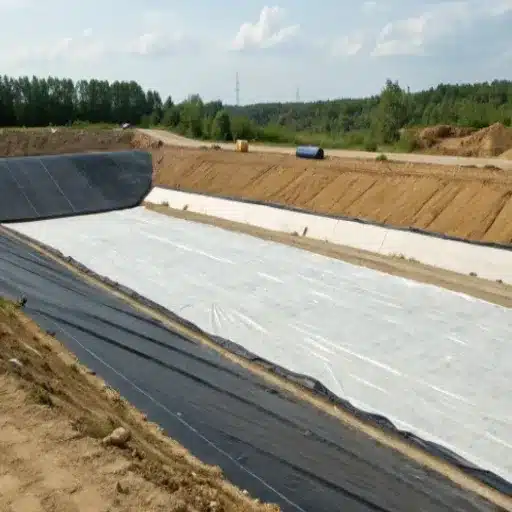
For the highest-risk containment applications, the answer to “geomembrane vs GCL” is often “both.” A composite liner places the geomembrane on top as the primary barrier and the GCL underneath as the secondary, self-healing layer.
Why the composite works:
- The geomembrane provides near-zero permeability and chemical resistance.
- The GCL self-seals minor punctures that may develop in the geomembrane.
- The two layers work synergistically, so even if one is defective, the other still protects the site.
- The GCL also reduces the consequences of wrinkles and installation defects in the geomembrane.
Composite GM/GCL systems are standard for municipal solid waste landfills and are preferred for mining containment and other high-risk facilities. Regulatory frameworks in many jurisdictions now require composite liner systems rather than a single barrier.
One practical note: the GCL must be hydrated and confined promptly after placement, and the geomembrane must be installed flat to maintain intimate contact between the layers. Poor contact undermines the composite’s theoretical advantage, so installation quality control remains the deciding factor.
Selection Checklist for Engineering Buyers
Use this checklist to move from “which is better” to “which is right for my project.”
- Liquid chemistry. Aggressive chemicals or leachate favor a geomembrane; clean or mildly mineralized water may tolerate a GCL.
- Risk tolerance. High environmental or regulatory risk favors a geomembrane or a composite system.
- Terrain and subgrade. Uneven slopes favor a GCL; flat engineered subgrades suit a geomembrane.
- Design life. Long service life favors a geomembrane; shorter-life or temporary works can use a GCL.
- Exposure conditions. UV-exposed, above-grade liners suit a geomembrane; buried or covered liners protect either material.
- Installation capability. Limited welding capacity and QA/QC resources favor a GCL; skilled crews favor a geomembrane.
- Budget and logistics. Compare material, freight, and installation together, not just the unit price.
- Regulatory requirements. Confirm whether your jurisdiction requires a composite liner system.
Need help deciding between a geomembrane and a GCL for your site? Contact our engineering support team for a technical recommendation based on your project conditions.
Frequently Asked Questions
Is a GCL cheaper than a geomembrane?
Generally, yes on material and installation cost, but not always on total delivered cost. A GCL is heavier and bulkier to ship, so freight can offset the material savings, especially for international projects. Compare total installed cost including logistics.
Can a GCL be used as a pond liner?
Yes. GCLs are commonly used for artificial lakes, irrigation ponds, and landscape water features, especially on uneven terrain where a geomembrane would be difficult to install. For potable or chemically sensitive water, confirm compatibility with the manufacturer.
How long does a GCL last?
A GCL can last roughly 50 years or more when it stays hydrated and confined. Performance degrades in arid conditions or under repeated wet-dry cycling, so cover it promptly and assess site moisture conditions.
Do I need both a GCL and a geomembrane?
For high-risk containment such as landfills, yes. The composite geomembrane-over-GCL system delivers the lowest measured leakage rates and provides redundancy. For lower-risk applications, either material alone may be sufficient.
Conclusion
The geomembrane vs GCL decision comes down to matching the material to the project. A geomembrane offers near-zero permeability, chemical resistance, and a long service life, but it demands skilled installation and offers no self-healing. A GCL is easier to install, conforms to uneven terrain, and self-seals minor damage, but it is more sensitive to chemistry and drying conditions.
For the highest level of containment, the composite geomembrane-over-GCL liner is the proven choice, delivering leakage rates as low as 0-4 L/ha/day compared with hundreds or thousands for a single barrier.
Start with your project’s liquid chemistry, risk tolerance, terrain, and budget. When in doubt, consult a supplier that understands both materials and how they interact. Request a technical quote from Shanxi Shengxing to get a specification recommendation, export-ready supply, and the engineering support your project needs.