Turbidity curtain anchoring starts with site loads, bottom conditions and water levels. A useful mooring plan connects those inputs to anchor locations, approved curtain attachments and line geometry. No universal anchor count establishes a suitable layout.
A floating line can look orderly while its moorings remain unprepared for the next change in current. That matters when a buyer receives a curtain length and an anchor-kit list but no record of the conditions behind them. The missing information belongs in the planning package before the equipment reaches the water.
This guide helps engineers, supervisors and buyers assemble that package. It explains the load path, compares layout questions and provides a worksheet for unresolved inputs. It does not assign anchor weights or replace the responsible designer’s site assessment. Use it alongside the floating silt curtain planning overview, keeping the anchoring review focused on position and restraint.
A floating sediment curtain also has a different purpose from a staked silt fence or an oil boom. Identify the actual system and its manufacturer before borrowing instructions from another barrier. A photograph of floats alone cannot establish the submerged arrangement, attachment details or installed holding resistance.
Key Takeaways
- Record both load directions, water-level references and bed information before selecting moorings.
- Check the whole load path, including reinforced curtain attachment points.
- Treat anchor mass, spacing and line ratios as separate design inputs.
- Carry open assumptions into a named review and installation handoff.
Record the Site Inputs Before Choosing Moorings
An unknown bed condition is an open design input, not a reason to order a heavier anchor. Start a site worksheet and assign each missing item to someone who can supply or review it. Prepare this worksheet before requesting equipment advice or a project quotation. A question tied to a drawing and a location is more useful than a request for a “standard anchor kit.”
Water levels and exposure
Record current direction and expected reversals, together with the basis for the stated operating conditions. Include wind, waves and vessel wakes where relevant. Distinguish a brief observation during a quiet visit from the conditions expected throughout the work period.
Give depths a location and water-level reference, or datum. Identify the expected high and low levels and the bed profile along the proposed run. A depth measured beside the staging area does not describe every offshore anchor position. Keep the curtain selection consistent with that exposure; the guide to turbidity curtain types covers the separate selection questions.
Use this worksheet structure, adding project-specific rows as needed:
| Input | Value or range | Location / datum | Source and time | Owner | Open action |
|---|---|---|---|---|---|
| Current and reversal | To confirm | Proposed alignment | Survey or documented assessment | Site lead | Obtain operating basis |
| Water levels and bed profile | To confirm | Each relevant reach | Survey and level reference | Survey lead | Reconcile references |
| Bed material | To confirm | Proposed anchor locations | Ground investigation or accepted evidence | Designer | Confirm suitability |
| Wind, waves and wakes | To confirm | Exposed reaches | Project exposure assessment | Project lead | Include vessel activity |
| Access and obstructions | To confirm | Mooring footprint | Site plan and checks | Supervisor | Resolve conflicts |
Bed, access and operating constraints
Record submerged services, navigation routes, property limits and areas where penetration or bed disturbance may be restricted. Check whether the installation and recovery equipment can reach the proposed anchor locations. List permit conditions and the person responsible for confirming them; a supplier catalogue does not resolve those constraints.
Illustrative scenario: An inlet appears sheltered during a site visit, but the worksheet has no entry for passing workboats. The supervisor records vessel wakes as unresolved and assigns the project lead to establish the operating exposure. The example identifies missing information; it does not demonstrate that any particular anchoring system would succeed there.
Keep evidence and assumptions in separate fields. When an input changes, identify which drawing and equipment decisions need review rather than silently replacing the value in a spreadsheet.
Trace the Load Path From Curtain to Bed
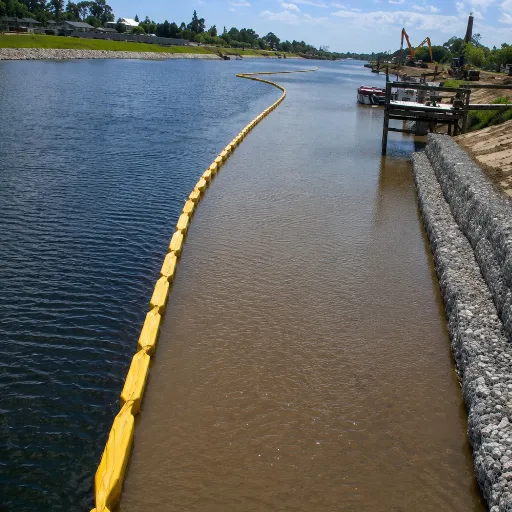
The strongest anchor cannot establish that the curtain attachment is adequate. Water loads the skirt. The assembled system must transfer those loads through its approved connections and moorings. Review that continuous path, rather than checking the anchor and curtain as unrelated purchases.
Trace the load through the curtain’s structural assembly and reinforced attachment. Then follow the connecting hardware and specified line or chain arrangement to the anchor. Ask the manufacturer to identify the actual load-carrying components. Do not assume an accessible grommet, seam or ballast pocket is an approved anchoring point.
The Alaska DOT&PF BMP collection, BMP-19 specifies manufacturer-provided reinforced attachment points for anchor lines, ballast and floats. That is a jurisdiction-specific example supporting the connection review, not a declaration that its specification governs every project.
Separate ballast from position holding
Ballast helps maintain the skirt’s hanging arrangement. Mooring anchors restrain the curtain’s position through the designed connections. The presence of a chain at the skirt bottom does not establish that the curtain has a suitable station-keeping system.
Request connection details showing compatible hardware, attachment locations and any documented limits. Check that the component names on the drawing match the equipment schedule. A line described only as “rope to curtain” leaves the interface unresolved, even if an anchor model appears elsewhere on the sheet.
Depth remains part of this review. Link the mooring arrangement to the specified skirt depth and bottom clearance, without assuming that every curtain should seal against the bed. For the inlet worksheet, this means identifying both the connection detail and the depth reference that still need confirmation.
Match Anchor Options to Confirmed Bottom Conditions
Anchor style is a compatibility decision before it becomes a quantity decision. Manufacturer guidance relates anchor choice to bed conditions and site exposure. A catalogue’s mass or product name does not establish installed holding resistance at the reader’s location.
Use the following comparison to prepare questions for the responsible designer. It is not a selection chart or a list of interchangeable systems. The anchor, connecting components and installation method must be reviewed together.
| Option | Mechanism to review | Information needed | Installation and recovery question |
|---|---|---|---|
| Fluke / Danforth | Penetration and engagement with suitable bed material | Bed character, setting conditions and load direction | Can it be set and its holding checked as specified? |
| Deadweight / pyramid | Weight and interaction with the supporting bed | Bed support, geometry and expected loads | Can equipment place and retrieve the complete assembly? |
| Embedded anchor | Resistance developed after specified installation in suitable ground | Ground profile, required installation method and acceptance basis | Is suitable installation equipment available? |
| Shore anchorage | Transfer of restraint into an approved land-side arrangement | Ground conditions, access rights and shore movement | Can it be installed without unresolved service or access conflicts? |
These mechanisms explain why changing anchor style can change the information required. A fluke arrangement proposed for penetrable sediment raises different setting questions from a weight resting on an irregular rocky bed. Neither description alone supplies a capacity or proves that the chosen equipment is appropriate.
Ask how the installed condition will be accepted
Request the basis for the proposed anchor choice and the method for confirming installation. Identify who checks the location, setting and connection, and what record they produce. Do not invent a pull-test value or acceptance threshold where the project documents provide none.
Also ask how the system will be recovered without conflicting with navigation, buried services or the curtain removal plan. A component that can be delivered to shore may still lack a reviewed offshore placement method. Resolve that access question before treating the equipment schedule as complete.
Where bed information is absent, keep selection open and obtain the required evidence. Substituting a heavier unit is not a documented resolution of unknown ground conditions.
Choose a Layout for Flow Direction and Reversals
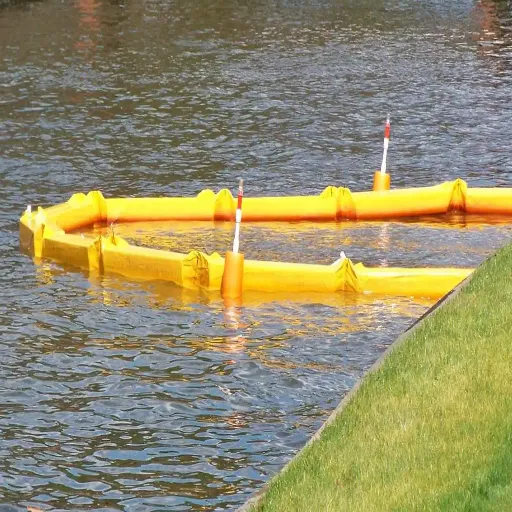
A layout drawn for one tide may not describe the return tide. Mark the expected load directions before positioning anchor symbols. The drawing should make clear whether restraint addresses one prevailing direction, several directions or a changing combination of current, wind and wakes.
The Texas Boom installation instructions distinguish calm-water arrangements from configurations addressing changing loads. Their examples help explain the directional questions; they do not establish that a depicted configuration is suitable for another manufacturer’s curtain or a different site.
Sheltered and mainly unidirectional conditions
For a protected, shore-bounded area, show the shore returns and how their ends remain restrained as water levels change. Review gaps and access at those ends. Calling the area “calm” does not remove the need to document the conditions used for that description.
For appreciable flow, Parker Systems discusses an alignment generally parallel to the current. A floating curtain should not be treated as a dam across the stream. Confirm whether the proposed alignment and exposure are suitable for the selected system. Do not force a floating curtain into a flow condition beyond its reviewed operating basis.
Corners and end connections deserve explicit detail because a simple straight-run symbol hides their geometry. Show where lines extend beyond the float line and whether they intersect work zones, navigation routes or nearby structures. The operational footprint includes those lines and anchors, not only the visible curtain.
Reversing current and other directional changes
Opposing moorings may be needed where current reverses. Document how the complete system accommodates both directions and changing water levels. Adding an anchor symbol on the other side does not by itself resolve line travel, conflicts or the curtain’s movement envelope.
Illustrative scenario: A tidal-work drawing shows ebb-flow arrows but no flood direction. During review, the team adds the missing directional case and asks the designer to reassess the proposed moorings and vessel corridor. No anchor count or successful installation is implied; the useful change is a drawing that exposes the previously omitted condition.
Before deployment, mark both load directions and route the assumptions for review. Include any planned vessel opening and the conditions for using it. Keep the drawing consistent with the approved curtain type. More anchors do not establish a higher exposure limit for the curtain itself.
Review Turbidity Curtain Anchoring Geometry and Spacing
Enough line to reach the bed does not establish enough holding resistance. Review line length, attachment elevation, horizontal reach and water-level range together. Keep anchor spacing separate. It concerns the distribution of restraint along the curtain and must match the reviewed system and loads.
Published ratios need their original context. ABASCO’s installation guide gives line-length examples of three times water depth for Danforth anchors and 1.5 times depth for deadweight or earth anchors. Texas Boom explicitly refers to maximum high-tide depth in its Danforth guidance. These examples demonstrate why anchor type and reference level matter; they are not interchangeable capacity calculations.
Make the line schedule traceable
Record the source of any proposed ratio, its depth reference and the component arrangement to which it applies. Ask the reviewer to confirm the resulting geometry across the operating water levels. If the survey and water-level records use different datums, resolve the conversion before comparing their elevations. Do not combine one maker’s ratio with another maker’s hardware and call the result an approved system.
A blank schedule row can use these fields:
| Point ID | Anchor / attachment detail | Bed level reference | Operating water levels | Proposed line length | Reviewer / open action |
|---|---|---|---|---|---|
| To assign | To confirm | To confirm | To confirm | Await review | Named reviewer required |
Check the horizontal footprint against access limits and the allowed curtain position. A line may fit within the available water depth yet extend into a vessel route. Likewise, a drawing measured at one level may leave its behavior at another level unexplained.
Avoid calculating an anchor count by dividing curtain length by a generic published interval. That shortcut omits ends, corners, direction changes and system-specific attachment locations. Request a reviewed location schedule tied to the drawing, with unresolved points clearly identified.
Turn the Mooring Plan Into a Reviewable Handoff
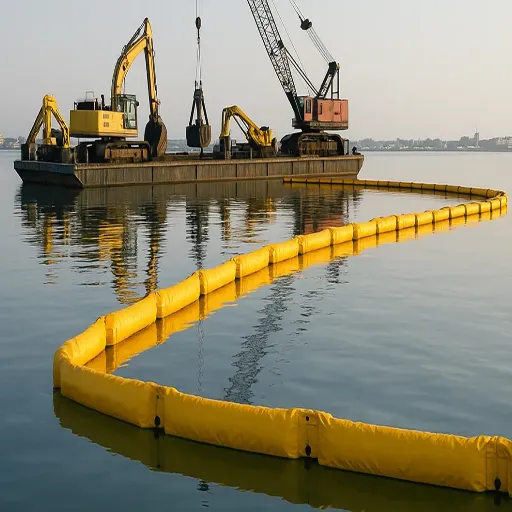
A plan becomes useful when another person can identify what was checked and against which drawing. Assemble the approved layout, site-input basis, equipment schedule and manufacturer connection details into one controlled handoff. Keep superseded drawings available as history, with the current revision clearly identified.
The handoff should identify the following:
- Drawing revision, curtain run and anchor-point references.
- Environmental conditions and water-level references used in review.
- Anchor, line, hardware and attachment details, including unresolved substitutions.
- Installation and setting checks, responsible people and required records.
- Hold points, operating limits and the route for escalating changes.
Separate a proposed layout from the installed record
Confirm the deployment sequence with the selected manufacturer’s instructions. ABASCO distinguishes sheltered conditions from current or wind exposure when discussing whether anchors are deployed before moving the curtain into position. Do not convert one sequence into a universal instruction, or unfurl the skirt while required mooring checks remain open.
Record the installed positions and the observations required by the project plan. Compare the curtain profile and mooring arrangement after relevant changes in load or water level. Escalate dragging, unexpected movement, loss of freeboard, damaged connections or unintended bed contact through the agreed project procedure.
Illustrative scenario: An inspection finds an anchor marker has shifted after a weather change. The supervisor records the location and conditions, then requests assessment against the approved arrangement. The previous drawing is no longer treated as sufficient proof of the installed condition. The example offers no diagnosis of the underwater cause or claim that repositioning alone resolves it.
Mechanical readiness and environmental performance require different evidence. An orderly float line does not demonstrate compliance with turbidity limits. Keep water-quality requirements and response responsibilities in the environmental plan.
For your next project discussion, bring the worksheet and marked-up drawing together. Turbidity curtain anchoring questions become easier to resolve when each proposed component has a known site basis and each open item has an owner. Seek project review before authorizing deployment on incomplete assumptions.
Frequently Asked Questions
How far apart should turbidity curtain anchors be?
Anchor spacing must follow the reviewed curtain system, site loads, bed conditions and layout. A manufacturer’s published interval is guidance within its stated context, not proof of suitability elsewhere. Ask for anchor locations tied to approved attachment points, including ends and corners, rather than deriving a count from curtain length alone.
For procurement, request the drawing revision that supports the quantity. A kit count alone leaves the basis unclear.
Does a curtain need anchors on both sides?
Anchors on both sides may be needed when currents or other loads reverse direction. The decision depends on the expected load cases and the complete mooring arrangement. Show both directions on the drawing and ask the responsible designer to review restraint, line movement and conflicts throughout the operating water-level range.
One calm visit cannot rule out later reversals.
Can the ballast chain act as the anchor?
Do not assume the ballast chain provides the curtain’s required position holding. Ballast helps maintain the hanging skirt, while the reviewed mooring system restrains position through approved attachments. Ask the manufacturer to identify each component’s function and the permitted load path before connecting mooring lines to any part of the curtain.
Visible chain alone is insufficient evidence of an approved anchoring arrangement. Check the assembly detail.
How much anchor line is needed at high tide?
Use the selected system’s reviewed line geometry and stated water-level reference. Texas Boom’s Danforth guidance names maximum high-tide depth, illustrating why a depth measured at another level is insufficient. Confirm anchor type, attachment elevation, available horizontal reach and operating range; a line-length ratio alone does not establish holding resistance.
Keep the level reference on the schedule so reviewers can reproduce the geometry.
What should I do if the bed material is unknown?
Record the bed condition as unresolved and obtain the information required by the responsible designer before finalizing anchor selection. Anchor mechanisms depend on their interaction with the ground, and installation access also matters. Choosing a heavier catalogue unit does not establish suitability, holding resistance or an acceptable setting method in unknown material.
Assign an owner and next action to that missing input. Keep procurement assumptions visible until the project review resolves them.