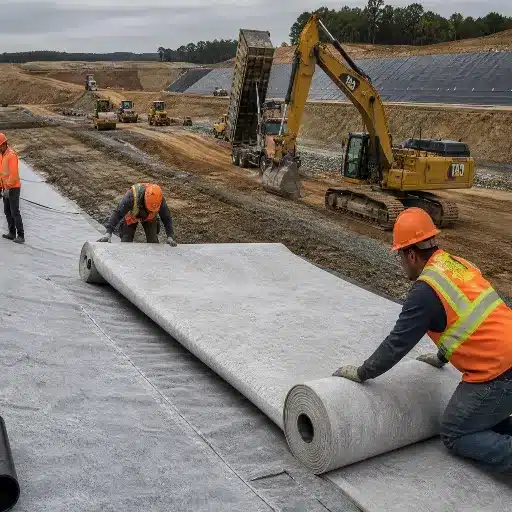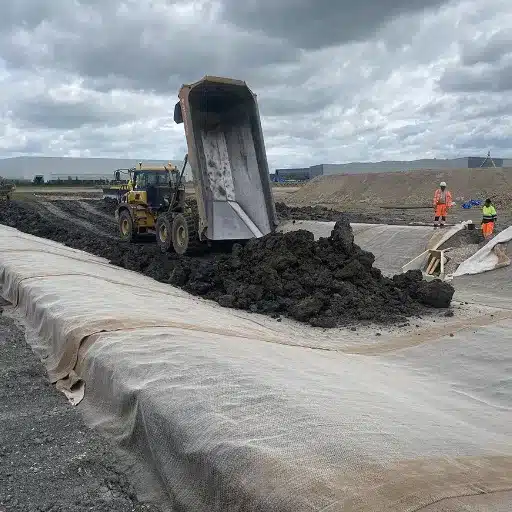
A geomembrane is a synthetic, impermeable barrier. It controls the movement of liquids, gases, and contaminants in civil and environmental projects. If your project involves landfills, mining containment, ponds, reservoirs, or wastewater lagoons, selecting the right geomembrane material and thickness matters. It directly affects long-term performance, regulatory compliance, and total cost.
What if the liner you specify today fails ten years from now?
It happens more often than engineering teams expect. A 0.75 mm sheet placed under a landfill cell loaded with abrasive waste. A smooth liner was deployed on a steep slope without enough friction. A seam installed in damp morning conditions without trial-weld verification. When a geomembrane fails, the cost is rarely limited to the liner itself. It includes environmental remediation, regulatory penalties, project downtime, and reputational damage.
You already know that choosing the right geomembrane matters. The challenge is navigating material options, thickness ranges, installation methods, and quality standards. This guide solves that problem. You will learn what geomembrane is, how it differs from related geosynthetics, which material fits which application, how thick your liner should be, and how to source geomembrane from a global supplier.
This guide is written for civil engineers, procurement buyers, and project managers. It provides the technical foundation needed to make an informed decision.
Need a quick specification check? Explore our HDPE geomembrane liners to see thickness ranges, tensile ratings, and export-ready options for your next project.
Key Takeaways
- A geomembrane is a synthetic impermeable barrier used to control fluid and gas migration in containment systems.
- HDPE, LLDPE, PVC, EPDM, and EVA each offer different balances of stiffness, flexibility, chemical resistance, and cost.
- Thickness typically ranges from 0.5 mm to 3.0 mm; landfills usually require at least 1.5 mm HDPE.
- Proper installation and welding quality are critical, since 10–15% of liner failures trace back to poor field practices.
- Global buyers should verify factory certification, virgin resin quality, sample retention, and export logistics capability.
What Is a Geomembrane?
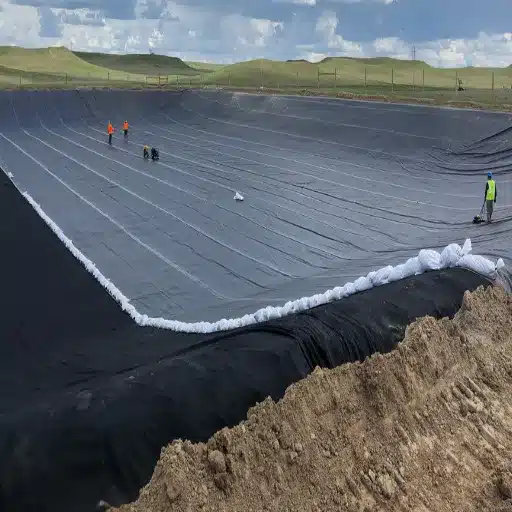
A geomembrane is a continuous synthetic sheet. It acts as an impermeable barrier. Unlike geotextiles, which are permeable and designed for filtration or separation, geomembranes block the passage of liquids and gases. They are produced from polymers such as HDPE, LLDPE, PVC, EPDM, and EVA.
Geomembranes differ from several related geosynthetic materials:
- Geotextile: A permeable fabric used for filtration, separation, reinforcement, and drainage. It often protects geomembranes from puncture.
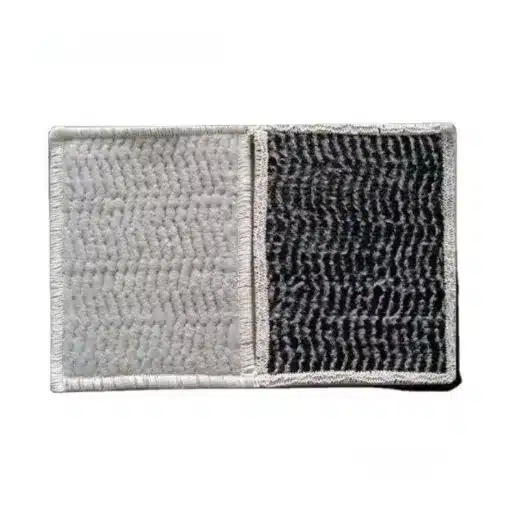
- Geosynthetic clay liner (GCL): A bentonite clay layer sandwiched between geotextiles. It provides a secondary barrier but is not as impermeable as a geomembrane.
- Geogrid: A grid-like material used for soil reinforcement and load distribution.
- Compacted clay liner: A layer of low-permeability soil. It is far thicker and more permeable than an HDPE geomembrane.
Geomembranes are available with different surface finishes. Smooth geomembrane is the most common type. It offers the highest impermeability and the easiest welding. Textured geomembrane has a roughened surface. This increases friction and helps prevent liner slippage on steep slopes. Learn more about textured vs smooth geomembrane. Conductive geomembrane includes an embedded conductive layer. It allows spark testing for pinhole detection during installation.
The global geomembrane market is projected at roughly USD 2.82 to 4.12 billion in 2026. Growth rates range from 5.4% to 7.7% per year through the early 2030s. Demand is driven by waste management rules, mining investment, water conservation, and infrastructure expansion across Asia-Pacific, North America, and the Middle East. Straits Research
Geomembrane Materials and How to Choose
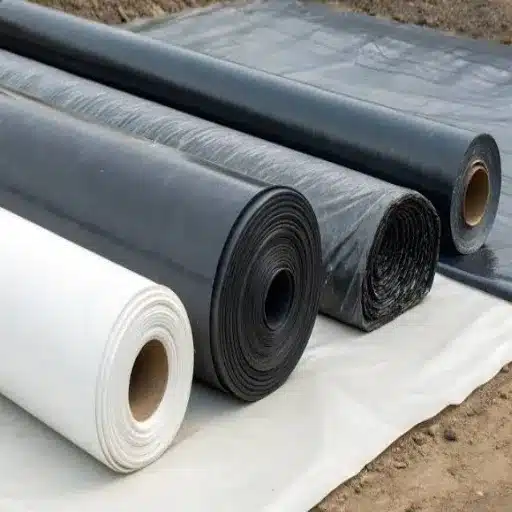
Not every geomembrane material behaves the same way. The right choice depends on chemical exposure, subgrade conditions, flexibility requirements, installation constraints, and budget.
HDPE Geomembrane
High-density polyethylene is the most widely specified geomembrane material. It resists chemicals, carries high tensile loads, and blocks liquids effectively. HDPE geomembrane is made from 97–99% virgin HDPE resin with 2–3% carbon black for UV stability.
Typical properties include:
- Density: 0.940–0.965 g/cm³
- Tensile strength: ≥27 MPa
- Elongation at break: ≥700% for smooth grades
- Permeability: below 1×10⁻¹³ cm/s
- Service life: 50–70 years when buried
HDPE is the default choice for landfills, mining heap leach pads, tailings facilities, and hazardous waste containment. Its main limitation is stiffness. HDPE does not conform as easily to irregular surfaces as LLDPE or PVC. It also expands and contracts with temperature changes. For a deep technical dive, see our HDPE geomembrane engineering guide.
LLDPE Geomembrane
Linear low-density polyethylene is more flexible than HDPE. It has higher elongation. It conforms better to uneven subgrades, settles without cracking, and performs well in cold temperatures.
Typical properties include:
- Density: ≤0.939 g/cm³
- Elongation at break: often 800% or higher
- Better puncture resistance under deformation
- Easier to fold and ship in prefabricated panels
LLDPE is often chosen for landfill caps, pond liners, and irrigation reservoirs. It also works well on settlement-prone or irregular subgrades. It is not as chemically resistant as HDPE for aggressive leachates. Material selection must match the containment chemistry. See our comparison of HDPE vs LLDPE geomembrane.
PVC Geomembrane
Polyvinyl chloride geomembranes are flexible, lightweight, and easy to install. They are commonly used for ponds, tanks, canals, and tunnel waterproofing.
Advantages include:
- High flexibility even at low temperatures
- Easy welding with solvent or hot air methods
- Good conformance to complex shapes
Limitations include lower chemical resistance than HDPE for some hydrocarbons and organics. UV stability is reduced unless stabilizers are added. For side-by-side guidance, read PVC vs HDPE geomembrane.
EPDM and EVA Geomembranes
EPDM is a rubber-like material. It is used for decorative ponds, landscaping, and exposed roofing. EVA geomembranes are soft and flexible. They are often used in tunnel waterproofing or applications requiring high elongation. Both are niche materials compared to HDPE, LLDPE, and PVC.
Material Selection Matrix
| Material | Density | Flexibility | Chemical Resistance | Typical Applications | Relative Cost |
|---|---|---|---|---|---|
| HDPE | 0.940–0.965 g/cm³ | Low | Excellent | Landfills, mining, hazardous waste | Medium |
| LLDPE | ≤0.939 g/cm³ | High | Very good | Ponds, landfill caps, reservoirs | Medium |
| PVC | 1.1–1.35 g/cm³ | Very high | Good | Tanks, canals, tunnels, ponds | Low–medium |
| EPDM | ~1.1 g/cm³ | Very high | Good | Decorative ponds, landscaping | Medium–high |
| EVA | ~0.94 g/cm³ | Very high | Moderate | Tunnel waterproofing, specialty liners | Medium |
When in doubt, start with the containment chemistry and mechanical demands. HDPE wins on chemical resistance and stiffness. LLDPE wins on flexibility and settlement tolerance. PVC wins on ease of installation in complex geometries.
Key Properties and Performance Standards
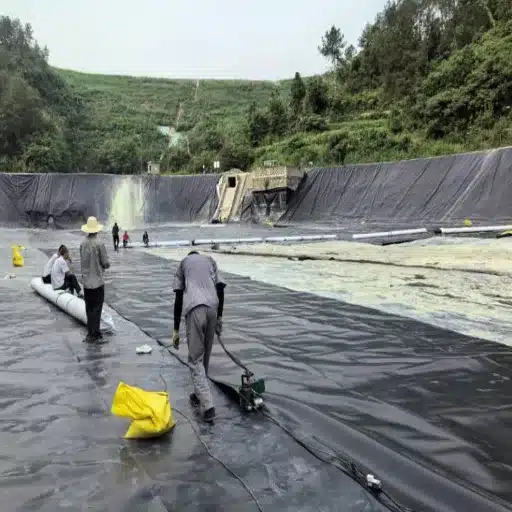
Engineering buyers evaluate geomembranes against measurable properties. Understanding these properties helps prevent specification errors.
Tensile Strength, Puncture, and Tear Resistance
Tensile strength measures how much stress a geomembrane can withstand before yielding. Quality HDPE geomembrane reaches a tensile strength of ≥27 MPa. Force resistance scales from roughly 25 kN/m for thin sheets to over 100 kN/m for thick liners.
Puncture resistance increases with thickness. A 1.0 mm HDPE panel typically resists ≥320 N of puncture force. A 1.5 mm panel resists ≥500 N. Tear resistance ranges from 25 N to 374 N depending on sheet thickness and resin grade.
Permeability
Geomembrane permeability is expressed as hydraulic conductivity. HDPE geomembrane typically has a permeability coefficient below 1×10⁻¹³ cm/s. That makes it roughly 100 to 1,000 times more impermeable than compacted clay.
Chemical and UV Resistance
HDPE geomembrane is chemically inert across pH 0.5 to 14. It resists acids, alkalis, and hydrocarbons. UV stability comes from carbon black content. Properly formulated HDPE retains approximately 90% of its original tensile strength after 1,600 hours of accelerated UV exposure.
OIT and Environmental Stress Crack Resistance
Oxidative Induction Time (OIT) measures thermal stability. Quality HDPE geomembrane achieves OIT ≥100 minutes at 200°C under ASTM D5885. Environmental Stress Crack Resistance (ESCR) is critical for long-term performance under constant load. HDPE geomembrane should reach ≥500 hours under ASTM D5397.
Key Standards
| Standard | Scope |
|---|---|
| GRI-GM13 | Specification for HDPE smooth and textured geomembranes |
| ASTM D6693 | Tensile testing of geomembranes |
| ASTM D5199 | Thickness measurement of smooth geomembranes |
| ASTM D5994 | Thickness measurement of textured geomembranes |
| ASTM D6392 | Seam strength by hot wedge welding |
| ASTM D5322 | Chemical resistance testing |
| ISO9001 | Quality management system certification |
Geomembrane Thickness Selection by Application
Thickness is one of the most important specification decisions. It directly affects puncture resistance, tensile strength, chemical diffusion resistance, handling difficulty, and cost.
Common Thickness Range
Geomembranes are manufactured from about 0.5 mm to 3.0 mm. The lower end is suitable for low-risk, temporary, or lightly loaded applications. The upper end is used for hazardous waste landfills, high-head reservoirs, and aggressive mining containment.
Application × Thickness Recommendations
| Application | Recommended Thickness | Notes |
|---|---|---|
| Decorative ponds, small water features | 0.5 mm | Low load, easy access for repair |
| Aquaculture ponds, irrigation canals | 0.75–1.0 mm | Balance of cost and puncture resistance |
| General water reservoirs | 1.0–1.5 mm | Higher loads, longer design life |
| Municipal solid waste landfill liners | 1.5 mm minimum | U.S. EPA 60 mil requirement |
| Hazardous waste landfills | 2.0–2.5 mm | Aggressive chemistry, high consequence of failure |
| Mining heap leach pads | 1.5–2.0 mm | Chemical and puncture resistance |
| Mining tailings storage | 1.5–2.5 mm | High loads, long-term exposure |
| Industrial lagoons | 1.0–1.5 mm | Depends on chemical exposure |
| Tunnel waterproofing | 1.5–2.0 mm | Often PVC or EVA for flexibility |
The U.S. EPA mandates a minimum of 60 mil, or 1.5 mm, HDPE geomembrane for municipal solid waste landfill liners.
Factors That Influence Thickness
Subgrade conditions: Rocky or gravelly soil with sharp protrusions demands thicker liners or a protective geotextile cushion layer. Soft, well-prepared clay subgrades can accept thinner specifications.
Applied loads: Deep reservoirs, heavy waste loads, and traffic over liners create higher mechanical stress. Thicker panels distribute these loads more effectively.
Chemical exposure: Aggressive environments such as mining heap leach pads or hazardous waste landfills benefit from thicker liners. The added material provides a longer diffusion path for chemicals.
UV exposure and service life: Exposed liners that will not be covered require extra thickness and higher carbon black content. This helps them withstand weathering over time.
Regulatory minimums: Many jurisdictions specify minimum thicknesses. Always confirm local requirements before finalizing a specification.
For a deeper selection framework, see our geomembrane thickness guide.
Major Applications of Geomembrane Liners
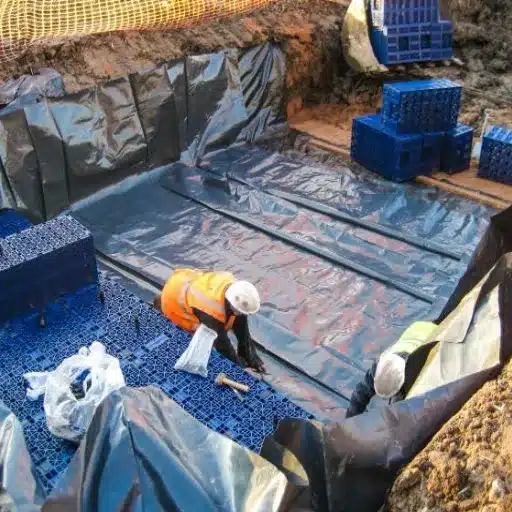
Geomembranes are used wherever containment, waterproofing, or environmental protection is required.
Landfills and Hazardous Waste Containment
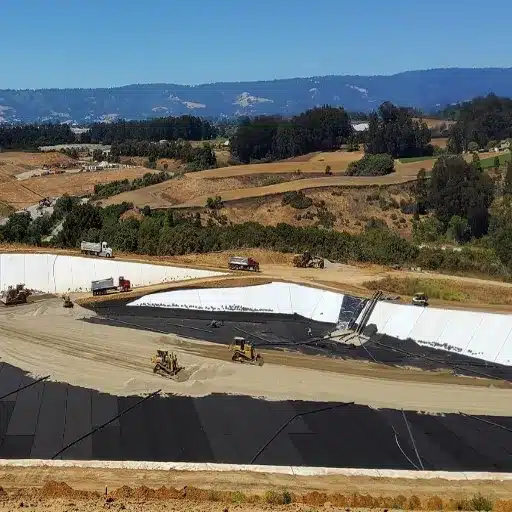
In landfill liner systems, geomembranes form the primary barrier between waste and the surrounding environment. A typical modern landfill uses a composite liner. HDPE geomembrane sits over a geosynthetic clay liner or compacted clay. A leachate collection layer is placed above. The geomembrane prevents leachate from contaminating soil and groundwater. Landfill caps also use geomembranes. They limit rainwater infiltration and control gas emissions. See geomembrane landfill liner systems for a detailed breakdown.
Mining Heap Leach Pads and Tailings Storage
Mining applications expose liners to acidic solutions, heavy loads, and abrasive materials. HDPE geomembrane is the most common choice. It resists chemicals and lasts under harsh conditions. Textured HDPE is often specified on slopes to prevent liner slippage. Heap leach pads typically use 1.5–2.0 mm liners. Tailings storage facilities may require 2.0 mm or more. Learn more in our guide to geomembrane for mining.
Ponds, Reservoirs, and Irrigation Systems
Geomembrane pond liners are used in aquaculture, irrigation, decorative ponds, and water storage reservoirs. HDPE is common for large, cost-sensitive installations. LLDPE and PVC are preferred when flexibility and conformance to uneven terrain matter. Potable water applications require NSF or equivalent certification. This confirms the material is safe for drinking water. Our geomembrane pond liner guide covers selection and installation in detail.
Wastewater Treatment and Industrial Lagoons
Wastewater lagoons, anaerobic digesters, and industrial process ponds use geomembranes. They prevent contamination of soil and groundwater. Material selection must account for the specific chemicals present. These may include oils, solvents, acids, and alkalis. HDPE is often specified for aggressive industrial waste. PVC or LLDPE may be used for municipal wastewater.
Agriculture, Aquaculture, and Biogas
In agriculture, geomembranes line irrigation reservoirs, canals, and evaporation ponds. In aquaculture, they create controlled environments for fish and shrimp ponds. In biogas systems, geomembranes seal digesters and lagoons to capture methane for energy use.
Civil Engineering and Tunnel Waterproofing
Geomembranes are used beneath concrete slabs, in tunnel linings, and in underground structures where groundwater control is essential. PVC and EVA geomembranes are common in tunnel waterproofing because they remain flexible and can be welded in confined spaces.
Installation, Welding, and Quality Assurance Overview
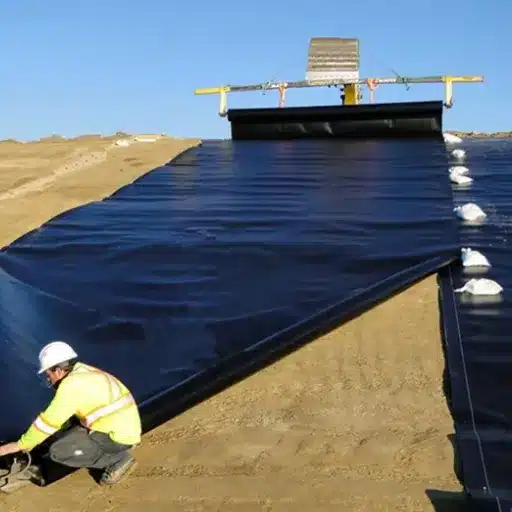
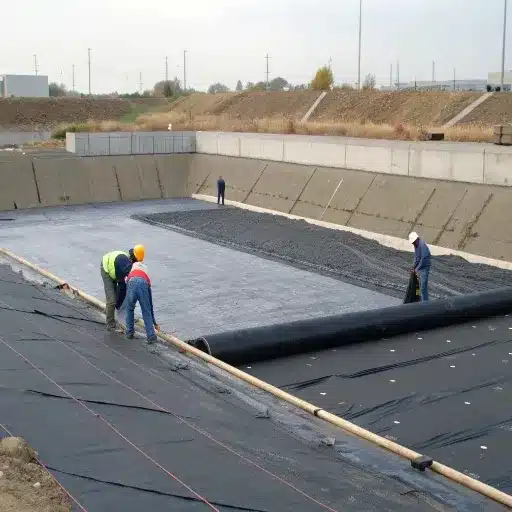
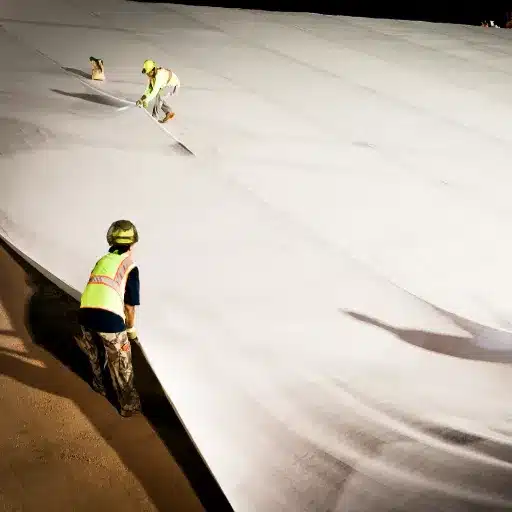
A geomembrane installation is only as reliable as its seams and subgrade preparation. Even the highest-quality roll can fail if it is installed incorrectly.
Subgrade Preparation
The subgrade must be smooth, compacted, and free of sharp objects, roots, and debris. A layer of nonwoven geotextile is often placed beneath the geomembrane. It provides puncture protection and cushioning. This is especially important on rocky or poorly graded soils. See our geotextile fabric guide for more on protective layers.
Three main welding methods are used in the field:
- Hot wedge welding: A heated wedge melts overlapping sheets. Rollers press them together. This creates a double-track seam with an air channel for pressure testing. It is the standard method for long, flat seams.
- Extrusion welding: A molten polymer rod is extruded into the seam. It is used for repairs, pipe boots, corners, and details where a wedge welder cannot reach.
- Hot air welding: Heated air softens the sheets before pressure bonding. It is common for PVC, LLDPE, and thin liners.
Proper hot wedge welding can reach approximately 95% of the base material’s tensile strength.
Quality Control Testing
| Test | Method | Purpose |
|---|---|---|
| Air channel test | Inflate channel to ~30 psi, hold 5 minutes | Detect leaks in double-track seams |
| Vacuum box test | Apply soap solution and vacuum | Detect leaks in extrusion welds |
| Spark testing | High-voltage detector over conductive layer | Detect pinholes in conductive geomembrane |
| Destructive testing | 25 mm peel/shear samples every ~150 m | Verify weld strength meets the specification |
Roughly 10–15% of geomembrane failures are tied to poor installation practices. Common causes include contaminated seams, inadequate overlap, welding in wet or windy conditions, and skipped trial welds.
For step-by-step installation guidance, read our geomembrane installation guide. For welding-specific detail, see geomembrane welding methods.
Geomembrane Pricing and Total Cost of Ownership
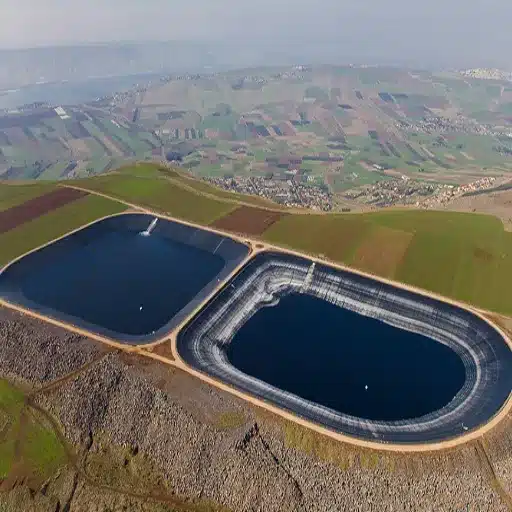
Material price per square meter is only one part of the total cost. A complete cost evaluation should include material, freight, installation, supervision, testing, and lifecycle performance.
Cost Drivers
- Material: HDPE is generally the most cost-effective option for large containment projects. PVC and EPDM can be more expensive per square meter.
- Thickness: Thicker liners cost more in material and handling but reduce failure risk.
- Surface type: Textured geomembrane typically costs more than smooth geomembrane due to the manufacturing process.
- Order volume: Larger orders reduce per-unit cost.
- Freight: Roll dimensions and shipping distance affect logistics cost. Factory-fabricated LLDPE panels can reduce field seams but increase shipping volume.
Installation and Supervision
Installation labor, welding equipment, and third-party construction quality assurance (CQA) can add significantly to project cost. Cutting corners on supervision or testing often increases long-term risk.
Lifecycle Cost
The cheapest liner is not always the least expensive option over the project life. A thicker HDPE liner with certified installation may cost more upfront but eliminates the risk of leaks, repairs, and regulatory issues later. For a detailed cost breakdown, see our geomembrane price guide.
Geomembrane vs Other Containment Solutions
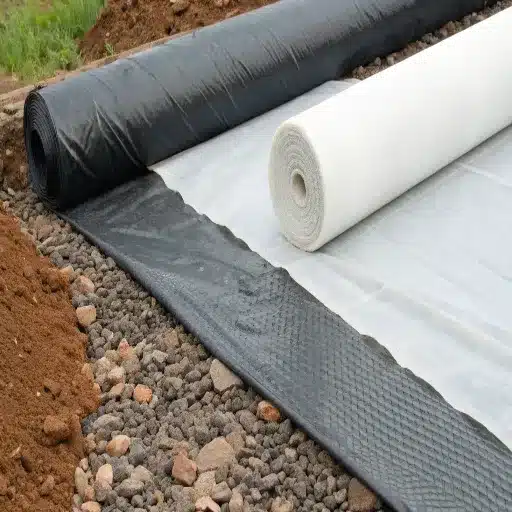
Engineers often compare geomembranes to compacted clay liners, geosynthetic clay liners, and concrete lining. Each system has different strengths.
Geomembrane vs GCL
A geosynthetic clay liner uses bentonite clay encapsulated between geotextiles. When hydrated, the clay swells to form a low-permeability barrier. GCLs are faster to install and can self-heal minor punctures. However, their permeability is higher than HDPE geomembrane. They are also vulnerable to desiccation and ion exchange.
Modern high-risk projects often use a composite system. HDPE geomembrane serves as the primary barrier. A GCL acts as the secondary barrier. This combination provides redundancy and reduces the consequences of a defect in either layer. See geomembrane vs GCL for a full comparison.
Geomembrane vs Compacted Clay Liner
Compacted clay liners rely on low-permeability soil placed in lifts. They are much thicker than geomembranes and have significantly higher permeability. HDPE geomembrane is roughly 100 to 1,000 times more impermeable than compacted clay. Clay liners are also more vulnerable to desiccation cracking and differential settlement.
Geomembrane vs Concrete Lining
Concrete is rigid and durable but can crack under settlement or thermal stress. Geomembranes conform to ground movement and can be repaired more easily. Concrete is often used for channels and tanks where structural strength is required, while geomembranes are preferred for large-area containment.
Composite Liner Systems
Composite liners combine geomembrane with GCL, geotextile, or compacted clay to improve overall performance. The geomembrane provides the primary impermeable barrier. The underlying layer provides secondary protection, cushioning, and leak detection benefits.
Sourcing Geomembrane from a Global Supplier
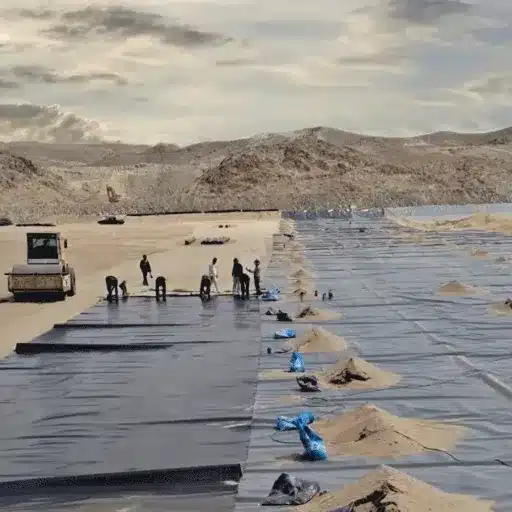
For international buyers, sourcing geomembrane involves more than comparing material prices. Factory capability, quality systems, documentation, and logistics all affect project success.
Factory Certification and Quality Systems
Look for suppliers with ISO9001 quality management certification. A documented quality system ensures consistent manufacturing, traceability, and corrective action.
Virgin Resin and Sample Retention
High-performance geomembrane should be produced from virgin resin, not recycled material. It should include 2–3% carbon black for UV stability. Reputable suppliers retain samples for several years. This allows performance to be verified if questions arise later.
Roll Dimensions and Shipping
HDPE geomembrane is typically supplied in rolls 4–10 meters wide and 50–200 meters long. Dimensions depend on thickness and transport constraints. Confirm roll weights and diameters so unloading and deployment equipment can be planned.
Export Documentation and Logistics
International shipments require proper packing lists, certificates of origin, mill test reports, and quality assurance documentation. A supplier with export experience can coordinate freight forwarding, customs clearance, and on-time delivery.
When to Request Technical Consultation
If you are unsure about material selection, thickness, or installation requirements, request technical consultation early. The right supplier can review your project specifications, subgrade conditions, and chemical exposure to recommend a tailored solution.
Ready to specify geomembrane for your project? Contact our engineering support team for a technical quote or product recommendation.
Frequently Asked Questions
What is a geomembrane used for?
A geomembrane is used as an impermeable barrier to control liquid and gas migration. Common applications include landfill liners, mining containment, ponds, reservoirs, wastewater lagoons, and tunnel waterproofing.
How thick should a geomembrane liner be?
Thickness depends on application and risk. Low-risk ponds may use 0.5–0.75 mm. Municipal solid waste landfills require at least 1.5 mm HDPE in many jurisdictions. Hazardous waste and mining applications often specify 2.0 mm or more.
What materials are geomembranes made from?
Geomembranes are made from polymers including HDPE, LLDPE, PVC, EPDM, and EVA. Each material offers different balances of stiffness, flexibility, chemical resistance, and cost.
How long does geomembrane last?
Buried HDPE geomembrane can last 50–70 years. Exposed liners typically last 5–20 years depending on UV exposure, material formulation, and maintenance.
Can geomembrane be used for potable water?
Yes, but the material must be certified for potable water contact. HDPE and LLDPE geomembranes are available with NSF or equivalent certification for drinking water reservoirs.
How is geomembrane installed?
Installation involves subgrade preparation, roll deployment, seam welding, and quality control testing. Common welding methods include hot wedge, extrusion, and hot air welding.
What is the difference between geomembrane and geotextile?
A geomembrane is impermeable and used for containment. A geotextile is permeable and used for filtration, separation, reinforcement, drainage, and protection. They are often used together, with geotextile protecting the geomembrane from puncture.
Conclusion
Geomembrane selection is an engineering decision that touches material science, site conditions, installation practice, and long-term cost. The right liner depends on what you are containing, how long it must perform, and what standards your project must meet.
HDPE remains the workhorse for landfills, mining, and hazardous waste. Its strength, chemical resistance, and long service life make it the default choice. LLDPE and PVC offer flexibility where subgrades are uneven or geometries are complex. Thickness should be chosen based on application risk and regulatory requirements, not habit or lowest price.
For global infrastructure and environmental projects, sourcing from a supplier with strong quality systems, export experience, and technical support reduces risk. Shanxi Shengxing manufactures and supplies geomembrane products for international buyers. Options range from standard HDPE and LLDPE liners to customized thickness and roll dimensions.
Need help specifying the right geomembrane for your project? Request a technical quote or explore our HDPE geomembrane range to get started.