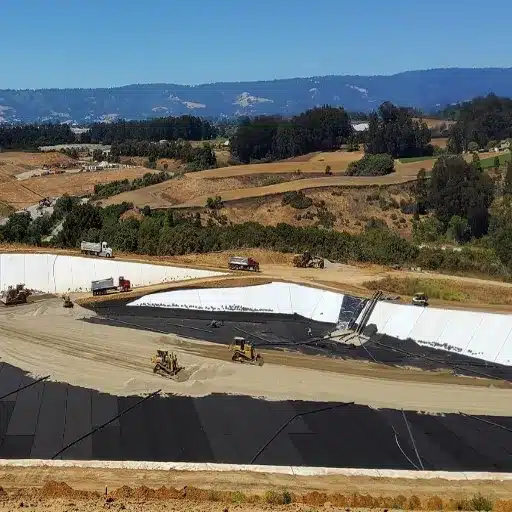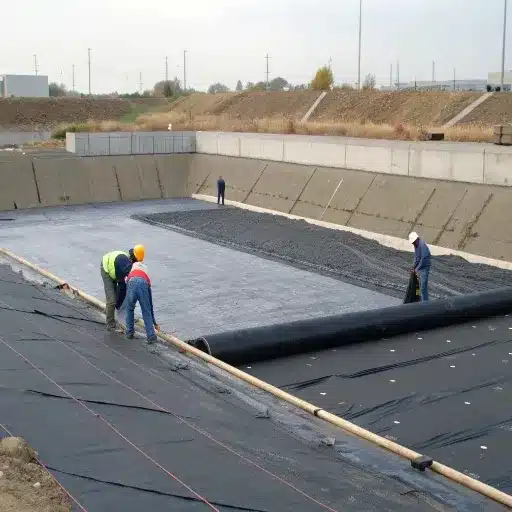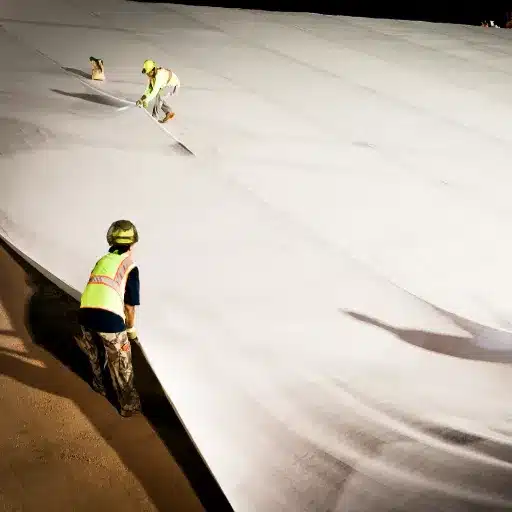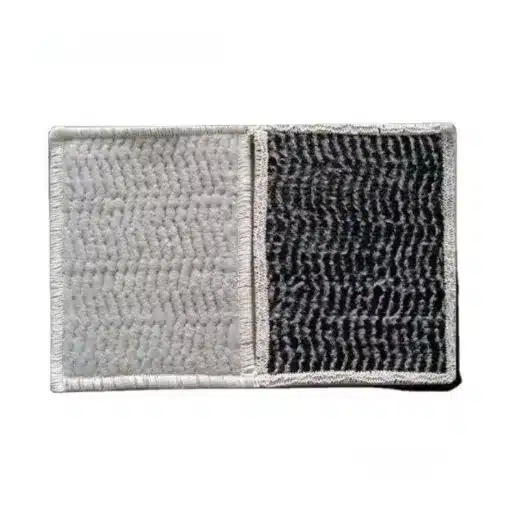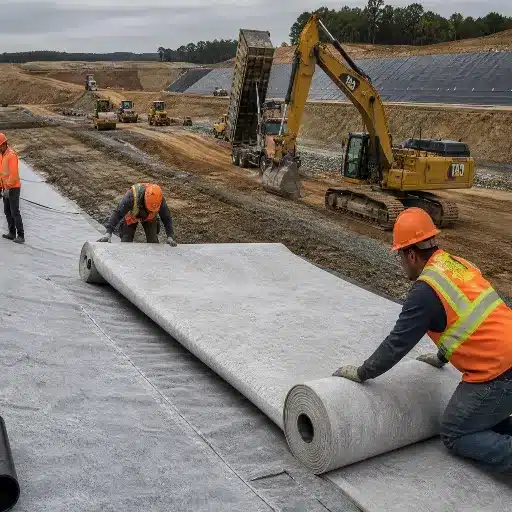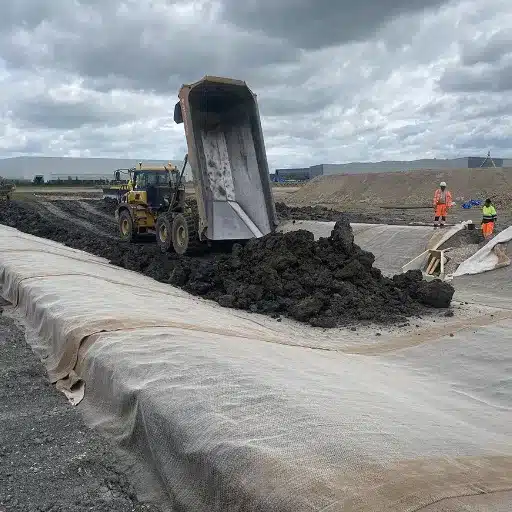
HDPE geomembrane functions as a high-density polyethylene liner, which establishes an unbreakable barrier for landfills and mining ponds, water reservoirs, and environmental containment systems. The material serves as the most common geomembrane selection used in civil and environmental engineering because it has a permeability coefficient below 1×10⁻¹³ cm/s and lasts 50 to 70 years when used in buried applications.
Will your containment system incur greater expenses because of a single pinhole defect in your liner?
The situation occurs at a rate that exceeds what engineering teams anticipate. The landfill base contains an entire thin panel. The mining tailings pond requires a sheet that exceeds its current specifications. A potable water reservoir contains a seam that has sustained damage. The failure of HDPE geomembrane results in material loss, but the impact reaches further. The environmental fines, project delays, and remediation costs, which can total millions, become part of the overall expense.
The process of choosing the correct geomembrane already exists as a fact that you understand. The process requires you to select HDPE specifications, which include thickness and quality standards that will meet your specific containment requirements. Incorrect selection results in leakage and regulatory violations, and the need to replace equipment. Correct selection results in an impermeable barrier that will maintain its effectiveness for multiple decades.
The guide explains the process that engineers should use to assess HDPE geomembrane materials. The document provides information about material properties, thickness selection, key usage areas, and quality control requirements. The document explains the necessary criteria for locating HDPE geomembrane materials, which will be used in worldwide infrastructure and environmental projects.
Key Takeaways
- The HDPE geomembrane achieves a permeability level that remains below 1 × 10⁻¹³ cm/s, which results in its ability to prevent water movement through its structure at 100 to 1000 times higher than compacted clay.
- The thickness selection for landfill construction ranges from 0.5 mm for aquaculture operations to 3.0 mm for hazardous waste disposal, which establishes a minimum thickness requirement of 1.5 mm.
- A high-quality HDPE geomembrane demonstrates a tensile strength that exceeds 27 MPa, together with chemical resistance that extends through the complete pH range from 0.5 to 14 and an ESCR that lasts over 500 hours.
- The correct implementation of hot wedge welding processes enables the achievement of approximately 95 percent base material strength, which requires certified welders to perform destructive peel testing.
- The total cost of ownership encompasses freight and installation supervision and CQA requirements, beyond the material cost, which is calculated per square meter.
- International buyers should make ISO9001 certification, virgin resin verification, 5-year sample retention, and export logistics capability their primary purchasing criteria.
What Is HDPE Geomembrane?
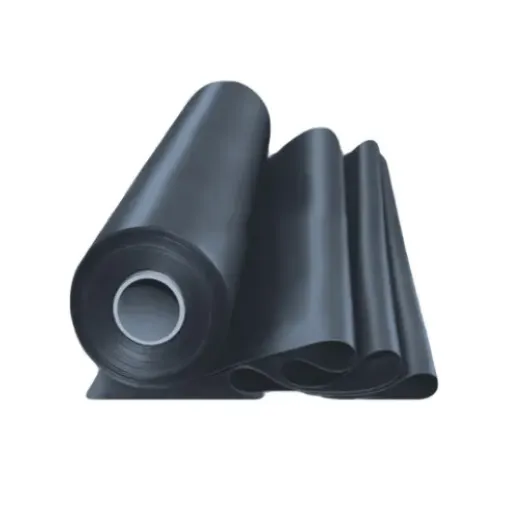
An HDPE (High-Density Polyethylene) geomembrane serves as a synthetic liner that protects civil and environmental engineering projects by stopping liquid, gas, and contaminant movement through its barrier. The product contains 97 to 99 percent virgin HDPE resin, which has a density range between 0.940 and 0.965 g/cm³ and includes 2 to 3 percent carbon black for UV protection along with antioxidants and thermal stabilizers.
The manufacturing process typically involves extrusion, where molten HDPE is formed into continuous sheets. The producers roll the sheets into widths which extend between 4 meters and 10 meters and create thicknesses which start at 0.2 mm and extend to 3.0 mm.
Three main types of HDPE geomembrane are used in the field:
- Smooth HDPE: The most common type, used in approximately 70% of applications where maximum impermeability and ease of welding are priorities.
- Textured HDPE: Features a roughened surface to increase the friction coefficient, making it essential for steep slopes where liner slippage is a risk. Learn more about textured vs smooth HDPE geomembrane.
- Conductive HDPE: Contains an embedded conductive layer that enables spark testing, allowing crews to detect pinholes and defects during installation. Explore conductive HDPE geomembrane for leak detection.
With a permeability coefficient of less than 1×10⁻¹³ cm/s, HDPE geomembrane is roughly 100 to 1,000 times more impermeable than compacted clay. This makes it the material of choice for applications where containment is non-negotiable.
Key Properties and Performance Standards
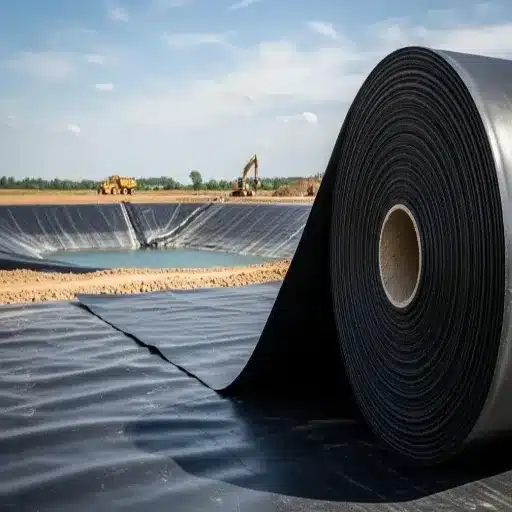
Not all HDPE geomembrane performs the same way. Mechanical strength, chemical resistance, and seam integrity determine whether a liner will survive decades of service or fail within years.
Mechanical Properties
Tensile strength is the fundamental indicator of how much stress a geomembrane can withstand before yielding. Quality HDPE geomembrane achieves a tensile strength of ≥27 MPa (or 15–35 MPa in typical product ranges), with force resistance scaling from roughly 25 kN/m for thin sheets to over 100 kN/m for thick liners.
Elongation at break measures flexibility under stress. Smooth HDPE typically reaches ≥700% elongation before rupture, while textured HDPE achieves ≥250% due to surface treatment.
Puncture resistance increases with thickness. A 1.0 mm panel typically resists ≥320 N of puncture force, while a 1.5 mm panel resists ≥500 N. Tear resistance ranges from 25 N to 374 N, depending on sheet thickness and resin grade.
Chemical and Environmental Resistance
The chemical structure of HDPE geomembrane remains stable through all pH levels from 0.5 to 14. The material protects itself against acids, alkalis, and hydrocarbons, which makes it suitable for handling intense leachate and mining process solutions. The testing under ASTM D5322 standards proves his ability to withstand various conditions.
The carbon black content provides UV protection to the material. The correct mixture of HDPE geomembrane maintains approximately 90% of its initial tensile strength after 1,600 hours of UV testing through accelerated methods. The exposed liners will last between 5 and 20 years while the buried installations will last between 50 and 70 years.
Oxidative Induction Time (OIT) serves as the standard method for assessing thermal stability. Quality HDPE geomembrane achieves an OIT of ≥100 minutes at 200°C under ASTM D5885 which demonstrates its capacity to withstand thermal oxidation.
Environmental Stress Crack Resistance (ESCR) is critical for long-term performance under constant load. HDPE geomembrane should achieve ≥500 hours in ESCR testing under ASTM D5397.
Seaming and Longevity
Field seams are the most vulnerable part of any geomembrane installation. Properly executed hot wedge welds achieve approximately 95% of the base material’s tensile strength, verified under ASTM D6392. For a complete breakdown of test methods and certification requirements, see our guide to HDPE geomembrane testing standards.
When an environmental contractor in Chile installed a 1.5 mm smooth HDPE geomembrane liner for a leachate pond in 2019, they required certified welders and 100% destructive peel testing at seam intersections. Five years later, the pond has recorded zero leaks. The upfront investment in welding quality and third-party testing eliminated the risk of costly remediation.
How to Select HDPE Geomembrane Thickness
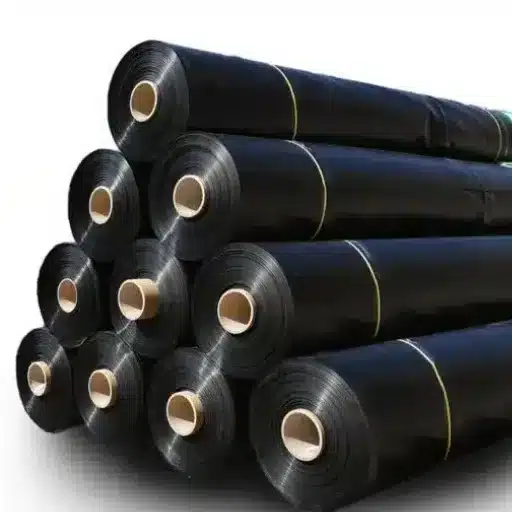
Thickness is not arbitrary. It directly affects puncture resistance, tensile strength, chemical diffusion resistance, and cost. Choosing the right thickness requires balancing project demands, subgrade conditions, regulatory requirements, and budget.
Factors That Determine Thickness
Subgrade conditions: Sub-base conditions: rocky or gravelly soil with sharp projections need thicker liners or a cushion layer of protective geotextile, whereas relatively softer, well-prepared clay of subgrade allows for thinner specifications.
Load conditions applied at subgrade: Applying loads such as large reservoirs, heavy waste loads, and traffic over a liner generates a higher mechanical stress. Thicker panels will distribute and deflect these loads effectively.
Chemical exposure: When aggressive conditions, such as those in mining heap leach pads or hazardous waste landfills, linings should be thicker based on the reason that additional material provides a longer diffusion path for chemicals, increasing chemical exposure to the liner.
UV exposure and serviceable life: Exposed liners not covered by soil or water are also extra thick to counter the effects of weathering over time and contain a higher content of carbon black.
Regulatory minimums: Localities may specify minimum thicknesses. The U. S.-EPA stipulates a minimum depth of 60 mil (1.5 mm) in HDPE geomembrane installation in municipal solid waste landfills.
Thickness by Application
| Application | Recommended Thickness | Key Considerations |
|---|---|---|
| Aquaculture/fish and shrimp ponds | 0.5 – 0.75 mm | Cost-effective, low mechanical stress, easy to handle |
| Agricultural irrigation/canals | 0.75 – 1.0 mm | Balance of durability and flexibility for moderate conditions |
| Water storage/wastewater ponds | 1.0 – 1.5 mm | Standard range for general containment |
| Municipal solid waste landfills | ≥ 1.5 mm | Regulatory minimum; high puncture resistance needed |
| Mining heap leach/tailings | 1.5 – 2.0 mm | Heavy loads and aggressive chemicals require robust protection |
| Exposed covers/landfill caps | 2.0 – 2.5 mm | Maximum UV resistance and weathering protection |
| Hazardous waste / critical chemical containment | 2.0 – 3.0 mm | Extreme-duty; highest safety margin |
Thin vs. Thick Trade-offs
Thin liners are cheaper, are easy to mobilize, and fit into larger, geometric structures that have been handled properly. However, its weakness manifests in the lower resistance to perforation and tensile property. Thicker liners provide excellent mechanical and chemical security; however, it is bulky, moderately rigid, and expensive to lay.
On no account can the liner be said to be made of 100 % virgin HDPE resin, no matter the thickness. A thick liner, even though spun from recycled or compounded resins, may have mechanical properties that will be inferior to a thin, virgin one. For more context, plausibly useful to the thickness selection framework with ground condition variables and regulatory tables, refer to the HDPE geomembrane thickness selection guide.
Still unsure which thickness fits your project? Contact our engineering support for a customized thickness recommendation based on your subgrade, load, and exposure conditions.
Major Applications of HDPE Geomembrane
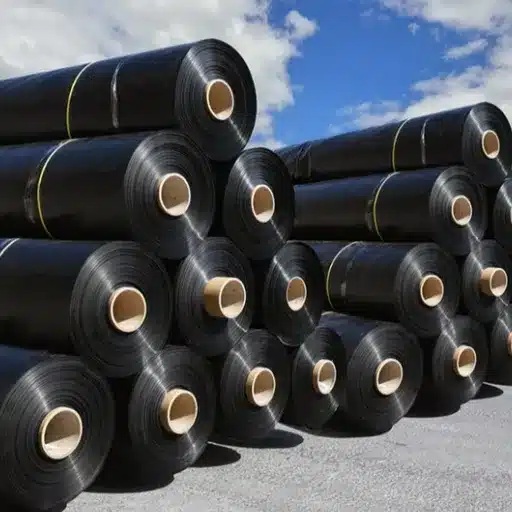
HDPE geomembrane is used across industries where containment, waterproofing, and environmental protection are essential. Here are the primary sectors and their typical use cases.
Environmental Engineering and Landfills
Landfill containment is the largest revenue-generating application for HDPE geomembrane. It is used for:
- Base liners: Preventing leachate from contaminating soil and groundwater
- Landfill caps: Controlling gas migration and limiting rainwater infiltration
- Leachate collection ponds: Storing contaminated liquids for treatment
The U.S. EPA’s 60 mil minimum reflects the critical nature of these applications. Failure here can trigger environmental violations and remediation costs far exceeding the liner investment. For a deep dive into regulatory compliance, base liner design, and leachate control, read our guide to HDPE geomembrane for landfill liner systems.
Mining
Mining represents one of the largest volume applications for HDPE geomembrane. Key uses include:
- Heap leach pads: Containing chemical solutions used to extract metals from ore
- Tailings dams: Storing fine waste materials and process water
- Evaporation ponds: Managing brine and process solutions
The chemical resistance of HDPE makes it the standard for these aggressive environments, where liners must withstand acids, salts, and heavy metals over long periods. For heap leach chemistry, tailings dam design, and mining-specific CQA requirements, see our article on HDPE geomembrane for mining applications.
Water Management
HDPE geomembrane plays a central role in water conservation and management projects:
- Reservoirs and potable water storage: Preventing seepage loss and protecting water quality
- Canals and irrigation systems: Reducing water loss in agricultural distribution networks
- Floating covers: Controlling evaporation, odor, and contamination in storage ponds
It gained popularity in large-scale municipal and industrial projects because of its low permeating capacity, its long-lasting longevity, and costing less than other possible materials. For requirements of specific species, air diffusers, and aquaculture standards, see our guide HDPE geomembrane for ponds and water containment.
Agriculture and Aquaculture
In agricultural and aquaculture settings, HDPE geomembrane provides:
- Manure lagoons: Containing animal waste for treatment and nutrient management
- Silage covers: Preserving feed quality and preventing spoilage
- Fish and shrimp ponds: Creating controlled aquatic environments with reduced water exchange
A Vietnamese prawn farmer has moved on from using concrete to a geomembrane lining of 0.75mm HDPE and saw a 60% reduction in construction time. Water retention was significantly improved. The catch has been the difficulty in keeping up with farming, which would have been impossible, as capacity had already gone up twice as fast as it could have been using the traditional techniques.
Civil Engineering and Petrochemical
HDPE geomembrane is also deployed in:
- Tunnel waterproofing: Protecting underground structures from groundwater infiltration
- Tank secondary containment: Providing spill protection around fuel and chemical storage tanks
- Green roofs and building foundations: Managing moisture and drainage in structural systems
HDPE vs. Alternative Geomembrane Materials
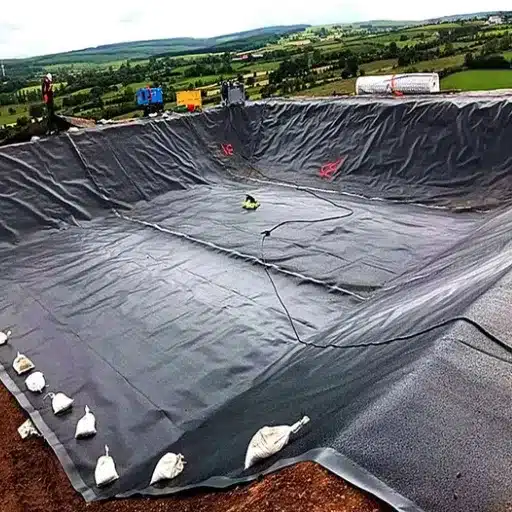
HDPE is the dominant geomembrane material, but it is not always the right choice. Understanding how it compares to LLDPE, PVC, and EPDM helps you select the optimal liner for your project.
LLDPE Geomembrane
Linear Low-Density Polyethylene (LLDPE) offers significantly higher flexibility than HDPE, with elongation at break often exceeding 800%. This makes it ideal for:
- Projects with dynamic settlement or ground movement
- Steep slopes where conformability reduces stress concentrations
- Tailings ponds and applications requiring more deformation tolerance
LLDPE has good chemical resistance but generally costs 30–40% more than HDPE for equivalent thickness. For projects where flexibility is more important than maximum chemical resistance, LLDPE is often the better choice. For a dedicated engineering procurement comparison, see our HDPE vs LLDPE geomembrane guide.
PVC Geomembrane
Polyvinyl Chloride (PVC) geomembrane is highly flexible and easy to install in complex three-dimensional shapes. It is commonly used for:
- Short-term containment projects
- Decorative ponds with irregular geometry
- Applications where ease of seaming and high conformability are priorities
However, PVC has poorer UV resistance and chemical resistance compared to HDPE. It is generally not suitable for long-term exposed applications or aggressive chemical environments.
EPDM Geomembrane
EPDM geomembrane basically consists of rubber, highly reversible, having very high flexibility and better properties for withstanding the very impact at the same time. It is used for the following:
- Ornamental water features and landscaping ponds
- Exposed roofing and waterproofing buildings
- Applications where aesthetics are very critical and extreme flexibility is needed
It is one of the most expensive types, but it lacks the same chemical resistance and impermeability that come with HDPE for industrial containment.
Material Comparison Summary
| Property | HDPE | LLDPE | PVC | EPDM |
|---|---|---|---|---|
| Chemical resistance | Excellent | Good | Moderate | Good |
| Flexibility/elongation | Moderate (≥700%) | High (≥800%) | Very High | Very High |
| UV resistance | Excellent | Good | Moderate | Good |
| Typical cost | Low-Medium | Medium | Medium | High |
| Best applications | Landfills, mining, and water containment | Tailings, slopes, dynamic settlement | Short-term, decorative ponds | Decorative, exposed roofing |
Installation, Welding, and Quality Assurance
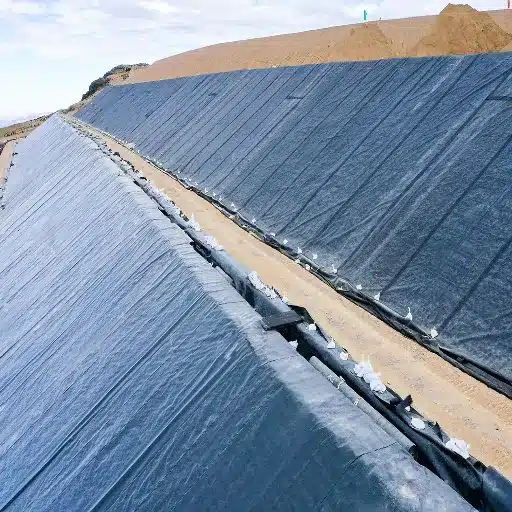
Even the highest-quality HDPE geomembranes will prove weak in case installation gets hurried or welding proves mediocre. One has to prepare the suboptimal parts, seam welding, and quality controls essentially within.
Subgrade Preparation
Before liner deployment, the record should be kept in a clean setting. Without these, the sharp rocks or debris, tree roots, or even protrusions will destroy the liner. Moreover, a smooth and well – compacted environment will accompany the surrounding area. If the area is very rocky or uneven, a protective layer of nonwoven geotextile shall be laid beneath the geomembrane to prevent puncture.
Welding Methods
Two types of the main welding methods are required for welding HDPE geomembrane:
- Hot wedge welding: This is the conventional method for long field seams; in this method, a heated wedge melts the overlapping edges of the two panels, which are then pressed together to get their fusion bond.
- Extrusion welding: This is mostly applied to tasks of patches, details, and repairs as well as hot-wedge’s accessibility limitations. A welding rod made of HDPE gets extruded into the groove prepared between panels.
Both methods involve well-trained, certified welders for a target seam strength level of about 95%. Please follow the HDPE geomembrane installation and welding guide for the detailed step-by-step procedures, equipment specifications, and welding troubleshooting.
Testing and Construction Quality Assurance
Quality control must comprise:
- Non-destructive Testing: Use air lance and vacuum box testing for identifying leakage across field seams
- Destructive Peel Testing: Testing of samples removed from production seams in laboratories for peel bond strength and shear strength.
- Third-Party Test Reports: Checking of resin grade and tensile strength, puncture resistance, and OIT independently before and during installation
The CQA and CQC programs in construction quality assurance and control certify activities at every stage of installation, encompassing tasks such as subgrade inspection and the completion of seam tests.
What to Demand from an International Supplier
There are four criteria that you can use as benchmarks for sourcing HDPE geomembrane for a project abroad, apart from price:
- Quality management systems: ISO9001 certification proves it is a manageable law for controlling consistency in material and dimensional measurement.
- Product testing and sample retention: Reputable suppliers keep production types together with the records of testing data available to provide traceability. The Industry standard for sample keeping is having retention last up to 5 years.
- Export logistics capabilities: Efficient container loading, export documentation, and timely delivery tracking are reducing the total landed costs.
- Technical consultation: Information on thickness selection, welding standards, and setting for the installation will be provided in the project-specific workshop.
We produce HDPE geomembranes with regard to ISO9001-certified systems at Shanxi Shengxing, with the highest quality. We keep samples of the five years to achieve consistency across batches. Having acknowledgment and recommendations for a particular requirement concerning infrastructure and managing the environmental project locally or globally.
Total Cost of Ownership and Sourcing Considerations
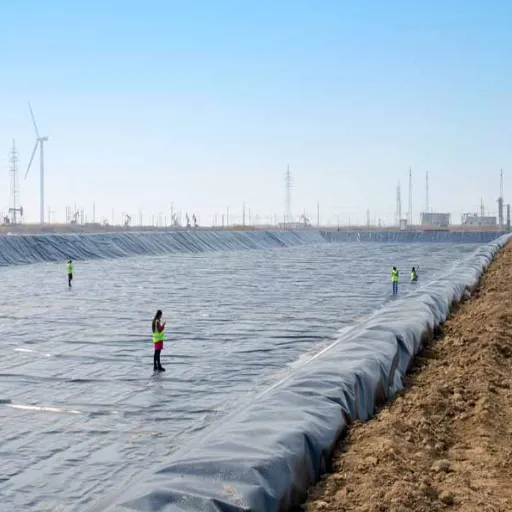
The price per square meter of HDPE geomembrane is only one component of total project cost. Smart buyers evaluate the full lifecycle economics. For a detailed pricing breakdown by thickness and volume, plus freight efficiency and TCO analysis, see our guide to HDPE geomembrane price and cost factors.
Material Cost vs. Lifecycle Value
HDPE geomembranes cost way less for every square meter than LLDPE and much less than EPDM. Sometimes the lowest bid is not the best value. Those who use recycled resin, do not perform quality tests, or maintain inconsistent thickness, may potentially be suppliers for undercut liners. It costs more in almost any case for a liner failure than the savings from a cheap initial purchase, including remediation, project delays, and regulatory fines.
Hidden Costs to Calculate
- Freight and logistics: Roll dimensions, weight, and container efficiency affect shipping cost
- Installation labor and equipment: Thicker, heavier rolls require more crew and machinery
- Welding supervision and CQA/CQC: Independent quality assurance adds upfront cost but reduces failure risk
- Site restoration and remediation: The cost of fixing a leak far exceeds the cost of preventing it
An Australian mining contractor initially selected a budget HDPE geomembrane supplier for a 40,000 m² tailings pond to reduce capital expense. Within 18 months, pinhole leaks were detected along poorly welded seams. The remediation required draining the pond, cutting out failed seams, and rewelding under full CQA supervision. The total repair cost was three times the original liner purchase price. The contractor subsequently standardized on thicker HDPE geomembrane with mandatory third-party testing and certified welders.
Conclusion
An HDPE geomembrane is not a commercial property. It is just an engineered material with certain parameters that dictate your containment projects’ safety, compliance, and economics.
Now the key below is the following:
- Understand the material: Manufactured from virgin HDPE resin with carbon black and with low levels of UV resistance, HDPE geomembrane may have a permeability of less than 1×10⁻¹³ cm/s.
- Match thickness with application: If it is for aquaculture, then the thickness may range between 0.2 and 0.5, but 1 or more is necessary for disposal in landfills and mining.
- Check mechanical and chemical properties: Tensile strength ≥27 MPa, chemical resistance across pH 0.5-14, and ESCR ≥500 hours.
- Insist on proper welding and testing: Certified welders, hot wedge and extrusion welding, and destructive peel testing are essential to procuring good seams.
- Evaluate total cost of ownership: It is not necessarily the purchasing price that counts the most, but long-term reliability and installation of quality. Some of this choice could depend on supplier support.
- Source with global logistics in mind: ISO9001 certification, sample retention, export packaging, and technical consultation separate reliable suppliers from product-only vendors
The correct HDPE geomembrane can give protection to not just the project but also your reputation and site for over 30 years.
Ready to select HDPE geomembrane for your next containment project? Request a technical quote and get customized recommendations on thickness, texture, and specifications based on your project requirements.
Frequently Asked Questions
What is HDPE geomembrane?
HDPE geomembrane is a synthetic liner manufactured out of HDPE resin with a polyethylene thickness. Its use in civil and environmental engineering helps to prevent fluid, gas, and impurity transfer. One of the tightest sealing materials with an extinction coefficient less than 1×10⁻¹³ cm/s.
What thickness HDPE geomembrane should I use?
Thickness depends on the application. Aquaculture ponds typically use 0.5–0.75 mm. Irrigation canals and wastewater ponds use 0.75–1.5 mm. Municipal solid waste landfills require at least 1.5 mm. Mining heap leach pads and hazardous waste containment typically use 1.5–3.0 mm.
How long does HDPE geomembrane last?
Buried geomembranes are expected to last 50 to 70 years, while most liners that are exposed to UV and prone to weathering tend to have a shorter lifespan, lasting only between 5 and 20 years. It depends on the type of carbon black content, thickness, and maintenance.
What is the difference between HDPE and LLDPE geomembrane?
HDPE has a higher resistance against chemicals and is less permeable than LLDPE. It costs less and, therefore, is best used for landfills or in the mining industry. LLDPE, on the other hand, can be stretched around stringent designs, and its performance is better on dynamic or steep slopes, but at a higher cost that ranges between 30 and 40 percent higher than HDPE.
Can HDPE geomembrane be shipped internationally?
Yes. HDPE geomembrane is available in rolled sheets, which can effectively be loaded into a container and exported. Respective suppliers are required to at least have some documents for their export experience, ISO9001 certification, and immediate logistics support.
What is conductive HDPE geomembrane used for?
The conductive HDPE geomembrane has an impregnated layer of the conductive matrix, which enables spark testing. This facility makes it easier for crews to inspect the whole sheet while in service during construction activities to check for pinholes and seam defects. It is ideal for critical containment where leak detection is mandatory.