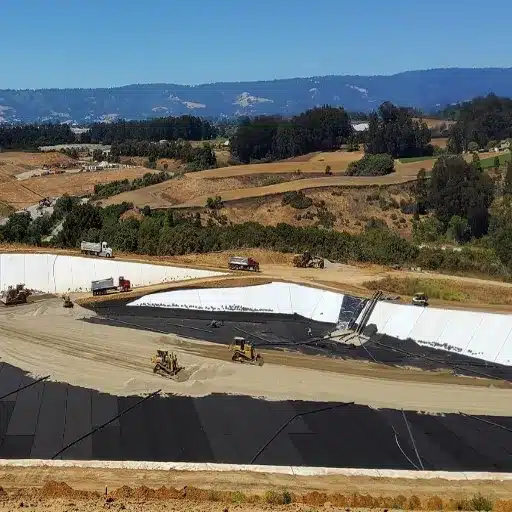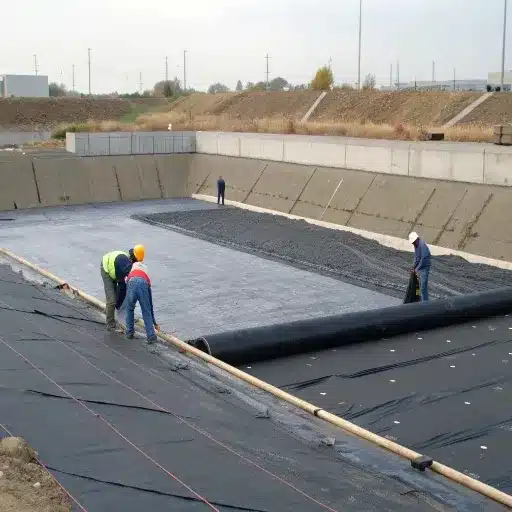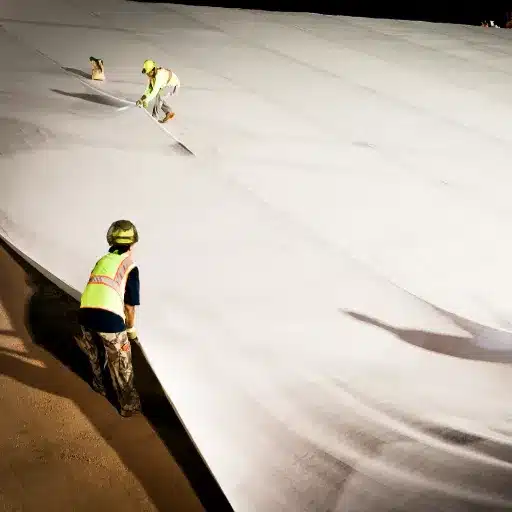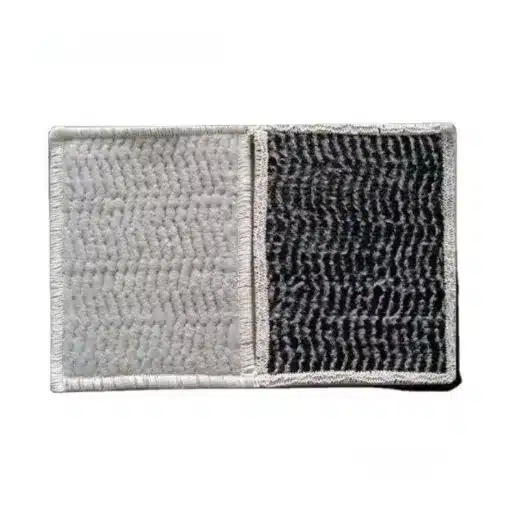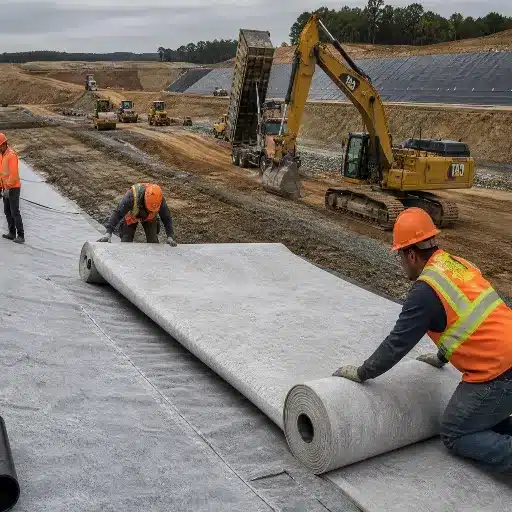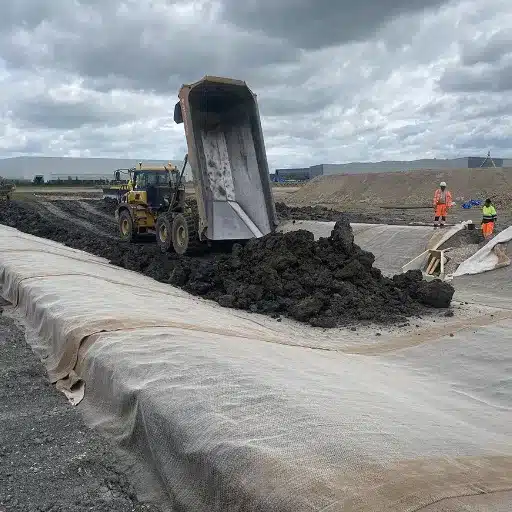
A geomembrane for mining is an engineered impermeable liner that protects soil and groundwater from hazardous leachates, tailings, and process chemicals. Mining operations rely on geomembranes for heap leach pads, tailings dams, process ponds, evaporation ponds, and acid mine drainage containment.
Mining containment failures are expensive. A single tailings dam breach can release millions of cubic meters of contaminated slurry, trigger regulatory shutdowns, and saddle operators with cleanup costs that stretch into the hundreds of millions. The right geomembrane liner is the first line of defense between a productive mine and an environmental liability. Yet many procurement teams and site engineers still struggle to match the correct material, thickness, and installation protocol to each containment challenge.
This guide explains how geomembranes are used in mining, compares the main liner materials, and shows how to specify a system that performs for the full mine life cycle.
Key Takeaways
- HDPE and LLDPE are the dominant geomembrane materials for heap leach pads and tailings dams, with HDPE preferred for aggressive chemistry and LLDPE for uneven or settling subgrades.
- Typical mining liner thickness ranges from 1.5 mm to 2.5 mm, depending on application consequence and loading conditions.
- Composite liner systems that combine geomembrane with geosynthetic clay liner (GCL) and leak-detection layers reduce seepage risk far below single-liner designs.
- Textured geomembranes improve slope stability, while conductive liners enable electrical leak-location surveys for high-consequence containment.
- Supplier selection should focus on certified manufacturing, chemical compatibility documentation, export logistics experience, and long-term sample retention.
What Is a Geomembrane and Why Does Mining Need It?
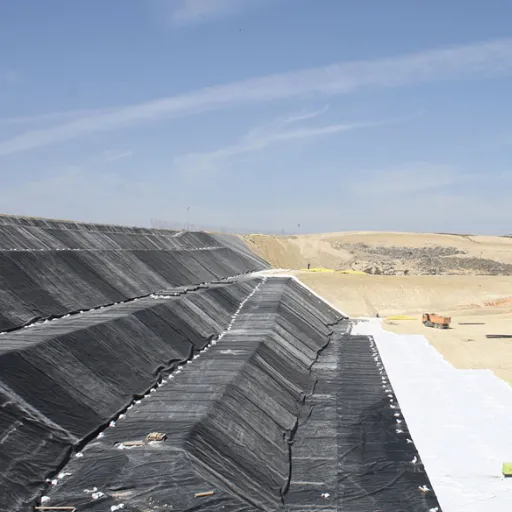
A geomembrane is a synthetic, impermeable barrier manufactured from polymers such as HDPE, LLDPE, PVC, or reinforced polypropylene. Its primary job is to stop liquids and dissolved contaminants from moving through soil, protecting groundwater and surrounding ecosystems.
In mining, that barrier function is critical. Ore processing uses aggressive chemicals- cyanide for gold leaching, sulfuric acid for copper heap leaching, ferric sulfate for bio-oxidation- and produces tailings that can remain chemically active for decades. Without reliable containment, these materials can seep into aquifers, damage farmland, and draw heavy regulatory penalties.
Geomembranes also support operational efficiency. In heap leach mining, liners collect pregnant leach solution (PLS) so valuable metals can be recovered instead of lost. In tailings storage facilities (TSFs), liners limit seepage and help manage the phreatic surface. In process ponds and evaporation ponds, liners prevent solution loss and protect soil quality.
The global geomembrane market was valued at roughly USD 2.5–2.8 billion in 2025 and is projected to grow at 5.1–5.8% CAGR through the early 2030s. Mining accounts for about one-third of that revenue, with heap leach and tailings applications driving much of the demand. (Mordor Intelligence)
Key Mining Applications for Geomembranes
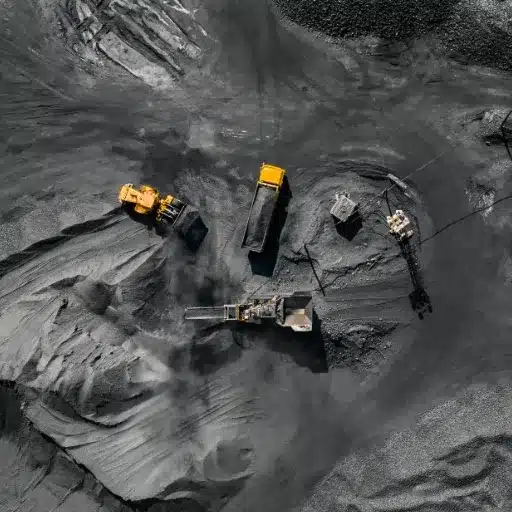
Heap Leach Pads
Heap leaching stacks crushed ore on a prepared pad and irrigates it with chemicals that dissolve target metals. A geomembrane for heap leach pads forms the bottom and side-slope barrier that:
- Contains cyanide, sulfuric acid, or alkaline leach solutions
- Collects pregnant leach solution for metal recovery
- Prevents contaminated solution from reaching soil and groundwater
Primary liners are typically 1.5–2.0 mm HDPE or LLDPE, often textured on slopes to improve interface friction. Interlift liners between ore lifts may be thinner, depending on consequence level.
Tailings Storage Facilities and Tailings Dams
Tailings are the fine-grained waste left after ore processing, often containing heavy metals, process reagents, and elevated salinity. Tailings dam liners must resist chemical attack, mechanical loading, and long-term settlement.
A tailings storage facility base liner commonly uses 2.0–2.5 mm HDPE over a GCL, sometimes as part of a double-liner system with leak detection between the primary and secondary geomembranes. This design directly responds to the Global Industry Standard on Tailings Management (GISTM), which pushes operators toward higher-consequence containment.
Historical data underscores the risk: a review of 366 tailings-dam accidents recorded over 279 million m³ of released tailings, 3,043 fatalities, and impacts across 4,868 km of affected areas.
Process Water and Solution Ponds
Pregnant, barren, and raffinate ponds hold process solutions between extraction stages. These ponds often contain the highest chemical concentrations on site, so double-liner systems with leak detection are common.
A 1.5–2.0 mm HDPE or LLDPE liner is typical, with conductive geomembrane specified when post-installation electrical leak-location (ELL) surveys are required.
Evaporation Ponds
Lithium brine and salt operations use evaporation ponds to concentrate dissolved minerals by solar evaporation. These ponds expose liners to intense UV, thermal cycling, and high salinity for years.
HDPE with enhanced UV stabilization or reinforced polypropylene (RPP) are common choices, typically 1.0–1.5 mm thick.
Acid Mine Drainage and Waste Rock Containment
Sulfide waste rock can generate acid rock drainage (ARD) or acid mine drainage (AMD) when exposed to oxygen and water. Geomembranes cap waste rock dumps, line treatment ponds, and contain settlement facilities to prevent long-term contamination.
Geomembrane Materials for Mining: Selection Guide
HDPE Geomembrane
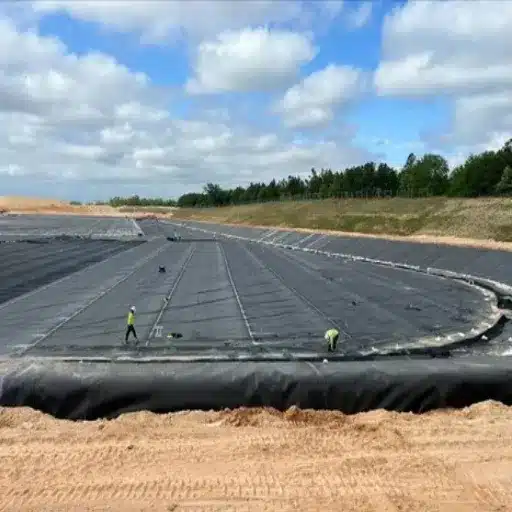
High-density polyethylene (HDPE) is the most widely specified mining liner. It offers excellent chemical resistance, UV stability, and long service life. HDPE permeability is typically ≤1×10⁻¹³ cm/s, making it effectively impermeable for mining solutions.
HDPE performs well in heap leach pads, tailings dams, and process ponds where aggressive chemistry dominates. Its main limitation is stiffness: it requires a well-prepared subgrade and does not conform as easily to uneven terrain as LLDPE.
You can learn more about HDPE specifications in our geomembrane thickness guide.
LLDPE Geomembrane
Linear low-density polyethylene (LLDPE) is more flexible and offers higher elongation than HDPE. It is often chosen for:
- Uneven subgrades with differential settlement
- Deep heap leach stacks where long-term strain is expected
- Cold climates where thermal flexibility matters
LLDPE has slightly lower chemical resistance than HDPE, so material selection should always include a chemical compatibility check for the specific leachate.
For a detailed comparison, see our guide on HDPE vs LLDPE geomembrane.
PVC Geomembrane
Polyvinyl chloride (PVC) geomembranes are flexible and easy to seam, making them suitable for process water ponds, canals, and mine closure caps. However, PVC is generally rated for pH 2–12 environments and is less resistant to hydrocarbons and some mining solvents than polyethylene.
PVC can work in less aggressive mining water containment, but HDPE or LLDPE are usually preferred for primary heap leach and tailings containment.
Reinforced Polypropylene (RPP)
RPP combines UV resistance with scrim reinforcement, making it a viable option for exposed evaporation ponds and some flexible containment applications. It is more specialized than HDPE or LLDPE and is typically selected for specific climatic or geometric conditions.
Material Selection Decision Framework
| Application | Recommended Material | Typical Thickness | Notes |
|---|---|---|---|
| Heap leach pad primary liner | HDPE or LLDPE | 1.5–2.0 mm | Textured for slopes |
| Tailings dam base liner | HDPE | 2.0–2.5 mm | Often double-liner with GCL |
| Process water pond | HDPE / LLDPE | 1.5–2.0 mm | Double-liner for cyanide/acid |
| Evaporation pond | HDPE / RPP | 1.0–1.5 mm | UV-stabilized |
| AMD containment | HDPE | 1.5–2.0 mm | Long-term closure focus |
| Mine closure cap | PVC / HDPE | 1.0–1.5 mm | Flexibility vs durability |
Engineering insight from the field: When Sarah, a geotechnical engineer on a Central Asian copper project, reviewed her heap leach pad design, she initially specified smooth HDPE across the entire pad to save cost. Her slope stability analysis showed insufficient interface friction on the 3H:1V side slopes. Switching to textured HDPE on slopes and smooth HDPE on the pad floor solved the stability issue without overspending on unnecessary texture in flat areas.
Composite Liner Systems and GCL in Mining
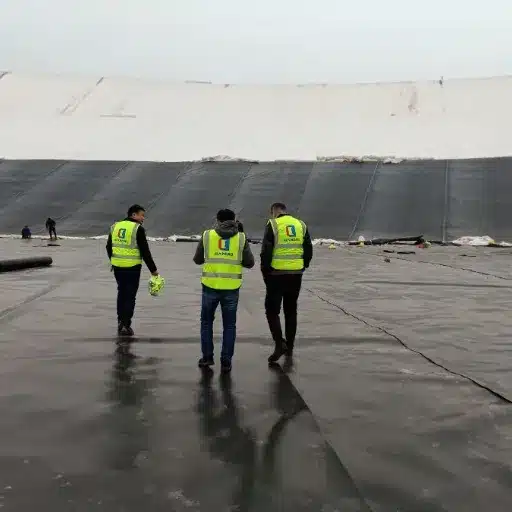
A geomembrane rarely works alone in critical mining containment. A composite liner system typically stacks materials from bottom to top:
- Prepared and compacted subgrade
- Geosynthetic clay liner (GCL) or compacted clay liner
- Primary geomembrane
- Protective geotextile
- Drainage layer or leak-detection geonet
- Secondary geomembrane (in double-liner systems)
- Overliner protection and ore or tailings
GCLs are factory-manufactured sodium bentonite composites that swell when hydrated to form a very low-permeability barrier. They can outperform a 500 mm compacted clay liner in equivalent hydraulic terms and install faster than importing and compacting large volumes of clay.
The self-healing property of bentonite is valuable: if the primary geomembrane is punctured, the GCL beneath can swell and partially seal the defect. However, standard sodium-bentonite GCLs can be vulnerable to aggressive acidic leachates unless chemically resistant formulations are used.
Double-liner systems with a leak-detection layer between primary and secondary geomembranes are increasingly specified for high-consequence tailings and pregnant solution containment. The same layered philosophy used for a geomembrane for landfill liner applies here: a primary geomembrane, low-permeability soil or GCL, and often a secondary liner work together to limit seepage to negligible levels.
Critical Specifications for Mining Geomembranes
Thickness Guidelines by Application
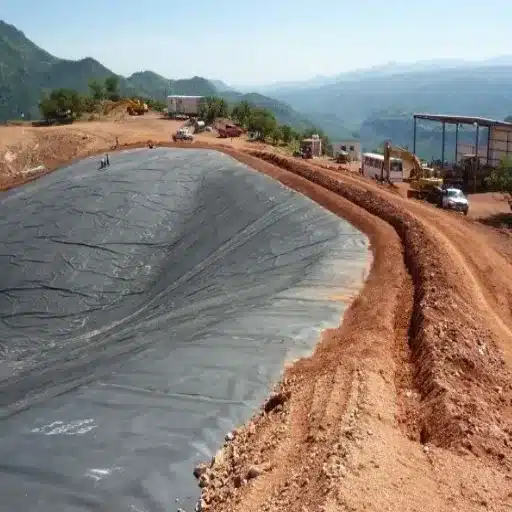
Geomembrane thickness directly affects puncture resistance, weld quality, and chemical barrier capacity. Common mining specifications include:
- Heap leach pads: 1.5–2.0 mm
- Tailings dams: 2.0–2.5 mm
- Process ponds: 1.5–2.0 mm
- Evaporation ponds: 1.0–1.5 mm
Thicker liners are not automatically better; they must be matched to subgrade quality, loading, and consequence level.
Surface Texture
The choice between smooth, textured, and conductive geomembranes affects both performance and cost:
- Smooth geomembrane: Best for flat floors and temporary containment where friction is less critical.
- Textured geomembrane: Used on slopes to increase interface friction and prevent liner sliding under heap loads. For more detail, read our comparison of textured vs smooth geomembrane.
- Conductive geomembrane: Enables electrical leak-location surveys to detect breaches after installation. Specified for high-consequence containment such as pregnant solution ponds and some tailings facilities.
Standards and Certifications
Mining-grade HDPE geomembranes should meet GRI-GM13 requirements, which define minimum properties for density, tensile strength, elongation, puncture resistance, oxidative induction time (OIT), and environmental stress crack resistance (ESCR). Tensile testing is commonly performed per ASTM D6693.
Manufacturing quality systems such as ISO9001 provide traceability, while batch testing and sample retention support long-term accountability.
Installation and Quality Assurance Essentials
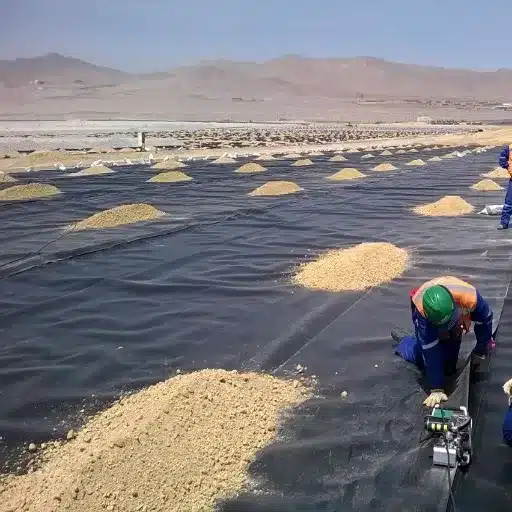
Even the best geomembrane will fail if it is installed poorly. Geomembrane installation for mining projects follows a strict sequence:
Subgrade Preparation
The subgrade must be stripped of organic material, rocks larger than 25 mm, and sharp debris. Compaction to at least 95% modified Proctor is typical. A nonwoven geotextile cushion, often 400 g/m² or heavier, protects the liner from puncture.
Panel Deployment
Large rolls, commonly 5.8 m or 7.0 m wide, reduce the number of field seams and improve container loading efficiency for remote mine sites. Panels are laid out with allowance for thermal expansion, which is especially important in desert or high-altitude climates.
Welding and Seaming
Geomembrane welding uses dual-track hot wedge welding for primary seams and extrusion welding for details, repairs, and pipe penetrations. Trial seams at the start of each shift verify that temperature, speed, and pressure settings are correct.
Testing and CQA
Quality assurance includes:
- Air pressure testing of dual-track welds
- Vacuum box testing of extrusion welds
- Destructive peel and shear tests at specified frequencies
- Electrical leak-location surveys for conductive liners
- Independent construction quality assurance (CQA)
Independent CQA is particularly important for mining projects, where liner failures can have environmental and financial consequences far exceeding the original material cost.
Selecting a Geomembrane Supplier for Mining Projects
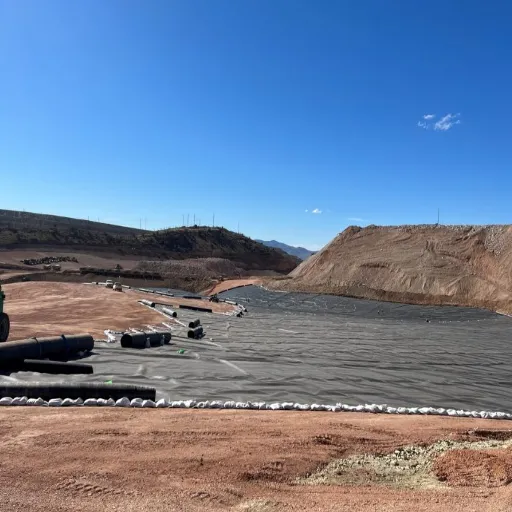
Supplier selection matters as much as material selection. A mining geomembrane supplier should provide:
- Certified manufacturing under ISO9001 with batch traceability
- Material range including HDPE, LLDPE, PVC, textured, and conductive options
- Customizable thickness and roll dimensions for large pad efficiency
- Chemical compatibility documentation for site-specific reagents
- Export packaging and container-loading expertise for remote mine sites
- Technical consultation on welding, anchor design, and CQA planning
- Long-term sample retention for accountability
Real-world sourcing challenge: Marcus, a procurement manager for a gold project in West Africa, received three quotes for tailings dam liner. The lowest bid used a generic HDPE with limited test documentation. The selected supplier provided GRI-GM13 batch certificates, chemical compatibility letters for cyanide-bearing solution, and a 5-year sample retention policy. The slightly higher material cost was offset by reduced CQA risk and faster customs clearance because the documentation package was complete.
For mining-specific HDPE options, explore our HDPE geomembrane product page.
Conclusion
Specifying a geomembrane for mining means matching material, thickness, texture, and liner system design to each containment challenge. HDPE dominates aggressive chemical applications such as heap leach pads and tailings dams. LLDPE suits uneven or settling subgrades. PVC and RPP fill specialized roles in process water and evaporation ponds. Composite systems with GCL and leak detection add layers of protection for high-consequence containment.
The key takeaways are clear:
- Match the material to the application chemistry and settlement risk.
- Use 1.5–2.5 mm HDPE or LLDPE for primary heap leach and tailings containment.
- Specify textured geomembranes on slopes and composite liners for critical containment.
- Verify chemical compatibility for site-specific reagents and temperatures.
- Partner with a certified supplier that offers global logistics, technical support, and traceability.
Proper geomembrane selection protects groundwater, supports regulatory compliance, and protects the long-term economics of the mine.
Ready to specify the right liner for your mining project? Contact our engineering support for a technical consultation or request a customized quote tailored to your heap leach, tailings, or process containment requirements.
Frequently Asked Questions
What is geomembrane used for in mining?
A geomembrane in mining is an impermeable synthetic liner used to contain leach solutions, tailings, process water, and waste rock drainage. It prevents contaminants from reaching soil and groundwater and supports solution recovery in heap leach operations.
What thickness geomembrane is needed for a tailings dam?
Tailings dam base liners typically use 2.0–2.5 mm HDPE, often as part of a composite or double-liner system with a GCL and leak-detection layer.
Which is better for heap leach pads: HDPE or LLDPE?
HDPE is better for aggressive chemical exposure and high UV conditions. LLDPE is better for uneven subgrades, differential settlement, and deep heaps where flexibility and elongation are critical.
Can PVC geomembrane be used in mining?
Yes, but primarily for less aggressive containment such as process water ponds, canals, and closure caps. HDPE or LLDPE are preferred for heap leach pads and tailings dams.
What is a composite liner system in mining?
A composite liner system combines a geomembrane with a low-permeability layer such as a GCL or compacted clay, plus protective geotextiles and sometimes a leak-detection drainage layer.
How long does a mining geomembrane liner last?
HDPE geomembranes can perform for 20–30+ years in exposed mining conditions and over 100 years when buried, depending on resin quality, additives, and installation quality.
Why are geomembranes important for tailings dam safety?
Geomembranes reduce seepage through the base and slopes of tailings storage facilities, limiting groundwater contamination and helping operators meet modern standards such as GISTM.