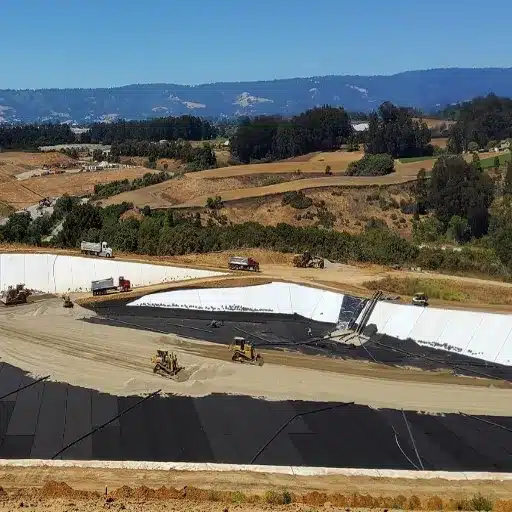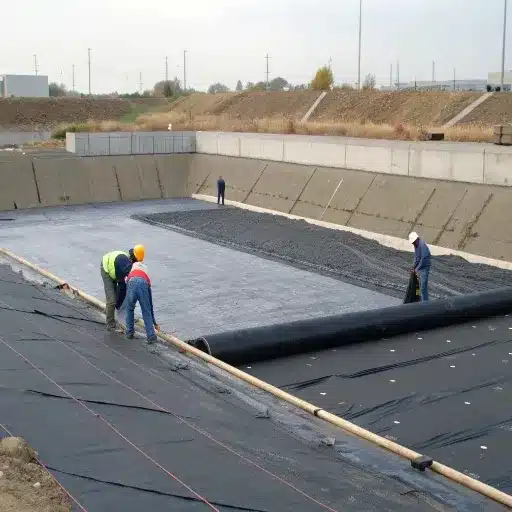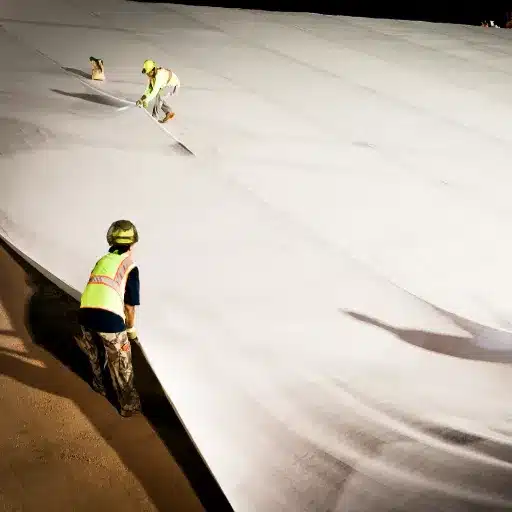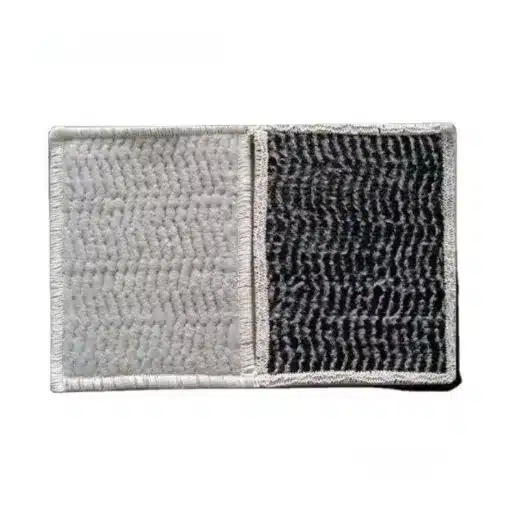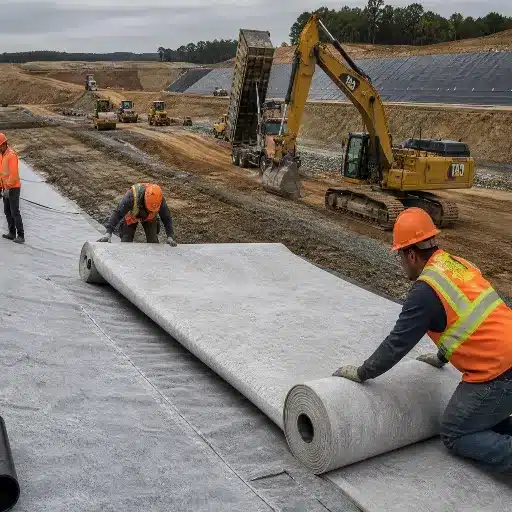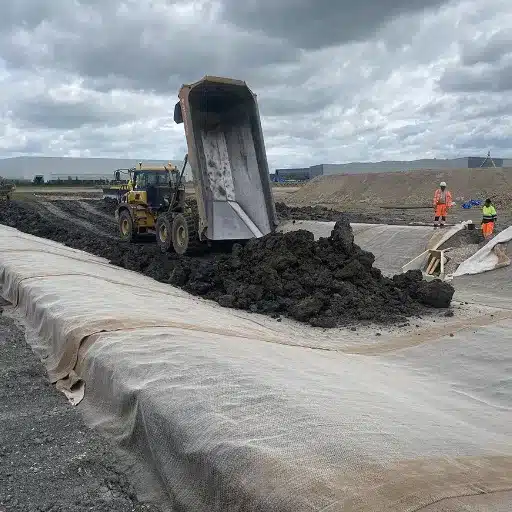
Choose textured geomembrane for slopes steeper than about 10°-15°, landfill side slopes, mining heap leach pads, or any composite liner where interface sliding could fail the system. Choose smooth geomembrane for flat bases, ponds, reservoirs, canals, and gentle slopes where friction is not the controlling design factor.
In 1990, the Kettleman Hills landfill in California experienced a massive slope failure. Investigators later found that a smooth HDPE geomembrane had created a low-friction plane at the interface with overlying soil, with friction angles reported as low as 8°. The liner itself did not tear, but the entire overlying waste mass slid. That case changed how engineers think about geomembrane surface selection forever.
If you are specifying HDPE geomembrane for containment, you already know thickness and chemical resistance matter. But the surface finish, textured or smooth, often determines whether the liner stays in place or becomes the weakest plane in your slope. This guide explains the engineering difference between textured vs smooth geomembrane, when each surface type is required, and how to write specifications that protect your project.
Key Takeaways
- Textured geomembrane provides higher interface friction than smooth geomembrane, making it essential for steep slopes and composite liner systems.
- Smooth geomembrane is suitable for flat or gently sloping containment areas and offers faster welding and lower material cost.
- Three texture types exist: co-extruded random, spray textured, and structured/flat-die embossed, each with different mechanical and welding behavior.
- ASTM D5321 direct shear testing is the only reliable way to verify friction angles for your actual site materials.
- GRI-GM13 specifies lower minimum elongation for textured HDPE (≥250%) than smooth HDPE (≥700%) because texture reduces strain capacity.
What Is the Difference Between Textured and Smooth Geomembrane?
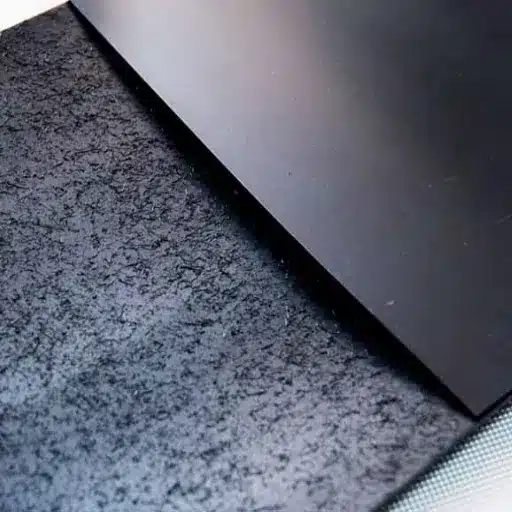
A smooth geomembrane has a flat, uniform surface on both sides. A textured geomembrane has a deliberately roughened surface on one or both sides to increase friction against soil, geotextile, or other geosynthetic layers.
Both types start as the same HDPE resin and provide the same fundamental function: an impermeable barrier with permeability coefficients typically ≤10⁻¹¹ cm/s. The difference is not waterproofing. The difference is mechanical interaction at the interface.
Think of smooth geomembrane as a sheet of glass. Water cannot pass through it, but anything placed on top can slide. Textured geomembrane is like sandpaper bonded to that glass. The barrier remains impermeable, but the rough surface grips the layer above it.
This distinction matters because most geomembrane failures in slope applications are not material ruptures. They are interface shear failures, one layer sliding over another. When that happens, the containment system can deform, tear at seams, or release contained materials.
Smooth HDPE Geomembrane
Smooth HDPE geomembrane is manufactured by flat-die extrusion or blown-film extrusion. Both processes produce a sheet with consistent thickness and very low surface roughness.
Typical applications include:
- Landfill base liners
- Pond and reservoir bottoms
- Canal lining
- Wastewater treatment lagoon floors
- Aquaculture tank liners
Because the surface is flat, smooth geomembrane is easier to deploy, align, and weld. Heat transfers evenly during thermal welding, so seam production is faster and quality control is more straightforward.
The trade-off is low interface friction. Against compacted clay or a nonwoven geotextile, smooth HDPE typically shows friction angles of only 10°-20°. On steep slopes, that is rarely enough to resist sliding under the weight of overlying soil, waste, or drainage stone.
Textured HDPE Geomembrane
Textured HDPE geomembrane adds a rough surface to one or both sides of the sheet. The texture increases the contact area and mechanical interlock with adjacent materials, raising the friction angle significantly.
Three manufacturing methods produce textured geomembrane:
- Co-extruded random texture: A nitrogen-blown outer layer is co-extruded with the HDPE core, creating an irregular sandpaper-like surface as gas bubbles expand and burst during cooling.
- Spray textured: A molten polyethylene spray is applied to the sheet surface after primary extrusion, building up roughness in a secondary operation.
- Structured / flat-die embossed texture: The sheet passes through embossing rollers while still hot, imprinting a regular pattern of studs, cones, or spikes.
Structured textures generally retain mechanical properties closer to smooth sheet because the core thickness remains uniform. Co-extruded and spray textures can reduce elongation and stress-crack resistance if the process thins the sheet or introduces stress concentrators.
Single-sided texture is common when only one interface needs higher friction, such as the underside of a landfill cap. Double-sided texture is used when both the subgrade and cover soil interfaces must resist sliding, such as on steep landfill side slopes or mining heap leach pads.
Engineering note: If your project specifies textured geomembrane, always ask whether the texture is co-extruded, spray, or structured. The manufacturing method affects elongation, welding preparation, and long-term shear behavior.
Textured vs Smooth Geomembrane: Friction and Slope Stability
The decision between textured vs smooth geomembrane is fundamentally a slope stability decision. You are selecting the interface that must resist shear stress under the weight of overlying materials.
Interface Friction Angles
Friction angle is the most common way to express textured geomembrane friction coefficient in geotechnical design. It is measured using the direct shear test per ASTM D5321. This test pulls one material across another under a known normal stress and reports peak and residual friction angles.
Typical reported ranges for HDPE geomembrane interfaces are:
| Interface | Smooth HDPE Friction Angle | Textured HDPE Friction Angle |
|---|---|---|
| Compacted clay liner | 18°-22° | 25°-32° |
| Nonwoven geotextile | 10°-18° | 22°-28° |
| Sandy gravel | 10°-15° | 25°-35° |
| Geosynthetic clay liner (hydrated) | 16°-20° | 23°-30° |
| Drainage composite | 8°-15° | 20°-28° |
These values are guidelines, not design constants. Actual friction depends on normal stress, moisture content, texture type, and the specific materials in contact. For critical slopes, project-specific ASTM D5321 testing is essential.
Post-Peak Strength Loss
Not all textures behave the same after peak stress. Co-extruded random textures can exhibit strain softening. After the peak friction is reached, the residual strength drops noticeably as asperities flatten or shear off. Structured textures usually show better residual strength because the embossed pattern maintains its geometry under shear displacement.
For landfill caps and tailings dams that may experience long-term creep or seismic loading, residual strength can be more important than peak strength. Specify structured texture or require residual friction data when post-peak behavior controls design.
Slope Angle Thresholds
A practical starting point for HDPE geomembrane slope stability and surface selection is slope angle:
- Less than 10°: Smooth HDPE is usually acceptable.
- 10° to 18°: Textured HDPE is recommended.
- Greater than 18°: Textured HDPE is generally required, and structured texture should be considered.
For reference, a 3:1 horizontal-to-vertical slope is about 18.4°. Most modern landfills use side slopes of 3:1 or steeper, which is why textured geomembrane has become standard for landfill side liner systems.
Normal stress also matters. At low normal stress, such as a thin soil cover on a landfill cap, even textured geomembrane may not develop enough friction to prevent sliding. At high normal stress, such as a deep heap leach pad, the required friction angle may increase and a double-sided structured texture may be necessary.
When in doubt, test. Specify ASTM D5321 direct shear testing for the actual geomembrane and interface materials at project-relevant normal stresses. Design based on the reported friction angles and your required factor of safety.
Mechanical Properties: Smooth vs Textured HDPE
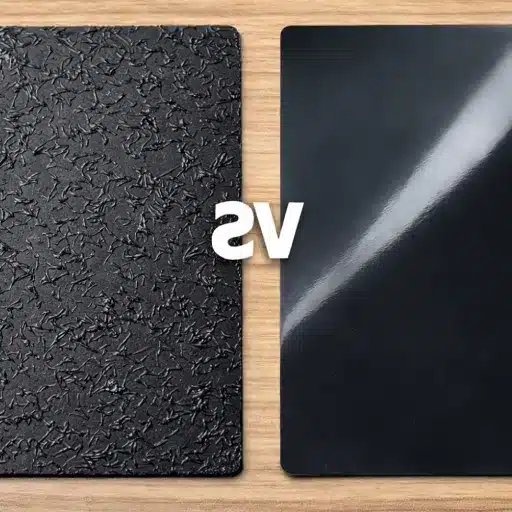
Surface texture changes some mechanical properties. The most important difference is elongation at break.
Tensile Strength and Elongation
Tensile strength at yield is similar for smooth and textured HDPE of the same nominal thickness. However, GRI-GM13 specifies different minimum average roll values for elongation at break:
- Smooth HDPE: ≥700% elongation at break
- Textured HDPE: ≥250% elongation at break
The lower value for textured sheet reflects the fact that texture creates stress concentrators and reduces the uniform strain capacity of the sheet. This does not mean textured geomembrane is weak. It means textured geomembrane is designed for interface friction, not for large uniform elongation.
Puncture and Tear Resistance
Textured geomembrane often shows slightly higher puncture resistance because the surface asperities absorb energy before the core is engaged. Tear resistance is comparable if the core thickness is maintained. Be cautious with heavily textured products where grinding for welding can locally thin the sheet.
Thickness Considerations
Textured geomembrane is commonly available in thicknesses from 0.75 mm to 3.0 mm. Smooth geomembrane can be produced in thinner gauges, down to about 0.3 mm, although 0.75 mm and thicker is typical for civil engineering applications.
When you select geomembrane thickness for a textured liner, specify the minimum core thickness at the valley of the texture, not just the overall asperity height. The core thickness is what carries tensile and puncture loads.
Installation and Welding: What Changes With Texture?
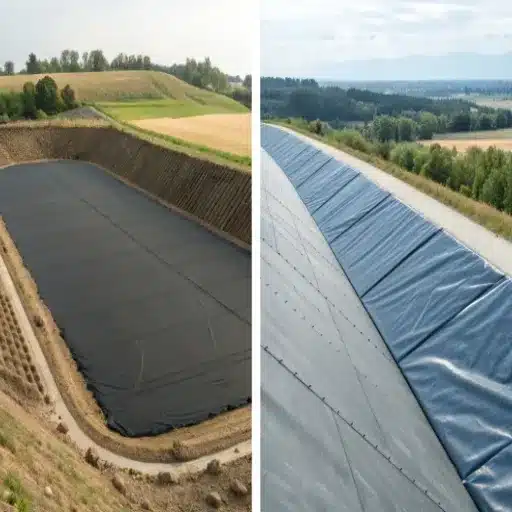
Textured geomembrane is not dramatically harder to install than smooth, but it requires additional steps and more attention to seam quality.
Deployment
On steep slopes, textured geomembrane is less likely to slide during placement because it grips the subgrade. However, that same friction makes it harder to pull and align large panels. Crews often use more temporary sandbags or anchors during deployment.
Smooth geomembrane panels slide into position more easily, especially in cool weather when the material is stiffer. This can reduce installation time on flat areas.
Grinding Before Welding
The biggest difference is welding. Textured surfaces cannot be thermally fused reliably, so the texture must be ground away in the seam overlap zone before welding.
Key quality control points:
- Grind a strip at least 100-150 mm wide in the overlap zone.
- Remove only the texture layer. Do not reduce the core thickness by more than 10%.
- On a 1.5 mm sheet, over-grinding can leave an effective seam thickness of 0.90-1.00 mm, creating a weak point.
- Clean the ground surface thoroughly before welding to remove dust and residue.
Welding Speed and Testing
Textured geomembrane welding typically runs at 70-80% of the speed for smooth geomembrane because of the grinding step and the need for slower heat input. Trial seams and destructive peel/shear testing should be performed at the start of each shift and whenever conditions change.
Air-pressure testing of double-track wedge welds follows the same principles as for smooth geomembrane, but pay extra attention to seams where grinding depth was marginal. Destructive testing at a higher frequency is common on textured liner projects.
For a deeper look at welding best practices, see our HDPE geomembrane installation guide.
Cost and Total Cost of Ownership
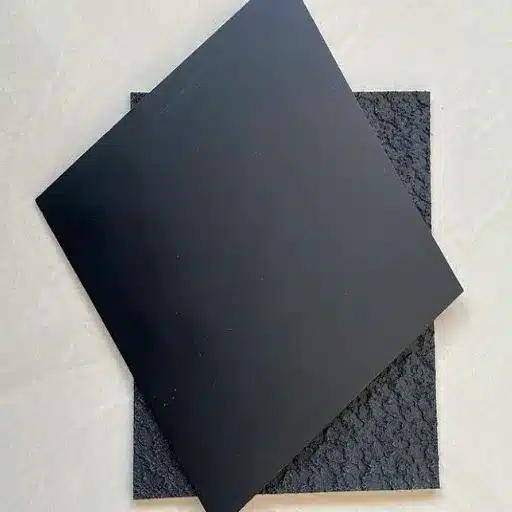
Textured geomembrane costs more than smooth, but the price difference is usually small compared with the cost of a slope failure.
Material Cost Premium
- Single-sided textured HDPE: approximately 10-15% more than smooth
- Double-sided textured HDPE: approximately 20-30% more than smooth
The premium covers additional manufacturing steps, resin formulation for texture layers, and quality control.
Installation Cost
Textured geomembrane installation takes longer because of grinding and slower welding. On a large landfill, this can add measurable labor cost. However, using smooth geomembrane on a steep slope where textured is required can lead to catastrophic sliding, repair, and potential regulatory liability.
When Textured Pays for Itself
Textured geomembrane is the right economic choice when:
- Slope angle exceeds the safe limit for smooth HDPE
- Overlying soil or waste will impose high shear stress
- The project uses a composite liner with multiple geosynthetic layers
- Long-term performance is more important than minor upfront savings
Marcus, a procurement manager for an environmental contractor in Southeast Asia, learned this the hard way. His team initially selected smooth HDPE for a tailings pond side slope to reduce material cost. Before installation, the geotechnical engineer ran an ASTM D5321 test and found the interface friction angle was only 12° against the site’s silty sand. The factor of safety against sliding was below 1.2. Switching to double-sided textured HDPE raised the friction angle to 27° and brought the factor of safety above 1.5. The material cost increased, but the avoided rework and failure risk saved the project significantly.
Application Guide: When to Specify Each Surface Type
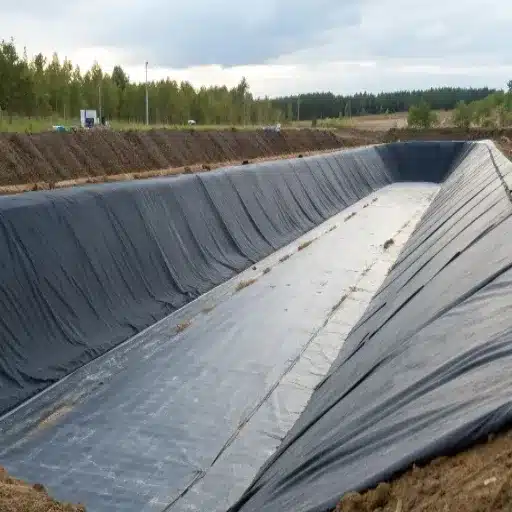
Choose Smooth HDPE Geomembrane When
- The area is flat or gently sloped, generally less than 10°.
- You are lining a pond, reservoir, canal, or wastewater lagoon floor.
- The project is a landfill base liner with minimal slope.
- Welding speed and ease of installation are priorities.
- Budget constraints are tight and slope stability is not a concern.
Choose Textured HDPE Geomembrane When
- Slope angle exceeds 10°-15°.
- The application is a landfill side slope or final cover.
- You are designing a mining heap leach pad or tailings dam.
- The liner is part of a composite system where inter-layer sliding is possible.
- High normal stress or seismic loading is expected.
Hybrid Designs
Many large containment projects use both surface types in the same liner system. A common approach is:
- Smooth geomembrane on the flat base for fast, economical welding.
- Textured geomembrane on the side slopes for slope stability.
This hybrid strategy balances cost and performance. It requires careful detailing at the transition between smooth and textured panels, usually with a welded seam at the toe of the slope.
Landfill liner design is a good example. The base liner is typically smooth HDPE because it sits on a relatively flat prepared subgrade and must be welded efficiently over a large area. The side slopes use textured HDPE because they interface with overlying drainage stone, soil cover, or waste. For more detail on landfill applications, see our guide on geomembrane for landfill liner design.
Specifying Surface Type in Project Documents
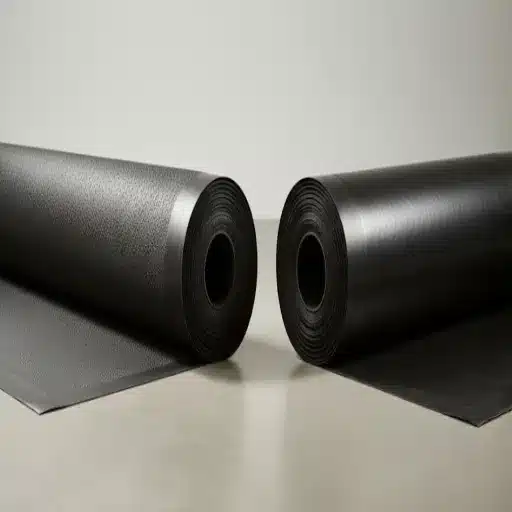
Vague specifications cause disputes and substitutions. Write surface requirements clearly.
Recommended Specification Language
“HDPE geomembrane shall be [smooth / single-sided textured / double-sided textured] as shown on the drawings. Textured geomembrane shall have a minimum core thickness of [] mm and shall comply with GRI-GM13 for textured HDPE geomembrane. Interface friction angles shall be verified by ASTM D5321 direct shear testing using the actual subgrade, geotextile, drainage composite, or soil cover materials proposed for the project. Minimum acceptable peak friction angle shall be []° and minimum residual friction angle shall be []° at the design normal stress of [] kPa.”
Texture Manufacturing Method
If the project is critical, specify the texture manufacturing method:
“Textured geomembrane for slopes steeper than [__]° shall be structured / flat-die embossed type. Co-extruded or spray-textured products require written approval from the engineer based on project-specific ASTM D5321 test data demonstrating comparable residual strength.”
Language to Avoid
- “Textured finish acceptable” does not define texture type, side, or performance.
- “Manufacturer’s standard texture”, allows substitution without engineering verification.
- “Slip-resistant geomembrane”, not a recognized engineering term.
Common Questions About Textured vs Smooth Geomembrane
Can smooth geomembrane be used on any slope?
Smooth geomembrane can be used on gentle slopes, typically less than 10°. On steeper slopes it becomes the weak plane in the system and sliding risk increases significantly. Anchoring trenches can help, but they do not eliminate the low-friction interface problem.
Does texture reduce the waterproofing performance of HDPE?
No. Both smooth and textured HDPE geomembranes provide excellent impermeability. The texture only affects the surface friction and some mechanical properties, not the barrier function.
Is welding textured geomembrane more difficult?
Yes, slightly. The texture must be ground away in the seam overlap zone before welding. Over-grinding can thin the sheet and create weak seams. With proper preparation and quality control, textured geomembrane welds perform reliably.
How do I know if I need single-sided or double-sided texture?
Single-sided texture is sufficient when only one interface needs higher friction, such as the underside of a cover system. Double-sided texture is required when both the subgrade interface and the cover soil interface are on a slope or subject to shear stress.
What is the best way to verify friction angles?
Project-specific ASTM D5321 direct shear testing is the only reliable method. Testing should use the actual geomembrane product and the actual soil or geosynthetic materials that will be in contact with it, at the normal stresses expected in service.
Conclusion
The choice between textured vs smooth geomembrane is not about which material is better overall. It is about which material fits the mechanical demands of your project.
Smooth geomembrane is fast to install, economical, and fully adequate for flat or gently sloped containment. Textured geomembrane is essential when slope stability, interface friction, and long-term shear resistance control the design.
Before you finalize your specification, ask three questions:
- What is the steepest slope in the liner system?
- What materials will contact the geomembrane surface?
- Has the interface friction been verified by ASTM D5321 testing?
If slope angle or shear stress is a concern, textured geomembrane is the safer engineering choice. The small increase in material and installation cost is insignificant compared with the cost of a slope failure.
For a broader overview of liner materials and applications, see our complete guide to geomembrane products.
At Shanxi Shengxing Building Materials Sales Co., Ltd., we supply smooth, single-sided textured, and double-sided textured HDPE geomembranes for containment projects worldwide. Our engineering team can help you select the right surface type, thickness, and specification for your slope conditions. Contact us for a technical quote or project-specific recommendation.