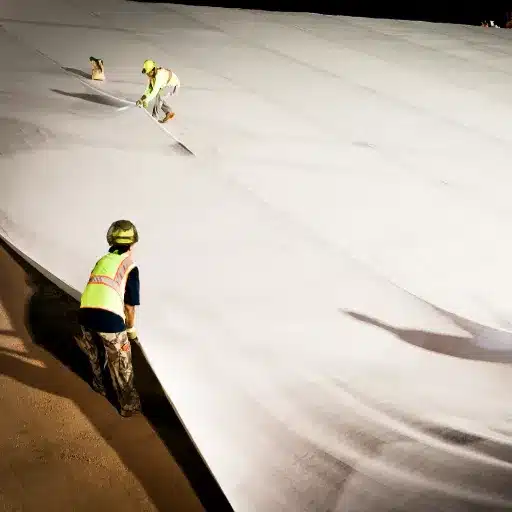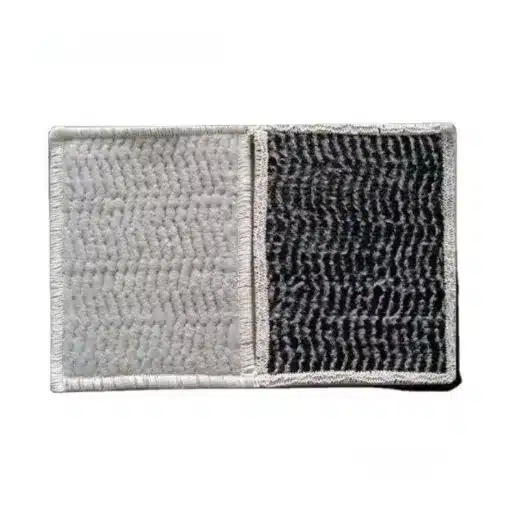
For a retaining wall, the short answer is: use nonwoven geotextile for the drainage and filtration layer behind the wall, and woven geotextile for internal soil reinforcement in taller engineered walls. Most well-built retaining walls use both.
Retaining walls fail far more often from water than from masonry. In a study of 301 failed mechanically stabilized earth (MSE) walls, 64% collapsed because of internal or external water buildup, not because of a defective product. The fabric you choose, and where you place it, determines whether that water drains away or pushes your wall over.
By the end of this guide, you’ll know exactly which geotextile goes in which layer, what weight and survivability class to specify, and how to install it so hydrostatic pressure never becomes a problem.
Key Takeaways
- Nonwoven geotextile is the standard choice for the drainage/filtration layer behind a retaining wall; it passes water while holding back soil fines that would clog drainage stone.
- Woven geotextile belongs in internal reinforcement layers of MSE/reinforced walls, where it carries tensile load like rebar in concrete.
- Most engineered walls use both: woven (or geogrid) for reinforcement, nonwoven for the drainage blanket.
- Water causes 64–68% of reinforced-wall failures; correct fabric selection and drainage can extend wall life 2–3×.
- Choose by weight and AASHTO M288 class (3.5–10 oz/yd² nonwoven by wall height; Class 1–3 by backfill severity), not by price.
The Short Answer: Which Geotextile for a Retaining Wall?
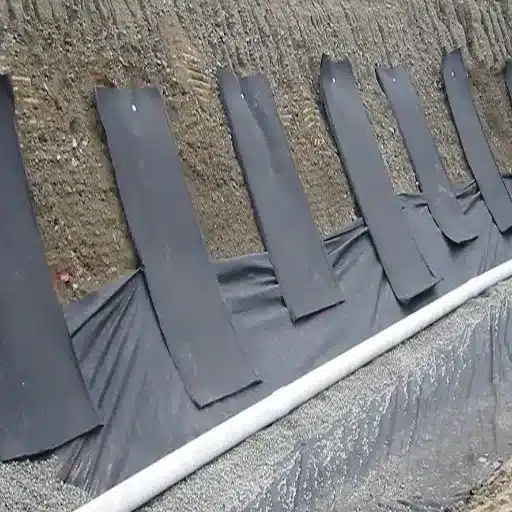
Nonwoven geotextile is the right fabric for the drainage and filtration layer behind a retaining wall. Its felt-like, three-dimensional structure lets water flow through while trapping soil particles, so your drainage stone and perforated pipe stay unclogged. Woven geotextile is the right fabric for internal reinforcement in taller reinforced walls, where its high tensile strength and low elongation hold soil masses together under load.
The rule of thumb that covers almost every project: loads on top → woven; water behind → nonwoven.
Keep that in mind as you read on. The detail behind it, including the engineering specs and the exact numbers, is what separates a wall that lasts 30 years from one that bulges and collapses after heavy rain. For the full woven-versus-nonwoven picture across every application, start with our woven vs nonwoven geotextile comparison and selection guide.
Why Drainage Is the #1 Cause of Retaining Wall Failure
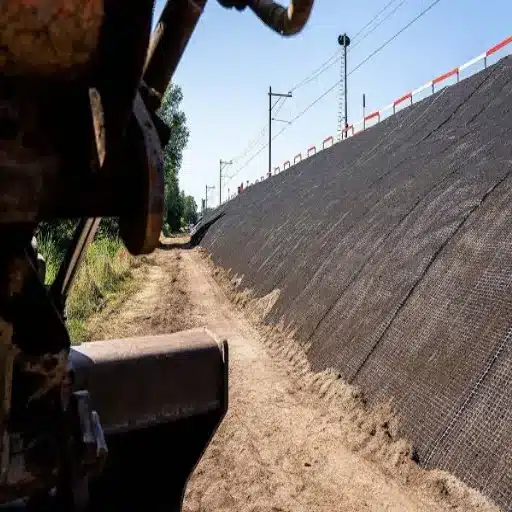
It’s tempting to blame a cracked or toppled wall on weak blocks or bad mortar. In practice, water is usually the real culprit.
Researcher Robert Koerner and his team compiled the largest database of reinforced-soil-wall failures in the industry. Across 301 failed MSE walls:
- 64% failed due to hydraulic causes: 37% from internal water (drainage pipe leakage, perched water, saturated backfill) and 27% from external water (seepage, surface infiltration, high groundwater).
- 73–76% used impermeable silt or clay backfill, which traps water instead of letting it drain.
- None of the 301 failures were caused by an improperly manufactured geotextile or geogrid. (Source: IGS/Geosynthetics Society proceedings)
The physics explain why. Water behind a wall exerts about 62.4 pounds of pressure per square foot for every foot of depth. Fill a few feet of space behind a wall with trapped water and you’re pushing on it with thousands of pounds of force that the wall was never designed to resist.
A properly designed drainage system, drainage stone, a perforated pipe, and a nonwoven geotextile filter remove that water before pressure builds. Walls with proper drainage and filtration typically last two to three times longer than those without (roughly 30 years versus 10), while budget installs without a quality filter often fail in as little as 2–5 years as sediment clogs the drainage layer.
Want to see how to build this drainage layer correctly? Our geotextile retaining wall installation and drainage guide walks through the full AASHTO-compliant procedure.
Woven vs Nonwoven for Retaining Walls: Side-by-Side Comparison
The two fabric families are built differently, and that difference drives everything.
| Property | Woven Geotextile | Nonwoven Geotextile |
|---|---|---|
| Structure | Interlaced yarns on a loom (grid-like) | Randomly bonded fibers (felt-like) |
| Tensile strength | High (designed by wide-width tensile, ASTM D4595) | Moderate (grab tensile, ASTM D4632) |
| Elongation at break | Low (5–25%) | High (>50%) |
| Permeability | Low to moderate | High |
| Filtration of fine soil | Poor (openings clog with fines) | Excellent (traps fines, passes water) |
| Primary wall role | Internal reinforcement, load-bearing | Drainage blanket, filter layer |
| Typical cost | Higher | Lower |
The single cleanest number to remember is permeability. Nonwoven geotextiles pass roughly 90–110 gallons per minute per square foot, while typical wovens pass only 4–5. If water needs to move through the fabric, nonwoven wins every time.
That’s also why choosing a fabric by price alone backfires. A cheap woven might cost less per square foot, but if it’s doing a drainage job it will clog, trap water, and set up the exact failure you were trying to avoid. We cover the real cost picture, including when each type is genuinely the economical choice, in our woven vs nonwoven geotextile cost guide.
When to Choose Woven Geotextile in a Retaining Wall: The Reinforcement Role
How Woven Fabric Holds a Wall Together
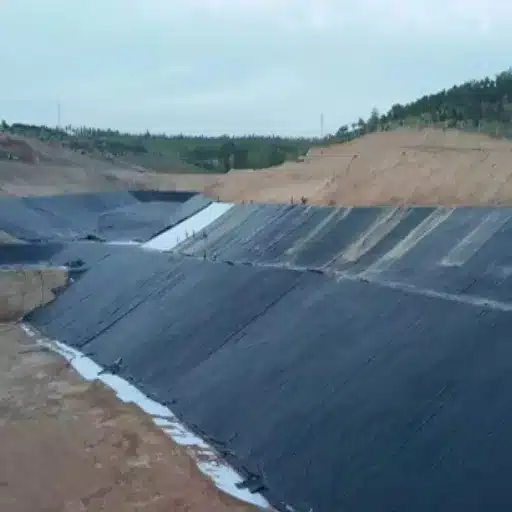
Woven geotextiles act like reinforcing steel inside soil. Laid in horizontal layers within the backfill, they develop tensile strength that resists the outward push of the retained earth. This is the core of a mechanically stabilized earth (MSE) wall: the fabric transfers load into the soil mass and keeps the wall from overturning.
Reinforcement geotextiles are specified by wide-width tensile strength (ASTM D4595) in kilonewtons per meter (kN/m), not by weight. The design uses an internal stability analysis to determine the layer spacing and the required strength at each depth, with reduction factors applied for creep, installation damage, and long-term durability.
AASHTO M288 assigns the highest survivability requirements to woven materials for this reason. A Class 1 woven reinforcement geotextile is the standard specification for reinforced soil walls, with a minimum grab tensile of 1,400 N, tear strength of 500 N, and CBR puncture resistance of 3,500 N.
Woven Yarn Types Matter
Here’s a nuance most guides skip: not all wovens are the same. There are three common yarn constructions:
- Slit-film woven, the cheapest and strongest, but nearly impermeable. It blocks water, so it’s wrong if any drainage must pass through it.
- Monofilament woven, has open spaces between yarns, so it can both reinforce and let water through. The hybrid pick when a woven must also drain.
- Multifilament woven, high strength with better flexibility and fabric integrity.
If your wall needs reinforcement but water also has to escape through the same layer, specify monofilament or multifilament woven, never slit-film.
When Geogrid Replaces Geotextile
For walls taller than about 1.2 meters (4 feet), or where fill loads are heavy, geogrid reinforcement is typically required in addition to or instead of geotextile. Geogrids have much higher tensile capacity and interlock with aggregate more effectively. The geotextile then stays outside the grid, as the drainage filter, so it doesn’t clog. If you’re deciding between the two, read about how geogrid and geotextile compare before you specify.
When to Choose Nonwoven Geotextile Behind a Retaining Wall: The Drainage & Filtration Role
The “High-Tech Coffee Filter” Behind the Wall
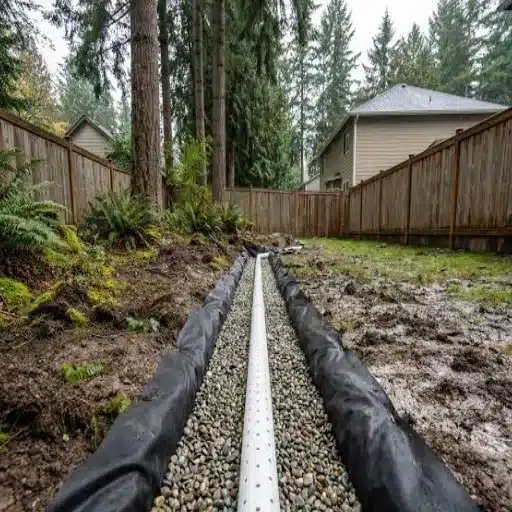
The nonwoven geotextile’s job is filtration. Its random fiber network lets water pass through the fabric thickness while trapping soil particles. Think of it as a filter that keeps fine silt and clay out of your drainage stone. Without it, soil washes into the gravel, clogs the voids, and the water that should drain away instead sits and builds pressure against the wall.
Place the nonwoven horizontally at the interface between the native soil and the drainage gravel. That’s the critical detail: it separates soil from stone so the drainage zone stays open. It should not be draped vertically against the wall blocks, where it can trap water instead of channeling it.
Nonwoven filter geotextiles are the standard product for this job. A needle-punched polypropylene nonwoven is the mainstream choice for most walls; polyester suits extreme environments such as desert heat, high humidity, or strongly acidic soils. For the design side of drainage, our nonwoven geotextile drainage guide covers filter selection and drain construction in depth.
Nonwoven Weight by Wall Height
The right nonwoven weight depends mostly on wall height and installation severity. A practical selection table:
| Wall Height | Recommended Nonwoven Weight |
|---|---|
| Under 2 ft (0.6 m) | 3.5–4.0 oz/yd² (120–140 gsm) |
| 2–3 ft (0.6–0.9 m) | 4.5–5.0 oz/yd² (150–170 gsm) |
| 3–6 ft (0.9–1.8 m) | 6.0–7.0 oz/yd² (200–240 gsm) |
| 6–10 ft (1.8–3.0 m) | 8.0 oz/yd² (270 gsm) |
| Over 10 ft (3.0 m) | 10.0 oz/yd² (340 gsm) or heavier |
Higher loads, poor drainage conditions, or silty backfill may require heavier fabric than wall height alone suggests. For a deeper dive into how weight, gsm, and AASHTO survivability classes connect, see our geotextile gsm weight guide.
Matching the AASHTO Survivability Class
AASHTO M288 classifies geotextiles by how much installation abuse they’ll survive. For a typical residential or light-commercial retaining wall, Class 2 is the default: minimum grab tensile of 1,100 N, tear of 400 N, and CBR puncture of 2,700 N. For heavy or abrasive backfill and poor installation access, step up to Class 1 (1,400 N / 500 N / 3,500 N). Class 3 is reserved for protected, low-stress applications only.
The filter layer’s apparent opening size (AOS) also matters. For fine-grained soils, specify a nonwoven with an AOS around 0.15–0.21 mm so fines stay out of the drainage zone.
How to Install Geotextile in a Retaining Wall: The Right Way

Correct placement is worth more than correct fabric. Here’s the sequence that keeps a wall draining properly for decades:
- Excavate and prepare. Dig 12–24 inches behind the wall for the drainage layer, remove loose soil and sharp objects, and compact the subgrade.
- Lay the nonwoven horizontally. Unroll it across the soil–gravel interface, extending from the base of the wall to the top of the backfill zone. Never place it vertically against the blocks and never under the wall base, which needs direct contact with compacted gravel for stability.
- Build the drainage stone bed. Use clean crushed stone (12.5–25 mm, roughly ASTM No. 57) at least 300 mm wide, with a 100 mm perforated pipe at the bottom sloping 10–20 mm per meter toward an outlet.
- Overlap and secure. Overlap adjacent sheets by 300 mm on firm ground and up to 900 mm on soft or wet ground. Lap the upper sheet over the lower (shingle style) so water flows across the joint, and pin seams with U-shaped steel staples.
- Backfill in thin lifts. Compact backfill in 150–200 mm lifts. Within 1 meter of the wall, use only walk-behind compactors under 500 kg, and never drive heavy equipment directly over exposed fabric.
- Cover quickly. Polypropylene loses roughly half its tensile strength after 500 hours of UV exposure, so cover the fabric with soil or aggregate within 24–72 hours.
When the drainage stone and pipe sit behind a poorly designed system, the fabric can’t save it. If your wall needs a higher-capacity drainage solution than gravel alone, geocomposite drainage blankets (a nonwoven filter bonded to a drainage core) are a space-saving alternative used on many commercial projects.
Common Retaining Wall Mistakes and How to Avoid Them
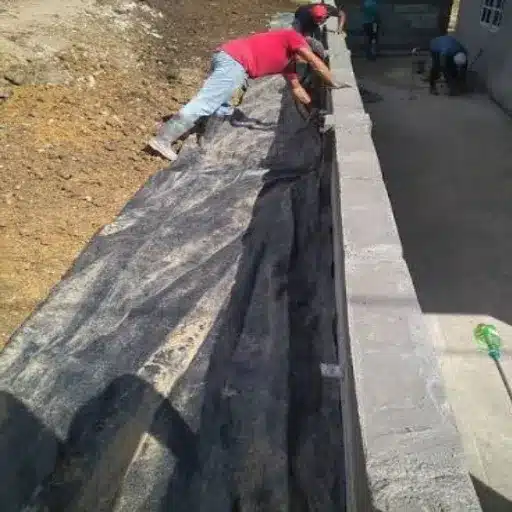
Even with the right materials, small mistakes cause big failures. Here are the ones we see most:
Mistake 1: Using woven (especially slit-film) as the drainage filter. Woven openings clog with fines, the fabric seals, and water builds up behind the wall. Carlos, a landscaper in Florida, installed cheap slit-film woven against his client’s block wall in 2023, believing it would drain. Eight months later the wall bulged 4 inches after a hurricane season, and the whole face had to be rebuilt at a cost of $18,000. The fabric itself was the problem.
Mistake 2: Using a light nonwoven for structural reinforcement. Nonwovens stretch more than 50% at break. Under sustained soil load, a light nonwoven reinforcement layer deforms, and the wall slowly bulges. Reinforcement needs a woven sized by wide-width tensile strength, or a geogrid.
Mistake 3: Skipping the filter fabric entirely. Fine soil washes straight into the drainage stone, clogs the pipe, and within a couple of years the wall stops draining. The drainage layer you paid for becomes a water trap.
Mistake 4: Choosing by price instead of function. A contractor once saved $0.40 per square meter by substituting a light nonwoven for a specified high-tensile woven on a reinforced wall. The wall progressively bulged, and the remediation cost dwarfed the initial savings. Selection by function is almost always cheaper than selection by price.
Mistake 5: Ignoring yarn type and survivability class. A torn or clogged fabric during construction sets up a future failure. Match the AASHTO class to the backfill, and specify monofilament woven wherever a reinforcing layer must also drain.
Interestingly, the same woven-versus-nonwoven logic applies whether you’re building a wall or a driveway: woven for load support, nonwoven for drainage. And because so many projects need both functions, we explain exactly when and how to combine them in this guide to using woven and nonwoven geotextile together.
Frequently Asked Questions
Which is better for a retaining wall, woven or nonwoven geotextile?
It depends on the layer. Nonwoven is better for the drainage and filtration layer behind the wall because it lets water through while trapping soil. Woven is better for internal reinforcement in taller engineered walls because it carries tensile load. Most well-built walls use both.
Does a retaining wall need geotextile?
Yes, for any wall with a drainage system. A nonwoven geotextile filter keeps soil fines out of the drainage stone so the stone and pipe continue to work. Without it, the drainage layer clogs and hydrostatic pressure builds.
Where does geotextile go in a retaining wall?
Place nonwoven geotextile horizontally between the native soil and the drainage gravel. If you’re building a reinforced (MSE) wall, lay woven reinforcement in horizontal layers within the backfill at the spacing your design specifies.
What weight nonwoven geotextile should I use behind a retaining wall?
Use roughly 3.5–4.0 oz/yd² for walls under 2 feet, 4.5–5.0 oz for 2–3 feet, 6.0–7.0 oz for 3–6 feet, and 8.0 oz or heavier for taller walls. Choose a higher weight for silty backfill or poor drainage.
Can I use landscape fabric instead of geotextile behind a retaining wall?
No. Garden-center landscape fabric is a weed barrier, not an engineering geotextile. It clogs, blocks water, and typically lasts only 3–5 years. Use a proper needle-punched nonwoven geotextile, which lasts 20–50 years when buried. For the practical difference, see our guide to geotextile fabric for landscape drainage and retaining walls.
Conclusion
The fabric choice behind a retaining wall is a two-part answer. Nonwoven geotextile handles the drainage and filtration that prevent the water failures behind most wall collapses. Woven geotextile handles the structural reinforcement that keeps taller walls standing under load. Most engineered walls need both.
To summarize:
- Water causes 64–68% of reinforced-wall failures, so drainage and filtration are non-negotiable.
- Use nonwoven (3.5–10 oz/yd² by wall height, Class 2 typical) as the filter at the soil–gravel interface.
- Use woven (Class 1, sized by wide-width tensile) for internal reinforcement layers; step up to geogrid above ~1.2 m.
- Install the nonwoven horizontally, never vertically against blocks, and cover it within 72 hours.
- Choose by function and survivability class, not by price.
Not sure which geotextile grade fits your wall height, backfill, and load? Our engineering team can help you specify the right material and confirm it against AASHTO M288 before you order. Request a technical quote or contact our engineering support for a tailored recommendation.
This guide was prepared by the engineering team at Shanxi Shengxing Building Materials Sales Co., Ltd., a global supplier of ISO9001-certified geotextiles, geomembranes, and geogrids for infrastructure and environmental projects.