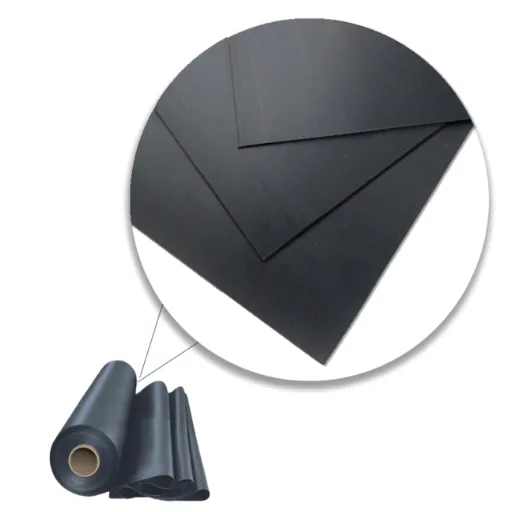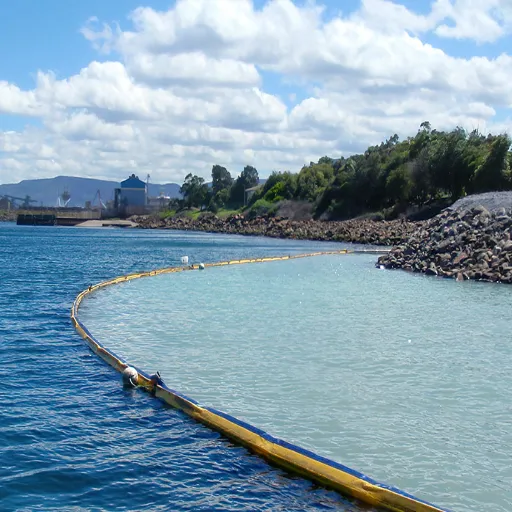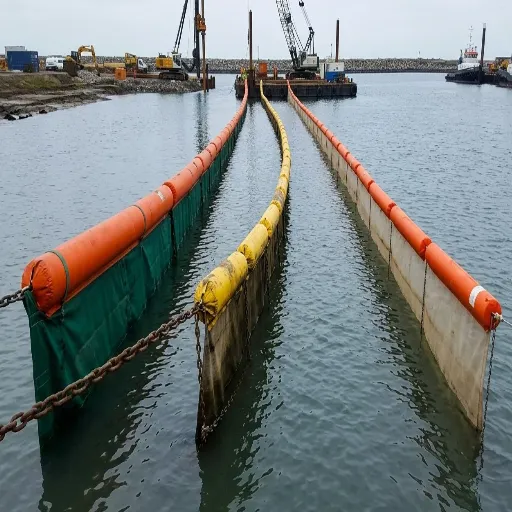
HDPE vs LLDPE geomembrane is a choice between two specifications, not two adjectives.
HDPE must meet GRI-GM13: a formulated density of at least 0.940 g/cc, a defined yield point, 700% break elongation on smooth sheet, and 500 hours of stress crack resistance. LLDPE must meet GRI-GM17: a formulated density no higher than 0.939 g/cc, no yield requirement, no stress crack test, and a 2% modulus capped at 60,000 psi.
Choose HDPE for chemical exposure and landfill containment. Choose LLDPE for settlement, conformability, and lower-modulus applications.
A datasheet that lists 25% break elongation for LLDPE isn’t describing smooth LLDPE to GM17. It’s describing textured sheet, or it’s wrong. That single line tells you whether the quoted material matches the design.
HDPE is stronger and LLDPE is more flexible. That shorthand is useful, but incomplete. At the same thickness, both standards require the same minimum break strength on smooth sheet. The real differences sit in yield, modulus, tear, puncture, stress cracking, seams, and aging.
This guide sets GRI-GM13 vs GRI-GM17 requirement by requirement at 30 mil, using the current revisions dated 11 June 2025, and shows how to check a datasheet before you approve a purchase order.
Need product data now? Compare our HDPE geomembrane and LLDPE geomembrane ranges, or request a technical quote with your project chemistry, thickness, and exposure.
Key Takeaways
- GRI-GM13 requires a formulated density of 0.940 g/cc or higher. GRI-GM17 caps formulated density at 0.939 g/cc.
- Smooth HDPE and smooth LLDPE share the same minimum break strength at 30 mil: 114 lb/in. HDPE adds a yield point and a 500-hour stress crack requirement.
- LLDPE’s flexibility is defined by a 2% modulus cap of 60,000 psi (414 MPa), not by the word “flexible.”
- Textured sheet changes the numbers. GM13 textured HDPE must reach 100% break elongation, and GM17 textured LLDPE must reach 250%, not 800%.
- HDPE retains more after oven and UV aging: 50% versus 35% after 1,600 hours of UV exposure.
Quick Answer: HDPE vs LLDPE Geomembrane at a Glance
HDPE geomembrane is a denser, stiffer sheet specified under GRI-GM13. LLDPE geomembrane is a lower-density, lower-modulus sheet specified under GRI-GM17. HDPE wins on chemical resistance, stress crack resistance, and aging. LLDPE wins on conformability, elongation, and settlement tolerance.
| Decision factor | HDPE | LLDPE |
|---|---|---|
| Governing specification | GRI-GM13 Rev 19 | GRI-GM17 Rev 17 |
| Formulated density | 0.940 g/cc or higher | 0.939 g/cc or lower |
| Minimum thickness | 0.75 mm (30 mil) | 0.50 mm (20 mil) |
| Smooth break elongation | 700% | 800% |
| Textured break elongation | 100% | 250% |
| 2% modulus | Not specified | 60,000 psi (414 MPa) maximum |
| Stress crack resistance | 500 hours required | Not required |
| UV retention, 1,600 hours | 50% | 35% |
| Best fit | Landfills, mining, aggressive leachate | Ponds, caps, settlement-prone sites |
At 30 mil, smooth HDPE and smooth LLDPE both have a minimum break strength of 114 lb/in. HDPE is stronger at yield, tear, puncture, and stress cracking, not at break.
What HDPE and LLDPE Geomembrane Are
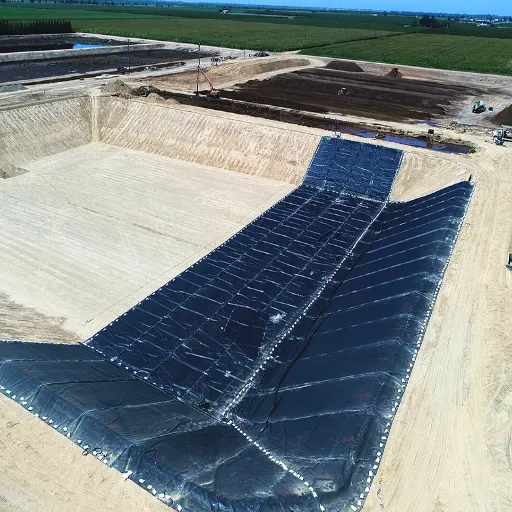
High-density polyethylene (HDPE) has minimal chain branching. The chains pack closely, which raises density and stiffness. GRI-GM13 covers formulated sheet at 0.940 g/cc or higher, in thicknesses from 0.75 mm to 3.0 mm.
The base resin is generally 0.932 g/cc or higher with a melt index below 1.0 g/10 min. It must be virgin material with no more than 10% rework, and no post-consumer resin may be added.
The tight structure gives HDPE lower permeability, higher chemical resistance, and a clear yield point. It also makes the sheet stiffer, which is why HDPE needs more care on uneven subgrade.
Linear low-density polyethylene (LLDPE) is an ethylene/alpha-olefin copolymer. The comonomer can be 1-butene, 1-hexene, 1-octene, or 4-methyl-1-pentene. Short-chain branching lowers crystallinity, which lowers density and modulus.
GRI-GM17 covers formulated sheet at 0.939 g/cc or lower, in thicknesses from 0.50 mm to 3.0 mm. The natural resin is generally 0.926 g/ml or lower, with a melt index of 1.0 g/10 min or less.
The lower modulus is the point. It lets the sheet stretch and conform under low strain, which suits settling ground, irregular pond shapes, and prefabricated panels.
The two standards meet at the density boundary. A product described as HDPE below 0.940 g/cc sits outside GM13. A product described as LLDPE above 0.939 g/cc sits outside GM17. Ask for the formulated density result and the test method, ASTM D1505 or D792.
Lena, a procurement engineer for a reservoir project in Southeast Asia, learned this from a quote review. The supplier listed “LLDPE, 0.925 density, 25% elongation.” Her team read “LLDPE” and assumed a flexible smooth sheet. The 25% figure belonged to textured LLDPE, while the project needed smooth sheet for a cushion detail. The re-quote added three weeks, but it arrived before shipment.
This scenario is an illustrative composite, not a customer account.
HDPE vs LLDPE Geomembrane: Property Comparison Under GM13 and GM17
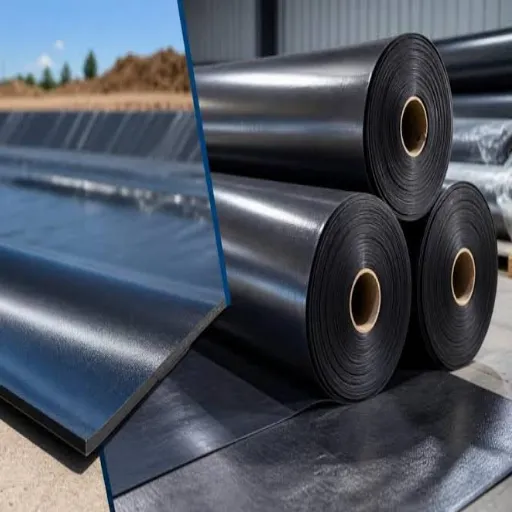
The table below uses minimum average values at 30 mil (0.75 mm) from GRI-GM13 Rev 19 and GRI-GM17 Rev 17. Values for other thicknesses scale with thickness, so read the column that matches the specified thickness.
| Property at 30 mil (0.75 mm) | HDPE smooth | HDPE textured | LLDPE smooth | LLDPE textured |
|---|---|---|---|---|
| Formulated density | 0.940 g/cc min | 0.940 g/cc min | 0.939 g/cc max | 0.939 g/cc max |
| Yield strength | 63 lb/in | 63 lb/in | Not specified | Not specified |
| Yield elongation | 12% | 12% | Not specified | Not specified |
| Break strength | 114 lb/in | 45 lb/in | 114 lb/in | 30 lb/in |
| Break elongation | 700% | 100% | 800% | 250% |
| 2% modulus | Not specified | Not specified | 60,000 psi max | 60,000 psi max |
| Tear resistance | 21 lb | 21 lb | 16 lb | 11 lb |
| Puncture resistance | 54 lb | 45 lb | 42 lb | 22 lb |
| Stress crack resistance | 500 h | 500 h | Not specified | Not specified |
| Carbon black content | 2.0–3.0% | 2.0–3.0% | 2.0–3.0% | 2.0–3.0% |
| Standard OIT | 100 min | 100 min | 100 min | 100 min |
| High-pressure OIT | 400 min | 400 min | 400 min | 400 min |
| Oven aging, 90 days at 85°C | 55% / 80% retained | 55% / 80% retained | 35% / 60% retained | 35% / 60% retained |
| UV resistance, 1,600 h | 50% retained | 50% retained | 35% retained | 35% retained |
Yield, Break Strength, and Elongation
HDPE has a defined yield point at 63 lb/in and 12% yield elongation. LLDPE has none, so HDPE gives the designer a clearer serviceability limit. At break, the two smooth sheets are equal at 114 lb/in.
Elongation is where the gap opens. Smooth HDPE must reach 700% and smooth LLDPE 800%, not the “800% to 900% versus 700%” range in some blog comparisons. A sheet can stretch far before it breaks and still resist small strains. That’s why GM17 adds a modulus cap.
Textured sheet is the bigger trap. GM13 textured HDPE requires 45 lb/in and 100% elongation at 30 mil. GM17 textured LLDPE requires 30 lb/in and 250%. Texture is not a load-bearing layer, so the measured tensile values drop.
A datasheet showing 25% is not GM17 smooth sheet. Match the surface finish to the number.
The 2% Modulus Cap
GM17 limits 2% modulus to 60,000 psi (414 MPa) by ASTM D5323. GM13 has no modulus requirement. This is how the LLDPE standard defines flexibility, and it is more useful to a designer than the word “flexible.”
Low modulus means the sheet conforms under small loads, such as settlement and thermal movement. High modulus means it resists those loads and transfers them to seams and anchors. Ask for the D5323 result when flexibility is the reason for choosing LLDPE.
Tear, Puncture, and the “LLDPE Is Tougher” Claim
At 30 mil smooth, GM13 requires 21 lb tear resistance and 54 lb index puncture. GM17 requires 16 lb and 42 lb. HDPE’s minimums are higher, not lower.
The claim that LLDPE is more puncture resistant comes from field experience, not these index values. LLDPE’s higher elongation lets it deform around a point instead of resisting it. That can help over soft subgrade, but it does not change the standard. For sharp, angular subgrade, specify a cushion geotextile, compact the subgrade, and inspect before deployment.
Stress Crack Resistance
GM13 requires 500 hours of stress crack resistance by ASTM D5397, using the single-point notched constant tensile load method and the criteria in GRI-GM10. GM17 has no such requirement.
Stress cracking happens under sustained tensile stress at a flaw or notch. Constrained shrinkage, settlement, and poor detailing can all create that condition. If the design carries sustained stress, HDPE’s requirement is a real selection factor.
Carbon Black, OIT, Oven Aging, and UV
Both standards require 2.0% to 3.0% carbon black and a minimum standard OIT of 100 minutes or high-pressure OIT of 400 minutes. Those values protect the sheet against oxidation during manufacture and early service.
The aging requirements diverge. After 90 days at 85°C, GM13 requires 55% retention by standard OIT or 80% by high-pressure OIT. GM17 requires 35% or 60%.
After 1,600 hours of UV exposure, GM13 requires 50% retention and GM17 requires 35%. These are minimums, so compare the same test method and exposure condition. A high-pressure OIT result is not interchangeable with a standard OIT result.
What the Standards Do Not Cover
GM13 and GM17 are manufacturing quality control standards. They tell you what the sheet must test at the factory. They do not certify chemical compatibility, service life, or interface shear strength.
Chemical resistance depends on the leachate, its concentration, temperature, and exposure time. Interface shear strength is site-specific, and GM13 Note 6 directs designers to ASTM D5321 and D6243 direct shear testing.
Conformance is necessary. It isn’t sufficient. A liner that meets GM13 can still fail in a chemistry it was never tested against.
Checking a supplier’s datasheet? Send it to our team and we will compare each property against the GM13 or GM17 requirement for your thickness and surface. Request a technical datasheet review.
HDPE vs LLDPE Geomembrane: Welding and Seam Requirements
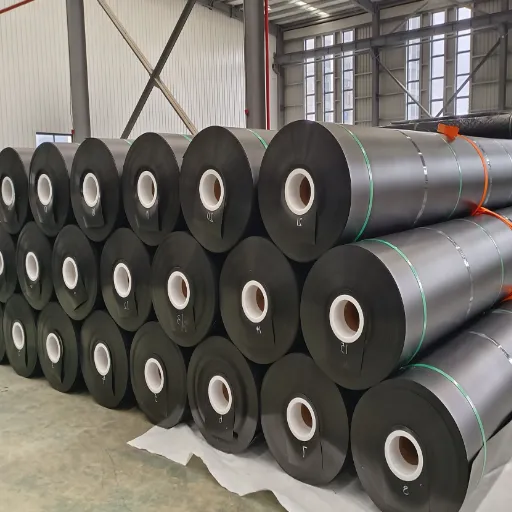
Both materials are thermally bonded, usually by hot wedge or extrusion fillet. GRI-GM19a sets the seam acceptance values for homogeneous HDPE and LLDPE sheet. The values differ because the base sheets differ.
| Seam type at 30 mil (0.75 mm) | HDPE shear | HDPE peel | LLDPE shear | LLDPE peel |
|---|---|---|---|---|
| Hot wedge | 57 lb/in | 45 lb/in | 45 lb/in | 38 lb/in |
| Extrusion fillet | 57 lb/in | 39 lb/in | 45 lb/in | 34 lb/in |
Both materials require 50% shear elongation at break and no more than 25% peel separation. All five specimens in each direction must meet the value. The test method is ASTM D6392.
Density, modulus, and surface texture change how the sheet absorbs heat and flows under the wedge. A setting that passes on 1.5 mm HDPE won’t automatically pass on 1.5 mm LLDPE.
Run a trial weld for each combination of material, thickness, surface, and machine. Test it by peel and shear before production welding starts, then keep the sample with the daily quality records.
GM19a does not set the sampling interval. GRI-GM14 and GRI-GM20 do. The most restrictive interval is one destructive sample per 150 m, relaxed with a documented quality system or an electrical leak location survey.
Reject the seam if any specimen falls below the shear or peel value, if shear elongation is under 50%, or if peel separation exceeds 25%. For hot wedge seams, adhesive failure codes AD and AD-Brk above 25% are unacceptable. For extrusion fillet seams, AD1, AD2, and AD-WLD are unacceptable even when strength passes.
Daniel, a CQA inspector on an LLDPE-lined pond, found the problem on the first day of production welding. The installer had copied the HDPE settings from the previous job, and peel strength came back at 28 lb/in against the 38 lb/in GM19a value.
The crew re-welded 180 m of panel and re-qualified the machine. The destructive samples caught it before the liner was covered.
This scenario is an illustrative composite, not a customer account.
The TWI video below shows the two common thermal methods, wedge welding and extrusion welding, on geomembrane lining material.
For a step-by-step field procedure, see our geomembrane welding guide and the geomembrane installation guide.
Which Geomembrane for Your Project?
The application usually decides the material before the price does.
| Application | Default | Reason | Specification note |
|---|---|---|---|
| MSWLF composite liner | HDPE | Chemical resistance and stress crack resistance | 40 CFR 258.40 requires HDPE FML at 60 mil or thicker |
| Landfill cap | LLDPE or HDPE | Conformability versus exposed UV life | Buried caps favor LLDPE; exposed caps favor HDPE |
| Pond or reservoir | Both | LLDPE for settlement; HDPE for exposure and chemistry | Engineering NZ PN21 recommends 1.50 mm for both in FDE ponds |
| Aquaculture | LLDPE | Conformability and panel fabrication | Confirm potable-water or aquatic approval for the formulation |
| Mining heap leach | HDPE | Aggressive chemistry and sustained stress | Require project-specific chemical compatibility testing |
| Industrial lagoon | HDPE | Chemical resistance | Confirm the leachate chemistry with the resin supplier |
| Factory-welded tank | LLDPE | Lower modulus and prefabrication | PN21 recommends 1.25 mm HDPE and 1.00 mm LLDPE |
| Uneven subgrade | LLDPE | Low modulus and high elongation | Still requires a cushion geotextile and compacted subgrade |
| Exposed liner | HDPE | Higher UV retention | 50% versus 35% retained after 1,600 hours |
Landfills and Containment
In the United States, 40 CFR 258.40(b) defines a composite liner with a minimum 30-mil flexible membrane liner. It then adds a specific rule: FML components made of HDPE must be at least 60 mil thick. That is 1.5 mm.
HDPE is the default for municipal solid waste landfills because of its chemical resistance and its stress crack requirement. LLDPE can appear in caps and some containment cells, but the design approval controls. Check the state or national rule before substituting a material or a thickness.
A project team in the United States learned this during a permit review. The draft specified 30-mil HDPE for a new cell, based on the general 30-mil minimum. The reviewer returned it because the same paragraph requires 60 mil for HDPE.
The redesign moved to 60-mil HDPE and a thicker cushion layer. The liner quantity doubled, and the schedule moved by six weeks.
This scenario is an illustrative composite, not a customer account.
Ponds, Reservoirs, and Aquaculture
Both materials work in ponds and reservoirs. Engineering New Zealand Practice Note 21 recommends at least 1.50 mm for both HDPE and LLDPE in farm dairy effluent ponds. For factory-welded tanks, it recommends 1.25 mm for HDPE and 1.00 mm for LLDPE.
Choose LLDPE when settlement, irregular geometry, or panel fabrication drives the design. Choose HDPE when the liner is exposed, the water chemistry is aggressive, or the design life depends on UV and chemical resistance. For pond-specific detail, see the geomembrane pond liner guide.
Mining, Settlement, and Prefabrication
HDPE is the default for heap leach pads, tailings containment, and industrial lagoons, where the chemistry is aggressive and the design carries sustained stress. LLDPE can suit low-chemical, settlement-prone containment, but it is not a drop-in substitute. Test the actual solution against the actual resin.
LLDPE’s 2% modulus cap and 800% smooth break elongation make it more tolerant of differential settlement. HDPE’s stiffness can bridge small voids, but sustained stress at a notch is the stress cracking risk. Neither material replaces site preparation. A flexible liner over a void is still a liner over a void.
The Datasheet Checklist
A complete datasheet should let you check every line below against GM13 or GM17:
- Formulated density and test method, ASTM D1505 or D792.
- Nominal thickness and tolerance, ASTM D5199, with the lowest of 10 values no more than 10% below nominal.
- Tensile properties by ASTM D6693 Type IV, in machine and cross-machine directions.
- Break elongation, stated for smooth or textured sheet.
- 2% modulus by ASTM D5323 for LLDPE, and stress crack resistance by ASTM D5397 for HDPE.
- Carbon black by ASTM D4218, within 2.0% to 3.0%.
- Standard OIT by ASTM D8117 or high-pressure OIT by ASTM D5885, with oven aging and UV retention results.
- The manufacturer’s certification, and a resin statement confirming virgin material with no post-consumer resin.
Five Red Flags
- LLDPE listed with 20% to 25% break elongation. That is textured sheet or a different material, not GM17 smooth sheet.
- HDPE listed below 0.940 g/cc formulated density. That is outside the GM13 definition.
- Geotextile properties on a geomembrane datasheet, such as apparent opening size, permittivity, or mass per unit area.
- “Typical values” with no test method, no thickness, and no surface finish.
- Seam values below the GM19a table, or no roll traceability and no certification.
What Drives the Quoted Price
The quote is not a single price per square meter. It reflects resin grade, thickness, roll width, surface finish, order quantity, freight, documentation, and welding labor. A smooth 1.0 mm sheet and a textured 1.5 mm sheet are different products, even when the price looks comparable.
Compare total installed cost: seams, destructive testing, CQA, repairs, and leak detection. A lower material price can disappear in seam labor and rework.
Ready to compare materials for your project? Contact our engineering team with the project type, contained chemistry, service temperature, exposure, thickness, and destination port, and we will confirm which specification fits.
Frequently Asked Questions
What is the difference between HDPE and LLDPE geomembrane?
HDPE meets GRI-GM13 at 0.940 g/cc or higher, with a yield point and a 500-hour stress crack requirement. LLDPE meets GRI-GM17 at 0.939 g/cc or lower, with a 2% modulus cap of 60,000 psi and no stress crack requirement. HDPE resists chemicals and aging better. LLDPE conforms to uneven ground better.
Which is better, HDPE or LLDPE geomembrane?
Neither is better in every project. HDPE is the better default for landfill liners, mining containment, aggressive chemistry, and sustained stress. LLDPE is the better default for settlement-prone ground, irregular ponds, and prefabricated panels.
Is LLDPE more flexible than HDPE?
Yes. GM17 caps 2% modulus at 60,000 psi (414 MPa), and GM13 sets no modulus limit. LLDPE also has a higher smooth break elongation, 800% versus 700%. The modulus value is the more useful comparison because it describes stiffness at small strains.
LLDPE vs HDPE pond liner: which is better?
Both work. LLDPE suits ponds with settlement, irregular shapes, or prefabricated panels. HDPE suits exposed ponds, aggressive water chemistry, and designs that depend on UV life. Engineering New Zealand Practice Note 21 recommends 1.50 mm for both materials in farm dairy effluent ponds.
Can LLDPE be used in a landfill liner?
LLDPE appears in landfill caps and some containment applications, but the United States municipal solid waste rule requires HDPE FML at 60 mil or thicker in a composite liner. Check the local design approval before substituting material or thickness.
Is LLDPE more puncture resistant than HDPE?
Not by the GRI index values. At 30 mil smooth, GM13 requires 54 lb puncture resistance and GM17 requires 42 lb. LLDPE’s higher elongation can help it deform around a point in service, but that is not a higher index value.
Can HDPE and LLDPE geomembranes be welded together?
GRI-GM19a sets seam values for each material separately. It publishes no acceptance value for a mixed HDPE-to-LLDPE seam, so a transition needs trial welds, project testing, and written acceptance from the designer.
Which geomembrane lasts longer?
No GRI specification predicts service life. Performance depends on UV exposure, temperature, antioxidant depletion, chemical contact, installation damage, and cover. HDPE retains more after the standard oven and UV aging tests, which favors it in exposed and aggressive service.
Conclusion
The HDPE vs LLDPE geomembrane decision is a specification decision. HDPE gives you a defined yield point, a 500-hour stress crack requirement, higher tear and puncture minimums, and better retention after oven and UV aging. LLDPE gives you a 2% modulus cap, 800% smooth break elongation, and better conformability on settlement-prone ground.
Check five things before you choose:
- Confirm the formulated density and the governing standard.
- Match smooth or textured values to the actual surface.
- Compare the 2% modulus for LLDPE and the stress crack result for HDPE.
- Use the GM19a seam values for the material you specify.
- Treat the datasheet as a test report, not a brochure.
If the project involves aggressive chemistry, sustained stress, or a landfill composite liner, default to HDPE and verify the thickness against the local rule. If it involves settlement, irregular geometry, or prefabricated panels, evaluate LLDPE and confirm the modulus. Those two paths settle most HDPE vs LLDPE geomembrane decisions, and the subgrade, cushion layer, and seam quality still decide the rest.
Need a specification review? Send our team the project chemistry, thickness, surface finish, and destination, and we will confirm the material and the documentation package. For the wider picture behind any HDPE vs LLDPE geomembrane decision, start with the geomembrane selection guide.