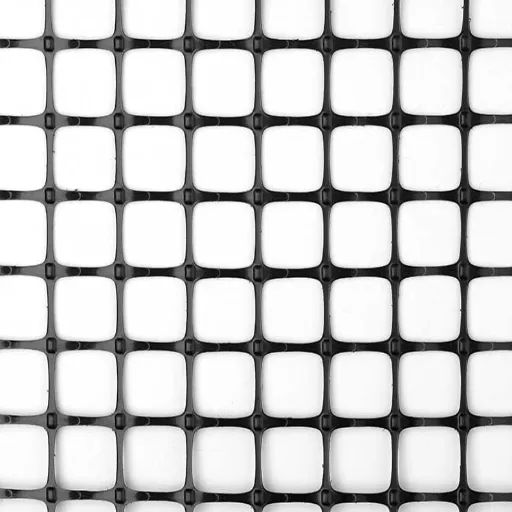
An LLDPE geomembrane is a flexible polyethylene liner made from linear low-density resin, specified under GRI-GM17 at a formulated sheet density of 0.939 g/ml or lower. It is the liner you choose when the ground will move, the basin is an awkward shape, or the sheet has to be fabricated into panels before it reaches site.
The material is also the most misquoted liner in the polyethylene family. Supplier pages list HDPE tensile values against LLDPE density, quote an 800% elongation that only applies to smooth sheet, and describe the product as a cheaper HDPE. None of it survives a reading of the standard.
This guide works from the two governing documents, GRI-GM17 and GRI-GM13, both revised 11 June 2025. It covers what GM17 actually requires at each thickness, how to pick a gauge, where LLDPE loses to HDPE and shouldn’t be sold, and how the material behaves under a welder.
If your site is already specified and you only need the material, the lists the thicknesses and finishes. If you’re still deciding between polymers, read the next section before you order.
Key Takeaways
- GRI-GM17 covers LLDPE at formulated density ≤0.939 g/ml, in thicknesses from 0.50 mm (20 mil) to 3.00 mm (120 mil).
- At 1.50 mm, GM17 requires the same 40 kN/m break strength as GM13 HDPE, with 800% elongation against HDPE’s 700%. LLDPE’s real deficit is tear, puncture and stress-crack resistance, not tensile strength.
- Textured LLDPE is specified at 250% minimum elongation, not 800%. Quoting the smooth value for textured sheet is a common and expensive error.
- GM17 deliberately omits an ESCR test. That omission, not the density, is the reason LLDPE is a poor default for a primary landfill liner.
- GSI predicts roughly 36 years of exposed life for GM17 sheet in a dry, arid climate. Buried life is longer, but no equivalent covered-lifetime model has been published for LLDPE.
Still weighing polymers? The sets every liner we supply side by side, so you can match the polymer to the site before anyone quotes a gauge.
What Is an LLDPE Geomembrane?
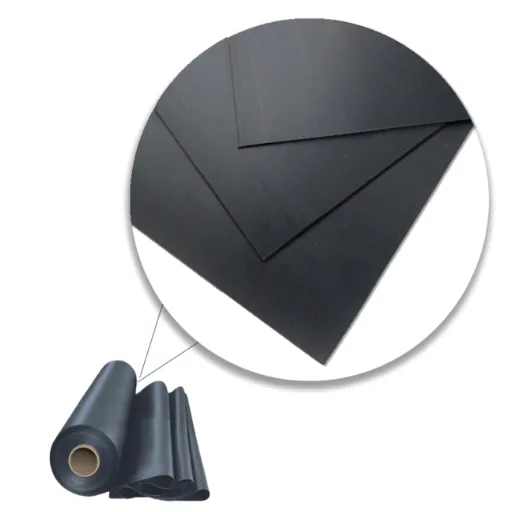
LLDPE geomembrane is a synthetic barrier sheet extruded from linear low-density polyethylene and used to control the movement of liquid, gas or waste. The polymer’s short chain branching produces a lower-density, less crystalline sheet than HDPE, and that structure is the source of every property that follows.
GM17 fixes the boundary in density rather than in name. A sheet qualifies if its formulated density is 0.939 g/ml or lower, measured by ASTM D1505 or D792. GM13 takes everything at 0.940 g/cc or higher. A formulator can move a resin across that line, which is why the density figure on a datasheet deserves more attention than the product name above it.
How LLDPE Differs From HDPE at the Polymer Level
HDPE has long, nearly unbranched chains that pack into a dense crystalline structure. LLDPE inserts short branches along the chain. The branches hold the chains apart, the crystallinity drops, and the sheet becomes softer, more extensible and easier to bend around a corner.
Two consequences matter commercially. The softer sheet conforms to irregular ground instead of bridging it, so a void under the liner tends to become a depression rather than a puncture. The same softness costs stiffness and tear strength, and those are the properties that protect a liner in a rough, load-bearing application.
GM17 formalises the second point with a cap rather than a floor. The 2% secant modulus mustn’t exceed 414 MPa. A sheet that’s too stiff fails the standard, because it’s no longer behaving like the flexible material the specification is written for.
What GRI-GM17 Covers
GRI-GM17 is a manufacturing quality control specification. It sets minimum, maximum or range values for physical, mechanical and endurance properties, and how often the manufacturer must test them.
It isn’t a design standard, and it doesn’t certify fitness for a project. A GM17-compliant sheet can still be the wrong liner for your site, which is why the application sections below matter as much as the property tables.
The standard also restricts what goes into the sheet. Resin must be virgin, rework is capped at 10% and must be the same formulation, and no post-consumer resin is permitted. Natural resin density is generally 0.926 g/ml or lower with a melt index of 1.0 g/10 min or less.
LLDPE Geomembrane Specifications Under GRI-GM17
The table below reproduces the smooth-sheet requirements from , Table 1(b), in SI units. These are minimum average values for break strength, tear, puncture and elongation, and a maximum for modulus and density.
| Property | Test method | 0.50 mm | 0.75 mm | 1.00 mm | 1.50 mm | 2.00 mm | 2.50 mm | 3.00 mm |
|---|---|---|---|---|---|---|---|---|
| Formulated density (max.) | D1505/D792 | 0.939 | 0.939 | 0.939 | 0.939 | 0.939 | 0.939 | 0.939 g/cc |
| Break strength | D6693 Type IV | 13 | 20 | 27 | 40 | 53 | 66 | 80 N/mm |
| Break elongation | D6693 Type IV | 800 | 800 | 800 | 800 | 800 | 800 | 800% |
| 2% secant modulus (max.) | D5323 | 414 | 414 | 414 | 414 | 414 | 414 | 414 MPa |
| Tear resistance | D1004 | 50 | 70 | 100 | 150 | 200 | 250 | 300 N |
| Puncture resistance | D4833 | 120 | 190 | 250 | 370 | 500 | 620 | 750 N |
| Axi-symmetric break strain | D5617 | 30 | 30 | 30 | 30 | 30 | 30 | 30% |
| Carbon black content | D4218 | 2.0–3.0 | 2.0–3.0 | 2.0–3.0 | 2.0–3.0 | 2.0–3.0 | 2.0–3.0 | 2.0–3.0% |
| Standard OIT, or HP-OIT | D8117 / D5885 | 100 / 400 | 100 / 400 | 100 / 400 | 100 / 400 | 100 / 400 | 100 / 400 | 100 / 400 min |
| Oven aging, 85 °C, 90 days | D5721 | 35 / 60 | 35 / 60 | 35 / 60 | 35 / 60 | 35 / 60 | 35 / 60 | 35 / 60% retained |
| UV resistance, 1600 h | D7238 | 35 | 35 | 35 | 35 | 35 | 35 | 35% HP-OIT retained |
Two rows in that table cause most of the confusion in the market. Break elongation of 800% is a smooth-sheet value. For single or double-sided textured LLDPE, GM17 Table 2(b) specifies 250% minimum, with a minimum average asperity height of 0.40 mm.
Texturing interrupts the surface that carries the strain, and the standard accounts for it. A page that advertises “800% elongation textured liner” is either quoting the wrong table or the wrong material.
The second row is density. GM17 is a ceiling, not a target. Any sheet at or below 0.939 g/cc qualifies, including material well below that line. Ask for the measured formulated density rather than assuming a nominal grade.
GM17 vs GM13: What Actually Differs
Placed side by side at 1.50 mm, and GM17 are closer than the sales literature suggests on tensile strength, and further apart on everything that governs field durability.
| Property at 1.50 mm, smooth | GRI-GM13 (HDPE) | GRI-GM17 (LLDPE) |
|---|---|---|
| Formulated density | ≥0.940 g/cc | ≤0.939 g/cc |
| Yield strength | 22 kN/m (required) | Not required |
| Break strength | 40 kN/m | 40 N/mm |
| Yield / break elongation | 12% / 700% | No yield / 800% |
| Tear resistance | 187 N | 150 N |
| Puncture resistance | 480 N | 370 N |
| Stress crack resistance (D5397) | 500 h required | Not in the standard |
| Oven aging, 90 days | 55% / 80% retained | 35% / 60% retained |
| UV, 1600 h | 50% retained | 35% retained |
| Minimum thickness | 0.75 mm (30 mil) | 0.50 mm (20 mil) |
Break strength is identical. Elongation favours LLDPE by 100 points. Everything else in the lower half of that table favours HDPE, and the most consequential row is the one marked “not in the standard”.
GM17 has no stress crack resistance requirement. It omits the ESCR test entirely, along with wide-width tensile, low-temperature impact, dimensional stability and ozone resistance, on the grounds that they’re outdated or not needed for routine manufacturing control. HDPE doesn’t have that luxury, because HDPE is the material that stress-cracks in service. If your application involves sustained tensile stress in a restrained sheet, GM13’s 500-hour requirement is doing real work.
What GM17 Does Not Test
A datasheet can say “manufactured to GRI-GM17” and still leave the site-specific questions unanswered. GM17 doesn’t address chemical compatibility. It doesn’t address design life. And until Rev 17, it didn’t address seam strength in the main tables at all.
Chemical resistance has to be established against the actual leachate, brine, effluent or process liquid, at the actual concentration and temperature. Neither GM13 nor GM17 substitutes for that test.
The new Rev 17 seam appendix is worth knowing about. Thermally bonded LLDPE seams must reach 30 lb/in shear at 20 mil, rising to 180 lb/in at 120 mil. Shear elongation must be at least 50%, peel strength runs from 25 to 150 lb/in by thickness, and peel separation mustn’t exceed 25%. Those are values you can write into a construction specification and test against.
LLDPE Geomembrane Thickness: How to Choose
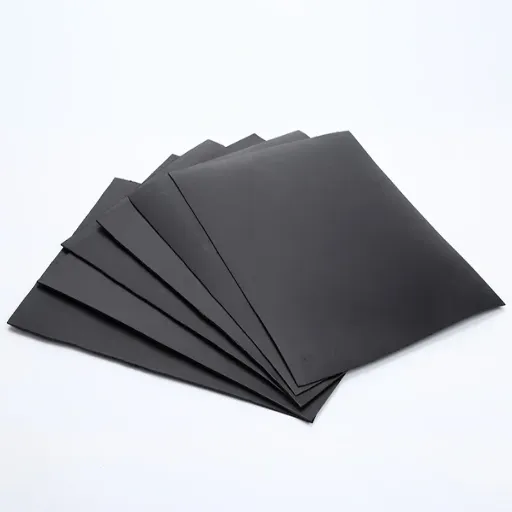
GM17 permits 20 mil to 120 mil. The useful range for most projects is narrower, and three inputs drive the choice: what will press on the sheet, how much of it will be exposed, and how much seam risk you’re willing to carry. The works through the full method.
| Thickness | Metric | Break strength | Puncture | Typical use |
|---|---|---|---|---|
| 20 mil | 0.50 mm | 13 N/mm | 120 N | Lining trays, small features, secondary containment over a prepared base |
| 30 mil | 0.75 mm | 20 N/mm | 190 N | Light-duty ponds and channels, protected installations |
| 40 mil | 1.00 mm | 27 N/mm | 250 N | Farm ponds, canals, factory-welded tanks |
| 60 mil | 1.50 mm | 40 N/mm | 370 N | Effluent ponds, reservoirs, closure caps |
| 80 mil | 2.00 mm | 53 N/mm | 500 N | Exposed reservoirs, sites with settlement risk |
| 100 mil | 2.50 mm | 66 N/mm | 620 N | Demanding containment, high exposure |
Mil-to-Millimeter Reference
One mil is 0.0254 mm. The conversion is exact; the roundings in the trade aren’t. A “1.0 mm” liner is a 40-mil liner and a “1.5 mm” liner is a 60-mil liner, and both names refer to nominal thickness.
GM17 allows the average measured thickness to sit at nominal, with no individual reading more than 10% below nominal on smooth sheet. On textured sheet the tolerance tightens to −5% for eight of ten readings and −10% for any single reading, because the texture has to be measured differently.
That asymmetry matters at handover. A textured 60-mil core isn’t a smooth 60-mil core, and the two shouldn’t be compared on one datasheet.
Application Floors and Regulatory Minimums
In the United States, sets the composite liner requirement for municipal solid waste landfill units. The upper component must be a flexible membrane liner of at least 30 mil, and where the FML is HDPE it must be at least 60 mil. The lower component is at least two feet of compacted soil at a permeability of 1×10⁻⁷ cm/s or less, and the leachate collection system must keep head below 30 cm.
Read it carefully before specifying LLDPE for a landfill. The 30-mil figure is a floor for non-HDPE membranes, not an endorsement of thin LLDPE in a waste cell. State programmes add their own requirements on top, and those govern.
Outside the regulated landfill context, published practice gives firmer numbers. recommends a minimum of 1.50 mm LLDPE for farm dairy effluent ponds. It accepts 1.00 mm for factory-welded tanks, where the seams are made under controlled conditions rather than in wind and dust.
The Two Thickness Mistakes
The first is buying thin to save on material. A 20-mil LLDPE geomembrane has a 120 N puncture resistance on the index test. Angular drainage aggregate, a rough base or one stone left in the subgrade can exceed that locally. The saving on resin is small against a repair.
The second is buying thick to compensate for a bad subgrade. Extra LLDPE geomembrane thickness raises the puncture index, but it doesn’t remove a protrusion, and it doesn’t fix a soft spot that will settle. A geotextile cushion and proper compaction solve those problems at lower cost than another 20 mil of polymer.
Where LLDPE Performs Best, and Where It Does Not
The application fit below reflects what GM17 sheet does well, what it does with caveats, and where another polymer is the better purchase. The scenarios are composites drawn from common project patterns, not named client jobs.
| Application | Fit | Reason |
|---|---|---|
| Irrigation and farm ponds | Suitable | Conforms to irregular basins; 1.50 mm is established practice for effluent ponds |
| Aquaculture ponds | Suitable with checks | Flexible and weldable; food-contact certification must be requested, not assumed |
| Landfill closure caps | Suitable | Tolerates differential settlement that would stress a stiff sheet |
| Wastewater and process lagoons | Suitable with testing | Chemical compatibility must be confirmed against the actual effluent |
| Secondary containment | Suitable | Good conformance over prepared bases |
| Reservoirs and dams | Suitable with care | Exposure and wave action push thickness and anchoring requirements up |
| MSW primary bottom liner | Not recommended | GM17 omits ESCR; state rules and practice favour 60-mil HDPE |
| Heap leach and aggressive mining | Not recommended as default | Chemical and thermal load favour HDPE |
Three Places LLDPE Loses
Primary landfill liners. The federal rule allows a non-HDPE FML at 30 mil, but the absence of a stress-crack requirement in GM17 is the real issue. Leachate containment is a long-term, restrained, chemically loaded application, and that’s precisely the combination HDPE’s 500-hour ESCR test is written for. The guide sets out what a waste cell actually requires.
Aggressive chemical service. GM17 doesn’t test chemical resistance, and neither does GM13. Where the contained liquid is hot, concentrated or variable, the material choice should follow a compatibility test rather than a polymer preference.
High-puncture, exposed sites. At equal thickness, GM13 requires 480 N puncture against GM17’s 370 N, and 187 N tear against 150 N. On demolition waste, sharp rock or a site where the liner can’t be protected, that gap is the deciding factor.
When LLDPE Is the Right Answer
A reservoir built on fill that will settle for a decade is the classic case. A stiff sheet bridges the void and concentrates stress at the edges. A flexible sheet deflects into the depression and keeps bearing on the subgrade.
The same argument applies to , where basins are rarely uniform. It also applies to a closure cap over waste that keeps compressing, and to a basin where factory fabrication removes hundreds of metres of seam.
In each case, the value is conformance and seam reduction, not strength. Buying LLDPE for strength is buying the wrong property.
The scenarios below are composites drawn from common project patterns, not named client jobs. Each one turns on one decision.
The reservoir on settling fill. A 4-hectare reservoir sat over 3 m of placed fill that the geotechnical report expected to consolidate 150 mm over five years. The first design called for 1.50 mm HDPE. The installer flagged the settlement risk: a stiff 60-mil sheet spanning a softening area concentrates stress at the void edge, and that’s where stress cracking starts.
The revision used 1.50 mm LLDPE at the same thickness, with a nonwoven cushion beneath and a wider anchor trench. The cost difference was negligible. The reason to change polymer was the ground, not the price.
The closure cap that couldn’t carry a load. A closed waste cell needed a final cap over uneven, uncompacted waste. HDPE at 60 mil would have bridged the low spots.
LLDPE at 60 mil was specified instead because it could deflect, take bearing on the waste surface, and be fabricated into large factory panels that reduced field seaming on an awkward plateau. The cap is buried, so UV exposure isn’t the governing case.
Specifying a pond or a cap? Send the basin dimensions, the subgrade description and the contained liquid. We will tell you whether LLDPE is the right polymer before you commit to a gauge. Talk to our technical team.
Installation and Welding: What Changes With LLDPE
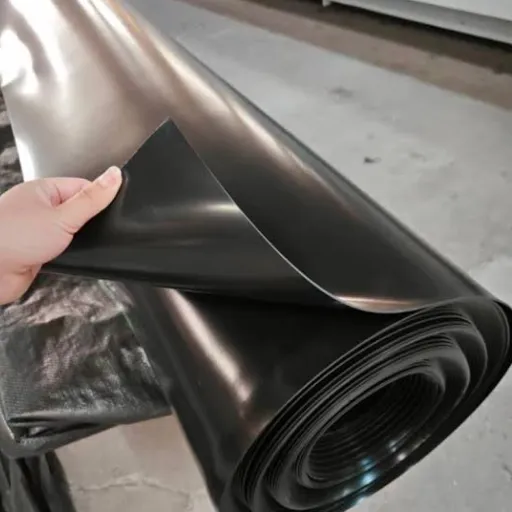
Installing LLDPE uses the same methods as HDPE: deploy, weight or anchor, weld with a hot wedge or extrusion fillet, then test the seam. What changes is the welder setting and the slack you leave in the sheet.
Thermal Movement and Slack
Polyethylene moves a great deal with temperature. HDPE has a coefficient of thermal expansion around 203 ×10⁻⁶ mm/mm/°C, and a 33 m liner can move more than half a metre across a −40 °C to +35 °C swing. LLDPE is a flexible, unsupported sheet, and flexible sheets tolerate that movement by stretching locally rather than by building stress, which is why they need less slack than a stiff sheet.
Less isn’t none. A restrained LLDPE panel welded into an anchor trench and left exposed will still contract, and the seam or the anchor takes the load. Install with slack distributed across the surface, place tie-in seams and backfill anchor trenches at the coolest part of the day, and measure temperature at the sheet rather than in the air. Black liner in sun can run far hotter than ambient.
Wedge and Extrusion Settings
LLDPE melts at a lower temperature than HDPE and welds across a different window. Carrying HDPE settings onto LLDPE sheet is the most common cause of a weak seam. Too much heat degrades the polymer at the weld interface, and the seam passes a visual check while failing in peel.
Set the machine by trial weld, not by a table. Weld a sample at the start of each shift, at the actual sheet thickness and surface finish, and pull it before production welding begins. ASTM D8580 covers wedge welding practice for polymeric geomembranes and is the reference to put in the method statement.
Seam Testing
Non-destructive testing for a double-wedge seam means an air channel test along the weld, plus visual inspection of the seam and the parent sheet. Destructive testing means cutting coupons at the frequency set in the project specification and testing them in shear and peel to the GM17 Rev 17 appendix values.
For a 60-mil (1.50 mm) sheet, that means 90 lb/in minimum shear strength, 50% minimum shear elongation, and 75 lb/in minimum peel strength with no more than 25% peel separation. Test results that meet shear but fail peel are a temperature problem, not a material problem, and the fix belongs in the welder settings.
Full method detail sits in the guide and the .
Chemical Resistance, UV, and Service Life
GM17 keeps a liner alive with three things: carbon black, antioxidants, and thickness. The standard tests all three, and the numbers are a better guide to durability than any marketing claim.
Carbon black content is specified at 2.0% to 3.0% by mass, with a dispersion requirement of nine out of ten microscopic fields in Category 1 or 2. Carbon black is the UV screen, and a sheet with poor dispersion has weak points even when the total content passes.
Antioxidants are measured by oxidative induction time. A conforming sheet must reach 100 minutes on the standard OIT test or 400 minutes on the high-pressure test. After 90 days at 85 °C in an oven, it must retain 35% or 60% of that value, depending on the method. After 1600 hours of UV exposure, it must retain 35% of its high-pressure OIT.
Those retained-percentage figures are where LLDPE and HDPE separate again. GM13 requires 55% and 80% retention after oven aging and 50% after UV; GM17 requires 35%, 60% and 35%. LLDPE is specified to hold less of its antioxidant reserve through the same aging regime. That’s a design input, not a defect, but it should inform how much the sheet is exposed and how long the design life is.
Exposed vs Buried Life
The Geosynthetic Institute’s lifetime work is the most-cited source here, and it’s careful about its own limits. In a dry, arid climate, its weathering programme predicts a half-life of approximately 36 years for LLDPE made to GRI-GM17, with the HDPE programme still running past 36 years. A separate GRI report puts 1.00 mm LLDPE at 33 years on the same basis.
Half-life means a 50% loss of strength or elongation, not failure. It’s also a dry-climate figure; hotter, wetter or more exposed sites will do worse, and the same GSI work shows predicted life falling steeply as service temperature rises.
Buried life is much longer, and here the honest answer is that nobody has modelled it for LLDPE the way it’s been modelled for HDPE. GSI’s covered-lifetime programme was built around HDPE, where predicted half-lives run into centuries at moderate temperature. No equivalent published model exists for GM17 sheet. Treat claims of a specific buried lifespan for LLDPE with suspicion unless the claimant can show the model.
What you can specify is a warranty. Engineering New Zealand’s practice note recommends seeking a minimum 20-year product warranty supported by the manufacturer, plus a five-year installation warranty, and warns that the supplier’s warranty mustn’t exceed the manufacturer’s.
Leak detection is worth budgeting for on any large installation. The method finds holes in an installed liner before it goes into service, and it works on LLDPE.
LLDPE vs the Other Flexible Liners
LLDPE sits between HDPE and the genuinely soft liners, and the trade-offs are easier to see as a set.
| Material | Strength | Flexibility | Best fit |
|---|---|---|---|
| HDPE (GM13) | Highest tear, puncture, ESCR | Low | Landfill bottoms, mining, chemical containment |
| LLDPE (GM17) | Moderate | High | Ponds, caps, settlement-prone ground |
| LDPE | Lowest | High | Light-duty and short-life liners |
| PVC | Moderate | Very high | Tanks, irregular shapes, decorative ponds |
| EPDM | Moderate | Very high | Long-life exposed water features |
Against HDPE, the decision comes down to whether the site moves and whether the contained liquid is aggressive. That argument is set out in full in the , and the page covers the other side of it.
Against PVC, LLDPE wins on chemical resistance and on having no plasticiser, which is why it suits aquaculture and potable-adjacent water. PVC wins on conformability around complex tank geometry and on solvent welding in tight spaces.
LDPE is the material LLDPE largely replaced. The names differ by one letter; the resins differ in almost everything that matters.
The pond where HDPE was the right answer. A contractor asked for LLDPE for a leachate holding pond at a composting facility. The leachate ran warm and carried organic acids at a concentration that a compatibility test flagged as aggressive.
The recommendation was 1.50 mm HDPE instead, because GM13’s stress-crack requirement covers exactly the sustained-load, chemically active case the pond presented, and GM17 has no equivalent test. LLDPE was the wrong purchase for that site. Saying so costs a sale and saves a liner.
How to Specify and Source LLDPE Geomembrane
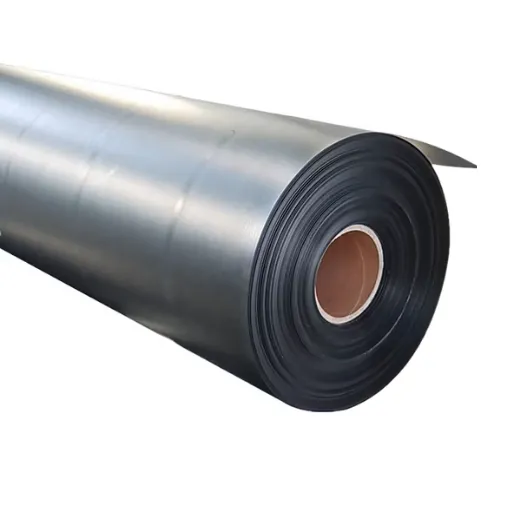
An LLDPE liner is only as good as the datasheet behind it. The checklist below is what a purchaser should be able to obtain before a container ships.
The Datasheet Checklist
- Formulated sheet density, measured, with the test method stated
- Resin density and melt index, with the ASTM method
- Thickness and the tolerance band, and whether smooth or textured
- Break strength and break elongation at the ordered thickness
- 2% secant modulus, tear and puncture values at the ordered thickness
- OIT value and method (standard or high-pressure), plus oven aging and UV retention
- Carbon black content and dispersion result
- Seam strength values the installer will be tested against
- A statement that the sheet contains no post-consumer resin
A datasheet reporting 20% or 25% elongation for LLDPE is carrying geotextile or HDPE figures and should be rejected. One reporting 800% for textured sheet has copied the wrong table.
What to Ask Before a Container Ships
Ask for the manufacturing quality control records for the production run, not a generic certificate. Ask which thicknesses are held in stock and which are made to order, because a made-to-order gauge changes the lead time. Ask for the panel layout that will minimise field seams on your basin, since seam count drives installation cost more than sheet price does.
For a project with a defined design life, ask for the chemical compatibility basis, not just a chemical resistance chart. A chart gives a ranking; your project needs a conclusion at your concentration and temperature.
Ready to specify? Send the thickness, surface finish, panel layout and destination port. We will confirm the sheet, the seam values and the documentation before you place the order. Request a technical quote.
Frequently Asked Questions
What is the difference between LLDPE and HDPE geomembrane?
LLDPE has a formulated density of 0.939 g/ml or lower under GRI-GM17; HDPE is 0.940 g/cc or higher under GRI-GM13. HDPE has higher tear, puncture and stress-crack resistance. LLDPE has higher elongation and conforms better to uneven ground. At 1.50 mm, both standards require 40 kN/m break strength.
Is LLDPE UV resistant?
GM17 requires a sheet to retain 35% of its high-pressure OIT after 1600 hours of UV exposure under ASTM D7238, with carbon black at 2.0% to 3.0% as the UV screen. That is resistance, not immunity. Exposed installations should be designed for the exposure and specified at greater thickness than buried ones.
Are LDPE and LLDPE the same?
No. LDPE has long-chain branching; LLDPE has short, controlled branching that produces a tougher, more extensible resin at similar density. LLDPE largely replaced LDPE in liner applications. They are different materials and should not be specified interchangeably.
Is LLDPE good for a pond liner?
Yes, for most farm, irrigation and aquaculture ponds. An LLDPE pond liner conforms to irregular basins, welds reliably and tolerates settlement. Engineering New Zealand’s Practice Note 21 recommends a minimum of 1.50 mm for effluent ponds. For a small decorative pond, a thinner consumer-grade liner may be adequate.
Can LLDPE geomembrane be welded?
Yes. Hot wedge and extrusion fillet welding are both used, and GM17 Rev 17 includes an appendix setting seam strength, shear elongation and peel requirements by thickness. LLDPE welds at a lower temperature than HDPE, so the machine must be set by trial weld on the actual sheet rather than by copying an HDPE setting.
How long does LLDPE geomembrane last?
GSI’s weathering programme predicts a half-life of roughly 36 years for GM17 sheet in a dry, arid climate, and a separate GRI report gives 33 years for 1.00 mm material. Buried life is considerably longer, but no published covered-lifetime model exists for LLDPE. A 20-year product warranty is standard practice.
What thickness LLDPE geomembrane do I need?
It depends on what presses on the sheet, how much is exposed, and the chemical load. A 20-mil sheet suits light duty over a prepared base; 40 mil is common for farm ponds and factory-welded tanks; 60 mil is the usual floor for effluent ponds, reservoirs and closure caps. Use the puncture and tear values in the table above as the starting point, not a single rule of thumb.
Conclusion
LLDPE geomembrane earns its place when the site moves, the geometry is awkward, or the seam count matters more than the sheet’s strength. It isn’t a budget version of HDPE, and the two standards make that clear: the break strength is the same at equal thickness, while the tear, puncture and stress-crack requirements diverge sharply.
Three points are worth carrying into a specification. GM17 is a density ceiling of 0.939 g/ml, not a grade name. The 800% elongation figure applies to smooth sheet, and textured sheet is specified at 250%. And the absence of an ESCR requirement is the real reason to think twice before using LLDPE in a primary landfill liner.
Choose an LLDPE geomembrane for conformance and elongation, protect it against puncture, and confirm chemical compatibility against your own liquid. Do that, and the liner will perform the way the standard says it should.
Not sure which polymer your site needs? Describe the basin, the subgrade and the contained liquid, and our technical team will tell you whether LLDPE is the right purchase or whether HDPE is. Start the conversation.