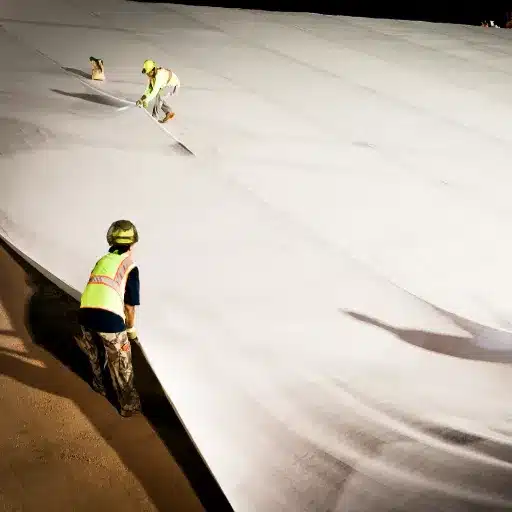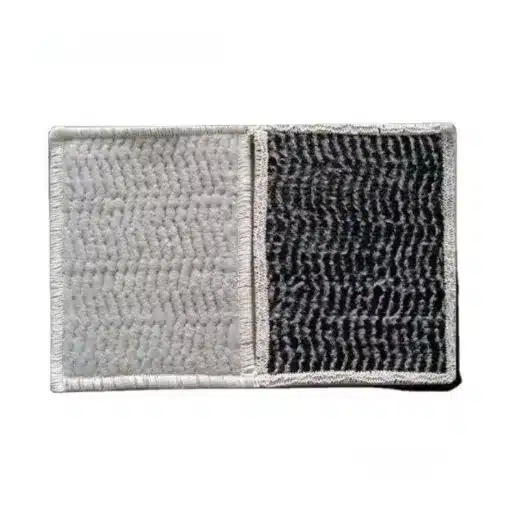
Temporary roadway mats are modular panels laid over unstable or sensitive ground to create stable, reusable access roads and haul routes for construction, utility, and infrastructure projects. They distribute vehicle loads, protect the subgrade, and can be removed and reused once the project is complete.
A project manager in East Africa learned this the hard way. His crew laid thin plywood sheets across a trenching site to move light trucks. After one heavy rain, the panels warped, the trucks sank, and the team lost two days digging equipment out of the mud. A switch to 20 mm HDPE temporary roadway mats with a geotextile underlayment kept the same access road open through the rest of the wet season.
This guide explains how to select, design, install, and cost-justify temporary roadway mats for real engineering projects.
Key Takeaways
- Temporary roadway mats create reusable haul roads over soft, wet, or sensitive ground without permanent earthworks.
- HDPE mats handle 30–120 t and suit rubber-tired vehicles; composite and timber mats are needed for steel-tracked plant and extreme loads.
- A well-designed temporary access road needs 3 m for single-lane traffic, 6 m for two-way traffic, passing bays every 100–150 m, and a turning radius of 12–15 m.
- Soft ground can reduce effective load capacity by 30–50%, so geotextile separation and, in severe cases, geogrid reinforcement are essential.
- Over a multi-year or repeat-use project, reusable mats typically cost less than aggregate roads when installation, maintenance, and restoration are included.
What Are Temporary Roadway Mats?

Temporary roadway mats are engineered panels used to build short- or medium-term driving surfaces over ground that cannot safely support repeated vehicle loading. They are also called trackway panels, access mats, haul road mats, portable road mats, and bog mats when used in wetland conditions.
Unlike small work pads that protect a single stationary area, temporary roadway mats are designed to form continuous routes. Trucks, excavators, cranes, and other plant can travel over them repeatedly without cutting ruts into the soil below.
These mats serve four core functions:
- Load distribution. They spread concentrated axle loads over a wider area, reducing ground pressure.
- Traction. Textured surfaces give tires and tracks grip in mud, sand, or clay.
- Subgrade protection. They prevent rutting, compaction, and contamination of the underlying soil.
- Reusability. Quality mats can be lifted, cleaned, stacked, and redeployed on the next site.
For buyers comparing broader ground protection products, our complete ground protection mats buyer’s guide covers mats for work pads, events, and general site protection. This article focuses specifically on continuous access roads and haul routes.
Types of Temporary Roadway Mats: HDPE, Composite, and Timber
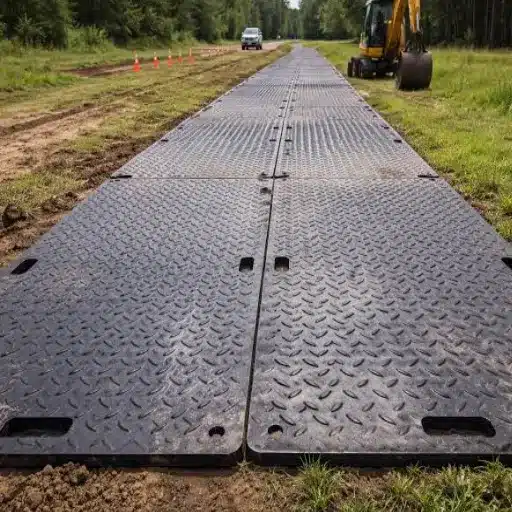
Material selection is the most important decision when specifying temporary roadway mats. Each material has a different strength-to-weight ratio, load capacity, lifespan, and handling cost.
HDPE Mats
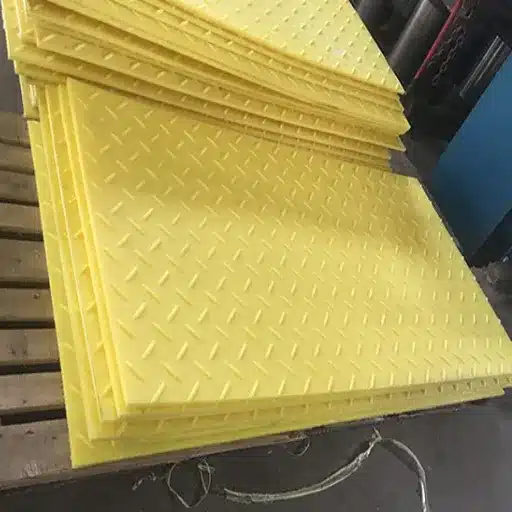
High-density polyethylene (HDPE) mats are the most common choice for general construction access. A standard 1.2 m × 2.4 m panel weighs 25–45 kg, which allows two workers to carry and position it by hand.
Typical HDPE temporary roadway mats support 30–120 t depending on thickness and ground conditions. They resist chemicals, UV exposure, and water absorption, and they are 100% recyclable. For a deeper look at HDPE specifications, see our guide to HDPE temporary roadway mats.
UHMWPE Mats
Ultra-high-molecular-weight polyethylene (UHMWPE) mats are denser and stronger than standard HDPE. A 4.0 m × 2.0 m × 53 mm panel can weigh 380 kg and support up to 250 t. These mats are often used where tracked equipment or extreme point loads are expected.
Composite Mats
Composite mats blend polymers, fibers, and sometimes steel reinforcement to create rigid panels with high load ratings. Signature Systems’ MegaDeck HD+, for example, measures 7.5 ft × 14 ft × 4 in and is rated up to 600 psi. These systems excel on long-term projects with heavy cranes or large steel-tracked plant.
Timber Bog Mats
Hardwood timber bog mats remain the traditional choice for steel-tracked equipment and wetland access. A 6 m × 1 m × 300 mm hardwood mat can weigh over 1,600 kg and support 200 t or more. Timber absorbs moisture over time, which limits lifespan and increases transport cost per use.
Material Comparison
| Material | Typical Weight | Load Capacity | Best For | Lifespan | Recyclable |
|---|---|---|---|---|---|
| HDPE | 25–45 kg per 1.2×2.4 m panel | 30–120 t | Rubber-tired vehicles, rapid install | 10–15 years | Yes |
| UHMWPE | 40–380 kg per panel | 80–250 t | Heavy-duty access, tracked plant | 10–15 years | Yes |
| Composite | 225–1,025 lbs per panel | 400–600 psi | Cranes, extreme loads, long-term | 10+ years | Limited |
| Timber | 230–1,620 kg per mat | 50–250+ t | Steel-track equipment, wetlands | 3–5 years | No |
For a direct comparison of the two most common modern materials, read our article on composite vs HDPE temporary roadway mats. If your project involves steel tracks or peat bogs, our guide to timber bog mats vs temporary roadway mats will help you decide.
Want to see HDPE specifications for your project? Browse our temporary roadway mats catalog or request a technical quote.
How to Plan a Temporary Access Road
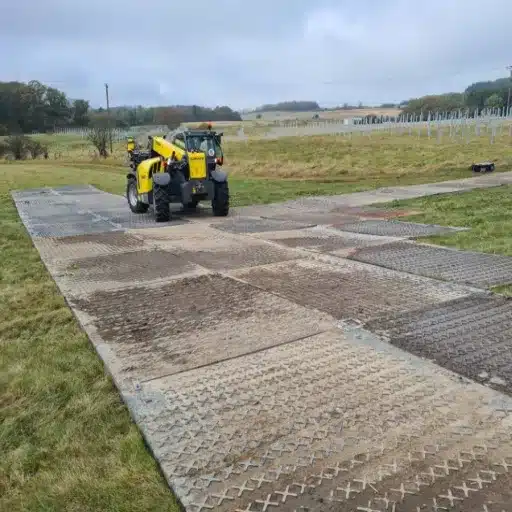
A temporary roadway is more than a line of panels on the ground. Poor planning causes rutting, delays, and unsafe conditions even with high-quality mats.
Site Assessment
Start with the ground itself. Collect or estimate:
- Soil type and moisture content. Clay, peat, sand, and silt behave very differently under load.
- California Bearing Ratio (CBR) or ground bearing capacity. Light-duty mats need >50 kPa; medium-duty work needs >75 kPa; heavy loads require site-specific engineering.
- Slope and drainage. Water trapped under a mat road weakens the subgrade.
- Buried utilities and obstructions. Mark these before any surface work begins.
Road Design Parameters
Use these minimum dimensions as a starting point:
- Single-lane width: 3 m
- Two-way width: 6 m
- Passing bays: every 100–150 m on single-lane routes
- Turning radius: 12–15 m for large trucks and cranes
- Gradient: ideally ≤10%; steeper slopes need anchoring
A civil engineer on a European wind farm project ignored the turning radius. A 35 m crane boom could not navigate the tight corner at the base of the access road. The crew had to lift and relay 80 mats to widen the bend, costing three days and €12,000 in labor.
For more details on layout and geometry, see our temporary roadway design guide.
Traffic Loading Analysis
List every vehicle that will use the road. Record:
- Gross vehicle weight
- Axle loads
- Wheel or track configuration
- Frequency of trips per day
- Braking, turning, and acceleration zones
Steel-tracked equipment creates high point loads and sharp turns that cut into HDPE. For these cases, specify timber or composite mats.
Installation Best Practices for Temporary Roadway Mats
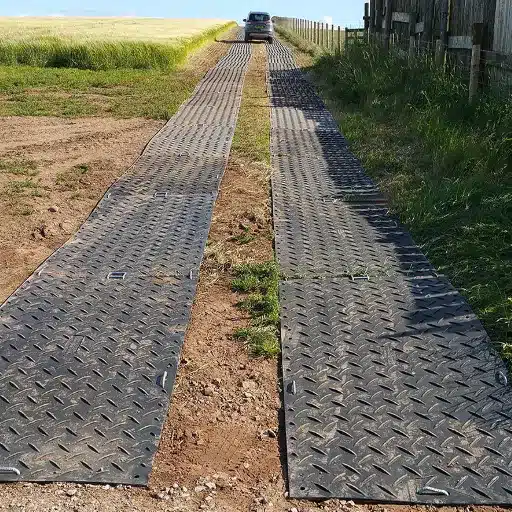
Correct installation determines whether a temporary roadway lasts one week or one year. The steps below apply to most modular mat systems.
1. Site Preparation
Clear vegetation, roots, and debris. Strip topsoil if it is soft or organic. Grade the surface to ±50 mm over a 10 m baseline so panels sit flat. Mark all utilities.
2. Subgrade Reinforcement
On firm, dry ground, mats can often be laid directly on the prepared surface. On soft or saturated soils, add a geotextile separation layer first. In severe cases — CBR below 30 kPa or visible water — combine geogrid with a compacted aggregate layer before placing mats.
Our geotextile fabric guide explains how separation layers work. For deeper stabilization, see our geogrid stabilization guide.
3. Layout and Connection
Begin laying mats on a firm surface, such as an existing road or compacted platform. Lay panels in the direction of travel. Stagger joints by at least half a panel length so no continuous seam crosses the road. Connect all edges before the first vehicle drives onto the roadway.
A Southeast Asia highway expansion used 20 mm HDPE mats to build a 200 m access road across soft clay. The contractor laid a nonwoven geotextile first, staggered joints, and pinned edges every 2 m. The road stayed level through monsoon rains that shut down neighboring aggregate access routes.
4. Edge Treatments and Ramps
Provide entry and exit ramps at transitions to existing surfaces. Verify the mat width matches the design width. Trip hazards at panel edges cause most minor incidents.
5. Anchoring on Slopes
Roadways on grades above 10% should be anchored. Options include stakes through panel holes, sandbags at edges, or dedicated anchor pins. Without anchoring, mats can shift downhill under braking loads.
For a step-by-step installation workflow, read our article on how to install temporary roadway mats on soft ground.
Load Capacity by Equipment Type
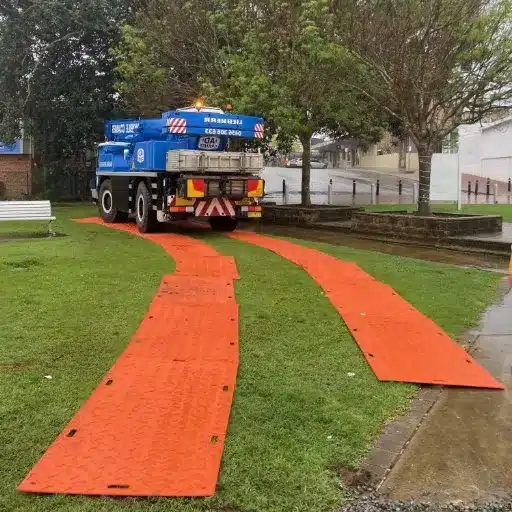
Load capacity tables are useful, but real performance depends on ground condition, panel thickness, connection quality, and vehicle dynamics.
Light Vehicles and Utilities
- Equipment: Cars, vans, light utility vehicles, small MEWPs
- Recommended mat: 10–12 mm HDPE
- Capacity: up to 25 t on firm ground
Trucks and Haul Vehicles
- Equipment: Dump trucks, concrete mixers, articulated haulers
- Recommended mat: 15–20 mm HDPE
- Capacity: 40–80 t on firm ground
Cranes and Heavy Plant
- Equipment: Mobile cranes, drilling rigs, piling equipment
- Recommended mat: 20–25 mm HDPE, UHMWPE, or composite
- Capacity: 100–250+ t
Crane outriggers create extreme point loads at the road edge. Always place additional support pads or thicker mats under outrigger feet.
Steel-Tracked Equipment
- Equipment: Excavators, dozers, crawler cranes
- Recommended mat: Timber bog mats or heavy-duty composite mats
- Why: Steel tracks cut and deform HDPE under turning loads
For equipment-specific guidance, see our article on temporary roadway mats for heavy equipment and crane access. For thickness selection, read our temporary roadway mat thickness guide.
Cost Comparison: Mats vs. Aggregate Roads
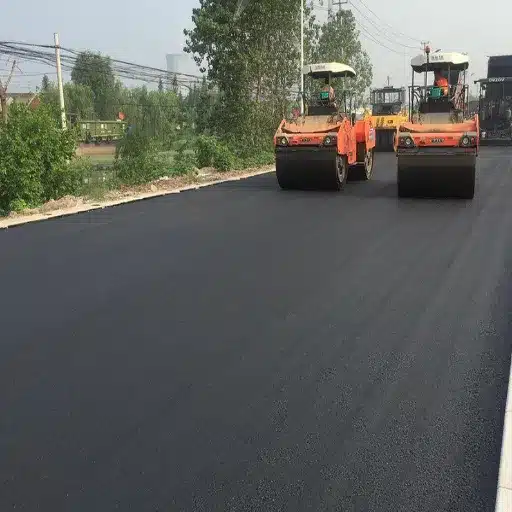
Cost decisions often drive the choice between temporary mats and traditional aggregate roads. The right answer depends on project duration, reuse potential, and site conditions.
Upfront Cost
At volume, HDPE temporary roadway mats typically range from $30–$76 per panel. Composite systems range from $200 per panel up to $4,200+ for extreme-duty mats. Timber bog mats fall in the mid-to-high range depending on hardwood species and dimensions.
Aggregate roads require earthworks, base course material, and surfacing. Costs vary widely by region, but a basic unpaved access road can easily run $15–$40 per linear meter.
Installation and Removal
A trained crew can install 50–75 HDPE mats per hour on flat ground. Removal is similarly fast. Aggregate roads take days or weeks to build and often require heavy equipment to remove.
Maintenance and Reuse
HDPE and composite mats need only cleaning and inspection between projects. Aggregate roads need regular grading and re-graveling. An Iowa State study on aggregate road maintenance lists re-graveling cycles at roughly $15,200 each.
10-Year Total Cost of Ownership
| Cost Factor | HDPE Mats | Aggregate Road |
|---|---|---|
| Upfront material | Medium | Low–Medium |
| Installation labor | Low | High |
| Annual maintenance | Low | High |
| Removal/restoration | Low | High |
| Reuse across projects | Yes | No |
| Typical best fit | <6 months rental; multi-year purchase | Very long-term, permanent routes |
For short-term or one-off projects, rental mats are often the lowest total cost. For multi-year or repeat projects, purchasing mats usually pays back within the first year of reuse.
A procurement director at a Nigerian pipeline project compared 200 plywood panels at $25 each against 200 HDPE mats at $70 each. The plywood had to be replaced three times in eight months, totaling $15,000. The HDPE mats lasted the full project with zero replacements. The higher upfront cost saved money and eliminated downtime from mat failure.
For a full cost breakdown, see our article on temporary roadway mats cost: buy vs rent vs lease.
Weather and Ground Condition Considerations
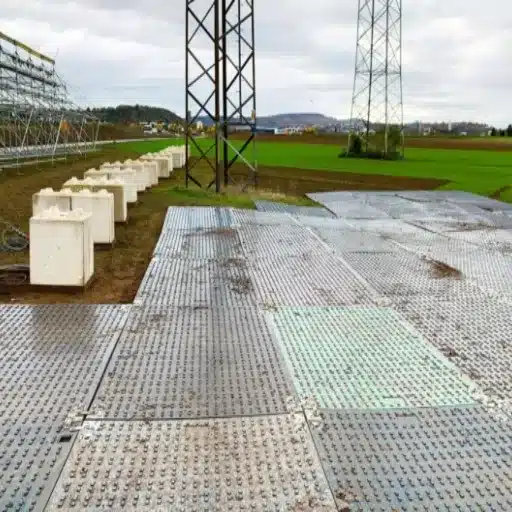
Climate and soil type change how temporary roadway mats perform.
Soft Ground and Saturated Soils
Wet clay, silt, and loose fill reduce effective load capacity by 30–50%. Always use a geotextile separation layer. For very soft ground, add a geogrid and aggregate base before placing mats.
Wetlands and Peat
Floating or large-panel systems work best in bogs and marshes. Timber bog mats are traditional here because their weight helps them settle and stay in place. Environmental permitting may require full removal and site restoration after use.
Freeze-Thaw Cycles
In cold climates, water trapped under mats can freeze and heave panels out of alignment. Use drainage channels and inspect joints after thaw events. Some composite pins can freeze solid; HDPE becomes brittle below -40°C, so handle carefully in extreme cold.
Sandy and Desert Conditions
Sand offers good drainage but poor anchoring. Mats can drift under wind or vehicle movement. Increase panel overlap and use edge anchoring. Avoid very thin panels that can flex and scoop sand.
Monsoon and Heavy Rain
Drainage is critical. Slope the road surface slightly to shed water. Inspect after major rain events for displacement or rutting. In the Southeast Asia example above, the geotextile layer prevented the subgrade from turning to mud.
For more on soft-ground applications, read our guide to temporary access mats for soft ground and wetlands.
Connection Systems for Continuous Roadways
A temporary roadway is only as strong as the joints between panels. The right connection system depends on load, slope, and how often the road will be moved.
Interlocking Flanges
Panels with built-in tongue-and-groove edges lock together without separate hardware. These systems install quickly and work well for light- to medium-duty rubber-tired traffic.
Pin and Bolt Systems
Holes along panel edges accept pins or bolts that prevent separation under heavy loads. These are required for crane access roads, sloped routes, and steel-tracked equipment.
Cam-Lock / Quick-Connect
Cam-lock systems allow fast installation and removal. They are popular in rental fleets and event applications where roads are laid and lifted frequently.
Connection Wear and Inspection
Pins, flanges, and locking mechanisms wear with use. Inspect connections after each project and replace damaged hardware. A failed joint under a loaded truck can cause panel displacement and vehicle damage.
For a detailed comparison of connection types, see our article on interlocking connection systems for temporary roadway mats.
Global Sourcing and Quality Assurance
For international buyers, sourcing mats from a manufacturer with export experience reduces cost and improves quality consistency.
Shanxi Shengxing manufactures HDPE and composite ground protection mats under ISO9001 quality management. Key advantages for global projects include:
- Container loading optimization. A 40-foot high-cube container holds roughly 300–500 HDPE mats depending on thickness, reducing freight cost per mat.
- Custom specifications. Thickness, surface texture, color, and connection systems can be tailored to project requirements.
- Sample retention. Production samples are retained for five years to support batch traceability and quality verification.
- Flexible MOQ. Order volumes can be scaled for pilot projects, mid-size contracts, or bulk fleet supply.
If you are comparing suppliers, ask for test data, load certificates, and references from similar projects. A low unit price means little if panels crack in the first season.
Need project-specific specifications? Contact our engineering team for a tailored recommendation.
Frequently Asked Questions
What are temporary roadway mats?
Temporary roadway mats are modular panels placed over soft, wet, or sensitive ground to create stable, reusable driving surfaces for construction and infrastructure projects.
How much weight can temporary roadway mats hold?
HDPE mats typically support 30–120 t depending on thickness and ground conditions. Composite and timber systems can handle 200 t or more, including steel-tracked equipment.
How thick should temporary roadway mats be?
Light vehicles need 10–12 mm; trucks and haul vehicles need 15–20 mm; cranes and heavy plant need 20–25 mm or more. Ground softness may require thicker mats or a reinforced subgrade.
Are temporary roadway mats better than aggregate roads?
For short-term, repeat-use, or environmentally sensitive projects, mats are usually faster to install, reusable, and lower in total cost. Aggregate roads make sense for permanent or very long-term routes.
Can temporary roadway mats be used on wetlands?
Yes, but choose larger, heavier panels or timber bog mats designed for soft ground. Geotextile and geogrid reinforcement are often necessary.
How long do temporary roadway mats last?
Quality HDPE and UHMWPE mats last 10–15 years with proper maintenance. Composite mats can last 10+ years. Timber bog mats typically last 3–5 years.
What is the cheapest temporary roadway mat?
Thin HDPE panels have the lowest upfront cost, but they may fail under heavy loads. The cheapest total cost depends on load, duration, and reuse potential.
How do you connect temporary roadway mats?
Connection methods include interlocking flanges, pin-and-bolt systems, and cam-lock fasteners. Heavy loads and slopes require mechanical fastening.
Conclusion
Temporary roadway mats turn unstable ground into usable haul roads without the time, cost, and environmental disruption of permanent earthworks. The right system depends on vehicle loads, ground conditions, project duration, and how often the mats will be reused.
Key points to remember:
- Match the material to the load: HDPE for rubber-tired traffic, composite or timber for steel tracks and extreme loads.
- Design the road before laying the first panel: width, turning radius, passing bays, and drainage all matter.
- Reinforce soft ground with geotextile and, if needed, geogrid plus aggregate.
- Include connection systems, edge ramps, and slope anchoring in the specification.
- Calculate total cost over the project life, not just the price per mat.
If you are planning a site access road, browse our HDPE temporary roadway mats or request a technical quote from our engineering team.