Choose composite temporary roadway mats for crawler cranes, long-term roads, and loads above 100 tons. Choose HDPE temporary roadway mats for rubber-tired vehicles, rapid deployment, and budgets where portability matters. Both materials reduce ground pressure, but they differ in stiffness, weight, freight efficiency, and total cost of ownership.
This guide covers the HDPE vs composite ground protection mats decision for construction, energy, utility, and infrastructure projects. You will learn how load capacity, panel weight, freight economics, lifespan, and track type affect the decision. You will also see why neither material is the right answer for steel-grouser tracks.
A utility contractor in East Texas had to build a 2 km access road across clay soil for 40-ton concrete trucks. He compared composite vs HDPE temporary roadway mats and chose 20 mm HDPE because two workers could install roughly 300 panels per day. The road held up for the full 8-month project, and the mats were reused on three later jobs without performance loss.
Key Takeaways
- Composite mats carry 100-600+ tons and suit heavy crawler cranes, long-term roads, and extreme mixed traffic.
- HDPE mats carry 30-120 tons, weigh 25-45 kg per 4′ x 8′ panel, and are ideal for rubber-tired vehicles and rapid deployment.
- On soft clay, peat, or saturated soils, reduce rated capacity by 30-50% for both materials.
- Neither standard HDPE nor most composite mats are suitable for steel-grouser tracks; use hardwood crane mats for steel-tracked equipment.
- Freight economics favor HDPE for light-duty export projects and composite for heavy-duty projects where fewer panels cover more area.
Quick Verdict
| Scenario | Recommended Material |
|---|---|
| Heavy crawler cranes, long-term roads, loads above 100 tons | Composite temporary roadway mats |
| Rubber-tired vehicles, rapid deployment, export freight | HDPE temporary roadway mats |
| Steel-grouser tracks, wetland extremes | Timber crane mats (see timber vs roadway mats comparison) |
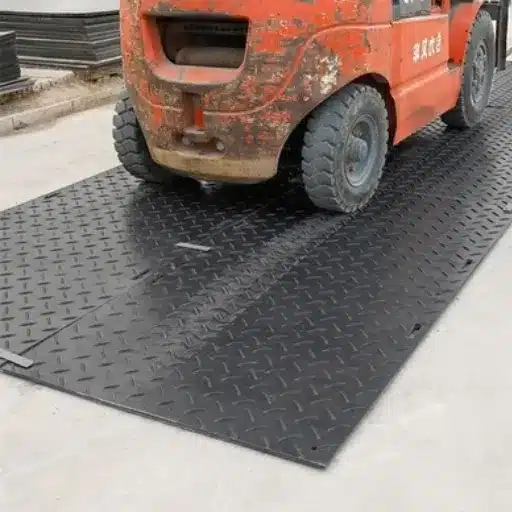
Composite mats provide higher stiffness and load capacity for crawler cranes and heavy equipment roads.
What Are Composite and HDPE Temporary Roadway Mats?
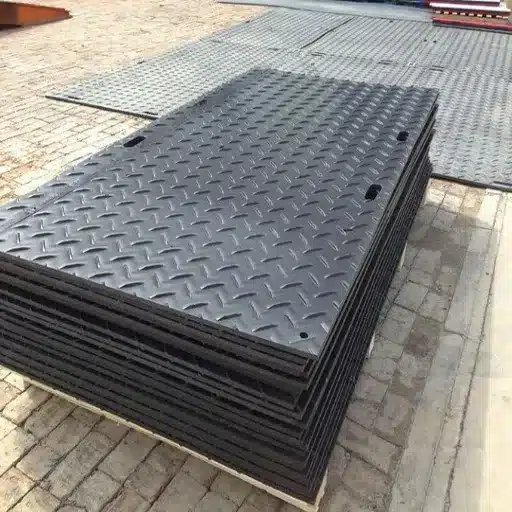
Temporary roadway mats are engineered panels that create stable access roads and work platforms over weak or sensitive ground. They distribute vehicle loads over a wider area, reducing ground pressure and protecting the subgrade from rutting, compaction, and shear failure.
For a complete overview of materials, sizes, and applications, see our complete guide to temporary roadway mats. This article focuses specifically on the composite vs HDPE temporary roadway mats decision.
HDPE Mats
HDPE roadway mats are manufactured from high-density polyethylene, a thermoplastic with a high strength-to-weight ratio, chemical resistance, and UV stability. Standard panels measure 1.2 m x 2.4 m (4′ x 8′) and range from 12.7 mm to 25 mm in thickness. A typical 20 mm panel weighs 25-45 kg, which allows two workers to handle installation by hand.
HDPE is the workhorse material for light-to-medium-duty access. It performs well under rubber tires and rubber tracks, resists most site chemicals, and can be cleaned and reused for many years. For detailed specifications and thickness options, see our HDPE temporary roadway mats specifications guide.
Composite Mats
Composite roadway mats are made from fiberglass-reinforced polymers or proprietary polymer blends. They are significantly stiffer and heavier than HDPE. Common panel sizes range from 2.0 m x 3.0 m up to 2.5 m x 4.0 m, with thicknesses from 25 mm to over 100 mm. Weight per panel ranges from roughly 100 kg to more than 460 kg.
The added stiffness means composite mats deflect less under concentrated loads. This makes them the preferred choice for crawler cranes, piling rigs, and long-term heavy-haul roads where joint stability and minimal settlement matter.
Composite vs HDPE Temporary Roadway Mats: Load Capacity and Engineering Performance
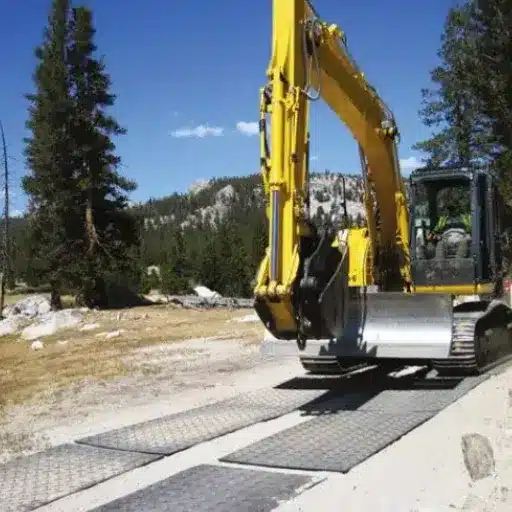
Load capacity is usually the first question buyers ask when comparing composite vs HDPE temporary roadway mats. Manufacturer ratings are helpful, but they must be interpreted with the subgrade condition in mind.
HDPE Load Capacity by Thickness
| Thickness | Typical Load Capacity | Best Use |
|---|---|---|
| 12.7 mm (1/2″) | 40-80 tons | Light trucks, utility vehicles |
| 15 mm | 60-100 tons | Service trucks, small excavators |
| 20 mm (3/4″) | 80-120 tons | Dump trucks, concrete mixers |
| 25 mm | 100-150 tons | Heavy haul roads, light crawler cranes |
These ratings assume firm, stable ground. On soft clay or saturated soils, effective capacity drops. We cover capacity reduction and safety factors in our temporary roadway mat thickness guide.
Composite Load Capacity by Thickness
| Thickness | Typical Load Capacity | Best Use |
|---|---|---|
| 25-38 mm | 100-250 tons | Crawler cranes, heavy trucks |
| 40-100 mm | 250-600+ tons | Large cranes, oil rigs, tower-crane bases |
Large-format composite systems such as MegaDeck HD+ can achieve ground-pressure ratings around 600 psi and are widely used for heavy crane platforms. According to Signature Systems, composite panels are engineered for continuous heavy traffic and repeated point loads.
Stiffness and Deflection
Composite mats have higher flexural stiffness than HDPE. Under a crawler crane track, a composite panel bends less and transfers load more evenly to the subgrade. HDPE is more flexible. It performs well under distributed tire loads but can deform or cup under repeated concentrated loads from outriggers or steel grousers.
A wind-farm contractor in Northern Europe learned this during turbine installation. His crew first laid 15 mm HDPE mats for a 90-ton crawler crane crossing a peat bog. After three moves, the mats rutted and shifted. The crew switched to 25 mm composite mats over a woven geotextile separation layer with 4-way interlocking joints. The crane completed 30 moves without failure.
Ground Pressure Reduction
Both materials reduce ground pressure by spreading the load over a larger contact area. A 40-ton dump truck tire may create 80-100 psi contact pressure. A well-laid HDPE or composite roadway can reduce that to roughly 15-25 psi at the subgrade surface. Composite maintains this reduction better under point loads and heavy turning forces.
When to Choose HDPE Temporary Roadway Mats
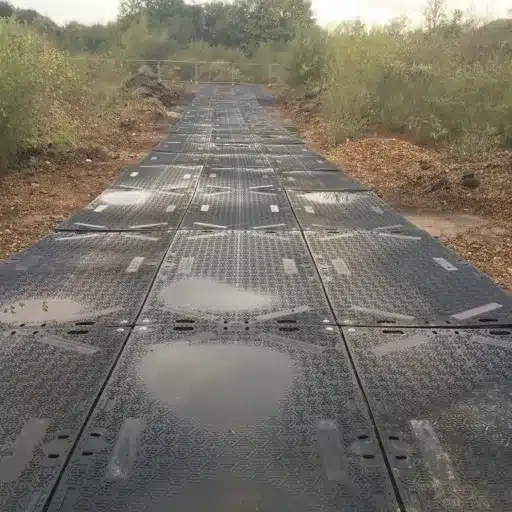
HDPE is the right choice when the project prioritizes speed, portability, and cost for light-to-medium loads.
Best Use Cases
- Rubber-tired vehicles such as dump trucks, concrete mixers, and utility trucks
- Rubber-tracked excavators and loaders
- Short-to-medium term projects up to 12 months
- Rapid deployment and removal
- Budget-sensitive projects with frequent relocation
Handling and Deployment Advantages
A standard 4′ x 8′ HDPE panel weighs 25-45 kg. Two workers can carry and place it without lifting equipment. This matters on remote sites where cranes or forklifts are not available for mat placement. A 40-foot high-cube container can hold 300-500 HDPE panels, delivering 700-1,200 m2 of coverage per shipment.
Connection systems for HDPE include simple cam-locks, pins, and overlapping edges. Installation rates of 200-300 panels per day are common with a small crew. For connection system guidance, see our article on interlocking temporary roadway mats.
Limitations
HDPE is not suitable for steel-grouser tracks. The narrow steel bars concentrate load and can cut, gouge, or deform the plastic. Thinner HDPE panels may also rut on very soft ground if the subgrade is not prepared or reinforced. On soft soils, reduce rated capacity by 30-50% and consider geotextile underlayment.
When to Choose Composite Temporary Roadway Mats
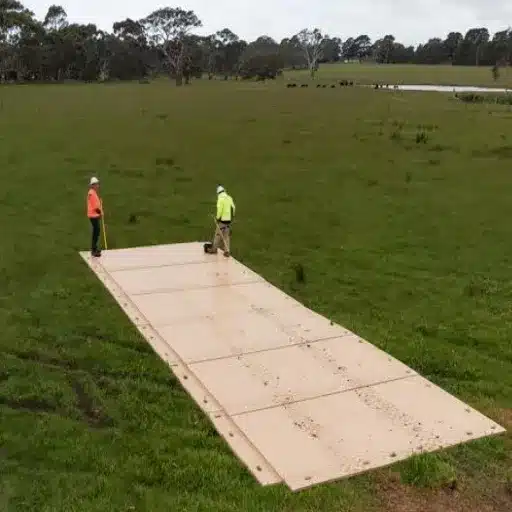
Composite mats win when loads are high, the road is permanent for the project duration, and joint stability is critical.
Best Use Cases
Here are the best use cases for composite access mats in heavy civil and energy projects:
- Heavy crawler cranes and piling rigs
- Long-term installations of 12 months or more
- Mixed heavy traffic with repeated passes
- Oil rigs, tower-crane bases, and heavy equipment staging areas
Handling and Deployment Considerations
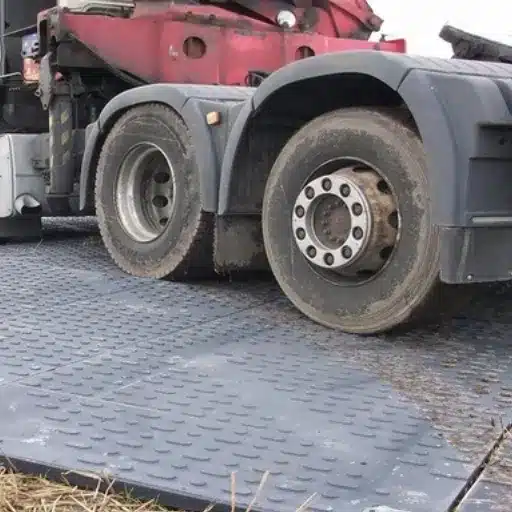
Composite panels require placement equipment. A 7.5′ x 14′ panel can exceed 460 kg, so a forklift or small crane is usually necessary. This increases mobilization cost but improves road stability once the mats are down.
A 40-foot container holds roughly 40-60 large composite panels, delivering 250-400 m2 of coverage. The lower panel count per container means freight cost per square meter is higher than HDPE for an equivalent route length. However, because each composite panel covers more area, the total number of panels needed for a heavy-duty road may still be lower.
Limitations
Composite mats have higher upfront cost and higher handling weight. Not all composite systems are rated for steel tracks. For steel-tracked equipment, most buyers should still consider timber alternatives. Our comparison of timber bog mats vs temporary roadway mats explains when hardwood crane mats are the safer choice.
Composite vs HDPE: Side-by-Side Comparison
The table below summarizes the main decision factors in this temporary road mats comparison.
| Factor | HDPE Mats | Composite Mats |
|---|---|---|
| Load capacity | 30-120 tons | 100-600+ tons |
| Panel weight | 25-45 kg typical | 100-460+ kg |
| Panel size | 1.2 x 2.4 m typical | 2.0 x 3.0 m to 2.5 x 4.0 m |
| Best for | Trucks, rubber-tracked machines | Heavy cranes, long-term roads |
| Steel-track compatible | No | Some specialized models only |
| Lifespan | 10-15 years | 10-15+ years |
| Upfront cost | Lower | Higher |
| Freight efficiency | High (more panels per container) | Lower (fewer panels per container) |
| Installation speed | Fast, by hand | Moderate, equipment needed |
| UV/chemical resistance | Excellent | Excellent |
Composite Mats vs HDPE Cost: Total Cost of Ownership
Upfront price per panel can be misleading. A better comparison includes transport, installation labor, cleaning, reuse, and lifespan.
Upfront Cost Comparison
| Material | Typical Cost Level | Notes |
|---|---|---|
| HDPE | Lower | Lower panel cost and lower freight per m2 |
| Composite | Higher | Higher panel cost but fewer panels for heavy loads |
| Timber | Medium | Lower panel cost but shorter lifespan and higher handling |
Exact prices vary by thickness, panel size, order volume, and freight distance. For a deeper cost breakdown, see our guide to temporary roadway mats cost.
TCO Factors
- Purchase vs rental: Projects under six months may benefit from rental. Multi-year projects usually justify the purchase.
- Transport cost per m2: HDPE ships more square meters per container, which matters for international buyers.
- Installation labor: HDPE installs faster by hand. Composite requires equipment and a larger crew.
- Cleaning and maintenance: Both materials clean easily. Timber absorbs moisture and gains weight, increasing maintenance.
- Reuse across projects: HDPE and composite both last 10-15 years or more, supporting reuse.
- Replacement frequency: Timber may need replacement after 3-5 years in wet conditions.
Break-Even Scenarios
HDPE wins when the project involves light traffic, frequent relocation, or export to remote sites where freight cost per square meter dominates. Composite wins when the project involves heavy cranes, long-term roads, or repeated loading where joint stability and stiffness prevent downtime.
Freight, Container Loading, and Global Sourcing
For international buyers, freight efficiency often tips the decision. The table below compares container loading for common mat types.
| Material | Panels per 40′ HC Container | m2 per Container | Best For |
|---|---|---|---|
| HDPE 4′ x 8′ x 20 mm | 300-500 | 700-1,200 | Export to remote sites |
| Composite 7.5′ x 14′ x 4″ | 40-60 | 250-400 | Heavy-duty local projects |
| Timber 6 m x 1 m x 200 mm | 10-30 | 60-180 | Wetland or extreme loads |
HDPE’s lighter weight often offsets composite’s performance advantage on medium-duty projects by reducing freight cost per square meter. However, on heavy-duty projects, the lower number of composite panels required can offset the higher per-panel freight cost. For a deeper cost breakdown, see our guide to temporary roadway mats cost. When sourcing internationally, ask for material test reports, connection hardware ratings, and a container loading plan for your destination.
At Shanxi Shengxing, we manufacture HDPE and composite temporary roadway mats for global export. We provide technical consultation, customized specifications, and container loading plans based on your project location and equipment loads.
Browse our HDPE and composite temporary roadway mats for available sizes and specifications.
Steel-Track Compatibility and Timber Alternative
Neither standard HDPE nor most composite mats handle steel-grouser tracks well. Steel grousers concentrate machine weight through narrow bars that can cut plastic panels or break composite surfaces. Specialized composite systems rated for steel tracks exist, but they are expensive and still require careful subgrade preparation.
For steel-tracked dozers, excavators, and loaders, 150-200 mm hardwood crane mats remain the standard. Hardwood species such as oak or azobe distribute concentrated loads and can bridge uneven ground better than plastic alternatives. Our article on timber bog mats vs temporary roadway mats covers this choice in detail.
Installation and Connection Differences
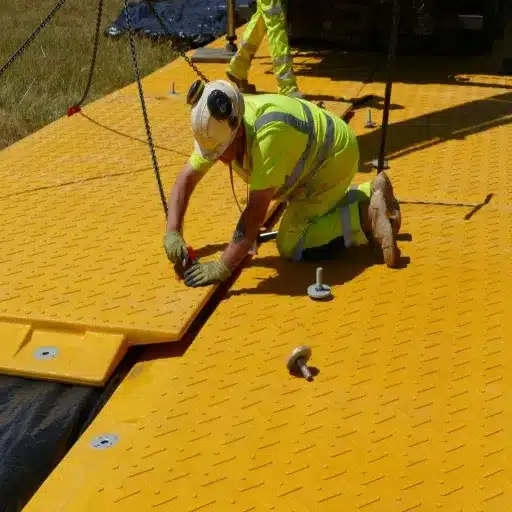
HDPE Installation
HDPE panels typically connect with cam-locks, pins, or simple overlapping edges. Two workers can place and lock panels quickly on firm or lightly prepared ground. The lightweight design makes HDPE ideal for projects that need to move the road frequently or install it without heavy equipment.
Composite Installation
Composite panels use heavy-duty 4-way interlocking systems that lock all four edges of each panel. This creates a continuous road surface that resists shifting under braking, turning, and crane travel. Equipment is required for placement, and joints must be fully connected before heavy loads use the road.
For mixed projects, some contractors use composite in crane pads and turning zones while using HDPE for haul roads. This hybrid approach balances performance and cost. For equipment-specific guidance, see our article on temporary roadway mats for heavy equipment.
Environmental and Chemical Resistance
Both HDPE and composite mats outperform timber in wet or chemically exposed environments. HDPE offers excellent chemical resistance and UV stabilization and is 100% recyclable. Composite materials also resist chemicals and UV degradation, and their longer service life under heavy loads can reduce replacement waste.
Timber absorbs moisture, gains weight, and eventually rots. Typical hardwood mat lifespan is 3-5 years, compared to 10-15 years for HDPE and composite. In contaminated or marine environments, plastic-based mats are usually the safer environmental choice. For the timber alternative, see our comparison of timber bog mats vs temporary roadway mats.
The global ground protection mats market was valued at approximately USD 1.45 billion in 2025 and is projected to reach USD 2.75 billion by 2034, growing at a CAGR of 7.4%. Infrastructure investment, renewable energy projects, and stricter environmental site-access rules are driving that growth. FNF Research
5-Step Decision Framework
Use this framework when deciding between composite vs HDPE temporary roadway mats for your project.
- Identify the heaviest equipment load. If the maximum load is under 80 tons and traffic is rubber-tired, HDPE is usually sufficient. If loads exceed 100 tons or include crawler cranes, consider composite.
- Check the track type. Rubber tires and rubber tracks work with HDPE or composite. Steel-grouser tracks require timber or specialized composite systems.
- Estimate project duration. Short projects under six months favor HDPE for fast deployment and removal. Long-term roads of 12+ months favor composite for stiffness and durability.
- Evaluate the subgrade. On soft clay, peat, or saturated soils, reduce rated capacity by 30-50% and plan for geotextile or aggregate improvement for either material.
- Compare freight and handling. HDPE ships more panels per container and installs by hand. Composite requires equipment but covers more area per panel and handles heavier loads.
Frequently Asked Questions
Are composite mats better than HDPE?
Composite mats are better for heavy loads, long-term roads, and applications where stiffness matters. HDPE mats are better for light-to-medium traffic, rapid deployment, and budgets where portability and freight cost matter. Neither is universally better; the right choice depends on load, duration, and ground conditions.
How much weight can composite mats hold?
Composite mats commonly handle 100-250 tons, and heavy-duty systems can exceed 600 tons depending on thickness and subgrade. Always reduce ratings by 30-50% on soft or saturated soils.
What is the lifespan of HDPE vs composite mats?
HDPE mats typically last 10-15 years. Composite mats last 10-15+ years, with some heavy-duty systems exceeding that under proper use. Both outlast timber, which usually lasts 3-5 years in wet conditions.
Can composite mats be used with steel tracks?
Some specialized composite systems are rated for steel tracks, but most standard composite mats are not. For steel-grouser equipment, 150-200 mm hardwood crane mats are usually the safer and more cost-effective choice.
Which is cheaper: HDPE or composite mats?
HDPE mats have lower upfront cost and lower freight cost per square meter. Composite mats cost more per panel but may require fewer panels for heavy-duty roads. Total cost of ownership depends on project duration, reuse, labor, and transport.
How many mats fit in a container?
A 40-foot high-cube container can hold roughly 300-500 HDPE panels or 40-60 large composite panels. HDPE delivers 700-1,200 m2 per container, while composite delivers 250-400 m2 depending on panel size.
Conclusion
The composite vs HDPE temporary roadway mats decision comes down to three factors: equipment load and track type, project duration, and freight and handling constraints. Composite mats carry 100-600+ tons, resist deflection, and suit heavy crawler cranes and long-term roads. HDPE mats carry 30-120 tons, weigh 25-45 kg per panel, and install quickly for rubber-tired traffic and short-to-medium projects.
On soft clay, peat, or saturated soils, reduce rated capacity by 30-50% for both materials and add a geotextile separation layer. For steel-grouser tracks, neither standard HDPE nor most composite mats are suitable; use hardwood crane mats instead.
If you need help choosing between composite vs HDPE temporary roadway mats for your project, contact Shanxi Shengxing engineering support. We provide material recommendations, load calculations, and container loading plans for global delivery.
Request a technical quote or browse our HDPE and composite temporary roadway mats to get started.