HDPE temporary roadway mats are modular, interlocking panels made from high-density polyethylene that create reusable haul roads and site access routes over soft, muddy, or sensitive ground. For most construction and infrastructure projects, 20 mm HDPE mats offer the best balance of load capacity, portability, and cost per meter of road.
A project manager in Southeast Asia recently faced a familiar problem. His crew needed a 200-meter access road across soft clay for a highway expansion. Traditional aggregate would take two weeks to install and cost thousands in removal and soil remediation. Instead, his team laid 20 mm HDPE temporary roadway mats over a geotextile separation layer. The road was operational in hours, stayed level through monsoon rains, and was lifted and reused on the next section days later.
This guide explains what HDPE temporary roadway mats are, how their specifications translate to real road performance, and how to select the right thickness and layout for your project.
Key Takeaways
- HDPE temporary roadway mats are lightweight, interlocking panels that distribute vehicle loads over soft or unstable ground.
- Standard 4′ × 8′ HDPE road mats weigh 32–45 kg and support 30–120 tons depending on thickness and ground condition.
- For continuous haul roads, choose 15–20 mm HDPE on firm ground or add a geotextile sub-layer on soft clay, peat, or saturated soils.
- HDPE mats typically last 10–15 years, are 100% recyclable, and can be more cost-effective than aggregate after 2–3 reuses.
- Steel-tracked equipment and extreme point loads usually require composite or timber mats instead of HDPE.
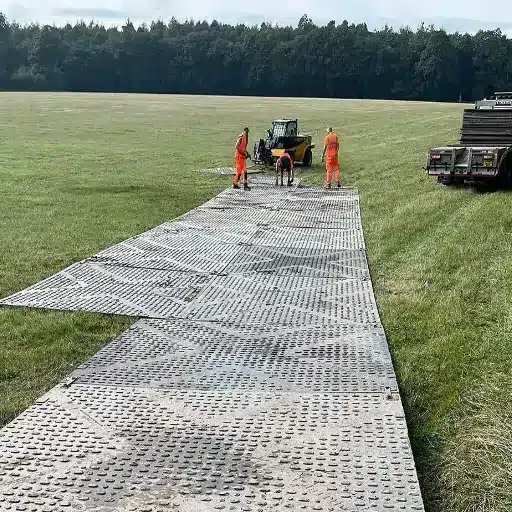
Interlocking 4′ × 8′ HDPE temporary roadway mats create a stable haul road over soft or sensitive ground.
What Are HDPE Temporary Roadway Mats?
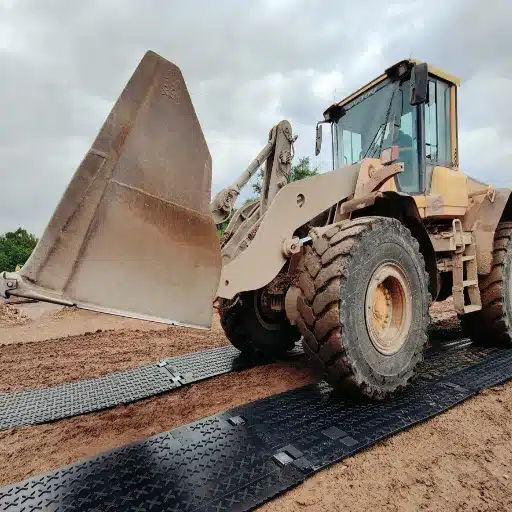
HDPE temporary roadway mats are reusable, interlocking road panels made from high-density polyethylene. They are laid over unstable or sensitive ground to create temporary access roads, work platforms, and haul routes for construction vehicles and equipment.
These mats are also called HDPE road mats, HDPE access mats, trackway panels, and haul road mats. They differ from general ground protection mats because they are designed for continuous vehicle traffic rather than localized work pads.
The material itself gives HDPE roadway mats several engineering advantages:
- High strength-to-weight ratio: A standard 4′ × 8′ panel weighs only 32–45 kg but supports 80–120 tons in the 20 mm thickness.
- Non-porous surface: HDPE absorbs less than 0.01% water, so mats do not rot, warp, or gain weight in wet conditions.
- UV stabilization: Additives protect the polymer from degradation during long-term outdoor exposure.
- Chemical resistance: HDPE withstands oils, fuels, acids, and alkalis common on construction sites.
- Recyclability: At the end of life, HDPE mats can be recycled into new products.
For a broader overview of temporary roadway mats and how to choose between materials, see our complete guide to temporary roadway mats.
HDPE Temporary Roadway Mats: Specifications and Engineering Standards
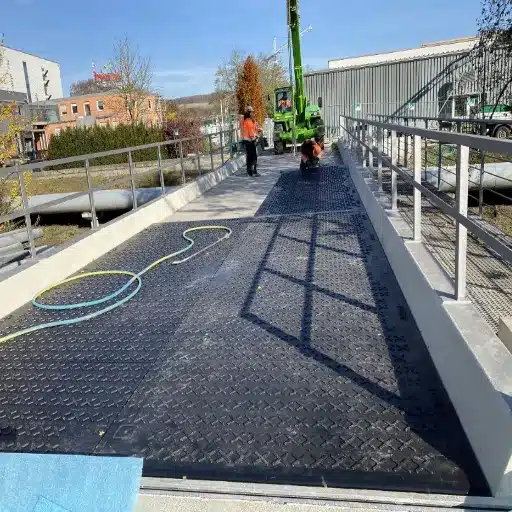
Understanding HDPE temporary roadway mat specifications is the first step in matching a panel to your project. The tables below summarize the material properties, sizes, surface textures, and connection systems that determine road performance.
Material Properties
HDPE used in temporary roadway mats is typically 100% virgin or recycled high-density polyethylene. The exact grade affects tensile strength, impact resistance, and long-term durability.
| Property | Typical Value | Test Method |
|---|---|---|
| Material | 100% Virgin or Recycled HDPE | — |
| Density | 0.95 – 0.98 g/cm³ | ASTM D792 |
| Water Absorption | <0.01% | ASTM D570 |
| Tensile Strength | 3,500 – 5,900 psi (24–41 MPa) | ASTM D638 |
| Compressive Strength | ≥27 MPa | — |
| Shore Hardness | 64 – 67 (Shore D) | ISO 868 |
| Melting Point | ~138°C | ASTM D3417 |
| Operating Temperature | -40°C to +80°C | — |
| UV Resistance | UV-stabilized | ASTM D2565 |
| Chemical Resistance | Resistant to oils, fuels, acids, and alkalis | — |
These properties make HDPE suitable for repeated loading, outdoor storage, and exposure to site contaminants. Premium grades can extend the operating temperature range to -70°C to +90°C for extreme climates.
Standard Dimensions and Weights
Roadway panels are produced in standard sizes to simplify layout and transport.
| Size (Imperial) | Size (Metric) | Weight Range | Typical Use |
|---|---|---|---|
| 2′ × 8′ | 610 × 2,440 mm | 15–20 kg | Pedestrian walkways, narrow trenches |
| 3′ × 8′ | 910 × 2,440 mm | 22–30 kg | Light vehicles, utility access |
| 4′ × 8′ | 1,220 × 2,440 mm | 32–45 kg | Standard haul road panel |
| 4′ × 10′ | 1,220 × 3,050 mm | 40–55 kg | Wide-axle vehicles, crane pads |
| Custom rig mats | Up to 5,900 × 2,500 mm | 100–350+ kg | Heavy cranes, drilling rigs |
The 4′ × 8′ size is the most common for temporary roadways because two workers can carry and position each panel without lifting equipment.
Surface Textures and Traction
HDPE roadway mats are available with several surface patterns:
- Diamond cleat: Aggressive traction for rubber-tired vehicles and muddy conditions.
- Dual-blade: Smooth directional pattern that reduces trip hazards while maintaining grip.
- Checkered: Balanced traction for mixed vehicle and pedestrian traffic.
- Reversible designs: One side optimized for vehicles, the other for pedestrian or turf protection.
The right texture depends on traffic type, slope, and weather exposure. For continuous haul roads, diamond or dual-blade patterns are most common.
Connection Systems for Continuous Roads
For roadway applications, panels must transfer loads across joints. Connection options include:
- Interlocking flanges: Molded edges that overlap adjacent mats for rapid deployment.
- Pin and bolt fasteners: Steel or composite pins through pre-drilled holes for heavy loads.
- 2-way connectors: Join panels along the long edge.
- 4-way connectors: Lock all four sides for maximum stability and load transfer.
On slopes greater than 10%, pins or bolts are recommended to prevent panel movement under braking and turning forces. For a deeper look at connection options, see our guide to interlocking temporary roadway mats.
HDPE Temporary Roadway Mats: Load Capacity and Equipment Matching
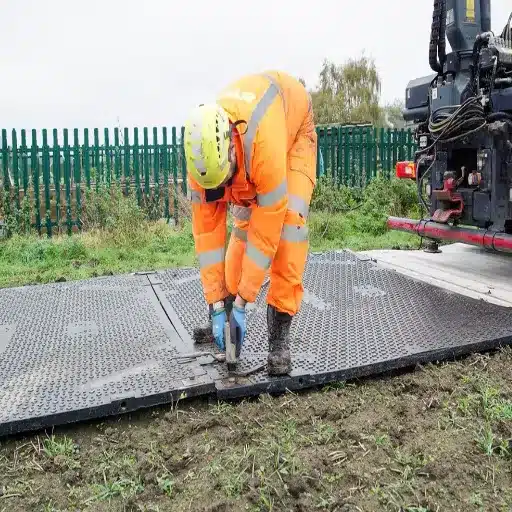
The HDPE temporary roadway mat load capacity you need depends on thickness, material grade, panel size, and ground condition. The following table provides typical static load ratings for firm, stable subgrades.
Load Capacity by Thickness
| Thickness | Static Load Capacity | Application Class |
|---|---|---|
| 10 mm (3/8″) | 30 – 60 tons | Light duty; pedestrian, landscaping, utility access |
| 12.7 mm (1/2″) | 40 – 80 tons | Standard duty; light trucks, general site access |
| 15 mm | 60 – 100 tons | Medium-heavy duty: excavators, dump trucks |
| 20 mm (3/4″) | 80 – 120 tons | Heavy duty: cranes, haul trucks, continuous roads |
| 25–38 mm | 100 – 150+ tons | Extreme duty; large tracked equipment, military |
Typical static load ratings for HDPE temporary roadway mats on firm subgrade. Actual capacity varies with ground condition and panel grade.
These values assume firm, dry ground. On soft clay, peat, or saturated soils, effective capacity can drop by 30–50%. In those cases, a thicker mat, a geotextile separation layer, or a geogrid-reinforced aggregate base may be needed.
Engineering guidance: Select a mat with a load capacity at least 25% greater than the maximum axle or equipment weight you expect. For continuous haul roads with repeated passes, add a safety margin.
Point Load vs. Distributed Load
A common mistake is confusing total vehicle weight with the load on the mat surface. Crawler cranes and outriggers create high point loads concentrated on small contact areas. Dump trucks and haul vehicles create distributed loads spread across multiple axles and large tire footprints.
For point loads, verify both the mat thickness and the connection system. Thin mats can flex and create a rocking effect under crawler tracks. If your project involves crawler cranes or drilling rigs, read our detailed guide on temporary roadway mats for heavy equipment.
For help choosing the right panel depth, see our temporary roadway mat thickness guide.
Applications for HDPE Temporary Roadway Mats
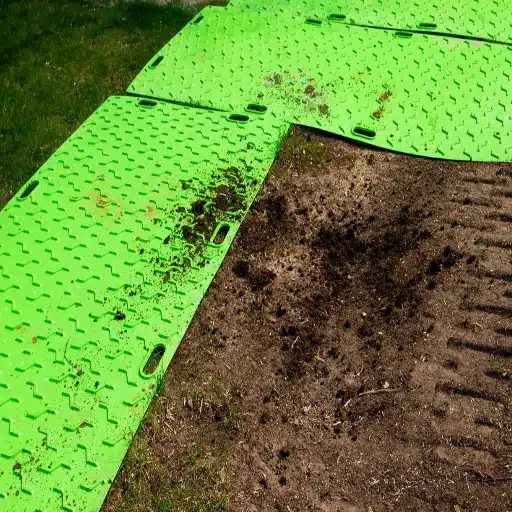
HDPE temporary roadway mats are used wherever vehicles and equipment need temporary access over ground that cannot support repeated loads. Common applications include construction haul roads, crane access routes, utility crossings, soft-ground pathways, and event surfaces.
Construction Site Haul Roads
HDPE temporary roadway mats excel on construction sites where trucks, excavators, and service vehicles need repeated access over prepared or unfinished ground. Standard 15–20 mm HDPE panels handle typical haul truck loads while protecting the subgrade from rutting and compaction damage.
Turning zones and braking areas experience higher shear forces. In these locations, use 20 mm mats with 4-way connectors and consider doubling the panel layer if subgrade strength is low.
Crane and Heavy Equipment Access Roads
Crawler cranes, drilling rigs, and piling equipment need stable access roads with minimal settlement. For these applications, 20–25 mm HDPE mats are typically used, often with a geotextile fabric or geogrid-reinforced base beneath.
Outrigger loads at crane positions require special attention. The road edge must extend at least 1 meter beyond the outrigger footprint, and thicker panels or composite outrigger pads may be needed at critical points.
Temporary Roads on Soft Ground
Soft clay, peat, and saturated soils reduce the effective load capacity of any mat system. On these sites, HDPE roadway mats should be combined with a geotextile separation layer to prevent the panels from sinking or pumping soil.
In extreme soft-ground conditions, HDPE may not be sufficient. Larger composite mats or timber bog mats distribute weight over a wider area and may be the better engineering choice. See our comparison of timber bog mats vs temporary roadway mats for a full breakdown.
Utilities and Pipeline Trenches
Utility contractors often need narrow access routes that cross trenches, existing pipes, or disturbed ground. Smaller 3′ × 8′ HDPE panels work well in these confined spaces. They are light enough to reposition frequently and strong enough for service trucks and small excavators.
Events and Pedestrian Walkways
For festivals, concerts, and outdoor events, 10–12 mm HDPE mats create temporary pathways and parking areas without damaging turf. These thinner panels are not suitable for heavy vehicle traffic but offer fast deployment and removal for pedestrian use.
HDPE vs Composite and Timber Roadway Mats
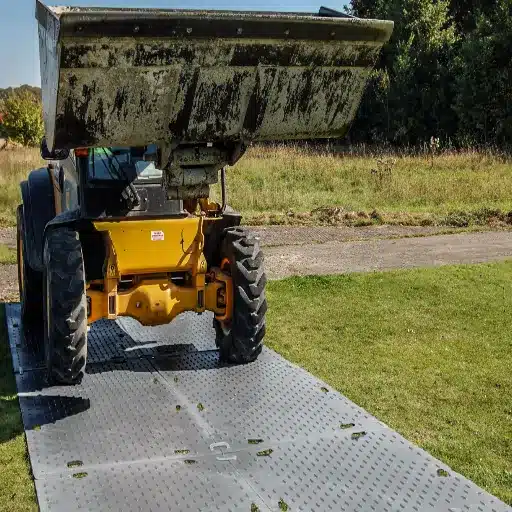
Choosing between HDPE vs composite temporary roadway mats starts with the equipment loads and project duration.
HDPE vs Composite Mats
Composite mats are made from layered fiberglass, plastics, or proprietary polymer blends. They are heavier and more rigid than HDPE, with higher load capacity for extreme equipment.
| Feature | HDPE Mats | Composite Mats |
|---|---|---|
| Weight (4′ × 8′) | 32–45 kg | 100–460+ kg |
| Load capacity | 30–120 tons | 100–600+ tons |
| Handling | Manual, two workers | Usually requires equipment |
| Lifespan | 10–15 years | 10–15+ years |
| Recyclability | 100% recyclable | Often limited |
| Best use | General haul roads, rubber-tired vehicles | Heavy cranes, extreme loads, long-term roads |
Comparison of HDPE, composite, and timber roadway mats by weight, load capacity, and best use case.
For most temporary roadway projects, HDPE is the more practical choice. Composite mats become cost-effective when equipment loads exceed HDPE ratings or when the road will remain in place for several years.
For a full comparison, see our guide on composite vs HDPE temporary roadway mats.
HDPE vs Timber Mats
Timber bog mats have been used for decades in wetland and heavy-equipment access. They handle steel-tracked equipment better than HDPE and can bridge uneven ground effectively. However, timber has significant drawbacks:
- Moisture absorption: Timber absorbs water, gains weight, and can rot or split.
- Lifespan: Hardwood mats typically last 3–5 years, compared to 10–15 years for HDPE.
- Transport efficiency: HDPE mats deliver 2–2.5 times more surface area per truckload.
- Environmental compliance: Timber can introduce invasive species or contaminants if not treated properly.
Steel-tracked equipment is the main reason to choose timber over HDPE. Steel cleats can gouge and deform HDPE under repeated passes. For these cases, timber or composite mats are the safer engineering choice.
Installation, Maintenance, and Cost Efficiency
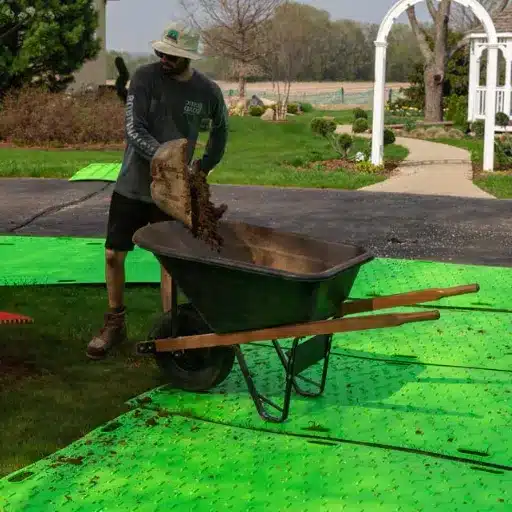
Installation Best Practices
Installing HDPE temporary roadway mats is straightforward, but proper preparation determines performance and lifespan.
- Clear the route. Remove vegetation, debris, and large rocks that could puncture or deform panels.
- Grade the subgrade. Aim for a surface level within ±50 mm over any 10-meter section.
- Install a separation layer if needed. On soft or contaminated ground, lay a geotextile fabric to prevent soil pumping and improve drainage.
- Lay panels in the direction of travel. Start from a firm surface and work outward.
- Stagger joints by half a panel length. This distributes loads across multiple panels and reduces weak lines.
- Connect all edges before first vehicle use. Unconnected mats can shift under braking or turning.
- Add edge ramps at entry and exit points. Ramps reduce trip hazards and allow smooth vehicle transitions.
- Anchor on slopes over 10%. Use pins, stakes, or sandbags to prevent downhill creep.
Proper installation of interlocking HDPE temporary roadway mats over a geotextile separation layer.
Maintenance and Storage
HDPE mats require minimal maintenance. After each project, pressure wash the surface to remove mud, fuel residue, and contaminants. For sites with chemical exposure, verify compatibility with your cleaning agent.
Store mats flat in a drained area. UV-stabilized HDPE resists sun damage, but long-term stacked storage under cover extends service life. Avoid dragging mats across sharp aggregate, which can scar the surface and reduce traction.
Total Cost of Ownership
The upfront cost of HDPE temporary roadway mats is higher than aggregate for a single short project. However, reusability changes the economics quickly.
A civil engineer in East Africa learned this during a 300-meter trenching project. He initially specified 12 mm HDPE mats to save money. After the first heavy rain, the thinner mats shifted and rutted under 40-ton service trucks. The crew upgraded to 20 mm HDPE with a geotextile underlayment and connection pins. The revised system stayed in place for the full project and was redeployed on two later sites.
For continuous haul roads, HDPE mats often break even against aggregate after 2–3 reuses. Additional savings come from faster installation, reduced removal costs, and avoided soil remediation. Aggregate roads require ongoing grading and re-graveling, with some studies citing re-graveling costs of approximately $15,200 per cycle.
Rental may be the better option for projects under six months, while purchase offers stronger ROI for multi-year or repeated use.
Global Sourcing and Quality Assurance
For international buyers, HDPE temporary roadway mats offer clear logistics advantages. A standard 40-foot high-cube container can hold 300–500 HDPE mats depending on thickness, panel size, and stacking pattern. This density reduces freight cost per square meter compared to timber or composite alternatives.
Quality systems matter when sourcing mats for demanding projects. Look for manufacturers with ISO9001 quality management certification, batch traceability, and sample retention programs. Material test reports should confirm density, tensile strength, and UV stabilization for the grade supplied.
At Shanxi Shengxing, we manufacture HDPE temporary roadway mats under strict quality control and provide technical consultation for project-specific specifications. Whether you need standard 4′ × 8′ panels or custom dimensions, we can recommend thickness, connection systems, and container loading plans for your destination.
Browse HDPE temporary roadway mats or request a technical quote for your project.
Frequently Asked Questions
What are HDPE temporary roadway mats?
HDPE temporary roadway mats are modular, interlocking panels made from high-density polyethylene. They create reusable access roads and haul routes over soft, muddy, or sensitive ground.
How much weight can HDPE temporary roadway mats hold?
HDPE roadway mats typically support 30–120 tons depending on thickness. A 20 mm panel on firm ground can handle 80–120 tons, while soft or saturated soils reduce effective capacity by 30–50%.
What thickness HDPE temporary roadway mat do I need?
For pedestrian and light utility access, 10–12 mm is sufficient. For truck and haul vehicle traffic, use 15–20 mm. For cranes and extreme loads, 25 mm or thicker HDPE or composite mats may be required.
How long do HDPE temporary roadway mats last?
Quality HDPE mats last 10–15 years with proper use and storage. UV-stabilized grades resist outdoor degradation, and the material does not rot or absorb water.
Are HDPE temporary roadway mats recyclable?
Yes. HDPE is a thermoplastic that can be recycled at the end of its life. Many mats are also manufactured with recycled HDPE content.
Can HDPE temporary roadway mats be used in cold weather?
Standard HDPE mats perform from -40°C to +80°C. Premium grades extend this range to -70°C to +90°C, making them suitable for cold-climate projects.
What sizes do HDPE temporary roadway mats come in?
Common sizes include 2′ × 8′, 3′ × 8′, 4′ × 8′, and 4′ × 10′. The 4′ × 8′ panel is the standard for haul roads.
Can HDPE roadway mats support steel-tracked equipment?
HDPE is generally not recommended for steel-tracked equipment. Steel cleats can gouge and deform the panels. Timber or composite mats are better suited for tracked machinery.
Conclusion
HDPE temporary roadway mats provide a practical, reusable solution for construction access roads, crane routes, utility crossings, and event pathways. Their combination of light weight, high load capacity, and long service life makes them a strong alternative to aggregate and timber for many infrastructure projects.
When selecting HDPE road mats, focus on four factors: thickness, expected equipment load, ground condition, and project duration. On firm ground, 15–20 mm HDPE panels handle most haul road requirements. On soft or saturated soils, add a geotextile separation layer and consider thicker panels or composite systems.
For global project buyers, HDPE mats also simplify logistics. Their lightweight allows more square meters per container, and their durability supports reuse across multiple sites.
If you need help specifying HDPE temporary roadway mats for your next project, contact our engineering team for a tailored recommendation and quotation.