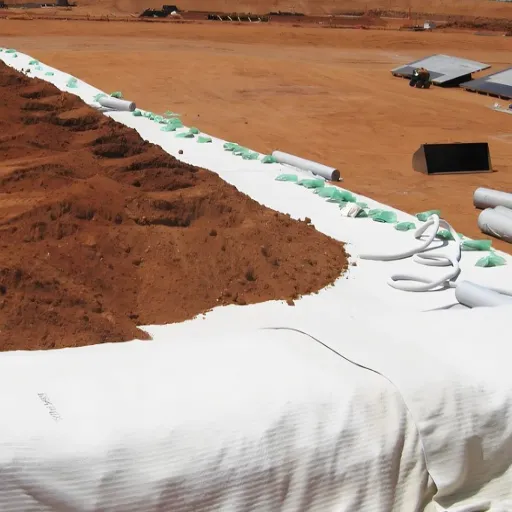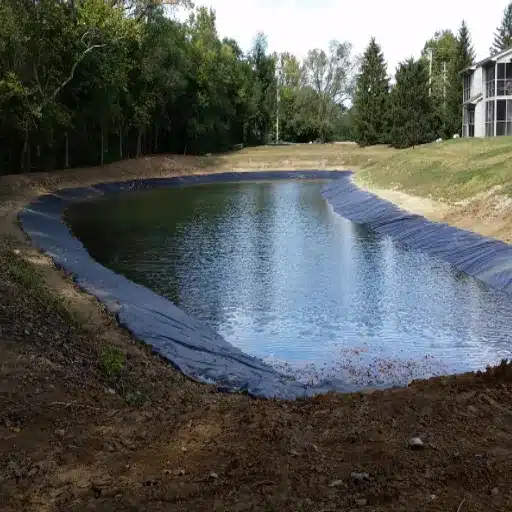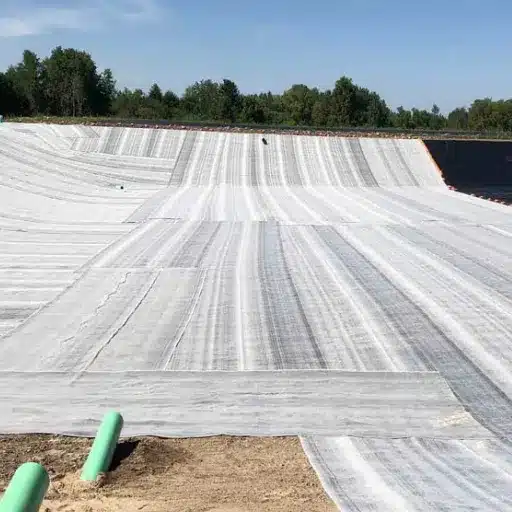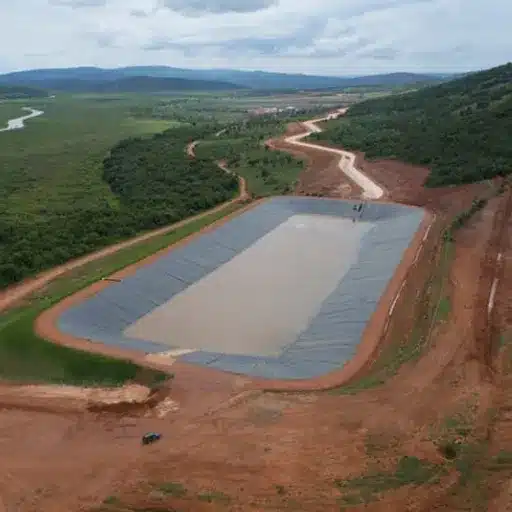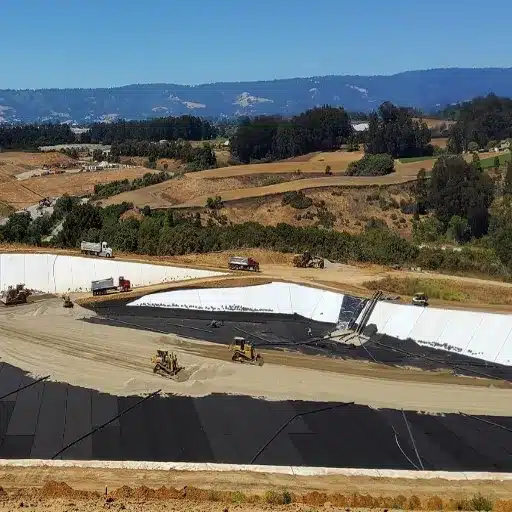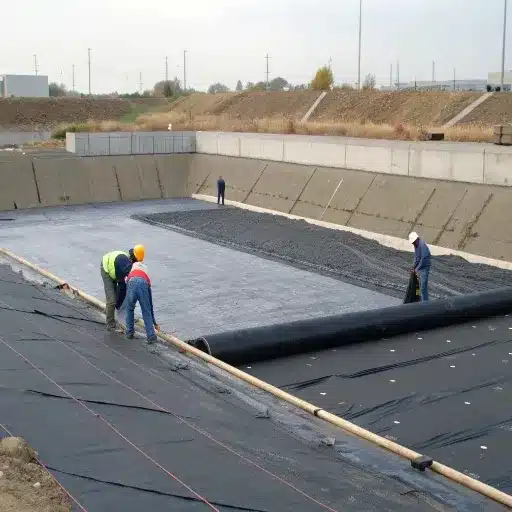
For most erosion control projects, a needle-punched nonwoven geotextile is the right choice. It filters soil, drains water, and cushions riprap against puncture. Choose a woven geotextile, specifically a monofilament weave, only when you need reinforcement strength on very soft, saturated subgrades. Here is how to decide for your slope, bank, or channel.
Erosion never stops working. Every rain event carries soil off exposed slopes, out of channels, and away from shorelines. Left alone, that soil loss widens channels, undermines roads, and empties into waterways. A geotextile for erosion control stops that movement while still letting water pass through.
But not all geotextiles behave the same way. Woven and nonwoven fabrics solve opposite halves of the problem. Pick the wrong one and you get clogging, hydrostatic blowout, or a fabric that rips under the first load of riprap. Pick the right one and the structure stays put for decades.
By the end of this guide, you will know which type fits your project, what the key specification numbers mean, and how to install it so it actually works. If you are comparing these fabrics for the first time, our complete woven vs nonwoven geotextile guide covers the full material comparison.
Key Takeaways
- For riprap and slope armor, a needle-punched nonwoven geotextile is the industry standard in roughly 90% of projects because it filters soil, relieves water pressure, and resists puncture.
- Choose a monofilament woven geotextile only for reinforcement on very soft subgrades; avoid slit-film woven fabrics under riprap because their low open area causes clogging.
- Specify a 300 to 500 GSM nonwoven under standard riprap and 500 GSM or heavier for coastal armor and breakwaters.
- Match the apparent opening size (AOS) to your soil’s particle size so fines stay in place while water flows.
- Cover the fabric quickly after installation; UV exposure degrades both types over time.
What Is a Geotextile for Erosion Control?
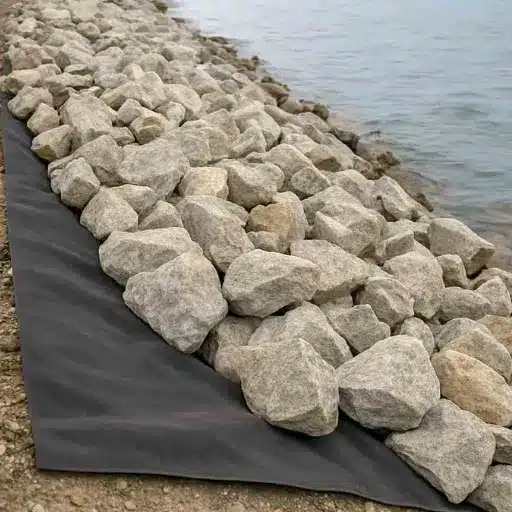
A geotextile is a permeable synthetic fabric placed between soil and the forces that erode it. It is most often made from polypropylene (PP) or polyester (PET) and performs four jobs:
- Filtration. Water passes through while soil particles stay behind.
- Separation. It stops two soil layers from mixing, such as riprap stone and the subgrade below it.
- Reinforcement. High-strength fabrics add tensile capacity that holds weak soil together.
- Drainage. In-plane water flow relieves pore pressure that would otherwise destabilize a slope.
In erosion control, filtration and drainage do most of the work. The fabric sits between the soil and a protective layer of riprap, erosion control blocks, or vegetation. Water drains through the fabric instead of washing soil out from beneath the armor.
You will hear the terms “erosion control fabric” and “geotextile” used interchangeably. They are the same material. A woven or nonwoven geotextile for erosion control is simply a filter and stabilizer designed for slopes, banks, channels, and shorelines.
Woven vs Nonwoven Geotextile: The Core Difference
The manufacturing process defines everything else. A woven geotextile is made by interlacing yarns on a loom, like burlap. The yarns can be slit-film tape, monofilament, or multifilament. The result is strong, tight, and rigid, with a grid-like texture.
A nonwoven geotextile is made by bonding randomly arranged fibers through needle-punching or heat. It looks and feels like felt. That open, three-dimensional structure gives it outstanding filtration and drainage performance.
| Property | Woven Geotextile | Nonwoven Geotextile | Best Fit in Erosion Control |
|---|---|---|---|
| Tensile strength | High (grab 200 to 1,000+ lbs) | Moderate (grab 80 to 300 lbs) | Woven for reinforcement |
| Elongation at break | Low (5 to 25%) | High (30 to 80%) | Nonwoven drapes over uneven ground |
| Permittivity | Low to moderate | High | Nonwoven relieves hydrostatic pressure |
| Filtration | Poor to fair | Excellent | Nonwoven traps fines in 3D structure |
| Puncture resistance | Moderate, snaps like a drumhead | High, stretches and cushions | Nonwoven under angular riprap |
| Clogging resistance | Low for slit-film | High | Nonwoven resists blinding in silty soil |
| Typical cost | $0.15 to $0.50/sq ft | $0.10 to $0.40/sq ft | Depends on weight and order volume |
The practical rule: woven for strength, nonwoven for flow. Erosion control is mostly about flow, so nonwoven fabrics win most applications. The Geosynthetics Magazine overview of woven and nonwoven geotextiles makes the same point with a useful caveat: the woven category itself is not uniform, and the yarn type changes how the fabric behaves.
Which Geotextile for Riprap and Slope Armor?
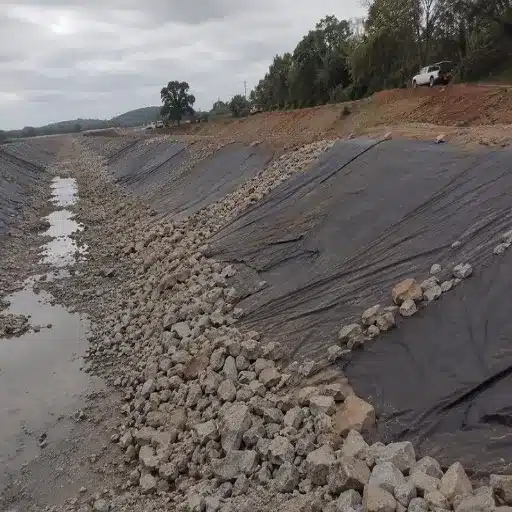
Under riprap, nonwoven geotextile is the go-to choice. Industry guidance puts it at roughly 90% of riprap and slope-armor projects, and the Waterproof Specialist riprap comparison explains why:
- Three-dimensional filtration. Soil particles get trapped at different depths inside the fabric instead of blinding the surface.
- High permittivity. Water passes through quickly, so pressure never builds up behind the armor and blows the stone off the slope.
- Puncture cushioning. The fabric stretches and deforms when angular rock drops on it. A woven fabric acts like a tight drumhead and tears.
- Drape and conformability. Nonwoven hugs ruts and bumps, keeping continuous contact with the soil and eliminating voids where erosion can start.
There is one important exception. On extremely soft, saturated subgrades such as deep marshland or highly organic peat, a monofilament woven geotextile provides the tensile strength needed to span weak soil and keep the system from sinking. Even then, engineers often pair a woven reinforcement layer with a nonwoven filter.
The Slit-Film Warning
Not every woven geotextile is suitable for erosion control. Slit-film woven fabrics have a percent open area of only 2 to 4%. They drain poorly, clog quickly in silty or fine-grained soil, and let hydrostatic pressure build up. Under riprap, that is a recipe for failure.
If a woven fabric is required, choose a monofilament woven with a percent open area of 8 to 12%. It drains far better and is the appropriate choice for gap-graded glacial soils where a heavier nonwoven could lose fines through its pore structure.
When to Choose Woven Geotextile for Erosion Control
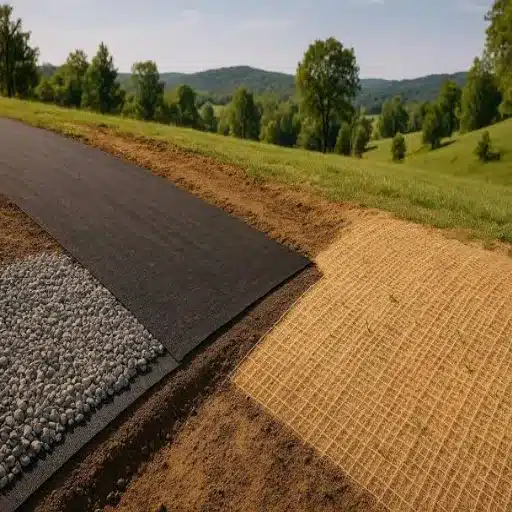
Woven geotextiles earn their place where the dominant force is load, not flow. Typical cases:
- Reinforcement and stabilization. Embankments, soft subgrades, and road base over weak soil where the fabric adds tensile capacity. This is covered in more depth in our guide to woven vs nonwoven geotextile for road construction.
- Shallow water and channel armor. Where the primary job is holding armor in place on a firm subgrade rather than filtering fines.
- Shoreline protection on weak soil. High tensile strength spans soft zones and prevents the whole system from sinking.
In many of these cases, the correct answer is not one fabric but both. A nonwoven filter protects the soil and drains water while a woven layer carries the load. If you are weighing that option, our article on using woven and nonwoven geotextiles together walks through when composite systems make sense.
Key Geotextile Specifications for Erosion Control
Do not select a geotextile by name alone. The specification sheet decides whether the fabric survives your site. Focus on these values:
Mass per Unit Area (GSM)
Weight is the fastest selection shortcut, though it is not strength. For erosion control:
| Application | Recommended Nonwoven Weight |
|---|---|
| Light slope cover, sand-cushion cases | 200 GSM (4 oz/sq yd) |
| Standard riprap underlayment | 300 to 400 GSM (6 to 8 oz/sq yd) |
| Heavy riprap, steep slopes | 400 to 500 GSM (8 to 10 oz/sq yd) |
| Coastal armor, breakwaters | 500 GSM and heavier |
The Maine DOT drainage and erosion control standard specifies an 8 oz/sq yd nonwoven or monofilament woven for routine work, with 4 oz acceptable only where a sand cushion protects the fabric. That mirrors what most erosion-control engineers specify.
Apparent Opening Size (AOS, ASTM D4751)
AOS is the largest soil particle that can pass through the fabric. The rule is simple: the fabric’s AOS must be smaller than the D85 size of your soil so fines stay put while water flows. Match the AOS to your actual soil gradation.
Permittivity (ASTM D4491)
Permittivity measures how fast water moves through the fabric. For riprap applications, a nonwoven with permittivity of 1.0 s⁻¹ or higher relieves hydrostatic pressure quickly and prevents blowout.
Grab Tensile (ASTM D4632) and CBR Puncture (ASTM D6241)
These measure survivability. Sharp, angular riprap dropped from a bucket or excavator will test both. For severe conditions, look for high CBR puncture values and a fabric that stretches instead of snapping.
Trapezoid Tear (ASTM D4533) and UV Resistance (ASTM D4355)
Tear strength matters once the fabric is on the ground and stone is being placed. UV resistance matters because a fabric left exposed degrades. ASTM D4355 recommends retaining at least 70% of strength after 500 hours of exposure. For a deeper look at how long fabric lasts and what degrades it, see our guide to geotextile UV resistance and lifespan.
How to Read a Spec Sheet
A complete spec sheet lists mass, AOS, permittivity, grab tensile, CBR puncture, tear, and UV retention, each tied to a test method. When you compare suppliers, ask for these values and the test reports behind them. A cheap import with no test certificate may claim strength it does not have. Insist on AASHTO M288 conformance and a mill test report for every roll.
How to Install Geotextile for Erosion Control
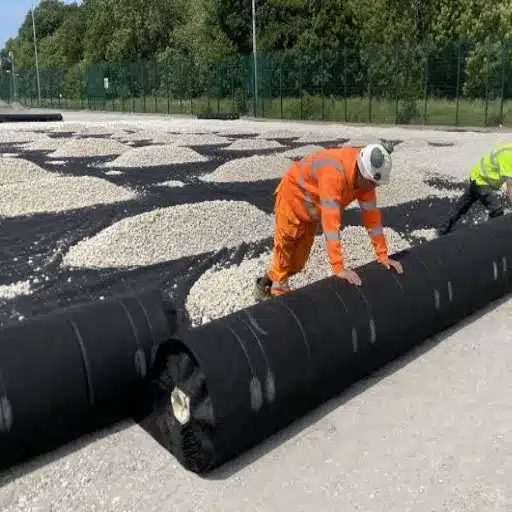
Installation errors cause more geotextile failures than material defects. Get these steps right:
- Prepare the surface. Trim and compact the slope. Remove roots, sharp stones, and debris that could puncture the fabric.
- Key in an anchor trench. Dig a trench at the top of the slope, lay the fabric into it, and backfill. This stops the fabric from creeping downslope under its own weight and water pressure.
- Overlap correctly. Overlap adjacent rolls by 12 to 18 inches. Place the up-slope sheet over the down-slope sheet so water runs across the seam instead of into it.
- Place riprap from the toe upward. Work from the bottom of the slope to the top. This keeps stone from rolling across already-placed fabric and dislodging it.
- Control the drop height. Do not drop large rock from excessive height onto exposed fabric. For sharp, angular stone, place a granular sand cushion first.
- Cover quickly. UV exposure weakens any geotextile. Cover with soil, gravel, or riprap as soon as possible and keep vehicles off the exposed fabric.
Common Mistakes and the Cost of Getting It Wrong
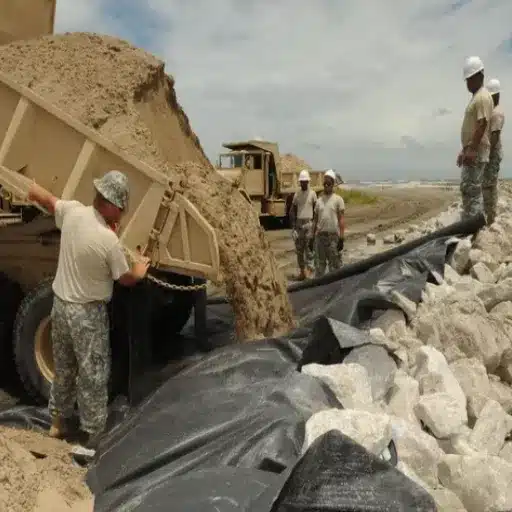
Contractor Dave Rivas learned this the hard way on a streambank project in 2024. His crew placed riprap directly on a clay subgrade with no filter fabric to save time and a few hundred dollars in material. Within the first season, soil piped up through the stone voids. By the second spring, the channel had widened by nearly 4 feet and the bank was slumping.
The fix meant demolishing 200 linear feet of armor, bringing in a tracked excavator for a second mobilization, and reinstalling everything with a 400 GSM needle-punched nonwoven keyed into a top trench. The rework cost more than 2.5 times the original budget. The fabric he skipped would have cost less than 4% of the total project.
The same pattern shows up again and again:
- Slit-film woven under riprap. Clogs, builds pressure, and blows out.
- Under-weight nonwoven under sharp stone. Punctures during installation.
- No anchor trench. The fabric creeps downslope and exposes the soil.
- Overlaps aligned with flow. Water finds the seam and undermines the armor.
Every one of these is preventable with a correct spec and proper placement.
Frequently Asked Questions
Which geotextile is best for erosion control, woven or nonwoven?
For most erosion control, a needle-punched nonwoven geotextile is best. It filters soil, drains water, and resists puncture under riprap. Use a monofilament woven only for reinforcement on very soft subgrades.
Do you need geotextile under riprap?
Yes, on fine-grained soils. The fabric holds soil in place and prevents particles from washing through the stone voids while still letting water seep back into the waterway. Omitting it on soft, tidal shorelines significantly increases the chance of failure.
What weight geotextile goes under riprap?
Use a 300 to 500 GSM nonwoven for standard riprap. Go to 500 GSM or heavier for coastal armor and breakwaters. A 200 GSM fabric is acceptable only with a protective sand cushion.
Does water pass through woven geotextile?
Poorly, especially slit-film woven. Monofilament woven fabrics allow more flow thanks to their higher percent open area, but nonwoven fabrics remain the standard when drainage matters.
Can you use woven and nonwoven geotextiles together?
Yes. A common design pairs a woven reinforcement layer with a nonwoven filter. The nonwoven protects the soil and drains water while the woven carries the load.
Conclusion
Choosing a geotextile for erosion control comes down to one question: does your project need strength or flow? Riprap, slopes, channels, and shorelines are dominated by filtration and drainage, which is why a needle-punched nonwoven is the default. Reach for a monofilament woven only when reinforcement on weak soil is the limiting factor, and never use slit-film woven under armor.
Specify by numbers, not by habit. Match the GSM to the application, the AOS to your soil, and the permittivity and puncture values to your installation conditions. Then install it right: prepare the surface, key in a top trench, shingle the overlaps, place stone from the toe upward, and cover the fabric fast to limit UV damage.
If you are ready to specify a fabric for your project, our engineering team can recommend the right grade. Request a technical quote or contact engineering support and ask for the test data behind every roll. We supply export-ready geotextiles to erosion-control projects worldwide.