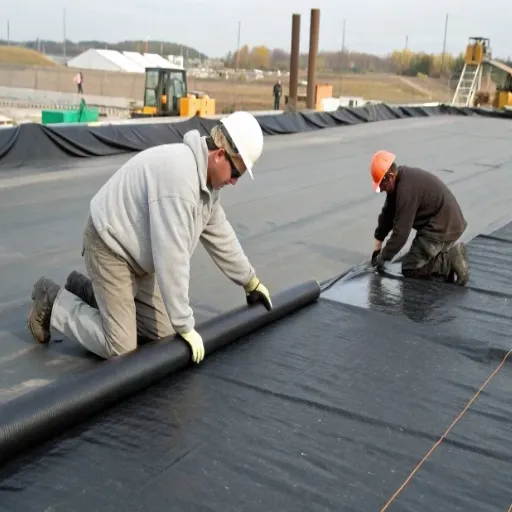
LLDPE geomembrane chemical resistance is strong against aqueous chemistry and weak against solvents. The sheet holds up in hydrochloric acid, sodium hydroxide, brine and most alcohols. It absorbs, swells and softens in benzene, toluene, ketones, esters and chlorinated solvents. Against nitric acid, hydrogen peroxide and other oxidisers the damage is permanent.
That answer comes with a warning. No geomembrane standard tests chemical resistance. GRI-GM17 Rev 17, the specification that governs LLDPE sheet, contains no immersion test at all. The chart a supplier emails you is a screening opinion, not a test result.
If you’ve been handed a compatibility table and told “LLDPE is fine for that,” you already know the problem. The table had letters, not evidence. This guide gives the class ratings with their source, the four test methods that decide a project, the UV and antioxidant numbers behind the durability claim, and the service-life figure that survives scrutiny.
Need a compatibility answer for a specific liquid? Send the chemical name and concentration. We’ll tell you what the chart says, what it doesn’t cover, and whether a project test is the honest next step. Talk to our technical team.
Key Takeaways
- LLDPE rates A on the Poly-Flex chart for non-oxidising acids, bases, salts and aliphatic alcohols, and C for long-term contact with aromatic and chlorinated hydrocarbons.
- GRI-GM17 Rev 17 tests carbon black, OIT, oven aging and UV resistance, but contains no chemical immersion test. Compatibility is a project decision, not a specification property.
- ASTM D5747 states that chemical resistance “is not a quantifiable term” and that the practice “does not offer procedures for interpreting the results.”
- LLDPE absorbs 3% to 15% by weight in plasticising chemicals, may swell 10%, and can lose 20% of yield strength. Those effects reverse after the chemical is removed, unless the sheet was under stress.
- The Geosynthetic Institute predicts a half-life of roughly 36 years for 1.00 mm GM17 LLDPE, exposed, in a dry arid climate. No published model exists for buried LLDPE.
What LLDPE Geomembrane Chemical Resistance Actually Means
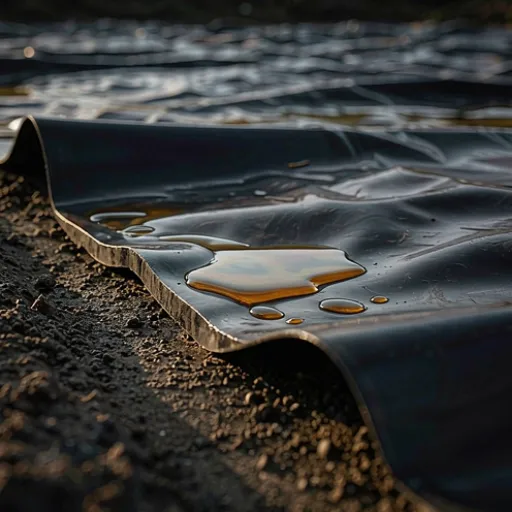
A polyethylene sheet meets a chemical in one of three ways, and the difference decides whether you have a maintenance item or a failure.
Three Ways a Chemical Meets a Polyethylene Sheet
The first is no effect. The chemical and the polymer don’t interact. Weight stays flat, the sheet doesn’t swell, and tensile values don’t move.
The second is oxidation. Oxidising agents cross-link the polymer chains and make the sheet brittle. This damage is irreversible.
A liner that chalked and cracked after a hypochlorite spill didn’t age fast. It oxidised.
The third is plasticisation, and it is the one buyers misjudge. The chemical dissolves into the polyethylene and acts as a plasticiser from the inside. The sheet gains 3% to 15% in weight, may swell by up to 10%, and its tensile strength at yield can drop by up to 20%.
Here’s the part that gets missed: these effects reverse once the chemical is removed and the sheet dries. One condition attaches. The liner must not have been under stress. A swollen sheet pinned against a slope anchor is under stress.
Those three categories come from the Poly-Flex Geomembrane Reference Manual, and the manual is candid about its own limits. Its chart is “a screening process,” the data are “not intended as a warranty or guarantee,” and even EPA Method 9090 is described as “just a method to generate data so that an opinion on chemical compatibility can be more reliably reached.”
Why Density Decides the Outcome
LLDPE sits at the bottom of the polyethylene density range. GM17 defines it as a formulated sheet at 0.939 g/ml or less, with a natural resin density of 0.915 to 0.926 g/ml. HDPE under GM13 starts at 0.940 g/cc.
That gap is small on paper and large in service. The EuroGeo4 keynote paper by Koerner and Hsuan puts it directly: chemical resistance, tensile strength, hardness and stress-crack resistance all rise with density, while flexibility and permeability fall. The paper states that MDPE is “a more suitable material for geomembranes used as landfill liners in comparison to LLDPE due to its chemical resistance, high strength, and low permeability.”
The mechanism is crystallinity. Oxygen and solvents diffuse into the amorphous phase far more easily than into the crystalline phase. Lower density means more amorphous content, so a chemical has an easier path in and an oxidant has more sites to attack. LLDPE’s flexibility and its chemical margin come from the same structural feature, pulling in opposite directions.
What the Standards Do Not Test
GM17’s section heading reads “Physical, Mechanical and Chemical Property Requirements.” Read the table and the chemical requirements turn out to be antioxidant content and carbon black content. Nothing in the standard exposes a specimen to a chemical.
Note 5 of GM17 lists the tests the specification deliberately omits. That list includes environmental stress crack resistance by ASTM D1693 and D5397, solvent vapour transmission, water absorption, ozone resistance, soil burial and hydrostatic resistance. Chemical resistance isn’t on the list because it was never a candidate.
A certificate of GM17 compliance tells you the sheet is well stabilised and dimensionally specified. It tells you nothing about whether the sheet survives your leachate.
LLDPE Chemical Resistance by Chemical Class
The table reproduces the class ratings from the Poly-Flex manual for primary containment (long-term contact) and secondary containment (short-term contact). A means little or no effect at any concentration below 150 °F. B means the effect varies with chemical, concentration and temperature, so consult the design engineer. C means a large effect at high concentration, generally not recommended.
| Chemical class (example) | Effect | HDPE primary | LLDPE primary | LLDPE secondary |
|---|---|---|---|---|
| Carboxylic acid, unsubstituted (acetic acid) | 1 | B | C | C |
| Carboxylic acid, substituted (lactic acid) | 1 | A | B | A |
| Carboxylic acid, aromatic (benzoic acid) | 1 | A | B | A |
| Aldehydes, aliphatic (acetaldehyde) | 3 | B | C | C |
| Amines, primary (ethylamine) | 3 | B | C | C |
| Cyanides (sodium cyanide) | 1 | A | A | A |
| Esters (ethyl acetate) | 3 | B | C | C |
| Hydrocarbons, aliphatic (hexane) | 3 | C | C | C |
| Hydrocarbons, aromatic (benzene) | 3 | C | C | C |
| Hydrocarbons, mixed (crude oil) | 3 | C | C | C |
| Halogenated hydrocarbons, aliphatic (dichloroethane) | 3 | C | C | C |
| Halogenated hydrocarbons, aromatic (chlorobenzene) | 3 | C | C | C |
| Alcohols, aliphatic (ethyl alcohol) | 1 | A | A | A |
| Alcohols, aromatic (phenol) | 1 | A | C | B |
| Inorganic acids, non-oxidising (hydrochloric acid) | 1 | A | A | A |
| Inorganic acids, oxidising (nitric acid) | 2 | C | C | C |
| Inorganic bases (sodium hydroxide) | 1 | A | A | A |
| Salts (calcium chloride) | 1 | A | A | A |
| Metals (cadmium) | 1 | A | A | A |
| Ketones (methyl ethyl ketone) | 3 | C | C | C |
| Oxidisers (hydrogen peroxide) | 2 | C | C | C |
Effect codes: 1 is no effect, 2 is irreversible oxidation, 3 is reversible plasticisation. Source: Poly-Flex Geomembrane Reference Manual, Poly-America, L. P., reproduced in an EPA Region 10 administrative record.
Where LLDPE Is Rated for Long-Term Containment
Read down the LLDPE primary column and the A ratings form a clear block. Non-oxidising inorganic acids, inorganic bases, salts, cyanides, metals and aliphatic alcohols all rate A. That covers hydrochloric and sulfuric acid service, caustic storage, brine ponds, de-icing salt runoff, and most fermentation and food-processing waste streams. It is also why LLDPE works in aquaculture, agricultural ponds and municipal wastewater, where the chemistry is aqueous, near neutral to mildly alkaline, and free of solvents.
Note the asymmetry on phenol. HDPE rates A for aromatic alcohols in primary containment. LLDPE rates C, with B for secondary. One substituted aromatic ring moves LLDPE two grades.
Anyone who generalises from “polyethylene resists alcohols” to “LLDPE resists phenol” has skipped a row.
An illustrative composite. A pond liner buyer in Hubei specced LLDPE for a shrimp farm’s settling pond and then reused the same sheet for a nearby processing plant’s wash-water sump, which carried a solvent-based sanitiser. Six months in, the sheet had swelled around the inlet and the seams were puckering. The wash water needed a compatibility test before any material was named. The example is illustrative, not a client record.
Where It Absorbs, Swells and Softens
Every hydrocarbon row reads C for both materials in primary containment. Aliphatic, aromatic, mixed, chlorinated. Crude oil, benzene and dichloroethane are all the same answer.
That is the practical ceiling on LLDPE in fuel and solvent service. The plasticisation mechanism means the sheet doesn’t fail instantly. It swells, softens and loses yield strength, then recovers if the exposure ends. Continuous contact never ends.
Esters, ketones, aldehydes and primary amines also rate C for LLDPE primary, where HDPE rates B. For a drum bund or a secondary containment tray that sees splashes and drains, LLDPE can be the right answer. For the primary liner under a tank of ethyl acetate, it isn’t.
Nitric acid and hydrogen peroxide carry effect code 2, and both rate C for LLDPE and HDPE. This is the category where polymer choice doesn’t rescue you. Oxidation cross-links the chains, the sheet goes brittle, and no amount of thickness buys back the lost elongation.
The same logic applies to hypochlorite at strength, peracetic acid and chromic acid. A clean-in-place cycle that runs hot caustic then hypochlorite is fine on the caustic step and hostile on the next one.
How to Test LLDPE Geomembrane Chemical Resistance Before You Specify
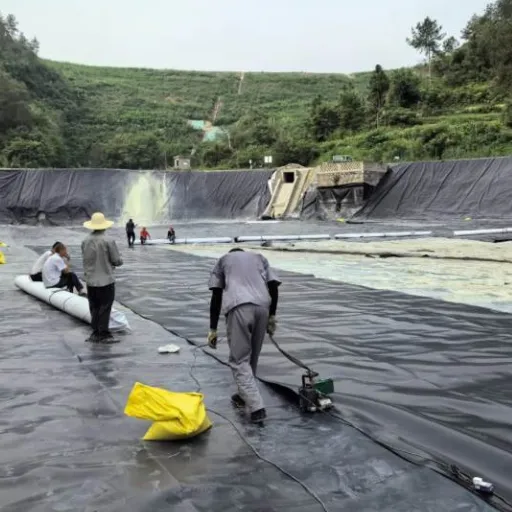
Four documents cover this ground, and they form a hierarchy.
EPA SW-846 Method 9090A, dated July 1992, is the regulatory method. Its purpose is to determine “the effects of chemicals in a surface impoundment, waste pile, or landfill on the physical properties of FML materials intended to contain them.” It is the test a permit writer will name.
ASTM D5322-23 is the laboratory immersion practice. Its scope note is revealing: it “was originally developed to supplement and expand EPA 9090,” and EPA 9090 “has not been updated since 1992.” D5322 extends the approach to all geosynthetics, not just flexible membrane liners.
ASTM D5747/D5747M-21(2026) is the umbrella practice that lists which tests to run. Its significance section is the most honest paragraph in the field. Chemical resistance “is not a quantifiable term.” Results are “a user judgment evaluation.” The practice “does not offer procedures for interpreting the results obtained.” And: “As a practice, this does not produce a test result.”
ASTM D543-21 is the plastics-industry parent. It warns that for continuous immersion, short-time tests “are of interest only in eliminating the most unsuitable materials or indicating a probable relative order of resistance.”
What a Test Report Must State
A usable report names the chemical and its concentration, the temperature, the exposure duration, the specimen thickness, and the properties measured before and after. It also states the acceptance criteria the owner set. Without those, you have data, not a decision. “LLDPE passed 30 days in leachate” tells you nothing until you know which leachate, at what temperature, and what passed meant.
The Poly-Flex manual makes the same point operationally. HDPE as primary containment for chlorinated hydrocarbons at 100% concentration may not be recommended, yet the same material may be acceptable at 0.1% for a limited period, or for secondary containment. Concentration and duration are the variables, and no chart holds them all.
Why a Manufacturer Chart Cannot Replace a Project Test
An illustrative composite. Dana, a process engineer at a chemical blending plant, needed a liner for a 10% acetic acid sump. One supplier’s chart showed C for LLDPE primary containment and she read that as avoid. A second chart showed the same class as acceptable, because it was rating 5% acid at ambient temperature for secondary containment.
Both charts were correct and neither answered her question. She ran an immersion test to D5322 at the actual 10% concentration and 35 °C, measured tensile strength and elongation at 30 and 90 days, then specified against those results. The example is illustrative, not a client record.
UV Resistance, Antioxidants and the OIT Number
GM17 handles weathering through three numbers, and each has a hard limit on what it proves.
Carbon black is specified at 2.0% to 3.0% by mass, with dispersion such that nine of ten microscopic fields fall in Category 1 or 2. Carbon black absorbs UV before it reaches the polymer backbone. Poor dispersion leaves weak points even when total content passes, which is why the dispersion test exists alongside the content test.
Oxidative induction time measures the antioxidant reserve. A conforming sheet must reach 100 minutes on standard OIT (ASTM D3895) or 400 minutes on high-pressure OIT (ASTM D5885). After 90 days at 85 °C, it must retain 35% of the standard value or 60% of the high-pressure value.
What GM17 Requires at 1,600 Hours
After 1,600 hours of UV exposure to ASTM D7238, GM17 requires 35% retention of high-pressure OIT. GM13, the HDPE specification, requires 50%. After oven aging, GM13 requires 55% and 80% retention where GM17 requires 35% and 60%.
That is the clearest numerical statement of the density effect in the standard set. Under an identical aging regime, the LLDPE sheet is allowed to lose more of its antioxidant reserve.
It does not mean LLDPE fails in the field. It means the design has less margin, so the exposure assumptions matter more. A capped, buried installation consumes almost none of that reserve. An exposed one consumes it continuously.
Why OIT Is a Quality-Control Number, Not a Lifetime
The temptation is to read 400 minutes as a durability figure. Both OIT standards close that door.
D5885 §5.3 states that use of the OIT value “to estimate the lifetime of the geomembrane from which the test specimen is taken is not addressed, nor shall it be used for this purpose.” D3895 Note 3 adds that no definitive relationship has been established between OIT on field samples and unused product, and that “the use of such values for determining life expectancy is uncertain and subjective.”
OIT tells you the sheet left the factory with an antioxidant package, and that the package survived aging and UV screening to a set percentage. It does not tell you how many years you get.
Service Life: What the Evidence Supports
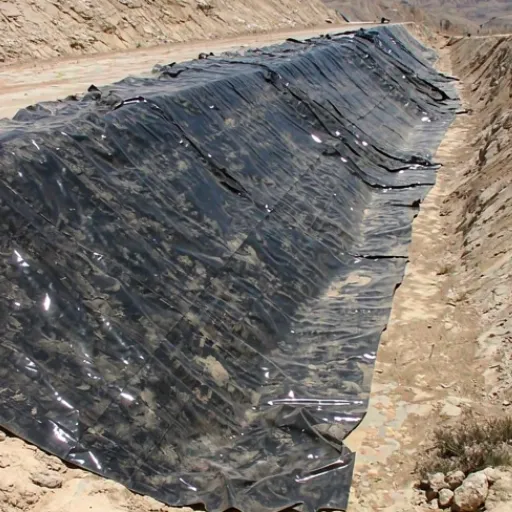
The most-cited figure for LLDPE service life is 36 years, from the Geosynthetic Institute’s exposure programme. What that number means is where supplier pages go quiet.
It is a half-life, defined by GSI as the time to a 50% reduction in a selected design property, usually elongation. The paper is explicit that the material still exists and still functions at half-life, at a lower factor of safety. Failure and half-life are not the same event.
It applies to 1.00 mm sheet made to GRI-GM17, exposed, in a dry and arid climate. The correlation behind it is roughly 1,200 light hours to one year in a hot climate, measured against field-exposed samples in West Texas and Southern California. Move the site to hot and humid and the number drops.
The 36-Year Half-Life and What It Covers
GSI’s Table 6 lists predictions to date: HDPE to GM13 above 36 years and still running, LLDPE to GM17 at about 36 years as a half-life, EPDM to GM21 above 27 years, flexible polypropylene at 30 years as a half-life, and PVC at roughly 18 years.
Read the table properly and the LLDPE figure holds up. It is roughly double the PVC prediction and in the same band the HDPE programme has reached so far.
Why Buried LLDPE Has No Published Model
GSI built a covered-lifetime model for HDPE using three stages: Stage A for antioxidant depletion, Stage B for the induction period, and Stage C for the time to 50% property loss. Summed, the model predicts 446 years at 20 °C and 69 years at 40 °C for covered GM13 sheet.
The same paper states that LLDPE, along with flexible polypropylene, EPDM and PVC, “have had essentially no focused effort on their covered lifetime prediction of the type described herein.”
That sentence is the whole answer to how long buried LLDPE lasts. The 446-year figure belongs to HDPE. Applying it to LLDPE is an extrapolation across a material change that no published source supports. A supplier who quotes a buried LLDPE lifespan in the hundreds of years either borrowed the HDPE model or invented the number.
The staged framework also explains why cover matters more than brand. Stage A runs fastest at high temperature and under UV, so covering the sheet slows the clock at the first stage rather than the last.
An illustrative composite. A closure engineer in Nevada asked three suppliers for a written LLDPE lifespan. Two quoted 100 years buried and one quoted 50. None could produce a model, a test programme or a citation.
The third supplier, asked to show its basis, admitted it had applied the HDPE covered-lifetime numbers. The project specified a 20-year product warranty instead, which is a commercial instrument and an honest one. The example is illustrative, not a client record.
When LLDPE Is the Wrong Liner for the Chemical Load
LLDPE loses the chemical job in four situations, and in each the answer is a different polymer or a different design.
Concentrated organic solvents in continuous contact. Benzene, toluene, xylene, dichloroethane, methyl ethyl ketone and ethyl acetate all rate C for LLDPE primary containment, and HDPE rates no better. Neither polyethylene is the answer for a solvent tank floor. Secondary containment is a different duty.
Strong oxidisers at strength. Nitric acid, hydrogen peroxide and hypochlorite at working concentration attack both polyethylenes. If the service includes a hot oxidising cleaning cycle, the liner is being asked to survive chemistry no PE sheet is rated for.
Aromatic alcohols and substituted aromatics. Phenol is the clearest case, where HDPE rates A and LLDPE rates C. The row exists in the chart and is easy to miss.
A landfill primary bottom liner under aggressive leachate. This one is about stress cracking as much as chemistry. GM17 omits ESCR testing entirely, and the EuroGeo4 paper recommends MDPE over LLDPE for landfill liners. The LLDPE geomembrane landfill guide covers the cap-versus-liner split, and the HDPE geomembrane page covers the material most permits name for the base.
The decision rule is short. Aqueous, non-oxidising, solvent-free: LLDPE is viable. Organic, oxidising or aromatic: test it, and expect the answer to be HDPE or something else.
Specifying LLDPE Where Chemical Exposure Is Real
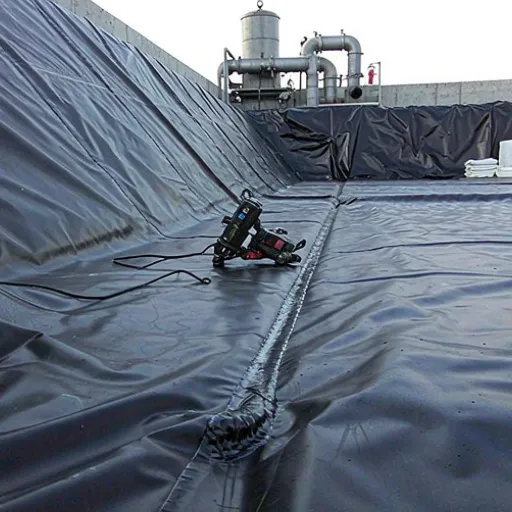
A specification that survives contact with a real chemical load has five parts.
Name the chemistry, not the material category. “Chemical storage” is not a service condition. The liquid, its concentration range, its temperature range, and whether contact is continuous or intermittent are the inputs every test method needs.
Set the acceptance criteria before the test runs. Decide which properties matter (tensile strength at yield, elongation at break, weight change, dimensional stability) and what percentage change is acceptable. ASTM D5747 won’t do this for you, by design.
Require the test method by designation. EPA 9090A, ASTM D5322 or ASTM D543, with exposure duration and temperature stated. A report that names no method is not a compatibility report.
Keep the GM17 property requirements separate from the compatibility question. Carbon black, OIT, oven aging and UV retention confirm the sheet is stabilised for its exposure class. That is a different question from whether your liquid attacks it.
Specify the exposure condition for the installed sheet. Covered or exposed, soil temperature range, expected service duration. The 36-year figure is an exposed, dry-climate, 1.00 mm half-life. If your sheet is covered, say so and design to the covered case, which is slower but unquantified for LLDPE.
Chemical compatibility is only half of containment. A sheet that passes every immersion test still leaks at a failed seam, so the LLDPE geomembrane installation requirements belong in the same specification, not a separate one.
Specifying a liner for a chemical duty? Send the liquid, the concentration, the temperature and the containment type. We’ll confirm the GM17 values at your gauge, flag any class the chart rates C, and tell you when a project test is the only defensible answer. Request a technical quote.
The LLDPE geomembrane specifications page carries the full GM17 property tables, and the LLDPE geomembrane thickness guide covers how gauge interacts with exposure. For the material decision in the other direction, the HDPE vs LLDPE geomembrane comparison covers density, strength and selection logic.
Frequently Asked Questions
Is LLDPE geomembrane chemically resistant?
Yes against aqueous chemistry, no against solvents. LLDPE geomembrane chemical resistance rates A for non-oxidising acids, bases, salts and aliphatic alcohols in primary containment, and C for aromatic and chlorinated hydrocarbons, ketones, esters and oxidisers. The source is the Poly-Flex compatibility chart, which is a screening guide, not a warranty.
What chemicals attack LLDPE geomembrane?
Benzene, toluene, xylene, hexane, crude oil, dichloroethane, chlorobenzene, methyl ethyl ketone, ethyl acetate, acetaldehyde, ethylamine and phenol all rate C for long-term LLDPE contact. Nitric acid and hydrogen peroxide rate C as well, and cause irreversible oxidation rather than reversible swelling.
Is HDPE more chemical resistant than LLDPE?
Yes, by one grade on several organic classes. On the same chart, acetic acid rates B for HDPE primary and C for LLDPE. Phenol rates A for HDPE and C for LLDPE, and esters, ketones, aldehydes and primary amines rate B for HDPE and C for LLDPE. Both rate C for every hydrocarbon class.
Higher density means higher crystallinity, which slows diffusion into the sheet.
Does GRI-GM17 test chemical resistance?
No. GM17 Rev 17 sets requirements for carbon black content and dispersion, OIT, oven aging at 85 °C for 90 days, and UV resistance at 1,600 hours to ASTM D7238. It contains no immersion test, and GM13, the HDPE specification, does not test it either.
Compliance covers stabilization and physical properties, not chemical duty.
Is LLDPE UV resistant?
GM17 requires 35% retention of high-pressure OIT after 1,600 hours of UV exposure, with carbon black at 2.0% to 3.0% as the screen. That is resistance, not immunity. ASTM D7238 notes that exposures do not simulate local effects such as pollution or salt spray, and that results for one thickness cannot be applied to another.
Peggs writes that LLDPE is not used for exposed geomembrane covers because of its lower weathering resistance, while the Fabricated Geomembrane Institute describes it as suitable for mid- to long-term exposed use. The disagreement is real, and an exposed LLDPE design should be justified by the site’s exposure rather than a generic claim.
How long does LLDPE geomembrane last?
GSI predicts a half-life of approximately 36 years for 1.00 mm GM17 LLDPE, exposed, in a dry arid climate. Half-life means a 50% loss of a design property such as elongation, not failure. Buried life runs longer, but no published covered-lifetime model exists for LLDPE, so any specific buried figure is an extrapolation. A 20-year product warranty is common practice and is a different instrument from a lifetime prediction.
Conclusion
LLDPE geomembrane chemical resistance is a real property with a hard boundary, and the boundary runs along the aqueous-to-organic line. Acids, bases, salts and aliphatic alcohols: rated A, long term, no qualification. Aromatic and chlorinated hydrocarbons, ketones, esters: rated C, for both polyethylenes. Oxidisers: irreversible, for both.
Three points are worth carrying into your next specification. There is no chemical resistance test in GM17, so a compliance certificate proves stabilization and nothing about your liquid. Chemical resistance is not a quantifiable term, in ASTM’s own words, so the chart is a starting point and a project test is the decision. And the 36-year figure is a half-life on exposed, dry-climate, 1.00 mm sheet, not a warranty and not a buried-life number.
Get those right and the material choice stops being an argument about brands. It becomes a question of which chemistry the sheet actually meets, which is answerable, and which your supplier should be able to document.