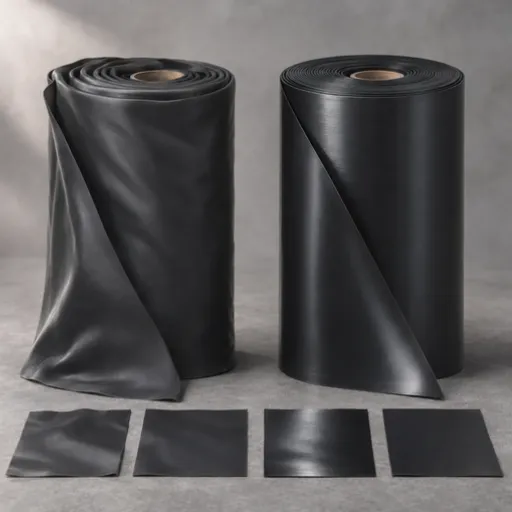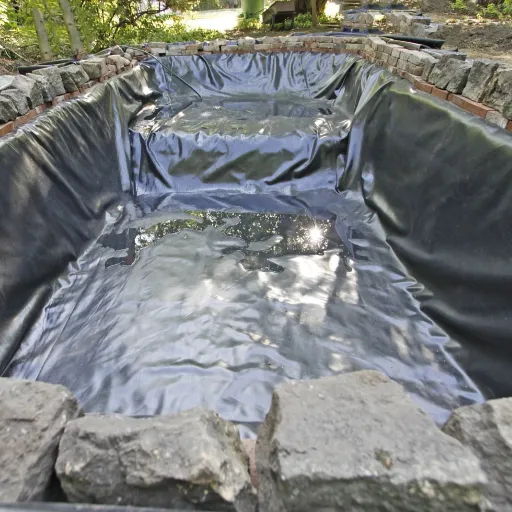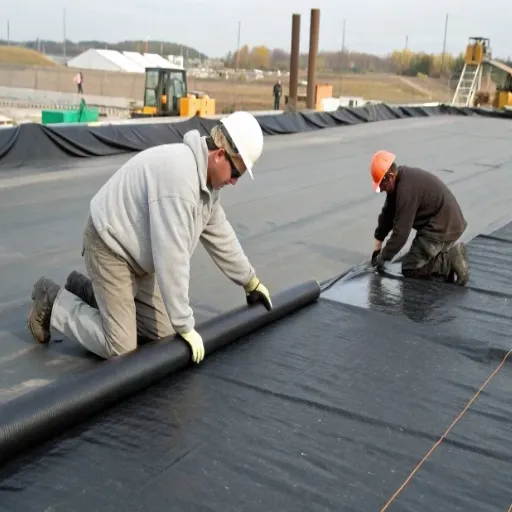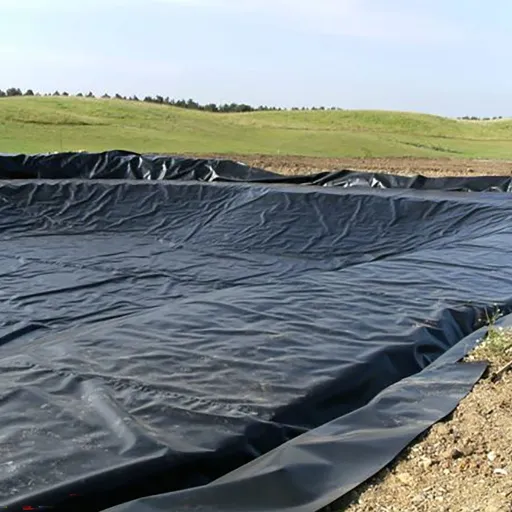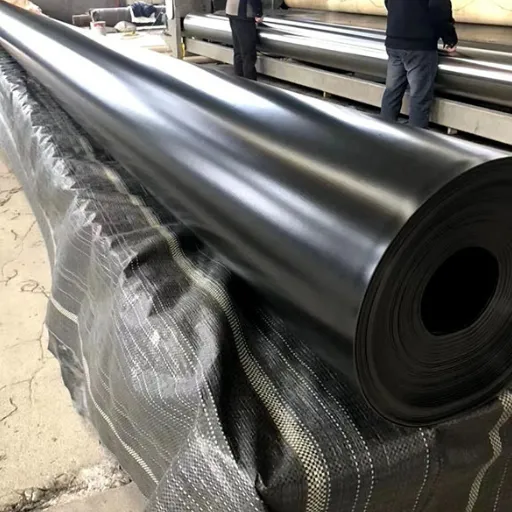
LLDPE vs PVC geomembrane comes down to exposure, not strength. LLDPE is the tougher, UV-tested polyethylene specified by GRI-GM17. PVC is the more conformable plasticized sheet specified by ASTM D7176 for buried applications.
Two rolls can both carry a 30 mil label and be specified for different worlds. One is a linear ethylene copolymer tested for UV and oxidation. The other is a vinyl compound carrying plasticizers, governed by a standard whose title ends with “Used in Buried Applications.”
Most comparisons stop at “LLDPE is stronger, PVC is more flexible.” This guide compares the standards at equal thickness and gives a rule for your tender. Request a technical review.
Key Takeaways
- ASTM D7176-22 is written for non-reinforced PVC in buried applications. GRI-GM17 covers LLDPE with UV, oven aging and OIT requirements.
- At 30 mil, GM17 requires 114 lb/in break strength, 800% elongation and 42 lb puncture. FGI 1126 requires 73 lb/in and 380% for PVC.
- PVC is far more conformable, with a 1,000 psi secant modulus against a 60,000 psi cap for LLDPE.
- PVC seams follow ASTM D7408 and FGI 1126. LLDPE seams follow GRI-GM19a, with a five-of-five acceptance rule.
- Choose LLDPE for exposed or movement-tolerant containment. Choose PVC for buried, complex shapes with a controlled cover.
Quick Answer: LLDPE vs PVC Geomembrane at a Glance
LLDPE is a polyolefin sheet with no plasticizer, specified under GRI-GM17 from 20 to 120 mil. PVC is a plasticized vinyl sheet, specified under ASTM D7176 for buried service and under FGI 1126 from 10 to 60 mil.
| Property | LLDPE (GRI-GM17) | PVC (ASTM D7176 / FGI 1126) |
|---|---|---|
| Base polymer | Linear ethylene/α-olefin copolymer | Polyvinyl chloride compound |
| Additives | Carbon black, antioxidants, no plasticizer | Plasticizers, heat and UV stabilizers, fillers |
| Material standard | GRI-GM17 Rev 17, 2025 | ASTM D7176-22; FGI 1126, revised 2026 |
| Thickness range | 20 to 120 mil (0.50 to 3.00 mm) | 10 to 60 mil (0.25 to 1.5 mm) |
| 30 mil break strength | 114 lb/in | 73 lb/in |
| 30 mil break elongation | 800% smooth, 250% textured | 380% |
| 30 mil tear | 16 lb | 8.0 lb |
| 30 mil puncture | 42 lb | Not specified in FGI 1126 |
| Stiffness | 2% secant modulus, 60,000 psi maximum | 100% secant modulus, 1,000 psi |
| UV and aging tests | Carbon black, OIT, oven aging, 1,600 h UV | No UV test in FGI 1126; burial assumed |
| Seam standard | GRI-GM19a | ASTM D7408 and FGI 1126 |
| Typical fit | Exposed ponds, reservoirs, caps, moving ground | Buried canals, tanks, aquaculture ponds |
LLDPE wins on break strength and tear at equal thickness, and GM17 adds a puncture minimum that FGI 1126 does not set. PVC wins on conformability and seam shear. Exposure decides the rest.
What Actually Separates LLDPE from PVC
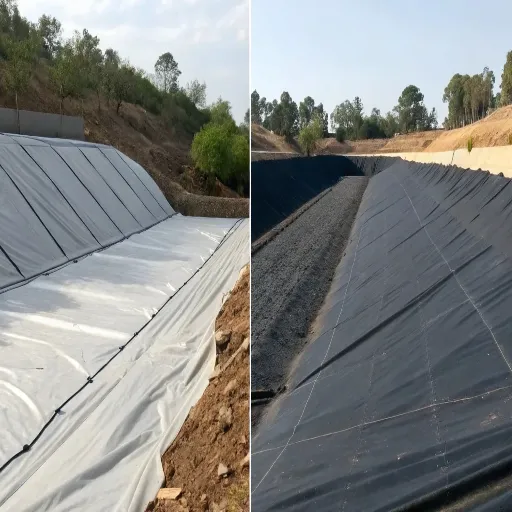
LLDPE Is a Linear Ethylene Copolymer With No Plasticizer
GRI-GM17 defines LLDPE as an ethylene/α-olefin copolymer with a linear molecular structure. The comonomer can be 1-butene, 1-hexene, 1-octene or 4-methyl-1-pentene. Natural resin density sits between 0.915 and 0.926 g/ml, and the finished sheet must stay at or below 0.939 g/ml. The resin must be virgin, with no more than 10% rework and no post-consumer material.
Flexibility comes from the polymer itself, which is why the material has no plasticizer to lose. Our LLDPE geomembrane guide covers the full requirement set.
Naming varies in quotations. Our LLDPE vs LDPE geomembrane comparison covers the adjacent LDPE question, and any sheet described as fMLDPE geomembrane should be checked against GM17 the same way.
PVC Is a Compound, Not a Single Polymer
PVC geomembrane is polyvinyl chloride resin compounded with plasticizers, heat stabilizers, UV stabilizers and other additives. The plasticizer turns a rigid polymer into a flexible sheet. It is also the component that governs long-term behaviour, because plasticizers can migrate, volatilize or be extracted by the pond contents.
FGI 1126 therefore tests plasticizer molecular weight, water extraction and volatile loss alongside tensile and tear. The current FGI 1126 specification tests the additive package, not just the polymer. Our PVC geomembrane guide covers formulation in more depth.
The Standards Point at Different Exposures
ASTM D7176-22 is titled “Standard Specification for Non-Reinforced Polyvinyl Chloride (PVC) Geomembranes Used in Buried Applications.” Its scope describes ponds, canals, reservoirs, landfill liners and covers where the membrane becomes inaccessible after construction. The ASTM scope page makes the buried assumption explicit.
GRI-GM17 carries no such restriction. It requires carbon black content, oxidative induction time, oven aging at 85°C for 90 days and UV resistance for 1,600 hours. Those tests exist because the sheet may spend decades exposed. The FGI PVC guide says the same from the other side: in most long-term containment designs, PVC is installed backfilled to minimise UV exposure and plasticizer loss.
LLDPE vs PVC Geomembrane Properties at Equal Thickness
Equal thickness is the only fair basis for the LLDPE vs PVC geomembrane comparison, and 30 mil is the common specification point for both.
| Property at 30 mil | LLDPE, GRI-GM17 | PVC, FGI 1126 |
|---|---|---|
| Break strength | 114 lb/in | 73 lb/in |
| Break elongation | 800% | 380% |
| Tensile at 100% elongation | Not specified | 30 lb/in |
| Tear resistance | 16 lb | 8.0 lb |
| Puncture resistance | 42 lb | Not specified |
| Secant modulus | 60,000 psi maximum at 2% | 1,000 psi at 100% |
| Specific gravity | 0.939 maximum, formulated | 1.2 typical |
| Hydrostatic resistance | Not specified | 100 psi |
One caveat belongs under that table. GM17 measures tensile with ASTM D6693 Type IV, while FGI 1126 uses ASTM D882. Different specimen geometry and strain rates mean the numbers compare direction, not a precise ratio. Both use ASTM D1004 for tear, which makes the 16 lb against 8.0 lb comparison more direct.
At the same gauge, LLDPE carries roughly half again the break strength, more than double the elongation and double the tear resistance. PVC carries a modulus about sixty times lower.
What Modulus Means on Site
A low modulus means the sheet stretches under small loads. That is why PVC drapes over a rough subgrade, follows a tight corner and conforms to a complex shape without wrinkling. It is also why PVC needs a firm surface and a cover that keeps it from being pulled.
A high modulus means the sheet resists deformation. LLDPE holds its shape under load, bridges small voids and tolerates settlement without thinning as quickly.
A decorative pond rewards conformability. A reservoir on settling ground rewards tensile strength and elongation. The full GM17 table is on our LLDPE specifications page.
GRI-GM17 covers LLDPE from 0.50 to 3.00 mm, or 20 to 120 mil. FGI 1126 and ASTM D7176 cover PVC from 0.25 to 1.5 mm, or 10 to 60 mil. Above 60 mil, PVC is not a standard option, which matters for landfill caps, deep reservoirs and designs needing heavy puncture protection. Our geomembrane thickness guide explains how to size the gauge.
Chemical Resistance, UV and Service Life
Both materials resist a wide range of aqueous chemistry, and both have failure modes a chart cannot capture.
Aqueous Chemistry
LLDPE and PVC both handle many aqueous acids, alkalis and salt solutions across a broad pH range. For a farm pond, a stormwater basin or neutral mine drainage, either material can work, and the choice usually turns on exposure and installation.
A 2002 paper by Delmas, Gourc and Girard describes flexible PVC as having excellent resistance to many aqueous solutions over a wide pH and temperature range. LLDPE’s non-polar structure gives it similar broad resistance to aqueous salts and bases.
Hydrocarbons, Ketones and Solvents
The divergence appears with organic chemistry. The same paper states that PVC is not designed for certain hydrocarbons such as ketones or ethers. Aromatic hydrocarbons, chlorinated solvents and many fuels attack PVC more aggressively, partly by extracting plasticizer from the sheet.
LLDPE is not immune. Hydrocarbons can absorb into polyethylene, causing swelling and a temporary loss of tensile strength. EPA-hosted guidance from Poly-Flex notes weight gains of 3 to 15% and tensile yield loss up to 20%, most of it reversible when the hydrocarbon evaporates. Primary containment of fuels or solvents still needs a project-specific review.
Neither material should be selected for a named chemical without an immersion test to ASTM D5322 or equivalent, at the real concentration, temperature and contact duration. A compatibility chart is a screening tool, not an approval.
UV and Plasticizer Loss
PVC’s vulnerability is cumulative and mostly invisible. UV exposure drives plasticizer migration to the surface, where it can be washed or volatilized away. The sheet stiffens, and the change is hard to reverse.
This is why D7176 is written for buried service and why FGI recommends backfill for long-term containment. The 2002 paper notes that properly formulated PVC can be exposed for 6 to 12 months in a non-tropical climate without significant change, and that polymeric plasticizers with high pigment loadings can extend exposed service beyond that. Those are formulation-dependent examples, not a guarantee.
LLDPE faces UV differently. GM17 requires carbon black between 2.0% and 3.0%, an OIT of 100 minutes standard or 400 minutes high pressure, retention of 35% or 60% after 90 days at 85°C, and retention of 35% high-pressure OIT after 1,600 hours of UV. These are quality control tests, not a service-life promise, but exposure was designed into the standard.
An illustrative example. An irrigation district planned a 12,000 m² exposed reservoir in PVC because the price per square meter was lower and the installer liked the conformability. During design review, the cover was deferred by two years. The team switched the exposed phase to 40 mil LLDPE and kept PVC for the buried canal.
What Service Life Can and Cannot Be Promised
Neither GRI-GM17 nor FGI 1126 states a service life in years. They state minimum properties at manufacture and, in FGI’s case, retained properties after soil burial. Everything beyond that depends on chemistry, temperature, cover, seam quality and inspection.
Be careful with any page that promises 20 or 30 years for either material. The number usually comes from a warranty, not the standard.
Seaming and Installation
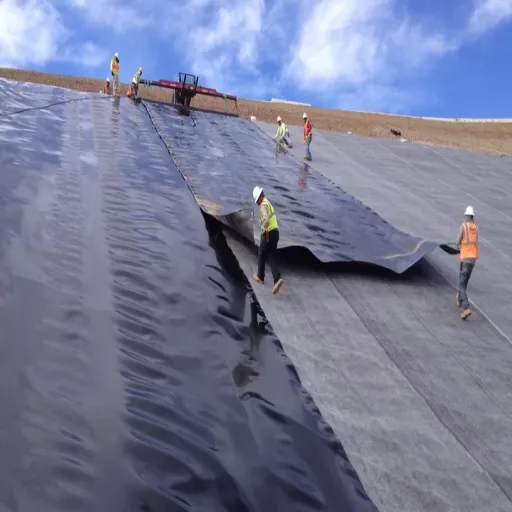
Seams fail more liners than sheet does. The two materials use different methods, test standards and acceptance values.
LLDPE Seams and GRI-GM19a
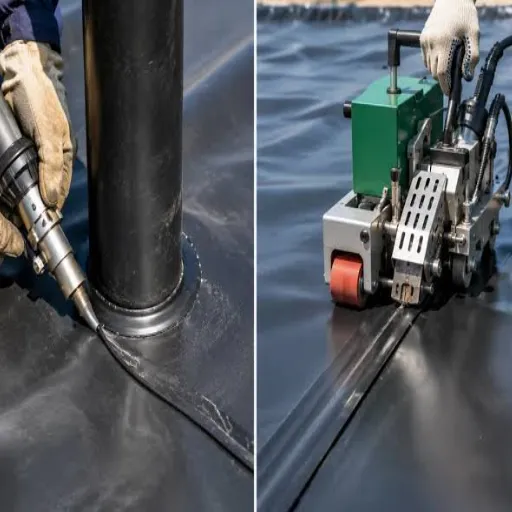
LLDPE is thermally bonded, usually with a hot wedge or an extrusion fillet. GRI-GM19a Rev 10 sets acceptance values for homogeneous HDPE, LLDPE and fPP seams. At 30 mil, LLDPE must reach 45 lb/in shear with 50% shear elongation, 38 lb/in peel for hot wedge and 34 lb/in peel for extrusion fillet, with peel separation no more than 25%.
All five of five specimens must meet both shear and peel values. A seam that passes four out of five fails. Testing follows ASTM D6392, with sampling frequency from GRI-GM14 or GM20. Our geomembrane welding guide covers settings and field sampling.
PVC Seams and ASTM D7408
PVC can be seamed by thermal wedge, hot air, radio frequency welding or chemical fusion. FGI 1126 points to ASTM D7408 for seam strength. At 30 mil, minimum seam shear is 58.4 lb/in and minimum peel is 15.0 lb/in at 2 in/min or 18.0 lb/in at 20 in/min.
Those shear numbers are higher than LLDPE’s, and that is not a contradiction. Specimen geometry, seam method and failure mode differ, so a PVC peel specimen distributes load differently from a polyolefin one.
Dual-track wedge welding allows a continuous air channel test along the seam, one of PVC’s practical advantages. A failed channel shows up before the cover goes on.
Cold Weather, Subgrade and Cover
FGI 1126 recommends that PVC not be handled or installed below 40°F (5°C) without a cold-weather work plan. PVC stiffens in the cold, and a sheet that was conformable in the yard can crack at a fold on a frosty morning. LLDPE also stiffens, but GM17 carries no equivalent restriction.
PVC needs a smooth, firm surface because it conforms to whatever it touches. LLDPE tolerates small irregularities but bridges larger voids, which can leave the sheet unsupported. Neither replaces a geotextile cushion where the subgrade is coarse.
Cost, Thickness and the 30-mil Question
Price per square meter hides the two variables that decide installed cost: mass per area and the cost of the cover.
Why Price per Square Meter Misleads
PVC has a specific gravity of about 1.2. LLDPE is capped at 0.939. At the same thickness, a square meter of PVC weighs about 28% more than LLDPE. Resin is sold by mass, so part of the price gap is simply more material in the roll.
Installation adds another layer. PVC’s conformability can reduce labour on a complex shape. LLDPE’s strength can allow a lighter gauge on a well-prepared subgrade. Seam method, testing frequency, cover material and site access all move the installed number. The LLDPE vs PVC geomembrane cost comparison that matters is installed cost, not roll price.
What 40 CFR 258.40 Actually Says
The federal landfill rule is often quoted as proof that 30 mil PVC equals 60 mil polyethylene. It does not say that. 40 CFR 258.40(b) defines a composite liner as at least 30 mil flexible membrane liner over two feet of compacted soil with hydraulic conductivity no more than 1 × 10⁻⁷ cm/sec. It then adds one sentence: FML components consisting of high density polyethylene shall be at least 60 mil.
The rule sets a floor for an FML and a higher floor for HDPE. It does not create an equivalence between PVC and LLDPE. State and local rules can be stricter.
Three Questions for Every Quote
- Which standard is the sheet certified to, and which edition?
- What is the seam method and the acceptance standard, with test frequency?
- What cover, cushion and subgrade preparation does the price assume?
A quote that cannot answer all three is not comparable to one that can. Send it to us and we will compare it properly. For the polyethylene side, our PVC vs HDPE comparison and HDPE vs LLDPE geomembrane comparison cover the adjacent decisions.
A second illustrative example. A poultry processor took the lowest of three quotes for 30 mil PVC on a wastewater pond. The winning quote assumed a smooth concrete base. The site had crushed aggregate, so the project needed a geotextile cushion and a heavier cover, and the difference erased the saving.
Which Liner for Your Project
Four questions decide it. Will the sheet be exposed? How complex is the shape? What chemistry will it contact? How much movement must it tolerate?
| Application | Exposure | Better fit | Reason |
|---|---|---|---|
| Exposed reservoir or pond | Years uncovered | LLDPE | GM17 UV and aging tests |
| Landfill cap or closure | Covered after placement | PVC or LLDPE | PVC to 40 mil; LLDPE for settlement or heavy gauge |
| Irrigation canal | Backfilled on schedule | PVC | Conformability and D7408 seam values |
| Aquaculture or decorative pond | Often partly covered | PVC | Complex shapes, air-channel seams |
| Tank or basin lining | Confined, aqueous | PVC | Conformability and chemical fusion |
| Hydrocarbon containment | Exposed or covered | LLDPE | No plasticizer to extract; test compatibility |
Our LLDPE geomembrane range covers smooth and textured sheet. Our PVC geomembrane range covers the available constructions. For farm-scale ponds, our LLDPE pond liner for aquaculture guide covers thickness and installation.
If the chemistry includes an aggressive solvent at elevated temperature, or the design needs a reinforced sheet, the answer may be a different liner system.
Frequently Asked Questions
Which is stronger, LLDPE vs PVC geomembrane?
At equal thickness, LLDPE. GM17 requires 114 lb/in break strength and 16 lb tear at 30 mil. FGI 1126 requires 73 lb/in and 8.0 lb tear for PVC. The tensile methods differ, so treat the comparison as directional.
Is PVC more flexible than LLDPE?
Yes, by a wide margin. PVC’s 100% secant modulus is about 1,000 psi. LLDPE’s 2% secant modulus is capped at 60,000 psi.
Can PVC geomembrane be left exposed?
It can be exposed for limited periods, and formulated sheets with polymeric plasticizers perform better. ASTM D7176 is written for buried applications, and FGI recommends backfill for long-term containment.
Can LLDPE and PVC be welded to each other?
Not with a standard thermal weld. The two materials have different melt behaviour and no common seam standard. Transitions usually use a mechanical batten, a flanged connection or a proprietary transition strip.
Which lasts longer, LLDPE or PVC?
Neither standard states a service life. Durability depends on chemistry, temperature, cover, seam quality and inspection. A buried PVC sheet and an exposed LLDPE sheet can both serve a long time, but their failure modes differ.
Which LLDPE vs PVC geomembrane is better for a fish pond?
Both are used in aquaculture, and neither is universally safe or unsafe. The answer depends on formulation, cure time after installation and water chemistry. Ask for formulation data and aquatic-toxicity documentation, and test the water before stocking.
Is 30 mil PVC equal to 60 mil LLDPE?
No standard establishes that equivalence. 40 CFR 258.40 sets a 30 mil floor for a flexible membrane liner and a 60 mil floor for HDPE. That is a regulatory minimum for landfill design, not a material conversion rule.
The LLDPE vs PVC geomembrane decision starts with the cover date. If the sheet will be uncovered for years, specify LLDPE to GRI-GM17 and design the seams to GM19a. If it will be buried within a defined period, on a complex shape, in compatible aqueous chemistry, PVC to ASTM D7176 and FGI 1126 is a legitimate and often more economical choice.
Send us the application, exposure period, chemical list, design gauge and planned seam method. We will tell you which standard the project needs and where the specification is thin. Talk to our technical team.