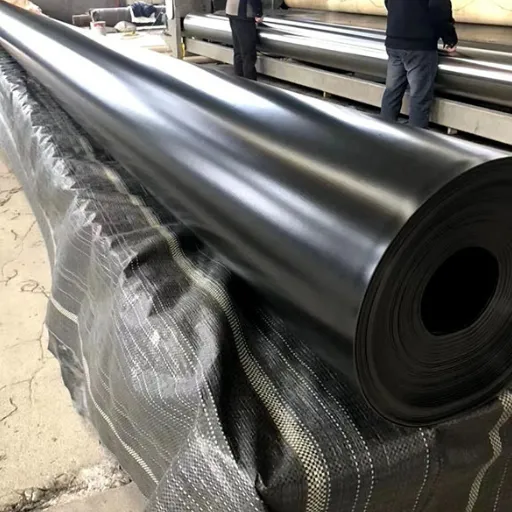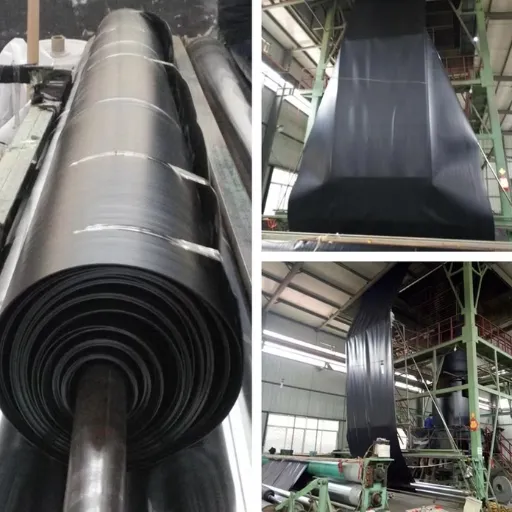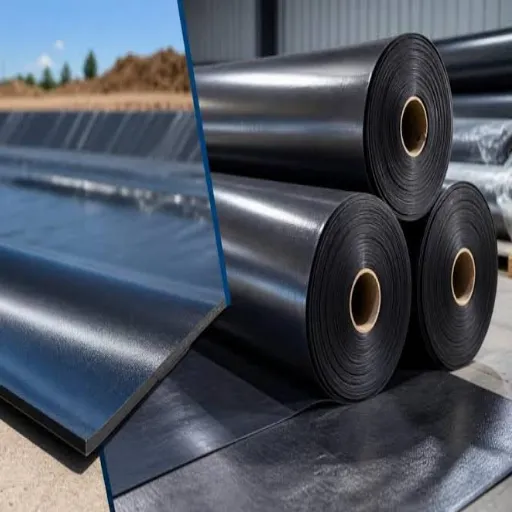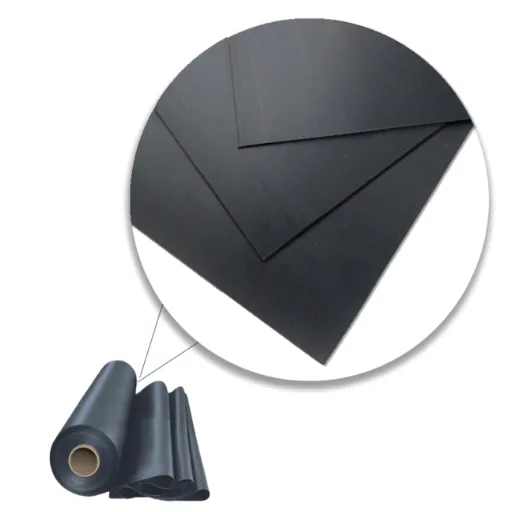
LLDPE geomembrane specifications are set by GRI-GM17, and the current revision is Rev 17, dated 11 June 2025. A complete specification names the density ceiling, the minimum average properties at the ordered gauge, the surface finish, the seam values, and the ASTM test behind each number.
Two datasheets can both claim GRI-GM17 and still disagree about elongation: one quotes 800% for textured sheet, the other 250%. Only one of them read Table 2.
If you’ve compared two “GM17-compliant” sheets and found different tensile values at the same thickness, the specification is usually the problem, not the material. This guide gives the full property sets, explains what each test runs, and ends with a clause you can paste into a purchase order.
Key Takeaways
- GRI-GM17 Rev 17 sets LLDPE geomembrane specifications at a formulated density of 0.939 g/cm³ or less, from 0.50 mm to 3.00 mm, smooth and textured.
- At 1.50 mm, smooth sheet must average 40 N/mm break strength, 800% elongation, 150 N tear and 370 N puncture.
- Textured sheet at the same gauge needs 16 N/mm, 250% elongation, 150 N tear and 300 N puncture, about 40% of the smooth break strength.
- Revision 17 added seam values: 394 N/25 mm hot wedge shear and 328 N/25 mm peel at 1.50 mm, with 50% shear elongation and no more than 25% peel separation.
- GM17 has no stress crack resistance test, so an ESCR requirement has to be added where the sheet carries sustained load.
LLDPE Geomembrane Specifications: The Short Answer
A specification you can enforce has six parts: GRI-GM17 Rev 17 by name; the density ceiling, virgin resin, rework limit and no post-consumer content; gauge and finish; the minimum average index properties at that gauge; seam requirements; and the records the manufacturer must supply.
The table extracts the smooth values from GRI-GM17 Rev 17 at three common gauges. The LLDPE geomembrane guide publishes all eight.
| Property at nominal gauge (smooth) | 1.00 mm | 1.50 mm | 2.00 mm |
|---|---|---|---|
| Break strength, ASTM D6693 | 27 N/mm | 40 N/mm | 53 N/mm |
| Break elongation, ASTM D6693 | 800% | 800% | 800% |
| Tear resistance, ASTM D1004 | 100 N | 150 N | 200 N |
| Puncture resistance, ASTM D4833 | 250 N | 370 N | 500 N |
| 2% secant modulus, ASTM D5323 | 414 MPa max | 414 MPa max | 414 MPa max |
| Formulated density | 0.939 g/cm³ max | 0.939 g/cm³ max | 0.939 g/cm³ max |
One thing matters more than the numbers: these are minimum average values, not minimum average roll values.
GM17 Section 5.2 says its values are neither MARV nor MaxARV and must be read through the named method. The modulus is a maximum: a sheet that’s too stiff stops behaving like the flexible liner the standard describes.
Want your draft specification checked before it goes into a tender? Send the gauge, finish and application, and our technical team will tell you which rows are missing. Request a specification review.
What Each GRI-GM17 Test Method Actually Measures
A value without its method isn’t a specification. The same polymer produces different numbers under different specimen shapes and speeds, which is why every LLDPE geomembrane specifications table names a method.
| Property | Method | What the test measures | What it does not prove |
|---|---|---|---|
| Thickness, smooth | D5199 | Average of 10 readings across the roll | Local thin spots |
| Thickness, textured core | D5994 | Core thickness below the texture | That texture survives handling |
| Asperity height | D7466 | Peak height of the textured surface | Interface friction |
| Formulated density | D1505 or D792 | Density of the finished sheet | Resin grade |
| Tensile properties | D6693 Type IV | Break strength and elongation | Field strain capacity |
| Tear resistance | D1004 | Force to initiate a tear | Puncture performance |
| Puncture resistance | D4833 | Index force through a probe | Performance under rock |
| Carbon black | D4218 | Content by mass | Dispersion |
| Oxidation resistance | D8117 or D5885 | Antioxidant reserve | Service life |
Tensile Properties: ASTM D6693 Type IV
GM17 requires five specimens in the machine direction and five in the cross-machine direction, tested at 21 °C ± 2 °C. Break elongation is calculated on a 50 mm gauge length at 50 mm/min.
LLDPE is specified at break only. GM13, the HDPE standard, also requires yield strength and yield elongation, because HDPE yields before it breaks. LLDPE stretches without a distinct yield point, so yield values on an LLDPE datasheet are borrowed format, not a GM17 requirement.
The 800% figure is a minimum average, not an allowable field strain. A sheet that stretches 800% in a laboratory has already failed as a barrier.
Tear, Puncture and 2% Secant Modulus
Tear resistance uses ASTM D1004, the initial tear resistance of plastic film. Puncture uses ASTM D4833, an index test with a standard probe. Both are comparative: they rank materials and batches reliably but don’t predict performance against a specific subgrade.
The 2% secant modulus (ASTM D5323) is capped at 414 MPa (60,000 psi) at every gauge. The cap is a flexibility requirement, so a formulator can’t meet the tensile row with a stiffer polyethylene that won’t conform to uneven ground.
Density, Carbon Black and Dispersion
Formulated density is measured by ASTM D1505 or D792 (Method B recommended), with a ceiling of 0.939 g/ml. Natural resin is generally 0.926 g/ml or lower, with a melt index of 1.0 g/10 min or less under ASTM D1238.
Carbon black must fall between 2.0% and 3.0% by mass (ASTM D4218), and ASTM D5596 checks dispersion across 10 views: at least nine in Category 1 or 2, no more than one in Category 3. Poor dispersion leaves unprotected polymer between agglomerates, and that’s where weathering starts.
OIT, Oven Aging and UV Resistance
Oxidative induction time is the antioxidant reserve. GM17 accepts a standard OIT of at least 100 minutes (ASTM D8117) or a high-pressure OIT of at least 400 minutes (ASTM D5885). The choice must be reported, because the results aren’t interchangeable.
Oven aging holds samples at 85 °C for 90 days (ASTM D5721), after which the sheet must retain 35% of standard OIT or 60% of high-pressure OIT. UV resistance uses ASTM D7238 for 1,600 hours of 20-hour UV cycles at 75 °C and four-hour condensation cycles at 60 °C, with at least 35% high-pressure OIT retention. GM17 doesn’t recommend standard OIT for UV-exposed samples, because the test temperature distorts some antioxidant results.
Retention is a ratio. A sheet that falls from 800 minutes to 240 has retained 30% and fails, even though 240 minutes still sounds high.
Smooth and Textured LLDPE Are Two Different Specifications
The most common LLDPE datasheet error is applying the smooth table to textured sheet. GM17 writes two sets of LLDPE geomembrane specifications, and the textured requirements are lower.
| Property, textured sheet | 0.50 mm | 0.75 mm | 1.00 mm | 1.25 mm | 1.50 mm | 2.00 mm | 2.50 mm | 3.00 mm |
|---|---|---|---|---|---|---|---|---|
| Break strength | 5 N/mm | 9 N/mm | 11 N/mm | 13 N/mm | 16 N/mm | 21 N/mm | 26 N/mm | 31 N/mm |
| Break elongation | 250% | 250% | 250% | 250% | 250% | 250% | 250% | 250% |
| Tear resistance | 50 N | 70 N | 100 N | 120 N | 150 N | 200 N | 250 N | 300 N |
| Puncture resistance | 100 N | 150 N | 200 N | 250 N | 300 N | 400 N | 500 N | 600 N |
| Asperity height | 0.40 mm | 0.40 mm | 0.40 mm | 0.40 mm | 0.40 mm | 0.40 mm | 0.40 mm | 0.40 mm |
Textured break strength runs at 38% to 45% of smooth, and puncture at 79% to 83%. Tear is unchanged at every gauge. Elongation drops from 800% to 250%.
That isn’t a defect. Texturing interrupts the continuous surface that carries tensile load, and the standard accounts for it. A page advertising “800% elongation textured liner” is quoting Table 1 for a Table 2 product.
Thickness runs differently too. Smooth sheet (D5199) must average nominal, with no reading more than 10% below. Textured core (D5994) must average nominal minus 5% or better, with eight of 10 readings within 10% and none more than 15% below. A smooth weld edge uses a modified D5199 and must stay within 10%.
Composite example. A procurement engineer in Queensland compares two 1.50 mm textured datasheets for a lagoon cover. One lists 800% elongation. The other lists 250% and a 0.40 mm asperity height. The first sheet may be good material, but its datasheet quotes the smooth table. The second supplier wins the order because the document matches the product.
The LLDPE geomembrane thickness guide works through gauge selection and tolerance arithmetic in more detail.
Seam Specifications Added in Revision 17
Until June 2025, GM17’s LLDPE geomembrane specifications covered sheet properties and left seam strength to a separate GRI document. Revision 17 moved those requirements into an appendix and withdrew the older GM19a reference.
| Nominal gauge | Hot wedge shear N/25mm | Hot wedge peel N/25mm | Extrusion shear N/25mm | Extrusion peel N/25mm |
|---|---|---|---|---|
| 0.50 mm | 131 | 109 | 131 | 95 |
| 0.75 mm | 197 | 166 | 197 | 150 |
| 1.00 mm | 263 | 219 | 263 | 190 |
| 1.25 mm | 328 | 276 | 328 | 250 |
| 1.50 mm | 394 | 328 | 394 | 290 |
| 2.00 mm | 525 | 438 | 525 | 385 |
| 2.50 mm | 657 | 547 | 657 | 500 |
| 3.00 mm | 788 | 657 | 788 | 595 |
Every seam must also reach 50% shear elongation, and peel separation can’t exceed 25%. Tests follow ASTM D6392. Hot wedge values also apply to hot air and ultrasonic seaming, and field testing may skip elongation but not shear or peel.
One boundary matters commercially. The appendix makes the installer responsible for seam compliance and creates no obligation for the sheet manufacturer. A supplier can certify the roll. Only the welding contractor can certify the seam.
The video shows both seam types in the table. For machine settings and trial-weld procedure, see the geomembrane welding guide.
GM17 vs GM13: Different Standards, Not Better or Worse
GM13 and GM17 split polyethylene at a density line. GM13 covers HDPE at 0.940 g/cc or higher, from 0.75 mm to 3.00 mm (GRI-GM13 Rev 19). GM17 covers LLDPE at 0.939 g/ml or lower, from 0.50 mm to 3.00 mm.
Tensile strength at 1.50 mm is the same under both, 40 kN/m. The differences are in the required tests. GM13 adds yield strength and yield elongation, a 500-hour stress crack resistance test under ASTM D5397, and higher oven-aging and UV retention. GM17 adds the 2% modulus cap and reaches down to 20 mil.
A GM17 sheet isn’t a cheaper GM13 sheet. It’s a different material with a different test set, and the missing ESCR row matters most in restrained, long-life containment.
Labels get it wrong in both directions. One live distributor page states that an LLDPE product meets GRI-GM13. That’s the wrong standard for the polymer, but it doesn’t make the sheet defective. It makes the datasheet unreliable.
Reinforced LLDPE is a third category. LLDPE-R products combine sheet with a scrim core and fall outside GM17, which covers homogeneous, nonreinforced sheet.
For the full comparison at equal gauge, see the LLDPE geomembrane guide and the HDPE vs LLDPE comparison.
What GM17 Does Not Cover, and What to Add
GM17 is a manufacturing quality control document: its LLDPE geomembrane specifications say what the factory must test and how often, not whether the sheet suits your site.
It deliberately omits stress crack resistance under ASTM D1693 and D5397, dimensional stability, low-temperature impact, wide-width tensile, ozone resistance, hydrostatic resistance and field seam strength. None of those omissions makes the property irrelevant.
- Chemical compatibility. Test against the actual leachate, brine or effluent at the real concentration and temperature.
- Interface shear. For slopes, use ASTM D5321 or D6243. Asperity height doesn’t predict it, and GM17 says so.
- Stress crack resistance. Add an ESCR requirement wherever the sheet is restrained under load.
- Potable water. Add NSF/ANSI 61 if the LLDPE liner will touch drinking water.
- Design life. The 1,600-hour UV test screens; it doesn’t predict. Exposed liners need thickness, a UV-stable formulation and a maintenance plan.
A specification that stops at “meets GRI-GM17” has covered the factory, not the site.
How to Write LLDPE Geomembrane Specifications
The clause below turns GRI-GM17 into LLDPE geomembrane specifications a purchase order can enforce. Replace the brackets and attach the relevant table.
LLDPE geomembrane shall comply with GRI-GM17, Revision 17 (11 June 2025), for [smooth / single-sided textured / double-sided textured] sheet at nominal thickness [X] mm ([Y] mil). The contract unit system is [SI / English]. Formulated sheet density shall not exceed 0.939 g/cm³. Resin shall be virgin, with no post-consumer content and no more than 10% same-formulation rework. Minimum average properties at the ordered gauge shall be [break strength, elongation, tear, puncture, 2% modulus] from GM17 Table [1(b) / 2(b)]. Thickness shall be verified by ASTM [D5199 / D5994], and any textured weld edge by modified D5199. Seams shall meet GM17 Appendix Table 3(b) for [hot wedge / extrusion fillet]. The manufacturer shall supply MQC records for the production run and a shipment certification under GM17 Section 10.1. Project additions: [chemical compatibility, interface shear per D5321 or D6243, ESCR where restrained, NSF/ANSI 61 where potable].
Choose One Unit System
GM17 publishes English and SI tables, and it calls the conversion between them “soft”: the metric columns are rounded names, not exact equivalents. One mil is exactly 0.0254 mm, so 60 mil is 1.524 mm, while the metric table says 1.50 mm.
The gap is 0.024 mm, about 1.6%, small in a description and large in an acceptance test. A contract that orders “60 mil” but tests against the 1.50 mm column will accept sheet thinner than the exact conversion. Name one system, cite the matching table, and use it for both.
Composite example. A reservoir project in northern Chile writes “60 mil LLDPE, GM17” in the purchase order and attaches the metric table. The first delivery averages 1.51 mm. It passes the metric column and would fail a strict 1.524 mm reading. The sheet isn’t the problem. The contract is. The fix is one sentence: “Acceptance shall use GM17 Table 1(b), SI units.”
What the Test Frequency Means in Area
GM17 sets minimum manufacturing frequencies, not site sampling rates. Tensile properties are tested every 9,000 kg, tear, puncture and carbon black every 20,000 kg, and density and initial OIT every 90,000 kg.
At 1.50 mm, sheet at 0.93 g/cm³ weighs about 1.395 kg/m². One tensile test covers roughly 6,450 m², or 0.65 hectares. One tear and puncture set covers about 1.43 hectares, and one density and OIT test covers about 6.45 hectares.
A 20-hectare project might see only a handful of tensile results from the factory, which is why project-level conformance testing matters.
What to Ask for Before Shipment
Ask for the MQC records tied to the production run, not a generic certificate: gauge, finish, test values and the mass each test represents. Ask which GM17 revision and unit system the factory works to, and for the formulation change record if the resin or additives changed since the last aging report.
Section 10.1 requires the manufacturer’s certification and test report on request. That’s a manufacturer’s statement, not third-party certification. If the project needs independent verification, write it in.
Ordering against a GM17 clause? Send the gauge, finish, volume and destination, and we’ll confirm the property values and the documents that ship with the rolls. Talk to our technical team.
Frequently Asked Questions
What is the current GRI-GM17 revision?
Revision 17, dated 11 June 2025. It added seam strength and related properties in an appendix, in place of GRI-GM19a. Older revisions remain online, so a submittal should name the revision it follows.
Is 800% elongation correct for LLDPE geomembrane?
Yes for smooth sheet, no for textured. GM17 Table 1 specifies 800% minimum average break elongation for smooth LLDPE. Table 2 specifies 250% for textured sheet, with a minimum average asperity height of 0.40 mm.
Does GM17 cover textured LLDPE?
Yes. GM17’s LLDPE geomembrane specifications cover smooth and textured sheet from 0.50 mm to 3.00 mm. Textured sheet has its own property table, its own thickness method (ASTM D5994), a weld-edge check and an asperity requirement.
Is LLDPE geomembrane GM13 or GM17?
GM17. LLDPE geomembrane specifications belong to GM17, at a formulated density of 0.939 g/ml or lower. GM13 is the HDPE standard, at 0.940 g/cc or higher.
What does GM17 leave out?
The LLDPE geomembrane specifications in GM17 leave out stress crack resistance, chemical compatibility, interface shear, dimensional stability, low-temperature impact, wide-width tensile and field seam strength. Those have to be added to the project specification where they matter.
Conclusion
A defensible set of LLDPE geomembrane specifications is short, specific and traceable. Name GRI-GM17 Rev 17 and one unit system. Set the density ceiling and the gauge. Publish the minimum average values from the correct table, smooth or textured.
Then add the seam values from the Rev 17 appendix, and the site-specific tests GM17 leaves out.
Three errors cause most disputes. Quoting 800% elongation for textured sheet. Mixing mil and millimetre limits. And treating “meets GM17” as a complete specification when it covers the factory.
Get those right and the datasheet becomes what it should be: a document a supplier can meet, an installer can weld to, and an owner can accept against.
Ready to specify? Send the application, gauge and finish. We’ll confirm the GM17 values, the seam requirements and the submittal package before you order. Request a technical quote.