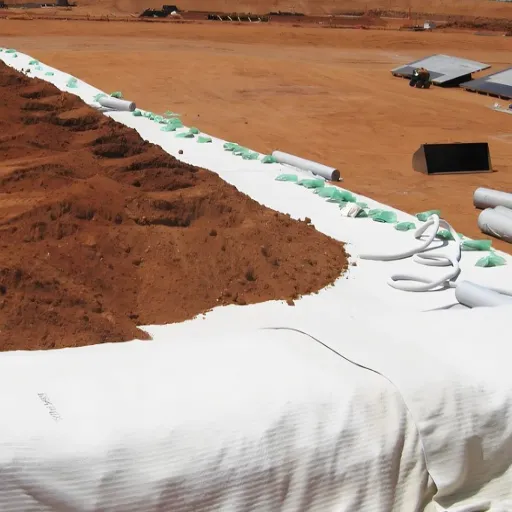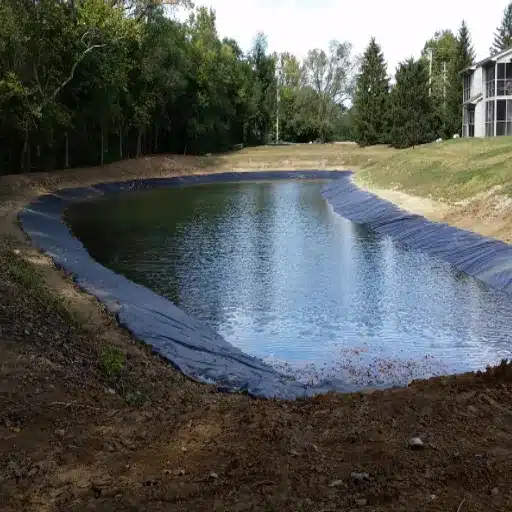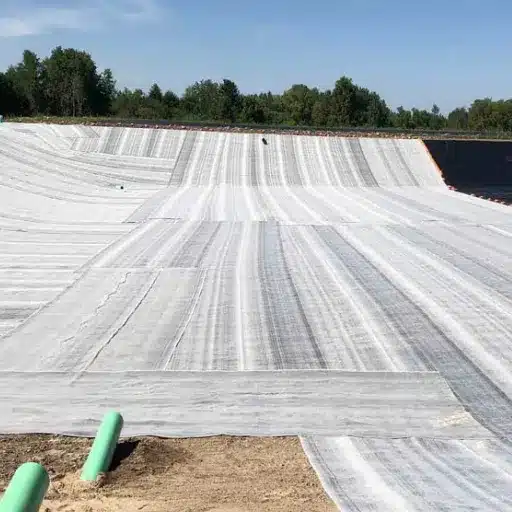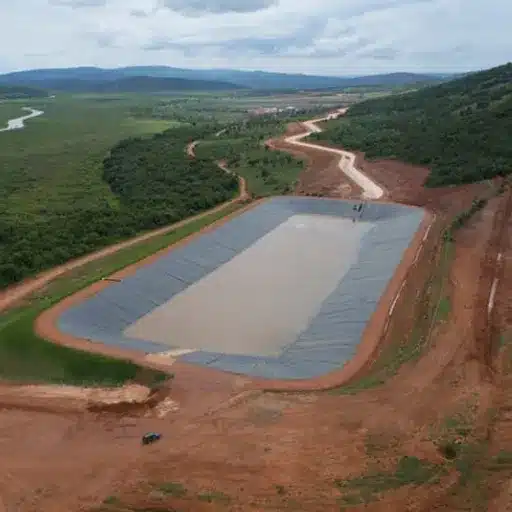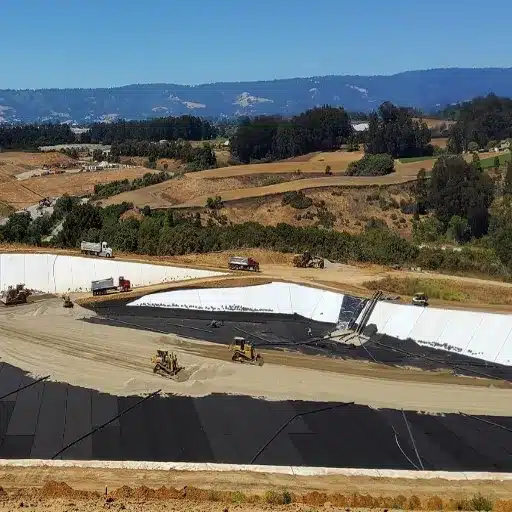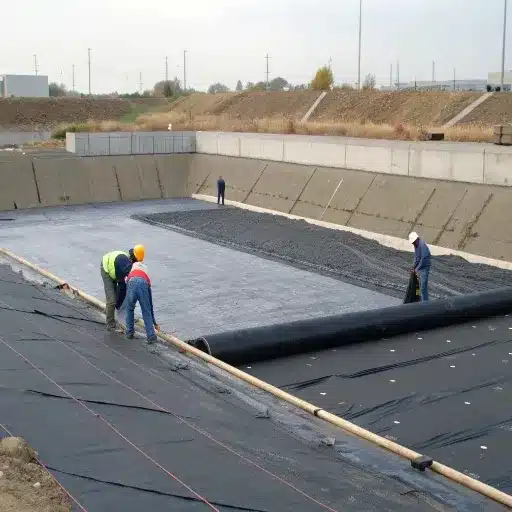
A quality geotextile that’s buried or covered lasts 25 years or more, but an unprotected geotextile left in direct sunlight can lose half its tensile strength within about six months in a high-UV climate. UV resistance is a measured laboratory property, typically 70% tensile strength retention after 500 hours per ASTM D4355. Lifespan is a field outcome that depends on polymer type, stabilizers, and whether the fabric is covered.
That last point catches a lot of people off guard. In Phoenix in 2023, a site superintendent named Greg unrolled a full order of black nonwoven geotextile on a Tuesday, expecting the aggregate to arrive that Friday. A permitting delay stretched it to eight months.
By the time the stone showed up, field sampling showed the fabric had already lost roughly half of its strength. The roll was rated “UV resistant.” It was still compromised.
This guide explains what geotextile UV resistance actually means, how it is tested, how long geotextile lasts in real projects, and exactly how to store, cover, and specify it so your material reaches its design life.
Key Takeaways
Key Takeaways
- Covered or buried quality geotextiles deliver 25+ year service lives; exposed fabric can lose half its strength in months.
- The industry benchmark is ≥70% tensile strength retention after 500 hours per ASTM D4355 (xenon-arc testing).
- Unstabilized polypropylene geotextiles can be destroyed within 18 to 21 months of outdoor exposure.
- Most manufacturers recommend covering geotextiles within 15 days of direct sun exposure; 30 days is generally safe for quality stabilized fabric.
- Carbon black (≥2%) and hindered amine light stabilizers (HALS) are the main factors that separate a 2-year fabric from a 25-year fabric.
How UV Light Damages Geotextiles
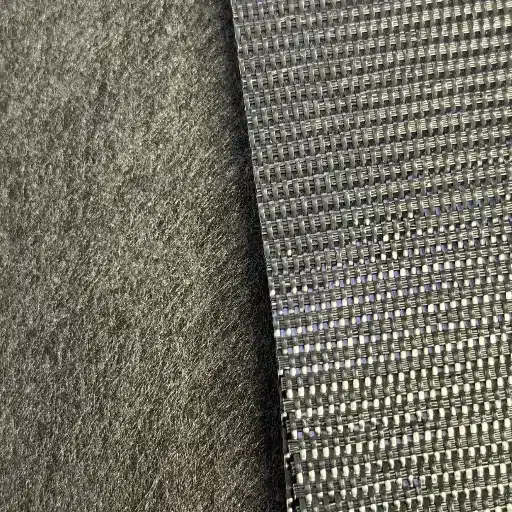
UV light degrades geotextiles through photo-oxidation, a chemical reaction that breaks the polymer chains holding the fabric together.
The mechanism follows a predictable path. High-energy UV photons strike the polymer, generating free radicals. Those radicals attack the molecular bonds, causing chain scission and crosslinking. Over time the material becomes brittle, develops microcracks, and loses tensile strength and elongation.
Infrared and visible light add heat, which accelerates the whole process.
Not all UV is equally damaging. UV-B (280 to 315 nm) causes the most severe polymer damage, while UV-A (315 to 400 nm) is moderate. That matters because UV-B intensity varies hugely by latitude, altitude, and season, which is why the same geotextile can last a decade in Seattle but fail in months in Phoenix.
Laboratory analysis confirms the damage is real and chemical, not just cosmetic. FTIR spectroscopy shows a rising carbonyl index after UV exposure, and scanning electron microscopy reveals transverse microcracks on fiber surfaces within one to two months of outdoor weathering. Nonwoven geotextiles are especially vulnerable because their large surface area of exposed fibers gives UV radiation more polymer to attack.
How Geotextile UV Resistance Is Tested (ASTM D4355 Explained)
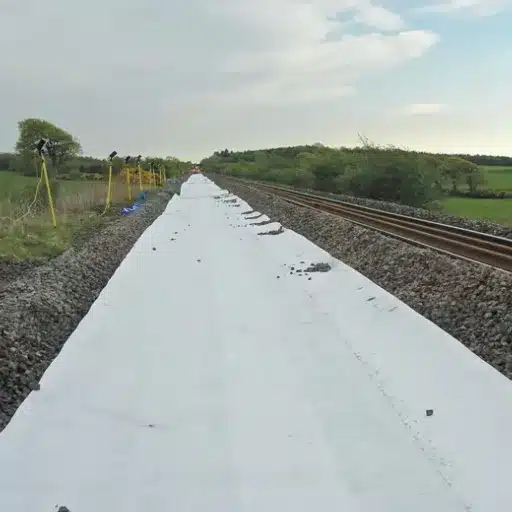
When a datasheet says a geotextile is “UV resistant,” it usually refers to a specific test result. Understanding that test tells you what the number actually means.
ASTM D4355 is the standard test method for deterioration of geotextiles by exposure to light, moisture, and heat in a xenon-arc apparatus. Test specimens are exposed in a xenon-arc weathering chamber, which simulates sunlight, at defined intervals (typically 150, 300, and 500 hours). Retained tensile strength is then measured, usually per ASTM D4595 for wide-width tensile.
The common acceptance threshold in infrastructure specifications is 70% tensile strength retention after 500 hours. Some stormwater specifications accept as low as 50%, while premium UV-stabilized grades reach 90% or more. A related method, ASTM D7238, measures UV resistance and is often cited as the “70% retained after 500 light-hours” value on product data sheets. In Europe, CE-marked geotextiles must pass a weathering test per EN 12224.
Here is the key point most people miss: a laboratory rating is not a service-life prediction. The 500-hour test is an index test, a way to compare products under controlled conditions. It doesn’t model your project site, your climate, or your installation schedule. A fabric can pass ASTM D4355 comfortably and still lose meaningful strength if it sits in the Arizona sun for six months.
How Long Does Geotextile Last?
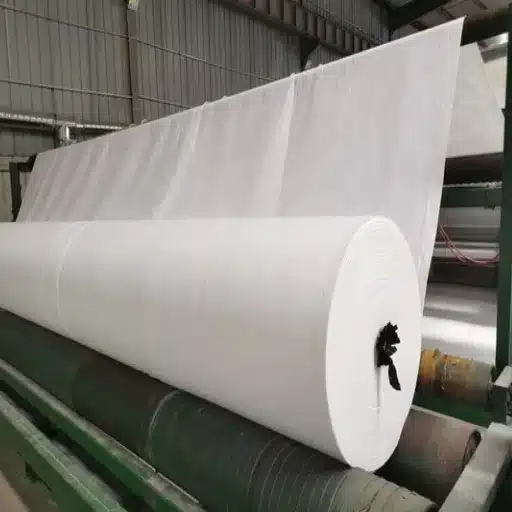
The honest answer depends on one variable above all others: is it covered?
Buried and covered geotextiles: the 25-year scenario
When a geotextile is buried under fill or covered by a slab, pavement, or erosion armor, it is protected from UV radiation. Under those conditions, quality geotextiles are rated for 25 years or more. Terram and mastaTEX, for example, rate their nonwoven fabrics for 25+ years in soils with a pH of 2 to 14 at temperatures below 25°C. Some UV-stabilized hybrid fabrics claim up to 80 years with proper installation.
Long-term field evidence backs this up. NCHRP Report 290 documented polyester geotextiles that retained usable strength after two years of sunlight exposure followed by six years buried in a soil-riprap embankment. When a geotextile is installed correctly under a concrete slab or in a road base and never sees the sun again, 25 years is a reasonable, conservative planning number.
Exposed geotextiles: the failure scenario
Leave the same fabric in direct sunlight and the picture changes completely.
- Unstabilized polypropylene: A 500 g/m² PP geotextile with no stabilizers was completely destroyed by natural weathering, losing more than 90% of its tensile strength within 18 to 21 months in the field.
- Stabilized polypropylene (half-life data): A 6 oz/yd² (~203 g/m²) PP nonwoven had a half-life of 0.29 years in strength and 0.21 years in elongation under laboratory weathering, projected to about 0.42 years in strength in Phoenix, AZ.
- Field case (Pearce Creek): A 350 g/m² black needle-punched PP nonwoven accidentally left exposed for 8 months had a half-life of roughly 200 days, despite a spec rating of 70% retained after 500 light-hours.
- Woven vs composite (5-month study): After five months of outdoor exposure, woven geotextiles retained only 69.55% of tensile strength, while composite geotextiles retained 94.19%.
For landscaping and light-duty uses, the numbers are similar. Uncovered landscape fabric typically degrades within 3 to 5 years (economy grades in as little as one year), while mid-grade fabric lasts 5 to 8 years under mulch and heavy woven fabric can exceed 15 years under stone.
Geotextile lifespan quick reference
| Situation | Material / Condition | Expected lifespan | Key driver |
|---|---|---|---|
| Buried or covered | Quality PP or PET | 25+ years | No UV exposure |
| Covered, heavy load | UV-stabilized woven | 15 to 80 years | Cover + stabilizers |
| Exposed, high-UV climate | Stabilized PP nonwoven | Half-life ~6 months | UV intensity |
| Exposed, mild climate | Stabilized PP nonwoven | Years | Lower UV-B |
| Unstabilized PP, exposed | No additives | Destroyed in 18 to 21 months | No stabilizers |
| Landscape fabric, uncovered | Economy PP | 1 to 5 years | Grade + exposure |
This is why our geotextile under concrete slab guide emphasizes proper slab-side installation: once the fabric is buried and the concrete is placed, the UV risk window closes and the material can deliver decades of separation and protection.
Geotextile UV Resistance by Material
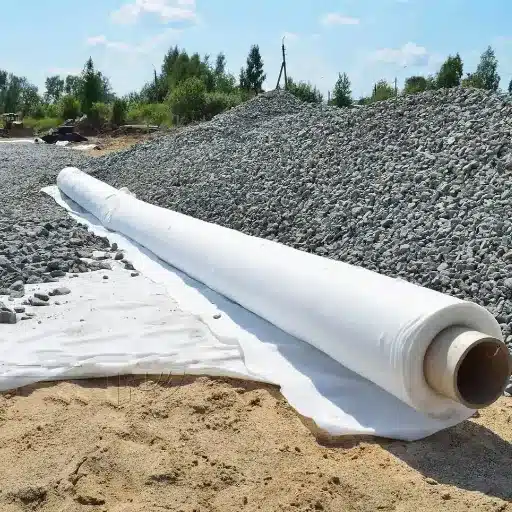
Material choice is the single biggest lever you control when it comes to UV resistance. Three factors matter most: polymer type, construction, and the stabilizer package.
Polymer type
- Polypropylene (PP) is the most common geotextile polymer and the most UV-susceptible. Without stabilizers, it is highly vulnerable to photo-oxidation. This is the material behind the “unstabilized PP destroyed in 18 to 21 months” data.
- Polyester (PET) generally degrades more slowly under UV than polypropylene. The NCHRP field evidence for polyester geotextiles exposed two years and buried six years supports its use in longer-exposure scenarios.
- Polyethylene / HDPE shows good UV resistance when compounded with carbon black, which is why it dominates geomembrane and heavier geosynthetic products.
Woven vs nonwoven construction
Construction type changes how UV damage shows up. In one five-month weathering study, woven geotextiles lost more tensile strength (69.55% retained) than composite geotextiles (94.19% retained), and they also showed loosening of fiber alignment after just one month. Nonwovens are vulnerable for a different reason: UV reaches a large surface area of exposed fibers.
That said, weave type alone is not the deciding factor. Stabilizers and polymer quality matter more. Our woven vs nonwoven geotextile comparison walks through how each construction behaves under different stresses, and the woven vs nonwoven geotextile for road construction guide covers which grade to choose when the fabric will sit in a road base before it is covered.
Stabilizers: carbon black and HALS
This is where the real performance differences come from. The stabilizer package mixed into the resin at manufacture is what separates a fabric that lasts two years from one that lasts 25.
- Carbon black at ≥2% loading is the workhorse UV shield. It absorbs radiation before it reaches the polymer, and UV-stabilized wovens with high carbon black content routinely exceed 90% strength retention after 500 hours.
- Hindered amine light stabilizers (HALS) suppress photo-oxidation by scavenging free radicals. Many modern geotextiles combine carbon black with a HALS package for the best balance.
The practical implication: when a datasheet says “UV stabilized,” ask what the stabilizer package actually is. And when you are comparing weights and grades, our geotextile gsm weight guide is a useful companion, because mass per unit area and UV performance are different specifications that buyers often conflate.
How Long Can Geotextile Be Exposed to Sunlight During Installation?
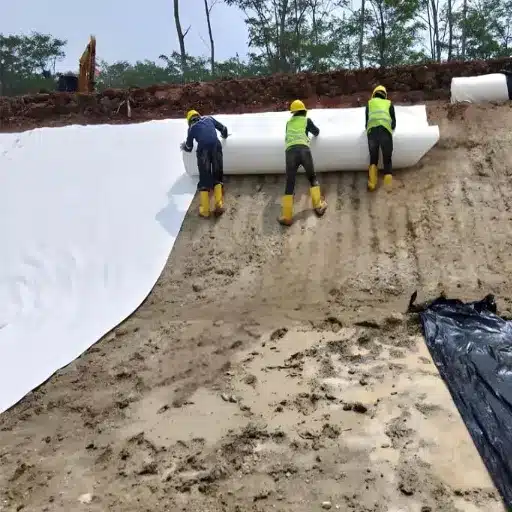
This is the question contractors actually face on site, and the answer is more forgiving than most specifications suggest.
The common spec limit is 7 to 15 days. GSE and Geotex PP110 (TenCate) recommend covering geotextiles within 15 days of direct sun exposure. Terram specifies 14 days. mastaTEX allows up to one month.
The data says 30 days is generally safe for quality stabilized fabric. Robert Koerner, writing for the GMA Techline, called the 7-day limit “extremely conservative” and noted that 30 days of exposure is quite doable for a quality polypropylene nonwoven. The strength half-life of such a fabric is on the order of six months even in a high-UV climate.
Climate changes everything. TenCate’s technical note correlates the 500-hour laboratory benchmark to field years: similar degradation might occur after roughly six months to one year in Tampa, Florida; seven to ten years in Seattle, Washington; and five to seven years in Toronto, Ontario. The diurnal cycle means average daily irradiance is only about 24% of peak, so a cloudy, northern climate gives you far more tolerance than a sunny, southern one.
The practical rule: if the geotextile will be exposed beyond roughly two to four weeks, plan to cover it or place fill. For critical or load-bearing applications, follow the conservative spec limit and record the installation date so everyone knows how long the fabric has been exposed.
How to Store and Protect Geotextiles Before Installation
Much of the UV damage that geotextiles suffer happens before the roll is even placed. Storage discipline prevents it.
- Keep rolls in intact packaging until the moment of installation. The protective film or shrink-wrap blocks UV and moisture.
- Store rolls off the ground on pallets, away from standing water and contaminants.
- Cover open-air storage with a tarpaulin or a black polyethylene sheet. This single step removes the UV variable from the storage equation.
- On site, cover exposed panels and schedule placement promptly. If a roll’s outer layer becomes contaminated or UV-damaged, discard it rather than installing degraded material.
- Track exposure dates. Write the date the geotextile was unrolled next to the panel location. Two weeks later, the crew knows exactly what they’re working with.
None of this is complicated, but it is where projects quietly lose their geotextile performance before a single wheel rolls over it.
How to Specify and Verify UV Resistance
If you’re buying geotextile for a project, you don’t have to take “UV resistant” at face value. You can specify and verify it.
- Require ASTM D4355 data on the datasheet, specifically retained tensile strength at 500 hours. Check whether the value is a MARV (minimum average roll value) or a typical value, because they are very different promises.
- Set a retention threshold that fits your risk. 70% after 500 hours is the default. For applications with long construction windows or revealed faces, require 90%+.
- Ask about the stabilizer package. Carbon black content and HALS type are legitimate questions, not trade secrets. A supplier should be able to tell you.
- Match the grade to installation survivability. If the fabric will sit exposed through a wet, sunny construction season, a heavier, stabilized grade is justified.
- Request third-party test reports for critical applications. Independent verification beats a marketing claim.
For surface-exposed applications like erosion control blankets, the same verification rules apply, and the geotextile for erosion control guide covers how to pick the right grade when the fabric has to survive on the surface rather than underground.
Common UV Mistakes and the Cost of Getting It Wrong
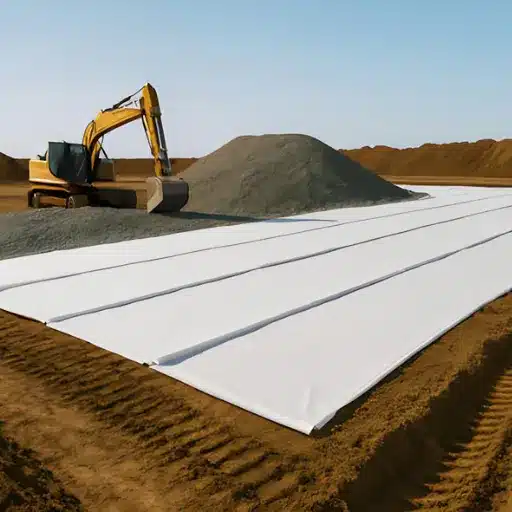
Mistakes in this area tend to be expensive, because the failure happens invisibly. The fabric looks fine, but its strength is gone.
- Mistake 1: Assuming a high lab rating means it can sit exposed indefinitely. A passing ASTM D4355 result does not mean “leave it out for the season.”
- Mistake 2: Buying economy or unstabilized fabric for projects with known delays. The few dollars saved per roll can cost the entire installation.
- Mistake 3: Leaving panels exposed more than 30 days in a high-UV climate without covering.
- Mistake 4: Ignoring storage. Rolls left unwrapped in direct sun degrade before they ever touch the ground.
- Mistake 5: Failing to record exposure dates, so nobody knows the fabric was out too long until it fails a strength check.
The cost math is simple. Replacing exposed fabric means re-ordering, re-unrolling, and re-installing, plus the schedule impact. In most cases that total far exceeds the cost of a few tarps and a cover schedule.
Frequently Asked Questions
How long does geotextile last?
Covered or buried, a quality geotextile lasts 25 years or more. Exposed to direct sunlight, it can lose half its strength within months in a high-UV climate.
Does geotextile degrade in the sun?
Yes. UV radiation causes photo-oxidation, which embrittles the polymer and reduces tensile strength. The rate depends on polymer type, stabilizers, and climate.
How long can geotextile be exposed to sunlight before covering?
Most manufacturers recommend covering within 15 days. The data shows 30 days is generally safe for quality stabilized fabric, with strength half-lives on the order of six months even in high-UV climates.
Is polypropylene geotextile UV resistant?
Polypropylene is the most UV-susceptible geotextile polymer. It becomes UV resistant only with an adequate stabilizer package, such as carbon black and HALS.
What does 70% strength retention after 500 hours mean?
It means the fabric retained at least 70% of its tensile strength after 500 hours of xenon-arc weathering per ASTM D4355. It is a comparison index, not a service-life guarantee.
Is woven or nonwoven geotextile more UV resistant?
Neither is inherently more UV resistant. Stabilizers and polymer quality dominate. Woven fabrics showed faster strength loss in one five-month study, but construction type is not the deciding factor.
Conclusion
Geotextile UV resistance and lifespan come down to one simple truth: covered geotextiles last decades, exposed geotextiles last months to a few years.
To protect your investment, understand the ASTM D4355 number on the datasheet, choose a polymer and stabilizer package that match your exposure risk, cover the fabric within 15 to 30 days of installation, store rolls properly, and specify the retention threshold your application actually needs.
Every geotextile project carries a UV risk window between unrolling and covering. Managing that window is cheaper than replacing the fabric, and it is entirely within your control.
Ready to source UV-stabilized geotextiles with verified test data? Contact our engineering support team for specification assistance, or request a technical quote for your project. We supply woven and nonwoven geotextiles worldwide with responsive technical consultation and quality assurance documentation.