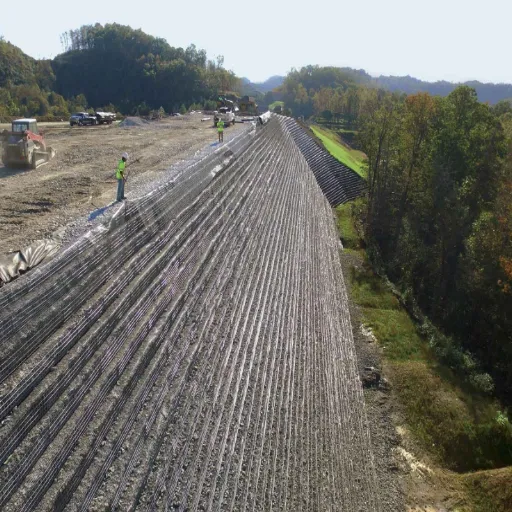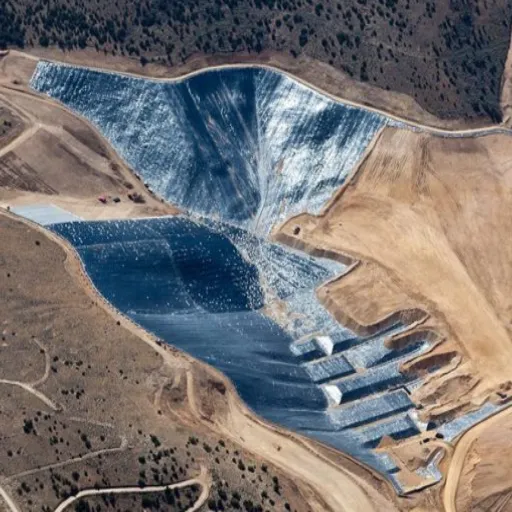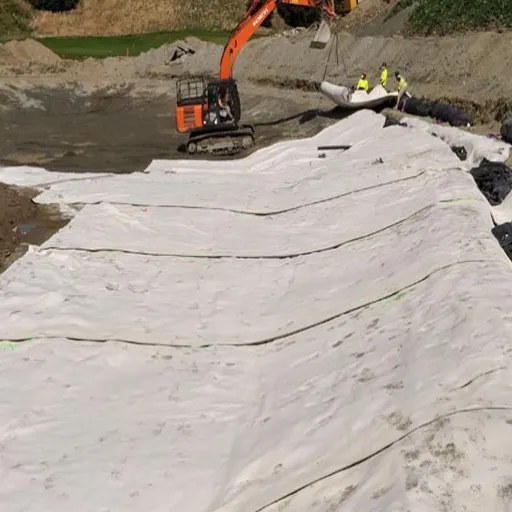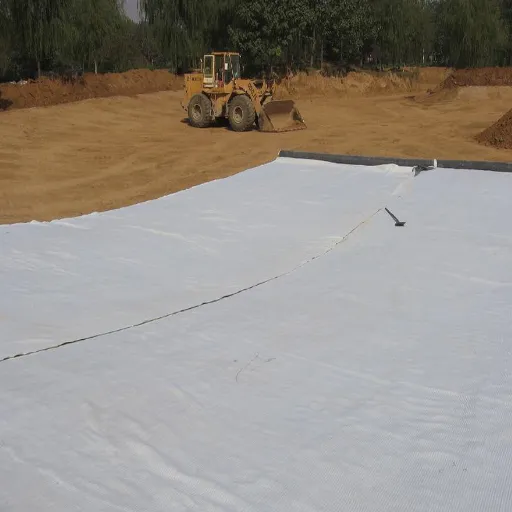
A geogrid is a polymer-based, open-grid geosynthetic that reinforces soil by mechanically interlocking with aggregate, and you choose between uniaxial, biaxial, and triaxial types based on the direction and magnitude of the load you need to carry. Uniaxial geogrids handle one-directional loads for retaining walls and slopes, biaxial geogrids carry balanced loads under roads and driveways, and triaxial geogrids distribute loads in all directions for heavy-traffic pavements. This guide explains how geogrids work, compares every type with real numbers, and walks you through a selection framework engineers and buyers can actually use.
When a logistics contractor in Vietnam needed to build a 400-meter haul road across a flooded rice paddy in early 2025, the first quote proposed excavating two meters of soft clay and replacing it with imported rock. The price came in at over 40% of the whole project budget. Switching to a biaxial geogrid over the unprepared subgrade let the crew place a thinner aggregate platform directly, and the road carried loaded trucks all season without rutting. That single material choice saved the client roughly a third of the earthworks cost. Stories like this repeat on roads, retaining walls, and working platforms across the world, which is why the global geogrid market now sits above $1.5 billion and keeps growing.
In this guide, you’ll learn what a geogrid is, how it reinforces soil, how the three main types compare on strength and application, which standards and specifications matter, how to install it without costly mistakes, what it costs, and how to choose the right one for your project.
Key Takeaways
- A geogrid reinforces soil through mechanical interlock, lateral restraint, and load distribution, not by acting like a fabric sheet.
- Uniaxial geogrids (30 to 200+ kN/m) suit retaining walls and slopes; biaxial geogrids (20 to 100 kN/m) suit roads and driveways; triaxial geogrids suit heavy-traffic pavements.
- Geogrid can cut base-course thickness by up to 64% and lift traffic life by as much as 8.9 times on soft subgrades.
- Specify by long-term design strength (LTDS), not just ultimate tensile strength; LTDS typically runs 33 to 50% of ultimate.
- Apertures should be about 1.5 to 3 times the aggregate size, and minimum aggregate cover before equipment traffic is 4 to 12 inches.
- Material cost runs roughly $0.10 to $10 per square meter depending on type and strength, but total installed cost and aggregate savings matter more.
What Is a Geogrid?
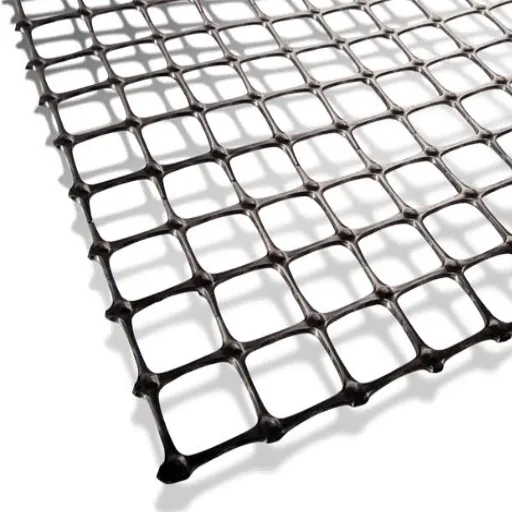
A geogrid is a high-strength, polymer-based geosynthetic with an open, grid-like structure of tensile ribs connected at junctions, with apertures large enough (typically 10 to 100 mm) for soil and aggregate to penetrate and interlock, a definition Tensar describes in detail. Unlike a geotextile, which is a solid fabric, a geogrid works as a structural reinforcement element. Engineers first used geogrids commercially in the 1980s after the design was patented in 1978, and they have since become standard in road construction, retaining walls, and slope stabilization.
Materials Geogrids Are Made From
Three polymers dominate geogrid manufacturing, and each brings different properties:
- Polypropylene (PP): The most common material for biaxial and triaxial geogrids. It offers good chemical resistance, high stiffness, and cost efficiency.
- High-Density Polyethylene (HDPE): Common in extruded and punched-and-drawn uniaxial geogrids. HDPE delivers high stiffness and excellent long-term durability under load.
- Polyester (PET): Used in woven and warp-knitted geogrids, especially high-strength uniaxial products. PET has the best creep resistance, making it ideal for long-term reinforcement like retaining walls.
The material choice affects stiffness, creep behavior, and durability, which is why the same strength grade in different polymers isn’t interchangeable.
How Do Geogrids Work?
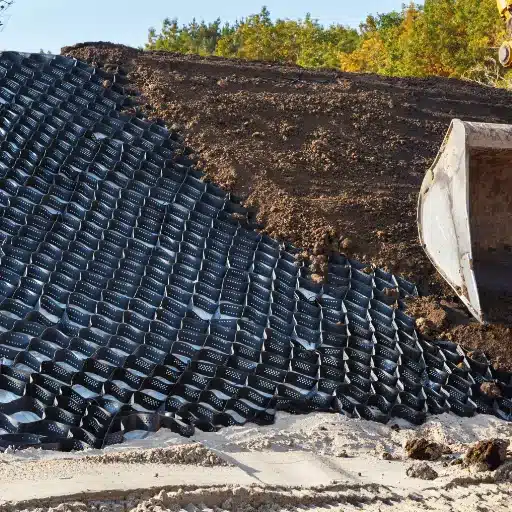
Geogrids reinforce soil through three interrelated mechanisms that turn a loose granular fill into a mechanically stabilized layer.
Mechanical interlock. Aggregate particles compacted over the grid lodge into the apertures and bear against the rib faces. This blocks lateral movement of the aggregate and creates a composite where soil and grid act as one structural unit. Interlock works best when the aggregate D50 is roughly 50 to 100% of the aperture dimension.
Lateral restraint and confinement. Once aggregate is locked in place, it behaves as a confined layer rather than loose material. Confinement raises the aggregate’s shear strength and makes it far more resistant to spreading sideways under wheel loads.
Load distribution. An unreinforced base transfers load almost straight down into the subgrade. A geogrid spreads the same load across a wider footprint before it reaches the weak soil, lowering stress intensity and preventing localized failure. On very soft ground, a secondary tensioned membrane effect adds support under large deformations.
The result shows up in measurable performance. A 2023 finite-element study by Abu-Farsakh and colleagues found that a single geosynthetic layer at the subgrade-base interface produced a base course reduction (BCR) of up to 64%, a traffic benefit ratio (TBR) of up to 8.9 times, and a 322% increase in base effective modulus. Field trials by Zornberg and Gupta at the University of Texas confirmed that reinforced sections rut less than unreinforced ones because the grid controls lateral spreading of the base. In practice, contractors see rutting reduced by up to 50% and vertical subgrade stress reduced by 25 to 40%.
For a deeper look at when reinforcement is actually required versus separation alone, read our geogrid soil reinforcement guide. It covers CBR thresholds and load-distribution benefits with real data.
Geogrid Types: Uniaxial, Biaxial & Triaxial
All geogrids reinforce soil, but they are built for different load patterns. The quickest way to understand the difference is the table below, which is also a featured-snippet target.
| Type | Aperture shape | Strength direction | Typical strength | Best applications |
|---|---|---|---|---|
| Uniaxial | Elongated rectangular | One direction (machine) | 30 to 200+ kN/m | Retaining walls, MSE walls, steep slopes, embankments |
| Biaxial | Rectangular/square | Two directions (MD + CD) | 20 to 100 kN/m | Road bases, driveways, subgrade stabilization, parking lots |
| Triaxial | Triangular (60°) | All directions (360°) | 20 to 50 kN/m typical | Heavy-duty pavements, haul roads, industrial yards, rail ballast |
Uniaxial Geogrid
Uniaxial geogrids are punched and drawn in one direction, aligning the polymer molecules to carry very high tension along the roll. They resist creep well, which matters for permanent structures. Use them wherever the load acts mainly in a single direction: mechanically stabilized earth (MSE) walls, reinforced steep slopes, bridge abutments, and landfill berms. On MSE walls, grid layers extend back into the compacted fill, typically 0.7 to 1.0 times the wall height, at vertical spacings of 18 to 24 inches.
Biaxial Geogrid
Biaxial geogrids are drawn in both machine and transverse directions, giving balanced tensile strength in two axes. They account for roughly 60% of road geogrid installations. Place a biaxial grid between a weak subgrade and the aggregate base, or within the base layer, to confine the aggregate and reduce base thickness. Biaxial geogrids are the standard answer for gravel driveways, parking areas, and low-volume roads.
Triaxial Geogrid
Triaxial geogrids use triangular apertures with ribs at 60-degree angles. That geometry distributes load in every direction and confines aggregate more uniformly than a rectangular grid. Triaxial grids excel under heavy or repeated traffic where multidirectional confinement matters, such as high-traffic roads, unpaved haul roads, industrial yards, and railway ballast. If you’re weighing a biaxial versus a triaxial product for your site, our biaxial vs triaxial geogrid comparison walks through aperture geometry, radial stiffness, and application fit.
Geogrid vs. Other Geosynthetics
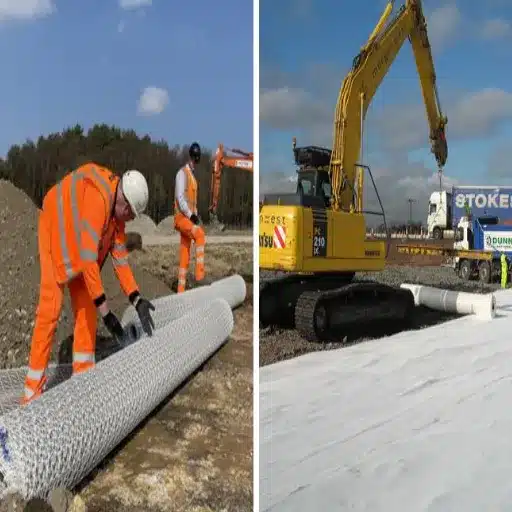
Buyers frequently confuse geogrids with geotextiles and geocells because the names sound similar. The materials solve different problems.
Geogrid vs geotextile. A geogrid is a structural reinforcement layer that locks aggregate in place through interlock. A geotextile is a permeable fabric that separates, filters, and drains. Geogrids are typically 10 to 100 times stiffer than geotextiles in tension. Use a geotextile when you need to keep fine soil out of clean aggregate, let water drain without washing away fines, or protect a geomembrane liner. Use a geogrid when the soil itself needs to carry more load. On soft subgrades with low CBR, contractors often install both: a geotextile separator beneath a geogrid reinforcement layer. Our geogrid vs geotextile comparison explains the decision in detail and when to combine them.
Geogrid vs geocell. A geogrid is a planar, two-dimensional reinforcement layer. A geocell is a three-dimensional honeycomb of interconnected cells that confines infill vertically and laterally, adding stiffness across a thicker zone. Geocells often win for gravel roads, steep slopes, and erosion-prone channels where 3D confinement helps; geogrids usually win for paved road bases and large-area subgrade stabilization where planar reinforcement is enough. See geogrid vs geocell: which stabilization system do you need? for a side-by-side comparison.
A geogrid is sold as a standalone reinforcement layer. If your project also needs a separation layer beneath it, a woven geotextile is the natural companion, and Shanxi Shengxing supplies both.
Geogrid Applications by Industry
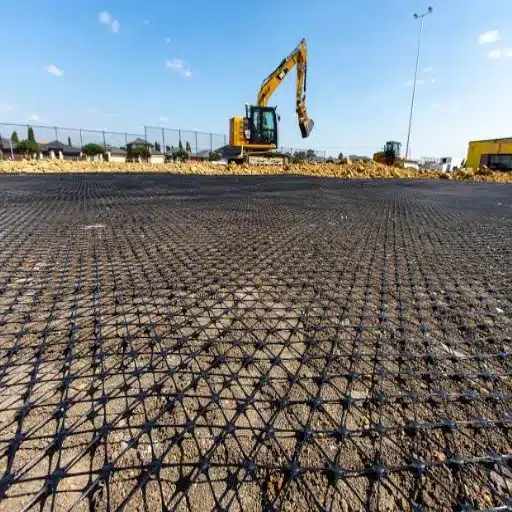
The same reinforcement mechanism serves a wide range of structures. Here is where geogrids show up most often.
Roads, Driveways, and Parking Lots
Place a biaxial geogrid between the subgrade and base course, or within the base, and you can reduce base thickness by 20 to 50% on weak subgrades while cutting rutting, a method documented in the US Army Corps of Engineers geogrid pavement guidance. Homeowners use the same approach on gravel driveways: a single layer of biaxial geogrid over a soft yard lets them reduce gravel depth and keeps the surface stable under vehicles. Our geogrid for road base and gravel driveway guide covers design, aggregate thickness charts, and procurement for both contractors and homeowners.
Retaining and MSE Walls
Uniaxial geogrids are the workhorse of mechanically stabilized earth walls. Layers of grid extend into the backfill and pull the wall face into a soil mass far heavier than the face itself, resisting overturning and sliding. Reinforcement is generally required for walls taller than about 4 feet, and the design is governed by FHWA and NCMA guidelines. A 20-foot MSE wall reinforced with uniaxial geogrid needs no massive concrete footing, which is why the method is so popular on tight sites. Start with our geogrid retaining wall guide for strength selection and layer spacing.
Steep Slopes and Embankments
Unreinforced slopes are usually limited to about 2:1 (horizontal to vertical). Wrapped-faced geogrid construction lets engineers build at 1.5:1, 1:1, or steeper, reclaiming usable land on constrained sites. The grid layers wrap around the face and extend back into the fill, creating a reinforced mass that resists sliding and settlement. See our geogrid for slopes and embankments guide for construction details.
Soft Ground and Subgrade Stabilization
Weak, low-CBR subgrades are one of the most expensive problems in earthworks. Biaxial and triaxial geogrids spread loads across the soft soil, letting equipment operate on sites that would otherwise require excavation and replacement. They support working platforms, unpaved haul roads, railway ballast, and mining access. Rutting on these sites typically drops 30 to 60%. Our geogrid for soft ground and subgrade stabilization guide covers design guidance for marginal soils.
When equipment must reach a soft site during construction, temporary roadway mats offer a fast, reusable access solution that works alongside geogrid-reinforced platforms.
Geogrid Specifications & Standards
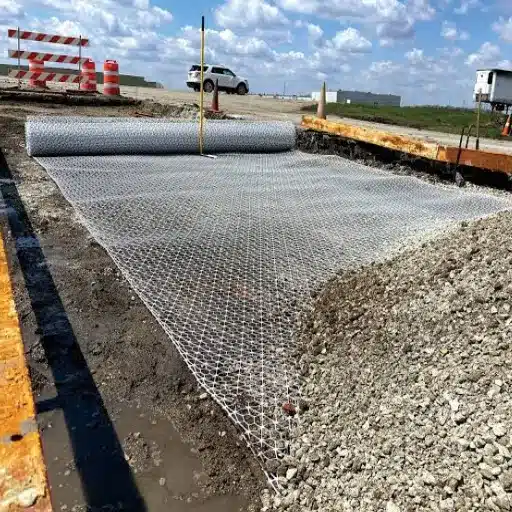
Specifying a geogrid by product name is a mistake. You specify by performance values, and those values come from standard test methods.
Ultimate tensile strength vs long-term design strength. Ultimate tensile strength (UTS) is the peak load the grid can carry in a short-term test. Long-term design strength (LTDS) is the load it can safely carry for the design life after accounting for creep, installation damage, and environmental degradation. LTDS typically runs 33 to 50% of UTS, so a grid with 100 kN/m ultimate might only be specified at 40 kN/m for a 75-year retaining wall. Engineers design to LTDS, not UTS.
Key test methods. The primary tensile standard for geogrids is ASTM D6637, with Method A (single rib) and Method B (multi-rib) procedures. Other relevant tests include ASTM D4595 (wide-width tensile), ASTM D4218 (carbon black content for UV resistance, minimum 2%), and ASTM D5262 or D6992 (creep). Junction efficiency, the strength at the rib intersections, is typically 90% or higher and is critical for load transfer.
Aperture size. Apertures must be 1.5 to 3 times the nominal aggregate size for proper interlock. Common biaxial apertures range from 25×33 mm to 40×40 mm. If openings are too small, aggregate sits on top instead of locking in; too large, and the grid rides above the aggregate.
To illustrate, a typical polypropylene biaxial geogrid in the 15 to 50 kN/m range tests at roughly 13% elongation at maximum load, with strength at 2% strain between 4 and 18 kN/m and at 5% strain between 8.5 and 35 kN/m. High-strength polyester grids reach 20 to 600 kN/m. The full geogrid specifications reference includes a comparison table of these values across types and polymers.
Geogrid Installation Best Practices
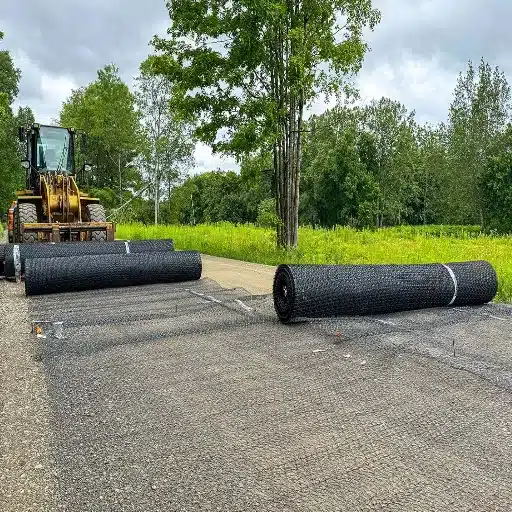
Even a correctly specified geogrid fails if installation is sloppy. The installation rules come down to preparation, tension, overlap, and cover.
Prepare the subgrade. Clear the site of stumps, sharp rocks, and debris that could puncture the grid. Level and compact the subgrade so the grid lies flat. Don’t strip a hard surface crust over weaker soil if the grid will be placed directly on it.
Lay it taut. Unroll the geogrid by hand and pull it tight to remove wrinkles. Wrinkles leave voids beneath the grid that defeat the reinforcement. Lay the grid directly on the subgrade when the design aggregate thickness is less than about 14 inches; place it in the middle of the aggregate layer when the thickness exceeds that.
Overlap and shingle. Overlap width depends on subgrade strength. On firm ground (CBR above 3), about 1 foot of overlap works; on weak ground (CBR 1 to 3), use 2 feet; on very weak ground (CBR below 1), use 3 feet or more. Stagger the seams rather than aligning them in a row, and overlap adjacent rolls like shingles in the direction the fill will be spread.
Anchor properly. Pin the start of each roll at the center and corners, then pin every 5 to 10 feet on flat areas and every 3 to 5 feet on slopes. Anchor spacing prevents the grid from shifting during backfill.
Cover before traffic. Never drive equipment on exposed geogrid. Place a minimum 4 to 12 inches of aggregate before any vehicle crosses it, using more cover for heavier equipment or softer soil. Cover the grid within 48 hours to limit UV exposure.
Compact in thin lifts. Compact in thin lifts, starting with static compaction on soft ground before vibratory rolling. The seven most common installation failures, including driving on the exposed grid and dumping fill from excessive height, are detailed in our geogrid installation step-by-step guide.
A quick story shows what happens when the rules are ignored. In 2022, a contractor installing a parking-lot base over clay spread fill from a tall dump truck directly onto the geogrid. The impact shifted the grid into folds, and ruts appeared within a month. The crew excavated, relaid the grid taut, and staggered the seams. The rebuilt base has stayed smooth through two winters.
Geogrid Cost Factors
Geogrid material prices vary widely, so a number without specification is meaningless. As a starting reference, a biaxial geogrid typically costs $0.10 to $1.50 per square meter, uniaxial products run $0.11 to $10 per square meter depending on strength, and triaxial grids run roughly $0.12 to $2.00 per square meter. High-strength and composite products sit at the top of those ranges.
What actually drives the price:
- Type and polymer: PP is the baseline; PET warp-knitted and steel-plastic composites cost more.
- Tensile strength grade: This is the main lever. Cost is nearly proportional to strength within a polymer family.
- Mass per unit area: Two grids can claim the same grade but weigh differently; lighter grids use less polymer.
- Roll size and freight: A 40-foot container holds about 53,000 square meters of a light 15-15 biaxial grid but only about 17,800 square meters of a heavier 40-40 grade, so freight per square meter can swing more than supplier price.
- Testing and certification: Third-party test reports to a named standard add real cost.
The most important point is that material price is not installed cost. A higher-performance geogrid can reduce aggregate thickness by 20 to 64%, which often lowers the total project cost even when the grid itself costs more. Our geogrid cost per square meter guide includes total-installed-cost modeling and 2026 pricing by type and strength.
How to Choose a Geogrid: Selection Framework

Choosing a geogrid is a step-by-step process, not a gut call. Work through the framework in order.
- Define the application. Is it a road base, retaining wall, slope, or working platform? The application sets the type.
- Assess the soil. Get the subgrade CBR or bearing capacity. Low-CBR soil drives the need for reinforcement.
- Determine the load. What traffic class, surcharge, or wall height must the structure carry?
- Select the type. Uniaxial for walls and slopes, biaxial for roads and driveways, triaxial for heavy-traffic or multidirectional loads.
- Set the strength class. Light duty around 20 kN/m, standard residential walls 35 to 55 kN/m, engineered walls 80 to 120 kN/m, and tall or heavy structures above 150 kN/m.
- Check aperture to aggregate. Confirm the aperture is 1.5 to 3 times the nominal aggregate size.
- Verify quality attributes. Check junction efficiency, carbon black content, and an ISO 9001 quality system.
- Compare total installed cost. Include aggregate savings and installation labor, not just the roll price.
- Qualify the supplier. Confirm export capability, minimum order flexibility, and access to technical support.
This framework is expanded into a full decision matrix in our how to choose a geogrid guide, including a supplier qualification checklist you can reuse on every project.
Ready to spec your project? Talk to our engineering team for a tailored geogrid recommendation based on your soil conditions and load requirements. We supply export-ready geogrids with flexible order quantities.
Frequently Asked Questions
What is a geogrid used for?
Geogrids reinforce soil in road bases, retaining walls, steep slopes, embankments, railway ballast, and working platforms. They lock aggregate in place and spread loads to prevent rutting and settlement.
How does a geogrid reinforce soil?
It reinforces through mechanical interlock, lateral restraint, and load distribution. Aggregate particles lock into the apertures, confine the layer, and spread loads over a wider footprint before reaching the subgrade. Our soil reinforcement guide covers the mechanisms in depth.
Is a geogrid better than a geotextile?
For structural reinforcement, yes; a geogrid is far stiffer in tension. A geotextile is better for separation, filtration, and drainage. The two are complementary and often used together. See the geogrid vs geotextile comparison.
How thick should geogrid be for a driveway?
Driveways typically use a biaxial geogrid in the 20 to 40 kN/m class. Aggregate depth depends on subgrade strength, but the grid lets you reduce it by 20 to 40% while keeping the surface stable. Our road base guide has thickness charts.
Is geogrid necessary for a retaining wall?
For walls taller than about 4 feet, reinforcement is generally required. Uniaxial geogrid with a long-term design strength matched to the wall height is the standard approach. See our retaining wall guide.
How long does a geogrid last?
Quality HDPE and polyester geogrids are engineered to last 75 to 120 years underground when designed to LTDS. The carbon black content protects against UV during exposure before burial.
How much does a geogrid cost per square meter?
Biaxial grids run about $0.10 to $1.50, uniaxial grids $0.11 to $10, and triaxial grids $0.12 to $2.00 per square meter depending on type and strength. Compare total installed cost, not just roll price. Our cost guide has the full breakdown.
Conclusion
A geogrid is a structural reinforcement geosynthetic that locks aggregate in place, and choosing the right one starts with matching the type to the load direction: uniaxial for walls and slopes, biaxial for roads and driveways, and triaxial for heavy-traffic pavements. The specification work comes down to long-term design strength, aperture-to-aggregate ratio, junction efficiency, and standard test methods like ASTM D6637. Installation discipline, including taut laying, correct overlap by CBR, and minimum aggregate cover, determines whether a good specification performs as designed. And the cost decision should weigh aggregate savings against material price, not compare roll prices in isolation.
The geogrid decision does not have to be complicated. Define the application, check the soil, and work the selection framework step by step. If you want an engineering check on your material choice, our team at Shanxi Shengxing can help you specify the right geogrid and supply it anywhere in the world with flexible order terms. Request a technical quote or contact engineering support to get started.