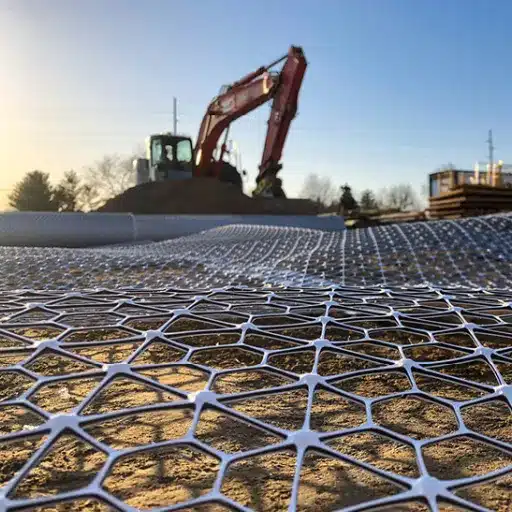
Geogrid and geocell solve two different problems, so the right choice comes down to whether you need tension or confinement. Choose a geocell when the problem is holding fill in place: weak or soft subgrade, gravel roads, steep slopes, and eroding surfaces. Choose a geogrid when the problem is planar reinforcement: road bases, driveways, embankments, and reinforced-soil walls. Demand both and the answer is often both, layered into one composite section.
That distinction is easy to state and easy to get wrong. In a full-scale railway ballast study over soft clay, a geocell cut track settlement by up to 73%, while a single geogrid layer managed 45%, and even two geogrid layers underperformed one geocell layer (Springer). Same design load, very different numbers, because the two products work in fundamentally different ways.
Most search results on this topic are written by geocell manufacturers who sell one answer. Here, we supply both, so the comparison is not a pitch. This guide covers the geogrid vs geocell difference by mechanism, depth of influence, application, and cost, plus the cases where each one is the wrong buy. For the wider background, see our complete guide to geogrid types and applications.
Key Takeaways
- A geogrid is a 2D planar grid that reinforces soil in tension through aggregate interlock; a geocell is a 3D honeycomb that confines the fill vertically and laterally.
- The geocell advantage on weak ground comes from its depth of influence: it stiffens the full cell depth plus material above and below, while a geogrid only confines the one or two aggregate layers touching its plane.
- Independent research backs confinement on soft subgrade: geocell reduced railway-ballast settlement up to 73% versus 45% for a single geogrid layer, and two geogrid layers still trailed one geocell layer.
- Geocell material costs more per square meter (roughly $0.50-$5.00/m² versus $0.10-$2.00/m² for geogrid), but on-site or marginal fill and reduced maintenance often offset the premium; compare total installed cost, not roll price.
- Geogrid wins on planar reinforcement and MSE walls and is the economical default over firm ground; geocell wins on containment, slopes, and weak subgrade. Combining them is standard practice on demanding sites.
Geogrid vs Geocell: The Core Difference
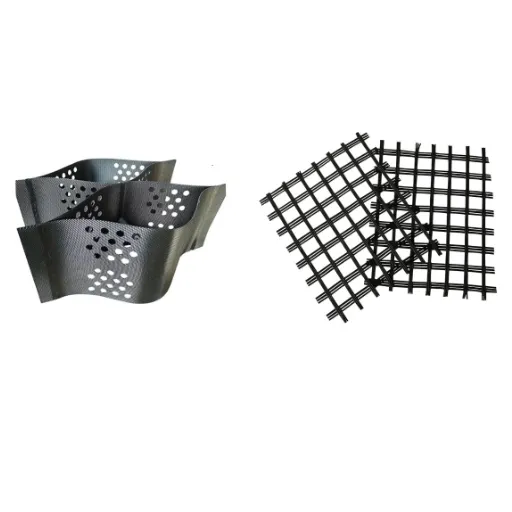
The cleanest way to frame the geogrid vs geocell decision is confinement versus tension. Everything else follows from that.
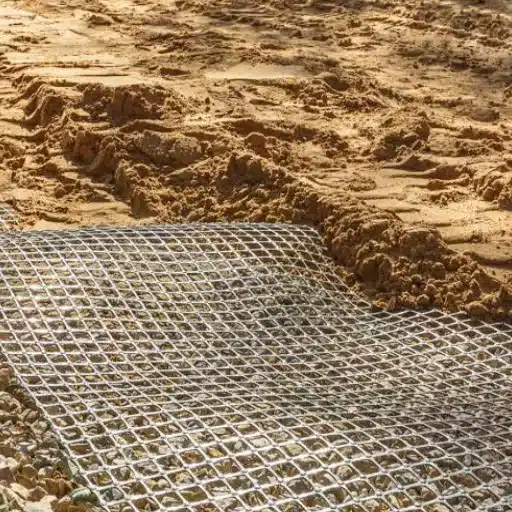
A geogrid reinforces. It is a flat, two-dimensional grid laid horizontally inside a compacted layer. Its ribs carry tensile load, and its apertures lock with the surrounding aggregate. When the soil tries to spread sideways under a wheel load, the grid restrains it and spreads the load over a wider footprint.
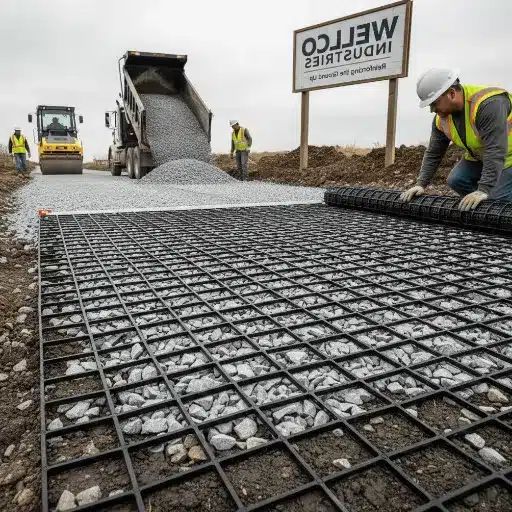
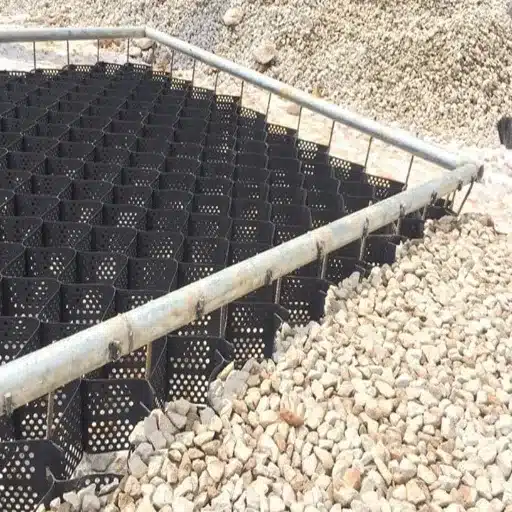
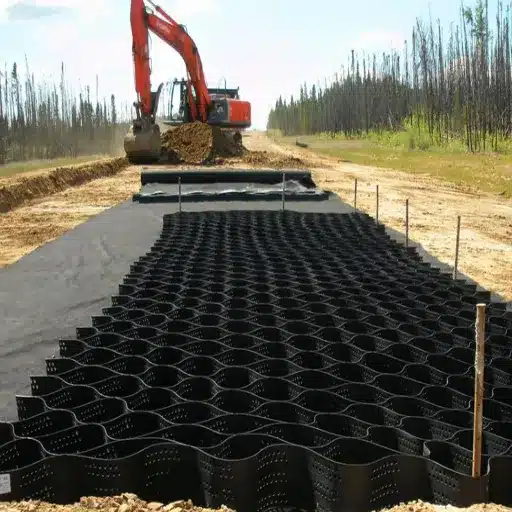
A geocell confines. It is a three-dimensional honeycomb of HDPE strips, expanded on site and filled with soil, aggregate, or concrete. Each cell wall pushes back against its neighbor through hoop stress and passive earth pressure, so the infill cannot move sideways. The result is a stiff, semi-rigid mattress that resists load immediately.
That difference in geometry is the whole story. A geogrid works in one plane. A geocell works through a volume. And it’s not a detail: it’s the one row in any comparison table that most often decides which product a project actually needs.
Consider what happened to Marcus, a contractor building a 400 m logging access road across a wet, organic silt flat in early 2025. He first priced a biaxial geogrid under 450 mm of imported crushed stone. The truck sank the first day of placement, the grid wrinkled under the tracking load, and half the expensive aggregate was lost to the mud. Switching to a 200 mm geocell mattress filled with local sand-bearing gravel and topped with 100 mm of crushed stone let the crew build over the same ground with far less import. The confinement held the weak silt in place; a planar grid could not.
Need help deciding which mechanism your site needs? Send our engineers your bearing conditions and load requirements and we will tell you whether you are solving a tension problem or a confinement problem.
Geogrid vs Geocell: Key Differences at a Glance
| Feature | Geogrid | Geocell |
|---|---|---|
| Structure | 2D planar grid, open apertures | 3D honeycomb, 50-300 mm deep |
| Working mechanism | Tensile reinforcement, aggregate interlock | 3D confinement, hoop and passive resistance |
| Depth of influence | 1-2 aggregate layers touching the plane | Full cell depth plus material above and below |
| Load response | Design and stiffness activated | Immediate, no surface displacement needed |
| Aggregate requirement | Well-graded crushed stone for interlock | Tolerates sand, RAP, C&D waste, recycled concrete |
| Slopes and erosion | Limited, no surface containment | Excellent, holds fill on steep gradients |
| Channels | Not typically used | Yes, vegetated or concrete infill |
| Install tolerance | Must be taut and correctly aligned | High tolerance, no pre-tensioning |
| Relative material cost | Lower, roughly $0.10-2.00/m² | Higher, roughly $0.50-5.00/m² |
| Best applications | Road base, driveways, embankments, MSE walls | Soft-ground base, steep slopes, channels, haul roads |
Read the table as a decision aid, not a scorecard. Neither column is better in absolute terms. The row that most often decides a project is depth of influence, and it is the one buyers overlook.
What Is a Geogrid?
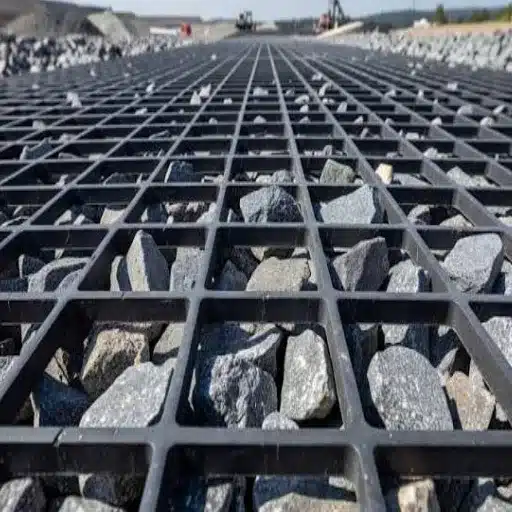
A geogrid is a planar, two-dimensional polymer grid, typically made from polypropylene, polyester, or fiberglass, that is laid horizontally within a compacted layer so its apertures interlock with aggregate and its ribs carry tensile load to restrain and reinforce the soil.
Its strength comes from stiffness, not thickness. Biaxial geogrids commonly run from 20-20 to 50-50 kN/m in the machine and cross directions, with apertures of roughly 25-46 mm to match the aggregate. Triaxial geogrids, with their triangular apertures, publish radial stiffness values in the range of 200-540 kN/m at 0.5% strain. For context, geogrids are on the order of 10 to 100 times stiffer in tension than a geotextile.
One claim you’ll read from geocell vendors is that a geogrid only reacts after the driving surface fails. That’s misleading. A geogrid is a design element: it’s selected so its stiffness mobilizes at the strains predicted by the pavement or slope analysis, not after visible rutting. For the underlying mechanics, see our guide to geogrid soil reinforcement.
The practical constraint on geogrid is the fill. Interlock only develops with well-graded, angular crushed stone. Put a geogrid under a uniform fine sand and it has little to grip, which is why geogrid performs best where quality aggregate is available. We supply biaxial, triaxial, and uniaxial geogrid reinforcement across the common strength classes.
What Is a Geocell?
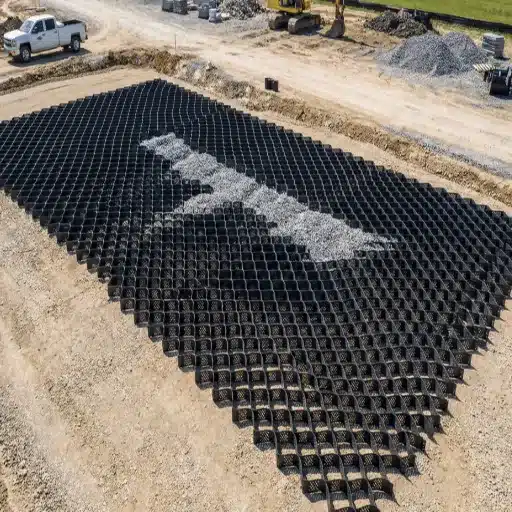
A geocell, or cellular confinement system, is a three-dimensional honeycomb of HDPE strips expanded on site and filled with soil, aggregate, or concrete, confining the infill vertically and laterally to form a stiff, load-spreading mattress.
Geocell specifications matter more than most buyers realize, because cell depth drives performance and price:
| Property | Typical value |
|---|---|
| Material | Virgin HDPE, density 0.935-0.965 g/cm³ |
| Sheet thickness | 0.9-2.0 mm (nominal 1.5 mm) |
| Cell depth | 50-300 mm |
| Weld spacing | 330-712 mm |
| Tensile strength at yield | ≥22 kN/m |
| Seam peel strength | ≥14.2 kN/m (USACE GL-86-19) |
| Carbon black content | ≥1.5-2% |
| Options | Perforated, textured |
Matching cell depth to the load is the single most important geocell decision. A 100 mm cell suits domestic cars, 150 mm suits delivery vans, 200 mm covers standard construction traffic, and 300 mm is reserved for heavy goods vehicles, mining trucks, and cranes. Undersize the depth and the mattress deflects; oversize it and you pay for confinement the load never needs. The seam peel strength requirement in USACE GL-86-19 is the standard test that keeps welded cells from pulling apart, and it is worth asking any supplier for the test report. We build the full range of HDPE geocell systems to these specifications.
How Depth of Influence Explains the Performance Gap
This is the technical heart of the geogrid vs geocell question, and it is where vendor narratives usually stop short.
A geogrid confines a thin, planar zone. Only the aggregate in direct contact with the grid, typically one or two layers, is restrained and interlocked. The material above and below the plane is largely unaffected until the whole section deforms.
A geocell confines a volume. Every particle inside the cell is held laterally through the full cell depth, and the mattress also stiffens a zone above and below it. That thicker stiffened layer spreads wheel loads over a larger area at depth, which is exactly what reduces stress on a weak subgrade.
On firm ground, that difference hardly matters, because the subgrade carries the load anyway. On soft, saturated, or variable ground, it decides whether the section works. This is the mechanistic reason the railway-ballast study produced a 73% versus 45% settlement result: the geocell stiffened a much deeper zone than the single grid plane.
Two more findings from the research reinforce the point:
- Lab tests on geocell-reinforced reclaimed asphalt pavement (RAP) bases showed higher resilient modulus and lower permanent deformation than unreinforced RAP (UT Arlington).
- A composite study found a geocell and geogrid placed together in a single layer outperformed geocell confinement followed by a separate geogrid layer.
Geoengineer.org makes the balanced summary well worth reading: neither system is universally superior, and selection should follow the governing mechanism, ground conditions, loading, and available fill (Geoengineer.org).
Which Applications Favor Geogrid vs Geocell
Match the system to the job, and the geogrid vs geocell decision becomes straightforward.
Choose geocell when you are holding material in place:
- Soft, weak, or variable subgrade with low CBR
- Gravel and dirt roads, driveways, and parking areas subject to rutting
- Working platforms, haul roads, and mining access
- Steep slopes and embankments where the face must be contained
- Erosion-prone slopes and drainage channels
- Retaining-wall facing and low earth-retention structures
- Railway ballast over soft clay
- Any site where local or marginal fill must substitute for imported aggregate
Choose geogrid when you are stiffening a layer:
- Planar tensile reinforcement of a road base or driveway over firm-to-moderate ground
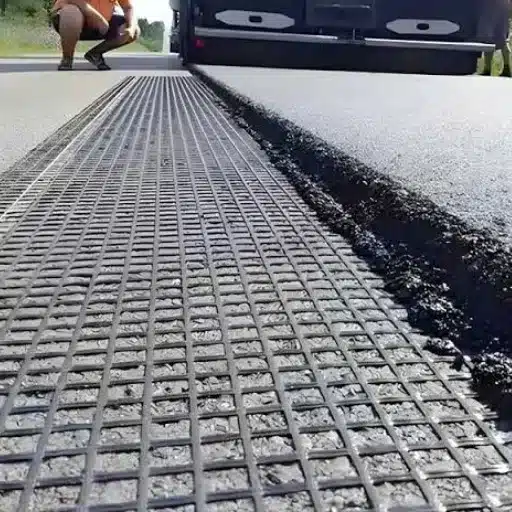
- Thick granular layers under asphalt
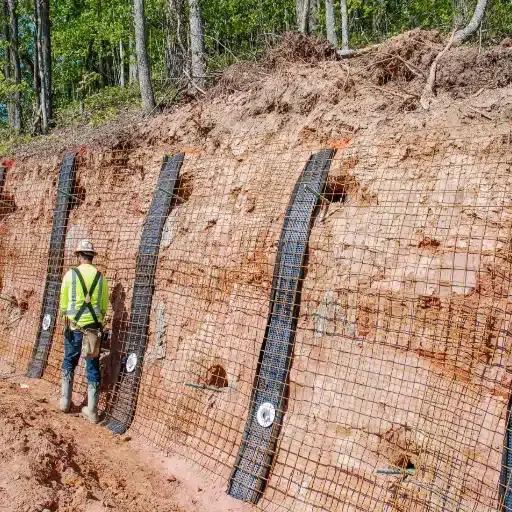
- Mechanically stabilized earth (MSE) and reinforced-soil walls, using uniaxial grades
- Embankment foundations and large-area subgrade stabilization
- Cost- or schedule-critical work where simplicity and speed matter
The rule of thumb is short enough to remember: hold the material, use geocell; stiffen the layer, use geogrid; do both on demanding ground. If you are working weak soils specifically, see our deeper guide to geogrid for soft ground and subgrade stabilization.
Ready to price the right system for your project? Request a technical quote with your load class and subgrade CBR, and we will recommend a section.
Geogrid vs Geocell Cost: Which Is the Value Buy?
On a per-square-meter basis, geogrid is cheaper. Geocell material generally runs from about $0.50 to $5.00 per square meter, with total installed cost, including infill, from roughly $0.90 to $6.50 per square meter. Geogrid typically falls between $0.10 and $2.00 per square meter depending on type and grade. Cell depth is the single biggest driver of geocell price, followed by sheet thickness, virgin versus recycled resin, and whether the panel is smooth, textured, or perforated.
But the roll price is not the project cost, and this is where the comparison flips.
Geocell accepts local and marginal fill: sand, fine aggregate, RAP, or recycled concrete. Replacing imported crushed stone with material already on site can erase the material premium and then some. In one documented compressor-station pad on soft silty clay, a composite of geocell plus geotextile plus biaxial geogrid cut granular fill volume by 42.3% and eliminated excavation entirely. Add the lower long-term maintenance that comes with a stiffer mattress, and the geocell premium often disappears over the life of the asset.
The reverse is also true. On a well-drained, firm subgrade with quality aggregate close at hand, the geocell premium buys confinement the load never needs, and a biaxial geogrid is the economical, fast answer. Compare total installed cost, not material cost, and tie the infill choice to what is actually available locally.
When Geogrid or Geocell Is the Wrong Choice
Honest selection means knowing when not to buy, and this is the section most supplier content skips.
Skip the geocell when you’re on firm, well-drained ground with quality crushed aggregate and only a thin planar reinforcement requirement. There, a geogrid or even no grid is the economical call. Geocell is also a poor fit on slopes built from large rock or coarse aggregate, because coarse material doesn’t lock into the cells the way soil does.
Skip the geogrid when the problem is an actively eroding or sliding slope face. A geogrid has no cell walls and provides no surface containment, so it can’t stop rill erosion or hold a slope face together. That’s a confinement job for geocell or a hybrid.
Two design cautions apply to both. First, for MSE and reinforced-soil walls and steep reinforced slopes, uniaxial geogrid is the correct reinforcement; a stabilization geocell isn’t a substitute for a tensile wall-reinforcement design. Second, on soft clay, pair either system with a separator geotextile so fines can’t pump up into the fill, a detail we cover in geogrid vs geotextile and in our woven geotextile range.
For a structured walk-through of application to specification, our guide to how to choose geogrid provides a decision framework you can apply to either family.
Frequently Asked Questions
What is the difference between geogrid and geocell?
A geogrid is a 2D planar grid that reinforces soil in tension through aggregate interlock, confining only the aggregate layers touching its plane. A geocell is a 3D honeycomb that confines fill vertically and laterally through its full cell depth, forming a stiff mattress. One stiffens a layer; the other holds material in place.
Is geocell better than geogrid?
Not universally. Geocell wins on weak or variable subgrade, dynamic and heavy repeated loading, and any problem of surface containment such as steep slopes and channels. Geogrid wins on planar tensile reinforcement, reinforced-soil walls, and cost-sensitive work over firm ground. The governing mechanism, not brand preference, should decide.
When should I use geocell instead of geogrid?
Use geocell when the surface must be held in place or the infill is poor: soft-ground base stabilization, gravel and dirt roads, working platforms, haul roads, steep slopes, channels, and wall facing. Use geogrid for buried planar reinforcement in pavements and embankments.
Which is cheaper, geogrid or geocell?
Geogrid is cheaper per square meter, roughly $0.10-$2.00 versus $0.50-$5.00 for geocell material. But geocell can offset its premium by allowing local or marginal fill instead of imported aggregate, and by reducing long-term maintenance. Compare total installed cost including fill volume and lifecycle.
Can you use geogrid and geocell together?
Yes, and on demanding sites it’s common practice. A typical hybrid uses geogrid for internal tensile strength inside the fill and geocell to confine the finished slope face. Research also shows a geocell and geogrid combined in a single layer can outperform sequential layers.
What is the cell depth of a geocell?
Geocells are made from 50 mm to 300 mm deep. Roughly: 75-100 mm for footpaths and cars, 100-150 mm for car parks and light vans, 150 mm for delivery vehicles, 200 mm for standard construction traffic, and 300 mm for heavy goods vehicles, mining trucks, and cranes. Match depth to the load.
What infill material does a geocell need?
Geocells accept sand, gravel, crushed stone, soil, RAP, construction and demolition waste, or concrete. Because the cells confine whatever they hold, geocells tolerate poorer and more local fill than geogrids, which need well-graded angular stone to develop interlock. If your only fill is local or marginal, that alone often settles the geogrid vs geocell question in favor of geocell.
Conclusion
The geogrid vs geocell choice is a question of mechanism, not marketing. A geogrid reinforces a layer in tension and is the right answer for road bases, driveways, embankments, and MSE walls, especially over firm ground where it is the more economical option. A geocell confines a volume and is the right answer for weak subgrade, steep slopes, channels, gravel roads, and haul roads, where its depth of influence is what keeps the section working. Independent research and the 73% versus 45% railway result confirm why confinement wins on soft ground.
Two habits separate a good decision from an expensive one. Judge cost on a total installed basis, including fill volume and maintenance, not on roll price. And remember that geogrid and geocell are not rivals so much as complements: on demanding sites, the correct specification is often both, with geogrid reinforcing inside the fill and geocell confining the surface.
We supply both product families and publish their verified test data, so our recommendation is not tied to one answer. To turn site conditions into a specification, request a technical quote and our engineers will size the right section for your subgrade, loads, and available fill.