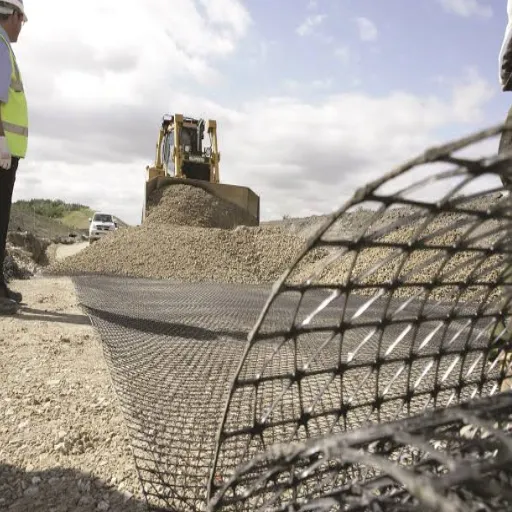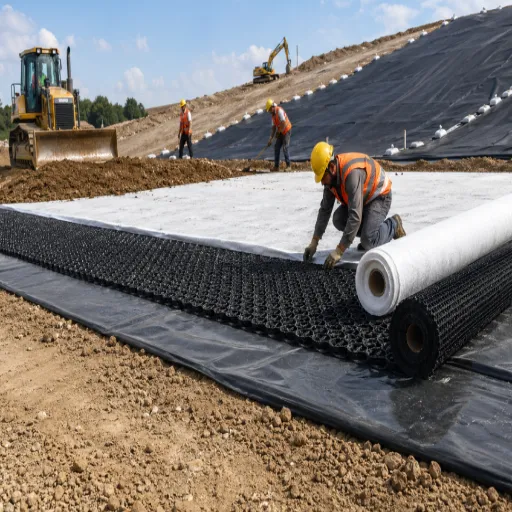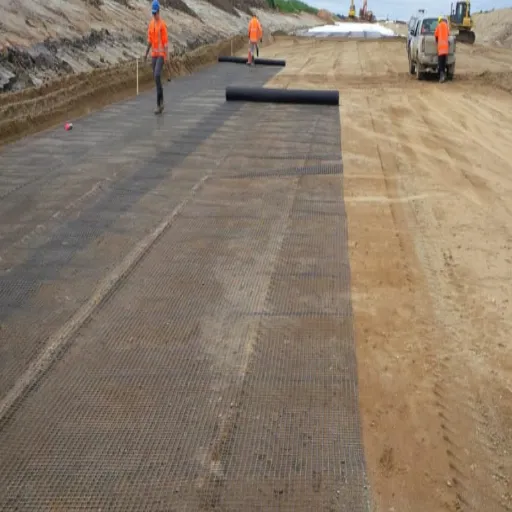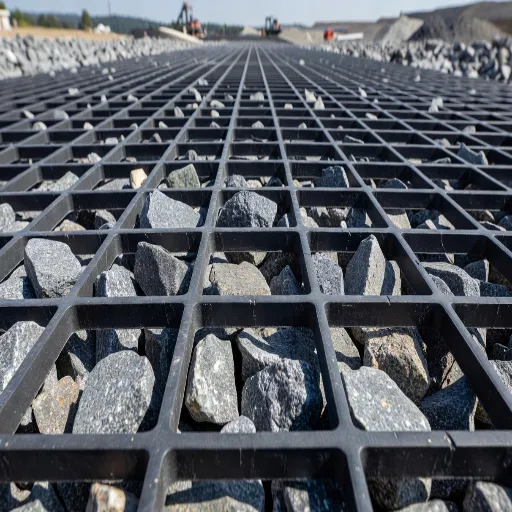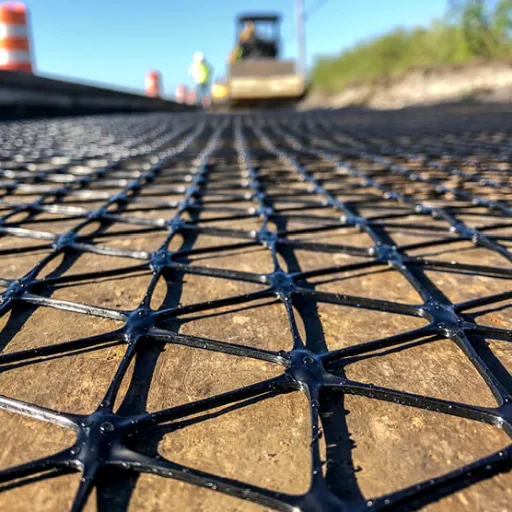
A geogrid for soft ground works by locking the aggregate above it into a stiff composite layer that spreads plant and vehicle loads over a much wider area of the weak subgrade, which typically cuts the granular thickness needed by 20-50%, controls rutting, and lets construction traffic run immediately. You need a geogrid when the subgrade is too weak to build on directly, usually at a California Bearing Ratio (CBR) below 3 to 4. Below a CBR of about 3 you also need a separator geotextile or a bonded geogrid composite to stop soft fines pumping up into the stone; below a CBR of 1 you are usually into a double-layer “floating” system.
Consider what happened on a soft-clay site a project manager we worked with described. The piling rig arrived on schedule, but by mid-morning its tracks had punched 300 mm into the working platform. The crew spent two days hauling in crushed stone, compacting, and re-leveling before a single pile was driven. The geotechnical report showed a subgrade CBR around 2. A single biaxial geogrid with a separator layer under the platform would have spread the rig load across the clay and kept the rig running on day one.
By the end of this guide you will know how a geogrid stabilizes soft, low-CBR ground, how to pick the right system from a CBR selection table, which design methods engineers actually use (BR 470, Giroud-Han, the static method), what the numbers show, where geogrids apply across working platforms, haul roads, rail, and mining, and how to install and buy it from a qualified supplier. We cover the full engineering background in our complete geogrid guide to types, applications, and selection.
Key Takeaways
- On subgrades below about CBR 3-4, a geogrid stabilizes soft ground by interlocking the aggregate into a stiff composite that spreads loads and cuts granular thickness 20-50%.
- Below CBR 3 you also need separation: a geotextile or a geogrid-geotextile composite stops soft fines from pumping into the base.
- Below CBR 1, single-layer platforms usually fail; peat and very soft soils need double-layer floating systems such as the 880 mm Benbrack wind farm construction.
- Design to a recognized method: BR 470 for tracked plant, Giroud-Han for unpaved roads, and the static method for crane and piling platforms.
- A geogrid reinforces what is already there; it does not fix moisture, drainage, or organic soil, so fix those problems first.
What Counts as Soft Ground, and Why It Fails
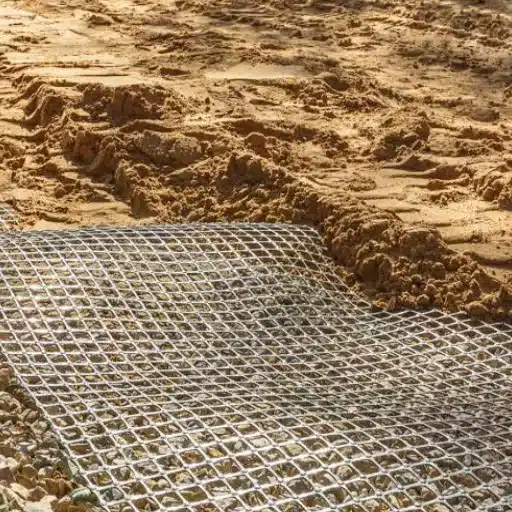
Soft ground is any subgrade with too little bearing capacity to carry construction traffic without excessive deformation. In practice that means soft clays, silts, peat, loose wet sands, and saturated marginal soils, most of them sitting in the CBR range below 5 and often below 3.
CBR, the California Bearing Ratio, is the standard index of subgrade strength used in road and earthworks design. It compares the penetration resistance of the soil against a reference crushed stone, so a CBR of 2 means the ground is roughly two percent as stiff as that reference. On cohesive soils you will also see undrained shear strength (cu) reported in kilopascals; the two measures are related, and either one can drive the design.
Weak subgrades fail in predictable ways under load. Soft clay and silt can shear locally beneath a wheel or track, letting the whole platform punch downward. Fines then pump upward into the aggregate, contaminate the stone, block drainage, and accelerate rutting. Each pass digs the ruts deeper until the section has to be rebuilt. That is why the fix is not simply “more stone.” Without confinement, a thicker base over a very soft subgrade still displaces sideways and sinks.
A geogrid changes that relationship at the interface. It does not change the clay. It changes how the granular layer above it behaves.
How a Geogrid Stabilizes a Soft Subgrade
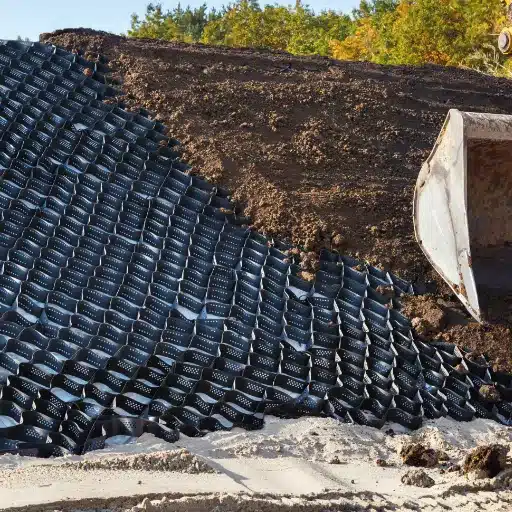
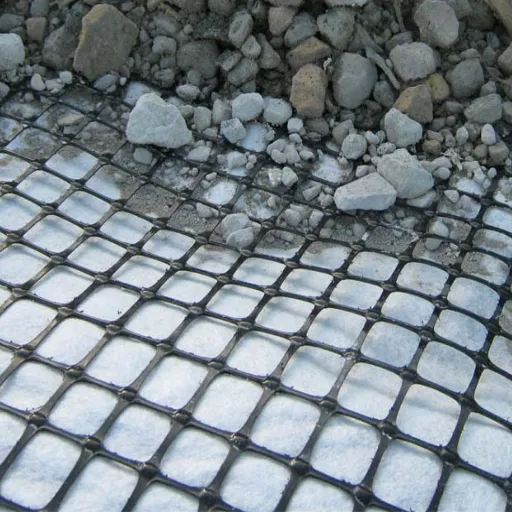
A geogrid stabilizes soft ground through mechanical interlock. Aggregate particles press into the apertures of the grid and bear against the ribs, which locks the stone together and prevents it from spreading sideways under traffic. The result is a mechanically stabilized layer that is far stiffer than the aggregate alone and that spreads each wheel load over a much larger footprint on the weak soil below.
Engineers distinguish stabilization from reinforcement. Stabilization happens at low strain: the grid confines the aggregate so the whole layer stays stiff under construction traffic. Reinforcement happens at higher strain, when the grid works like a tensioned membrane that supports load after deep rutting begins. For working platforms and unpaved roads over soft ground, the confinement effect matters most, and that is why aperture shape and stiffness can matter more than raw tensile strength.
The practical outcome is that the load reaches the subgrade at a much lower stress. One finite element study of a low-capacity subgrade reinforced with a geogrid at the interface found permanent deformation under cyclic loading dropped from 68.89 mm unreinforced to 6.48 mm reinforced, a reduction of about 90%. Laboratory tests show vertical stress on the subgrade falling by roughly 7-18% depending on base thickness, while the number of load cycles to reach the same rut depth climbs several times over.
The choice of grid geometry matters. Biaxial geogrids give balanced strength in two directions and suit most site access, haul road, and platform work. Multiaxial and triaxial grids spread load through a wider angle and are favored under heavy, multidirectional plant. Our geogrid guide compares every type in detail.
Which Geogrid System Do You Need? A CBR Selection Guide
The biggest mistake on soft ground is specifying a bare geogrid where separation is also needed, or a single layer where the soil is soft enough to demand two. Use the subgrade CBR and soil type to choose the system before you choose the product.
| Subgrade condition | What you typically need | Indicative granular thickness |
|---|---|---|
| Firm, CBR 5 or higher | Geogrid optional for light duty; standard section design applies | 200-350 mm |
| Medium, CBR 3-5 | Single biaxial or triaxial geogrid at the interface | 200-350 mm |
| Soft cohesive, CBR 1-3 | Geogrid plus a separator geotextile, or one geogrid-geotextile composite | 350-600 mm |
| Very soft clay, silt, or peat, CBR under 1 | Double-layer geogrid system, often with separation, built as a floating road or platform | 500-1,000 mm |
Treat these figures as starting points, not final designs. The aggregate must be angular and sized to the grid aperture, with a median particle size around half the aperture opening. And a geotechnical engineer should confirm the section for real plant loads.
The threshold logic is consistent across suppliers and standards. Above a CBR of roughly 3 to 4, a clean granular subgrade can carry a compacted platform, and a geogrid alone adds the confinement that lets you reduce the stone. From CBR 3 down to about 1, soft cohesive fines will migrate up through the apertures, contaminate the base, and rut from below, so you must add separation and filtration. Below CBR 1, on very soft clay, silt, or peat, a single grid rarely provides enough support, which is why double-layer systems are the norm.
For roads and pavements on firmer ground rather than genuinely soft sites, see our separate guide to geogrid for road base, which covers base-course thickness charts in detail.
Design Methods Behind a Soft-Ground Geogrid Section
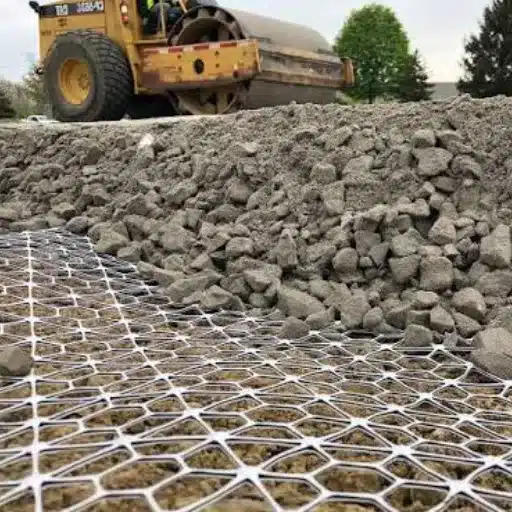
Soft-ground geogrid design is not guesswork. Several published methods let an engineer size the platform for the actual plant.
BR 470 for tracked plant. The UK Building Research Establishment guide “Working Platforms for Tracked Plant” is the reference for piling rigs, cranes, and similar tracked machines. It uses a punching shear model in which the granular platform is strong and the subgrade below is weak, and it is generally considered valid for cohesive subgrades with an undrained shear strength between about 20 and 80 kPa. The geogrid adds vertical restraint around the punching perimeter, and the method applies a factor of two to the grid strength to limit deformation. Typical platform thickness lands between 0.5 and 1.5 times the track width, with a minimum of about 300 mm.
Giroud-Han for unpaved roads. For haul roads and access tracks over soft ground, the Giroud-Han method is the standard analytical approach. It assigns a bearing capacity factor of roughly 5.7 to a geogrid-reinforced aggregate layer against about 3.1 unreinforced, which is the mathematical reason a thinner reinforced section can carry the same traffic. The method is designed around an allowable rut depth, typically about 50 mm for unpaved roads.
The static method for crane and piling platforms. Where BR 470 punching assumptions do not fit, engineers use a load-spread approach that raises the allowable subgrade bearing pressure from roughly pi times the undrained strength for an unstabilized platform to about two times that for a geosynthetic-stabilized one. Back-analysis of plate tests supports a “surcharge transfer” version of this idea and has produced some of the largest documented gains.
Whichever method you use, specify it. Buyers should ask their supplier or engineer for the design basis, the subgrade strength used, and the traffic assumption, because those three numbers control everything downstream.
What a Geogrid Delivers on Soft Ground: The Numbers
The benefit of geogrid subgrade stabilization is well documented, and the case studies give numbers you can use to justify the material.
- At Laem Chabang in Thailand, a mechanically stabilized platform over extremely soft dredged silt reached a bearing capacity of about 290 kPa against roughly 43 kPa for the unreinforced subgrade, a gain of about 6.7 times.
- At the Benbrack onshore wind farm in Scotland, a double-layer geogrid system over peat raised the working CBR from about 0.5% to 20%, letting heavy turbine deliveries run on a floating road built without excavating the peat.
- A finite element study of a low-capacity subgrade recorded about a 90% reduction in permanent deformation under cyclic loading when a geogrid was placed at the interface.
- Large-scale model tests on soft clay show a single geogrid at the base/subgrade interface increases the load cycles to reach a given rut depth by roughly 1.7 to 6 times, with the biggest gain on the thinnest bases.
- Research on geogrid-stabilized prepared subgrades reports modulus improvement factors of about 1.2 to 2.8, and a high-stiffness grid can lift effective subgrade CBR from around 5% toward 13%.
- Independent studies put the aggregate thickness saving on weak subgrades at roughly 20-30%, while installer experience on very soft sites commonly reaches 30-50%.
- One economic comparison found a polypropylene geogrid-stabilized subgrade about 48% cheaper than a cement-stabilized one.
For the full cost economics of geogrid supply, request a quote or review pricing from a supplier who will quote by specification rather than by a generic “geogrid” line.
Request a technical quote for your project and we will help you specify the right geogrid system.
Where Geogrids Are Used on Soft Ground
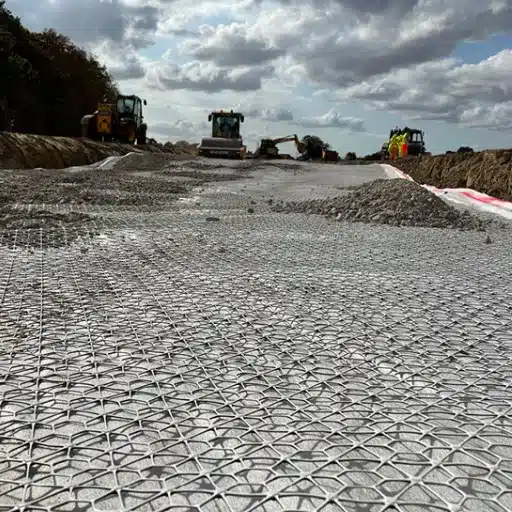
Soft-ground geogrids appear wherever heavy plant must work over weak soils.
Working platforms for tracked plant. Piling rigs and cranes impose high track pressures, and a stabilized granular platform spreads that load so the machine does not punch through. BR 470 exists almost entirely for this case. The Harvey Norman bulky goods development in Australia built over subgrades with a CBR as low as 1%, using a geogrid-geotextile composite and a roughly 350 mm granular platform instead of expensive excavation.
Temporary access and unpaved haul roads. Site access roads over soft clay and alluvium are the most common geogrid application of all. The grid lets trucks and dozers run immediately after compaction, keeps the stone out of the mud, and, because the aggregate stays clean, the road can be stripped and the stone reused when the job ends. For conventional paved and unpaved road sections on ordinary ground, see geogrid for road base.
Railway ballast and formation over soft ground. Geogrids are used in the sub-ballast over weak subgrades chiefly to build a working platform that can be compacted and trafficked during construction. A US Army Corps of Engineers review cautions against cutting the conventional track design thickness purely because a geogrid is present; the grid is a construction and performance aid, not a license to remove ballast.
Mining working platforms and access roads. Mining roads move some of the heaviest loads on earth over remote, soft, and often wet ground. A biaxial or composite geogrid in the haul road keeps the surface passable for rigid trucks, and geogrids support drill pads, crusher pads, and crane platforms. Clean aggregate recovery at the end of life is a major benefit on temporary mine works.
Floating roads over peat. Where peat is deeper than about one meter, excavation is both expensive and environmentally damaging. Floating road construction lays a geogrid directly on the peat surface, builds up granular fill, places a second grid mid-fill, and completes the section, with up to 1,000 mm of fill and deep monitoring where the peat is thickest.
For slopes and embankments on soft or unstable ground, the engineering changes because gravity acts sideways, not just downward. That is a different application covered in our guide to geogrid for slope stabilization.
Geogrid vs Lime, Cement, and Over-Excavation
Geogrid is not the only way to deal with soft ground, and it is not always the right one. Here is how to compare the options.
Lime and cement stabilization chemically treat the soil itself. They lower plasticity, reduce swelling, and can build a hard working platform, but the reactions need warmth and time to cure, they stall in saturated ground, and they add little tensile strength or lateral confinement. On wet, soft, low-CBR sites, a geogrid works the moment it is installed and needs no curing, which is why contractors often choose it on schedule-critical jobs. On the A556 road scheme in the UK, very soft clay at a CBR of about 1.5-2% was treated with a geogrid-stiffened capping after lime treatment and dig-and-replace were rejected on cost and time grounds, saving around 2 million pounds.
Over-excavation and dig-and-replace is the most certain method and usually the most expensive, because you haul away the weak soil, dispose of it, and import clean fill. A geogrid platform commonly avoids most of that excavation while keeping the load off the weak soil.
The honest limit is this: a geogrid reinforces what is already there. It does not fix high moisture content, organic soil, or a drainage problem. If the ground is saturated or pumping, deal with drainage or moisture first, then use the geogrid for the load-spreading layer. On deep, soft, compressible clay where settlement over years is the risk, wick drains and staged construction are the right tools, sometimes combined with a geogrid platform to spread load during consolidation.
When the two approaches are combined they can work synergistically. Laboratory work on a weak lateritic subgrade found that lime treatment plus a geogrid together reached far higher soaked strength than either method alone.
How to Install a Geogrid Over Soft Ground
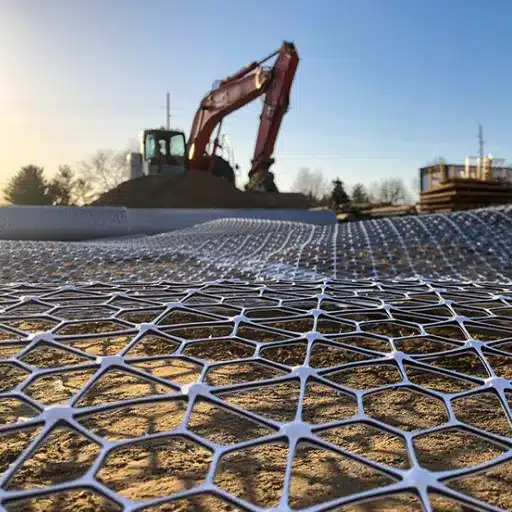
Installation on soft ground follows the same logic as any geogrid job, with extra rules for weak, wet, or organic subgrades.
- Prepare the subgrade. Strip only where needed, remove standing water, and proof-roll so you know what you are building on. Never lay a grid on a saturated, uncompacted surface.
- Add separation first on cohesive ground. Where the CBR is below about 3, place a nonwoven separator geotextile on the prepared subgrade, or use a factory-bonded geogrid-geotextile composite so both functions sit in one layer.
- Roll the geogrid out flat and taut. Do not pre-tension aggressively on soft ground. Overlap adjacent rolls by roughly 500 mm along the length and 300 mm at the ends, and stagger the joints.
- Never track plant directly on the exposed grid. End-tip aggregate from the edge you have already built and spread it forward, keeping at least 150 mm of cover so the grid is never driven on.
- Place and compact angular, well-graded stone in lifts. On soft ground, spread each load over a length of at least 10 m to avoid impact loading, and compact to the design density.
- Build double-layer systems in sequence on very soft ground. On peat or subgrades below CBR 1, lay the lower grid or composite on the ground surface, fill, place the upper grid mid-fill, and complete the fill. Never run equipment directly onto exposed peat.
- Monitor and protect deep, soft areas. Where peat exceeds about 2 m, install movement-monitoring posts and consider pressure berms beside the road.
For the complete step-by-step installation protocol that applies to any geogrid project, see our geogrid installation guide.
Frequently Asked Questions
Can a geogrid be used on soft ground?
Yes. A geogrid is one of the most effective ways to build over soft, low-CBR ground because it locks the aggregate into a stiff composite that spreads loads across the weak subgrade, cuts rutting, and lets construction traffic run immediately.
How does a geogrid stabilize soft soil?
The grid apertures trap and confine the aggregate above, stopping it from spreading sideways under load. The confined stone then behaves as one stiff layer that spreads each wheel or track load over a much wider area of the soft soil below.
Do you need a geotextile under a geogrid on soft clay?
Below a CBR of about 3, yes. A geotextile separator keeps soft clay fines from pumping up into the aggregate, while the geogrid provides the confinement. A bonded geogrid-geotextile composite delivers both in one layer.
What CBR is too low for a geogrid?
No single cutoff exists. Above CBR 3-4 a geogrid alone is often enough; between about CBR 1 and 3 you need separation as well; below CBR 1 on silt or peat you typically need a double-layer floating system.
Does a geogrid work on wet soil?
It works in wet conditions where chemical treatment struggles, because it needs no curing and does not rely on soil chemistry. But it does not remove water. If the ground is saturated or draining poorly, fix the drainage and moisture problem first.
Geogrid or lime: which is better for a soft subgrade?
Geogrid wins where the soil is wet, cold, or schedule-critical and where you need tensile confinement rather than chemical bonding. Lime and cement win where you need to reduce plasticity or swelling. On weak, moisture-sensitive soil the two often work best together.
Can you build a road on peat with a geogrid?
Yes, using floating road construction. Lay a geogrid directly on the peat, build up granular fill, place a second grid mid-fill, and complete the section. The Benbrack wind farm used an 880 mm double-layer system that raised the working CBR from about 0.5% to 20%.
Conclusion
Soft ground is the most expensive ground to build on until you change the system rather than the thickness. A geogrid placed at the base/subgrade interface turns weak soil and loose stone into a single stiff composite that spreads plant loads, controls rutting, and usually cuts granular thickness by 20-50%. The choice is driven by CBR: a geogrid alone above CBR 3-4, a geogrid with a separator below that, and a double-layer floating system below CBR 1. Design it to BR 470, Giroud-Han, or the static method, install it so the grid is never driven on directly, and fix moisture and drainage problems the grid cannot fix.
Contact engineering support and we will help you select the right geogrid system for your soft-ground project, with export-ready supply and flexible order quantities.