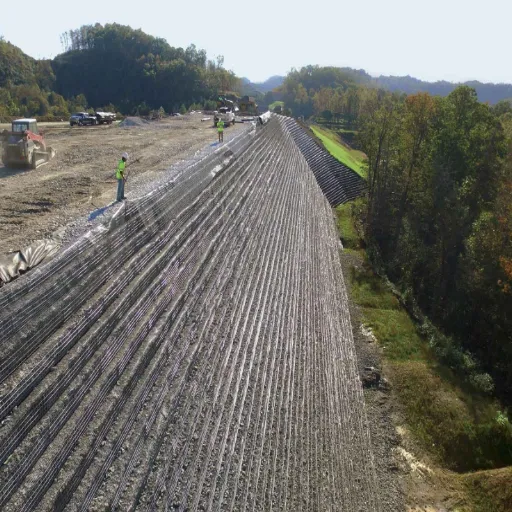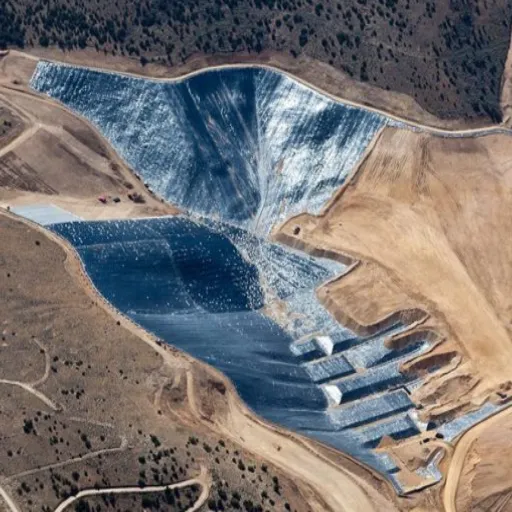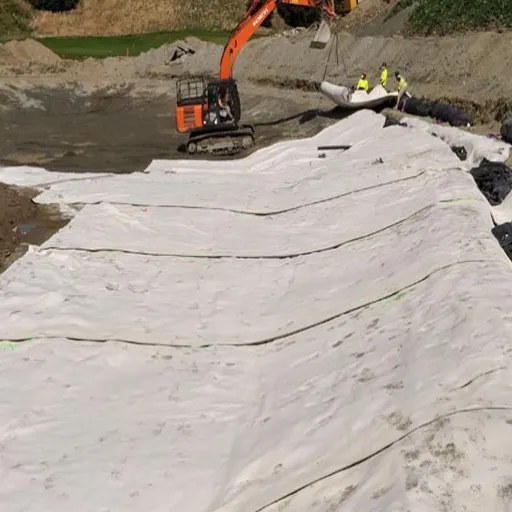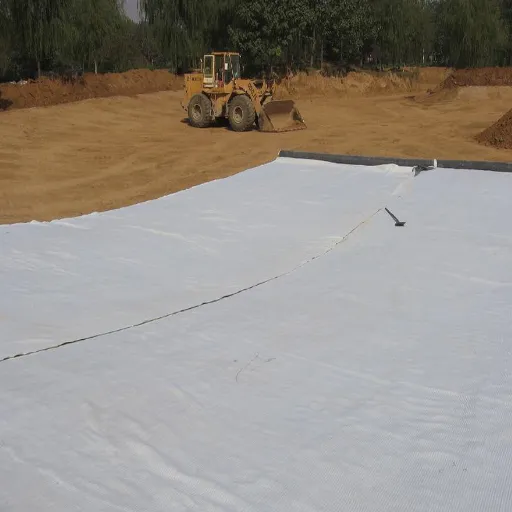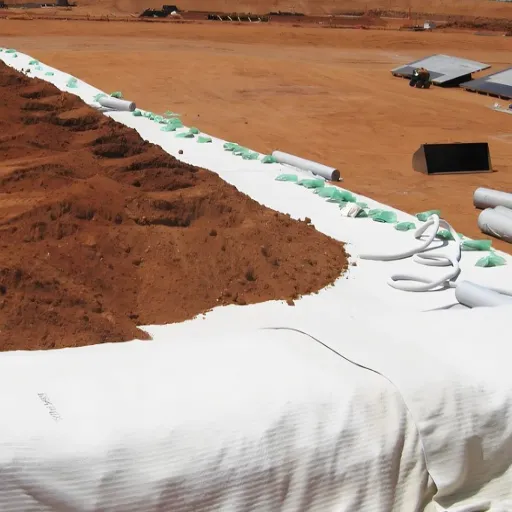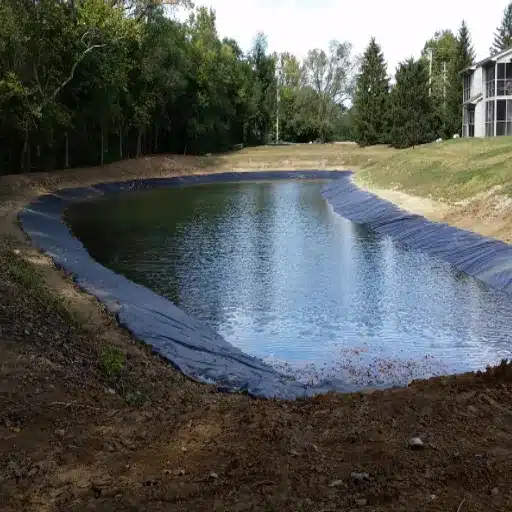
Geogrid soil reinforcement is a geotechnical technique that embeds a high-tensile polymer grid in the ground so soil and aggregate interlock through its apertures, allowing the grid to carry the tensile loads soil alone cannot support. The payoff is stronger subgrades, steeper slopes, taller retaining walls, and road bases that hold up under heavy traffic with less aggregate.
Here’s the problem most engineers and buyers run into: manufacturers are glad to tell you a geogrid reinforces soil, but almost nobody explains when you actually need it, which type to specify, or what real-world payback to expect. That gap causes two expensive mistakes. Some teams over-specify reinforcement on sites that only need a separation geotextile, burning budget on material they never needed. Others under-build on low-CBR subgrades that quietly rut and fail within the first season.
This guide covers how geogrid soil reinforcement works at the mechanism level, when it is genuinely required (with CBR-based decision tables), which type fits which application, the performance data that justifies the cost, and how to specify and install it correctly. By the end, you’ll be able to make a confident, data-backed reinforcement decision for your next project.
Key Takeaways
- Geogrid soil reinforcement works through four mechanisms: aggregate interlock, lateral restraint, load distribution, and, at large deformations, a tensioned membrane effect.
- Reinforcement is required when soil must carry tensile load (walls, slopes) or when a weak subgrade with a CBR below roughly 4-8 must be stabilized under traffic; below CBR ~3 you also need a geotextile separator.
- Full-scale data shows base course reductions (BCR) up to 64%, traffic benefit ratios (TBR) up to 8.9x, and rutting life extended from ~20 to ~540 load cycles.
- Choose uniaxial geogrids for walls and slopes, biaxial for road bases, and triaxial for heavy pavements and haul roads.
- Specify by tensile strength class (kN/m), aperture-to-aggregate ratio (~1.2-1.6x), and junction efficiency (90%+), then verify with ASTM test reports.
What Is Geogrid Soil Reinforcement?
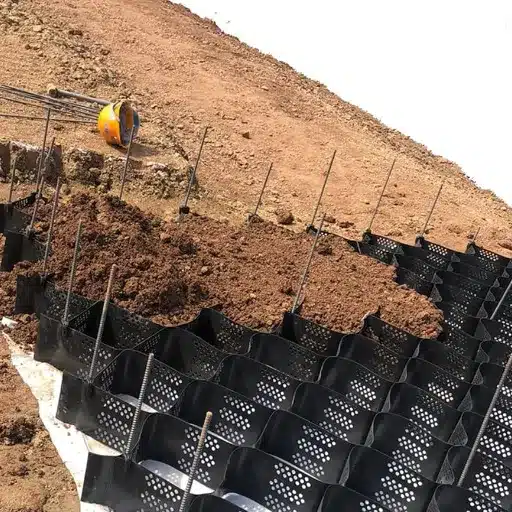
Geogrid soil reinforcement is the use of a high-tensile-strength polymer grid, embedded in soil and interlocked with aggregate, to carry tensile loads that soil alone cannot sustain. The soil provides compressive strength; the geogrid provides tensile strength; together they behave as a composite mass with higher bearing capacity, slope stability, and resistance to deformation.
Geogrids are made from polypropylene (PP), polyester (PET), or high-density polyethylene (HDPE). They come in three main geometries, each matched to a different job:
- Uniaxial geogrids carry high strength in one direction and are built for retaining walls, steep slopes, and embankments.
- Biaxial geogrids deliver roughly equal strength in two directions and are the workhorse for road bases and subgrade stabilization.
- Triaxial geogrids spread load in three directions and perform best under heavy, multidirectional traffic.
Think of it this way. Unreinforced soil is strong in compression but weak in tension. A geogrid supplies the missing tensile component, and the two materials work as one unit. That’s why a 2:1 slope is about the limit for unreinforced fill, while reinforced slopes can be built at 1.5:1, 1:1, or even steeper on tight sites. For a full overview of types, applications, and selection, our complete geogrid guide walks through the whole product family.
How Does a Geogrid Reinforce Soil?
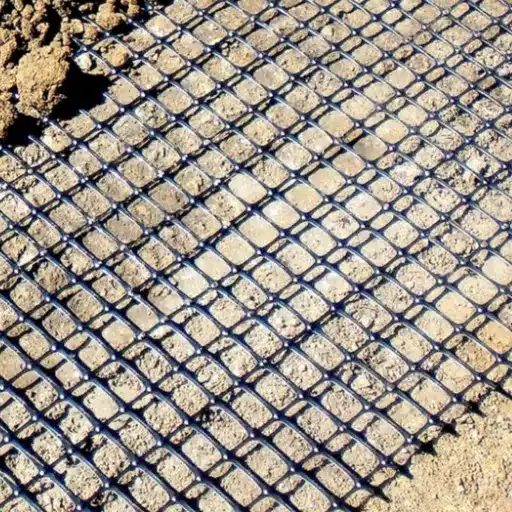
Four mechanisms explain how a geogrid reinforces soil, and they work together rather than in isolation.
Mechanical Interlock
Aggregate particles drop through the grid apertures and bear against the transverse ribs. This passive bearing resistance is the defining advantage of a geogrid over a flat geotextile: the ribs physically lock onto the aggregate. Interlock works best when the aperture is roughly 1.2-1.6 times the nominal aggregate size, so particles partially strike through and get gripped.
Lateral Restraint and Confinement
Friction along the rib surfaces restrains lateral spreading of the granular layer under load. Confined aggregate behaves like a stiffer material, forming what manufacturers call a mechanically stabilized layer (MSL). This confinement is the main reason geogrids cut rutting on roads and working platforms.
Tensioned Membrane Effect
At very large deformation, such as ruts around 100 mm, the geogrid stretches and acts like a tensioned membrane, distributing load across the span. This effect matters mainly for unpaved and temporary roads where deep ruts are tolerable before surfacing.
Load Distribution and Composite Action
The grid spreads wheel loads over a wider subgrade area, reducing vertical stress intensity and subgrade pressure. Combined with compaction, the geogrid plus aggregate behaves as a single structural unit rather than a loose layer on top of weak soil.
For the numeric side of this, a 2023 modeling study that fed full-scale results into the MEPDG pavement framework found a single geosynthetic layer delivered a base course reduction (BCR) up to 64%, a traffic benefit ratio (TBR) up to 8.9x, and a 322% gain in effective base resilient modulus. Geogrids outperformed geotextiles in that study because of the aggregate interlock inside their apertures. If you need the exact tensile values and test methods behind those claims, our geogrid specifications and tensile strength guide breaks down the datasheets.
Not sure which reinforcement mechanism your project actually needs? Our engineers provide tailored recommendations based on your soil report and loading. Talk to engineering support and get a straight answer.
Soil Reinforcement vs. Soil Stabilization: What’s the Difference?
The terms are often used interchangeably, but ISO distinguishes them, and the difference changes your specification.
Soil reinforcement uses the stress-strain behavior of the geosynthetic to improve the soil mass. It matters where continuous loads translate into tensile stress on the grid, such as retaining walls and steep slopes, where the geogrid crosses potential failure planes.
Soil stabilization improves the mechanical behavior of an unbound granular material by confining particles and reducing lateral movement. It matters on roads and pavements, where a stiffer stabilized layer resists rutting under repeated wheel loads.
In practice, the same geogrid can do both, depending on where you place it and what load you apply. And many projects genuinely need both: a reinforced slope built over a stabilized subgrade, or a geogrid paired with a geotextile separator on a soft, fine-grained subgrade. The comparison in our geogrid vs geotextile guide explains exactly when each product carries the load and when you need them layered together.
When Do You Need Geogrid Reinforcement?
The most practical trigger is subgrade strength, measured by the California Bearing Ratio (CBR). The US Army Corps of Engineers guidance (ETL 1110-1-189) and manufacturer design practice give clear thresholds:
| Subgrade CBR | Primary Function | Recommended System |
|---|---|---|
| < 0.5 | Mechanical subgrade stabilization | Design a construction platform so equipment can work |
| 0.5 – 4.0 | Stabilization + base reinforcement | Geogrid reinforcement; add a geotextile separator on fine-grained subgrades (CBR <= 4) |
| < 3.0 | Separation also required | Geogrid + nonwoven geotextile, or a factory-bonded geocomposite |
| < 1.0 | Very soft ground | Double-layer geogrid for “floating road” construction (e.g., over peat) |
| 4.0 – 8.0 | Base reinforcement primary | Geogrid at the base/subgrade interface; separator generally not needed |
| > 8.0 | Base reinforcement | Empirical thickness charts not valid; design from test sections |
Two points deserve emphasis. First, a geogrid doesn’t filter. It reinforces, but it lets fines migrate, so on soft clays and silts below about CBR 3 you pair it with a separation geotextile or a geocomposite. Second, reinforcement isn’t always needed. On competent subgrades above roughly CBR 8, on shallow temporary slopes, or on low walls under about 1.2 m, a geogrid adds little value. The full treatment of very soft sites, from peat to saturated clays, lives in our geogrid for soft ground and subgrade stabilization guide.
Geogrid Reinforcement by Application
Roads, Subgrades and Working Platforms
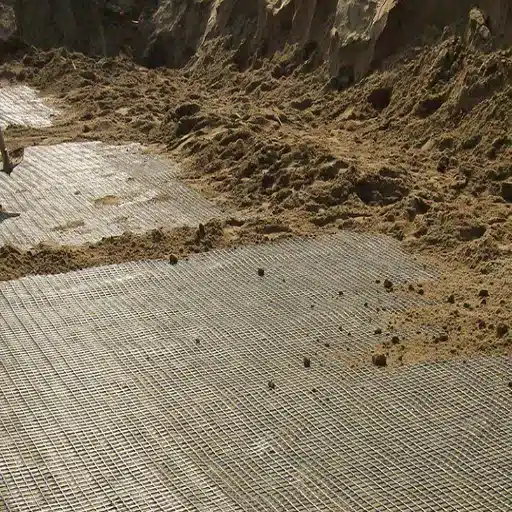
Place a biaxial or triaxial geogrid at the subgrade/base interface, spread aggregate, and compact. The grid confines the aggregate, which cuts rutting, reduces differential settlement, and typically lowers base thickness by 30-50%. Our geogrid for road base guide covers design and installation for driveways, access roads, and heavy haul routes.
Retaining and MSE Walls
Uniaxial geogrid layers extend horizontally into compacted backfill behind the wall face. The grid carries the tensile forces that hold the reinforced soil mass together, which lets segmental walls reach heights conventional cantilever walls cannot match without massive footings. Typical vertical spacing runs 8-24 inches, with embedment of at least 0.7 times the wall height per AASHTO guidance.
Slopes and Embankments
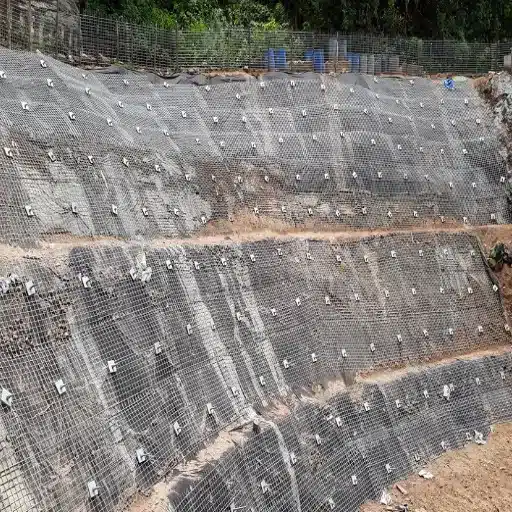
On slopes, geogrid layers cross the potential slip surface and supply tensile resistance that lets you build steeper than the unreinforced limit. On embankments over soft ground, basal reinforcement reduces lateral spreading and settlement during construction. Field case histories, including a 33 m-high reinforced embankment built at a 1V:0.5H angle in China, show what the technique achieves in practice. Our geogrid for slopes and embankments guide details the design approach.
Soft Ground and Working Platforms
On very low CBR sites, a geogrid inside a crushed-rock pad creates a stiff working surface that spreads heavy equipment loads and stops machines from sinking. For extreme conditions, such as haul roads across peat, double-layer systems come into play. When cellular confinement is the better answer, our geogrid vs geocell comparison helps you decide which reinforcement product suits the soil.
When a Geogrid Isn’t the Answer
If the requirement is filtration, drainage, or separating two different soil layers with no structural load, a geotextile is the right tool, not a geogrid. The geogrid vs geotextile guide lays out the full decision so you don’t buy reinforcement where a separator would do.
Proven Performance: What the Data Shows
Reinforcement claims sound good in a brochure, so here is the evidence from full-scale testing and published studies.
- Base course reduction (BCR): up to 64% with a single geosynthetic layer in the 2023 MEPDG study. Triaxial geogrid field trials computed reductions of 21.6-44.8%, and full-scale UNLV testing cut an unreinforced 406 mm base by 26% (biaxial) and 45% (triaxial).
- Traffic benefit ratio (TBR): up to 8.9x in modeling; full-scale sections recorded TBR values of 3, 7.5, 3, and 4 at 6 mm of rutting.
- Rutting resistance: in one Naue test, an unreinforced base reached 75 mm of rutting after about 20 load cycles, while the geogrid-reinforced section lasted roughly 540 cycles.
- Aggregate savings: road and platform projects typically reduce base thickness by 30-50%. A mine haul road in Australia fitted with heavy-duty biaxial geogrid eliminated rutting entirely and cut base thickness by half.
- CBR improvement: Indian highway guidance (IRC SP 49) reports reinforcement factors of 2.0-3.0 in sub-base layers.
Here is a concrete example. A highway contractor working over expansive clay in Texas kept seeing rutting after every rain during construction. Adding a single layer of biaxial geogrid at the interface let them cut the aggregate base from 18 inches to 12 inches, eliminated the rutting, and finished the season on schedule. The geogrid paid for itself in material savings alone, before counting the days it saved the crew.
The pattern is consistent across the literature: the softer the subgrade, the larger the benefit. Benefits shrink as the subgrade stiffens, which is exactly why the CBR threshold table above matters.
Design and Installation Essentials
Tensile Strength and Long-Term Design Strength
Geogrids are rated in kilonewtons per meter (kN/m), usually at 2% and 5% strain. Don’t specify off the ultimate tensile strength (UTS) alone. Long-term design strength (LTDS) accounts for installation damage, creep, and chemical and biological degradation, and typically lands at 33-50% of UTS. Apply reduction factors around 1.1-2.0 for installation damage, 1.5-2.5 for creep, and 1.0-1.5 for chemical and biological effects.
Aperture and Aggregate Compatibility
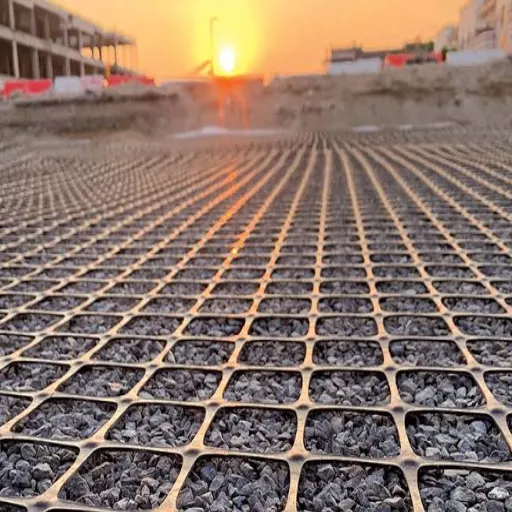
Interlock only works when the aggregate is the right size for the apertures. As a rule of thumb, aperture should run about 1.2-1.6 times the nominal particle size, and junction efficiency should be 90% or better. Verify both on the datasheet before you approve a roll.
Pullout Resistance and Embedment
In walls and slopes, the grid must extend far enough beyond the failure plane to resist pullout. Design uses a coefficient of interaction (Ci) measured in pullout tests. AASHTO and FHWA guidance (FHWA-NHI-10-024) governs embedment lengths for MSE walls.
Placement and Installation
- Lay the geogrid flat and taut, with no wrinkles, and shingle overlaps of at least 300 mm in the direction of fill.
- Place the first layer at the subgrade/base interface. If the base exceeds about 450 mm, add a second layer within the base, where the upper third performs best.
- Cover with a minimum 150 mm of aggregate before any equipment travels on it. Never run plant directly on exposed geogrid.
- Protect rolls from UV during storage and cover exposed panels within the manufacturer’s window, typically 7-15 days.
- Compact in thin lifts, using static passes first on soft ground to avoid pumping the subgrade.
How to Choose and Specify Geogrid Reinforcement
Follow this sequence and you’ll avoid both over-specification and under-building.
- Confirm the need. Run the CBR framework above. If separation is all you need, use a geotextile.
- Define the load. Traffic class, wall height, slope angle, and surcharge all drive the strength class.
- Pick the type. Uniaxial for walls and slopes, biaxial for road bases, triaxial for heavy pavements and haul roads.
- Specify the strength class (kN/m). Compare suppliers on LTDS, not just UTS, and ask for the 2% and 5% strain values.
- Check aperture and junction efficiency. Match apertures to your aggregate and require 90%+ junction efficiency.
- Verify quality. Ask for ASTM test reports, ISO 9001 manufacturing certification, and carbon black content for UV stability.
- Compare total installed cost. Roll price is only part of the story. Include aggregate savings, installation time, and expected service life, which for quality HDPE and PET geogrids runs 75-120 years underground.
Here is the flip side of the Texas story. A design engineer at another firm habitually specified a heavy biaxial grid on every road job because no one had ever given him a decision framework. A review of 20 case histories by Allen and colleagues found reinforcement is typically over-specified by 1.5-4 times what long-term stability actually requires. Once he applied a CBR-based approach, he right-sized his specs and cut material costs noticeably on the next batch of projects.
Want the step-by-step selection process with worked examples? Our how to choose geogrid guide walks through a full project from soil report to purchase order.
Frequently Asked Questions
How does a geogrid reinforce soil?
A geogrid reinforces soil through aggregate interlock, lateral restraint, load distribution, and, at large deformation, a tensioned membrane effect. Aggregate particles bear against the grid ribs, confining the granular layer and letting the grid carry tensile loads the soil cannot support alone.
When is geogrid reinforcement required?
Reinforcement is required when soil must carry tensile load, such as in retaining walls and steep slopes, or when a weak subgrade (roughly CBR below 4-8) must carry traffic. Below about CBR 3, combine the geogrid with a geotextile separator to stop fines migration.
Is geogrid better than geotextile for soil reinforcement?
For carrying tensile load and confining aggregate, yes, a geogrid is the structural product. A geotextile excels at separation, filtration, and drainage but adds far less tensile reinforcement. On soft fine-grained subgrades, use both together.
What CBR does geogrid reinforcement need?
There is no minimum CBR for using a geogrid; rather, low CBR is the reason to use it. The softer the subgrade, the greater the benefit. Very soft ground below CBR 1 may need double-layer geogrid systems, and below CBR 0.5 you also need a construction platform.
How much aggregate can a geogrid save?
Typical base course reductions run 30-50%. Full-scale trials have documented reductions up to 64%, with the largest savings on the weakest subgrades.
Does a geogrid stop settling?
A geogrid reduces and evens out settlement by distributing load and confining the aggregate, but it doesn’t stop consolidation settlement of deep soft soils. On those sites, combine reinforcement with other ground-improvement measures.
Conclusion
Geogrid soil reinforcement is an engineered solution, not a commodity add-on. It works through interlock, lateral restraint, and load distribution, it’s genuinely required when soil must carry tensile load or when a low-CBR subgrade must support traffic, and the data shows measurable payback: base course reductions up to 64%, traffic benefit ratios up to 8.9x, and rutting life extended from roughly 20 to 540 cycles.
The practical takeaways are simple. Match the geogrid type to the job, uniaxial for walls and slopes, biaxial for road bases, triaxial for heavy pavements. Specify by long-term design strength, aperture compatibility, and junction efficiency, not by brochure numbers. And use the CBR framework to decide whether you need reinforcement at all, because the biggest waste in this industry is paying for a material a site never needed.
If you are specifying a project and want an independent read on the geogrid type, strength class, and quantity, our engineering team supplies export-ready geogrids with technical consultation and flexible order terms. Start with our complete geogrid guide, then request a technical quote with your soil report and loading details.