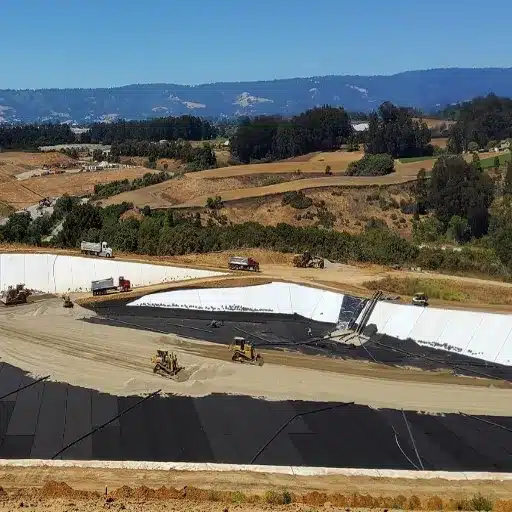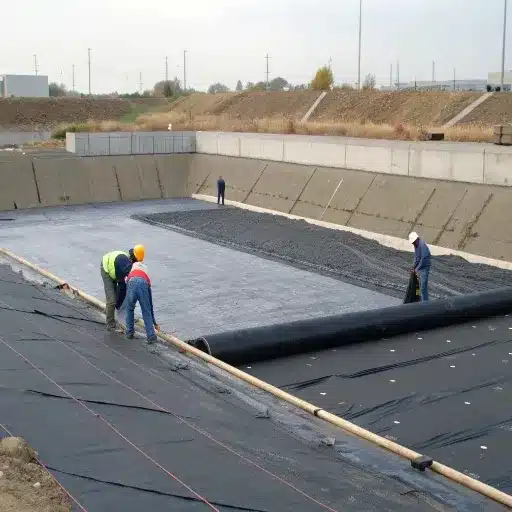
HDPE geomembranes dominate mining applications due to their capability to deliver a permeability value of ≤1×10⁻¹³ cm/s, in addition to their resistance to cyanide as well as sulfuric acid corrosion. Service life under exposed conditions can be expected to exceed 20–30 years. The baseline in the industry for heap leach pads is a 1.5–2.0 mm textured HDPE geomembrane conforming to GRI GM13. Double liner leak detection has been established as acceptable practice in tailings storage facilities; it has almost invariably been a 2.0–2.5 mm-thick HDPE geomembrane.
The reliable containment of cyanide. One breach in a heap leach pad liner allows a cyanide-bearing solution to migrate right into groundwater. Ordinarily, such events expose mining companies to multimillion-dollar costs for remediation, resulting in regulatory shutdowns. However, many purchasers are still not well versed in chemistry relevant to mining, design overliner protection, and vendor qualification for remote projects.
And overcome this problem. Learn exactly how to choose the right HDPE geomembrane for heap leach pads, tailings dams, and process containment. We provide details about the thickness by application, chemical resistance to mining reagents, how to install them correctly, and how to obtain the sourcing of certified materials for global mining projects.
Key Takeaways
- Heap leach pads require 1.5–2.0 mm textured HDPE geomembrane; tailings dams need 2.0–2.5 mm, often with double-liner leak detection.
- HDPE resists cyanide, sulfuric acid, ferric sulfate, and heavy metals across pH 0.5–14, making it the default for chemical-intensive mining.
- Overliner protection (geotextile + aggregate) prevents puncture from ore loading equipment and heap settlement.
- GRI-GM13 compliance, ESCR >500 hours, and 5-year sample retention separate engineering-grade suppliers from commodity traders.
- Textured HDPE with 28–34° interface friction angle is essential for heap leach and tailings dam slope stability.
Why HDPE Geomembrane Mining Containment Dominates
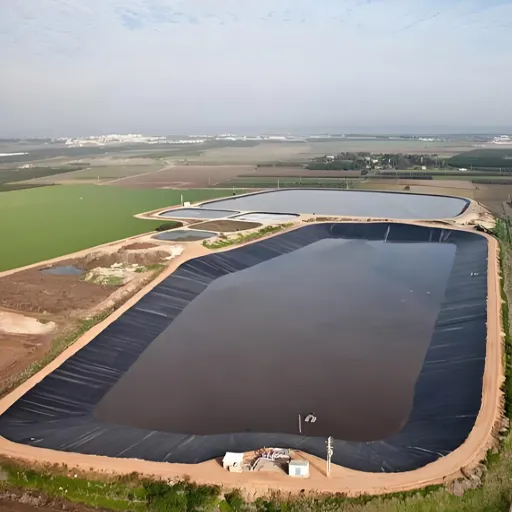
HDPE geomembrane dominates mining containment for seven engineering reasons. First, its permeability coefficient of ≤1×10⁻¹³ cm/s makes it effectively impermeable for solution containment. Second, it resists acids, alkalis, cyanide, and complex leachate across a pH range of 0.5–14. Third, tensile yield strength of ≥22 kN/m and puncture resistance of ≥480 N handle mechanical stress from ore piles and construction traffic. Fourth, carbon-black-loaded formulations withstand UV exposure on uncovered pads and ponds. Fifth, field data confirms service lives exceeding 30 years exposed and 100+ years buried. Sixth, hot wedge welding creates seams with strength ≥80% of the parent material. Seventh, the cost per square meter is lower than alternative liner materials at the mining scale.
When Ravi Patel reviewed bids for a copper heap leach expansion in Central Asia, he faced three liner proposals: a local clay liner, an LLDPE alternative, and an HDPE system with a textured surface. The clay option could not meet the hydraulic conductivity under sulfuric acid loading. The LLDPE option offered flexibility but poor puncture resistance against the planned 300 mm crushed aggregate overliner. Patel specified 1.5 mm textured HDPE with 400 g/m² geotextile cushion and 300 mm aggregate protection. Three years later, zero leaks were detected across 120,000 m² of pad area. The HDPE geomembrane mining liner paid for itself in avoided solution loss alone.
The material also wins on chemical compatibility. While LLDPE geomembrane offers more elongation for uneven subgrades, HDPE’s superior chemical resistance and stiffness make it the rational choice for static containment where reagent chemistry is the primary threat. For a complete overview of HDPE geomembrane types, properties, and applications, see our comprehensive HDPE geomembrane guide.
Key HDPE Geomembrane Mining Applications
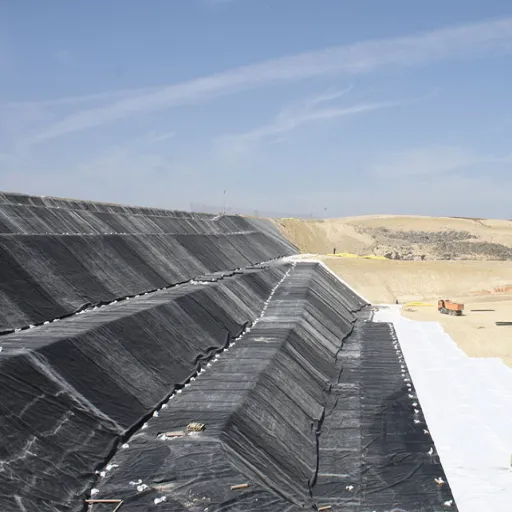
Mining operations make use of HDPE geomembrane mining liners contained within four main categories of primary containment. Each type has its unique specifications, thickness, and protection systems, needed.
Heap Leach Pads
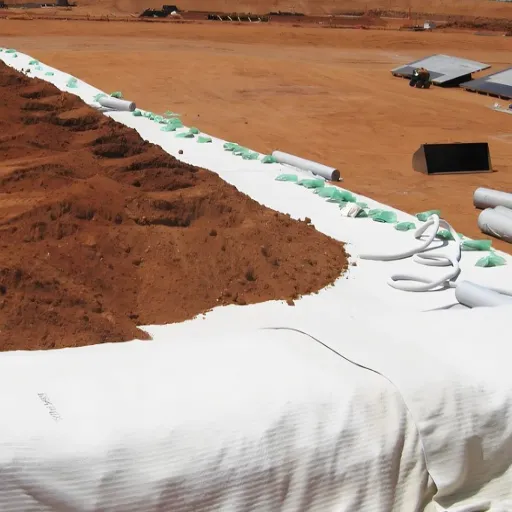
Typical of heap leach pools is that geotechnical methods are used on an area exposed to copper, uranium, or gold from heap leach pads depositing chemicals through crushed piles of ore. A special type of liner, HDPE geomembrane heap leach pad liner beneath the ore, would prevent solution loss and groundwater contamination. Normally, it uses 1.5 to 2.0 mm textured HDPE for primary liners at the base. Down between a stacked ore aisle, interlift liners sometimes require smoother 1.0 to 1.5 mm HDPE where not important.
Chemical exposure to cyanide (100-500 ppm for gold), sulfuric acid (5-50 g/L for copper), and ferric sulfate oxidants. Overliner protection is necessary. An example of such a system involves 400 g/m² nonwoven geotextile directly above the geomembrane, followed by 150-300 mm of crushed aggregate to distribute loads of heavy equipment.
Tailings Storage Facilities (TSF)
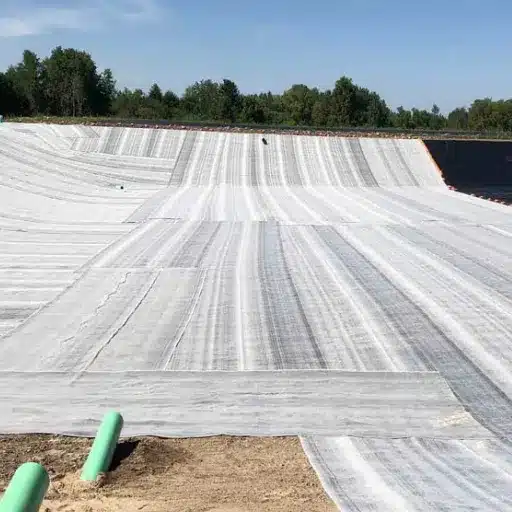
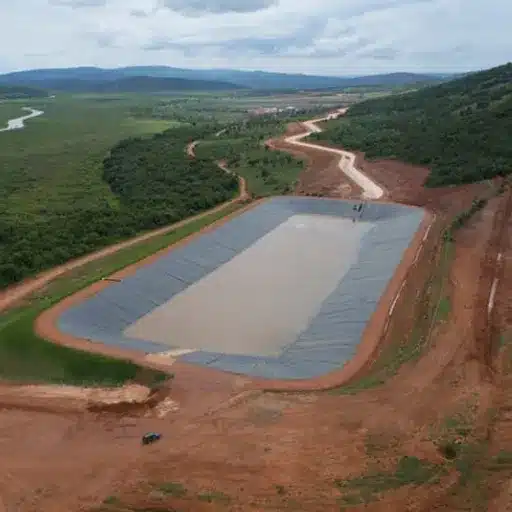
In ore processing, slurry, especially of the fine waste (tailings), is stored in tailings dams for further treatment. The high-density polyethylene (HDPE) liner system is favored for tailing dams to prohibit seepage into groundwater and to contain the phreatic surface within the embankment. The thickness of an HDPE geomembrane ranges from 2.0 to 2.5 mm for high-hazard plants that, for instance, provide the common double-liner system, incorporating a leak detection in between layers.
Seismic and liquefaction concerns influence the design of lining systems. It is because settlements and deformation associated with raised embankment construction (upstream, downstream, or centerline methods) require the liner to manage them. The HDPE geomembrane cap acts as a closure cover system that prevents long-term acid rock drainage and allows reclamation.
Process Water and Raffinate Ponds
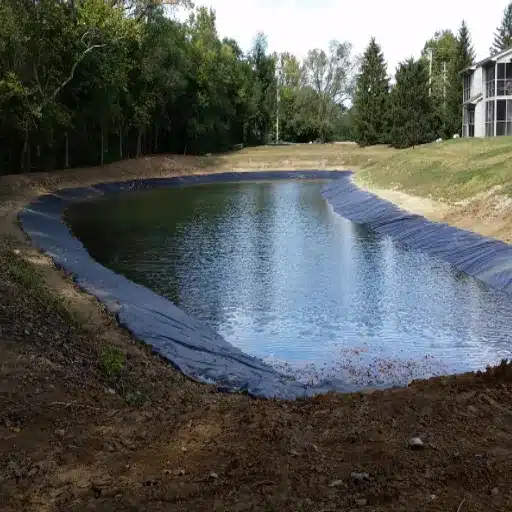
Pregnant leach solution (PLS), barren solution, and raffinate require contained ponds between processing stages. These ponds often hold the most chemically aggressive solutions on site. Double-liner design with leak detection is standard for cyanide or high-acid containment.
Evaporation ponds in arid mining regions use 1.0–1.5 mm HDPE with enhanced UV stabilizer packages. High-altitude operations face UV intensity 40% above sea level, demanding premium additive formulations.
Acid Mine Drainage (AMD) and Waste Rock Containment
Oxidation and moisture production associated with acid rock drainage (ARD) are produced by mineralized sulfide waste. Made of high-density polymers, HDPE geomembranes or linings cap the waste rock, divert the drainage to be managed, and provide an impediment to long-term environmental liability. Closing designs must take into account the water management for mining for decades to come.
Critical Specifications for HDPE Mining Geomembranes
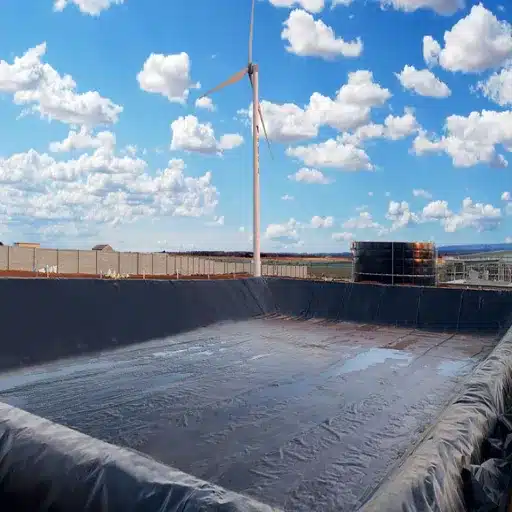
Thickness Requirements by Mining Application
Project engineers dictate minimum thickness based on application consequence, chemical exposure, and design life. The table below summarizes standard practice. For a detailed comparison of thickness selection across all applications, see our HDPE geomembrane thickness guide:
| Application | Minimum Thickness | Notes |
|---|---|---|
| Heap leach pad (primary liner) | 1.5–2.0 mm | Textured surface for slope stability |
| Heap leach (interlift liner) | 1.0–1.5 mm | Smooth often acceptable |
| Tailings dam base liner | 2.0–2.5 mm | Double-liner with leak detection common |
| Process water/raffinate pond | 1.5–2.0 mm | Double-liner for cyanide or acid |
| Evaporation pond | 1.0–1.5 mm | Enhanced UV stabilizer package |
| Waste rock AMD containment | 1.5–2.0 mm | Long-term closure requirement |
| Temporary access roads/pads | 1.0 mm | Short-term use only |
Key Material Properties (GRI-GM13 / ASTM)
Mining-grade HDPE geomembrane must meet GRI-GM13 and verified ASTM test criteria. For detailed test methods and certification requirements, see our HDPE geomembrane testing standards guide:
- Density: ≥0.940 g/cm³
- Tensile yield (1.5 mm smooth): ≥22 kN/m (ASTM D6693)
- Elongation at break: ≥400%
- Puncture resistance: ≥480 N (ASTM D4833)
- HP-OIT: ≥400 min (ASTM D5885): measures oxidative resistance
- ESCR: >500 hours (ASTM D5397): environmental stress crack resistance
- Carbon black content: ~3% by weight
- Seam strength: ≥80% of parent material (ASTM D6392)
ESCR deserves special attention in mining. Chemical solutions and tensile stress from heap settlement create conditions where stress cracking propagates slowly and invisibly. Batch-level ESCR data above 500 hours is non-negotiable for mining applications. A supplier who cannot provide this data should not be considered for heap leach or tailings work.
Smooth vs. Textured vs. Conductive HDPE for Mining
Smooth HDPE works on flat base areas, process pond floors, and temporary containment. Textured or structured HDPE is essential for heap leach pad side slopes and tailings dam embankments. It increases interface friction between the geomembrane and underlying soil or GCL, preventing sliding under heap loads.
Structured textured geomembranes are preferred over co-extruded textures. They preserve base-material mechanical integrity and deliver consistent friction angles of 28–34°. For slopes steeper than 3:1, interface friction testing per ASTM D5321 should confirm stability before final specification.
Conductive HDPE geomembrane contains an embedded conductive layer that enables electrical leak location (ELL) surveying. It is specified for high-consequence containment where post-installation integrity verification is mandatory. The conductive layer allows technicians to detect pinholes, punctures, and seam defects without flooding the containment.
HDPE Geomembrane Mining Chemical Resistance
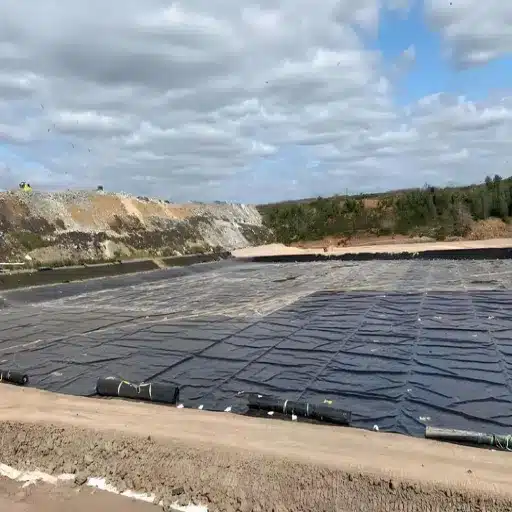
Common Mining Reagents and HDPE Compatibility
HDPE geomembrane chemical resistance is one of its primary advantages in mining. The table below summarizes compatibility with common reagents:
| Reagent | Concentration Range | HDPE Compatibility | Notes |
|---|---|---|---|
| Cyanide (NaCN) | 100–500 ppm | Excellent | Primary gold leach reagent |
| Sulfuric acid | 5–50 g/L | Excellent | Copper heap leach |
| Ferric sulfate | 1–10 g/L | Excellent | Oxidant in bioleaching |
| Sodium hydroxide | 1–10% | Excellent | pH adjustment |
| Hydrochloric acid | Dilute | Excellent | Equipment cleaning |
| Diesel/kerosene | Trace | Good | Equipment spillage |
| Heavy metals (Cu, Zn, Pb, Cd) | Variable | Excellent | Contained in the solution |
Temperature Considerations
HDPE sulfuric acid resistance and overall chemical compatibility degrade marginally above 60°C. Most heap leach solutions operate at ambient to 40°C. Elevated temperature tailings or process streams may require material verification beyond standard GRI-GM13 testing.
Verification Requirements
Request a manufacturer’s chemical compatibility letter for site-specific reagents. Immersion testing per ASTM D543 validates non-standard chemistries. Review the additive package for antioxidant and stabilizer adequacy, especially in oxidizing environments with ferric sulfate or peroxide-based reagents.
HDPE Geomembrane Installation for Mining Projects
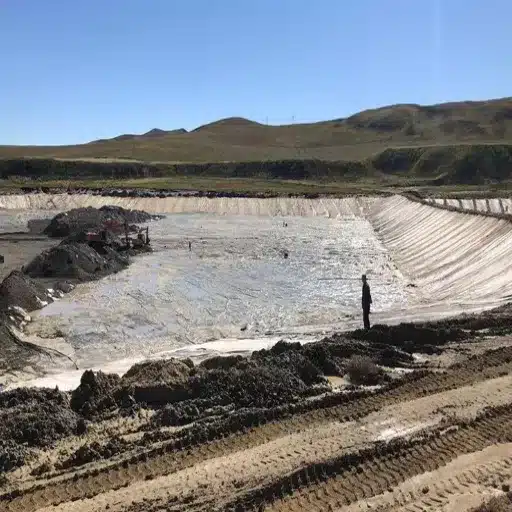
Manufacturing quality means nothing if field installation introduces defects. For step-by-step welding and deployment guidance, see our HDPE geomembrane installation guide. Heap leach pad liner installation demands strict construction quality assurance from subgrade preparation through ore placement.
Subgrade Preparation
Clear and strip all organic material. Compact the subgrade to ≥95% modified Proctor density. Remove rocks and sharp objects larger than 25 mm. Use select fill or sand bedding where native material is rocky or uneven. Install a nonwoven geotextile cushion (minimum 400 g/m²) beneath the liner in aggressive terrain.
Verify subgrade surface evenness before any panel deployment. No abrupt transitions or depressions should remain. One overlooked rock can create a stress concentrator that propagates cracks under heap loads.
Panel Deployment and Welding
Large rolls (5.8 m or 7.0 m width) minimize field seams over large pad areas. Unroll panels along the slope direction. Overlap minimum 75 mm before welding. Avoid installation during precipitation, frost, or wind above 25 km/h.
Hot wedge welding creates primary field seams. A heated wedge melts opposing surfaces, which pressure rollers fuse into a double-track weld with a central air channel. Extrusion welding handles repairs, T-joints, pipe penetrations, and detail work. Both methods require daily trial seams verified before production welding begins.
Account for thermal expansion in high-temperature climates. Install during cooler morning periods where possible. Cover with overliner or ore promptly to minimize UV and thermal-cycling stress.
Overliner Protection System
The overliner protects the geomembrane from ore loading equipment and heap settlement. A typical system includes:
- Geotextile cushion: ≥400 g/m² nonwoven directly above the geomembrane
- Sand or fine aggregate layer: 150–300 mm where heavy equipment loads ore
- Rip-rap or gabion protection: On perimeter berms subject to erosion
Controlled dumping procedures reduce ore drag and equipment turning abrasion. Inadequate overliner thickness is a leading cause of liner damage on active heap leach pads.
Testing and Quality Assurance
Every seam must be tested. Air pressure testing verifies continuity in double-track hot wedge seams. Vacuum box testing checks extrusion welds and repairs. Destructive peel and shear tests, sampled at specified intervals, confirm seam strength meets the ≥80% parent material requirement.
Electrical leak location (ELL) surveying uses conductive geomembrane or post-installation electrode arrays to detect breaches. Independent CQA verification of materials, welding, and documentation provides additional assurance. Manufacturer batch certifications must confirm GRI-GM13 compliance for every roll delivered.
During a 2024 tailings facility project in Africa, the CQA inspector discovered a batch of delivered geomembrane with surface oxidation from transit exposure to high temperatures. The inspector rejected the material before deployment. The supplier replaced the rolls within 96 hours and provided updated batch certifications. That single catch prevented seam failures that would have compromised a 2.5 mm double-liner system worth millions in environmental liability.
Common Failure Modes and Prevention in Mining
Even well-specified HDPE geomembrane mining liners can fail if design, manufacturing, or installation details are wrong. Understanding failure modes helps procurement teams ask better questions and specify stronger protections.
| Failure Mode | Root Cause | Prevention Strategy |
|---|---|---|
| Environmental stress cracking (ESC) | Poor resin quality, tensile stress, and chemical exposure | Specify virgin resin with ESCR >500 hours; minimize tensile stress during installation |
| Puncture | Sharp subgrade rocks, ore loading, equipment traffic | Rigorous subgrade prep; geotextile cushion; controlled traffic protocols |
| Seam failure | Poor welding, contaminated surfaces, thermal cycling | Certified welders; trial seams; clean surfaces; proper temperature parameters |
| Slope sliding | Heap settlement, insufficient interface friction | Textured geomembrane; interface friction testing (ASTM D5321); adequate berm design |
| UV degradation | Extended exposure before ore placement | Rapid overliner placement; schedule installation sequencing |
| Chemical degradation | Incompatible reagents or elevated temperature | Verify chemical compatibility; specify adequate additive package |
| Overliner abrasion | Ore drag and equipment turning | Adequate overliner thickness; controlled dumping procedures |
ESC causes more catastrophic failures than puncture in mining applications. It develops slowly under the combined action of tensile stress and chemical exposure, making it nearly impossible to detect during construction. Batch-level ESCR testing and proper resin selection are the only reliable defenses. Thickness alone does not prevent stress cracking.
A procurement manager for a gold mining contractor in Southeast Asia learned this lesson during a 2023 heap leach project. The lowest bid came from a trader who could not provide ESCR data or mill certificates. The contractor paid 10% more for HDPE geomembrane from an ISO9001-certified manufacturer with 5-year sample retention and GRI-GM13 compliance. Two years later, independent testing of retained samples confirms the liner continues to meet specification. The premium was negligible compared to the cost of a pad-wide liner replacement.
Selecting an HDPE Geomembrane Supplier for Mining Projects
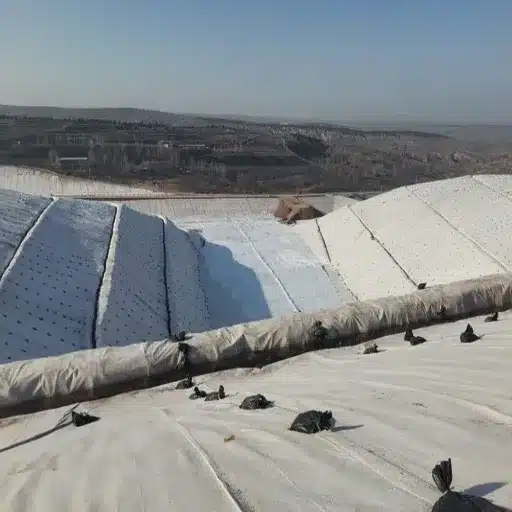
HDPE geomembrane mining liner procurement is not commodity buying. The supplier you choose becomes a long-term partner in environmental protection and operational efficiency. Evaluate candidates against these criteria:
Manufacturing certifications. ISO9001 quality management is the baseline. GRI-GM13 compliance must be verifiable with third-party test reports, not just a supplier claim.
Material traceability. Virgin resin verification, batch testing records, and retained samples allow future testing if questions arise. A 5-year sample retention policy demonstrates manufacturing confidence and supports long-term mining project accountability.
Chemical compatibility documentation. The supplier should provide compatibility letters for cyanide, sulfuric acid, ferric sulfate, and other site-specific reagents. Generic “chemical-resistant” claims are insufficient for mining procurement.
Customization capability. Mining projects rarely fit standard roll dimensions. The supplier should offer customizable thicknesses from 0.1 mm to 3.0 mm, variable roll widths, smooth and textured surfaces, and conductive options from the same production line.
Export and logistics experience. Remote mine sites in Africa, Central Asia, Southeast Asia, and South America require dips in customs removal, container loading skills, and correct packaging. The standard roll widths for 20-foot can be 5.8 m and 7.0 m using optimum accomplishment.
Technical consultation. The best suppliers provide welding method recommendations, anchor design review, CQA planning guidance, and installation supervision options, not just a product datasheet.
Request a technical quote with your ore type, leach reagent, pad area, slope geometry, and site location. Our engineering team will recommend the right thickness, texture, overliner design, and engineering-grade HDPE geomembrane composite system configuration for your specific requirements.
Conclusion
Specifying HDPE geomembrane for mining containment demands more than picking a thickness from a table. It requires matching material properties to leach reagent chemistry, designing robust overliner protection, enforcing rigorous installation quality assurance, and partnering with a certified manufacturer who understands mining from ore body to closure.
The five decisions that matter most are:
- Match thickness to application consequence: 1.5–2.0 mm for heap leach, 2.0–2.5 mm for tailings, 1.5–2.0 mm for process ponds
- Verify chemical resistance for site-specific reagents, not generic claims
- Specify textured HDPE for slopes and conductive HDPE for high-consequence containment requiring ELL surveying
- Design robust overliner and CQA protocols to prevent puncture, seam failure, and slope sliding
- Partner with a certified manufacturer offering mining-specific technical support, export logistics, and 5-year sample retention
Specification quality at the design stage prevents catastrophic environmental and financial costs over the mine life cycle. The right HDPE geomembrane mining liner protects groundwater, controls solution loss, and delivers the design life your project demands.
If you are planning a mining containment project and need engineering-grade geosynthetics with global delivery support, contact our team today for customized recommendations and a detailed technical quotation.
Frequently Asked Questions
What thickness HDPE geomembrane is used for heap leach pads?
The primary bottom liners in the heap leach pads are required to be 1.5–2.0 mm textured HDPE geomembrane. The practical alternatives that are considered for using liners between ore lifts are 1.0–1.5 mm smooth HDPE geomembrane. Most high-hazardous or double-lined systems require 2.0 mm geomembrane.
How long does HDPE geomembrane last in mining applications?
Well installed ahd protected HDPE geomembrane will perform 20-30+ years in exposed mining conditions and over 100 years when buried. The difference in longevity is mainly attributed to the resin quality, UV stabilizer package, quality of installation workmanship, and protection from physical damage and chemical attack.
What is the difference between smooth and textured HDPE geomembrane for mining?
Smooth HDPE is applied in horizontal floor areas and process pond areas where friction is not very important. Textured or profiled HDPE is vital for steeper heaps at heap leach side slopes and the tailings dam embankment since it introduces interface friction, slowing slipping under the weight of ore. Structured textured geomembranes are the preferred ones with uniform friction angles and retained mechanical power.
Is HDPE geomembrane resistant to cyanide and sulfuric acid?
Yes, HDPE geomembrane possesses some staggering opposition property against cyanide (100-500 ppm), sulfuric acid (5-50g/L), ferric sulfate, sodium hydroxide, heavy metals, and within the range of pH 0.5-14. This is the main reason why HDPE is used as a core material in heap leach projects, tailings, and process containment in mineral processing.
What standards should HDPE mining liners meet?
The requirements for the mining HDPE geomembrane are GRI-GM13 and ASTM D5199, D6693, D6392, D4833, D5885, and D5397. Additional project-specific standards may be ICOLD tailings dam guidelines, as well as specific site-specific CQA procedures.
How is HDPE geomembrane installed on a heap leach pad?
Installation follows subgrade preparation and compaction, geotextile cushion placement, panel deployment with downslope roll orientation, hot wedge welding for primary seams, extrusion welding for repairs and details, overliner protection system placement, and comprehensive testing, including air pressure testing, vacuum box testing, and destructive peel tests.
What is an overliner protection system?
An overliner protection system is the multi-layer cover placed above the HDPE geomembrane to protect it from ore loading equipment and heap settlement. It typically includes a nonwoven geotextile cushion (≥400 g/m²) and a crushed aggregate layer (150–300 mm). Adequate overliner design prevents puncture and abrasion during operational loading.
When should a double-liner system be used in mining?
Double-liner systems are used for high-consequence containment where leakage would cause severe environmental or financial damage. Common applications include tailings storage facilities, cyanide-bearing process ponds, and pregnant leach solution containment. The secondary liner provides redundancy, while a leak detection layer between liners enables early warning if the primary barrier is compromised.