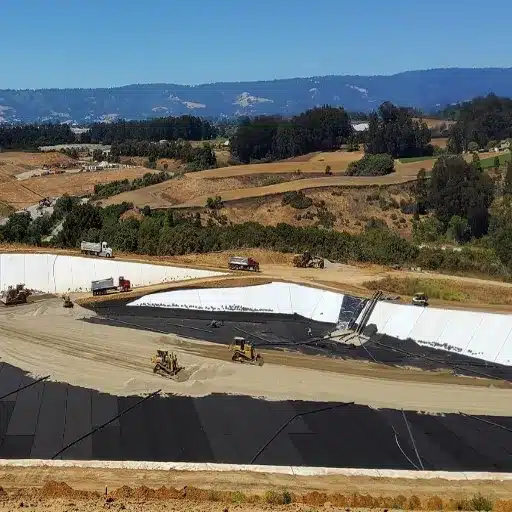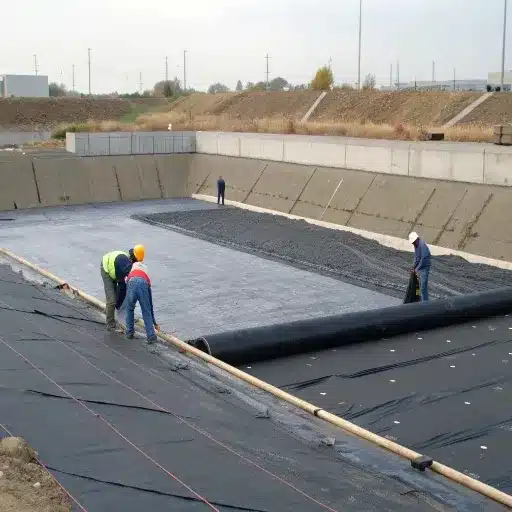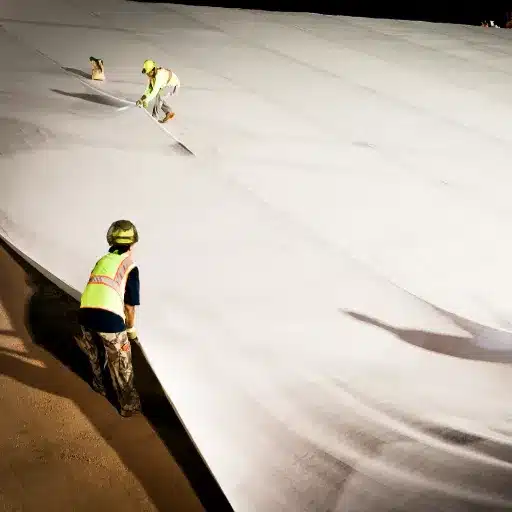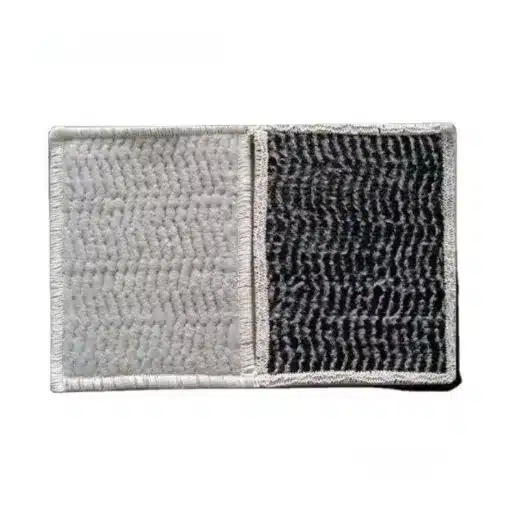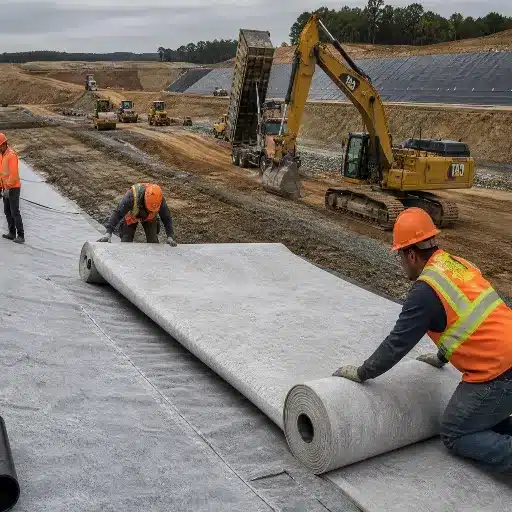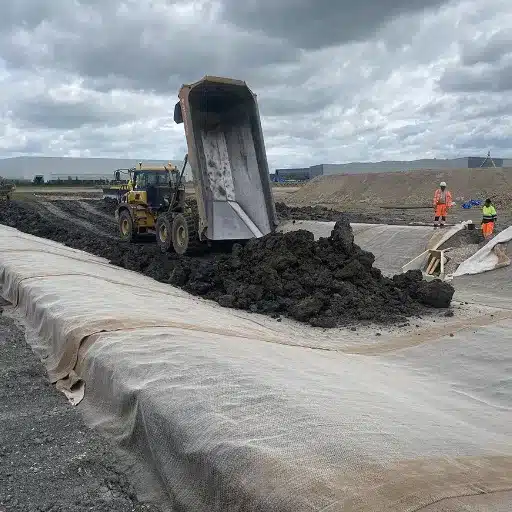
HDPE geomembrane for landfill liner is commonly used as it is a standard impermeable barrier in the industry due to its extremely low permeability (≤1×10⁻¹³ cm/s), outstanding chemical durability to complex leachate, and ensured performance life of more than 20–30 years in exposed applications and 100+ years if covered or buried. And for municipal solid waste landfills, 1.5 mm (60 mil) smooth or textured HDPE geomembrane compliant with GRI-GM13 is the basic requirement for the first containment system
If one layer of liner fails, then it may take years to remediate the contaminated groundwater. Frequently cost of remediation exceeds the cost of construction by several times. And yet many purchasing organizations cannot plan for different waste types within the specification, design composite liner systems appropriately, or conduct due diligence on their vendors.
This article addresses the issue addressed herein. You will be taught how to correctly determine the thicknesses of HDPE geomembrane for landfill liner and other types of landfills, design multi-component systems, control quality from production to construction, and providers able to supply qualified material and also in good time for any project worldwide.
Key Takeaways
- EPA requires that landfills for municipal solid wastes use a minimum of 1.5 mm (60 mil) HDPE geomembrane; sites hazardous to waste require at least 2.0 mm or double liner systems.
- A finished composite liner would typically include a compacted clay or GCL, HDPE geomembrane, geotextile protection, and leachate drainage. You should never depend on a single membrane without other reinforcement.
- High-profile, quality suppliers from those players are determined by their compliance with GRI-GM13, retests through ASTM, and other crucial factors, such as 5-year sample retention.
- Use a textured HDPE geomembrane to enable a stable, long-term slope above a 3:1 ratio and prevent interface sliding.
- Liner failures are associated with environmental stress cracking rather than the blunt power of a puncture; the quality of the resin as well as seam testing actually matters significantly more than mere thickness.
Why HDPE Geomembrane Is the Standard for Landfill Liners
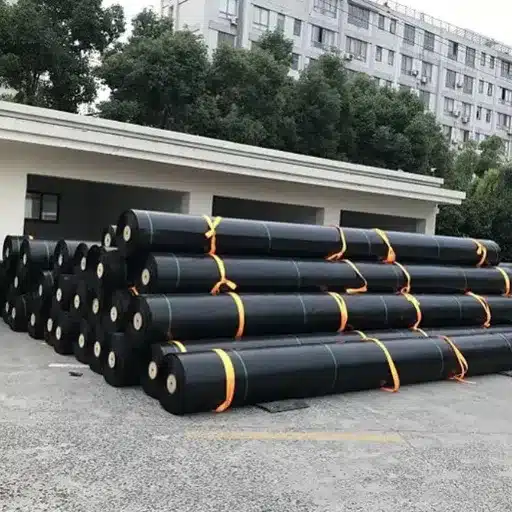
HDPE geomembrane dominates landfill liner design for five engineering reasons. First, its permeability coefficient of ≤1×10⁻¹³ cm/s makes it 100 to 1,000 times more impermeable than compacted clay. Second, it resists acids, alkalis, and complex organic leachate across the pH range of 0.5–14. Third, its tensile yield strength of ≥22 kN/m and puncture resistance of ≥480 N handle mechanical stress from waste loading and soil settlement. Fourth, carbon-black-loaded formulations with UV stabilizers withstand weather exposure during construction. Fifth, decades of field data and geosynthetic research confirm service lives exceeding 30 years.
When David Chen reviewed bids for a municipal landfill expansion in Vietnam, he faced three proposals: compacted clay alone, a PVC liner, and a composite HDPE system. The clay option failed the hydraulic conductivity requirements. The PVC option offered flexibility but poor chemical resistance to the site’s industrial co-discharge stream. Chen specified 1.5 mm textured HDPE over a geosynthetic clay liner. Five years later, leak detection monitors report zero measurable leakage. The HDPE geomembrane landfill liner paid for itself in avoided environmental liability alone.
The material also wins on the total cost of ownership. While LLDPE geomembrane offers more flexibility for tailings dams with dynamic settlement, HDPE’s superior chemical resistance and stiffness make it the rational choice for static landfill cells where leachate chemistry is the primary threat. For a complete overview of HDPE geomembrane types, properties, and applications, see our comprehensive HDPE geomembrane guide.
Critical Specifications for HDPE Landfill Geomembranes
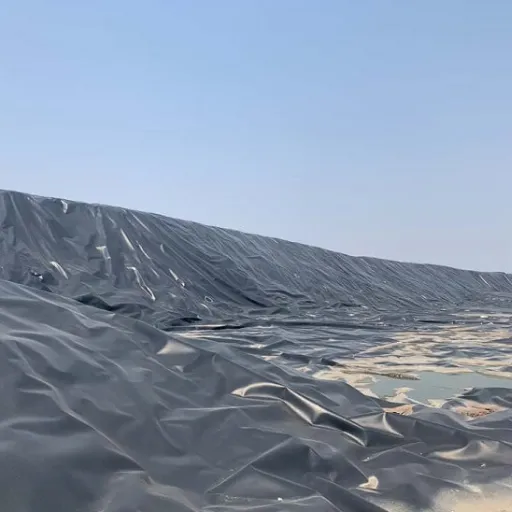
Thickness Requirements by Waste Type
Regulatory agencies and project engineers dictate minimum thickness based on waste classification and design life. The table below summarizes standard practice. For a detailed comparison of thickness selection across all applications, see our HDPE geomembrane thickness guide:
| Landfill Type | Minimum Thickness | Regulatory Driver |
|---|---|---|
| Municipal Solid Waste (MSW) | 1.5 mm (60 mil) | U.S. EPA Subtitle D |
| Hazardous Waste | 2.0 mm (80 mil) | RCRA Subtitle C often requires a double liner |
| Industrial Waste | 1.5–2.0 mm | State/provincial EPA guidelines |
| Mining / Tailings | 1.5–2.5 mm | Project-specific geotechnical design |
| Temporary Containment | 1.0 mm | Short-term use; reduced regulatory burden |
Many jurisdictions explicitly prohibit single geomembrane liner systems. A composite liner, HDPE geomembrane combined with a secondary barrier and leachate collection, is mandatory under U.S. EPA Subtitle D regulations, European Union directives, and Australian guidelines.
Key Material Properties (GRI-GM13 / ASTM)
Landfill-grade HDPE geomembrane must meet GRI-GM13 and verified ASTM test criteria. For detailed test methods and certification requirements, see our HDPE geomembrane testing standards guide:
- Density: ≥0.940 g/cm³
- Tensile yield (1.5 mm smooth): ≥22 kN/m (ASTM D6693)
- Elongation at break: ≥400%
- Puncture resistance: ≥480 N (ASTM D4833)
- HP-OIT: ≥400 min (ASTM D5885): measures oxidative resistance
- ESCR: >500 hours (ASTM D5397): environmental stress crack resistance
- Carbon black content: ~3% by weight
- Seam strength: ≥80% of parent material (ASTM D6392)
ESCR deserves special attention. Standard HDPE performs poorly under multiaxial strain. High-quality resin and structured texturing improve stress-crack resistance significantly. A supplier who cannot provide batch-level ESCR data should not be considered for landfill work.
Smooth vs. Textured HDPE for Landfill Applications
Smooth HDPE works on flat base areas where friction is not critical. Textured or structured HDPE is essential for side slopes. It increases interface friction between the geomembrane and underlying soil or GCL, preventing sliding.
Structured textured geomembranes are preferred over co-extruded textures. They preserve base-material mechanical integrity, deliver more consistent friction angles, and weld more predictably. For slopes steeper than 3:1, interface friction testing per ASTM D5321 should confirm stability before final specification.
Composite Landfill Liner System Design
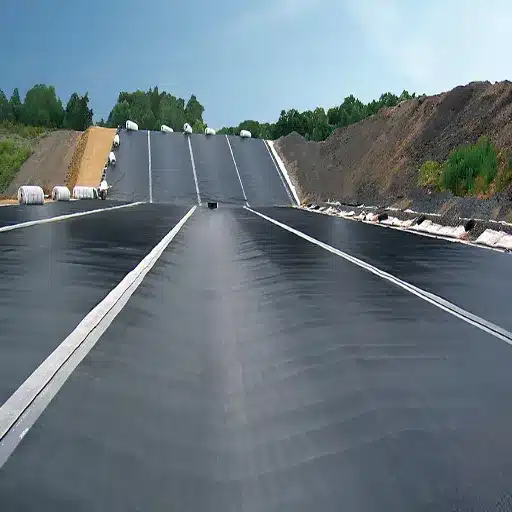
A modern landfill bottom liner is never a single sheet. It is a multi-layer engineered system. Each layer serves a distinct function. Together, they create redundancy that a single membrane cannot provide.
Standard Multi-Layer Bottom Liner
From the ground surface up, a typical composite landfill liner system consists of the following:
- Prepared subgrade: Excavated, leveled, compacted, and cleared of sharp objects
- Secondary Barrier: At least 2 feet thick compacted clay liner (CCL) with hydraulic conductivity no higher than 1×10⁻⁷ cm/s or geosynthetic clay liner (GCL)
- Primary Liner: 1.5 TO 2.0 mm HDPE Geomembrane
- Protective nonwoven geotextile: Cushions the geomembrane from puncture by the overlying drainage layer
- Drainage layer: Geonet or gravel laid over a leachate collection pipe.
- Leachate collection pipe network: System for carrying leachate to treatment or storage
The leachate collection system is features located above the liner instead of embedded within; this minimizes the hydraulic heads on the primary liner, and it offers operators a warning of increased leakage rates.
Geosynthetic Clay Liner vs. Compacted Clay
GCLs had a slim profile, easy installation, and the unique property of self-repairing bentonite following a minor puncture. CCLs were marketed based on cheap material costs and have been tested and field-proven for many years. The hybrid application was to lay down GCL under the HDPE geomembrane to double up and make compacted clay the last layer as the second barrier.
Ensure that the GCL manufacturer provides data on peel strength and considers the bentonite formulation in relation to the leachate chemistry on the site if you have a project that specifies the use of a geosynthetic clay liner.
HDPE Geomembrane Installation Best Practices
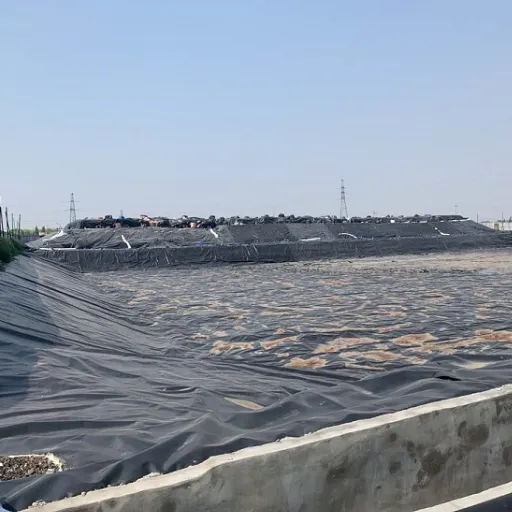
Manufacturing quality means nothing if field installation introduces defects. For step-by-step welding and deployment guidance, see our HDPE geomembrane installation guide. Landfill liner installation demands strict construction quality assurance (CQA) from subgrade preparation through final cover.
Subgrade Preparation
The subgrade must be smooth, compacted, and free of rocks, debris, and sharp objects. A nonwoven geotextile cushion layer is mandatory above any surface that could puncture the geomembrane. Subgrade quality inspection should occur before any panel deployment. One overlooked stone can create a stress concentrator that propagates cracks over time.
Panel Deployment and Welding
Rolls are unrolled downslope to minimize wrinkles and fishmouths. Panels overlap 80–150 mm, oriented parallel to the maximum slope line like shingles. Crews must avoid dragging panels, which can scratch or abrade the surface.
Hot wedge welding creates the primary field seams. A heated wedge melts opposing surfaces, which pressure rollers then fuse into a double-track weld with a central air channel. Extrusion welding repairs patches, T-seams, pipe penetrations, and detail work. Both methods require daily trial welds verified by a field tensiometer before production welding begins.
Testing and Quality Assurance
Every seam must be tested. Air pressure testing verifies continuity in hot wedge seams. Vacuum box testing checks extrusion welds and repairs. Destructive peel and shear tests, sampled at intervals per ASTM D6392, confirm that seam strength meets the ≥80% parent material requirement. Independent QA testing of delivered rolls verifies that batch certifications match GRI-GM13 specifications.
During a 2023 landfill capping project in Indonesia, the installation crew discovered a batch of delivered geomembrane with surface oxidation from improper storage. The project CQA inspector rejected the material before deployment. The supplier replaced the rolls within 72 hours. That single catch prevented seam failures that would have required full-scale repairs after cover soil placement. The incident underscores why material inspection on delivery matters as much as welding technique.
Common Failure Modes and Prevention Strategies
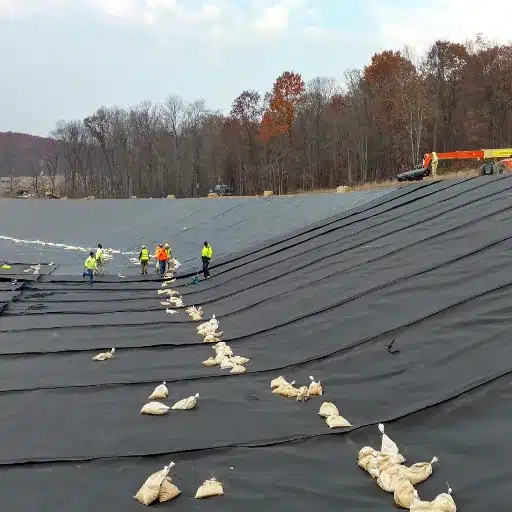
Even well-specified HDPE geomembrane landfill liners can fail if design, manufacturing, or installation details are wrong. Understanding failure modes helps procurement teams ask better questions and specify stronger protections.
| Failure Mode | Root Cause | Prevention Strategy |
|---|---|---|
| Environmental stress cracking (ESC) | Poor resin quality, sustained tensile stress, and chemical exposure | Specify high-quality resin with ESCR >500 hours; use structured textured geomembranes with improved crack resistance |
| Puncture | Stones, construction debris, inadequate cushion | Install protective nonwoven geotextile; conduct rigorous subgrade inspection |
| Seam failure | Contaminated weld surfaces, incorrect temperature or speed | Use certified welders; perform daily trial welds; test 100% of seams |
| Thermal expansion/wrinkles | Temperature swings during installation | Sequence work to minimize exposure; cover promptly with soil or ballast |
| UV degradation | Extended pre-cover exposure | Minimize exposure time; specify adequate carbon black and stabilizer packages |
| Slope sliding | Insufficient interface friction | Specify textured HDPE; conduct ASTM D5321 interface friction testing |
ESC causes more catastrophic failures than puncture. It develops slowly under stress and chemical exposure, making it hard to detect during construction. Batch-level ESCR testing and proper resin selection are the only reliable defenses. Thickness alone does not prevent stress cracking.
A procurement manager for an environmental contractor in East Africa learned this lesson during a 2022 hazardous waste cell project. The lowest bid came from a trader who could not provide ESCR data or mill certificates. The contractor paid 8% more for HDPE geomembrane from a GRI-GM13-certified manufacturer with 5-year sample retention. Three years later, independent testing of retained samples confirms the liner continues to meet specification. The premium was negligible compared to the cost of potential failure.
Selecting an HDPE Geomembrane Supplier for Landfill Projects
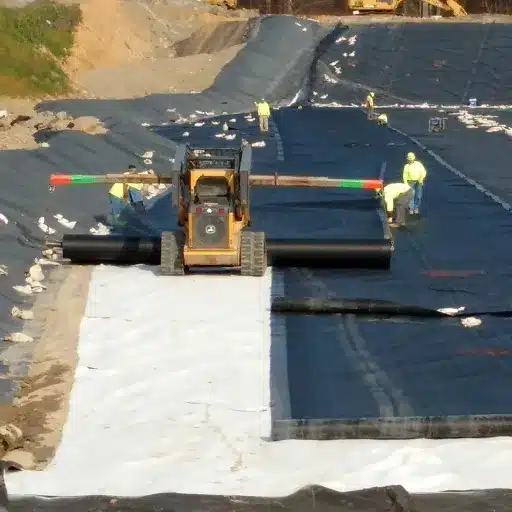
Landfill liner procurement is not commodity buying. The supplier you choose becomes a long-term partner in environmental protection. Evaluate candidates against these criteria:
Manufacturing certifications. ISO9001 quality management is the baseline. GRI-GM13 compliance must be verifiable with third-party test reports, not just a supplier claim.
Material traceability. Virgin resin verification, batch testing records, and retained samples allow future testing if questions arise. A 5-year sample retention policy demonstrates manufacturing confidence.
Customization capability. Landfill projects rarely fit standard roll dimensions. The supplier should offer customizable thicknesses from 0.1 mm to 3.0 mm, variable roll widths, and both smooth and textured surfaces from the same production line.
Export and logistics experience. International landfill projects require proper export packaging, container loading expertise, and documentation that clears customs without delay. A supplier with proven global delivery reduces project risk.
Technical consultation. The best suppliers provide installation guidance, welding parameter recommendations, and responsive engineering support, not just a product datasheet.
Request a technical quote with your waste type, site area, slope geometry, and regulatory jurisdiction. Our engineering team will recommend the right thickness, texture, and composite system configuration for your specific requirements.
Conclusion
Selecting the right HDPE geomembrane for a landfill liner will be more than picking a thickness out of a chart. That would involve a suitable match of materials properties and focus on waste chemistry, involving good design of redundant composite barriers, implementation of a quality assurance program, and diligence in employing a manufacturer that provides long performance guarantees.
The five decisions that matter most are:
- Match thickness to waste type: 1.5 mm for MSW, 2.0 mm for hazardous, 1.5–2.5 mm for mining
- Design composite liner systems with secondary barriers and leachate collection
- Specify GRI-GM13 compliant material with verified ESCR, OIT, and tensile data
- Demand rigorous seam testing and independent QA during installation
- Partner with a certified manufacturer offering technical support and sample retention
The good quality of specs up front is worth more than losing out on disasters late. The HDPE geomembrane, which is used as a liner in landfills, is the protector of groundwater, as well as liability control and design-life formula. Every project needs this material.
If you are planning a landfill containment project and need engineering-grade geosynthetics with global delivery support, contact our team today for customized recommendations and a detailed technical quotation.
Frequently Asked Questions
What thickness HDPE geomembrane is used for landfills?
Municipal solid waste landfills usually need 60 mil (1.5 mm) HDPE geomembrane as a minimum primary liner thickness. In the case of hazardous waste facilities, usually 2.0 (80 mil) or more is specified, frequently with double-liners. Mining and industrial applications usually vary from 1.5-2.5 mm, depending on chemical exposure and mechanical loading.
How long does an HDPE landfill liner last?
A high-quality high-density polyethylene (HDPE) geomembrane can stand 20 to 30 + years, even when exposed (nearly 100 years when it is covered below the ground) without UV exposure. End life also lies in the hitherto described terms together with guaranteed first quality resin, good installation, and protection against physical damage and chemical attack, obviously.
What is the difference between smooth and textured HDPE geomembrane for landfills?
Smooth HDPE serves the function of covering smooth-terrain ground surfaces where demands for low friction are not present. Rough or textured HDPE, on the other hand, would be necessary for side slopes as it enhances the friction forces at the interface between the liner and the foundation soils or GCL; thus preventing lateral slope slumping. Structured textured-line geomembranes are preferable to coextruded textures for consistent friction and retained mechanical strength.
What standards should HDPE landfill liners meet?
These grades correspond to the GRI-GM13, ASTM D5199 (including D6693, D6392, D4833, D5885, and D5397). Regulatory methods such as those are U. S. EPA Subtitle D, RCRA Subtitle C for hazardous waste, and many more, depending on the state or internationally, within EPA limits.
How is HDPE geomembrane installed in a landfill?
Installation follows subgrade preparation, geotextile cushion placement, panel deployment with downslope roll orientation, hot wedge welding for primary seams, extrusion welding for repairs and details, and comprehensive testing including air pressure testing, vacuum box testing, and destructive peel tests.
What is a composite landfill liner system?
A composite landfill liner system is made up of several layers, usually of an individual clay or a geosynthetic clay liner as the secondary barrier, high-density polyethylene (HDPE) geomembrane as the main barrier, a protective geotextile cushion, and a leachate collection drainage layer; together they create a combination of both barrier systems that go beyond a single barrier material on its own.
Is HDPE geomembrane chemically resistant to leachate?
Yes. Also, in terms of resistance to leachate, HDPE geomembrane is quite effective because such compounds include acids, alkalis, and organic compounds or complex leachate compositions, throughout a pH range between 0.5 and 14, one of the important reasons for choosing HDPE for municipal, industrial, and hazardous waste landfills when variation and aggressive conditions of leachate chemistry are considered.