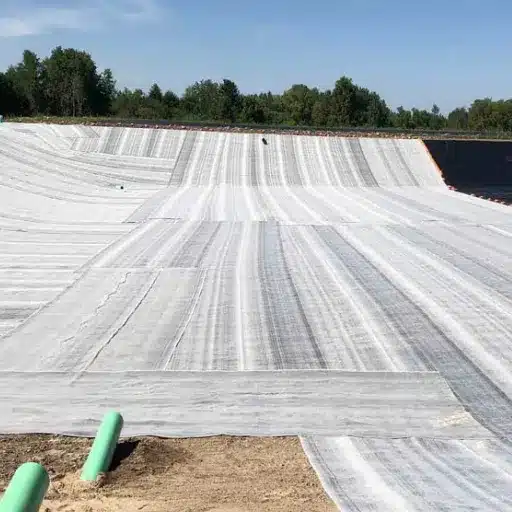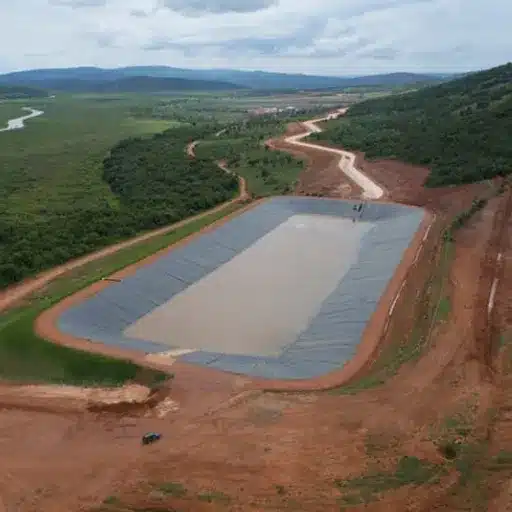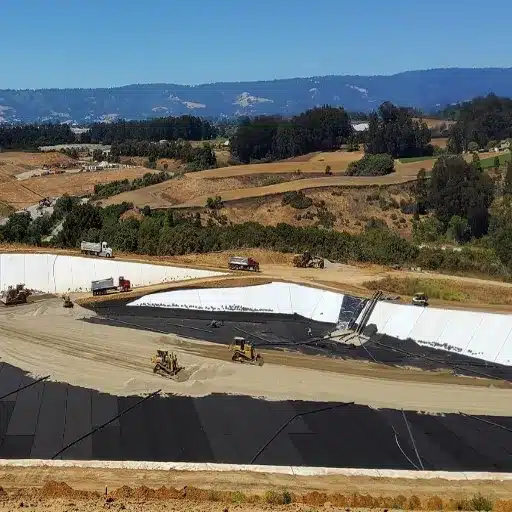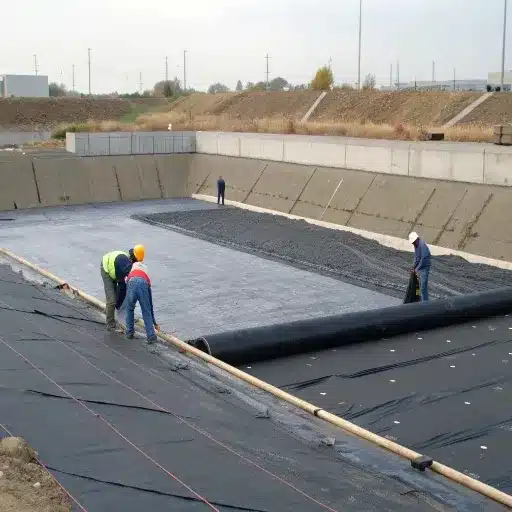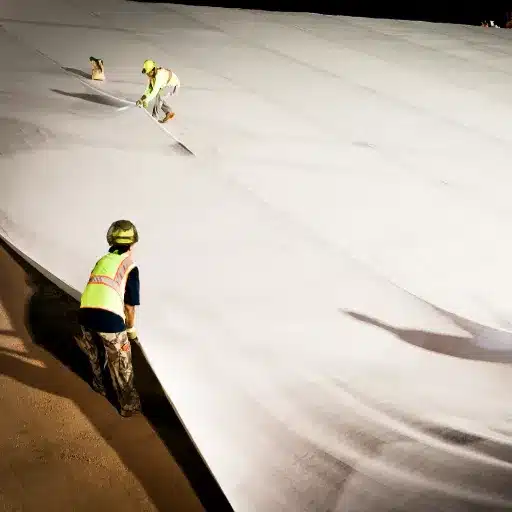
A GCL pond liner is a factory-manufactured geosynthetic clay liner in which sodium bentonite, typically 4,000–5,000 g/m², is encapsulated between geotextiles and needle-punched or stitch-bonded into a flexible sheet. When hydrated and covered with soil, it forms a low-permeability, self-sealing barrier for ponds, irrigation reservoirs, canals, and decorative lakes.
That’s the short answer. The longer answer is where most pond projects go right or wrong.
Every year, unlined ponds and canals lose water to seepage. In the Hetao Irrigation Area of Inner Mongolia, heavy canal seepage held water-use efficiency to just 0.42, and concrete lining failed under freeze–thaw cycles and shallow groundwater. That project is not unusual. It’s the normal condition of water infrastructure that was never properly sealed.
The problem is that buyers searching for a “bentonite pond liner” land on pages that never distinguish a manufactured GCL from an in-place bentonite blanket, publish no permeability values, and skip the two things that decide whether a lining fails: pond size and drawdown. This guide covers all of it, in the order a designer needs it.
Key Takeaways
- A GCL pond liner is a manufactured sheet with a controlled bentonite mass (4,000–5,000 g/m²), not the same product as an in-place bentonite blanket or a compacted clay liner
- GCLs are generally not recommended for ponds smaller than about 2,000 m², because tight turns cannot accommodate the required overlaps and mandatory cover soil
- Pond-specific seams require 150 mm longitudinal overlaps, 300 mm where water depth exceeds 1 ft, and 600 mm at panel ends, with a continuous bentonite bead of at least 0.4 kg/m
- A GCL must be covered within 24–72 hours; leaving it exposed is the most commonly cited cause of GCL failure
- Rapid drawdown is a real failure mode: a >2 m water-level drop in 4 hours triggered a 1,000 m embankment collapse at the Kerian Irrigation Scheme
- For critical water containment, a composite HDPE-over-GCL system cuts leakage to 0–4 L/ha/day, against ~860 L/ha/day for GCL alone
What Is a GCL Pond Liner?
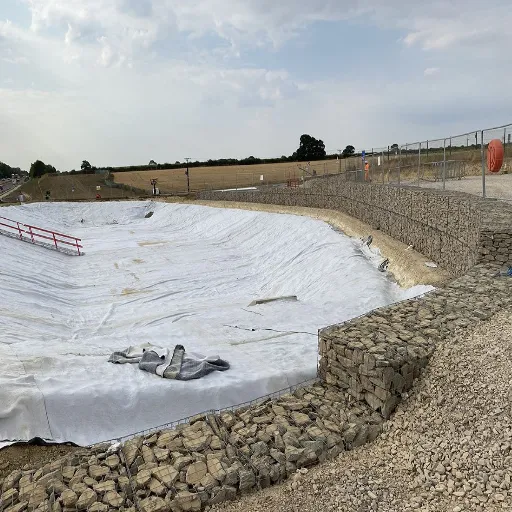
A geosynthetic clay liner is a hydraulic barrier built around sodium bentonite, a swelling clay. The bentonite sits between a woven carrier geotextile and a nonwoven cover geotextile, bonded by needle-punching, stitch-bonding, or adhesive. Dry, the sheet is roughly 5–7 mm thick. Hydrated, it swells to form a dense, low-permeability gel.
The mechanism is straightforward. Sodium montmorillonite absorbs water into its interlayer structure and swells roughly 10–16 times its dry volume. That swelling drives hydraulic conductivity below 5 × 10⁻¹¹ m/s, on the order of 100 times less permeable than 30 cm of well-compacted clay.
Two properties matter for ponds. First, the barrier is self-sealing: hydrated bentonite migrates into punctures and gaps, closing them without a welding crew. Second, the barrier is physical, not chemical. It works because the clay stays hydrated and confined. Remove either condition, and performance drops.
That second point is why a GCL is described as low-permeability rather than waterproof. Set that expectation at the start of a project, and the design decisions that follow make sense. For the full material science, see our complete guide to geosynthetic clay liners.
Consider what happens when that expectation is skipped. A shrimp farm in coastal Java lined two 1.5-hectare ponds in 2023 with a bentonite blanket spread over a sandy floor. It held for one season.
By the second, the seal had broken down, and the ponds were draining to half depth within a week of filling. The soil was too coarse for a blanket to consolidate, and the slightly brackish water worked against the clay. No product would have saved that site. A pre-construction diagnosis would have.
GCL vs Bentonite Blanket vs Natural Clay
“Sodium bentonite liner” describes three genuinely different products, and conflating them is the most common sourcing error in pond work. The chemistry is similar. The construction, verification, and risk are not.
A GCL is manufactured under factory quality control with a verifiable bentonite mass per unit area. It arrives as a roll, installs by overlap in hours, and its specification is measurable against a standard.
A bentonite blanket, more precisely a soil-bentonite treatment, is built in place. Bentonite is mixed or layered into soil at roughly 1–3 lb/ft² and compacted. Material cost is low. Site work, moisture control, and restoration cycles are not. In US practice this falls under NRCS Practice Code 520 (Compacted Soil Treatment).
A natural compacted clay liner needs soil with at least 20% clay, placed in 6–8 inch layers at a minimum 1 ft thickness for water depths under 10 ft, plus 2 inches for every additional foot of depth. It is thick, haul-intensive, and heavily dependent on local borrow material.
A GCL, by contrast, is addressed under NRCS Practice Code 521 (Pond Sealing or Lining, Geomembrane or GCL). That regulatory distinction is rarely published by suppliers, but it matters for permitting and for how a project is inspected.
| Method | Manufactured or in place | Typical barrier thickness | Permeability | Self-healing | Chemistry sensitivity | Best fit |
|---|---|---|---|---|---|---|
| GCL | Manufactured | 5–7 mm dry | ≤5 × 10⁻¹¹ m/s | Yes, up to ~75 mm | Moderate | Covered ponds, reservoirs, canals |
| Bentonite blanket | In place | 2–6 in soil-bentonite | Variable | Limited | High (soil dependent) | Sites with local clay, tolerant of seepage |
| Compacted clay liner | In place | 0.6 m+ | ~1 × 10⁻⁷ cm/s | Some | Low-med | Where cheap clay is nearby |
| HDPE geomembrane | Manufactured | 0.5–2.0 mm | Essentially impermeable | No | Low | Exposed, saline, or critical water |
When a GCL Pond Liner Is the Right Choice, and When It Is Not
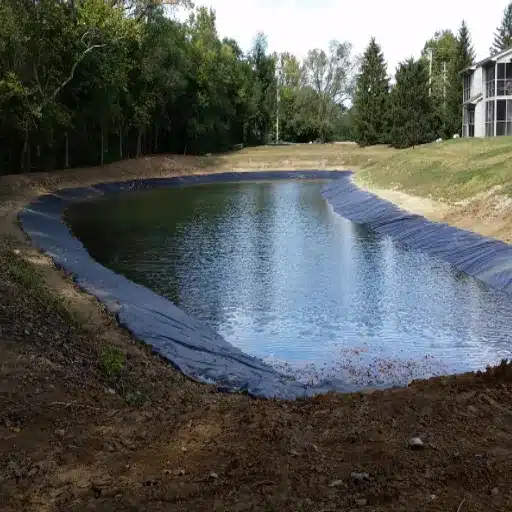
Choose a GCL when the pond is covered water containment, the subgrade can be prepared smooth and compacted, and the contained water is chemically compatible with sodium bentonite. That covers irrigation reservoirs, farm and fish ponds of adequate size, decorative lakes, canals and ditches, and secondary containment. It’s also the right call when suitable clay is scarce or must be hauled long distances.
Don’t choose a GCL when any of the following applies:
- The pond is smaller than about 2,000 m². Tight turns can’t accommodate the required overlap geometry, and the mandatory cover soil becomes impractical to place and maintain. Most suppliers never state this. It is one of the most useful answers in pond lining.
- The liner will stay exposed. Without cover, the bentonite desiccates, shrinks, and cracks.
- The water is saline or brackish. High ionic strength degrades the bentonite seal.
- Divalent cations dominate. Calcium and magnesium displace sodium in the clay and cut swell capacity.
- Bottom-feeding fish will continually disturb the bentonite. Turbidity rises and gill tissue can be irritated.
That is a specific decision sequence, not a preference. Work through contained-water chemistry, available confining cover, pond size and geometry, wet–dry exposure, and the regulatory requirement, in that order. Our GCL selection framework expands each step into a checklist you can take to a specification meeting.
GCL Pond Liner Installation: Overlaps, Bentonite and Cover Soil
Pond installation differs from general GCL work in two ways: overlap widths driven by water head, and a continuous bentonite bead at every longitudinal seam. Get these wrong and the lining leaks at the seams, not through the sheet.
Subgrade preparation
The subgrade must be smooth, compacted, and proof-rolled, with no protrusions or stones larger than 1/2 inch (12 mm). That is stricter than the 3/8 inch limit for geomembranes. Where angular rock is present, place a cushion layer: a nonwoven geotextile of 10 oz/yd² or heavier, or at least 6 inches of suitable soil.
Overlaps and bentonite
- Longitudinal (side) seams: 150 mm minimum under standard conditions; 300 mm where water depth exceeds 1 ft, with supplemental bentonite
- End-of-panel (transverse) seams: 600 mm, shingled in the direction of grade so runoff cannot enter the overlap zone
- Supplemental bentonite: a continuous bead or fillet of at least 0.4 kg/m, placed roughly 150 mm from the panel edge. Some products ship with bentonite-impregnated or self-seaming edges
- Allowance: add about 7% extra material for overlaps and off-cuts
Panels are joined by overlap only. A GCL is never welded. It’s a hydrated-bentonite seal, not a thermoplastic membrane, and no welding crew or seam-testing equipment is required.
Anchoring and cover
Perimeter anchor trenches typically run 300–500 mm wide and 450–1,000 mm deep, with 300 mm of liner laid in and backfilled. Cover soil must be at least 300 mm (12 in) measured perpendicular to the finished surface, increasing to 600 mm (24 in) on side slopes unless protected from erosion.
Then comes the rule that decides most projects: place the cover within 24–72 hours, and deploy only as much GCL in one day as can be covered that day. Leaving the liner exposed is the single most commonly cited cause of claimed GCL failures.
Repairs use patches extending at least 300 mm beyond the damage, with granular bentonite placed beneath the patch. Avoid installing in standing water, and never below a separation layer more permeable than the subgrade. The full procedural sequence is in our GCL installation, overlap and hydration guide.
Dario’s crew lined a 3,000 m² reservoir in northern Italy in September 2024, working to finish before the autumn rains. The GCL went down cleanly over two days.
Then the pump order slipped, and the cover soil sat in a stockpile for eleven days while the liner lay exposed. By the time the crew returned, the surface was cracked and brittle. The overlaps had held, but the panel interiors had desiccated, and the rework cost more than the original installation. The 24-to-72-hour cover rule exists because of projects like that one.
Want a spec review before you order? Send us your pond dimensions, water depth and cover plan, and our engineering team will check the overlap and cover requirements against your design. Request a technical review →
Drawdown, Slope Stability and Failure Modes to Design Against
This is the section competitors omit. It’s also where lining projects fail.
In one documented case at the Kerian Irrigation Scheme, the channel water level dropped by more than 2 metres within 4 hours. The rapid drawdown triggered a 1,000 m embankment collapse along a newly installed GCL layer. The initial investigation pointed to a reduction in GCL friction angle and cohesion, which undermined embankment stability along a line parallel to the bank.
The lesson is not that GCLs are unsafe. It’s that interface friction is a design criterion in ponds and canals, not an afterthought. Rapid-drawdown scenarios require verification of GCL friction and cohesion, not just permeability.
Other failure modes worth designing against:
- Cation exchange. Ca²⁺ and Mg²⁺ in pond water or cover-soil seepage displace Na⁺ on the montmorillonite. Swell capacity drops and conductivity rises.
- Desiccation cracking. Thin cover or repeated wet–dry cycling lets bentonite shrink and crack, and cracks may not re-close on refilling. Full self-sealing generally needs 0.75–1.0 m of cover for adequate confining stress.
- Permeable separation layers. A layer more permeable than the subgrade traps water pressure beneath an impermeable lining, causing buoyancy damage to roughly 1 m below the water line.
- Saline water. High ionic strength degrades the seal, which rules out many coastal ponds.
- Gas migration. An unhydrated GCL isn’t a gas barrier.
- Roots and burrowing animals. Both must be excluded, and tree or shrub roots removed promptly.
Where chemistry is aggressive or shear demand is high, the answer is a reinforced, polymer-modified, or geomembrane-laminated GCL grade, or a composite build-up. The underlying test methods and conductivity values are covered in our GCL hydraulic conductivity guide.
GCL Pond Liner vs HDPE and LLDPE Geomembrane
Both materials line ponds. They fail in opposite directions.
A geomembrane is a thermoplastic sheet, heat-welded into a continuous barrier that is essentially impermeable and UV-stable even when exposed. It resists saline and brackish water and carries no bentonite to degrade. Its weakness is it can’t heal itself: every puncture, wrinkle, or bad weld is a permanent leak path.
A GCL is a mineral barrier. It self-seals punctures up to roughly 75 mm, tolerates a variable subgrade, and installs without welding equipment or seam testing. Its weakness is that it must stay hydrated and covered, and its chemistry is finite.
The practical split looks like this:
- Exposed ponds, fluctuating levels, saline or brackish water: geomembrane. See our geomembrane pond liners guide for material and welding detail.
- Covered ponds, reservoirs and canals with compatible water: GCL, at lower material cost and far faster installation. GCL material runs roughly $0.35–$1.00/sq ft, HDPE roughly $0.50–$2.10/sq ft, before labour.
Where containment is critical, the answer is often neither alone. A composite liner, HDPE directly over GCL, in contact, delivers leakage of 0–4 L/ha/day. That compares with 100–1,000 L/ha/day for geomembrane alone and roughly 860 L/ha/day for GCL alone, according to benchmarking published by ABG Geosynthetics. The design requirement is direct geomembrane-to-clay contact, with no sand or drainage layer between the two barriers. Our composite liner system guide covers the build-up.
Canals, Ditches and Irrigation Reservoirs
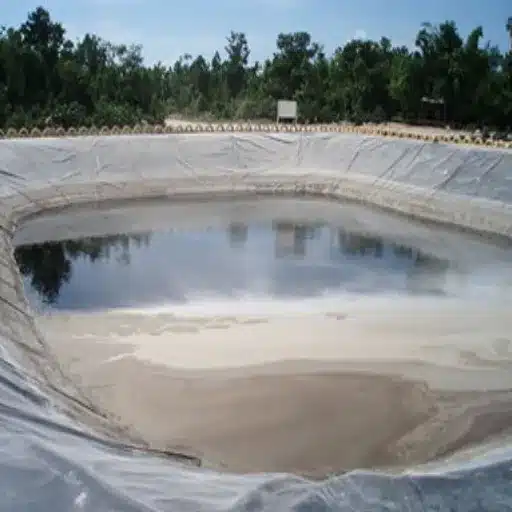
Conveyance structures are the clearest economic case for lining. Seepage loss is continuous, measurable, and expensive. In the Hetao Irrigation Area, that loss held water-use efficiency to 0.42 and prompted a reassessment of concrete lining, which had degraded under freeze–thaw and shallow groundwater.
GCLs suit conveyance for four reasons: less excavation than a compacted clay liner, tolerance of a variable subgrade, self-healing under desiccation and freeze–thaw, and rapid deployment. Productivity in the field runs to thousands of square metres per shift with a small crew.
Two canal-specific cautions:
- Rapid drawdown governs slope design. Maintained water levels are not the design case. Emergency drawdown is.
- Bentonite mass per unit area rises with the application. Irrigation canals and reservoirs commonly specify 4,500 g/m², against 4,000 g/m² for general ponds and landscape lakes and 5,000 g/m² for lagoons, dams, and industrial basins.
GCL Pond Liner Cost and Specification
Three variables drive cost, and only one of them is the roll price.
Bentonite mass per unit area is the primary specification. A 4,000 g/m² product suits general ponds and canals. A 4,500 g/m² product suits reservoirs and fish farms. A 5,000 g/m² product suits lagoons, dams, and industrial containment. Higher mass reduces flux and raises unit cost.
Grade follows site conditions.A scrim-reinforced or reinforced (RNP) grade is needed on steep banks or a rough subgrade, where internal shear strength matters. A geomembrane-laminated grade is needed where chemistry is aggressive.
Logistics and installation complete the picture. Budget $0.35–$1.00/sq ft for GCL material, plus roughly $0.50–$1.00/sq ft for labour, protection geotextile, and cover soil placement. Installed GCL typically lands at $6–$12/m². Add about 7% material for overlaps and off-cuts, plus cover soil haulage and CQA.
Frame these as typical market factors, not quotations. Freight, roll width, and panel sizing move the number more than buyers expect, and a project-specific take-off is the only reliable figure.
Priya, a procurement lead for a municipal water authority in Southeast Asia, saw this play out on a 12-hectare raw water reservoir. The lowest bid specified GCL alone at roughly $8/m² installed. A competing bid offered HDPE over GCL at nearly double the material cost.
She chose the composite, and the reasoning was simple: the reservoir feeds the town’s drinking water supply, and the leakage benchmark runs 0–4 L/ha/day for a composite against roughly 860 L/ha/day for GCL alone. The cheaper roll price was not the cheaper decision.
Comparing options for a specific pond? We can price GCL, geomembrane, and a composite system side by side from your drawings. Request a project quote →
Our GCL cost per square meter guide breaks these ranges down by grade and application.
Sourcing GCL Pond Liners from a Global Supplier
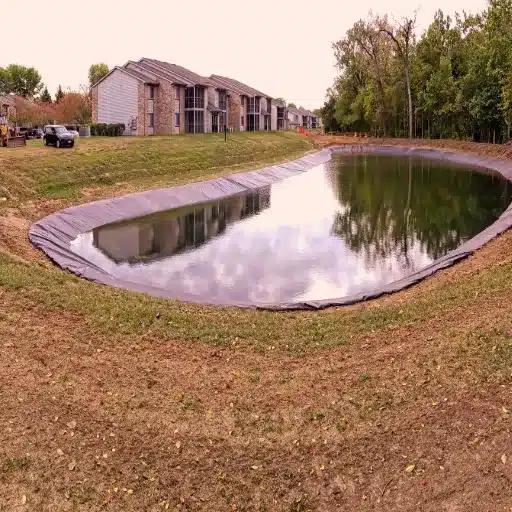
Roll configuration is where a supplier earns its place. Standard GCL widths run 4–6 m, and cut-to-length panels reduce field overlap and wastage. Steel-cored rolls are used for longer lengths.
For export projects, the documentation matters as much as the roll. Ask for:
- GRI-GCL-3 conformance for the specified bentonite mass and index flux
- Per-batch ASTM test reports, D5887 (index flux), D5890 (swell index), D5891 (fluid loss), D5993 (bentonite mass per unit area), D6243 (internal and interface shear)
- ISO 9001 quality system certification and retained samples
Shanxi Shengxing supplies needle-punched GCL, scrim-reinforced grades for rough or sloped subgrades, geomembrane-laminated composite GCL, and the HDPE geomembrane and nonwoven geotextile that complete a composite pond lining. We support export packaging, flexible minimum order quantities for pilot and mid-scale ponds, and engineering consultation on pond size, cover thickness, and overlap specification.
Frequently Asked Questions
Is bentonite safe for fish ponds?
Natural sodium bentonite is non-toxic and does not introduce harmful chemicals, which is why GCLs are used in fish ponds and aquaculture. The practical risk is turbidity: bottom-feeding fish can stir bentonite fines into the water, raising turbidity and irritating gill tissue. Adequate cover soil addresses this.
Can a GCL be used for a drinking water reservoir?
Products made from natural sodium bentonite are described as non-toxic and suitable for potable water storage, and reservoirs are a standard application. Final approval depends on local drinking water regulation, so confirm the specific certification your authority requires before specifying.
Does a GCL pond liner need to be covered with soil?
Yes. A GCL is a low-permeability barrier, not a waterproof membrane, and it depends on hydration and confining stress. Minimum cover is 300 mm, rising to 600 mm on side slopes, and it must be placed within 24–72 hours of deployment. Exposure is the most common cause of GCL failure.
What is the minimum pond size for a GCL liner?
GCLs are generally not recommended for ponds smaller than about 2,000 m². Smaller ponds have tight turns that can’t accommodate the required overlap geometry, and the mandatory cover soil is impractical to place and maintain. A geomembrane or a preformed liner is usually the better answer below that size.
Do I need a GCL or a bentonite blanket?
Choose a GCL when you need a verifiable, factory-controlled bentonite mass and fast installation with minimal earthworks, which is most covered water containment. Choose a bentonite blanket when local clay or bentonite is cheap, the soil is suitable, the water is not saline, and the project can tolerate some seepage and periodic replenishment.
How long does a GCL pond liner last?
Bentonite is an inorganic mineral, so it doesn’t age, corrode, or degrade the way polymers can. Service life depends on hydration and confinement: with adequate cover and compatible water chemistry, a GCL is designed for decades, commonly modelled over 25–50 years. Loss of cover or cation exchange shortens that considerably. See our sodium bentonite liner guide for the chemistry.
How much does a bentonite pond liner cost per square meter?
GCL material runs roughly $0.35–$1.00/sq ft, with labour, protection geotextile, and cover soil placement adding about $0.50–$1.00/sq ft. Installed GCL typically lands at $6–$12/m². Cost rises with bentonite mass, reinforcement, and geomembrane lamination.
Conclusion
A GCL pond liner is a manufactured hydraulic barrier of sodium bentonite between geotextiles, and it belongs in covered water containment where the pond is large enough, the subgrade is prepared, and the water chemistry is compatible with bentonite.
Five things decide whether it works. Distinguish a GCL from a bentonite blanket, a compacted clay liner, and a geomembrane, because they’re not interchangeable. Respect the pond size floor of roughly 2,000 m². Build the seams correctly, with 150 mm longitudinal overlaps, 300 mm where water depth exceeds 1 ft, 600 mm at panel ends, and a continuous bentonite bead of at least 0.4 kg/m. Cover within 24–72 hours, every time. And design for drawdown and interface friction, not just permeability, because that is where canal and reservoir linings actually fail.
Where containment is critical, a composite HDPE-over-GCL system is the strongest answer, cutting leakage to 0–4 L/ha/day.
If you are specifying a GCL pond liner and want the overlap, cover, and grade checked against your drawings, our engineering team will work through it with you. Request a technical GCL quotation →