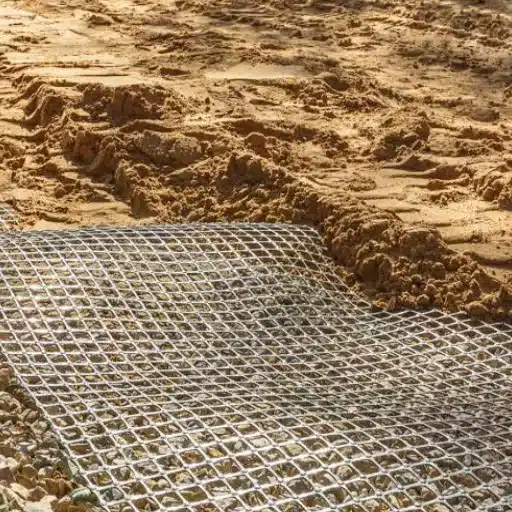
A geosynthetic clay liner (GCL) is a factory-made hydraulic barrier that sandwiches a thin layer of sodium bentonite between two geotextiles. When the bentonite hydrates, it swells to roughly 10 to 16 times its dry volume and forms a low-permeability barrier that seals around punctures by itself.
That self-healing behaviour is the reason a geosynthetic clay liner now appears in landfills, reservoirs, canals, and heap leach pads across the world. It’s also the reason the material gets specified badly more often than almost any other geosynthetic, because the same clay that seals a puncture can lose most of its swelling capacity when the wrong chemistry reaches it.
The global GCL market sits at roughly USD 509 million and is forecast to reach USD 689 million by 2031, a 5.19% compound annual growth rate.
If you’re comparing a GCL against compacted clay or a geomembrane, the numbers that decide the argument usually aren’t the ones on a product datasheet. They’re bentonite mass per unit area, index flux, cover thickness, and the chemistry of whatever liquid you’re containing.
This guide covers the composition and swelling mechanism, the type taxonomy, the permeability values and ASTM test methods that govern acceptance, comparisons against geomembrane and compacted clay, composite design, installation requirements, the limitations most suppliers don’t publish, and a selection framework you can apply to a real project.
Key Takeaways
- A GCL is 6 to 10 mm thick dry and replaces 0.6 m of compacted clay, which is why it preserves landfill airspace and cuts haulage from 150+ truckloads to one.
- Hydrated sodium bentonite reaches hydraulic conductivity below 10⁻⁹ cm/s and self-seals punctures up to about 75 mm; no geomembrane can do that.
- GRI-GCL-3 sets a maximum index flux of 1 × 10⁻⁸ m³/m²/s, and index flux plus bentonite mass per unit area is a better specification than permeability alone.
- Divalent cations (calcium and magnesium) and desiccation cracking are the two real failure modes. Together they raised permittivity four to five orders of magnitude in a documented field trial.
- A composite build-up of geomembrane over GCL leaks 0 to 4 L/ha/day, against roughly 860 L/ha/day for a GCL alone and 100 to 1,000 L/ha/day for a geomembrane alone.
What Is a Geosynthetic Clay Liner (GCL)?
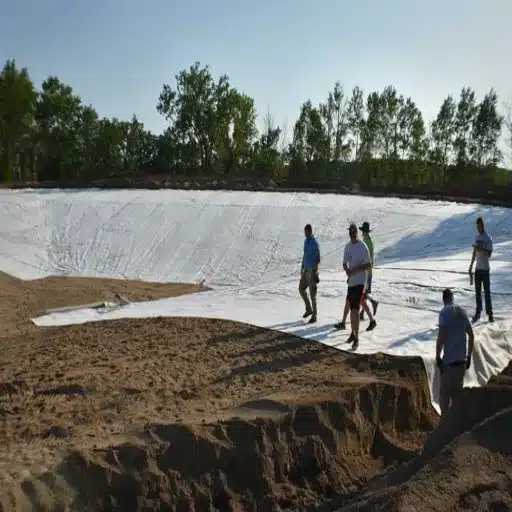
A geosynthetic clay liner is a manufactured hydraulic barrier consisting of a layer of sodium bentonite clay, typically 3.7 to 5.0 kg/m², encapsulated between geotextiles and bonded by needle-punching, stitch-bonding, or adhesive. It arrives on a roll, installs in a fraction of the time a compacted clay liner requires, and swells on contact with water to form a self-sealing barrier.
The bentonite is the working component. It’s a natural sodium montmorillonite clay, the same mineral used in drilling mud and cat litter, chosen because its crystal structure absorbs water between its layers and expands. Every bentonite clay liner depends on that one property.
Woven and nonwoven geotextiles do the rest of the job. The woven carrier layer gives the roll its tensile strength and handles handling loads. The nonwoven cover layer holds the bentonite in place and lets water through so the clay can hydrate. GRI-GCL-3 recommends a nonwoven cover of at least 200 g/m².
The three layers are locked together by needle-punching, stitch-bonding, or adhesive. Needle-punching drives fibres from the cover geotextile down through the bentonite and into the carrier, which is why needle-punched GCLs hold their internal shear strength better than the alternatives and dominate the North American market.
A finished roll is thin. The bentonite layer runs about 4 to 6 mm, and the complete dry GCL measures 6 to 10 mm. Once hydrated and confined it expands to roughly 10 to 15 mm. For comparison, the compacted clay liner it usually replaces is 0.6 m thick, which is 60 to 100 times more material.
That thickness difference is the commercial argument. A single truckload of GCL delivers the barrier function of more than 150 truckloads of compacted clay.
For a deeper look at how the different constructions compare, see our guide to types of geosynthetic clay liner, and for the clay itself, read sodium bentonite liners.
How GCLs Work: Bentonite Swelling and Self-Healing
The barrier in a geosynthetic clay liner is physical, not chemical. Water enters the bentonite’s interlayer structure, the clay expands, and the swollen mass closes the void space that would otherwise let liquid through. Understanding that mechanism explains both why a GCL performs so well and why it can fail.
Hydration and swelling
Dry sodium bentonite is a stack of microscopic platelets with sodium ions between them. When water arrives, those ions draw it in and the stack separates, expanding the clay to roughly 10 to 16 times its dry volume.
The swelling does two things at once. It fills the pore space inside the bentonite layer, and it drives the hydraulic conductivity down by several orders of magnitude. Dry bentonite conducts water relatively freely at around 10⁻⁶ cm/s. Fully hydrated and confined, the same clay drops below 10⁻⁹ cm/s.
Self-healing
Swollen bentonite is a gel, and gel flows. When a stone punctures the GCL or a panel edge pulls apart, hydrated clay migrates into the gap and re-seals it. Field and laboratory work places the practical self-healing limit at roughly a 75 mm hole.
This is the property that separates a GCL from every polymer liner on the market. A geomembrane with a 20 mm puncture leaks through that puncture forever. A GCL with the same defect seals itself, provided it stays hydrated and confined.
Why “physical barrier” matters
Because the barrier depends on hydration and confinement rather than on chemical inertness, it can be undermined by conditions that dry the clay out or replace its sodium ions. Those conditions are predictable and testable, and we cover them in the limitations section below.
For the full chemistry, including how polymer-modified and dense-prehydrated bentonites extend the working range, see our article on sodium bentonite chemistry and swelling behaviour.
Types of Geosynthetic Clay Liners
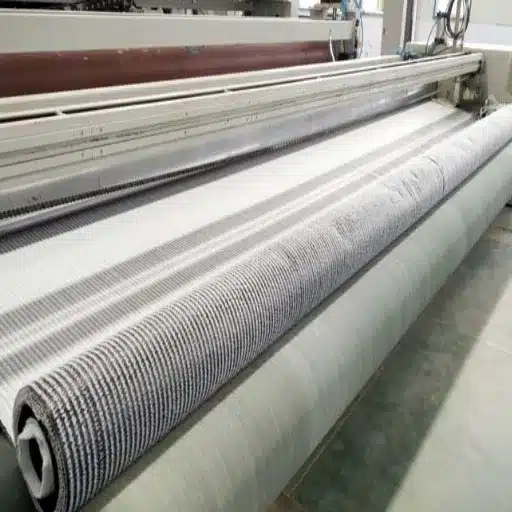
GCLs are classified three ways: by how the layers are bonded, by the form the bentonite takes, and by what’s been added for reinforcement or lamination. Most specification arguments come down to the second and third categories.
By bonding method
Needle-punched products are the default for slopes and any application with meaningful shear demand, because the punched fibres create a mechanical connection between the geotextiles that survives shear displacement. Stitch-bonded products use a similar principle with thread. Adhesive-bonded products rely on glue and are generally limited to flat or lightly loaded applications.
By bentonite form
Powdered bentonite hydrates faster and more uniformly, which makes it the usual choice for landfill containment and for polymer-modified grades where consistent hydration matters. Granular bentonite is easier to handle in wind and light rain, resists premature hydration better during installation, and performs well on steep or vertical surfaces. Both forms deliver the same conductivity once properly hydrated and confined.
Reinforced GCLs (RNP and RNP2)
Reinforced nonwoven products add a layer of high-strength fibres or a scrim to raise internal shear strength. They exist because unreinforced GCLs have limited resistance to shear displacement on steep slopes, and slope failures in lined cells almost always trace back to interface or internal shear. Reinforced types accounted for 57.34% of 2025 GCL revenue, which tells you where the market has moved.
Geomembrane-laminated composite GCLs
A composite GCL bonds the bentonite directly to an HDPE or thin geofilm backing during manufacture. The result is a factory-made two-in-one barrier: the polymer blocks liquid and the clay seals around any defect in the film. In one landfill final cover study, a conventional GCL degraded within 4 to 15 months while a polyethylene-laminated composite GCL performed well beyond five years.
| Type | Bonding method | Bentonite form | Relative shear strength | Typical application |
|---|---|---|---|---|
| Standard needle-punched | Needle-punched | Powdered or granular | Moderate | Landfill base liners, ponds, flat areas |
| Reinforced (RNP/RNP2) | Needle-punched + reinforcement | Granular | High | Steep slopes, landfill sidewalls |
| Stitch-bonded | Stitch-bonded | Granular | Moderate | General containment |
| Geomembrane-laminated | Adhesive or thermal | Powdered | Varies | Aggressive chemistry, final covers |
For the complete taxonomy mapped to slope angle and shear demand, see our GCL types by slope and application.
Key Properties and Performance Standards
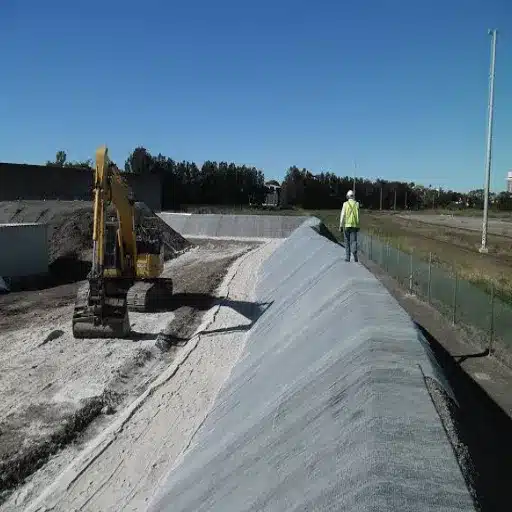
Specification is where geosynthetic clay liner projects are won and lost. Two buyers can order “a GCL” and receive materials whose field performance differs by orders of magnitude, because the bentonite loading, the fibre bond, and the clay chemistry all vary.
Hydraulic conductivity
Dry bentonite sits around 10⁻⁶ cm/s. Properly hydrated and confined, a sodium GCL drops below 10⁻⁹ cm/s, and high-performance products are specified at 5 × 10⁻¹¹ m/s or better. The spread across commercially available products is therefore enormous, and a single “permeability” number on a datasheet tells you very little on its own.
Index flux versus permeability
This is the specification detail that separates a serious buyer from a casual one. Permeability is a calculated value that depends on the true thickness of the bentonite layer, and that thickness is hard to measure in a swollen, confined specimen. ASTM D5887 measures index flux instead, a direct measurement under prescribed conditions, with the specimen hydrated for at least 48 hours at 80 psi cell pressure and 75 psi backpressure.
Because of this, current best practice is to specify index flux alongside bentonite mass per unit area rather than permeability alone, using the acceptance criteria in GRI-GCL-3.
Shear strength
On slopes, the governing question is rarely permeability. It’s whether the GCL and its interfaces can resist the shear demand without displacement. Internal shear strength and interface friction against the subgrade and cover soil both matter, and textured geomembranes are often used above a GCL specifically to raise interface friction. ASTM D6243 covers the measurement.
Germany’s BQS 5-5 standard, introduced in 2026, adds a shear-creep testing requirement at 80 °C, which reflects how seriously the industry now treats long-term creep on slopes.
Standards cross-reference
| Standard | What it measures |
|---|---|
| GRI-GCL-3 | Minimum specification requirements; max index flux 1 × 10⁻⁸ m³/m²/s |
| ASTM D5887 | Index flux through saturated GCL (flexible-wall permeameter) |
| ASTM D5890 | Swell index of the bentonite |
| ASTM D5891 | Fluid loss of the bentonite |
| ASTM D5993 | Mass per unit area of bentonite |
| ASTM D6243 | Internal and interface shear strength |
| ASTM D6766 | Hydraulic properties with potentially incompatible liquids |
| ASTM D5889 | Quality control of the finished product |
| ASTM D5888 | Storage and handling |
| ASTM D6496 | Peel strength of the bonded layers |
Keep this table beside any quotation you receive, because it’s the fastest way to check whether the price is backed by real testing. Both ASTM D5887 and the Geosynthetic Institute’s GRI-GCL-3 are public documents, so you can verify the acceptance criteria yourself. Our dedicated guide to GCL hydraulic conductivity goes deeper into the test methods and the confining-stress effects behind these numbers.
GCL vs Other Liner Systems
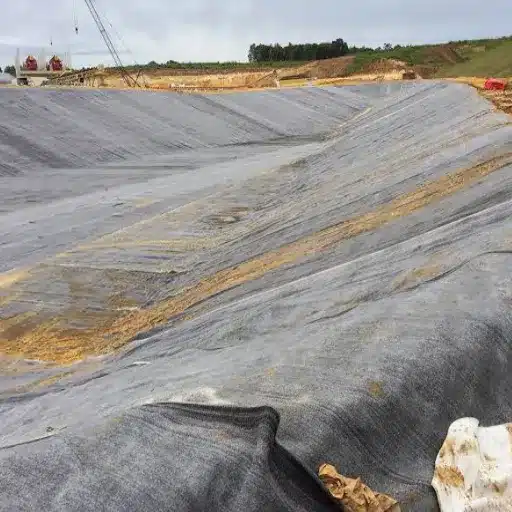
The two comparisons that decide most projects are GCL against compacted clay, and GCL against geomembrane. They answer different questions, and neither is a simple win.
GCL vs compacted clay liner
Compacted clay has been the default containment barrier for decades. It’s made from soil, it’s well understood, and where good clay is available within a few kilometres of site it can be the cheapest option on the table.
The GCL liner case rests on three things. First, thickness: 6 to 10 mm against 0.6 m, which preserves airspace in a landfill and reduces the excavation and haulage dramatically. Second, factory quality control: a GCL’s bentonite content and conductivity are tested in a plant, while a compacted clay liner’s performance depends on moisture conditioning and compaction achieved in the field. Third, productivity: a GCL crew installs roughly 5,000 to 8,000 m² per day, while a compacted clay liner takes about 2.4 times the labour hours and carries a heavier testing burden, with moisture and density checks per lift.
The honest counter-case is a site with abundant suitable clay close by. In that situation, haulage costs stay low and compacted clay can still compete. The full comparison is in our article on GCL vs compacted clay liner.
GCL vs geomembrane
These two materials are often presented as rivals, which misses the point. A geomembrane is a polymer sheet with essentially zero permeability and excellent chemical resistance. A GCL is a mineral barrier with self-healing behaviour and a chemistry sensitivity.
The geomembrane wins on chemical inertness and on mechanical strength. The GCL wins on self-healing and on the ability to seal around penetrations and irregular geometry. A geomembrane has a defect at every seam and every wrinkle; a GCL has a repair mechanism for those defects.
Our side-by-side look at geomembrane vs GCL covers permeability, durability, chemical resistance, and lifespan in detail.
The comparison table
| System | Barrier mechanism | Typical thickness | Permeability | Self-healing | Chemical resistance | Relative cost | Best fit |
|---|---|---|---|---|---|---|---|
| GCL | Hydrated bentonite | 6–10 mm dry | <10⁻⁹ cm/s hydrated | Yes, to ~75 mm | Chemistry-dependent | Low–medium | Landfill covers, ponds, composite liners |
| HDPE geomembrane | Polymer film | 0.5–2.0 mm | Essentially zero | No | High | Medium | Primary barriers, aggressive leachate |
| Compacted clay | Dense soil | 600 mm (0.6 m) | ~10⁻⁷ cm/s at best | Limited | Good | Low–high (site-dependent) | Sites with local clay, low-budget containment |
| GM + GCL composite | Polymer plus mineral | 7–12 mm | 0–4 L/ha/day leakage | Yes, through GM defects | High | Medium–high | Best available containment performance |
Composite Liner Systems: Why GM over GCL Wins
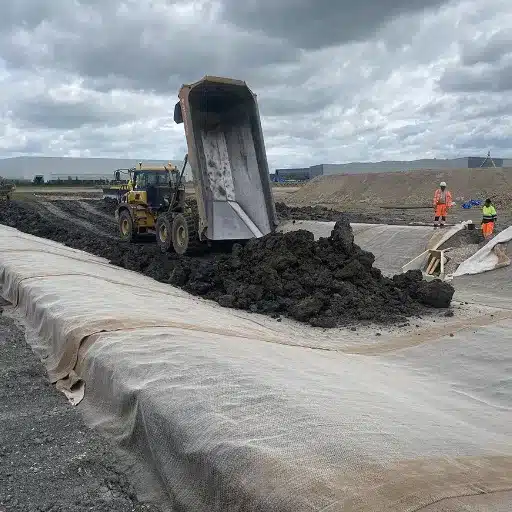
If you want the lowest leakage rate money can buy, the answer is a composite: a geomembrane laid directly over a GCL. The two barriers compensate for each other’s weaknesses, and the published leakage data is unambiguous.
A geomembrane alone leaks 100 to 1,000 L/ha/day, because every seam, wrinkle, and installation defect becomes a flow path. A geosynthetic clay liner alone leaks around 860 L/ha/day, roughly comparable. A composite of the two drops to 0 to 4 L/ha/day, an improvement of two to three orders of magnitude.
The mechanism is redundancy plus tortuosity. A hole in the geomembrane is no longer a hole in the barrier, because the swollen bentonite directly beneath it seals the defect and the leak path has to work much harder to find a route through.
One design requirement makes or breaks the system. The geomembrane must sit in direct contact with the GCL. If a sand layer, drainage geonet, or any other material is placed between them, the self-sealing mechanism is bypassed and the GCL contributes far less than the design assumed.
There’s a known caveat worth stating plainly. Where contact is poor, because of severe wrinkling, bridging, or an interposed layer, a GCL beneath a primary geomembrane may not measurably reduce leakage at all. Designers who assume the composite benefit without specifying contact quality are relying on a mechanism they haven’t actually built.
One operational note: as a landfill cell fills, consolidation water expressed from a GCL can be detected in the leak detection system and misread as leakage. Analysing the fluid chemistry distinguishes the two.
Our guide to composite liner system design covers friction, wrinkle management, and interface shear in full.
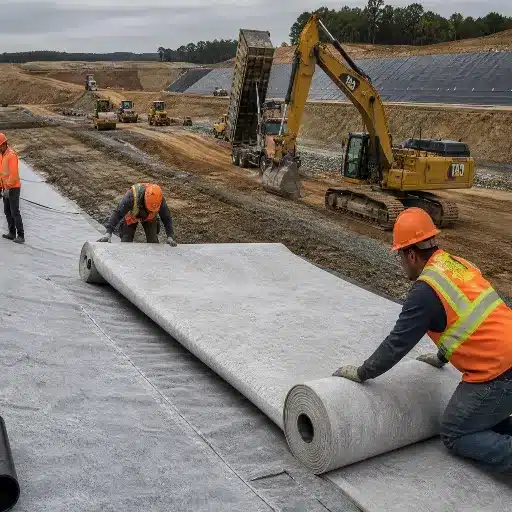
GCL Installation, Overlap, and Anchoring Overview
A GCL is only as good as its overlaps. Every panel joint is a potential seepage path, and the field evidence on what happens when joints are done badly is stark.
Subgrade preparation comes first. The surface needs to be proof-rolled, smooth, and compacted to at least 85% standard Proctor, with protrusions and stones over about 20 mm removed. A rock poking into the clay layer becomes a puncture, and the clay has to be hydrated and confined for self-healing to work.
Rolls are deployed downslope, shingled in the direction of grade so water runs over the lap rather than into it.
Overlap widths are set by product and position. Standard overlaps run 200 to 300 mm. Film-backed products can use 100 mm because the film carries the barrier across the joint. End-of-panel and roll-end overlaps go to 600 mm.
Supplemental bentonite isn’t optional. Granular bentonite is applied at a minimum of about 0.4 kg per metre of overlap to fill the gap between panels. Overlaps installed without it leaked up to eight times more in field monitoring. The same monitoring showed a 300 mm overlap retained only about 32% of its width after 28 months of shrinkage.
Anchoring secures the edges. Anchor trenches or runout anchors hold panel ends, and pins are spaced roughly 300 to 500 mm on slopes and up to 500 mm on flat ground.
Cover follows promptly: 300 mm of soil, increased to 600 mm in areas under traffic. Hydration control matters throughout, because bentonite that swells before placement becomes difficult to work and loses overlap integrity.
Our full GCL installation guide covers the sequence step by step, including repairs and weather limits.
Major Applications of Geosynthetic Clay Liners
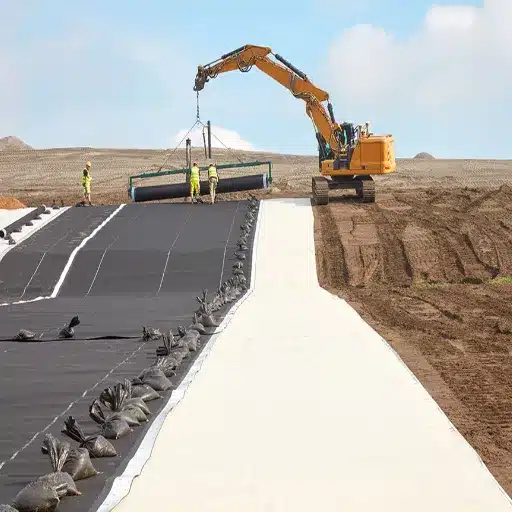
Landfill base liners and final covers
Landfills are the largest GCL market, taking 45 to 50% of global demand. Base liners use composite GM/GCL build-ups to meet regulatory flux limits under standards such as US EPA Subtitle D, the EU Landfill Directive, and Wisconsin’s NR 504.
Final covers use GCLs to cap closed cells, where desiccation risk is highest and cover thickness becomes a design variable rather than a detail. Mature markets have shifted from new construction toward closure and capping work, which has kept GCL demand steady even as landfill openings slow. The airspace argument matters commercially too, since every millimetre of liner thickness is volume that can’t hold waste. See our guide to GCL landfill liners.
Ponds, reservoirs, and canals
Water containment is the second major use: aquaculture ponds, irrigation reservoirs, decorative lakes, canals, and ditches. Pond work has its own detail requirements for overlap width and bead placement. Designers here are choosing between a bentonite blanket, a GCL, and an HDPE or LLDPE geomembrane, and the right answer usually depends on whether the site has natural clay, how steep the side slopes are, and whether the water is potable. Our article on GCL pond liners covers the decision.
Mining: heap leach pads and tailings
Mining is the fastest-growing GCL application at 7.01% CAGR, covering heap leach pads, tailings storage facilities, process ponds, and evaporation ponds. The technical challenge is chemistry. Acidic and high-salinity process solutions load the bentonite with divalent cations and can collapse its swelling capacity.
Mitigation usually means polymer-modified bentonite, dense-prehydrated GCL, reduced-loading mining grades, or a geomembrane-primary design with the GCL as a backup. Remote-site logistics and steep-slope shear demand on stacked lifts add further constraints. See GCL for mining.
Wastewater and secondary containment
Process ponds, leachate lagoons, and bunded storage areas use GCLs as a secondary barrier beneath a primary geomembrane, where the requirement is less about the primary flux limit and more about having a self-sealing backstop if the primary barrier is compromised.
Shanxi Shengxing supplies GCL alongside HDPE geomembranes and geotextiles for exactly these layered systems. If you’re specifying a composite build-up, our engineering team can review your chemistry and slope data before you commit.
GCL Limitations and Design Cautions
This section is the one most supplier pages leave out, and it’s the one that decides whether your GCL will still be performing in twenty years.
Cation exchange
Sodium bentonite depends on sodium ions sitting between the clay platelets, because sodium ions hydrate strongly and pull the layers apart. Calcium and magnesium ions hydrate far less. When they’re present in the surrounding liquid, they displace the sodium through cation exchange, the clay swells less, and the barrier weakens.
Divalent cations arrive from several sources: aggressive leachate, limestone drainage, and cover-soil seepage. Conversion takes one to three years in most field settings, with complete conversion observed after ten years in one study. On its own, ion exchange raises hydraulic conductivity by about half to one order of magnitude. That’s manageable if the design accounts for it.
Desiccation and wet-dry cycling
The bigger risk is drying. Under low confining stress, defined as less than about 15 kN/m² or less than 0.75 m of cover soil, a GCL can desiccate and crack.
In one field trial, the cracks that formed did not close again after repeated rewetting cycles, and the GCL’s permittivity ended up four to five orders of magnitude higher than the as-installed sodium product. A landfill cover with only about 0.5 m of soil reached 1.8 × 10⁻⁶ m/s after ten years. Kerry Rowe’s GCL research for the ISSMGE documents the same ion-exchange and diffusion behaviour.
The combination is what makes this dangerous. Cracking alone or ion exchange alone is survivable. Cracking on top of ion exchange isn’t, because the calcium form of the clay has already lost much of its capacity to re-swell and seal the cracks.
Self-sealing requires confinement
Calcium bentonite GCLs can still self-seal, but only with enough cover. Practical guidance points to more than 0.75 m, and preferably 1.0 m, of soil cover, which corresponds to about 15 to 20 kN/m² of confining stress. Below that threshold, self-sealing is unlikely and the cracking-plus-exchange failure mode dominates.
Other cautions
Internal shear strength on slopes is low unless the GCL is reinforced, which is why RNP products exist. Unhydrated bentonite isn’t a gas barrier, so gas migration control needs a separate design. Premature hydration, wind uplift, and construction traffic damage are all installation-phase risks that good practice manages through sequencing and cover discipline.
The design implication is simple. If the contained liquid is aggressive, or if the GCL will sit exposed or lightly covered, move the design toward polymer-modified bentonite, a dense-prehydrated product, or a geomembrane-primary system with the GCL as backup. Compatibility testing to ASTM D6766 tells you which side of that line your project is on.
GCL Cost and Total Project Economics
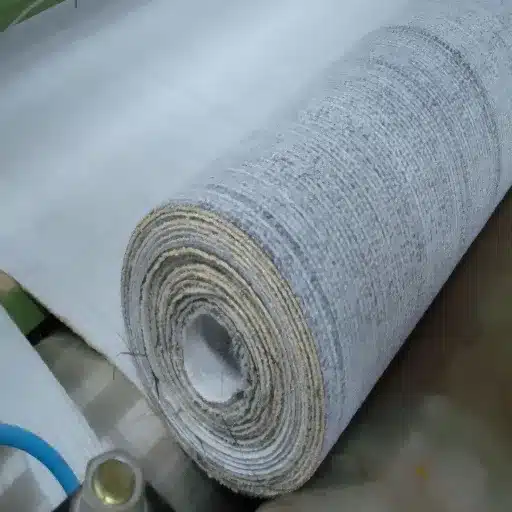
GCL pricing varies with bentonite loading, construction type, and reinforcement, so per-square-metre rates aren’t comparable without matching specifications. Bentonite mass per unit area is the main driver, typically 3.7 to 5.0 kg/m² for standard grades, with reduced-loading products for mining. Polymer modification, reinforcement, and geomembrane lamination each add cost.
As a working range, a GCL installed costs roughly USD 0.55 to 1.10 per square foot, or about USD 6 to 12 per square metre, including material and installation. A compacted clay liner runs USD 0.80 to 2.50 per square foot with on-site clay, rising to USD 2.00 to 6.00 per square foot when clay has to be imported.
The composite comparison is more telling than the material comparison. A 25-hectare municipal solid waste landfill case study priced the full system at USD 20.80/m² for HDPE plus GCL against USD 39.50/m² for HDPE plus 0.6 m of compacted clay, roughly 47% lower upfront. The GCL option also built in 12 weeks against 24 weeks for the clay alternative.
Beyond the initial cost, GCL preserves landfill airspace, which has revenue value over the life of the site. It also reduces the CQA and testing burden relative to compacted clay, where moisture and density testing runs per lift.
Our detailed GCL cost per square meter guide breaks down material versus installed cost and works through a full lifecycle comparison.
How to Choose the Right Geosynthetic Clay Liner
A GCL selection problem is really five questions in sequence. Work through them in order and the product choice usually makes itself.
- Characterise the contained liquid. Measure ionic strength, divalent cation concentration, pH, and hydrocarbon content. This single step eliminates more wrong specifications than any other.
- Identify the regulatory requirement. Find the permitted flux or conductivity your design must meet, because that sets the acceptance criteria you’ll specify.
- Establish hydraulic head and confining stress. Head drives the required flux, and anticipated cover thickness determines whether the clay will stay confined or desiccate.
- Assess slope angle and shear demand. Slopes above about 3:1 usually push the specification toward reinforced or granular-bentonite products.
- Confirm design life and wet-dry exposure. A capped cover with cycles of drying is a different problem from a permanently saturated base liner.
Then specify the product: bonding method, bentonite form, reinforcement, and lamination. Set the required bentonite mass per unit area and index flux to GRI-GCL-3. Decide whether the build-up is a single liner or a composite. Finally, fix the roll width, length, and core type against your site logistics.
Supplier qualification deserves its own step: GRI-GCL-3 conformance, batch-specific ASTM test reports, ISO 9001 certification, and retained samples. A supplier who can’t produce these is asking you to take performance on trust.
Our article on how to choose a GCL expands this into a full decision matrix with a supplier qualification checklist and the red flags worth screening out.
Sourcing GCL from a Global Supplier
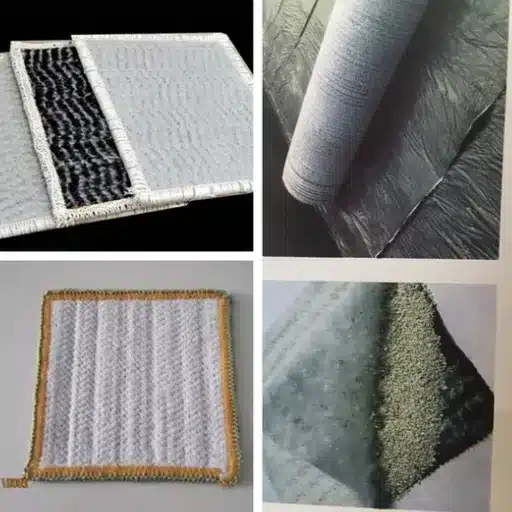
Roll configuration matters more than most buyers expect, because it drives both freight cost and installation efficiency. Standard widths are 2.5 m for agricultural and pond applications and 5 m for industrial projects, with lengths generally 30 to 40 m. Rolls over 30 m need a steel core to prevent telescoping.
You can review our geosynthetic clay liner product range for the current roll dimensions and bentonite loadings before you specify.
Documentation is the second consideration. A GCL order should arrive with four things:
- GRI-GCL-3 conformance evidence
- ASTM test reports for the specific production batch
- ISO 9001 quality system certification
- Retained samples for traceability
Shanxi Shengxing manufactures GCL and geotextile fabrics under documented quality control, with samples retained for traceability.
Third is logistics. Export packaging, container loading, and flexible minimum order quantities let you run a pilot or a mid-scale project without committing to a full container of a single specification.
If you’re working through a containment design and want a specification review before you issue a tender, talk to our engineering team. We’ll look at your chemistry, slope, and cover data and tell you which grade fits, including when the answer isn’t a GCL at all.
Frequently Asked Questions
What is a geosynthetic clay liner made of?
A geosynthetic clay liner is made of sodium bentonite clay, typically 3.7 to 5.0 kg/m², sandwiched between a woven carrier geotextile and a nonwoven cover geotextile. The layers are bonded by needle-punching, stitch-bonding, or adhesive. The geotextiles are polypropylene or polyester.
How thick is a geosynthetic clay liner?
The bentonite core measures about 4 to 6 mm. A complete dry GCL is 6 to 10 mm thick and expands to roughly 10 to 15 mm once hydrated and confined. That compares with 600 mm (0.6 m) for the compacted clay liner it typically replaces.
How long does a geosynthetic clay liner last?
German guidance requires a service life above 25 years, and manufacturers project 50 years using ISO TR 20432 modelling, since sodium bentonite is an inorganic mineral that doesn’t corrode or age. Real-world life depends on chemistry and cover thickness, and GCLs exposed to divalent cations or repeated drying can degrade far faster.
What is the difference between a GCL and a compacted clay liner?
A GCL is a factory-made 6 to 10 mm roll containing tested sodium bentonite. A compacted clay liner is 0.6 m of soil compacted on site to specified moisture and density. GCLs install faster with less haulage and testing, while compacted clay can win where suitable clay sits close to the site. See our full comparison of GCL against compacted clay.
Can GCL and geomembrane be used together?
Yes, and this is the highest-performing containment build-up available. A geomembrane laid in direct contact over a GCL reduces leakage to 0 to 4 L/ha/day, against 100 to 1,000 L/ha/day for the geomembrane alone. Direct contact between the two layers is essential; any interposed drainage layer defeats the mechanism.
Is GCL cheaper than geomembrane?
It depends on the specification rather than the material category. A geomembrane is usually cheaper per square metre as a material but requires welding, testing, and full seam quality control. In composite systems the two are used together, so the comparison becomes a design decision rather than a purchasing one.
How much does a geosynthetic clay liner cost per square meter?
Installed cost typically falls between USD 6 and 12/m², depending on bentonite loading, reinforcement, polymer modification, and lamination. Freight and roll logistics can shift the number significantly on export projects. Our installed GCL pricing breakdown covers the full range.
Conclusion
A geosynthetic clay liner is one of the few containment products that repairs itself, and that property is worth designing around properly.
Hydrated sodium bentonite delivers hydraulic conductivity below 10⁻⁹ cm/s and self-seals punctures to roughly 75 mm, but specification should be built on index flux and bentonite mass per unit area to GRI-GCL-3, not on a single permeability figure.
GCLs win on airspace, haulage, installation speed, and cost against compacted clay wherever local clay is scarce or distant. They lose to geomembrane on chemical inertness, which is why a composite build-up of geomembrane over GCL in direct contact is the strongest system available. The two failure modes worth designing against are divalent cation exchange and desiccation cracking, and both are predictable from the liquid chemistry and the cover thickness.
Get those decisions right, and a GCL will outperform its own datasheet. Get them wrong, and the material will be blamed for a design problem.
If you’re specifying a geosynthetic clay liner for a landfill, reservoir, or mining containment project, request a technical quotation and we’ll review your chemistry, slope, and cover data against the right grade before you tender.