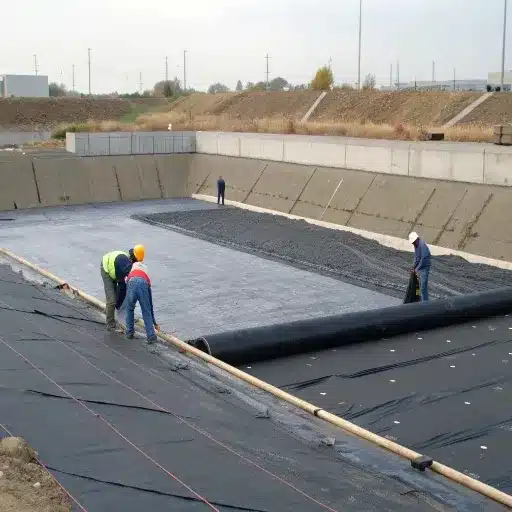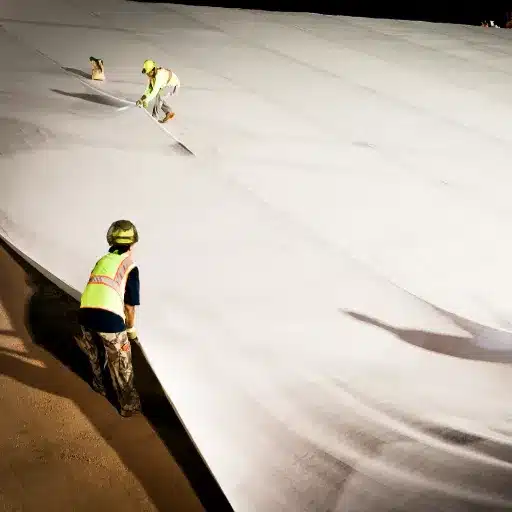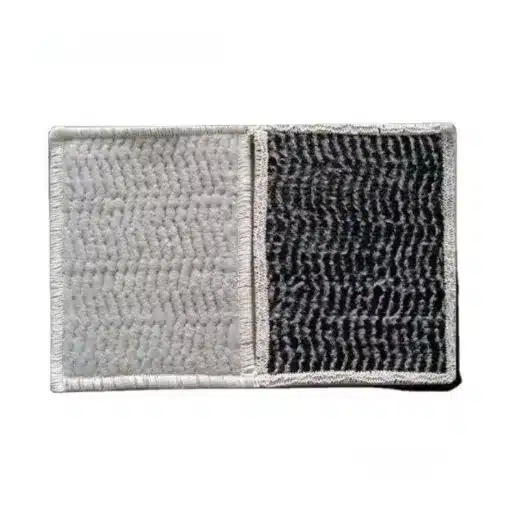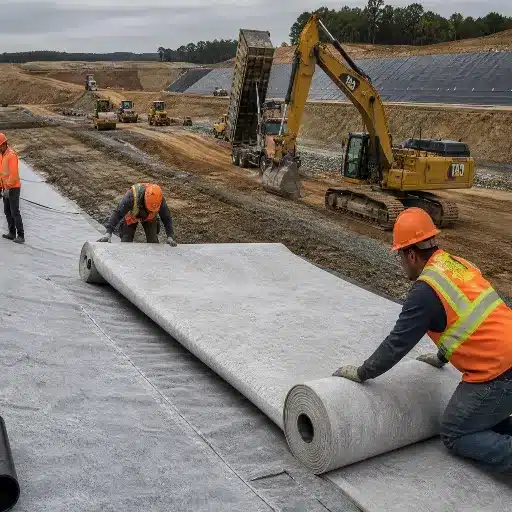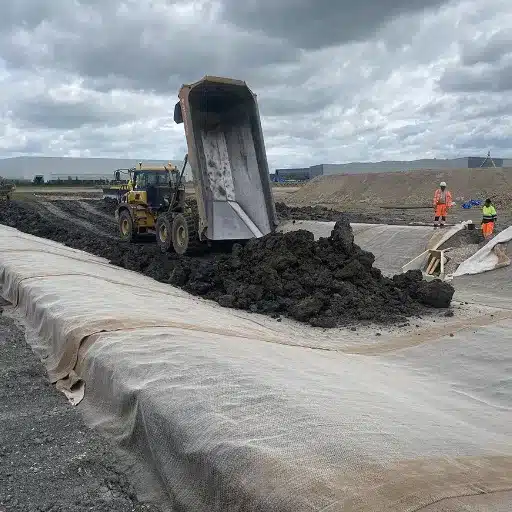
A GCL landfill liner is a factory-manufactured sheet of sodium bentonite held between two geotextiles that replaces the compacted clay component of a landfill barrier. It is used in two places: the base liner, where it sits beneath the waste under deep cover and a permanent leachate head, and the final cover, where it sits above the waste under less than a metre of soil and almost no load. Landfills take the largest share of global GCL demand, at roughly 38% of the market, according to Mordor Intelligence.
Those two positions put the same material under opposite physical conditions, and that is where most landfill liner mistakes begin.
A base liner works wet and confined. Water arrives from above, the waste mass compresses the bentonite, and the barrier gets stronger as the cell fills.
A final cover works dry and nearly unconfined. Water leaves, the bentonite shrinks, and the barrier gets weaker as the cap ages.
Treating “GCL in landfills” as one subject hides this split, and the split determines the regulation you must satisfy, the build-up you should specify, and the risks worth testing for.
This guide covers both. You will get the regulatory requirements for each position, the composite build-ups, published field evidence on how GCLs actually degrade in service, the conditions where sodium bentonite is the wrong choice, and cost figures in both metric and imperial units.
Key Takeaways
- A landfill base liner and a landfill final cover impose opposite conditions on a GCL. Base liners are confined and wet; covers are unconfined and dry. Specify and test for each separately.
- Subtitle D sets the base liner rule at 40 CFR 258.40(b) and the cover rule at 40 CFR 258.60. A GCL-based cap normally needs an alternative-cover equivalency demonstration under 258.60(b).
- Exhumed GCLs from four landfill covers showed swell index falling from the typical 24 mL/2g or higher to 6.9–11 mL/2g, with hydraulic conductivity varying over five orders of magnitude.
- Desiccation damage is partly permanent. Controlled drying and rewetting raised conductivity by 1.5 to 4 orders of magnitude even under 1 m of overburden.
- Installed GCL typically runs $5–8/m² in material plus $2–4/m² in installation, against $18–25/m² for imported compacted clay.
Not sure which liner build-up fits your cell? Review our geosynthetic clay liner (GCL) range →
What Is a GCL Landfill Liner?
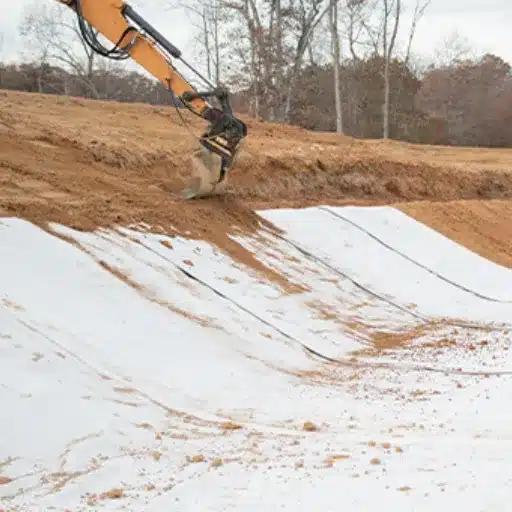
A GCL landfill liner is a geosynthetic clay liner used as the low-permeability mineral layer in a landfill containment system. Sodium bentonite, typically 3.7 to 5.0 kg/m², is bonded between geotextiles. Once hydrated and confined, it reaches a hydraulic conductivity below 1×10⁻⁹ cm/s (1×10⁻¹¹ m/s), letting a 7 to 15 mm sheet do the work of 600 mm of compacted clay.
Three roles are common in modern landfill design:
- Base liner clay component. The GCL replaces the two-foot compacted soil layer beneath the geomembrane in a Subtitle D composite liner.
- Secondary liner. In double-composite systems, a GCL forms part of the lower barrier beneath the leak detection layer.
- Final cover infiltration layer. The GCL replaces the compacted clay cap, most often directly beneath a geomembrane in direct contact.
A GCL is not a polymer membrane, so framing the choice as GCL versus HDPE geomembrane misses the point: in a composite liner the two work together. A GCL is a mineral barrier whose performance depends on two variables you cannot control at the factory, water content and pore-fluid chemistry. That distinction explains nearly every field failure discussed later in this article. Our complete geosynthetic clay liner guide covers the material science in more depth.
GCL Landfill Base Liners: Design and Composite Build-Up
The regulatory starting point for a GCL landfill liner in the base of a municipal solid waste cell is 40 CFR 258.40(b). It prescribes a composite liner: a flexible membrane liner of at least 30 mil (60 mil where HDPE is used) placed over at least two feet of compacted soil with a hydraulic conductivity no greater than 1×10⁻⁷ cm/s, which is 1×10⁻⁹ m/s. You can read the rule text directly.
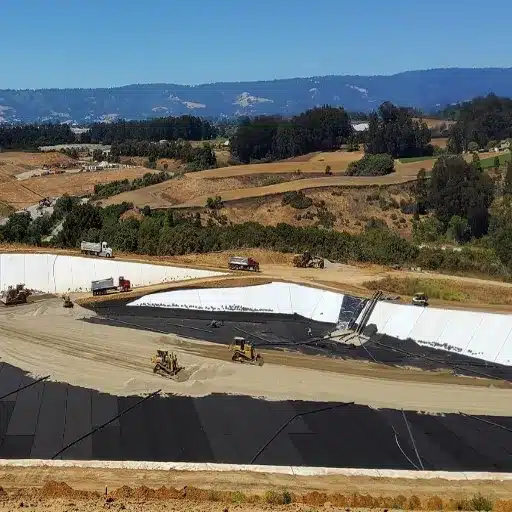
A GCL enters the design where that two-foot clay layer is expensive, unavailable, or steals airspace. A prepared subgrade is proof-rolled and compacted, the GCL is deployed and overlapped, the geomembrane is placed in direct contact with it, a protective geotextile follows, and the leachate collection and removal system sits above.
Thermal, drainage, and protective layers are drawn from the same submittals that govern the geomembrane placed above it, so the two specifications must be coordinated.
The contact requirement is not optional. A composite liner works because a hole in the geomembrane is overlain by a low-permeability mineral layer in intimate contact. Leakage spreads laterally at the interface rather than passing straight down, which raises the travel path and the breakthrough time. Where a drainage geonet or sand layer separates the geomembrane from the GCL, that mechanism weakens. The composite still performs, but not at the rates assumed in design.
Published leakage rates at a 0.3 m head make the point:
| Liner configuration | Leakage rate (L/ha/day) |
|---|---|
| Compacted clay liner, 0.6 m, k = 1×10⁻⁹ m/s | 1,300 |
| Standard GCL | 860 |
| Membrane-laminated GCL | 8.6 |
| Composite geomembrane over GCL | 0 to 4 |
Base liners have one structural advantage over covers: they hydrate. Waste placement delivers the confining stress that drives bentonite swelling and closes the manufacturing pore space. A well-built base liner tends to improve with time.
In 2024, a waste authority expanding a 12-hectare cell in Southeast Asia priced imported clay at roughly $24/m² placed, with a 22-week schedule. Switching the clay layer to a reinforced GCL with a 60-mil HDPE membrane above cut the liner package to about $15/m² and the schedule to 13 weeks. The saving came from freight, not from the sheet price.
GCL Landfill Liner Final Covers: A Different Set of Risks
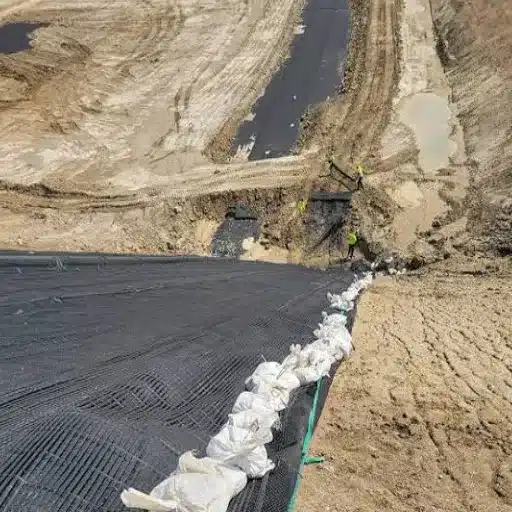
Final cover design answers to 40 CFR 258.60. The prescriptive cover requires an 18-inch earthen infiltration layer with a conductivity no greater than 1×10⁻⁵ cm/s, plus a 6-inch erosion layer. Section 258.60(b) allows an alternative cover that demonstrates equivalent infiltration reduction. That equivalency pathway is how GCL caps get approved, and it is where the EPA guidance matters most to your submittal.
Outside the United States, the EU Landfill Directive (Council Directive 1999/31/EC) sets a comparable framework. It requires a mineral barrier plus a low-permeability membrane for hazardous and non-hazardous cells.
A typical GCL cap, bottom to top: gas management layer, reinforced GCL, geomembrane of 40 mil or more in direct contact, drainage geocomposite, 600 to 800 mm of subsoil, and a vegetated erosion layer.
Wisconsin’s rule for GCL caps is unusually explicit and worth reading as a template. NR 504.07 allows a GCL to replace a 2-foot clay cap over a 2-foot soil barrier layer. It also requires:
- Geomembrane coverage the same day, in dry conditions
- Installation relaxed and free of tension
- 6-inch longitudinal overlaps and 20-inch panel-end overlaps
- 12-inch minimum patch overlaps
- Loose bentonite seals at 0.25 lb per linear foot
- Needle-free certification and traffic restrictions
A full procedure belongs with the GCL overlap and anchoring requirements.
Desiccation, not leakage, governs cap performance. Egloffstein’s field work on landfill capping found that sodium-to-calcium exchange develops over one to three years where the GCL contacts cover-soil seepage, with conductivity rising by roughly half an order to one order of magnitude. The more serious effect is physical. Below about 15 kN/m² of confining stress, which corresponds to less than 0.75 m of cover soil, GCLs develop desiccation cracks and permeability climbs sharply. Above that threshold, calcium bentonite GCLs can self-seal.
A closure crew coring a 1990s cap in a semi-arid region in 2021 found exactly this pattern. The GCL recovered from beneath 0.5 m of cover soil was dry, cracked, and no longer behaving as a sodium bentonite barrier. Two cells away, under 1.1 m of cover, the same product sampled intact. The variable was cover thickness.
Gas adds a second cover-specific risk. Dry bentonite is permeable to landfill gas. If the GCL never hydrates, it is not a barrier at all.
Base Liner vs Final Cover: Side-by-Side
| Design factor | GCL base liner | GCL final cover |
|---|---|---|
| Governing rule | 40 CFR 258.40(b) | 40 CFR 258.60, 258.60(b) |
| Primary function | Contain leachate | Limit infiltration |
| Confining stress | High, increases with waste depth | Low, set by cover soil thickness |
| Governing failure | Chemical incompatibility | Desiccation and ion exchange |
| Hydration state | Hydrates from above and below | May stay partly dry |
| Geomembrane contact | Required for composite benefit | Required, often same-day |
| Typical GCL | Standard or reinforced | Reinforced |
| Cover thickness | Waste mass | 0.6 to 0.8 m minimum practical |
| CQA focus | Seams, subgrade, damage | Same-day cover, hydration, traffic |
| Design life exposure | Saturated, reducing conditions | Wet-dry cycling, seasonal |
The single most useful insight on this page is in that table. The same product needs different specifications in each position, and the specification follows from which mechanism will govern failure. Confining stress and chemistry on the base; desiccation and cover thickness on the cap.
Designing both layers of the system? See how composite geomembrane and GCL liner design works in practice →
What Exhumed GCLs Reveal About GCL Landfill Liner Performance
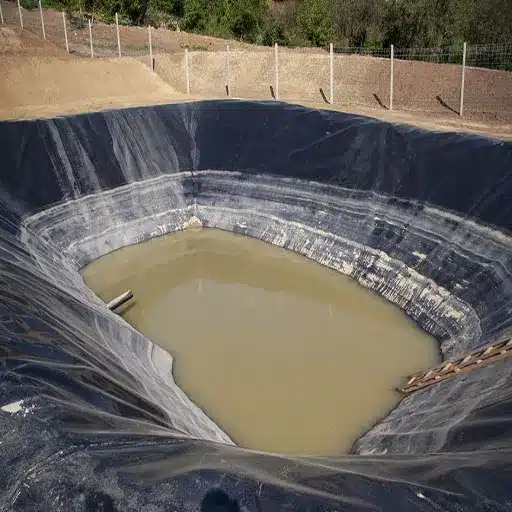
Laboratory values describe a new product. The landfill record describes an old one. The most quoted field study in this field, Meer and Benson’s 2007 analysis of GCLs exhumed from four landfill final covers, is uncomfortable reading for anyone selling or specifying GCLs. That is precisely why it is worth citing.
The findings:
- Cation exchange was pervasive. Calcium and magnesium had exchanged for sodium on the bentonite, with the source being the overlying and underlying cover soils.
- Swell index collapsed. Values fell from the typical 24 mL/2g or higher to 6.9–11 mL/2g, meaning the bentonite now behaved like a calcium bentonite rather than a sodium one.
- Conductivity tracked water content. Values spanned five orders of magnitude, running 10⁻⁸ to 10⁻⁶ m/s where sampled water content was below about 85%, against 10⁻¹⁰ to 10⁻⁹ m/s above about 100%.
- Desiccation damage was partly permanent. Controlled drying and rewetting raised conductivity by 1.5 to 4 orders of magnitude even under overburden simulating a 1 m cover, and the effect became permanent once water content dropped below roughly 100%.
- More soil did not fix it. A cover 750 to 1,000 mm thick, or a geomembrane overlain by soil, did not guarantee protection against ion exchange or large conductivity increases.
An independent lysimeter study corroborated the pattern, with field conductivity rising from 2.7–7.8×10⁻⁹ cm/s in the new GCL to 1.4×10⁻⁶–9.1×10⁻⁵ cm/s in service.
The engineering conclusion is not that GCLs fail. It is that a GCL is an effective advective barrier if its integrity is maintained, and the design task is protecting water content and chemistry rather than specifying a thickness. That is the argument for prehydration, adequate overburden, polymer-modified or dense-prehydrated bentonite, and natural sodium bentonite over sodium-activated calcium bentonite. The mechanisms are covered in more detail in our GCL hydraulic conductivity and testing standards reference.
When a GCL Is the Wrong Landfill Liner
Sodium bentonite is a mineral. Some leachates attack it directly, and no amount of quality control changes the chemistry.
Specify something else when:
- Leachate carries high divalent cations. Calcium, magnesium, or high ionic strength pore fluid exchange onto the bentonite and raise conductivity.
- The waste stream is mining-influenced or acid-generating. Acid rock drainage is aggressive to sodium bentonite.
- The site is arid and the cap will cycle wet and dry. Repeated shrinkage below the 0.75 m confining-stress threshold drives cracking.
- The cell generates high gas volumes and the GCL may stay dry. Unhydrated bentonite is permeable to gas.
- The subgrade is coarse, irregular, or settlement-prone. Puncture risk rises and contact quality falls.
- Slopes are steep enough that internal shear strength governs. Creep demand can exceed what an unreinforced product provides.
The alternatives are a geomembrane-primary design, a thicker compacted clay layer, a Subtitle C double composite, or a polymer-modified and dense-prehydrated GCL. A leachate compatible liner is one whose mineral barrier survives the pore fluid it will actually meet, and sodium bentonite is not always it. Aggressive leachate chemistry deserves its own analysis.
Working with a difficult leachate profile? Request a technical quote and we will match the bentonite grade to your chemistry →
GCL Landfill Liner Cost and Airspace Economics
Transparency first, caveats second. GCL material typically costs $5–8/m² with installation at $2–4/m², for an installed range of roughly $7–12/m² ($0.65–$1.10/sq ft). Imported compacted clay runs $18–25/m², against $5–10/m² for suitable on-site clay. Full pricing structure and lifecycle comparison live in the dedicated GCL cost per square meter guide.
A line-item view of a composite build-up for a 10-hectare cell shows where the money goes:
| Layer | Cost per m² |
|---|---|
| Subgrade preparation | $3.00 |
| 1.5 mm HDPE geomembrane | $7–8 |
| GCL, material plus installation | $7 |
| Protective geotextile | $2 |
| Drainage geonet | $3–4 |
| Welding | $5–6 |
| Third-party CQA | $1.50 |
| Electrical leak location survey | $0.50 |
| Total, excluding contingency | ~$26–31 |
Add 15% contingency and the package lands near $34.50/m². Against an imported-clay composite at about $45/m², that is a saving of roughly $1.05 million on a 10-hectare cell.
Two further data points show the spread. A 25-hectare municipal cell priced at $20.80/m² with HDPE over GCL against $39.50/m² with HDPE over compacted clay, with construction at 12 weeks versus 24. Madera County’s alternative liner analysis, which included a GCL, saved about $310,000 against the prescriptive liner and roughly $750,000 against a double composite.
Airspace is the second saving, and the mechanism is simple. Every millimetre of mineral layer you remove comes out of the waste prism cross-section, so each cell accepts more waste in the same footprint. Replacing a 600 mm clay layer with a 15 mm GCL frees volume that would otherwise be spent on barrier.
Freight compounds it. A single truckload of GCL replaces more than 150 truckloads of compacted clay. Volume terms typically improve 5 to 10% above 50,000 m² and 10 to 20% above 200,000 m².
Where good clay sits on site and tipping fees are low, a compacted clay layer can still be the cheaper choice. That is a legitimate outcome, not a failure of the analysis.
How to Specify a GCL for a Landfill Project
Run the decision in this order, because each step constrains the next:
- Characterise the contained waste and leachate. This decides whether sodium bentonite is viable at all.
- Confirm the regulatory pathway. Prescriptive base liner under 258.40(b), or an alternative-cover equivalency demonstration under 258.60(b).
- Set the slope geometry and shear demand. Reinforced GCLs held 57.34% of 2025 GCL revenue for a reason: needle-punch reinforcement is what mobilises internal shear strength on demanding slopes. Germany’s BQS 5-5 standard introduces shear-creep testing at 80 °C as the emerging benchmark.
- Check the confining stress and cover thickness. Keep cover soil above the 0.75 m threshold wherever the GCL may dry.
- Plan hydration and CQA. Same-day geomembrane coverage, traffic control, and a documented hydration strategy.
- Qualify the supplier. Ask for GRI-GCL-3 conformance and test reports covering the properties that matter in landfill service: ASTM D5887 (index flux), D5890 (swell index), D5891 (fluid loss), D5993 (bentonite mass per unit area), D6243 (internal and interface shear strength), and D6766 (chemical compatibility). Add ISO 9001 quality management and retained samples.
Frequently Asked Questions
Does a GCL meet Subtitle D liner requirements?
Yes, for the base liner, when it performs as the compacted soil component of a composite liner under 40 CFR 258.40(b). For final covers, a GCL normally requires an alternative-cover equivalency demonstration under 258.60(b) showing equivalent infiltration reduction.
How thick should a GCL be for a landfill base liner?
A GCL is specified by bentonite mass per unit area, not thickness. Landfill grades typically run 3.7 to 5.0 kg/m² per ASTM D5993, which gives a dry sheet of roughly 7 to 15 mm. Thickness is an outcome, not a design input.
Why do GCLs fail in landfill final covers?
Two mechanisms dominate: divalent cation exchange that collapses the bentonite swell capacity, and desiccation cracking where confining stress falls below about 15 kN/m². Both are aggravated by thin cover soil.
How much airspace does a GCL save in a landfill?
It depends on the clay layer it replaces. A 600 mm compacted clay layer substituted by a 15 mm GCL removes roughly 585 mm of mineral thickness from the waste prism cross-section, so each cell accepts more waste in the same footprint.
Can a GCL replace the compacted clay layer in a landfill liner?
Yes, where the chemistry suits sodium bentonite and the design provides adequate confining stress. It is the wrong choice beneath high-divalent-cation or acid-generating leachate. Compare it against the traditional barrier with a GCL versus compacted clay liner analysis.
Conclusion
A GCL landfill liner is not one product applied to one problem. It is the same bentonite sheet used in two positions that break it in different ways.
The base liner is confined, saturated, and limited by chemistry. The final cover is unconfined, cyclic, and limited by desiccation and cover thickness. Get that split right and the rest of the specification follows: the regulatory pathway, the overlap detail, the reinforcement choice, and the CQA plan.
The published field evidence is clear on one thing. Water content and pore-fluid chemistry decide whether a GCL keeps working, not the thickness you ordered. Design for those two variables and a GCL will outperform a metre of compacted clay at a fraction of the footprint and the cost. Ignore them and the cap will dry out, exchange its sodium, and stop being a barrier.
Ready to specify? Request a technical quote or contact engineering support, and we will match the bentonite grade, reinforcement, and roll configuration to your cell geometry and leachate profile. Our team supports international landfill and containment projects with ISO 9001 quality documentation and flexible order quantities.