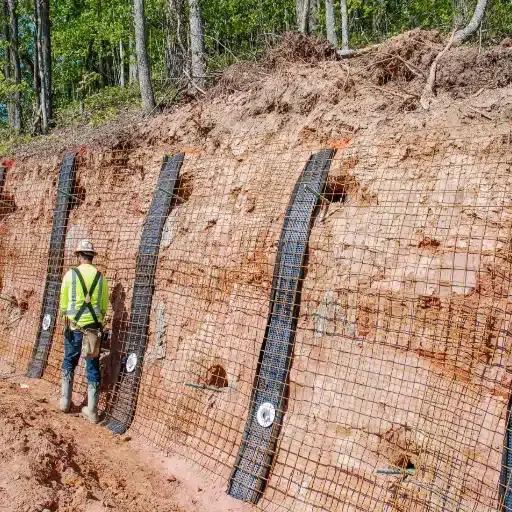
Comparing a GCL vs a compacted clay liner comes down to one structural difference: a GCL delivers its barrier in 6 to 12 mm of factory-made bentonite, while a compacted clay liner needs roughly 600 mm of engineered, compacted soil. That single difference drives everything else, including hydraulic conductivity, installation labor, construction schedule, airspace value, and total installed cost. Which one wins depends on where your clay comes from, what your site’s climate does to it, and how much void space you are willing to give away.
For decades, the compacted clay liner (CCL) was the default containment barrier in landfills, ponds, and industrial impoundments. Then geosynthetic clay liners arrived and changed the arithmetic. A GCL of 6 to 12 mm can be specified to replace about 2 ft (0.6 m) of compacted clay, and it arrives on a roll instead of in a borrow pit.
Yet the decision isn’t automatic. A 2021 Wisconsin DNR study found that a standard 4 ft on-site clay liner at $143,118 per acre was still cheaper than a GCL substitution at $252,487 per acre. Where good clay sits close to the site, the traditional material can win outright. This guide works through the numbers on both sides, so you can specify with evidence instead of assumption.
Key Takeaways
- A GCL reaches design hydraulic conductivity of about 1 × 10⁻⁹ cm/s at 7 mm, while an EPA-compliant CCL must achieve ≤ 1 × 10⁻⁷ cm/s through 0.6 m of compacted soil (40 CFR 258.40(b)).
- Installed cost runs $0.55 to $1.10 per sq ft (~$5.90 to $11.80/m²) for a GCL versus $0.80 to $2.50 per sq ft (~$8.60 to $26.90/m²) for on-site clay and $2.00 to $6.00 per sq ft (~$21.50 to $64.60/m²) for imported clay.
- Both barriers degrade. Compacted clay cracks under desiccation and freeze-thaw, with field conductivity rising by up to three orders of magnitude. A GCL loses performance to divalent cation exchange and drying.
- A GCL cuts installation labor dramatically: roughly 2.4× fewer man-hours per 10,000 m² and 3 to 4 workers per shift instead of 8 across three trades.
- Where good clay is local and cheap, a compacted clay liner can still be the lowest-cost option. The selection is site-specific, not categorical.
What Is the Difference Between a GCL and a Compacted Clay Liner?
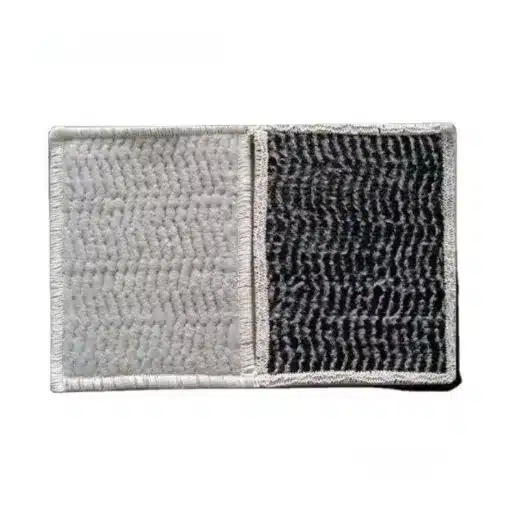
A compacted clay liner is a layer of engineered soil, placed in lifts and compacted to a target moisture and density, where the soil mass itself forms the barrier. A geosynthetic clay liner is a factory-manufactured roll of sodium bentonite, typically 3.7 to 5.0 kg/m², encapsulated between geotextiles, where hydrated bentonite forms the barrier.
The two approaches reach low permeability by different routes. A CCL depends on mechanical compaction to eliminate connected voids. A GCL depends on the chemistry of sodium montmorillonite, which absorbs water into its interlayer structure and swells roughly 10 to 16 times its dry volume. That swelling is what closes the pore network, and it’s also why the GCL can self-seal small punctures that would permanently compromise a soil barrier.
For a full treatment of the material itself, including bonding methods and bentonite grades, see our complete geosynthetic clay liner guide.
| Dimension | Geosynthetic Clay Liner (GCL) | Compacted Clay Liner (CCL) |
|---|---|---|
| Barrier material | Sodium bentonite between geotextiles | Engineered low-permeability soil |
| Installed thickness | 6 to 12 mm dry; ~10 to 15 mm hydrated | 0.6 m (2 ft) typical for Subtitle D |
| Design hydraulic conductivity | ~1 × 10⁻⁹ cm/s (1 × 10⁻¹¹ m/s) | ≤ 1 × 10⁻⁷ cm/s (1 × 10⁻⁹ m/s) |
| Barrier mechanism | Bentonite hydration and swelling | Mechanical compaction of soil |
| Self-healing | Yes, seals minor punctures | None |
| Puncture resistance | Low, thin profile | High, soil mass |
| Desiccation resistance | Moderate; vulnerable under low confining stress | Low; cracks under wet-dry cycling |
| Freeze-thaw resistance | High; little measurable change | Low; conductivity can rise over 1,000× |
| Installation labor | 3 to 4 workers per shift | 8 workers per shift across 3 trades |
| QA intensity | Factory-controlled plus seam checks | Per-lift density and moisture testing |
| Weather sensitivity | Low, covers quickly | High, moisture window dependent |
| Best fit | Restricted sites, imported clay, tight schedules | Local quality clay, aggressive leachate, arid sites |
Hydraulic Conductivity: GCL vs Compacted Clay Liner
Hydraulic conductivity (k) is the number that decides most GCL vs CCL arguments. It describes how quickly water moves through a saturated barrier, and lower is better. Compacted clay liner hydraulic conductivity and GCL hydraulic conductivity operate at different orders of magnitude, but the gap narrows once field conditions are accounted for.
The regulatory baseline
Under 40 CFR 258.40(b), an EPA Subtitle D composite liner requires at least a 30-mil flexible membrane liner, or 60-mil if HDPE is used, over a lower component of at least 2 ft of compacted soil with a hydraulic conductivity no greater than 1 × 10⁻⁷ cm/s. That is equivalent to 1 × 10⁻⁹ m/s. Every CCL design starts from that threshold, and demonstrating it across a large area is where the cost and schedule pressure begins.
Design conductivity values
EPA design values put a GCL at roughly 1 × 10⁻⁹ cm/s at about 7 mm thickness against a CCL at 1 × 10⁻⁷ cm/s at 0.6 m. For a 1 ft head, the computed flux ratio of GCL to CCL works out to about 0.3, meaning the GCL allows less percolation than the thicker soil barrier. GRI-GCL-3 caps GCL permeability at 5 × 10⁻⁹ cm/s and index flux at 1 × 10⁻⁸ m³/m²/s.
Leakage rates at a 0.3 m head
Design conductivity isn’t the same as leakage, because leakage also depends on defects. Measured against a 0.3 m head, ABG Geosynthetics reports:
- Compacted clay liner (k = 1 × 10⁻⁹ m/s, 0.6 m thick): 1,300 lphd
- Standard GCL: 860 lphd
- Membrane-laminated GCL: 8.6 lphd
- Composite geomembrane over GCL: 0 to 4 lphd
The last line matters. Neither clay barrier alone approaches the performance of a composite system, which is why the “which is better” question often resolves to “use both.” Our geomembrane vs GCL comparison works through the polymer side of that argument in detail.
Where the numbers break down
Laboratory conductivity describes an intact specimen. Field performance describes a barrier that has been rained on, dried out, frozen, and walked across. Those are different numbers.
Compacted clay is the more fragile of the two in this respect. Albrecht and Benson (2001, Journal of Geotechnical and Geoenvironmental Engineering) subjected eight liner soils to wetting and drying cycles and found that cracking increased hydraulic conductivity by up to three orders of magnitude. A later field study of a compacted clay final cover in southern Georgia documented in-situ conductivity rising from about 1 × 10⁻⁷ to 1 × 10⁻⁴ cm/s over four years, with dye tracing revealing cracks and root channels through the full barrier thickness. Freeze-thaw is similarly punishing: CRREL research found compacted natural clay conductivity increasing by more than 1,000× after cycling, while GCLs showed little measurable change.
A GCL has its own vulnerabilities, and they are chemical rather than mechanical. Sodium bentonite depends on sodium ions occupying its interlayer space. When the pore fluid carries divalent cations such as calcium or magnesium, those ions displace the sodium, the clay swells less, and conductivity can rise by one to three orders of magnitude. Arid conditions and low confining stress create a second risk: if the bentonite dries out, it loses its hydraulic function and becomes highly permeable to gas.
The test methods that settle the argument
Specifying conductivity without naming the test method invites disputes at handover. The standards that matter here are:
- ASTM D5084 and ASTM D5856 for saturated hydraulic conductivity of soils
- ASTM D5887 for index flux through hydrated GCL specimens
- ASTM D6766 for GCL performance when permeated with chemically incompatible liquids
- ASTM D5890 (swell index), ASTM D5891 (fluid loss), and ASTM D5993 (bentonite mass per unit area)
- ASTM D6243 for internal and interface shear strength
- ASTM D698 and ASTM D1557 for Proctor compaction of the clay liner
- GRI-GCL-3 for GCL acceptance criteria
Thickness, Footprint, and the Airspace Argument
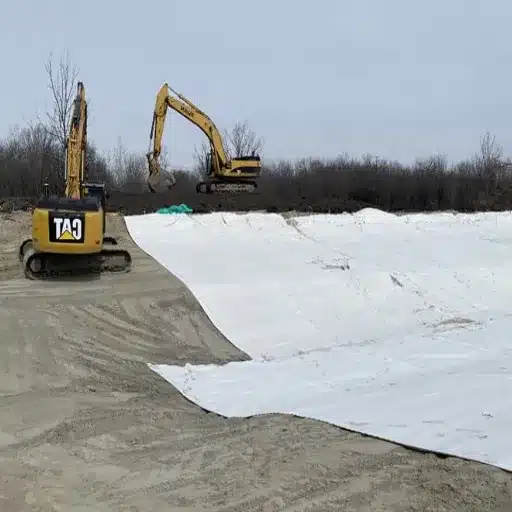
Thickness is where a GCL vs compacted clay liner comparison becomes a commercial argument rather than a technical one. Geosynthetic clay liner thickness runs roughly 10 to 15 mm hydrated, while a Subtitle D CCL occupies 0.6 m. That is a difference of about 40 to 60×, and in a landfill it converts directly into void space that can hold waste.
Those clay liner airspace savings compound. A 24-inch CCL consumes around 3.7 cubic yards of compacted clay per 100 sq ft, all of which must be sourced, hauled, placed, moisture-conditioned, and tested. EPA and CRREL analysis estimated that eliminating the frost-protection layer and the compacted clay layer frees airspace value exceeding $200,000 per acre, or roughly $494,000 per hectare, representing 3 to 16% of a disposal site’s fixed costs.
Consider how this plays out on a constrained site. A project engineer in a densely populated region priced a 4 ft on-site clay liner and found the haul route crossed a residential corridor, adding truck movements and permit conditions that pushed the schedule out by two months. Re-specifying as a GCL over a thinner soil foundation cut the imported fill volume enough to keep the haul traffic inside the original permit envelope. The barrier cost was similar; the schedule and the civic risk were not.
Where this advantage evaporates is where land is cheap and space is abundant. An open quarry site with low tipping fees and no airspace constraint has little reason to pay for thinness.
Installation: Compaction vs Roll-Out
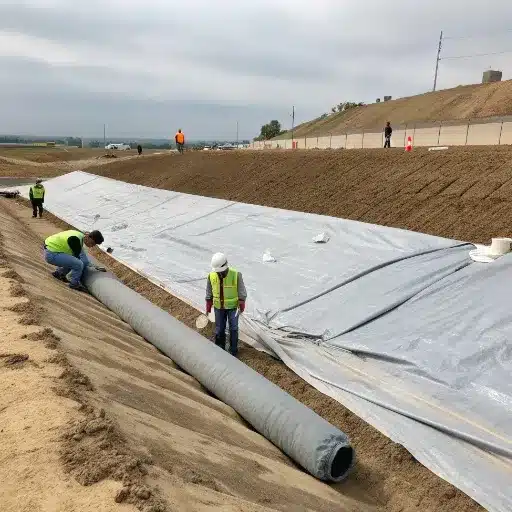
The installation contrast is where the two systems diverge most sharply, and where project schedules are won or lost.
Compacted clay liner
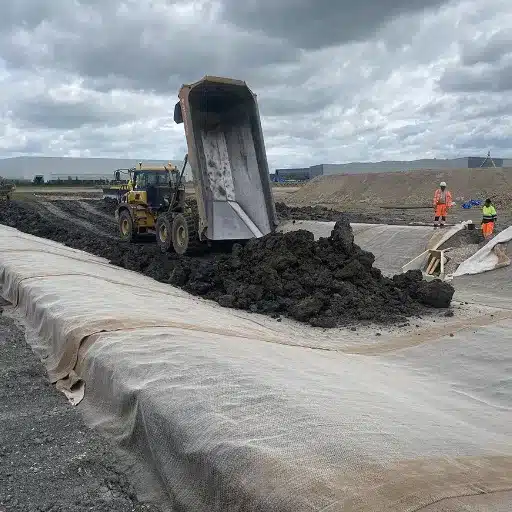
A CCL is built from the ground up. The subgrade is graded and leveled, the clay is moisture-conditioned to within about ±2% of optimum moisture content, and the material is compacted in roughly four lifts of about 150 mm. A deviation of even 2 to 3% from optimum moisture can raise conductivity by an order of magnitude, which is why moisture control dominates the field inspection program.
Material quality is equally unforgiving. A plasticity index of at least 12 is typically required, gravel content must stay at or below 5%, and particles larger than 19 mm are screened out. Every lift is density-tested. A single underspecification can force rework across an entire panel, and rework of compacted clay means excavating, reconditioning, and recompacting.
Geosynthetic clay liner
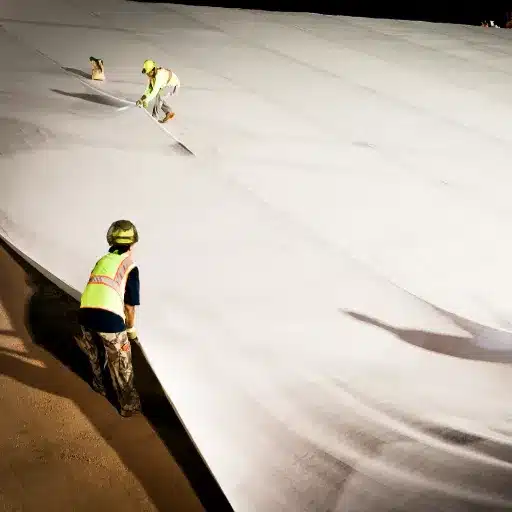
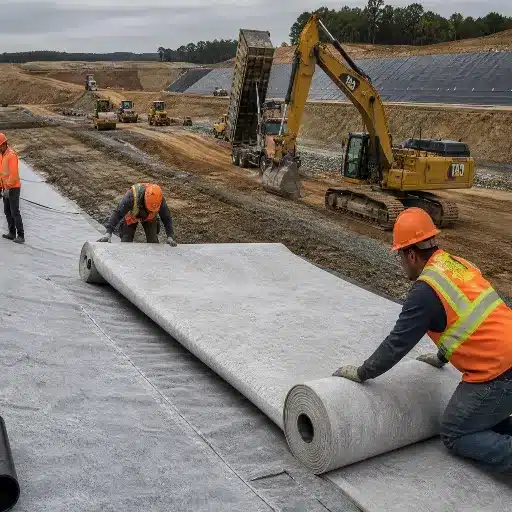
A GCL is unrolled, overlapped, and covered. The subgrade must be proof-rolled and smooth, free of protrusions, rutting, standing water, and oversize particles. Panels are laid with a minimum 0.3 m overlap, and 0.5 kg/m² of supplemental bentonite is applied along the seams. Spray-curing brings the material to roughly 80% of peak hydration within 24 hours, after which a cover layer protects it.
The critical control during GCL installation is preventing premature hydration before the panels are loaded. A GCL that swells too early, before it is confined, can wrinkle and lose contact with the layer above.
Labor, schedule, and weather
The labor difference is substantial. A 10,000 m² seepage barrier takes roughly 2.4 times the man-hours to build in compacted clay as in GCL. A CCL crew typically runs about eight people per shift across three trades, while a GCL crew runs three to four. Compaction equipment time is six to nine times longer for the clay option.
Schedules follow the same pattern. In one 25 ha municipal solid waste comparison, an HDPE+GCL system was built in 12 weeks against 24 weeks for HDPE+CCL.
Weather compounds it. Compacted clay needs a moisture window, so rain delays placement and drying delays compaction. A GCL covers quickly and tolerates a wider range of conditions, though it shouldn’t be installed during precipitation.
Ready to shorten your liner schedule? Request a technical quote for GCL supply and roll configuration →
Cost Comparison: Installed Cost and Life-Cycle Economics
This is where the GCL vs compacted clay liner decision usually gets settled, and where most published comparisons go quiet. The honest answer is that compacted clay liner cost and GCL cost are close on material alone, and the divergence comes from logistics and schedule.
Material and installed cost
| Cost Component | GCL | Compacted Clay Liner |
|---|---|---|
| Material | $0.40 to $0.80 per sq ft | Clay borrow: 8to8to20 per cubic yard |
| Installation | $0.15 to $0.30 per sq ft | Placement, compaction, testing: $8.50/m² |
| Total installed, on-site clay | $0.55 to $1.10/sq ft (~$5.90 to $11.80/m²) | $0.80 to $2.50/sq ft (~$8.60 to $26.90/m²) |
| Total installed, imported clay | Same as above | $2.00 to $6.00/sq ft (~$21.50 to $64.60/m²) |
A GCL’s installed cost is largely fixed by the product and the crew. A CCL’s cost is dominated by where the clay comes from. That distinction is why two projects with identical designs can produce opposite cost conclusions.
Case study: 25 ha municipal solid waste cell
In a published 2024 comparison, an HDPE+GCL system came in at $20.80/m² installed, made up of GCL supply at $4.20/m² plus installation at $1.80/m². The HDPE+CCL alternative came in at $39.50/m², driven by clay borrow at $16.20/m² plus placement, compaction, and testing at $8.50/m². The GCL option was 47% cheaper upfront and finished in half the time. Notably, a clay-only design at $10 to $15/m² was priced but failed the Subtitle D composite requirement, so it was never a compliant option.
Life-cycle cost
Upfront cost is only part of the picture, because the two barriers age differently. An IFAI benefit-cost analysis found the probability that the discounted life-cycle cost of a CCL exceeds that of a GM/GCL composite liner to be 82%. Under Benson (2007) deterioration assumptions, with field clay conductivity degrading to 1 × 10⁻⁷ cm/s, that probability rose to 100%.
The result flips when the clay is assumed to stay ideal at 1 × 10⁻⁹ cm/s, in which case the same analysis favored the CCL in 94% of cases. So the conclusion isn’t that one material is cheaper. It’s that the answer depends on how much you trust the clay to hold its conductivity over the design life.
The honest counter-case
Any supplier can present a comparison that favors their product. The more useful exercise is to find the scenario where the traditional material wins.
The Wisconsin DNR’s 2021 Alternate Liner Study priced a one-acre bottom liner four ways. A standard 4 ft on-site clay liner came in at $143,118 per acre, the lowest of the four.
The other three options cost more. A dual composite liner reached $217,510, a GCL substituting for 2 ft of clay reached $252,487, and offsite clay came last at $356,724.
Read those numbers carefully, because they define the boundary of the GCL argument. Where suitable clay is available on site, close to the work face, and cheap to move, a compacted clay liner can beat a GCL on pure installed cost. A GCL becomes compelling when the clay has to travel, when the schedule is compressed, when airspace is valuable, or when freeze-thaw exposure makes the clay’s long-term conductivity unreliable. See our GCL cost per square meter analysis for the full pricing breakdown.
GCL vs Compacted Clay Liner: How to Choose
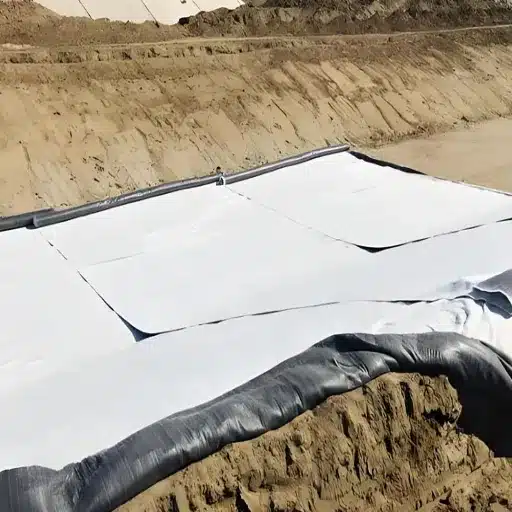
With the numbers established, the GCL vs CCL selection reduces to a set of site conditions. Work through these in order.
When a GCL wins
- Clay must be imported, or hauled more than a short distance from the borrow pit
- Void space carries real value, as in a landfill approaching capacity
- The construction schedule is compressed and the weather window is uncertain
- Design temperatures include freeze-thaw cycling
- Consistent factory quality control matters more than low material unit price
- The contained liquid is benign to sodium bentonite
When a compacted clay liner wins
- Suitable clay is available on or near the site at low cost
- The contained liquid is high in calcium or magnesium, or is otherwise aggressive to bentonite
- Puncture risk is elevated from coarse subgrade or heavy construction traffic
- The site is arid, creating desiccation and gas permeability risk for a GCL
- Chemical attenuation capacity is part of the design intent, not just hydraulic isolation
When a composite wins
Where regulatory flux limits are tight and neither barrier alone meets them, a composite geomembrane over GCL is the highest-performing option, with measured leakage of 0 to 4 lphd. That build-up relies on direct geomembrane-to-clay contact, with no drainage layer interposed between the two barriers. Our composite geomembrane and GCL liner systems guide covers the design requirements, including wrinkle management and interface friction on slopes.
Limitations to weigh
GCL: divalent cation exchange, desiccation under low confining stress, gas permeability when unhydrated, low puncture resistance, and limited internal shear strength on steep slopes.
Compacted clay liner: desiccation and freeze-thaw cracking, root intrusion, clay sourcing and haul risk, clod size and moisture control defects, and a footprint that consumes significant airspace.
One final caveat deserves emphasis. Equivalency between a GCL and a compacted clay liner can’t be reduced to a single hydraulic conductivity value. Long-term leachate migration through low-permeability barriers is governed by diffusion, so two barriers can be equivalent on breakthrough time while differing on diffusive flux or cumulative mass transfer.
Koerner and Daniel’s methodology for assessing GCL and CCL equivalency makes the same point: equivalency is project-specific and must be demonstrated, not assumed. For a structured walkthrough, see how to choose the right GCL.
Frequently Asked Questions
Can a GCL replace a compacted clay liner?
Yes, in many applications, provided the site conditions suit it. A GCL of 6 to 12 mm is commonly specified to replace about 0.6 m of compacted clay, and regulators such as the EPA allow it where equivalent performance is demonstrated. It is a poor substitute where leachate is rich in divalent cations, where puncture risk is high, or where the site is arid.
How thick does a compacted clay liner need to be?
Under 40 CFR 258.40(b), an EPA Subtitle D composite liner requires at least 2 ft (0.6 m) of compacted soil achieving a hydraulic conductivity no greater than 1 × 10⁻⁷ cm/s. That is equivalent to 1 × 10⁻⁹ m/s. Some jurisdictions and site-specific approvals allow different thicknesses.
Is a GCL cheaper than a compacted clay liner?
Often, but not always. Installed GCL cost runs about $0.55 to $1.10 per sq ft, while a compacted clay liner runs $0.80 to $2.50 per sq ft with on-site clay and $2.00 to $6.00 per sq ft with imported clay. Where good clay is local and cheap, the Wisconsin DNR found on-site clay cheaper than a GCL substitution.
Does a GCL meet Subtitle D liner requirements?
A GCL can’t serve as the sole component of a Subtitle D composite liner in place of the flexible membrane liner, but it can replace the compacted soil component where equivalency is demonstrated. Many approved alternative designs use a 60-mil HDPE geomembrane over a GCL with conductivity at or below 5 × 10⁻⁹ cm/s.
Which lasts longer, a GCL or a compacted clay liner?
Both are normally designed for 25 years or more, and both can degrade faster under adverse conditions. A compacted clay liner is most vulnerable to desiccation cracking, freeze-thaw cycling, and root intrusion. A GCL is most vulnerable to cation exchange and drying under low confining stress. Design life depends far more on site conditions and installation quality than on material choice.
Conclusion
The GCL vs compacted clay liner question has a clear answer once you stop looking for a universal winner. A GCL wins on thickness, airspace, installation speed, labor, and quality consistency. A compacted clay liner wins on on-site economics, puncture tolerance, chemical attenuation, and performance in arid conditions. A composite of geomembrane over GCL wins on containment, with measured leakage an order of magnitude below either barrier alone.
Three numbers are worth carrying into your next specification meeting. A GCL delivers design conductivity near 1 × 10⁻⁹ cm/s in about 7 mm, against a regulatory CCL requirement of 1 × 10⁻⁷ cm/s through 0.6 m. A GCL installs in roughly 2.4× fewer man-hours. And on-site clay can still beat a GCL when haul distances are short, so verify your clay source before you commit to either option.
If your site has imported clay, a compressed schedule, or a capacity constraint, a GCL is worth pricing alongside the conventional design. Review our geosynthetic clay liner product range for roll widths and bentonite loadings, then send us your liner area, contained liquid chemistry, and site conditions, and we will return a comparison you can take to your engineer.