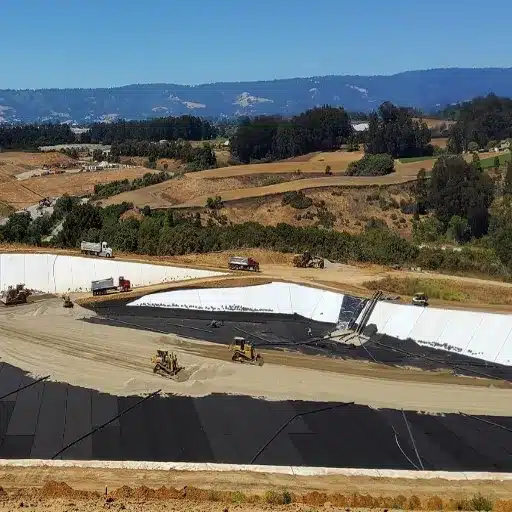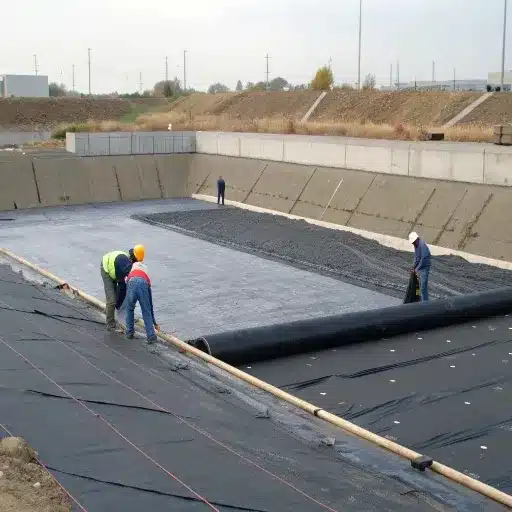
Yes, you should put geotextile under a concrete slab when the subgrade is soft, clayey, or poorly drained: use woven geotextile for load-bearing separation and nonwoven geotextile for drainage and vapor-barrier protection. On a well-compacted, well-drained granular subgrade, the fabric is optional but still worth treating as low-cost insurance against settlement and moisture problems.
The advice you will find online is genuinely contradictory. Building-science editors say the fabric is unnecessary under a properly compacted slab. Experienced builders call it cheap insurance and install it on every pour. If you’re planning a driveway, patio, garage floor, or foundation, that disagreement is confusing, and choosing wrong can cost far more than the fabric itself.
Here’s what this guide covers: what geotextile actually does under a slab, which type belongs where, when you can skip it, and how to install it so it works for decades. By the end you’ll know exactly what to specify, and you’ll be able to explain the difference to your contractor with confidence.
Key Takeaways
- Woven geotextile goes under a slab for separation and load distribution: it keeps the aggregate base from sinking into soft or clay subgrade and bridges weak spots and voids.
- Nonwoven geotextile handles moisture: it drains water, filters fines, and protects vapor barriers from punctures on rough subgrades.
- Geotextile is not a vapor barrier. It lets water through. For a poured concrete slab you may need both: fabric below the base, a damp-proof membrane above it.
- Skip the fabric is risky, not impossible. On well-compacted, well-drained granular ground it is optional, but on clay, expansive soil, or a high water table it’s close to essential.
- The strongest woven fabrics rated for subgrade separation deliver 200+ lb grab tensile strength; heavy applications call for AASHTO M288 Class 1 survivability.
What Does Geotextile Do Under a Concrete Slab?
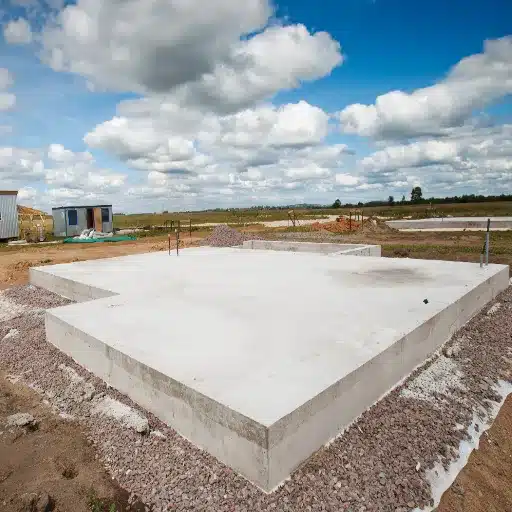
A geotextile under a concrete slab is a synthetic fabric that performs up to five distinct jobs. Each job matters for a different reason, and the right fabric type depends on which job you need it to do.
Separation: Stop the Base Sinking into the Subgrade
This is the most common reason contractors install geotextile under a slab. Without a separation layer, a compacted crushed-stone base gradually migrates down into soft or clay soil. Over a few years, the stone and the soil mix, the base loses thickness, and the slab settles unevenly. A woven geotextile laid between the subgrade and the aggregate keeps the two materials apart so the base keeps its designed thickness. This is the classic separation function, and it is what most driveway and garage-floor fabric is doing.
Filtration: Keep Fines Out of the Aggregate
Geotextiles also filter. Water moving through a slab system can carry fine soil particles up into the aggregate base, a process engineers call pumping. Over time, the fines clog the drainage paths, and the base becomes a slurry. A filtration geotextile lets water pass while trapping the fines, keeping the aggregate open and free-draining. The correct fabric has an apparent opening size (AOS) matched to the soil, generally smaller than the soil’s D85 particle size.
Reinforcement: Bridge Weak Spots and Voids
On a subgrade with soft pockets, old fill, or voids, a woven geotextile spreads the slab load across a wider area. Think of it as a hammock under the aggregate: it bridges the weak zone so the slab does not crack over it. This is a real engineering benefit, not marketing language. Woven fabrics with high grab tensile strength and low elongation are the ones that carry this job, because they hold their shape under weight.
Drainage: Let Water Escape
A nonwoven geotextile is highly permeable, so it can act as a drainage or capillary-break layer under a slab. On a site with a high water table or poor drainage, hydrostatic pressure can push water up against the concrete and cause cracking, rising damp, or floor coating failures. A drainage geotextile or geocomposite gives water a path to escape sideways to an edge drain, relieving that pressure. This function is separate from, and compatible with, a vapor barrier placed higher in the stack.
Protection: Cushion the Vapor Barrier from Punctures
Where a vapor barrier sits directly on angular crushed stone, sharp aggregate can puncture the membrane during the pour. Builders routinely place a nonwoven geotextile beneath or above the vapor barrier as a cushioning layer. Some high-end vapor barriers ship with a nonwoven geotextile face laminated on, precisely so the concrete interlocks with the fabric and the membrane stays in contact with the slab. That mechanical bond prevents “pocketing,” where the barrier separates from the concrete and lets condensation pool under the floor.
Woven vs Nonwoven Geotextile Under Concrete Slabs
The two fabric families are built differently and solve different problems, so the choice under a slab depends on your primary concern: load or water.
| Property | Woven Geotextile | Nonwoven Geotextile |
|---|---|---|
| Manufacturing | Flat yarns interlaced on a loom | Random fibers needle-punched or heat-bonded |
| Grab tensile strength | High (200+ lb typical) | Moderate to high, stretches more |
| Elongation/stretch | Low, holds shape under load | Higher, conforms to surface |
| Permeability | Lower; water passes slowly | High; drains freely |
| Primary slab job | Separation, reinforcement, bridging voids | Drainage, filtration, cushioning, protection |
| Best under | Soft subgrade, clay, expansive soil, heavy loads | High water table, drainage layers, vapor-barrier protection |
| Common weight | 4 oz to 8 oz (per sq yd) | 4 oz to 10 oz (per sq yd) |
The rule of thumb is the same one we use for gravel driveways and roads: loads on top, choose the weave; water through, choose the felt. If the slab is about carrying weight over a weak subgrade, specify woven. If the slab is about managing moisture, specify nonwoven. On many real projects you use both: woven for separation under the base, nonwoven for drainage or to protect the vapor barrier above it. The geotextile under a gravel driveway surface follows the same logic for a gravel drive, and the woven vs nonwoven geotextile comparison guide breaks down the manufacturing and performance differences in detail if you are comparing the two families in general.
A quick example. Tom, a contractor in Ohio, poured a garage floor over hard red clay. He skipped the fabric to save time, laying 6 inches of stone directly on the clay. Two years later the floor had a visible dip where the stone had worked down into the saturated clay during a wet spring. The fix meant jackhammering the slab and re-pouring. A roll of woven geotextile would have cost him under 10 percent of that repair bill.
Do You Actually Need Geotextile Under a Slab?
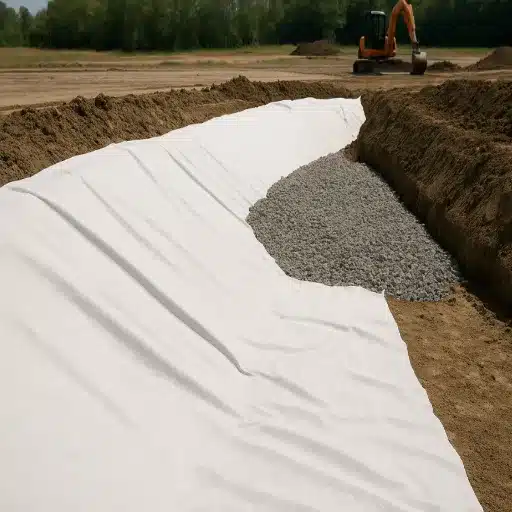
This is the question that starts the online arguments, and the honest answer is: it depends on the ground.
When Geotextile Is Essential
Install geotextile under a concrete slab when any of these conditions apply:
- Soft or clay subgrade. Cohesive soils migrate into aggregate under load, so separation is critical.
- Expansive or voided ground. Shrink-swell clays and old fill move and settle; a woven fabric bridges the movement.
- High water table or poor drainage. You need drainage and filtration to control hydrostatic pressure.
- Deep aggregate fill. The deeper and heavier the base, the more the stone wants to sink and the more valuable the fabric becomes.
When Geotextile Is Optional
On a well-compacted, well-drained granular subgrade that has been tested and proof-rolled, geotextile is not strictly required. Building-science editors make a fair point: if the fill is properly compacted, there is no mechanism for settlement, so the fabric is doing less work. In that situation, treat the fabric as insurance rather than a necessity. Most builders still install it because the cost is small relative to the cost of a failed slab.
The “Cheap Insurance” Debate
The disagreement you see online is usually a misunderstanding of what the fabric does. One camp treats geotextile as a substitute for compaction, which it is not. The other treats it as a safeguard that protects against what compaction cannot control: soil migration, fines pumping, and moisture. Both can be right. On a genuinely good subgrade the fabric is protective. On a questionable one it is essential. The GreenBuildingAdvisor forum discussion on geotextile between soil and gravel below a slab shows exactly this split, with editors arguing against fabric on properly compacted slabs and builders reporting zero settlement cracks using woven geotextile under deep stone fills on silty, high-water-table sites.
What Geotextile Cannot Fix
Be clear about the limits. A geotextile will not fix a poorly compacted subgrade, and it’s not a drainage system by itself. It won’t stop concrete from cracking if the mix, reinforcement, or joints are wrong. And critically, it’s not a vapor barrier, so it will not stop moisture rising into a slab. Each layer has one job, and the fabric only does its part.
Geotextile vs Vapor Barrier vs Termite Barrier: Don’t Confuse Them
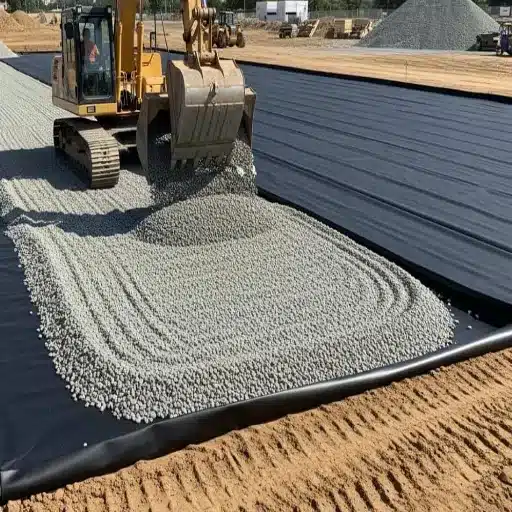
Three different products sit under concrete slabs, and buyers routinely mix them up. A geotextile is permeable and drains water. A vapor barrier is impermeable and blocks moisture. A termite barrier is a specialized chemical membrane that keeps subterranean insects out of the building. They’re different layers doing different jobs, and in some assemblies they all appear in the same slab.
For a poured concrete floor, the standard layering is: compacted subgrade, then geotextile if the soil is weak, then a compacted aggregate base, then a vapor barrier, then the concrete. The vapor barrier is the layer that actually stops rising damp. Skip it and moisture will wick up into the slab even with perfect fabric below.
Some vapor barriers are sold with a nonwoven geotextile face laminated on. The concrete interlocks with the fabric fibers, creating a mechanical bond that holds the membrane against the slab even if the ground settles, which prevents the “pocketing” problem that causes moisture damage in polished or coated floors. Bentonite-geotextile waterproofing systems, covered under ASTM D8425-22 for below-grade cast-in-place concrete, use the same principle with a layer of sodium bentonite sandwiched between two geotextiles to self-seal against groundwater. The CETCO VOLTEX installation manual documents peel-adhesion values of roughly 15 pounds per inch for this bond, which is why these systems stay watertight under pressure.
In Australia, where termite management is mandatory, an under-slab termite barrier is a separate requirement. These are geotextile or polymer membranes impregnated with a termiticide and installed before the pour, complying with AS 3660.1. If you’re buying for an Australian project, a geotextile under the slab does not satisfy the termite-barrier requirement on its own, and vice versa.
How to Install Geotextile Under a Concrete Slab
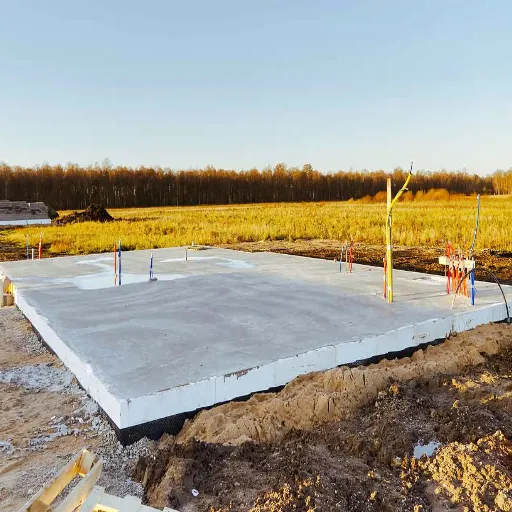
Installation is where most slab-fabric failures happen, and almost all of them are avoidable.
The Layer Stack
For a typical slab-on-grade, the assembly from the ground up is:
- Compacted subgrade. Excavate to design depth, remove organics, compact and proof-roll.
- Geotextile (when needed). Woven for separation on soft soil; nonwoven for drainage or vapor-barrier protection.
- Compacted aggregate base. Crushed stone spread and compacted in lifts, typically 4 to 8 inches.
- Vapor barrier (for poured slabs). A polyethylene or composite membrane to block rising moisture.
- Concrete slab. Reinforced as designed, with proper joints.
Placement and Seaming
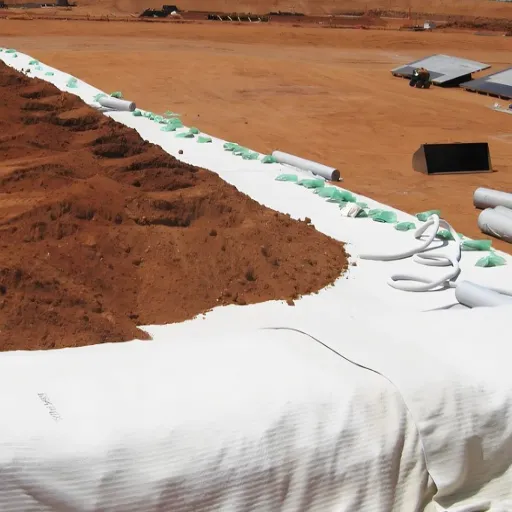
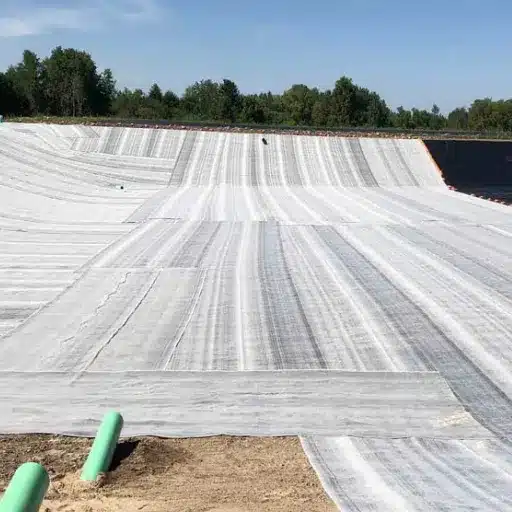
Lay the geotextile flat and smooth on the prepared subgrade, with no wrinkles that could create voids under the concrete. Overlap adjacent rolls by at least 12 inches (some specs require 18), and stagger the seams so they do not line up with the slab’s control joints. On slopes or windy days, anchor the fabric with staples or sandbags so it stays in place until the stone goes down. Place the aggregate immediately after laying; a geotextile is not meant to sit exposed.
The UV Exposure Window
Geotextile is damaged by sunlight. Polypropylene and polyester fabrics degrade under UV exposure, so cover the fabric within a matter of days, ideally the same day. If a project runs long and the fabric sits in the sun, you may need to replace it. Carbon-black-stabilized fabrics resist UV far better than unstabilized ones, and the geotextile UV resistance and lifespan guide explains the degradation timeline in detail.
Marcus, a landscape contractor in Texas, learned this the hard way. He laid a roll of nonwoven geotextile under a paver-base pour on a Friday and covered it with a tarp for the weekend. The tarp blew off Saturday night, and by Monday the fabric had bleached noticeably. He ordered a replacement rather than risk a warranty claim. The lesson: schedule the pour before you lay the fabric, not after.
Geotextile Specifications to Specify
When you buy, skip vague descriptions and specify numbers. These are the values engineers check, and any reputable supplier can provide them on the mill test report:
| Property | Test Standard | What to Look For |
|---|---|---|
| Grab tensile strength | ASTM D4632 | 200+ lb for slab separation wovens; higher for heavy loads |
| Trapezoid tear strength | ASTM D4533 | Higher resists ripping during installation |
| CBR puncture resistance | ASTM D6241 | High values survive sharp aggregate and construction traffic |
| Permittivity | ASTM D4491 | Higher for drainage and filtration roles |
| Apparent opening size (AOS) | ASTM D4751 | Match to soil; smaller AOS retains finer soil |
| Weight | GSM/oz per sq yd | 4 oz to 8 oz typical for slab applications |
| Survivability class | AASHTO M288 | Class 1 for harsh construction, Class 2 or 3 for lighter duty |
The right weight depends on the subgrade. For a light residential patio on decent soil, a 4 oz woven is often enough. For a garage floor or driveway over clay, step up to a heavier woven or a Class 1 fabric rated for high survivability. If you need help translating soil conditions into a weight and grade, the geotextile weight and GSM guide maps fabric weights to AASHTO survivability classes. And because the choice between woven and nonwoven drives the price, the woven vs nonwoven geotextile cost comparison helps you budget before you order.
For a slab on expansive clay, a newer option worth knowing about is a wicking geotextile. These fabrics draw soil moisture out laterally and make suction under the slab more uniform, which reduces differential settlement and the stress that cracks slabs. Research on wicking geotextiles under concrete pavement has shown large reductions in slab stress compared with unreinforced sections. It’s more expensive than a standard woven, but on shrink-swell soils it can be cheaper than the damage it prevents.
Frequently Asked Questions
Do I need geotextile under a concrete slab?
Yes if the subgrade is soft, clayey, expansive, or poorly drained; optional on well-compacted, well-drained granular ground. Treat it as low-cost insurance: the fabric is a small fraction of the cost of a slab that settles, cracks, or pumps fines.
Does geotextile stop concrete from cracking?
No. Geotextile reduces the risk of settlement-related cracking by keeping the base stable and bridging weak subgrade. It does not control cracking from poor concrete mix, missing reinforcement, or bad joints.
Can I use landscape fabric under concrete?
Not as a substitute for geotextile. Landscape fabric is a lightweight weed barrier with little tensile strength. Under a slab carrying load you need an engineering geotextile rated for separation and survivability, not a consumer weed membrane.
Geotextile vs vapor barrier: do I need both?
Often yes, for different reasons. The geotextile keeps the base stable and drains water; the vapor barrier blocks moisture from rising into the concrete. One does not replace the other.
What goes under a concrete slab, layer by layer?
Compacted subgrade, then geotextile if the soil is weak, then compacted aggregate base, then a vapor barrier for poured slabs, then the concrete.
Conclusion
The geotextile-under-slab decision comes down to ground conditions and water, not to guesswork. Choose woven geotextile when the slab carries load over a soft, clay, or voided subgrade, because it separates the base and bridges weak zones. Choose nonwoven geotextile when moisture is the enemy, because it drains, filters, and protects the vapor barrier. And never confuse the fabric with a vapor barrier, termite barrier, or landscape fabric, because each has one job.
If you’re pouring on questionable ground, the small cost of an engineered geotextile is the cheapest insurance your slab will ever get. On a clean, compacted, well-drained site, you can leave it out, but most owners still install it and never regret the decision.
Ready to spec the right fabric for your project? Request a technical quote and our engineering team will help you match a woven or nonwoven geotextile to your subgrade, load, and moisture conditions, with mill test reports and export-ready supply.