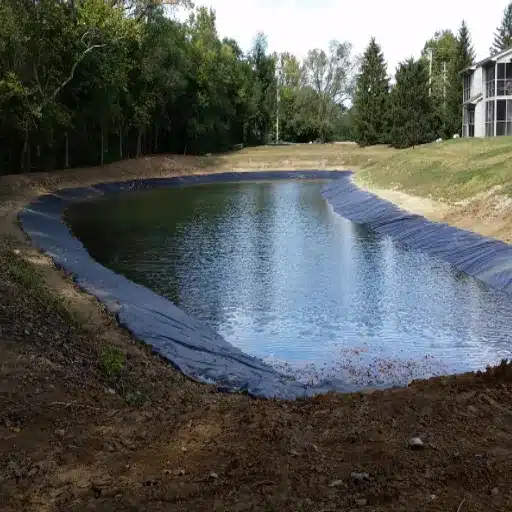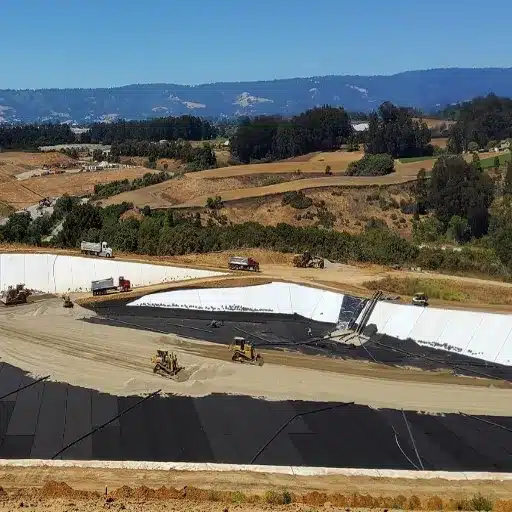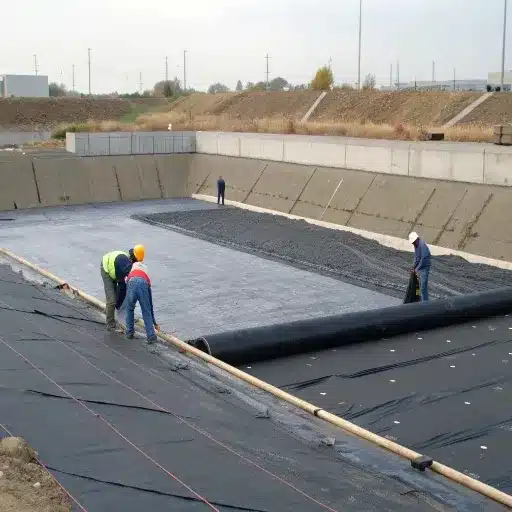
The HDPE geomembrane pond liner serves as the most cost-effective solution, which lasts for aquaculture, irrigation, and drinking water storage because its permeability rate remains below 1×10⁻¹³ cm/s. The 0.75 to 1.0 mm liner provides adequate coverage for most fish ponds, while agricultural reservoirs require 1.0 to 1.5 mm liners, and large municipal or industrial impoundments need 1.5 to 2.0 mm liners, which must obtain NSF/ANSI 61 certification.
Unlined earthen ponds lose between 30 and 50 percent of their water through seepage during each irrigation season, according to irrigation field studies. The financial impact of that loss destroys farm budgets because it requires additional pumping while it reduces productive time for all crops. Aquaculture operators face higher expenses because soil pathogens and ammonia spikes, together with unstable water chemistry conditions, create harmful effects that reduce survival rates and increase the need for antibiotics.
This guide serves as the solution to your problem. The guide teaches you how to determine the required HDPE geomembrane pond liner thickness for each application while you verify that the resin meets GRI-GM13 and NSF/ANSI 61 standards through proper installation and welding methods, which enable you to acquire project materials from any global location.
Key Takeaways
- Most aquaculture ponds use 0.5–1.0 mm HDPE; irrigation reservoirs use 1.0–1.5 mm; potable water and large industrial ponds require 1.5–2.0 mm with NSF/ANSI 61 certification.
- HDPE permeability of ≤1×10⁻¹³ cm/s converts a leaky earthen basin into a 99%+ retention asset, eliminating the 30–50% seepage loss typical of unlined dams.
- Virgin-resin HDPE with 2–3% carbon black, GRI-GM13 compliance, and verified ESCR data separates engineered pond liner from low-grade recycled material.
- Hot wedge welding handles long field seams; extrusion welding handles details and repairs. Air pressure testing of double-track welds is mandatory.
- For international projects, 5.8 m roll widths fit 20-foot ocean containers efficiently, cutting freight cost per square meter delivered.
Why HDPE Geomembrane Is the Default for Pond Lining
The HDPE material shows five key engineering strengths that prove it is the best choice for pond lining. The material achieves complete impermeability through its permeability coefficient, which reaches a maximum value of 1×10⁻¹³ cm/s while compacted clay shows leakage rates that exceed this value by 100 to 1,000 times. The material can support hydrostatic pressure and withstand operational impacts because it exhibits a tensile yield strength of 22 kN/m and a puncture resistance that exceeds 480 N. The material remains chemically inert because it does not release plasticizers into the water, which makes HDPE the preferred material for fish operations and drinking-water reservoirs. The welded seams create an uninterrupted waterproof barrier, which differs from the glued laps used in PVC and the seam-tape connections employed in EPDM. The 20–30 years of service life from exposed materials and the 50-plus years of performance from buried materials have been validated through multiple decades of field performance research.
HDPE proves more cost-effective than other materials. The material costs between 0.60 and 1.20 per ft² (6.50 to 13 per m²), which makes it competitive against PVC while remaining much cheaper than EPDM. The HDPE material shows superior economic value because its replacement cycle lasts two to three times longer than other products. Our comprehensive HDPE geomembrane guide presents all types of HDPE geomembrane materials and their properties and applications.
For flexible projects that require special design solutions but operate on irregular pond shapes, LLDPE geomembrane produces better results. However, HDPE serves as the standard starting point for most aquaculture, irrigation, and water-storage projects.
HDPE Pond Liner Applications and Specification Implications
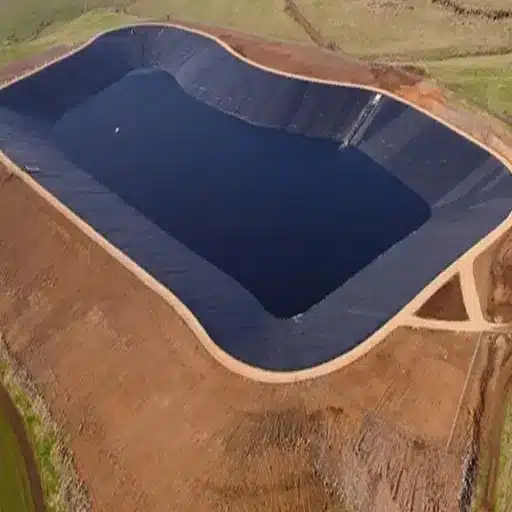
Not every pond is the same project. The biology of fish stocks, the chemistry of process water, and the regulatory status of drinking-water storage each push specifications in different directions.
Aquaculture (Fish, Shrimp, and Crab Farms)
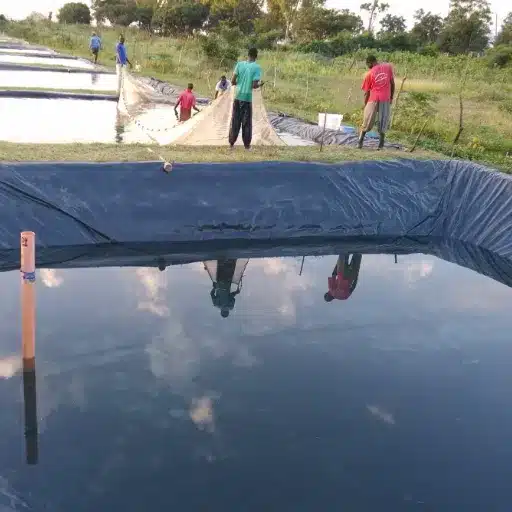
HDPE pond liners create a barrier that separates artificial ponds from the natural earth. The single modification prevents ammonia and hydrogen sulfide from moving through the organic-rich substrate while it removes disease-causing pathogen pools and maintains stable pond water temperature and pH levels. Operators observe better survival rates and improved feed conversion ratios after they change their earthen ponds into HDPE-lined systems.
The operation reduced water exchange frequency by 50 percent and brought antibiotic use down to almost nonexistent levels when Anh Nguyen transformed ten 4,000 m² shrimp ponds in the Mekong Delta from earthen construction to 0.75 mm HDPE-lined systems. The harvest survival rates increased sufficiently to cover the total liner investment after two grow-out cycles. The HDPE geomembrane pond liner became core infrastructure rather than an upgrade.
Recommended thickness ranges:
- Shrimp ponds: 0.5–0.75 mm
- Fish ponds (commercial): 0.75–1.0 mm
- High-value species or rocky subgrade: 1.0–1.5 mm
Irrigation Reservoirs and Farm Dams
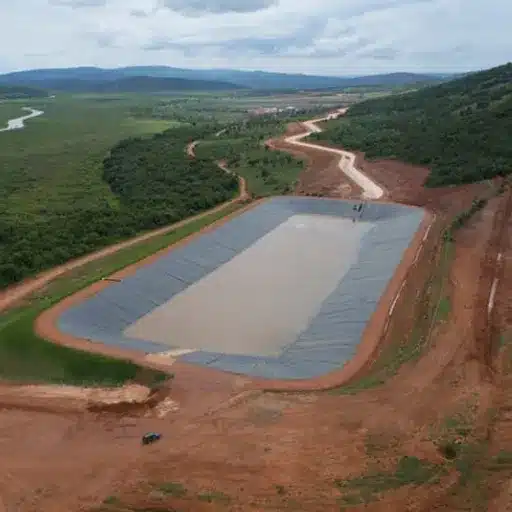
A well-installed HDPE liner converts a porous earthen storage basin into a 99%+ retention reservoir. That eliminates the seasonal seepage loss that drains unlined dams to unusable levels during peak irrigation demand. The same liner reduces turbidity that clogs drip emitters and inhibits aquatic weed growth on pond banks.
Recommended thickness for agricultural storage:
- Small irrigation pond (<2,000 m²): 0.75–1.0 mm
- Medium reservoir (2,000–20,000 m²): 1.0–1.5 mm
- Large agricultural reservoir: 1.5–2.0 mm
Potable Water and Municipal Storage
Drinking-water reservoirs, raw-water basins, and treatment lagoons require HDPE material that meets NSF/ANSI 61 certification standards. The certification process establishes that the polymer plus its associated additives will not release any toxic substances into drinking water. The municipal procurement teams need to obtain both the NSF certificate and GRI-GM13 batch test data before they allow any liner shipment to proceed.
The standard specification requires 1.5 to 2.0 millimeters of NSF/ANSI 61 certified HDPE, which building projects commonly use together with floating covers that control both evaporation and contamination.
Industrial Process Water and Mining Ponds
Mining process ponds, evaporation cells, and industrial cooling reservoirs need 1.5–3.0 mm HDPE with verified chemical resistance to the specific process chemistry. Textured surfaces are preferred for steep impoundment slopes, and conductive liner options support electrical leak location surveys for high-risk containment.
Decorative and Landscape Ponds
Smooth 0.5–0.75 mm HDPE works well for koi ponds, water features, and landscape integrations where flexibility matters less than long-term puncture resistance and welded leak-proof joints. Resort and hospitality projects increasingly specify HDPE for the same reason municipal projects do: the welded envelope simply does not leak.
Need help selecting the right specification for your pond project? Talk with our engineering team for thickness, surface, and certification recommendations matched to your application.
How to Select HDPE Pond Liner Thickness
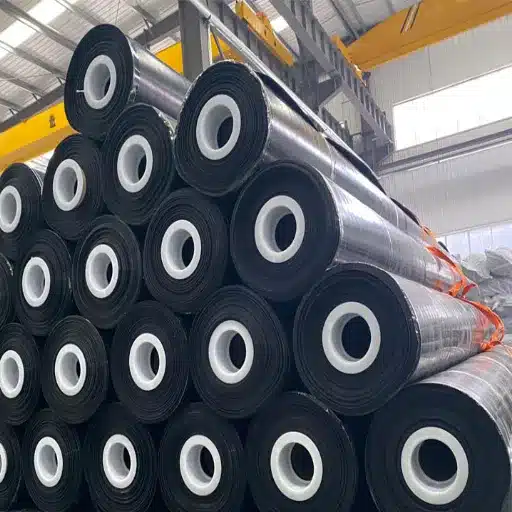
Thickness drives both performance and budget. Specify too thin, and the liner fails early under hydrostatic load or punctures from subgrade defects. Specify too thick, and you overspend on freight and installation labor. The matrix below summarizes industry practice. For a deeper dive across every application, see our HDPE geomembrane thickness guide.
| Pond Type | Recommended Thickness | Service Life Target |
|---|---|---|
| Decorative / koi pond | 0.5 mm (20 mil) | 10–15 years |
| Shrimp pond | 0.5–0.75 mm | 5–10 years |
| Fish pond (small commercial) | 0.75–1.0 mm | 8–15 years |
| Irrigation reservoir (small) | 1.0–1.5 mm | 15–25 years |
| Large agricultural reservoir | 1.5–2.0 mm | 25–40 years |
| Potable water reservoir (NSF 61) | 1.5–2.0 mm | 25–40 years |
| Industrial / process water | 2.0–3.0 mm | 25+ years |
Beyond the table, five variables push the specification thicker:
- Hydrostatic load: The weight of water in deeper ponds, together with the weight of heavy process fluids, pushes engineering requirements to use thicker liners.
- Subgrade quality: The presence of rocky and sharp subgrades requires construction teams to use either thicker liners or protective geotextile cushions.
- Service life expectation: The design requirements for a 10-year aquaculture cell differ from those of a 30-year municipal reservoir.
- Chemical exposure: The aggressive processing chemistry requires organizations to use thicker HDPE materials, which have undergone complete chemical testing.
- UV exposure: The liners that receive permanent sunlight exposure require additional thickness and certified carbon-black content to achieve their performance objectives.
Smooth vs Textured Surface
Smooth HDPE works for flat pond bases and gentle slopes. For side slopes steeper than 3:1, textured HDPE geomembrane is essential to prevent interface sliding. Structured texturing delivers a 28–34° friction angle and preserves the base sheet’s mechanical integrity better than co-extruded textures.
For critical containment, conductive HDPE supports post-installation electric leak location (ELL) testing, which catches pinholes and seam defects that visual inspection misses.
Critical HDPE Pond Liner Specifications (GRI-GM13 / ASTM)
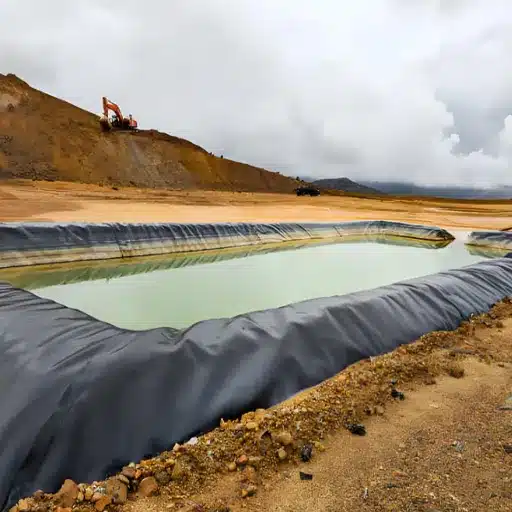
A pond liner is only as good as the resin and additive package behind it. Specifications must reference GRI-GM13 test methods and ASTM values, not generic marketing claims.
| Property | Test Standard | Minimum Value (1.5 mm smooth) |
|---|---|---|
| Density | ASTM D1505 | ≥0.940 g/cm³ |
| Tensile yield | ASTM D6693 | ≥22 kN/m |
| Tensile break | ASTM D6693 | ≥40 kN/m |
| Elongation at break | ASTM D6693 | ≥700% |
| Puncture resistance | ASTM D4833 | ≥480 N |
| Tear resistance | ASTM D1004 | ≥187 N |
| Carbon black content | ASTM D4218 | 2–3% |
| OIT (standard) | ASTM D3895 | ≥100 min |
| HP-OIT | ASTM D5885 | ≥400 min |
| ESCR | ASTM D5397 | >500 hours |
| Seam strength (peel) | ASTM D6392 | ≥80% parent |
Material Composition
A reliable pond liner uses 97–98% virgin HDPE resin, 2–3% carbon black for UV protection, and an antioxidant-stabilizer package tuned for long service life. Recycled-content liners are common in low-cost markets and often visibly bumpy, smell pungent, and sink in water rather than float, all signs of contaminated resin. For ponds expected to last 15+ years, virgin-resin certification is non-negotiable.
NSF/ANSI 61 for Potable Water
Municipal reservoirs need HDPE, which has received NSF/ANSI 61 certification for its use in drinking water storage and treatment lagoons and dual-purpose reservoirs. The certification verifies the entire formulation, polymer plus additives, leaches no harmful substances into the water column. The certificate should be requested by procurement teams through the SKU and lot number before container loading.
HDPE Pond Liner Installation Best Practices
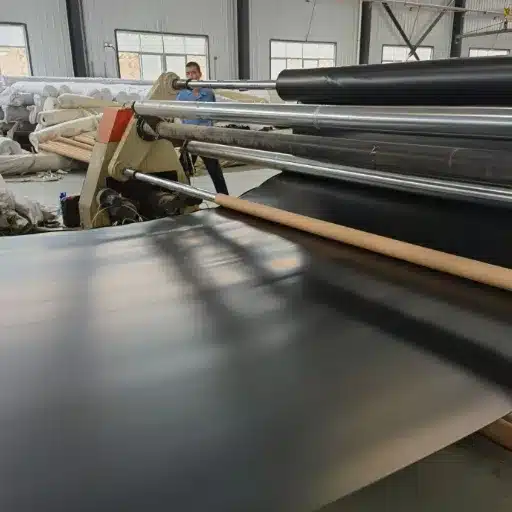
Site preparation prevents 80% of liner punctures. Welding determines the long-term integrity of every seam. The two together account for nearly all field-installation failures. For a step-by-step procedure, see our HDPE geomembrane installation guide.
Subgrade Preparation
- Compact the subgrade to ≥95% Proctor density
- Remove all sharp objects larger than 3 mm
- Smooth the grade with no abrupt elevation changes
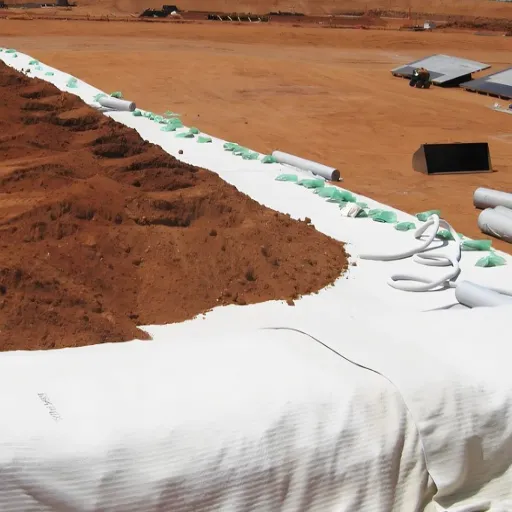
- Install a nonwoven geotextile cushion (200–400 g/m²) over rocky or aggressive subgrades
- Excavate an anchor trench 300–500 mm deep around the perimeter, U-shaped or inverted trapezoidal
Panel Deployment
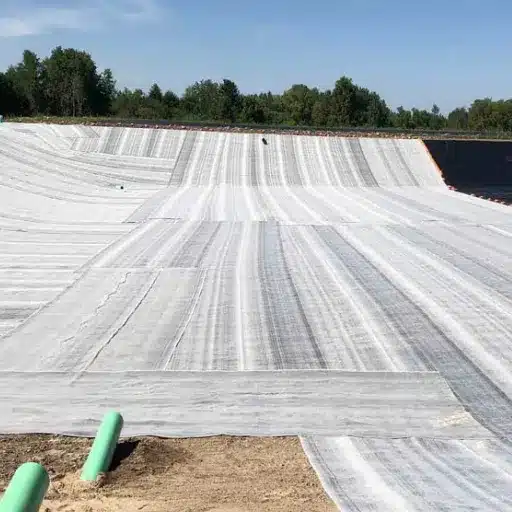
Unroll panels along the slope direction, using 5.8 m wide rolls to minimize seam length. Overlap panels at least 75 mm before welding. Avoid installation during precipitation, frost, or wind above 25 km/h. Cover the liner with backfill or fill the pond within 30 days to limit thermal-cycling stress and UV exposure.
Welding: Hot Wedge vs Extrusion
Hot wedge welding is the primary method for long field seams. The dual-track weld creates a central air channel for non-destructive pressure testing. Speed runs 0.8–2.5 m/min at 280–460°C, depending on liner thickness and ambient conditions. Extrusion welding handles detail work, T-joints, pipe boots, and repairs where the wedge welder cannot reach. Industry data confirms that manual extrusion welds fail at higher rates than double wedge welds. Most pinhole leaks discovered post-installation trace back to extrusion welds at penetrations and corners. Reduce penetrations where possible, and reinforce remaining details with extrusion fillet welds and proper boot details.
Quality Control and Testing
- Air pressure test (double-track welds): pressurize the central channel to 30 PSI and hold for 5 minutes
- Vacuum box test: extrusion seams and field repairs
- Destructive samples: every 150 m of seam, with both peel and shear tests per ASTM D6392
- Spark test: 15 kV survey for pinhole detection on critical containment
- Electric leak location: post-installation survey for high-value or regulated ponds
When Maria Santos managed the construction of a 30,000 m³ raw-water reservoir for a Latin American municipal authority, she required mill test reports for every shipped roll, double-track welds with full air-pressure testing, and a post-fill ELL survey before the basin was approved for service. Two pinholes were detected and repaired before water entered the supply chain. The added QA cost was a fraction of a single regulatory failure event.
Common Failure Modes and Prevention
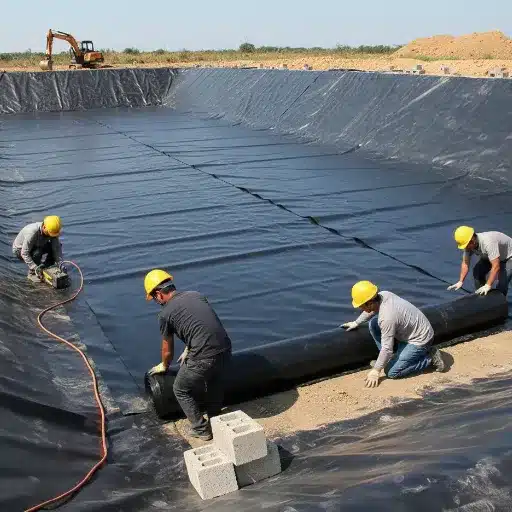
Most HDPE pond liner failures trace to one of six causes. Each is preventable with proper specification and installation discipline.
| Failure Mode | Cause | Prevention |
|---|---|---|
| Puncture | Sharp subgrade objects | Geotextile cushion + subgrade inspection |
| Seam separation | Weld parameter drift, wet or dirty surfaces | Trial seams + surface prep + certified welders |
| Wrinkles and thermal stress | Hot installation followed by cold filling | Stage installation around mid-temperature window; backfill quickly |
| UV degradation | Recycled resin or low carbon black | Specify virgin resin with verified 2–3% carbon black |
| Slope sliding | Insufficient interface friction | Specify textured liner + interface friction test (ASTM D5321) |
| Penetration leaks | Poor extrusion-weld detail | Reduce penetrations; reinforce with extrusion fillet + boot detail |
The single most underrated failure mode is environmental stress cracking. Standard HDPE performs poorly under sustained multi-axial strain. High-quality resin combined with structured texturing improves stress-crack resistance dramatically. A supplier who cannot provide batch-level ESCR data should not be considered for any pond expected to last more than a decade.
Sourcing HDPE Pond Liner for Global Projects
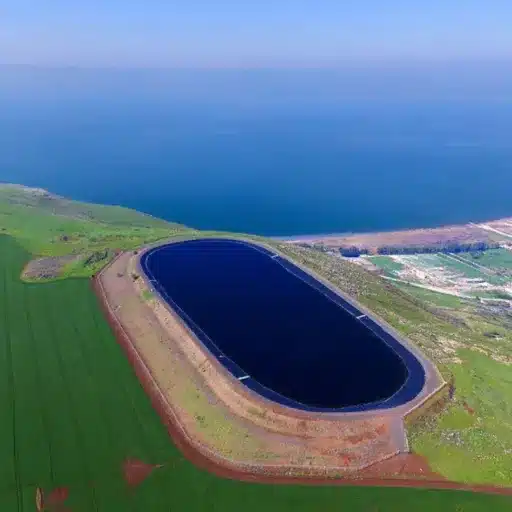
The right liner specification means little if the supplier cannot deliver verified material on time and at the right freight cost. International procurement teams should evaluate three categories of criteria.
Manufacturing credentials:
- ISO 9001 quality system certification
- GRI-GM13 batch testing with mill test reports
- NSF/ANSI 61 certification for potable water projects
- Virgin-resin verification with carbon-black content data
- 5-year sample retention policy for traceability
Logistics efficiency:
- 5.8 m roll widths fit standard 20-foot ocean containers efficiently
- Verified container-loading expertise minimizes damage during ocean transit
- FOB and CIF terms with documented lead times
- Customs documentation packages for the destination country requirements
Technical support:
- Welding method recommendations matched to project geometry
- Anchor trench and slope detailing review
- CQA/CQC support for installation contractors
- Lifecycle cost modeling: material + freight + installation + replacement over 25 years versus cheaper alternatives that need replacement every 5–10 years
The procurement decision is not “which liner is cheapest per square meter at the factory gate.” It is “which supplier delivers certified material to my project site, on time, with documentation that satisfies my regulator and a welding plan that survives the next 25 years.”
Conclusion
The proper definition of an HDPE geomembrane pond liner converts a defective earthen basin into a permanent asset that lasts for 25 years. The specification rules are not complicated, but each one matters:
- Match thickness to application: 0.5–0.75 mm for shrimp, 0.75–1.0 mm for fish, 1.0–1.5 mm for irrigation, 1.5–2.0 mm for potable water and large reservoirs, 2.0–3.0 mm for industrial process ponds.
- Verify GRI-GM13 compliance and demand NSF/ANSI 61 for any potable water project.
- Specify virgin resin with 2–3% carbon black and verified ESCR data; reject recycled-content material for long-life ponds.
- Install with discipline: prepared subgrade, geotextile cushion where needed, hot wedge welding with air-pressure testing, and electric leak location for critical containment.
- Source from a manufacturer that offers ISO 9001, GRI-GM13 documentation, NSF certification, and container-loading efficiency for international shipping.
The pond liner achieves its highest reliability when you install all five necessary components correctly because it becomes the most dependable part of the entire facility.
Our engineering team provides assistance to size and specify HDPE geomembrane products for your worldwide aquaculture, irrigation, potable water, and industrial pond projects. Contact our specialists for a tailored technical quote, including thickness, surface, and certification matched to your specific application.
Frequently Asked Questions
What thickness HDPE pond liner do I need for a fish pond?
The 0.75 to 1.0 mm HDPE liner provides commercial fish ponds with optimal value because it combines affordable costs with long-lasting durability, which extends between 8 and 15 years of service. Shrimp ponds typically use 0.5–0.75 mm. The specification requires 1.0 to 1.5 mm thickness for operations that involve higher-value species or deeper underwater areas or rocky ground conditions.
How long does an HDPE pond liner last?
The HDPE pond liner lasts between 20 and 30 years when exposed to elements, while achieving a lifespan of 50 years throughout its buried or covered existence. Virgin-resin formulations with 2 to 3 percent carbon black and verified ESCR, together with proper subgrade protection, achieve the maximum lifespan of that range.
Is HDPE pond liner safe for fish and drinking water?
Yes, when specified correctly. HDPE will not release any chemicals because it contains no plasticizers. For drinking water and food-grade aquaculture, specify HDPE certified to NSF/ANSI 61. The certificate needs to be verified through the SKU and lot number before the shipment process begins.
What is the difference between smooth and textured HDPE pond liner?
Smooth HDPE works on flat bases and slopes gentler than 3:1. Textured HDPE provides a 28 34° interface friction angle, which functions as a critical requirement for areas with steep slopes, because smooth liner will move when wet conditions or fill loading happen.
How is HDPE pond liner welded?
The hot wedge welding method, with its double-track weld together with a central air channel, creates non-destructive pressure testing for field seams. Detail work, T-joints, and repairs use extrusion welding. The two techniques need certified operators together with calibrated equipment and documented trial seams to function properly.
How does HDPE compare to EPDM and PVC for pond liners?
HDPE provides the longest welded-seam service life and the strongest chemical resistance at a material cost that matches PVC and stays below EPDM. EPDM provides better flexibility for small, irregular ponds, although it cannot be welded. PVC costs less at the beginning, but it breaks down after 5 to 7 years of UV exposure, while containing plasticizers that are harmful to fish and drinking water.
What is the typical cost of HDPE pond liner per square meter?
The cost of HDPE material ranges between 6.50 and 13 per square meter, which equates to 0.60 to 1.20 per square foot based on the material’s thickness, surface characteristics, and certification status. The total installed cost includes expenses for freight and geotextile cushion, labor, welding, and CQA work. International buyers should also factor in 5.8 m roll widths to minimize container freight cost per delivered square meter.