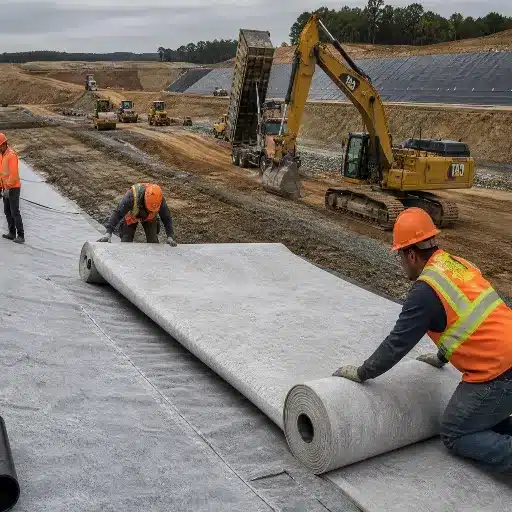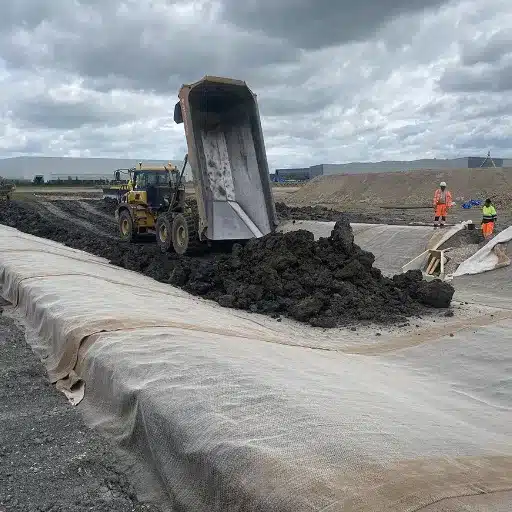
Nonwoven geotextile is the standard filtration and drainage fabric for subsurface systems because its entangled fiber matrix delivers permittivity 5-10 times higher than woven alternatives while retaining soil particles through controlled apparent opening size. For French drains, retaining walls, and subsurface drainage, the correct specification prevents failure.
James Whitfield thought he had saved $200. In 2022, his landscaping crew installed a 30-meter French drain behind his Nashville home using a standard woven landscape fabric instead of nonwoven geotextile drainage fabric. The woven fabric’s low permittivity trapped water against the foundation. By spring 2024, hydrostatic pressure had cracked the basement wall in two places. The repair bill reached $18,500. The fabric had not torn or degraded. It simply could not transmit water fast enough to relieve pressure.
This guide prevents that outcome. You will learn why nonwoven geotextile dominates drainage engineering, how to select the correct apparent opening size and permittivity for your soil conditions, the burrito wrap installation method that protects French drains for decades, and the five specification mistakes that destroy drainage performance before water ever reaches the pipe.
Key Takeaways
- Nonwoven geotextile permittivity (0.5-5.0 sec⁻¹) exceeds woven fabric by 5-10x, making it the only rational choice for drainage applications.
- Apparent opening size (AOS) must match soil gradation: 0.15-0.21 mm for silty sands, tighter for high-fines soils.
- The burrito wrap method fully encapsulates aggregate and pipe in nonwoven geotextile, preventing soil contamination that causes >70% of French drain failures within 5 years.
- Retaining wall drainage nonwoven geotextile reduces hydrostatic pressure by 35-55% when paired with a clean granular drainage layer.
- AASHTO M288 specifies minimum permittivity of 0.5 sec⁻¹ for soils with <15% fines, 0.2 sec⁻¹ for 15-50% fines.
Why Nonwoven Geotextile Is the Standard for Drainage
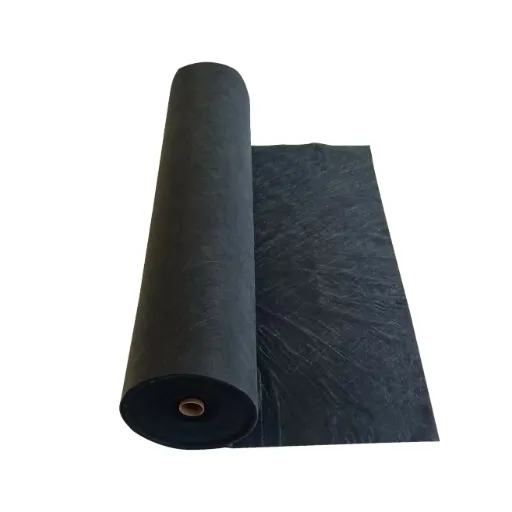
The difference between woven and nonwoven geotextiles is not aesthetic. It is hydraulic. Woven fabrics are engineered for tensile strength and load distribution. Their interlaced yarn structure creates a relatively impermeable plane. Nonwoven fabrics are engineered for filtration. Their randomly oriented, needle-punched fiber matrix creates a tortuous, three-dimensional flow path with high void content.
Hydraulic Performance Advantage
Permittivity measures the rate at which water passes through a geotextile under a hydraulic head. Typical values tell the story:
- Nonwoven needle-punched geotextile: 0.5-5.0 sec⁻¹ (ASTM D4491)
- Woven slit-film geotextile: 0.05-0.2 sec⁻¹
- Woven monofilament geotextile: 0.2-0.5 sec⁻¹
A 200 gsm nonwoven geotextile can transmit 50-300+ gpm/ft² under standard test conditions. A comparable-weight woven slit-film fabric transmits less than one-tenth of that volume. In a drainage application, the woven fabric becomes the bottleneck, not the solution.
Filtration vs. Woven Geotextile
Beyond flow rate, nonwoven geotextiles provide consistent filtration across a broad spectrum of soil gradations. The random fiber orientation creates a gradient pore structure that forms a stable filter cake at the soil-fabric interface. This filter cake prevents soil piping while maintaining long-term permeability.
Woven geotextiles, by contrast, have discrete, regular openings between yarns. Fine silts and clay particles pass through or clog these openings unpredictably. For soils with d₈₅ below 0.075 mm, woven fabrics are generally unsuitable regardless of yarn type.
For a side-by-side comparison of mechanical and hydraulic properties, see our woven vs nonwoven geotextile guide.
Geotextile Drainage Design: AOS and Permittivity Selection
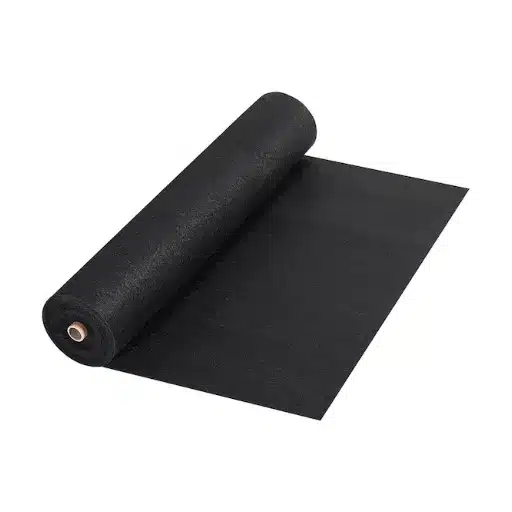
Proper drainage design begins with matching the geotextile to the soil it must filter. Two parameters govern this match: apparent opening size (AOS) and permittivity.
AOS Selection by Soil Type
AOS, designated O₉₅ in ASTM D4751, is the particle size at which 95% of openings in the geotextile are smaller. It determines which soil particles the fabric retains and which pass through.
| Soil Type | d₈₅ Range | Recommended AOS (O₉₅) | Common US Sieve |
|---|---|---|---|
| Clean gravel, coarse sand | >2.0 mm | 0.43 mm (#40) | Sieve #40 |
| Medium to fine sand | 0.5-2.0 mm | 0.25 mm (#60) | Sieve #60 |
| Silty sand, loam | 0.075-0.5 mm | 0.15-0.21 mm (#70-#100) | Sieve #70-#100 |
| Silty clay, high fines | <0.075 mm | 0.075-0.15 mm (#100-#200) | Sieve #100-#200 |
The standard retention criterion states that AOS should be less than or equal to d₈₅ of the adjacent soil. For critical applications or soils with high uniformity coefficients, engineers may apply a more conservative ratio of AOS ≤ 0.5 × d₈₅.
Permittivity Requirements
Permittivity must exceed the flow demand of the drainage system. AASHTO M288 establishes minimum permittivity values by soil fines content:
| Fines Content (% passing #200 sieve) | Minimum Permittivity (sec⁻¹) |
|---|---|
| < 15% | 0.5 |
| 15-50% | 0.2 |
| > 50% | 0.1 |
These are minimums, not targets. For high-flow applications such as retaining wall drainage or blanket drains beneath roads, specify nonwoven geotextiles with permittivity above 1.0 sec⁻¹ to provide an adequate safety margin.
Clogging Resistance
The gradient ratio test (ASTM D5101) measures long-term clogging potential. A gradient ratio below 3.0 indicates acceptable performance. Needle-punched nonwoven geotextiles typically achieve gradient ratios of 1.5-2.5 in silty sand conditions, confirming stable long-term flow.
For a deeper technical reference on filtration mechanics and soil-matching design, see our geotextile separation and filtration guide.
The Burrito Wrap Method: Step-by-Step French Drain Installation
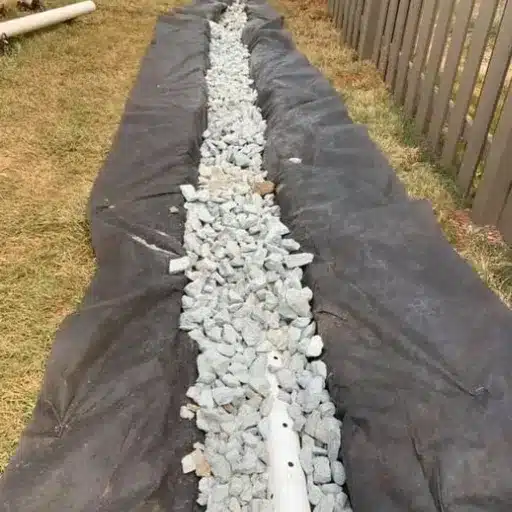
The burrito wrap is not a marketing term. It is an encapsulation technique where the entire aggregate bed and perforated pipe are fully wrapped in nonwoven geotextile, preventing native soil from contaminating the drainage voids over time. Without the wrap, soil migration gradually seals the system. Industry data indicates that over 70% of French drain failures within 5 years result from soil infiltration into the aggregate layer.
Trench Excavation and Slope
Excavate a trench 300-600 mm wide and 450-600 mm deep, depending on drainage volume and soil conditions. Maintain a minimum slope of 1% (10 mm per meter) toward the discharge point. A slope below 0.5% risks standing water and sediment deposition. Over-excavate by 50 mm at the bottom to allow for bedding material.
Grade the trench bottom smooth and free of rocks or roots larger than 25 mm. Any sharp object beneath the fabric creates a puncture point that allows soil entry.
Fabric Placement
Unroll the nonwoven geotextile into the trench so it extends up both sides with at least 300 mm of excess above the anticipated aggregate surface. The fabric must line the bottom and both walls, creating an open shell or trough. Do not stretch the fabric taut; allow enough material for the wrap to drape naturally around the aggregate and pipe without tension.
For trench drainage applications, refer to our geotextile installation best practices guide for overlap and anchoring standards.
Aggregate and Pipe Installation
Place a 100 mm bedding layer of clean, washed aggregate (19-25 mm crushed stone or gravel chips) on the fabric bottom. Avoid pea gravel, limestone with fines, or crushed concrete, as these impede flow or cement together over time.
Lay the perforated pipe on the bedding with perforations facing downward, typically at the 4 and 8 o’clock positions. This orientation allows water to enter from the bottom of the trench while sediment can be flushed through the system. Connect pipe sections with appropriate fittings and maintain the 1% slope.
Add aggregate to 150 mm above the pipe, keeping the pipe centered in the aggregate bed. The aggregate provides both the drainage medium and structural protection for the pipe.
Wrapping and Overlap
Fold the excess fabric from both sides over the top of the aggregate bed. Overlap the two edges by a minimum of 200 mm at the centerline of the trench. For soils with high fines content or in areas with seasonal groundwater fluctuation, increase overlap to 300 mm. Secure the overlap with geotextile pins or staples at 500 mm intervals.
The result is a fully encapsulated drainage envelope: soil cannot enter from the sides or top, while water freely enters through the nonwoven geotextile filtration layer.
Backfill Protocol
Backfill the trench with native soil in 150 mm lifts, compacting each lift to approximately 85% of standard Proctor density. Do not use heavy compaction equipment directly over the wrapped drain until a minimum of 300 mm of soil cover is in place. Avoid dropping backfill from height; a 1-meter drop of soil containing rocks can puncture the fabric.
If the drain passes beneath a trafficked area, add a 150 mm-thick layer of coarse aggregate above the wrap before backfilling with soil. This distributes wheel loads and protects the fabric from dynamic stress.
Retaining Wall Drainage with Nonwoven Geotextile
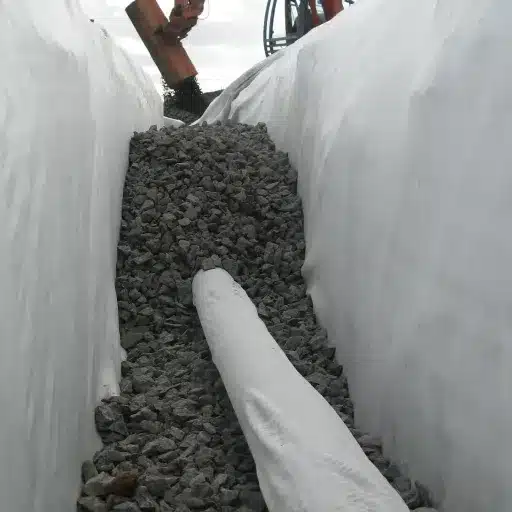
Retaining wall failures are rarely caused by the wall itself. They are caused by water. Every 300 mm of water accumulation behind a wall exerts approximately 4.7 kN/m² of hydrostatic pressure, equivalent to adding 1,800 kg of lateral force per meter of wall length. Nonwoven geotextile drainage systems reduce this pressure by creating a clear flow path from the retained soil to the wall’s drainage outlet.
Placement Behind the Wall
Install the nonwoven geotextile in direct contact with the native soil behind the retaining wall, not floating within the aggregate. The fabric should extend from the base of the wall to the ground surface or to the level of the drainage outlet. Maintain 300-450 mm overlaps at all vertical and horizontal seams, with the upper sheet overlapping the lower sheet to prevent water infiltration at joints.
At the wall base, extend the geotextile to the drainage collection pipe or weep hole level. Terminate the fabric with a return fold or anchor trench to prevent soil migration at the edge.
Drainage Aggregate Layer
Place a 300-450 mm thick layer of clean, open-graded aggregate (19-25 mm) between the geotextile and the wall back face. This aggregate layer acts as the primary drainage column, collecting water that passes through the geotextile filter and conveying it to the base drainage system.
For walls exceeding 2 meters in height or subject to sustained groundwater flow, consider a geocomposite drainage net within the aggregate layer to increase transmissivity. FHWA guidelines recommend a minimum transmissivity of 3 × 10⁻⁵ m²/s for moderate-height retaining wall drainage.
Hydrostatic Pressure Reduction
Properly designed drainage systems behind retaining walls reduce hydrostatic pressure by 35-55%. This reduction translates directly into structural savings: a wall designed for saturated soil conditions with no drainage may require footing depths and stem thicknesses 30-40% greater than an equivalent drained wall.
For detailed retaining wall installation procedures, including staged backfilling and compaction, see our geotextile retaining wall guide.
Common Drainage Geotextile Mistakes
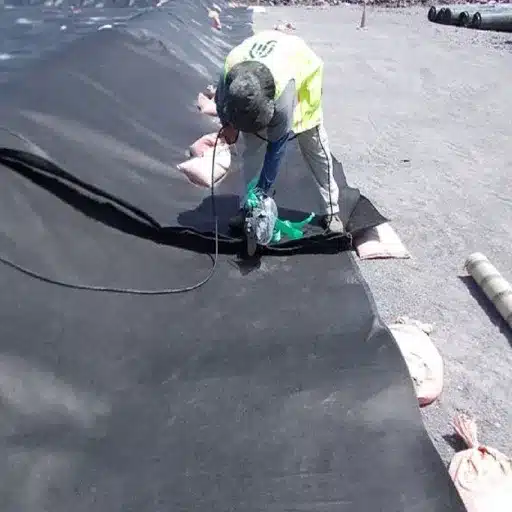
These five mistakes cause the majority of drainage system failures. Each is preventable with correct specification and installation discipline.
Mistake 1: Using woven geotextile for drainage
Woven fabrics transmit insufficient water for drainage applications. Their permittivity is one-tenth to one-fiftieth that of nonwoven alternatives. Water backs up behind the fabric, increasing hydrostatic pressure and defeating the purpose of the drainage layer. The fix is simple: specify needle-punched nonwoven geotextile for all drainage and filtration functions.
Mistake 2: Pipe sock only, no full wrap
Wrapping only the perforated pipe in a geotextile sock reduces the filtration area to the pipe circumference. Soil infiltrates the aggregate between the sock and the trench walls, gradually sealing the system. The burrito wrap method encapsulates the entire aggregate bed, maintaining full filtration area and preventing contamination from all directions.
Mistake 3: Wrong AOS for soil gradation
Specifying a geotextile with an AOS of 0.43 mm behind a silty sand subgrade allows fines to pass through, clog the aggregate layer, and blind the fabric surface. Within two to three years, flow rates drop by 50-80%. Match AOS to d₈₅ using the selection table above. When in doubt, select the tighter AOS.
Mistake 4: Inadequate overlap at seams
A 100 mm overlap on a French drain in expansive clay soil pulls apart within one wet-dry cycle. Soil migrates through the gap, contaminating the aggregate. Standard practice calls for 200 mm minimum overlap in trench applications and 300-450 mm in retaining wall and slope applications. Sewn seams are required for slopes exceeding 10%.
Mistake 5: Compacting aggregate through the fabric
Running plate compactors directly on aggregate separated from soil by only a thin geotextile layer drives aggregate into the fabric, puncturing it and creating preferential flow paths for soil fines. Always place a minimum 100 mm soil buffer between the fabric and compaction equipment, or compact in thin lifts with light equipment.
Specification Quick Reference
The following table summarizes typical nonwoven geotextile drainage specifications by application.
| Application | Fabric Weight | AOS (O₉₅) | Min. Permittivity | Min. Grab Tensile |
|---|---|---|---|---|
| Residential French drain | 135-200 gsm (4-6 oz/yd²) | 0.21 mm (#70) | 0.5 sec⁻¹ | 400 N |
| Commercial perimeter drain | 200-270 gsm (6-8 oz/yd²) | 0.15 mm (#100) | 1.0 sec⁻¹ | 600 N |
| Retaining wall drainage | 200-400 gsm (6-12 oz/yd²) | 0.15-0.21 mm | 0.5 sec⁻¹ | 800 N |
| Road edge drain/blanket drain | 270-400 gsm (8-12 oz/yd²) | 0.21 mm (#70) | 1.0 sec⁻¹ | 900 N |
| Erosion control under rip rap | 400-600 gsm (12-18 oz/yd²) | 0.25 mm (#60) | 0.5 sec⁻¹ | 1,100 N |
All specifications should reference ASTM D4491 (permittivity), ASTM D4751 (AOS), and ASTM D4632 (grab tensile). For critical infrastructure projects, a gradient ratio test per ASTM D5101 with a maximum value of 3.0.
For nonwoven drainage geotextile products manufactured to these specifications, browse our nonwoven drainage geotextile fabric range.
Conclusion
Nonwoven geotextile drainage systems succeed when three elements align: the correct fabric specification for the soil conditions, the burrito wrap installation method to prevent contamination, and disciplined construction practices that protect the fabric during placement and cover.
James Whitfield’s $18,500 basement repair was not caused by a failed pipe or a collapsed trench. It was caused by a fabric that could not transmit water. The woven landscape fabric looked identical to a nonwoven drainage geotextile on the roll. Only under hydraulic load did the difference become catastrophic.
Use the AOS selection table to match fabric pore size to soil gradation. Apply the AASHTO M288 permittivity minimums as baseline requirements, not final specifications. Install the burrito wrap with adequate overlap and slope. And inspect the system before cover placement to confirm fabric integrity.
If you are designing a drainage system and need help selecting the correct nonwoven geotextile weight, AOS, and permittivity for your soil conditions, our engineering team can review your subgrade data and provide a project-specific specification. Request a technical consultation today →
Return to the complete geotextile fabric engineering guide for an overview of all geotextile functions, or review our woven vs nonwoven geotextile comparison to confirm you have selected the right fabric category for your application.