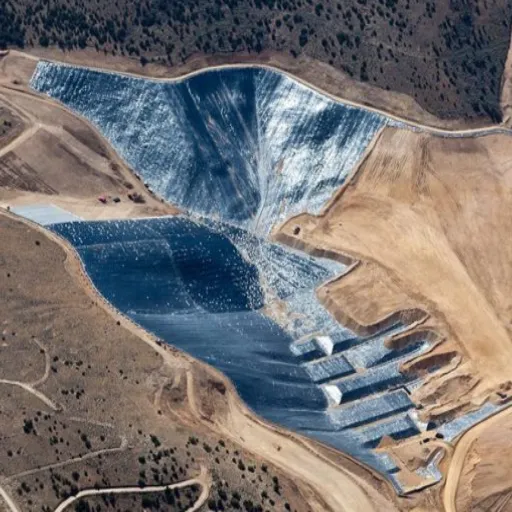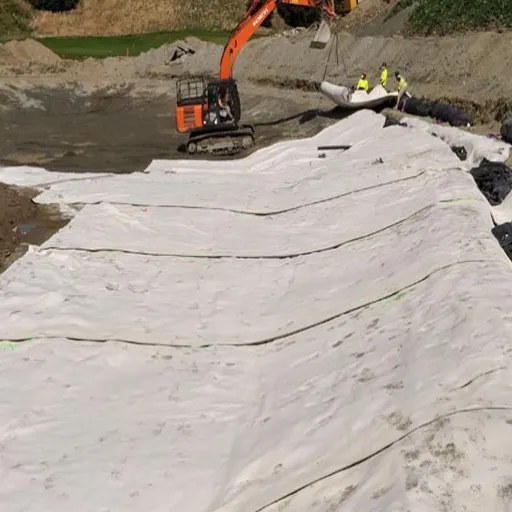
Temporary access mats for soft ground distribute vehicle and equipment loads over soil that cannot support the same weight on its own. HDPE and composite panels work well on saturated clay and mud; timber or floating systems are often better for peat bogs and marshes. The deciding factors are soil bearing capacity, environmental sensitivity, and whether the mats will be removed and reused. This guide also applies to temporary access mats for wetlands, wetland access mats, swamp access mats, and soft ground access mats where low-bearing-capacity soil is the main constraint.
For a full overview of mat types and load principles, see our complete temporary roadway mats guide.
Key Takeaways
- Temporary access mats for soft ground reduce ground pressure by spreading loads over a larger footprint.
- Saturated clay, peat, marsh, and loose fill each need a different mat type and subgrade preparation.
- Soft ground reduces effective mat capacity by 30–50%; the mat is only as good as the soil beneath it.
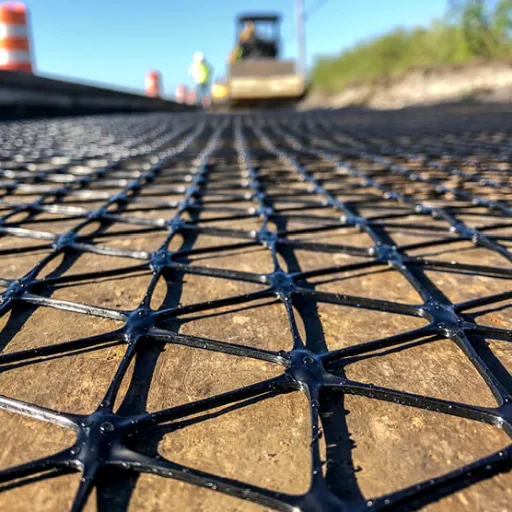
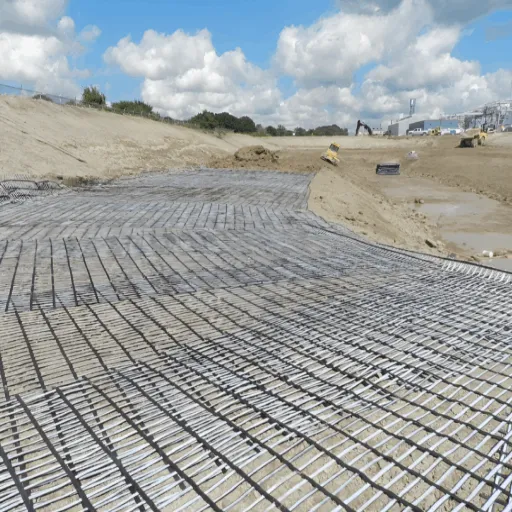
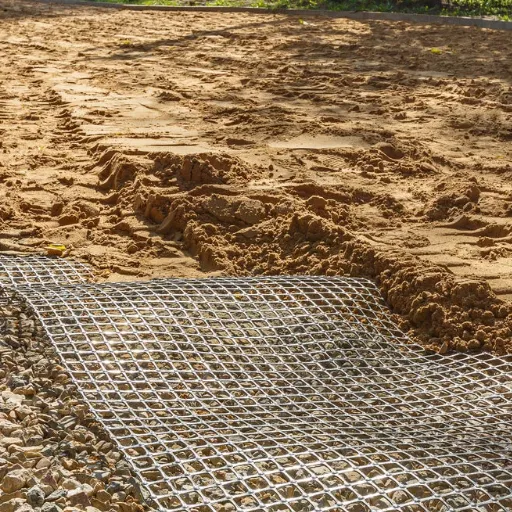
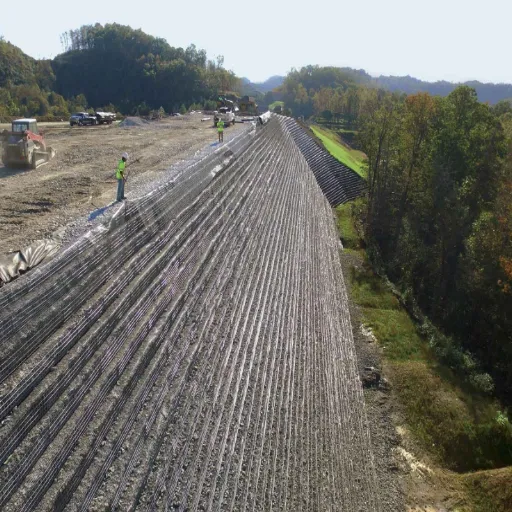
- Geotextile separation, geogrid reinforcement, and aggregate working platforms are the standard subgrade toolkit.
- Wetland projects require permits, timing restrictions, wash-down protocols, and a reinstatement plan.
Temporary access mats for soft ground only work when the subgrade is prepared: vegetation cleared, geotextile laid, and panels placed with staggered joints.
What Are Temporary Access Mats for Soft Ground?
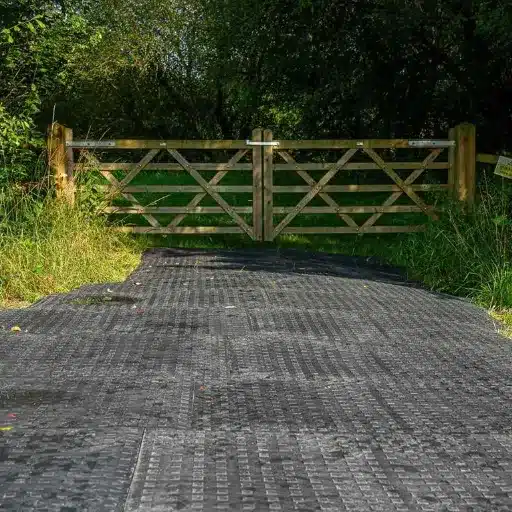
Temporary access mats for soft ground are load-spreading panels that keep vehicles, cranes, and haul trucks from sinking or rutting in low-bearing-capacity soil. They are used on construction sites, pipeline corridors, wind farms, solar farms, and utility projects where the native ground is wet, loose, or protected.
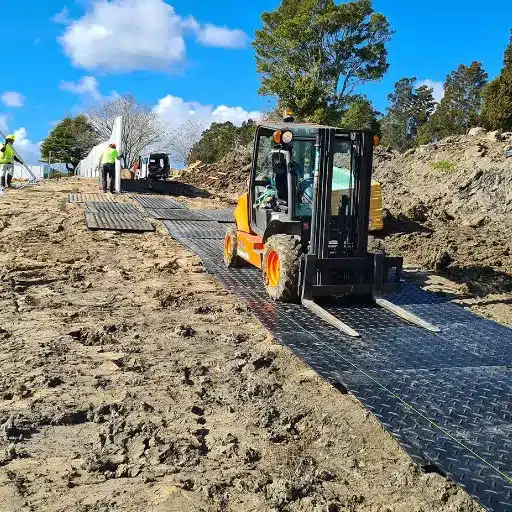
The mat does not eliminate ground pressure; it redistributes it. A crawler crane track that would sink directly into peat can sit on a mat system that spreads the same load across several square meters. For a full installation walkthrough, see our temporary roadway mat installation guide.
Soft Ground Types and How They Affect Temporary Access Mats
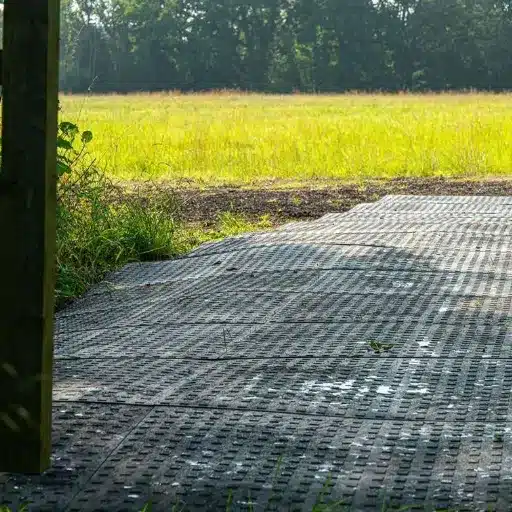
Saturated Clay and Silt
Saturated clay has low shear strength and high moisture content. It ruts easily under repeated passes. Standard HDPE mats work only if a separation layer and possibly a thin aggregate bed are placed first. Composite mats handle the point loads better but still need subgrade support. This is the most common scenario for temporary roadway mats for muddy conditions.
Peat and Organic Soil
Peat is highly compressible and has very low bearing capacity, sometimes below 10 kN/m². It is also environmentally sensitive. Composite mats spread loads over a wide area, but severe peat often needs a geogrid-stabilized working platform or a timber/floating solution.
Marsh and Wetland
Marsh areas have standing water and fragile vegetation. Floating or amphibious mat systems maintain water flow beneath the roadway and minimize habitat disturbance. Timber bog mats are sometimes used for single crossings where mats may be left in place. For the engineered-vs-timber trade-off, see timber bog mats vs temporary roadway mats. This is the primary use case for swamp access mats and other wetland access mats.
Sand and Loose Fill
Sand has better drainage than clay but can shift laterally under shear. Interlocking HDPE or composite mats with a geotextile separation layer prevent rutting and maintain alignment.
Temporary Access Mats by Ground Type
| Ground Type | Bearing Capacity | Best Mat Type | Subgrade Prep | Notes |
|---|---|---|---|---|
| Saturated clay / silt | Low–medium | Thick HDPE or composite | Geotextile + aggregate | Common during wet seasons |
| Peat / bog | Very low | Composite or timber/floating | Geogrid + geotextile + working platform | High environmental sensitivity |
| Marsh / wetland | Very low | Floating amphibious mats | Minimal site prep | Standing water, permits required |
| Mud / loose silt | Low | Composite or HDPE with aggregate | Geotextile separation | High rutting risk |
| Sand / loose fill | Low–medium | Interlocking HDPE | Geotextile separation | Lateral movement risk |
The global ground protection mats market is projected to grow from USD 1.45 billion in 2025 to USD 2.75 billion by 2034, driven in part by wetter winters and larger infrastructure projects in marginal ground. (FNF Research) Wetter weather is pushing more contractors toward engineered access solutions on soft sites.
How to Prevent Mats from Sinking
Increase the Footprint
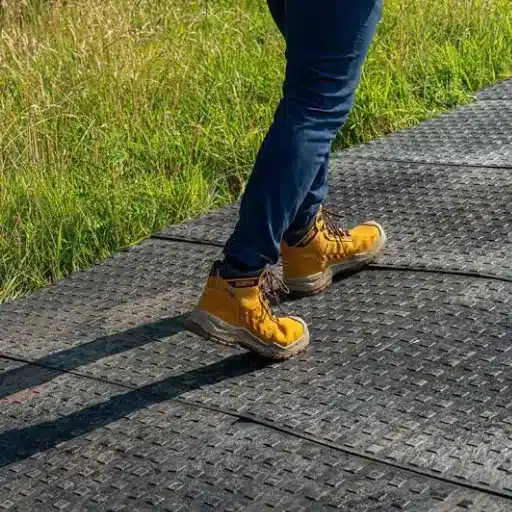
A larger mat or overlapping panel layout spreads the same load over more soil. Composite mats and larger panel sizes outperform small panels on peat and marsh.
Add a Separation Layer
Geotextile prevents the subgrade from pumping up into the mat and stops the mat from punching into the soil. On saturated clay, separation is often the difference between success and rutting. Learn more in our geotextile fabric guide.
Build a Working Platform
For very weak soils, a 150–300 mm layer of aggregate over geogrid and geotextile creates a working platform. The platform carries the mat, and the mat carries the traffic.
Reduce Traffic Speed and Turns
Sharp turns and fast stops create dynamic loads that exceed static ratings. On soft ground, traffic should move slowly, avoid spinning wheels, and minimize turning in place.
Subgrade Preparation Steps
Follow this sequence on soft ground before placing mats:
- Clear vegetation and debris. Remove topsoil, roots, and organic litter without disturbing the subgrade more than necessary.
- Grade to a crowned or level profile. A 1–2% crown helps shed water from the running surface.
- Lay geotextile separation fabric. Extend it beyond the mat footprint so fines cannot migrate around the edges.
- Add geogrid if the CBR is below 3%. Geogrid locks the aggregate and reduces settlement.
- Place 150–300 mm of aggregate if required. This working platform is common on peat and marsh crossings.
- Install mats with staggered joints. Avoid continuous seams that create weak lines across the roadway.
- Anchor edges on slopes and curves. Connection systems and edge bars prevent migration.
Installation Best Practices for Wetlands
Minimize Habitat Disturbance
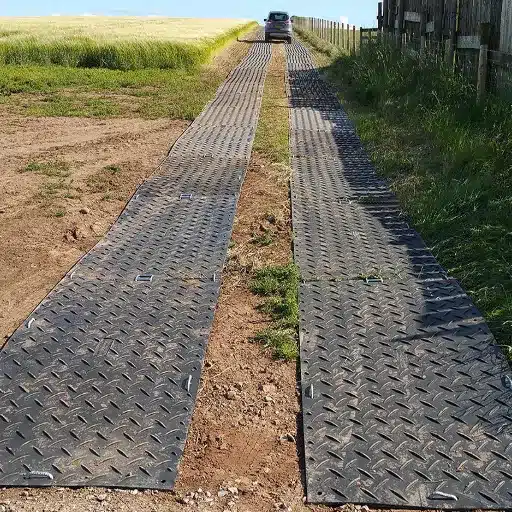
Limit the access width to the minimum needed for equipment. Use wider mats rather than wider corridors when possible, and avoid repeated detours off the designated path.
Timing Restrictions
Many wetland permits restrict mat placement and removal to non-nesting or low-water seasons. Schedule mobilization around biological windows to avoid permit violations.
Edge Protection and Wash Boards
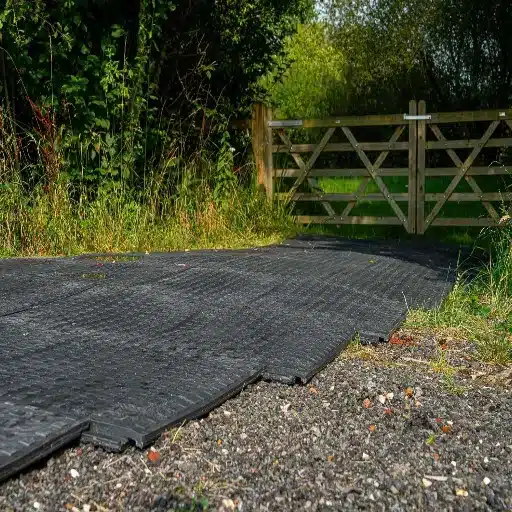
Place timber or composite washboards at entry and exit points to reduce erosion and mat displacement. Edge ramps improve safety and prevent vegetation damage from abrupt mat edges. For connection system guidance, see our article on interlocking temporary roadway mats.
Wash-Down and Biosecurity
Wash mats before moving them between sites to prevent invasive plant and pathogen transfer. HDPE and composite panels are inert and washable; timber can harbor pests and absorb water.
A European wind-farm contractor laid 25 mm composite mats over a geogrid-and-geotextile platform across a peat bog. The 90-ton crawler crane reached every turbine pad, and the mats were pressure-washed, inspected, and shipped to the next project.
Environmental Compliance and Restoration
Permits and Assessments
Wetland access usually requires an environmental impact assessment and a permit. The permit defines corridor width, timing, mat type, monitoring, and mitigation. Begin the permit process before selecting mats.
Mat Removal and Site Reinstatement
Remove mats as soon as they are no longer needed. Fill ruts, regrade to original contours, and replant native vegetation. Photograph the site before, during, and after to document compliance.
Invasive Species Prevention
Timber mats can carry insects, fungi, and seeds across regions. Engineered mats eliminate most of that risk but still need cleaning when moved from contaminated sites.
Washable vs Biodegradable Trade-Offs
Engineered panels are washable and reusable. Timber is biodegradable and sometimes left in place on restoration sites where removal would cause more disturbance. The right choice depends on permit conditions and reuse plans.
Temporary Access Mats Cost on Soft Ground
Soft ground adds cost. Subgrade preparation with geotextile, geogrid, and aggregate can add 20–50% to the installed mat cost. Thicker or composite mats cost more per panel but reduce the risk of sinking and replacement.
A cheap mat on unprepared peat is not cheap. It will sink, rut, and delay the project. A higher-spec mat on a prepared platform is usually the lower total cost once downtime and rework are counted.
Need a soft-ground design for your site? Shanxi Shengxing can recommend mat type, thickness, subgrade layers, and container loading for global delivery. Request a technical quote.
Frequently Asked Questions
What are temporary access mats for soft ground?
Temporary access mats for soft ground are panels that distribute vehicle and equipment loads over weak or saturated soil. They prevent rutting, sinking, and habitat damage on clay, peat, marsh, and loose fill.
Do you need geotextile under mats on soft ground?
Yes, in most cases. Geotextile separates the mat from the subgrade, prevents fines from pumping upward, and helps the mat distribute load evenly. It is standard practice on saturated clay and peat.
How do you stop access mats from sinking?
Increase the load footprint with larger or composite mats, add a geotextile separation layer, build a geogrid-and-aggregate working platform, and reduce traffic speed and sharp turns on the mat road.
What thickness mat do I need for soft ground?
Thicker mats are generally needed on soft ground because the soil provides less support. A 20–25 mm HDPE mat or a 38 mm+ composite mat is common for medium-to-heavy equipment on saturated clay. For extreme loads on peat, a working platform is usually required regardless of mat thickness.
Can you use HDPE mats on peat bogs?
Thin HDPE panels are usually insufficient on peat. Thick HDPE or, more often, composite mats over a geogrid-stabilized working platform are the engineered solution. Timber or floating systems are alternatives where permitted.
Do wetland access mats require permits?
Yes. Most wetland projects require environmental permits that specify corridor width, mat type, installation timing, monitoring, and site restoration. Always check local regulations before mobilizing.
How do you restore ground after removing mats?
Fill ruts, regrade to original contours, replace topsoil, and replant native vegetation. Document the site with photos before, during, and after to demonstrate compliance with permit conditions.
Are composite mats better than timber for wetlands?
Composite mats are better for reusable wetland access because they are washable, inert, and reusable. Timber is biodegradable and sometimes acceptable for single-use crossings where mats may be left in place. The choice depends on permit conditions and project duration.
Conclusion
Temporary access mats for soft ground work are only used when the mat, the subgrade, and the environmental plan are designed together. Saturated clay needs separation and aggregate. Peat needs a working platform or flotation. Marsh needs permits, timing discipline, and restoration planning. The mat is only as good as the ground beneath it.
Match the mat type to the soil, prepare the subgrade, follow the permit, and plan for removal and reinstatement. That is the difference between a temporary road that survives the season and one that becomes a costly remediation.
For project-specific recommendations, contact Shanxi Shengxing engineering support. We provide material selection, subgrade design guidance, container-loading plans, and volume quotes for global delivery.
Request a technical quote or browse our HDPE temporary roadway mats catalog to get started.