Geogrid for a driveway typically costs $0.30 to $0.90 per square metre ex-works, $0.35 to $0.50 per square foot at retail, or about $1 to $4 per square metre installed as a line item. On a full driveway project, the grid usually accounts for 5 to 10 percent of the budget. Stone, excavation and labour make up the rest.
That range sounds useless until you see why it’s there.
Consider Mark, a homeowner in Ohio who received two quotes for the same 120 m² gravel drive. One contractor listed “geogrid” at $380. The other listed “stabilization grid” at $3,900.
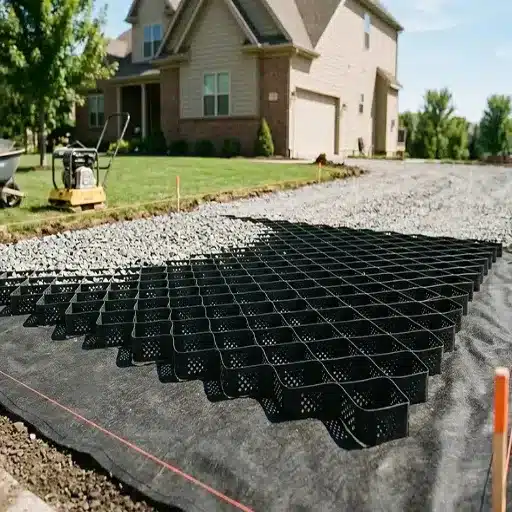
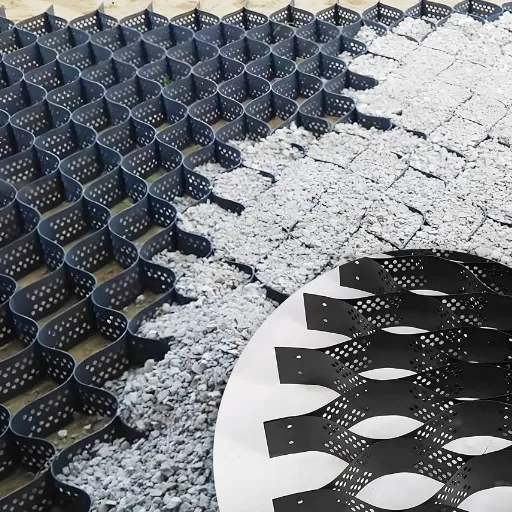
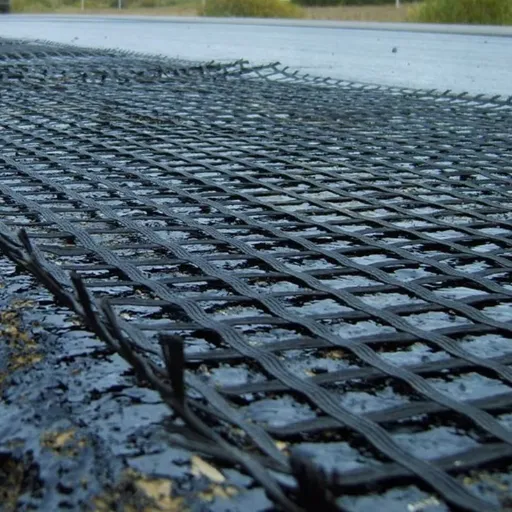
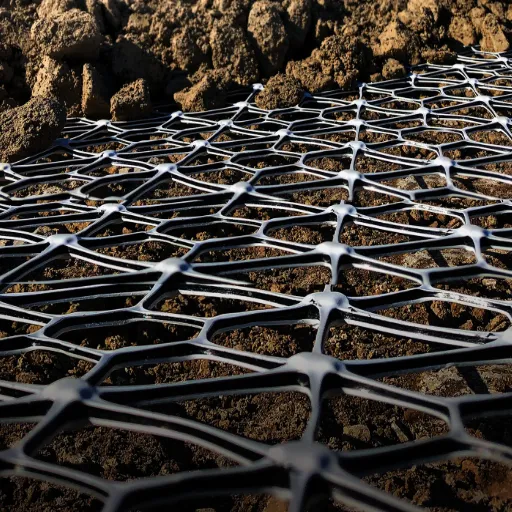
Both quotes were honest. The first priced a roll of biaxial geogrid. The second priced a honeycomb gravel paver, a different product that sits at the surface and does a different job.
The geogrid driveway cost question is really a scope question. Once you know which scope you’re buying, the numbers stop contradicting each other.
If you have a quote in hand and the number feels too low or too high, you’re right to check it. This guide builds the budget from the ground up: the line items, three worked examples, the break-even math against adding more stone, and the eight things a credible quote should itemize. For the design method behind the depth figures, the complete guide to geogrid for road bases and driveways covers the CBR charts and installation protocol.
Key Takeaways
- Grid material runs $0.30–$0.90/m² ex-works or $0.35–$0.50/sq ft at retail; installed as a line item it adds roughly $1–$4/m².
- On a 120 m² clay driveway, the grid is about 7% of an $8,600 budget. Stone, earthworks and compaction are most of the rest.
- At a 30% base reduction, retail grid roughly breaks even on stone savings at a 200 mm base and pays above 250 mm.
- On firm, well-drained ground, geogrid often does not pay back. On soft clay, it pays through avoided rework and maintenance.
- A honeycomb gravel grid is not a geogrid. It can cost ten times more and solve a different problem.
How Much Does a Geogrid Driveway Cost?
Geogrid for a driveway costs about $0.30–$0.90/m² ex-works, $0.35–$0.50/sq ft at retail, or $1–$4/m² installed as a line item. A full driveway budget including stone, excavation and labour commonly runs $4–$10/sq ft, with the grid at 5–10 percent of the total.
The geogrid cost for driveway projects is usually quoted in one of four scopes. They are easy to confuse because suppliers rarely label them.
| What you are pricing | Unit | Typical range | What it includes |
|---|---|---|---|
| Ex-works material | $/m² | $0.30–$0.90 | Grid only, 1,000 m²+ order, no freight |
| Retail roll | $/sq ft | $0.35–$1.50 | Grid only, small quantity, brand markup |
| Installed line item | $/m² | $1.20–$4.20 | Grid plus placement, large-project bid data |
| Full driveway | $/sq ft | $4–$10 | Grid, stone, excavation, labour, compaction |
The installed line comes from state DOT bid data compiled by the ASCE Geo-Institute, where geogrid in-place prices ran $1.00–$3.52/sq yd in 2009–10.
The same 100 m² driveway can carry a $30 grid line, a $1,600 grid line, or a $10,800 total. All three can be correct.
Most homeowners land in the retail band. A light biaxial grid at $0.35–$0.50/sq ft costs about $380–$540 for 100 m² before overlap. That’s the number to use when you’re standing in a builder’s merchant or ordering a short roll online. If you’re comparing suppliers, the geogrid driveway cost per square foot is the cleanest number to normalize.
For the full unit-price tables by polymer, strength class and order volume, see geogrid cost per square meter. That page covers the export pricing and container economics this one deliberately leaves out.
If you already have dimensions and a soil description, request a technical quote and we will price the grid and separator against your actual area.
The Full Cost Breakdown: What Goes Into a Geogrid Driveway
A complete geogrid driveway cost breakdown starts with the line items. A stabilized gravel driveway cost includes the grid, separator, stone, excavation, labour and contingency. The grid is one line in a longer invoice. Here is the rest, priced per square metre and per square foot at 2026 rates.
| Line item | $/m² | $/sq ft | Notes |
|---|---|---|---|
| Geogrid, retail | $3.80–$5.40 | $0.35–$0.50 | Light biaxial, 15–30 kN/m |
| Separator geotextile | $0.40–$1.00 | $0.04–$0.09 | Clay and silt only |
| Crushed stone, 150 mm | $7.70–$11.50 | $0.72–$1.07 | At $30–$45/ton |
| Crushed stone, 200 mm | $10.20–$15.30 | $0.95–$1.42 | At $30–$45/ton |
| Excavation and grading | $10.80–$21.50 | $1.00–$2.00 | Site-dependent |
| Labour and compaction | $10.80–$21.50 | $1.00–$2.00 | Contractor rates |
| Haulage | $50–$100/load | n/a | Not a per-m² cost |
| Contingency | 10–15% | n/a | Always include |
The arithmetic is simple, but two multipliers catch people out.
Overlap. Grid panels must overlap. Allow 10 percent on firm ground and 15 percent on soft ground, where the overlap runs from 300 mm to 600–900 mm. A 100 m² drive needs 110–115 m² of grid.
Compaction. Stone is ordered by loose volume, not compacted depth. A 200 mm compacted base needs roughly 260 mm of loose stone, about 1.3 times the finished thickness.
The full formula is:
- Grid quantity = area × (1 + overlap allowance)
- Stone volume = area × compacted depth
- Stone tonnage = volume × 1.7
- Stone cost = tonnage × price per ton
- Total = grid + separator + stone + excavation + labour + haulage + contingency
The stone specification matters as much as the price. Angular, well-graded crushed stone interlocks with the grid; rounded pea gravel does not. If you’re unsure what to order, aggregate for geogrid base course explains the gradation and aperture match.
Excluded from this model: drainage works, edging, permits, and removal of an old surface. On a failed drive, those can add more than the grid ever will.
Three Worked Geogrid Driveway Budgets
These three geogrid driveway cost examples use one set of assumptions. Change the stone price or the labour rate and the answer moves, which is the point.
Assumptions: crushed stone $40/ton, bulk density 1.7 t/m³, retail grid $4.30/m², separator $1/m², excavation and grading $21.50/m², contractor labour and compaction $21.50/m², 10 percent contingency, USD, excluding tax.
| Line item | 50 m² DIY, firm, 150 mm | 120 m² contractor, soft clay, 225 mm + separator | 200 m² contractor, medium, 175 mm |
|---|---|---|---|
| Geogrid | $237 | $593 | $989 |
| Separator | n/a | $132 | n/a |
| Stone | $510 | $1,836 | $2,380 |
| Excavation and grading | $1,077 | $2,584 | $4,306 |
| Labour and compaction | DIY; $200 equipment | $2,584 | $4,306 |
| Haulage | included | $150 | $300 |
| Contingency 10% | $202 | $788 | $1,228 |
| Total | ≈$2,225 | ≈$8,666 | ≈$13,509 |
| Per m² | $44.50 | $72.20 | $67.55 |
| Per sq ft | $4.13 | $6.71 | $6.28 |
These are budgeting examples, not quotes. Local stone, labour and haulage prices can move the totals by 20–30 percent.
The pattern matters more than the exact numbers. The grid is about 11 percent of the 50 m² DIY job, 7 percent of the 120 m² job and 7 percent of the 200 m² job. Stone, earthworks and compaction are 70–85 percent of every budget.
That’s the core insight of geogrid driveway cost: the grid isn’t the expensive part. The base is.
Priya, a homeowner outside Toronto, learned this the expensive way. Her first quote for a 120 m² clay drive was $9,400, with a heavily upgraded grid.
When the quote was itemized, the grid was $593 and the earthworks were over $5,000. She kept the standard biaxial grade, added a separator, and put the savings into better stone and compaction. The drive hasn’t rutted in two winters.
Whether your own base can be reduced is a soil question, not a shopping question. Whether geogrid works on your gravel driveway walks through the depth by soil class.
Does Geogrid Pay for Itself? The Break-Even Math
Geogrid pays for itself when the stone it saves costs more than the grid. That depends on three things: the base depth, the base course reduction the design can actually claim, and the price you pay for the grid.
The published base course reduction range is 20–50 percent, with 20–40 percent the figure most design guides converge on. The method behind those figures comes from USACE ETL 1110-1-189 and the Giroud and Han design approach.
The formula is:
Stone saved = base depth × BCR × bulk density × stone price
At a 30 percent BCR, 1.7 t/m³ and $40/ton stone, the numbers look like this:
| Base depth | Stone saved at 30% BCR | Value at $40/t | Retail grid cost | Verdict |
|---|---|---|---|---|
| 150 mm | 45 mm | $3.06/m² | $4.30/m² | Marginal |
| 200 mm | 60 mm | $4.08/m² | $4.30/m² | Break-even |
| 250 mm | 75 mm | $5.10/m² | $4.30/m² | Pays on stone alone |
| 300 mm | 90 mm | $6.12/m² | $4.30/m² | Pays |
Three qualifications change the answer.
First, at wholesale prices of $0.30–$0.90/m², the grid pays at every depth. That’s why contractors and road projects see a clear return and a homeowner buying one roll often doesn’t.
Second, at premium retail prices of $16/m², the grid doesn’t pay on stone alone at any residential depth. A high-strength grid on a light driveway is usually over-specification.
Third, the table assumes the design actually reduces the section. If the engineer or contractor keeps the full base and adds the grid, there’s no stone saving. You’re buying confinement and maintenance benefits, not a thinner pavement.
Maintenance is the part the stone math misses. A 100 m² drive that needs a 25 mm top-up every two years consumes about 4.25 tons of stone per top-up, or roughly $170 at $40/ton. Over ten years, five top-ups cost about $850.
If the grid halves that, the saving is roughly $425, close to the $430–$470 retail grid cost for 100 m². The bigger win is avoiding a base failure that would cost thousands to rebuild.
The honest verdict: on firm, well-drained ground, geogrid driveway cost is often money you do not need to spend. On soft clay or silt, it pays through avoided rework and lower maintenance, even when the first-build stone saving is modest.
Send us your subgrade description and traffic type, and we will tell you whether the section can actually be reduced. Request a technical quote.
Geogrid Driveway Cost: DIY vs Contractor
The geogrid driveway installation cost is mostly labour, compaction and stone, not the grid itself. DIY can save 20–40 percent of the total, but only if you own or rent the right compaction equipment and have the time to place stone in lifts.
| Item | DIY | Contractor |
|---|---|---|
| Grid material | Retail | Retail plus 10–20% |
| Stone | Delivered | Delivered plus markup |
| Excavation | Rented equipment | Included |
| Compaction | Plate compactor or roller rental | Included |
| Labour | Your time | $1–$3/sq ft |
| Risk | You own it | Warranty |
| Typical saving | 20–40% | n/a |
DIY is a false economy in four situations: soft clay that needs a separator and careful proof-rolling, a drive larger than about 100 m², no access to a roller or heavy plate compactor, and a tight timeline that forces you to skip lifts.
Tom, a retired engineer in rural Vermont, installed a 50 m² drive himself in 2024. He rented a plate compactor and saved about $900 on labour.
He skipped the proof roll because the ground looked firm. The first spring, the edge rutted where the subgrade had been soft.
Rebuilding the edge cost $600, and he still had to buy more stone. The grid was fine. The preparation was not.
How to Read a Geogrid Driveway Quote
A credible quote itemizes eight things:
- Area and compacted base depth
- Grid type, grade and strength at 2% strain
- Overlap allowance and roll coverage
- Separator specification, if clay or silt
- Stone gradation and compacted depth
- Excavation, disposal and haulage
- Compaction method and lift thickness
- Exclusions and contingency
Four red flags should stop you:
- A per-roll price with no coverage area
- A product described as geogrid that is actually a honeycomb paver
- No compaction method or lift thickness
- No contingency, or a total that excludes excavation and haulage
If you’re unsure which grade belongs on a residential drive, what geogrid for driveway decodes the 15-15 to 50-50 naming and maps it to traffic.
Geogrid Driveway Cost vs More Gravel vs Gravel Grid
A geogrid driveway cost comparison has to put three options on the same basis. The geogrid vs more gravel cost comparison usually settles the argument. Here is the 100 m² comparison.
| Option | Upfront cost, 100 m² | What it fixes | What it doesn’t |
|---|---|---|---|
| Add 50 mm gravel | ~$340 stone + labour | Raises the surface, buys time | Ruts return, stone still punches in |
| Geogrid + separator | ~$580 materials + stone | Stops punching, reduces top-ups | Does not fix drainage |
| Gravel grid paver | $3–$7/sq ft = $3,200–$7,500 | Surface retention, aesthetics | Not reinforcement |
The Fixr gravel driveway guide is worth naming here. It lists a stabilized drive at $4–$10/sq ft, with a “stabilizer grid” adding $3–$7/sq ft.
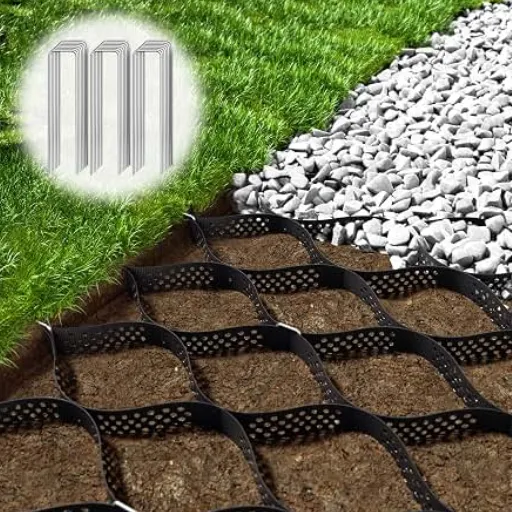
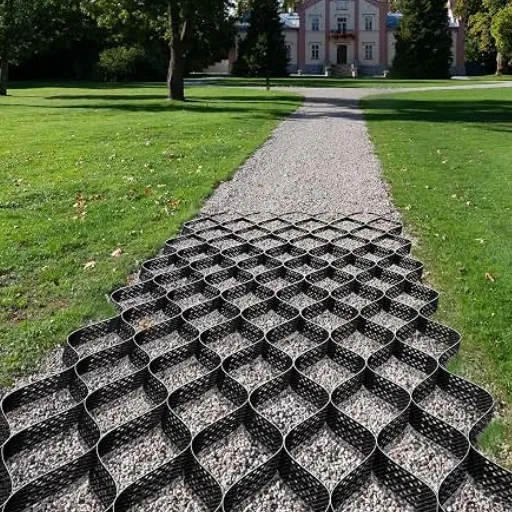
That grid is a honeycomb paver, not a geogrid. It confines the surface stone and looks tidy, but it doesn’t reinforce the base. A quote built on it will look ten times higher than a geogrid quote, and it will be answering a different question.
Geocell is a third product. It confines stone in three dimensions and usually costs more than a geogrid. It suits steep slopes and heavy confinement, not a typical residential drive.
If the real problem is water, none of these options fixes it. Drainage comes first, then separation, then reinforcement.
Frequently Asked Questions
How much does geogrid cost for a driveway?
Grid material costs about $0.30–$0.90/m² ex-works, or $0.35–$0.50/sq ft at retail. Installed as a line item, expect $1–$4/m². On a full driveway, the grid is typically 5–10 percent of the project budget.
Is geogrid worth the cost for a gravel driveway?
It’s worth it on soft, wet or clay ground where ruts return and stone disappears. On firm, well-drained ground, the benefit is small and may not cover the cost. Fix the drainage first if water is the real problem.
How much does geogrid add to a driveway project?
At retail, about 5–10 percent of a contractor-built driveway budget. At wholesale or project scale, it can be 1–2 percent. The grid is a small line item compared with stone, excavation and labour.
Geogrid vs gravel grid: which is cheaper?
A honeycomb gravel grid costs $3–$7/sq ft, while a biaxial geogrid costs $0.35–$0.50/sq ft. They do different jobs. The gravel grid retains surface stone; the geogrid reinforces the base. Compare them only after you know which problem you have.
How much geogrid do I need for a 100 m² driveway?
Order 110–115 m² to allow for overlap. On firm ground, 10 percent is enough. On soft ground, allow 15 percent for 600–900 mm overlaps. Check the roll width and length before you calculate the number of rolls.
Can I install geogrid myself to save money?
Yes on a small, firm site with rented compaction equipment and time to work in lifts. No on soft clay, a large drive, or a tight timeline. Poor compaction costs more to fix than the labour you save.
Conclusion
Three numbers decide geogrid driveway cost. The grid itself is small, usually $0.35–$0.50/sq ft at retail. The base is large, often 70–85 percent of the project. The payback depends on the subgrade, not the product label.
On soft ground, the grid earns its place by stopping stone from punching into the subgrade and by cutting the annual top-up loop. On firm ground, it is often optional. Either way, the budget should be built from the ground up, not from a per-square-metre headline.
If you’re comparing quotes, ask for the eight items above and check whether the “geogrid” is actually a geogrid. That one question separates a $580 materials line from a $7,500 surface system.
A useful geogrid driveway cost estimate starts with your dimensions and soil, not a national average. Ready to price your drive? Request a technical quote with your dimensions, soil description and traffic type. We’ll return a grade recommendation and an itemized budget, not a single number with no basis.