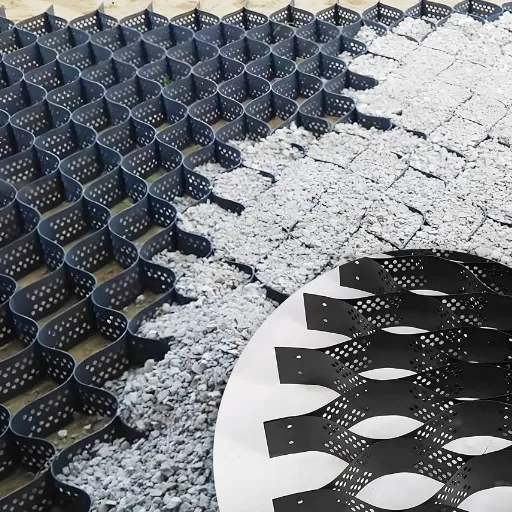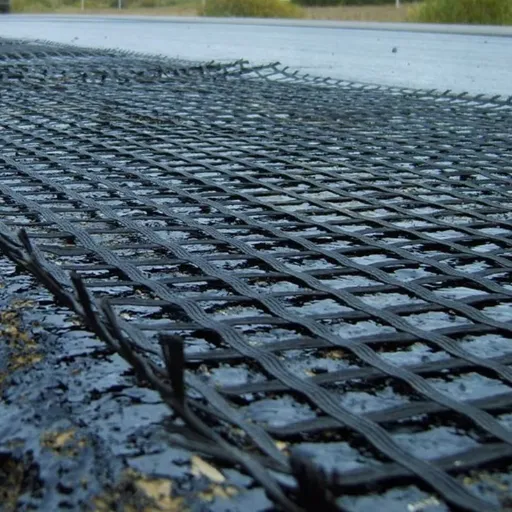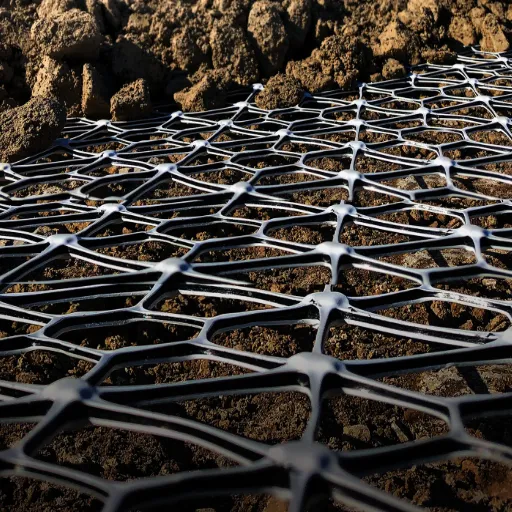
Place 100 to 150 mm (4 to 6 in) of compacted angular stone over geogrid for cars on firm ground. Use 150 to 200 mm on medium soil and 200 to 250 mm on soft clay, plus a separator fabric. Never place less than 100 mm.
That is the short answer to how much gravel over geogrid you need. The longer answer starts at the quarry counter, where nobody sells depth. They sell tonnes.
A 50 m² drive can follow every guide online, choose the right 150 mm base, and still come up two tonnes short. The missing step is almost always the same: compacted depth is not the same as the loose stone you order.
This guide gives you both. You will see the minimum cover over geogrid, the depth that suits your subgrade, and the exact volume-to-tonnage math. There is a reference table, three worked examples, and a calculation method you can check in a few minutes. The design logic follows our guide to geogrid for road base and gravel driveways.
Key Takeaways
- Minimum cover is 100 mm (4 in) compacted; 150 mm (6 in) is the practical minimum for vehicle traffic.
- Cars on firm ground need 100 to 150 mm; medium soil 150 to 200 mm; soft clay 200 to 250 mm plus a separator.
- Order 1.3 times the compacted volume if buying by volume, but never add 30% to the tonnage.
- At 100 mm, one tonne covers about 5 m²; at 200 mm, about 2.5 m².
- A 50 m² drive at 100 mm needs about 11 tonnes with waste; a 200 m² drive at 200 mm needs about 88 tonnes.
How Much Gravel Goes Over Geogrid? The Short Answer
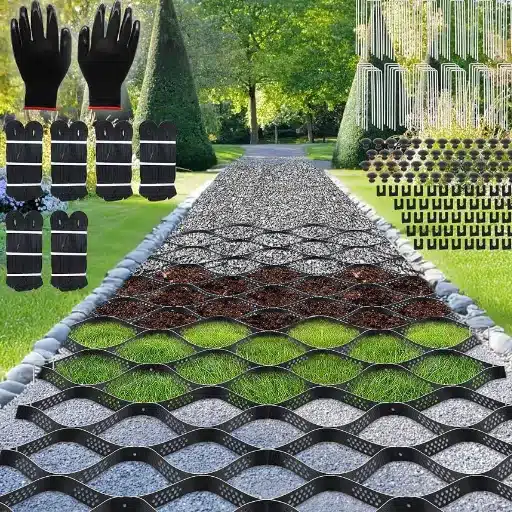
The minimum cover is 100 mm (4 in) of compacted angular stone. For any vehicle traffic, treat 150 mm (6 in) as the practical minimum. Below 100 mm, the grid is damaged during placing and cannot develop tension.
Use this table as the starting point:
| Ground condition | Compacted gravel over grid | Typical use |
|---|---|---|
| Firm, well drained | 100 to 150 mm (4 to 6 in) | Cars and light SUVs |
| Medium | 150 to 200 mm (6 to 8 in) | Cars and light trucks |
| Soft clay or silt | 200 to 250 mm (8 to 10 in), plus separator | Cars and light trucks |
| Very soft or organic | 300 mm+ (12 in+), two lifts | Geotechnical advice first |
Three rules sit above the table.
First, never place less than 100 mm of compacted cover. The grid needs stone above it to transfer load and to protect it from traffic.
Second, make the first lift about 150 mm loose. That compacts to roughly 115 mm, enough to hold the grid flat while you place the rest.
Third, compact in 150 to 200 mm loose lifts. Thicker lifts trap loose stone at depth, and the base will rut even with the grid in place.
Depth is set by the subgrade and traffic, not by the grid. The grid lets you reduce the thickness a competent design would require. It does not let you skip the base.
Consider a homeowner we will call Daniel. He had a 50 m² drive, ordered 8 tonnes because a neighbor said “two loads,” and spread it 100 mm loose. That compacted to about 75 mm, below the minimum.
The grid was exposed at the edges after the first wet week. His second order of 4 tonnes came with a small-load surcharge, so the correction cost more than the original delivery.
If you want the depth checked against your soil before you order, send your dimensions to our engineering team for a technical quote.
Gravel Depth by Subgrade and Traffic
The table above is a summary. The full version separates cars from light trucks and shows the unreinforced thickness for comparison.
| Subgrade CBR | Cars and light vans (over grid) | Light trucks (over grid) | Without grid (light trucks) |
|---|---|---|---|
| Firm, 8 or above | 100 to 150 mm | 150 to 200 mm | 200 to 250 mm |
| Medium, 4 to 8 | 150 to 200 mm | 200 to 250 mm | 250 to 300 mm |
| Soft, 2 to 4 | 200 to 250 mm plus separator | 250 to 300 mm | 300 to 350 mm |
| Very soft, below 2 | 300 to 400 mm, two lifts | 350 to 450 mm | 400 to 500 mm |
CBR stands for California Bearing Ratio. It measures how much load a soil can carry before it deforms. A CBR of 2 is soft, wet clay. A CBR of 10 is firm, compacted granular soil.
You do not need a lab test for a driveway. Strip the topsoil, let the subgrade drain, then walk across it after rain. If your boots sink 25 mm or more, treat it as soft. A proof roll with a loaded truck does the same job on a larger site.
Two adjustments matter:
- Add a separator on clay or silt. A nonwoven geotextile under the grid stops fines from pumping into the stone. Without it, the base loses drainage and the grid loses support. Our guide to geogrid for a driveway on clay soil covers the layered fix.
- Add 50 to 100 mm in frost regions. Frost-susceptible silts and fine sands draw water upward and lose strength during thaw. The grid does not stop frost heave, but a thicker section helps.
The ranges follow USACE ETL 1110-1-189, the Corps’ guidance on geogrid in pavement construction, adjusted for residential traffic. For the design method behind these numbers, see the full geogrid road base guide. For the decision of whether your driveway needs geogrid at all, see geogrid for a gravel driveway.
How Much Gravel Over Geogrid: Volume and Tonnage Math
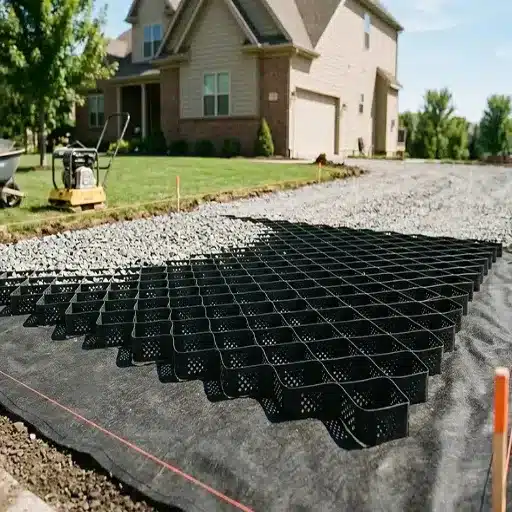
Depth is only half the order. The other half is volume, and volume is where most quotes go wrong.
Use this six-step method.
1. Measure the area. Multiply length by width in metres. Subtract any area that will not receive stone, such as a planted island or a concrete apron.
2. Choose the compacted depth. Use the table in the previous section. Write it in metres, so 150 mm becomes 0.15 m.
3. Calculate compacted volume. Multiply area by depth.
4. Convert to loose volume. Multiply the compacted volume by 1.3. Loose stone settles as it compacts, so you need more volume than the finished layer.
5. Convert to mass. Multiply the compacted volume by 2.0 t/m³. This is the design default for well-graded crushed stone. Your supplier’s stone may run from 1.9 to 2.1 t/m³, so confirm it on the quote.
6. Add waste. Add 5 to 10% for edges, settlement and an uneven subgrade. Round up to the next full tonne or truckload.
Here is the reference table for common depths:
| Compacted depth | Compacted volume per m² | Loose volume per m² | Approx. mass per m² | Coverage per tonne |
|---|---|---|---|---|
| 100 mm (4 in) | 0.10 m³ | 0.13 m³ | 0.20 t | 5.0 m² |
| 150 mm (6 in) | 0.15 m³ | 0.20 m³ | 0.30 t | 3.3 m² |
| 200 mm (8 in) | 0.20 m³ | 0.26 m³ | 0.40 t | 2.5 m² |
| 250 mm (10 in) | 0.25 m³ | 0.33 m³ | 0.50 t | 2.0 m² |
| 300 mm (12 in) | 0.30 m³ | 0.39 m³ | 0.60 t | 1.7 m² |
The mistake to avoid: 1.3 is a volume factor, not a weight factor. Compaction does not create or destroy stone. If you multiply the tonnage by 1.3, you over-order by 30%.
A landscaper we will call Priya nearly made that mistake on a 200 m² shared drive. Her first pass produced 80 tonnes, then she multiplied by 1.3 and added 10% waste. The total came to 114 tonnes.
The correct order was 80 tonnes plus 10%, or 88 tonnes. The 26-tonne difference was enough to fill a small tipper, and it would have made her quote 20% higher than the contractor who won the job.
Ordering by weight or by volume
Ask the supplier how they sell before you calculate.
- By tonne: use the compacted volume and the 2.0 t/m³ default. Do not apply 1.3.
- By cubic metre or cubic yard: order the loose volume, which already includes the 1.3 factor.
- By bulk bag: one tonne is roughly 0.65 m³ loose. Round up.
- By truckload: confirm the payload locally. A six-wheel tipper is often 10 to 12 tonnes, and an eight-wheel 15 to 20 tonnes. These vary by region.
In US units, one short ton covers about 100 ft² at 2 inches. That rule matches the metric table, so you can use either one.
Ordering and placing the stone
A correct quantity still fails if the stone is placed badly.
Back-dump from the far end and push the stone forward with the blade. Never drive a wheeled or tracked machine directly on exposed grid. Keep at least 150 mm of cover ahead of the machine.
Lay the grid taut, with 300 mm overlaps on firm ground and 600 to 900 mm on soft ground. Add edge restraint so the base cannot spread sideways. Shape a crown of 2 to 3% so water runs off, and cut side ditches where the ground is flat.
If you want a quantity and a grid grade checked together, request a technical quote with your area, depth and soil description.
Worked Examples: 50 m², 120 m² and 200 m² Driveways
These examples use the method above. They are illustrative, not project case studies.
50 m² driveway, firm ground, car, 100 mm
- Compacted volume: 50 × 0.10 = 5.0 m³
- Loose volume: 5.0 × 1.3 = 6.5 m³
- Mass: 5.0 × 2.0 = 10.0 t
- With 10% waste: 11.0 t
In US units, 60 yd² at 4 in is about 6.7 yd³ compacted, or 8.7 yd³ loose. That is roughly 11 short tons before waste.
On firm ground, the grid may not pay for itself. The 100 mm figure is the minimum, not a target. If the drive drains well and has never rutted, a separator fabric or a thicker surface layer may be the better spend.
120 m² driveway, soft clay, car, 250 mm plus separator
- Compacted volume: 120 × 0.25 = 30.0 m³
- Loose volume: 30.0 × 1.3 = 39.0 m³
- Mass: 30.0 × 2.0 = 60.0 t
- With 10% waste: 66.0 t
In US units, 144 yd² at 10 in is about 40 yd³ compacted, or 52 yd³ loose. That is roughly 68 short tons before waste.
This is the case where the grid earns its cost. The clay needs a separator, and the section needs the full 250 mm. For the layer sequence and the drainage checks, see the clay driveway guide.
200 m² shared drive, light truck, 200 mm
- Compacted volume: 200 × 0.20 = 40.0 m³
- Loose volume: 40.0 × 1.3 = 52.0 m³
- Mass: 40.0 × 2.0 = 80.0 t
- With 10% waste: 88.0 t
In US units, 239 yd² at 8 in is about 53 yd³ compacted, or 69 yd³ loose. That is roughly 90 short tons before waste.
Light trucks change the answer. The depth comes from the traffic table, not from the grid. If the drive also serves as a parking pad for a delivery van, size it as a light-truck section. Our guide to geogrid for parking lots covers turning loads and pad design.
What Size Gravel Goes Over Geogrid?
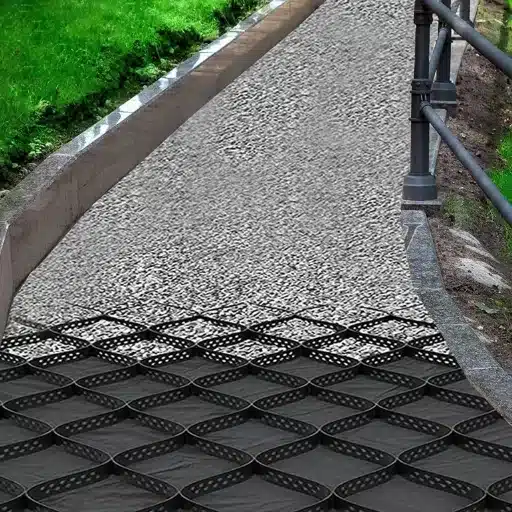
Use angular, well-graded crushed stone, typically 0 to 32 mm or ¾-inch minus. The angular faces interlock with the grid apertures. Rounded pea gravel and river rock do not.
A simple rule: the median aggregate size, or D50, should be roughly half the aperture. A 40 mm aperture suits a 20 mm D50. Too small a stone falls through. Too large a stone bridges the aperture and never interlocks.
| Geogrid aperture | Suitable D50 | Typical stone |
|---|---|---|
| 30 mm | 15 mm | 0 to 20 mm crushed |
| 40 mm | 20 mm | 0 to 32 mm crushed |
| 50 mm | 25 mm | 0 to 40 mm crushed |
The full selection logic, including gradation limits and aperture matching, is in aggregate for geogrid base course. For the grid grade itself, see what geogrid for a driveway.
Can You Put Too Much Gravel Over Geogrid?
There is no structural maximum in the standards. A thicker base does not damage the grid, provided it is compacted in lifts.
There are three practical limits.
Lift thickness. Stone placed deeper than about 200 mm loose does not compact properly. The surface may look firm while the lower layer stays loose.
Cost. Stone beyond the design depth is wasted money. The grid is supposed to reduce the section, not justify a thicker one.
Finished level. Raising the drive can trap water against the house, garage or retaining wall. It can also break the edge detail. Water is the most common cause of driveway failure, and a thicker base does not fix it.
A homeowner we will call Marcus doubled his base from 150 to 300 mm “for safety” on firm, well-drained ground. The extra 15 m³ cost about 30 tonnes of stone and two additional deliveries. The drive performed well, but a 150 mm section with a proper crown would have done the same job for roughly half the stone.
The costly error is too little cover, not too much. Below 100 mm, the grid is damaged during placing and cannot develop tension. If you are unsure, spend the money on drainage and compaction before you spend it on extra stone.
Field trials have shown a 150 mm reinforced base performing like a 250 mm unreinforced base on weak ground (Zornberg, 2014). That is the saving the grid is meant to earn. Manufacturers sometimes quote “up to 50%” thickness reduction, but that figure applies to weak subgrades under repeated heavy loads, not a firm driveway with car traffic (Tensar).
Frequently Asked Questions
How much gravel do I need per square metre over geogrid?
About 0.20 t/m² at 100 mm compacted, 0.30 t/m² at 150 mm, and 0.50 t/m² at 250 mm. If your supplier sells by volume, order 1.3 times the compacted volume. Add 5 to 10% for waste and round up to the next truckload.
What is the minimum cover over geogrid?
100 mm (4 in) of compacted angular stone is the absolute minimum. 150 mm (6 in) is the practical minimum for any vehicle traffic. Below 100 mm, the grid is damaged during placing and by traffic, and it cannot develop tension.
Does gravel go over or under geogrid?
Gravel goes over the geogrid. The grid is laid on the prepared, proof-rolled subgrade, then covered with angular crushed stone. A separator geotextile, if needed, goes under the grid, not over it.
How much does 1 tonne of gravel cover at 100 mm?
About 5 m² at 100 mm compacted, 3.3 m² at 150 mm, and 2.5 m² at 200 mm. In US units, one short ton covers roughly 100 ft² at 2 inches. These figures assume a compacted bulk density of about 2.0 t/m³.
Can you put too much gravel over geogrid?
Not structurally, provided it is placed in lifts under about 200 mm and compacted. But stone beyond the design depth is wasted money, and raising the finished level can trap water. The costly mistake is too little cover, not too much.
Do I need gravel under the geogrid?
No. The grid sits directly on the prepared subgrade so aggregate can interlock through its apertures. A nonwoven separator may go beneath it on clay or silt, but a bedding layer of gravel is not required and can reduce interlock.
Conclusion
The gravel over geogrid question has three answers, and you need all of them.
Use 100 to 150 mm of compacted cover for cars on firm ground. Move to 150 to 200 mm on medium soil and 200 to 250 mm on soft clay, with a separator. Then calculate the order from the compacted volume, convert to loose volume with the 1.3 factor, and add 5 to 10% waste.
Do not apply the 1.3 factor to the tonnage. That single mistake is the difference between a tight quote and an expensive over-order.
If you would rather not run the numbers alone, send us the driveway dimensions, the soil description and the traffic it carries. We will return a quantity, a grid grade and a short installation sequence. Request a technical quote and we will check the math before you order.