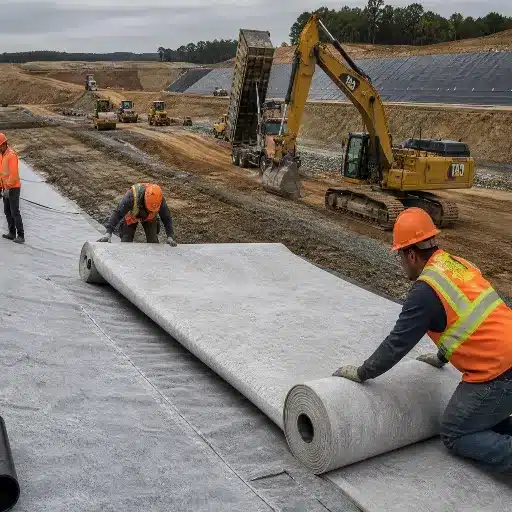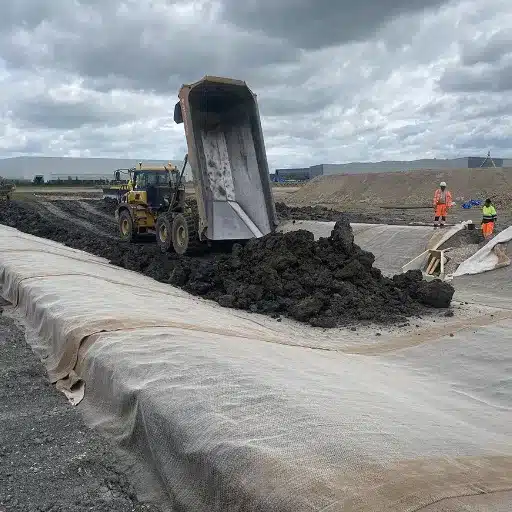
The EPA estimates that construction sites generate 20 billion pounds of sediment runoff every year. Most of that comes from unprotected soil. Ground protection mats prevent 80-90% of erosion on the areas they cover. They’re not just engineering tools. They’re environmental protection measures.
Construction projects damage the environment in three main ways. They compact the soil. They cause erosion. They destroy vegetation.
Most project managers see ground protection as a logistics issue. They focus on keeping equipment moving. But the environmental benefits of ground protection mats go far beyond access roads.
This article explains how ground protection mats protect soil biology. It covers how they preserve vegetation, control erosion, support regulatory compliance, and cut site restoration costs. If you are evaluating ground protection for an environmentally sensitive project, our complete ground protection mats buyer’s guide covers material selection and specs in detail.
Key Takeaways
- Ground protection mats reduce soil compaction, which destroys water infiltration by 70-90% and kills microbial communities
- HDPE mats are 100% recyclable (recycling code #2) with a 10-15 year lifespan, compared to 3-5 years for timber mats
- Mats reduce surface erosion by 80-90% on protected areas, supporting EPA/NPDES compliance
- Turf damage is reduced by 85-95% on mat-protected areas, eliminating costly re-seeding
- Site restoration savings of $15,000-$57,000 are typical on a 500-ft access road project
How Ground Protection Mats Prevent Soil Compaction
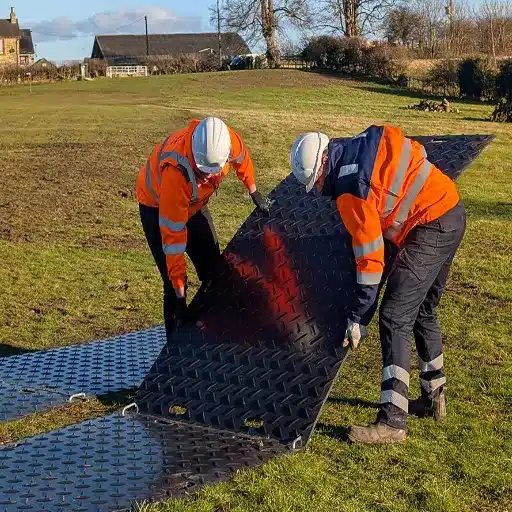
Soil compaction is one of the worst environmental impacts of construction. It’s also one of the hardest to see.
When heavy equipment drives over bare ground, the weight pushes soil particles together. This kills the tiny gaps (pore spaces) that let water, air, and roots move through the soil. It’s one of the most common environmental damages on construction sites.
What Soil Compaction Does to Ecosystems
The USDA Soil Conservation Service reports that compacted soil fails in several ways:
- Water infiltration drops 70-90% because pore spaces collapse
- Surface runoff increases 2-5x, carrying sediment into waterways
- Soil biology dies as microbial communities lose oxygen and habitat
- Root growth stalls because plant roots cannot penetrate dense soil
- Vegetation recovery slows from months to years
A single pass of a 40-ton excavator can compact soil to a depth of 12 inches. Three passes can double that depth. The damage is often invisible until months later, when vegetation fails to recover, and drainage patterns change permanently.
How Mats Distribute Load
HDPE ground protection mats spread heavy loads across a larger area. A tire might create 80-120 psi at one point. The mat spreads across several square feet. This keeps soil pressure low enough to prevent compaction.
The result: soil structure, porosity, and biology remain intact beneath the mat. When the project ends, and the mats are removed, the ground beneath them is in the same condition as before the project started.
Turf and Vegetation Preservation
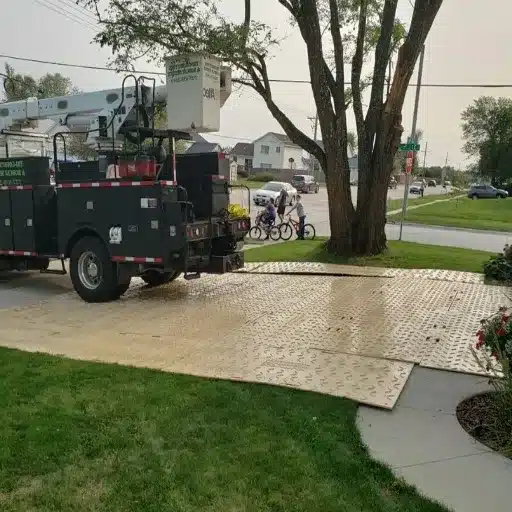
Protecting vegetation is one of the clearest environmental benefits of ground protection mats. Turf and roots are fragile. Heavy equipment destroys them in minutes. But recovery takes months or years.
Protecting Root Systems
Ground protection mats create a barrier between equipment and soil. This barrier protects root zones from direct damage. It also keeps moisture in the soil below the surface. This is critical for root survival during dry periods.
Without mats, one construction season can destroy 90-100% of turf on access routes. With mats, damage stays at 5-15% of the protected area. That’s not a small difference. It’s the difference between a site that recovers on its own and one that needs full re-grading and re-seeding.
Reducing Vegetation Recovery Time
Sites that use ground protection mats consistently require minimal restoration work after project completion. The International Erosion Control Association (IECA) notes that preventing damage is far more cost-effective than repairing it.
When Marcus managed a pipeline installation through agricultural land in Iowa, he used HDPE mats across the entire 2,000-foot access corridor. After the project, the farmer’s field showed almost no visible damage. The neighboring section, which used plywood sheets instead of proper mats, left ruts six inches deep and required $18,000 in soil remediation and re-seeding.
Erosion Control and Stormwater Management
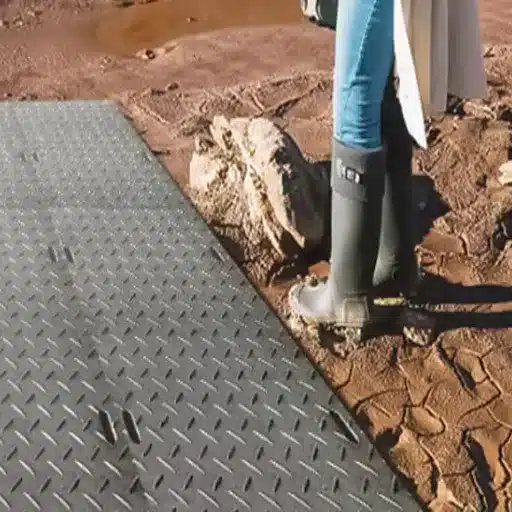
Erosion is a primary environmental concern on construction sites today. Unprotected soil is vulnerable to wind and water erosion, which carries sediment into storm drains, streams, and wetlands.
Preventing Sediment Runoff
Ground protection mats cut surface erosion by 80-90% on covered areas. They act as a shield that stops rain from knocking soil loose. They also direct water flow along controlled paths instead of letting it run across bare ground.
The EPA requires construction sites to use Best Management Practices (BMPs) for erosion control under the NPDES permit. Ground protection mats count as structural BMPs. They directly reduce sediment discharge.
Supporting SWPPP Requirements
Most projects over one acre need a Stormwater Pollution Prevention Plan (SWPPP). Ground protection mats help meet SWPPP rules in several ways:
- Track-out prevention at site entrances and exits
- Sediment control on access roads and staging areas
- Reduced the need for additional erosion control measures like silt fences and sediment basins
For projects near streams or wetlands, mats can make the difference between passing and failing environmental checks.
A contractor in British Columbia was building a bridge near a salmon stream. Regulators required zero sediment discharge to the water. HDPE mats covered the full 150-meter approach.
After the project, water tests showed no rise in sediment. The contractor avoided fines of up to $50,000 per violation.
HDPE Recyclability and Circular Economy
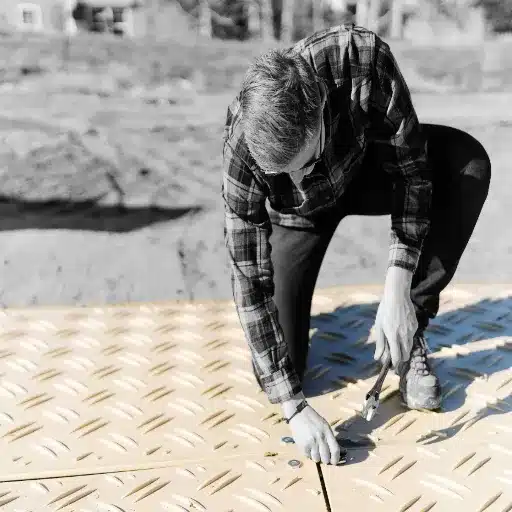
The environmental benefits of ground protection mats go beyond site protection. The mats themselves are sustainable products. They have a clear end-of-life path.
HDPE Material Properties
HDPE (High-Density Polyethylene) is one of the easiest plastics to recycle. HDPE ground protection mats carry recycling code #2. Almost all recycling programs accept this code worldwide.
Key sustainability properties of HDPE mats:
- 100% recyclable into new products without quality degradation
- No chemical treatment required, unlike timber mats that need preservatives
- Closed-loop potential, as old mats can be reprocessed into new mats
- No toxic leaching into soil or water during use
- Non-absorbent surface that prevents cross-contamination between sites
Lifecycle Comparison: HDPE vs. Timber
HDPE mats win the environmental case when you compare full lifecycle impacts:
| Factor | HDPE Mats | Timber Mats |
|---|---|---|
| Lifespan | 10-15 years | 3-5 years |
| Chemical treatment | None | Pressure-treated with preservatives |
| End of life | Fully recyclable | Landfill or incineration |
| Deforestation impact | None | Requires harvesting mature trees |
| Over 24 years | 2 mats needed | 6 mats needed |
Timber mats often get marketed as “natural” or “eco-friendly” because they are wood. But they need mature trees to be cut down. They get treated with chemicals that can leak into the soil. And they end up in landfills.
HDPE mats come from petroleum. But they last far longer and are fully recyclable. Over the full product lifecycle, HDPE is the lower-impact choice.
Site Restoration Cost Savings
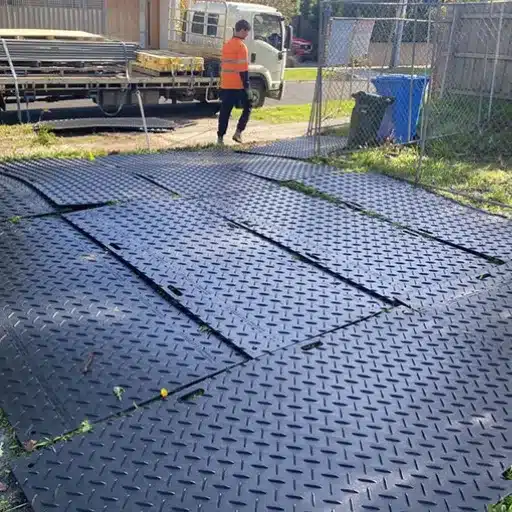
Environmental protection and cost savings don’t have to compete. Ground protection mats deliver both.
Quantified Environmental Protection Savings
Without ground protection, site restoration costs can be substantial:
- Soil remediation: $0.50-$18.00 per square foot, depending on compaction severity
- Turf replacement: $1-$3 per square foot for damaged areas
- Erosion repair: $2-$8 per square foot for gully and channel restoration
- Regulatory fines: $10,000-$50,000 per NPDES violation
Ground protection mats cost $1.50-$3.00 per square foot of protected area, and they are reusable for 10-15 years. For a full breakdown of ground protection mats cost and total cost of ownership, see our detailed pricing guide.
Case Example: 500-Foot Access Road
Consider a typical 500-foot access road, 12 feet wide (6,000 square feet):
- Without mats: $30,000-$72,000 in soil restoration costs alone
- With mats: $8,000-$15,000 initial mat investment, reusable for multiple projects
- Net savings: $15,000-$57,000 plus environmental protection
These savings don’t count avoided fines. They don’t count lower insurance costs. And they don’t count the value of showing environmental responsibility.
When Sarah managed a solar farm installation in Nevada, she budgeted $45,000 for post-project site restoration. Her colleague on a similar project nearby did not use ground protection mats. His restoration bill came to $112,000.
Sarah’s cost was $0 for restoration because the HDPE mats kept the ground in perfect condition. The mat rental cost her company $12,000. Net savings: $33,000 on one project.
Ground Protection Mats for Environmentally Sensitive Sites
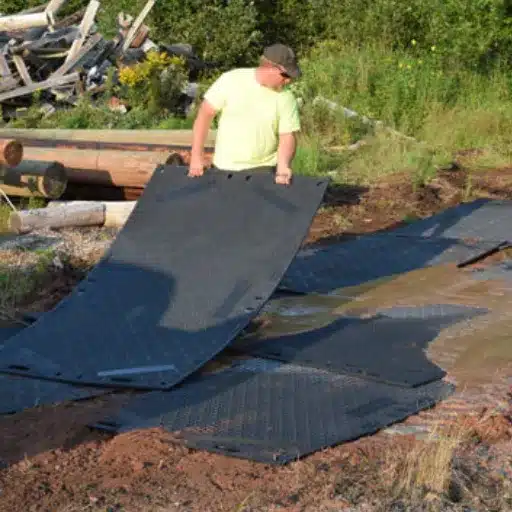
Some projects need ground protection for more than soil preservation. They need it to meet rules for sensitive environments.
Wetland and Riparian Zone Protection
HDPE ground protection mats are ideal for work near wetlands, streams, and riparian buffers. Here’s why:
- Non-absorbent HDPE prevents chemical cross-contamination between sites
- No pressure-treated wood that could leach preservatives into sensitive ecosystems
- Minimal ground disturbance during installation and removal
- Clean surface that does not shed particles or fibers
- Easy to clean between uses, preventing invasive species transfer
Protected Area Compliance
Environmental permits for work near protected areas often require ground protection. Mats provide proof that the contractor took steps to reduce environmental impact.
Projects in national forests, wildlife refuges, or coastal zones often list ground protection mats in their permit conditions. Using HDPE ground protection mats that meet ASTM D4020 specs ensures you meet these rules.
Frequently Asked Questions
Are ground protection mats environmentally friendly?
Yes. Ground protection mats prevent soil compaction. They reduce erosion. They preserve vegetation. They cut site restoration costs. They also support regulatory compliance.
HDPE mats are 100% recyclable and last 10-15 years. This makes them a sustainable choice for construction sites.
How do ground protection mats prevent soil erosion?
Mats act as a shield between rain and soil. They cut surface erosion by 80-90% on protected areas. They stop soil particles from washing away. And they direct water flow along controlled paths.
Are HDPE ground protection mats recyclable?
Yes. HDPE mats carry recycling code #2. Almost all recycling programs accept them.
They can be made into new mats or other HDPE products without losing quality. This supports a circular economy.
Do ground protection mats protect vegetation?
Yes. Mats cut turf damage by 85-95% on protected areas. They create a barrier between the equipment and the root systems.
Sites that use mats need little re-seeding. They recover much faster than unprotected sites.
What is the environmental impact of HDPE vs timber mats?
HDPE mats last 10-15 years and are fully recyclable at the end of life. Timber mats last 3-5 years, require chemical treatment, and end up in landfills. Over 24 years, a project would need 6 timber mats for every 2 HDPE mats.
Conclusion
The environmental benefits of ground protection mats are real and measurable. They stop soil compaction that kills water infiltration and biology. They preserve vegetation and cut recovery time.
They control erosion and support NPDES compliance. They are fully recyclable. And they save tens of thousands of dollars in site restoration costs.
If your project involves sensitive environments, regulations, or sustainability goals, ground protection mats aren’t optional. They’re essential.
Browse our HDPE ground protection mats catalog or request environmental compliance guidance from our engineering team.