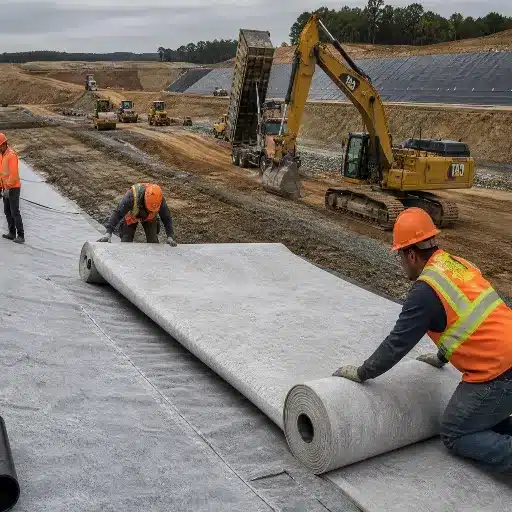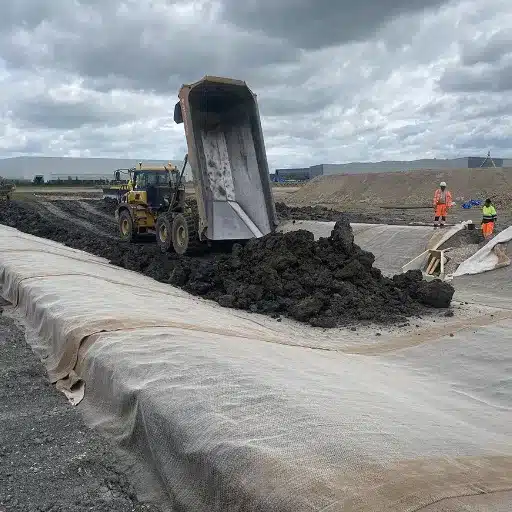
The engineers who evaluate HDPE and LLDPE geomembrane selection for containment projects base their decision on three factors, which include molecular structure and site conditions, and design life requirements. The HDPE geomembranes provide better chemical protection and stronger tensile strength, which makes them suitable for hazardous containment areas, whereas the LLDPE geomembranes deliver superior flexibility and the ability to adapt to irregular surfaces. The right choice depends entirely on your project conditions, not on which material is universally “better.”
Every year, engineering teams waste thousands of dollars while they spend weeks trying to solve geomembrane failures that they could have avoided through proper specification work. Marcus Torres, who worked as a project engineer in Santiago, specified a 2.0 mm HDPE liner for municipal landfill cover in 2023, which formed a standard assumption. He believed that higher tensile strength would ensure performance. But the site had differential settlement. The stress cracks developed in the seam lines after 18 months. The repair cost exceeded the original material budget. The experience taught Marcus that tensile strength alone does not determine whether a material is suitable.
Civil engineers, procurement buyers and project managers who assess geomembrane products understand that product selection involves more than purchasing a standard item. Your materials need to meet the actual conditions that exist at your construction site. Your materials need to match the actual conditions that exist at your building site. You need to establish standards that you can use to confirm your results. You need to establish standards that you can use to confirm your results. You need to establish standards that you can use to confirm your results. Your supplier must possess knowledge about how to distinguish between product sales and solving client needs.
This guide reveals the molecular differences that exist between HDPE and LLDPE geomembranes while demonstrating how those differences impact real-world performance to show which material should be used in your project specification. The study will review mechanical characteristics, which include chemical resistance and installation methods, and budget elements, together with an instant application model for purchasing. If you want to start learning about geomembrane selection, you should begin by reading our HDPE geomembrane engineering guide, which provides a complete overview of material options.
Key Takeaways
- HDPE geomembranes provide exceptional tensile strength which ranges from 27 MPa to 60 MPa and they display outstanding chemical resistance properties which make these materials appropriate for use in landfills and mining leach pads and facilities that need to contain aggressive chemicals.
- LLDPE geomembranes enable users to achieve 950% material elongation at break while maintaining their ability to conform to uneven ground surfaces which makes this product suitable for use in agricultural ponds and aquaculture facilities and areas that experience frequent land settlement.
- The two materials do not provide any single material that performs better than all other materials. The correct material selection requires evaluation of the subgrade conditions together with the chemical exposure and climate factors and the design life needs.
- The GRI-GM13 standard establishes HDPE quality requirements while GRI-GM17 defines LLDPE quality requirements. Testing organizations need to confirm third-party test reports before organizations purchase products.
- Mining and landfill operations increasingly adopt hybrid systems which combine primary HDPE liners with secondary LLDPE layers for their complex projects.
HDPE vs LLDPE Geomembrane: What Is the Core Difference?
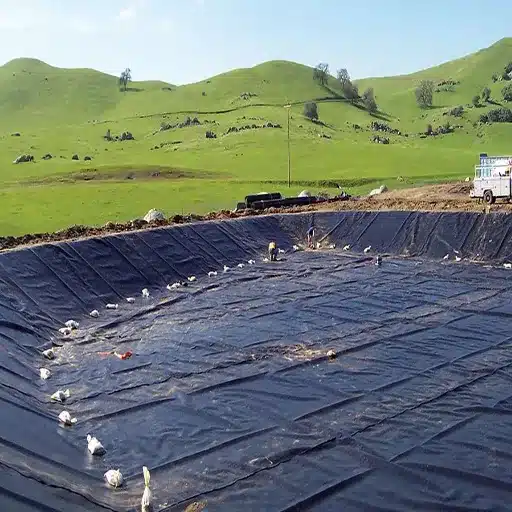
The two types of geomembranes, HDPE and LLDPE, exhibit different molecular structures that affect their performance characteristics. The tightly packed crystalline chains of HDPE (High-Density Polyethylene) provide high tensile strength and chemical resistance, which makes it suitable for landfill and mining containment applications. LLDPE (Linear Low-Density Polyethylene) has short-chain branching, which enables better flexibility and elongation capabilities in ponds and aquaculture and uneven terrain areas.
The geomembranes made from HDPE and LLDPE appear the same at first sight. The two materials both use polyethylene as their base material to create synthetic liners. The materials both exist as black flexible sheets. The two materials use carbon black to achieve ultraviolet (UV) protection through stabilization. The two materials demonstrate different performance characteristics because their molecular structures have fundamental differences.
Molecular Structure and Density
HDPE (High-Density Polyethylene) displays a molecular structure that consists of highly organized crystalline materials. The polymer chains in this material form compact structures that require limited branching to achieve their current state. HDPE maintains its rigidity and strength characteristics through a density range that falls between 0.94 and 0.97 g/cm³.
LLDPE (Linear Low-Density Polyethylene) contains short-chain branches along its linear polymer backbone. These branches create loose packing arrangements between the molecules. The resulting density of 0.91–0.94 g/cm³ creates a more open, flexible molecular matrix.
This situation requires an explanation. HDPE behaves like a tightly woven rope. It demonstrates excellent resistance to pulling force yet shows difficulty in bending. LLDPE behaves like a bungee cord. It stretches and conforms to irregular shapes without breaking.
The performance traits that matter in the field exist because of this structural distinction.
Industry Standards That Govern Quality
Engineering buyers should not assess geomembranes because they must base their evaluations on established industry standards.
GRI-GM13 standard establishes fundamental requirements that HDPE geomembranes must meet to serve their purpose in environmental containment applications. The standard establishes required minimums for tensile strength, puncture resistance, and carbon black concentration, OIT, and ESCR.
GRI-GM17 standard establishes essential requirements for LLDPE geomembranes. GM17 establishes suitable material testing standards for tensile strength, elongation, and seam strength because LLDPE exhibits distinct mechanical characteristics.
Your quotation request should include a requirement for third-party testing results that show compliance with applicable standards. The internal certificate that manufacturers provide does not meet project requirements for high-risk situations.
HDPE vs LLDPE Geomembrane: Mechanical Properties Compared
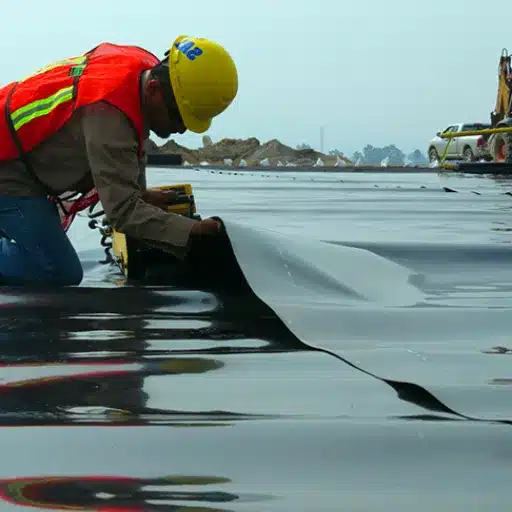
The mechanical performance of geomembranes specifies their performance under applied loads and their response to settlement and puncture threats. The comparison between HDPE and LLDPE geomaterials shows their essential engineering metrics.
Tensile Strength and Elongation
HDPE geomembranes achieve very high tensile strength at yield, typically 27–60 MPa depending on thickness and manufacturing process, as measured by ASTM D6693. The material proves suitable for applications which involve applications that require heavy overburden and steep slopes, and high internal pressure conditions.
LLDPE geomembranes reach 13–30 MPA tensile strength. The strength falls short of HDPE, yet it remains sufficient for most containment applications. The trade-off becomes clear when you examine elongation.
LLDPE material demonstrates breaking strength that extends between 800 and 950 percent. HDPE reaches approximately 700%. The extra elongation capacity enables projects that experience differential settlement, seismic activity, or ground movement to use liners that adapt instead of cracking.
Flexibility and Subgrade Conformance
HDPE is rigid. It lies flat on prepared surfaces. It does not drape well over rocks, root systems, or undulating terrain. Installation crews often describe HDPE panels as “stiff sheets” that fight back during placement.
LLDPE is highly conformable. It drapes over irregular surfaces without wrinkling or bridging. It adapts to minor subgrade imperfections that would cause HDPE to bridge gaps or concentrate stress.
When Linh Phan expanded her shrimp farm in the Mekong Delta in 2024, she faced a site with mixed clay and rocky outcrops. An HDPE liner would have required extensive subgrade preparation, adding two weeks and significant earthwork cost. She chose a 1.0 mm LLDPE liner instead. It conformed to the terrain with minimal surface grading. Installation finished five days ahead of schedule.
Puncture Resistance and Stress Crack Resistance
HDPE offers great resistance to puncture under static loads. You will rarely have sharp, pointed pieces of rock piercing an HDPE cover if well specified. The problem with HDPE is that it is more ESC-prone when subjected to point loads, thermal cycling, or seam quality.
LLDPE, however, is infinitely stronger against stress cracking when it is compared to HDPE. Since stress spreads only through the molecular structure branches of LLDPE, not concentrating, it is far more forgiving of wear and installation imperfections as well as thermal expansion cycles.
Table: HDPE vs LLDPE Geomembrane Mechanical Properties
| Property | HDPE Geomembrane | LLDPE Geomembrane |
|---|---|---|
| Tensile Strength | 27–60 MPa | 13–30 MPa |
| Elongation at Break | ~700% | 800–950% |
| Density | 0.94–0.97 g/cm³ | 0.91–0.94 g/cm³ |
| Flexibility | Low / Rigid | High / Conformable |
| Stress Crack Resistance | Moderate | Excellent |
| Puncture Resistance (Static) | Excellent | Good to Excellent |
Chemical Resistance and Environmental Performance
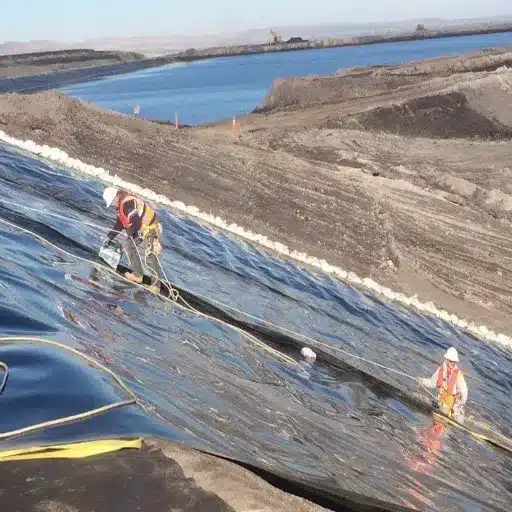
Containment projects expose geomembranes to chemicals, UV radiation, and temperature extremes. Material selection must account for all three.
Chemical Resistance
It is remarkable about HDPE when it comes to taking a beating from all kinds of chemicals. The stuff takes on every acid, alkali, solvent, hydrocarbon, and aggressive leachate thrown at it. This continuity to barrier performance is undoubtedly the reason why HDPE would definitely own stock in landfill liner specifications and heap leach pad mining design.
LLDPE is fairly resistant to most common chemicals. Its performance is very compatible with that of the HDPE regarding typical environmental contaminants. However, when compared to HDPE, LLDPE shows just slightly lower resistance against strong oxidizing agents as well as some aromatic hydrocarbons.
Very seldom is the difference important for potable water reservoirs and decorative ponds, where chemical exposure is minimal. Significant is a difference in industrial and hazardous waste containment networks.
UV and Temperature Resistance
The two substances coming from both types of material can be called something that is added for UV stabilizer. Although HDPE is generally a long-lived material on exposure, performance figures suggest something between 20 and 30 years of durability in an outdoor setting in temperate climatic conditions.
LLDPE remains the most flexible in the extreme cold. Up to approximately -60°C tends to be ductile, whereas high-density polyethylene shows a noticeable change in its properties when the operational temperatures go below -45°C. For cold-climate installations in the north of Europe, Central Asia, and in regions of high altitude, such as LLDPE’s low temperature performance would be more advantageous.
Thermal Expansion Behavior
HDPE has a high coefficient of thermal expansion, causing panels to sway significantly as per the day-to-day temperature variations. It creates fishmouths, wrinkles in the field, and the panels tunnel over time.
LLDPE is found to render a lower thermal expansion coefficient conveniently. It continues to remain more stable with respect to temperature cycling. The disadvantage comes when the LLDPE, upon laying, appears flat lying for a time.
This surface improves installation labor and maintenance. That is one of the reasons that makes LLDPE’s exposure floating covers be chosen for specified applications such as variable climate pond liners over time.
HDPE vs LLDPE Geomembrane Application Guide
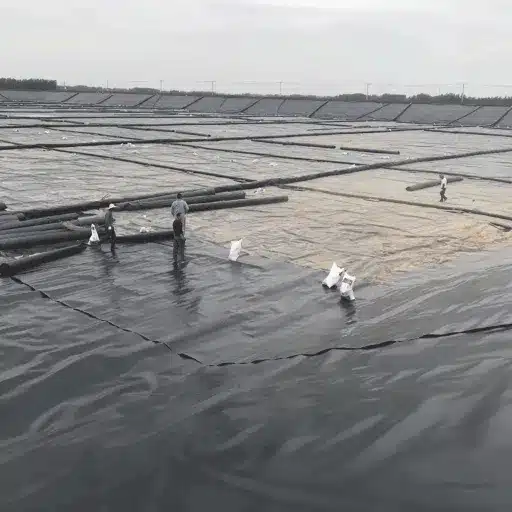
The correct material is the one whose strengths align with your project’s dominant risk factors. This HDPE vs LLDPE geomembrane material selection framework will help you match specifications to site conditions.
Choose HDPE When:
- Maximum chemical resistance is a must. In particular, this kind of resistance makes HDPE suitable for use in base liners for landfills, heap leach pads for mining, and ponds for industrial wastewater and for containment systems for handling aggressive media.
- Preparation is made with a well-composed and strong subgrade. It is actually a minimal expected settlement at flat compacted surfaces for HDPE to work without any mechanical stress.
- Long-term underground durability is important. Basically, HDPE for burial always ends with a design life of 50-100 years and is the most conservative solution for permanent infrastructure.
- Heavy or High Mechanical Load is Involved. HDPE’s superior tensile strength is especially advantageous in the presence of steep slopes, massive overburden, and high internal hydraulic pressure.
- GRI-GM13 is Compulsorily Satisfied. Most of the international engineering specifications and government tenders explicitly state that GM13-compliant HDPE liners are required.
Choose LLDPE When:
- Uneven terrain or rocky ground. LLDPE conforms to uneven subgrades without bridging or stress concentrations.
- Settlement to ground is expected. Landfill caps, mining reclamation projects, and even applications on soft ground will benefit from LLDPE’s greater elongation.
- Cold weather will come to install/operate. LLDPE keeps pliability to temperatures where HDPE becomes stiff and hard to manage.
- Installation speed and labor pricing are a high priority. LLDPE also features lighter panels with easier maneuvering and fewer reps for field welding. Generally speaking, the duration for installation in total would be about 15-20% faster.
- Factory fabrication is preferred. LLDPE can be prefabricated into large custom panels off-site to reduce field seams and provide greater quality control.
Hybrid Systems: Using Both Materials Together
Some complex projects use HDPE and LLDPE in combination. The standard approach places an HDPE primary liner at the base for chemical resistance and impermeability, then adds an LLDPE secondary liner or cover layer to accommodate settlement and thermal movement.
The Acme Mining Corporation used this hybrid approach at a copper heap leach facility in Peru. The base liner is 2.0 mm HDPE for leachate resistance. The cover system uses 1.5 mm LLDPE to accommodate seasonal thermal expansion and minor slope movement. After three years of operation, monitoring shows zero seam distress and containment efficiency above 99%.
Installation and Cost Comparison

Material cost is only one line item in the total project budget. Installation labor, site preparation, and construction quality assurance often represent larger shares.
Handling and Deployment
HDPE panels are heavy and stiff. Crews need mechanical assistance to position large panels, especially in windy conditions. The material resists folding and must be handled carefully to avoid creasing.
LLDPE panels are lighter and fold easily. Two workers can typically position panels that would require four with HDPE. On steep slopes or confined areas, this difference compounds significantly.
Welding and Seaming
Both materials use hot wedge welding (typically 350–450°C) or extrusion welding for field seams. HDPE seams achieve excellent strength when executed by qualified technicians, but the material is less forgiving of temperature variation during welding.
LLDPE welds more consistently across a wider temperature window. It is also more suitable for factory fabrication, where large panels are welded in controlled conditions and shipped to site as folded units. Factory fabrication reduces field seams by 60–80% on many projects.
Cost Factors
Material costs vary by region, thickness, and order volume. In most markets, LLDPE material runs slightly lower per square meter than HDPE, though pricing converges for thicker specifications.
The real cost difference appears in installation. LLDPE’s lighter weight, faster deployment, and reduced welding time can lower total installed cost by 10–20% on complex sites. On flat, prepared sites with minimal settlement risk, HDPE’s lower material cost and proven durability often make it the more economical choice over the full design life. For a detailed breakdown of material pricing by thickness and volume, see our guide to HDPE geomembrane price and cost factors.
Table: HDPE vs LLDPE Geomembrane Cost and Installation Factors
| Cost Factor | HDPE | LLDPE |
|---|---|---|
| Material Cost (typical) | 1.50–1.50–2.50/m² | 1.00–1.00–2.00/m² |
| Installation Labor | Higher | Lower |
| Site Preparation | Extensive (smooth subgrade) | Moderate (forgiving) |
| Factory Fabrication | Limited | Highly suitable |
| Total Project Cost (complex site) | Higher | Often 10–20% lower |
| Total Project Cost (flat site) | Competitive | Comparable |
Procurement Checklist: Specifying the Right Geomembrane
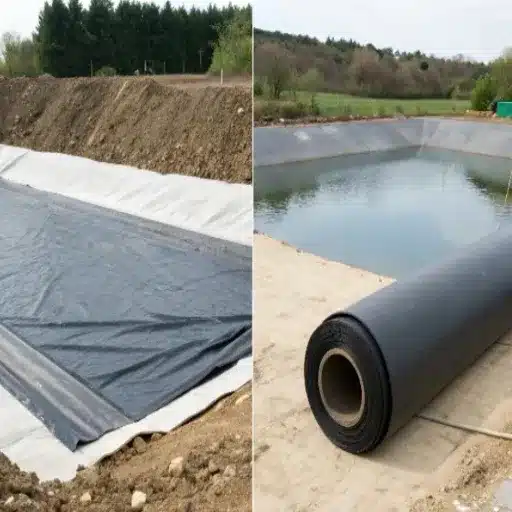
Use the presented six-step structure to ensure your specific requirements meet all the requirements your project is looking for.
- Define the application and design lives. A temporary irrigation pond may have unique requirements when compared to a hazardous waste landfill. Design life directly affects material grade and thickness selection.
- Assess site conditions. Documentation of subgrade geology, expected rates of settlement, slope angles, harsh winter conditions, and chemical exposure- Every single one of those will overwhelm the dichotomy between HDPE and LLDPE.
- Check the standards. Say you follow GRI-GM13 to HDPE or GRI-GM17 to LLDPE. Imply laboratory records from accredited laboratories, not manufacturer certificates.
- Hang onto manufacturing systems. ISO9001-certified manufacturing provides traceability and consistency. Enquire about lot tracking, sample retention policies, and pre-shipment inspection protocols.
- Plan for construction quality assurance. Your specification must document the non-destructive as well as destructive verification of pre-installation subgrade, witnessed seam welding, non-destructive seam testing (using air lance or vacuum box), and destructive seam sampling at intervals.
- Require chemical compatibility verification. Do not believe in generic compatibility charts with polymers; just specifically ask for test data from the chemicals of leachates that your liner will be containing.
Ready to move from evaluation to procurement? Request a technical quote with your project specifications, and our team will recommend the optimal material grade, thickness, and delivery schedule.
Frequently Asked Questions
Which geomembrane is better for pond liners, HDPE or LLDPE?
For decoration and agriculture, LLDPE is used for ponds that have an uneven bottom or are full of rock substrates due to its conformability and easier installation. For a large storage or farm pond with properly prepared subgrade and long-term exposed service, HDPE might turn out to have better UV stability and lower material cost.
Can HDPE and LLDPE geomembranes be welded together?
No, because HDPE and LLDPE have differing melt flow indexes and crystallization behaviors. So, these cannot be thermally welded to one another. Put according to the schematics and dimensions. The two materials must be housed in separate panels with an overlap transition or else bolt the union at intersections.
What thickness geomembrane should I specify?
Application risk determines the extent of the thickness. These are usual ranges:
- Decorative ponds and temporary containment: 0.5-1.0 mm
- Agricultural ponds and secondary containment: 1.0-1.5 mm
- Landfill liners and mining containment: 1.5-2.0 mm
- High-risk primary containment: 2.0-3.0 mm
Seek with your site-specific geotechnical engineer the right thickness for your specific site conditions.
Does LLDPE cost more than HDPE?
Different areas and volumes of the order can affect pricing, but LLDPE material is usually costlier than HDPE, so per square meter. However, the increased costs are usually lower for the LLDPE installation because its installation rate is quicker and needs minimal groundwork. Besides that, it is easy to apply it to complicated terrain.
How do I verify that a geomembrane meets GRI-GM13 or GRI-GM17?
Get an independent lab that should test from an approved laboratory or by Indeed, other comprehensive laboratories, for example, SGS, Bureau Veritas, or Intertek, to produce this report for you. That usually contains tensile property data and puncture resistance data, carbon black content, oxidative induction time, and stress crack resistance, which should all meet ISO standard minimum thresholds.
Conclusion
The HDPE vs LLDPE geomembrane decision is not about finding a winner. It is about matching material properties to project realities.
HDPE delivers the chemical resistance, tensile strength, and long-term durability that landfill engineers and mining operators depend on. It is the conservative, proven choice for high-risk containment. LLDPE delivers the flexibility, conformability, and installation efficiency that agricultural, aquaculture, and environmental contractors need on challenging terrain.
Your specification should begin with site conditions, not product preference. Assess your subgrade, chemical exposure, climate, and design life first. Then select the material — and the standard — that aligns with those conditions.
Every successful containment project starts with the right specification. If you need engineering guidance, test data, or a customized quotation for your next project, contact Shanxi Shengxing today. We provide ISO9001-certified geomembranes with full third-party test reporting, global export logistics, and technical consultation to help you specify with confidence.