For most construction, infrastructure, and event projects, the answer to HDPE vs composite ground protection mats is simple: HDPE wins. It is lighter, cheaper per use, fully recyclable, and handles 90% of typical equipment loads. Composite mats only make sense when you need extreme load capacity beyond 150 tons or semi-permanent crane pad installations where machinery is available for placement.
Yet the decision is not that simple. The ground protection mat industry uses the word “composite” to describe three completely different products. Buyers routinely order the wrong material because of this confusion. Some suppliers market pure HDPE blends as “composite mats.” Others sell true fiberglass-reinforced multi-material panels. The performance gap between these products is enormous. The wrong choice can derail budgets, timelines, and site safety.
This guide clears the terminology confusion and gives you a direct, engineering-grade comparison. For a complete overview of all mat types and selection criteria, see our complete ground protection mats buyer’s guide. You will learn how each material is manufactured, where composite mats genuinely outperform HDPE, where HDPE is the clear winner, and how to choose based on your equipment, ground conditions, and budget.
Key Takeaways
- The term “composite ground protection mats” describes three different products: pure HDPE, proprietary HDPE blends, and true fiberglass-reinforced multi-material panels.
- HDPE mats weigh 32-45 kg per 4×8 ft panel and support 60-120 tons; true composite mats weigh 100-150 kg and support 100-200+ tons.
- HDPE delivers the best cost-per-use over 10 years and is 100% recyclable; true composites are often non-recyclable and require machinery for every move.
- Choose HDPE for general construction, events, utilities, and infrastructure. Choose true composite only for extreme point loads like crane outriggers and oil rig platforms.
- For international buyers, HDPE’s lighter weight means 2-2.5x more mats per container, cutting freight costs by 30-50%.
What Are Composite Ground Protection Mats?
The Terminology Problem: Three Products, One Name
Walk into a procurement meeting and say “composite ground protection mats,” and three different products could show up on the delivery truck. The industry has never standardized the term, and this ambiguity costs buyers time and money.
Product 1: Pure HDPE mats. These are 100% high-density polyethylene panels, either virgin or recycled, with UV stabilizers. They are lightweight, manually portable, and fully recyclable. Some manufacturers avoid the word “composite” entirely and call these “HDPE ground protection mats.” Others, like Signature Systems, market proprietary HDPE formulations as “composite” because the material is engineered. Industry comparisons clarify that true composites contain fiberglass or rubber reinforcement, not just engineered polymer.
Product 2: “Composite” HDPE blends. These are still pure polymer products, but they use advanced formulations such as high-molecular-weight polyethylene (HMWPE) or proprietary additive packages for enhanced grip, color stability, or slightly higher load capacity. They remain 100% recyclable and manually portable. The word “composite” here refers to an engineered polymer, not a multi-material construction. These engineered polymer mats behave almost identically to standard HDPE.
Product 3: True multi-material composite mats. These are the fiberglass composite ground mats that combine HDPE or other polymers with fiberglass, rubber, or hybrid reinforcement cores. They are significantly heavier, require forklifts or cranes for placement, and are often non-recyclable due to mixed materials. These are the products that genuinely outperform HDPE on extreme loads, but they come with major handling and disposal trade-offs.
Understanding which product you are actually comparing is the foundation of every decision in this article. When we say “HDPE vs composite ground protection mats,” we are comparing pure HDPE (Product 1) against true multi-material composites (Product 3). “Composite” HDPE blends (Product 2) behave almost identically to pure HDPE and are not a separate category for most engineering decisions.
How True Composite Mats Are Manufactured
True composite mats begin with a thermoplastic base layer, typically HDPE or polyurethane, which is laminated or co-extruded with fiberglass mesh, rubberized surfaces, or engineered fiber cores. The manufacturing process is more complex than extruding pure HDPE sheets. Layers must bond under heat and pressure, and surface textures are often molded separately before assembly.
This complexity drives the higher upfront cost. A true composite mat can cost 50-100% more per panel than an equivalent HDPE mat. The added material weight also increases transport and handling costs, which we will examine in detail below.
HDPE vs Composite Ground Protection Mats: Head-to-Head Comparison
The following table compares pure HDPE mats against true multi-material composite mats across the specifications that matter for procurement decisions. This HDPE vs composite mats breakdown covers weight, load capacity, cost, and recyclability.
| Feature | HDPE Mats | True Composite Mats (Fiberglass-Reinforced) |
|---|---|---|
| Material | 100% virgin or recycled HDPE | Polymer + fiberglass/rubber blend |
| Weight (4′ x 8′ panel) | 32-45 kg (70-100 lbs) | 100-150 kg (220-330 lbs) |
| Static load capacity | 60-120 tons | 100-200+ tons |
| Surface pressure rating | Up to 600 psi | 600-1,000+ psi |
| Portability | 2 workers, manual carry | Forklift or crane required |
| Setup time (per panel) | 30-60 seconds | 5-15 minutes (with machinery) |
| Lifespan | 10+ years | 10+ years |
| Upfront cost (per panel) | Moderate | High (50-100% more) |
| Cost per use (10-year cycle) | Best ROI | Justified only for extreme loads |
| Recyclability | 100% recyclable | Often non-recyclable (mixed materials) |
| Connection system wear | Low | Higher (flanges and pins wear faster) |
| Best use case | General construction, events, utilities | Crane pads, oil rigs, military, and power transmission |
For a deeper look at HDPE specifications, including ASTM test methods and density values, see our HDPE ground protection mat specifications guide.
HDPE vs Composite Mat Load Capacity: Where Composite Wins (and Where It Doesn’t)
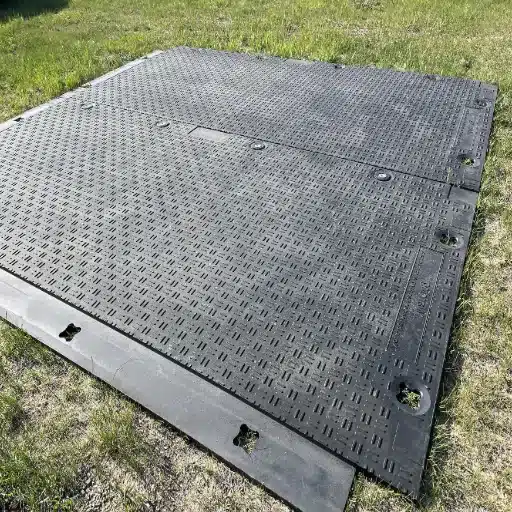
Static Load Ratings by Thickness
Load capacity is the one metric where true composite mats genuinely outperform HDPE. The fiberglass reinforcement distributes extreme point loads across a wider area and resists deformation under concentrated stress. This makes composites ideal load distribution panels for crane outriggers and other concentrated loads.
| Thickness | HDPE Static Load | Composite Static Load |
|---|---|---|
| 10 mm | 30-60 tons | 50-80 tons |
| 15 mm | 60-100 tons | 90-130 tons |
| 20 mm | 80-120 tons | 120-180 tons |
| 25-38 mm | 100-150 tons | 150-250+ tons |
At 20 mm thickness, the most common specification for heavy construction, HDPE handles 80-120 tons while composite handles 120-180 tons. The gap is real, but it matters only for a narrow set of applications.
Point Load vs Distributed Load
A 100-ton crane sounds like it needs composite mats. But cranes distribute their total weight across four outrigger pads. Each pad might exert 50+ tons through a contact area of less than one square meter. This is a point load, not a distributed load, and it is where composite mats show their advantage.
For the vast majority of construction equipment, HDPE capacity is sufficient. Excavators, dump trucks, concrete mixers, and tracked dozers all operate within the 60-120 ton range that HDPE covers comfortably. Composite mats become necessary only when equipment loads exceed 150 tons or when point loads from crane outriggers create stress concentrations beyond HDPE’s rating.
For equipment-specific load calculations and recommended mat types by machinery class, refer to our ground protection mats for heavy equipment guide.
The Hidden Cost of Over-Specification
A procurement manager named Sergei learned this lesson on a highway interchange project in Eastern Europe. His equipment list topped out at 80-ton dump trucks and 40-ton excavators, well within HDPE capacity. But a colleague recommended “composite mats for heavy-duty work,” and Sergei approved the order without checking the terminology. The delivery arrived: 200 panels of true fiberglass-reinforced composite, each weighing 120 kg. His crew had no forklift on site. Setup took three days instead of six hours. The project budget absorbed an unexpected €8,000 in equipment rental. Sergei later calculated that HDPE mats would have handled every piece of equipment on his site, cut setup time by 90%, and saved 35% on total matting costs.
Weight, Handling, and Transport Economics in HDPE vs Composite Mats
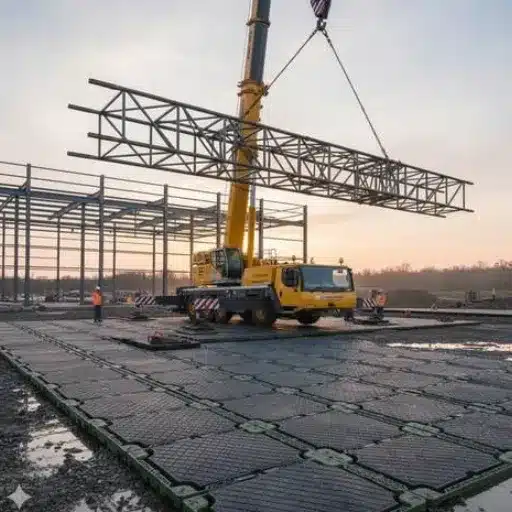
Manual Handling vs Machinery Requirements
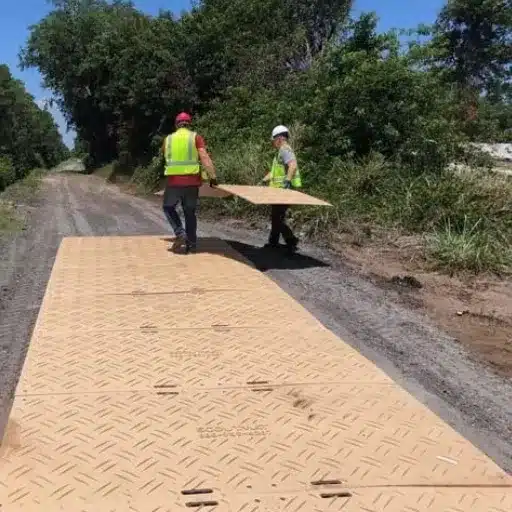
Weight is the single biggest practical difference between HDPE and composite mats. A standard 4′ x 8′ HDPE panel at 32-45 kg can be carried by two workers and positioned by hand. A composite panel at 100-150 kg requires a forklift, crane, or specialized lifting equipment for every single placement and removal.
This difference cascades through the entire project:
- Labor: HDPE setup requires 2 workers per panel. A composite setup requires 2 workers plus an equipment operator, plus machinery.
- Time: HDPE panels deploy in 30-60 seconds each. Composite panels take 5-15 minutes each with machinery.
- Flexibility: HDPE panels can be repositioned instantly as site conditions change. Composite panels require machinery every time they move.
- Safety: Manual handling of HDPE at 45 kg is ergonomically manageable. Attempting to move 150 kg composite panels without machinery creates injury risk.
Transport Cost Per Truckload
Transport economics strongly favor HDPE. Independent pipeline equipment analysis confirms that lighter mats deliver 2-2.5x more surface area per truckload, cutting freight costs by 30-50%.
For a 500-mat project, the transport math is stark:
| Cost Factor | HDPE Mats | Composite Mats |
|---|---|---|
| Mats per truckload | 120-150 | 50-70 |
| Truckloads required | 4 | 8-10 |
| Freight cost (indexed) | 100 (baseline) | 180-250 |
| Unloading time | Same day | 2-3 days |
Container Loading for Export
For international buyers, the weight gap translates directly into container efficiency. A 40-foot container holds roughly 300-350 HDPE mats versus 120-150 composite mats. The per-unit landed cost for composite mats rises accordingly. When you factor in import duties calculated by weight in some jurisdictions, the cost penalty for composite mats grows even larger.
This is why export-focused suppliers like Shanxi Shengxing standardize on HDPE for global distribution. The lighter weight reduces freight costs, simplifies customs documentation, and allows buyers to optimize container space. For a full breakdown of freight, duty, and lifecycle costs, see our ground protection mats cost and TCO analysis.
Durability and Connection Systems in the Field
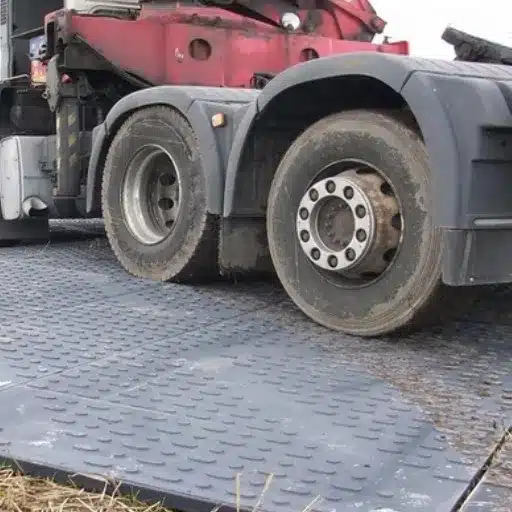
Weather and UV Resistance
Both HDPE and composite mats are rated for outdoor use across extreme temperatures. HDPE formulations operate reliably from -40 °C to +80 °C. Premium HDPE with UV-stabilized formulations retains over 90% of original tensile strength after 5,000 hours of accelerated UV exposure testing per ASTM D2565.
True composite mats perform similarly in heat and UV. However, the fiberglass reinforcement layer can become brittle in sustained freezing conditions. Industry reports from cold-climate pipeline projects note that composite interlocking pins and connection hardware are more prone to freezing in place during winter disassembly, creating delays that HDPE pin systems avoid.
Connection System Wear
Connection systems are the weak point most buyers overlook. HDPE mats use tongue-and-groove edges or steel pin fasteners. The uniform polymer material wears evenly, and pins can be replaced individually if needed.
Composite mats use heavier overlapping flanges, bolted corner plates, or cam-lock systems. The mixed-material construction creates differential wear: the polymer surface may abrade at a different rate than the fiberglass core, and the heavier connection hardware experiences more stress during repeated assembly and disassembly. Field reports from rental fleet operators indicate composite connection systems require inspection and hardware replacement 2-3x more frequently than HDPE systems.
A fleet manager named Ingrid ran a mat rental business in Scandinavia, serving construction and event clients. She started with a mixed fleet of HDPE and composite mats. After three years, her maintenance records told a clear story. HDPE mats needed pressure washing and occasional pin replacement. Composite mats needed flange realignment, bolt replacement, and surface delamination repair on 15% of panels. Ingrid phased out composite mats for all except crane pad rentals, where the extreme load requirement justified the higher maintenance burden.
Environmental Impact and Recyclability
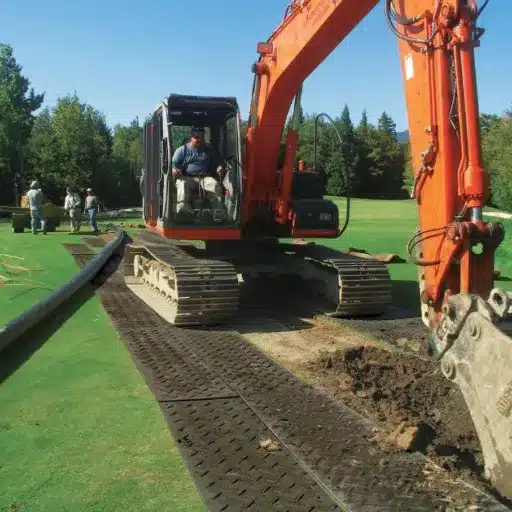
End-of-Life Disposal
HDPE is 100% recyclable. At end of life, HDPE mats can be ground, melted, and re-extruded into new ground protection mats, drainage pipes, or other plastic products. Many manufacturers now offer mats with 30-50% recycled HDPE content, creating a closed-loop material flow.
True composite mats face a landfill problem. The fiberglass reinforcement cannot be separated from the polymer matrix using standard recycling processes. Most composite mats end up in construction waste landfills or require specialized industrial downcycling facilities that are not widely available. For buyers with corporate ESG mandates or LEED certification goals, this disposal reality is a significant factor.
Cross-Contamination Risk
HDPE is non-porous and does not absorb hydrocarbons, chemicals, or biological contaminants. Mats can move from an oil and gas site to an environmental remediation project after pressure washing, with zero cross-contamination risk.
Composite mats with surface polymer layers also resist absorption when new. However, as the surface wears and the fiberglass core becomes exposed, the material can trap contaminants in the fiber matrix. This creates potential cross-contamination issues when mats move between sensitive ecosystems.
ESG and LEED Considerations
Sustainability reporting increasingly requires supply chain transparency. HDPE mats contribute positively to ESG scores through recyclability, lower transport emissions per panel, and reduced landfill impact. Composite mats, by contrast, add landfill liability and higher carbon emissions from heavier transport.
For projects requiring environmental compliance documentation, HDPE is the straightforward choice. Its material pedigree is simple: one polymer, one recycling stream, one lifecycle.
Decision Framework: Which Is Better HDPE or Composite Mats?
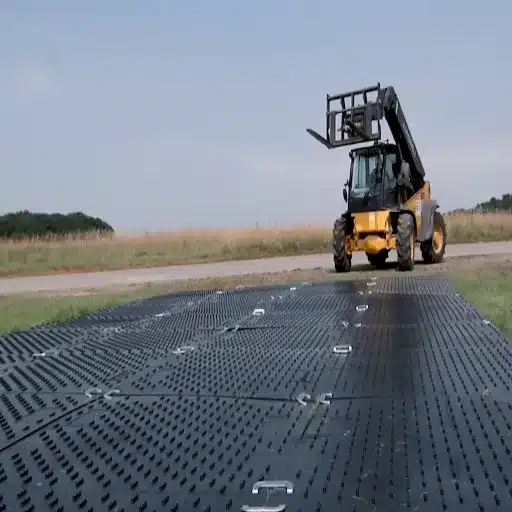
Choose HDPE Mats If
- Your heaviest equipment is under 120 tons
- You need manual handling and a fast setup without machinery
- Your project requires frequent mat repositioning
- You value 100% recyclability and ESG compliance
- You are shipping mats internationally or optimizing container loads
- Your budget prioritizes cost-per-use over upfront specifications
- Your project duration is under five years (the payback period where HDPE TCO wins)
Choose True Composite Mats If
- Your equipment loads exceed 150 tons or create extreme point loads
- You are building semi-permanent crane pads or oil rig platforms
- You have machinery and operators available for every mat move
- Your budget accommodates a 50-100% higher upfront cost
- Your project duration is long enough to amortize the higher initial investment
- Transport and handling logistics are not a constraint
The Middle Ground: “Composite” HDPE Blends
For buyers who want slightly higher performance than standard HDPE without the weight penalty of true composites, proprietary HDPE blends offer a middle path. These products use HMWPE or additive-enhanced formulations to push load capacity toward the upper end of the HDPE range (100-130 tons) while maintaining manual portability and full recyclability. They cost 10-20% more than standard HDPE but remain far cheaper and lighter than true composites.
For a complete selection framework covering equipment type, ground conditions, project duration, and budget, see our 7-factor guide to choosing ground protection mats.
Frequently Asked Questions
Are composite mats made of HDPE?
Sometimes. Many “composite” mats on the market are actually proprietary HDPE blends that remain 100% polymer. True composite mats add fiberglass, rubber, or other reinforcing materials to the polymer base. Always ask your supplier for the exact material composition and weight per panel before ordering.
Which is lighter: HDPE or composite ground protection mats?
HDPE mats are significantly lighter. A standard 4′ x 8′ HDPE panel weighs 32-45 kg, while an equivalent true composite panel weighs 100-150 kg. This 3x weight difference is the primary reason HDPE mats can be carried and positioned by hand.
Can composite mats be recycled like HDPE?
No. True multi-material composite mats combine polymers with fiberglass or rubber, making them difficult or impossible to recycle through standard processes. HDPE mats are 100% recyclable. If recyclability is important for your project, specify pure HDPE.
Do composite mats require machinery to install?
Yes. True composite mats at 100-150 kg per panel require forklifts, cranes, or specialized lifting equipment for placement and removal. HDPE mats at 32-45 kg can be installed by two workers without machinery.
Which lasts longer: HDPE or composite mats?
Both last 10+ years with proper maintenance. The difference is in the connection system wear. Composite mat connection hardware (flanges, bolts, cam-locks) wears faster due to heavier stress loads. HDPE pin systems typically require less frequent maintenance over the same service life.
Are composite mats worth the extra cost?
Only for extreme load applications. For 90% of construction, infrastructure, and event projects, HDPE mats deliver sufficient load capacity at lower upfront cost, lower transport cost, and better cost-per-use over time. Composite mats justify their premium only when equipment loads exceed HDPE ratings or when semi-permanent installations eliminate the handling penalty.
Which is better: HDPE or composite ground protection mats?
For most construction, infrastructure, and event projects, HDPE is the better choice. It handles 90% of equipment loads, is installed by hand, and costs less over time. Choose composite mats only when your equipment exceeds 150 tons or when you are building semi-permanent crane pads and have machinery on site.
What are composite ground protection mats made of?
True composite mats combine a polymer base (typically HDPE or polyurethane) with fiberglass mesh, rubberized surfaces, or engineered fiber cores. The layers are bonded under heat and pressure. Many “composite” mats sold today are actually proprietary HDPE blends with no fiberglass at all. Always ask your supplier for the exact material composition and weight per panel before ordering.
How much weight can composite ground protection mats hold?
True fiberglass-reinforced composite mats support 100-200+ tons depending on thickness. At 20 mm thickness, composite mats handle 120-180 tons. At 25-38 mm, they reach 150-250+ tons. Proprietary HDPE “composite” blends perform nearly identically to standard HDPE: 60-120 tons.
Conclusion
HDPE vs composite ground protection mats is not a contest with one winner. It is a decision that depends on knowing exactly what product you are specifying and matching that product to your project’s actual requirements.
For the vast majority of buyers, HDPE ground protection mats are the correct choice. They handle 60-120 tons, weigh 32-45 kg, are installed by hand in seconds, and deliver the best total cost of ownership over a 10-year lifecycle. They are fully recyclable, non-porous, and optimized for international shipping. A construction site, a music festival, a utility trenching project, or a temporary haul road across soft ground: HDPE covers them all.
True composite mats earn their place only at the end of the load spectrum. Crane outrigger pads, oil rig platforms, power transmission sites, and military applications where 150+ ton loads are routine: these are the scenarios where composite’s higher capacity outweighs its heavier weight, higher cost, and handling complexity.
The buyer’s job is simple. Know your equipment loads. Know your handling constraints. Know your transport logistics. Then match the mat to the job, not the marketing term to the purchase order.
Ready to specify ground protection mats for your project? Browse our HDPE ground protection mats for detailed specifications and dimensions, or request a technical quote from our engineering team. We provide load calculations, material recommendations, and customized specifications for construction and infrastructure projects worldwide.