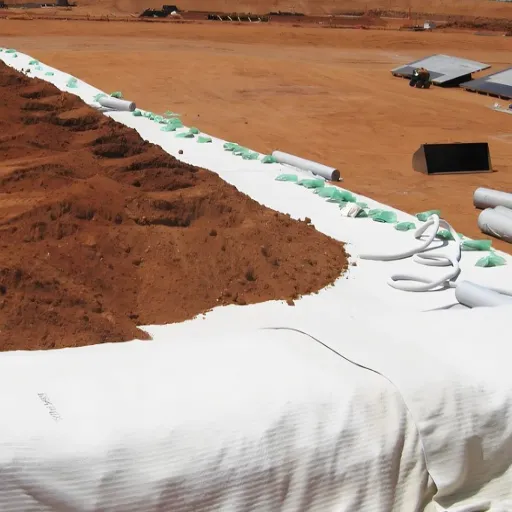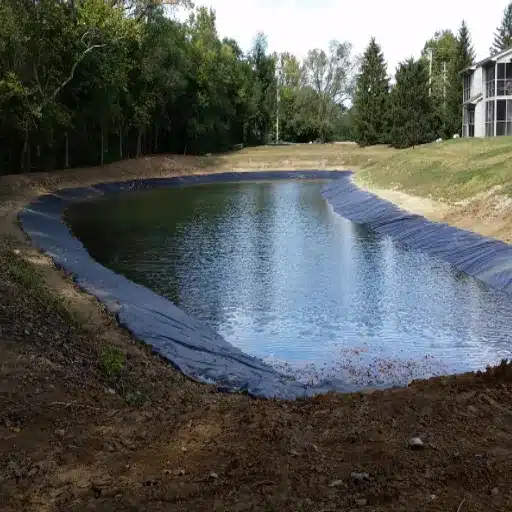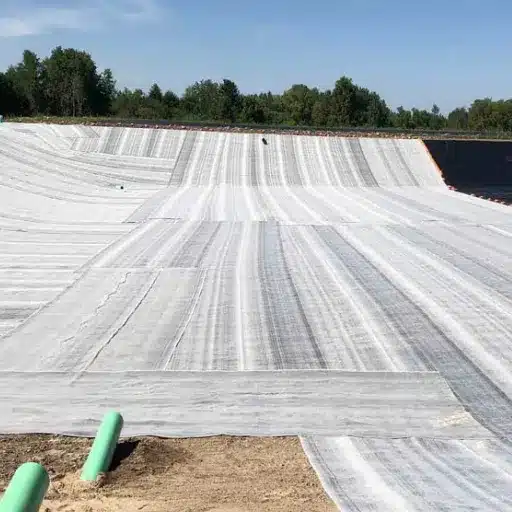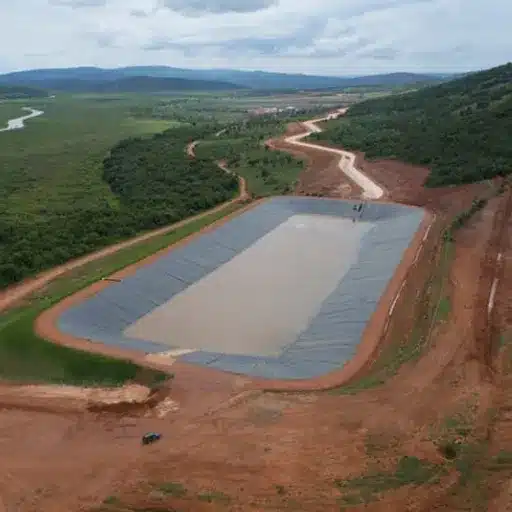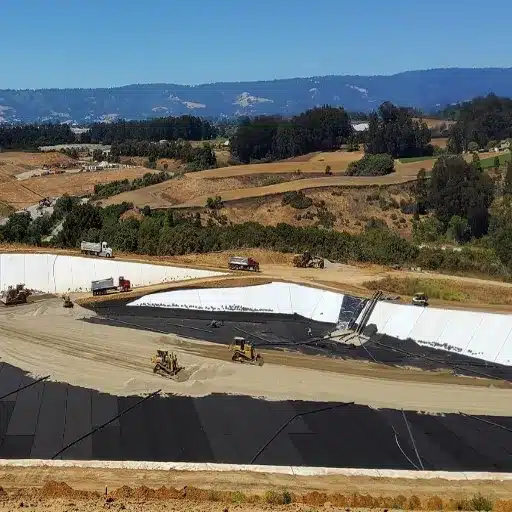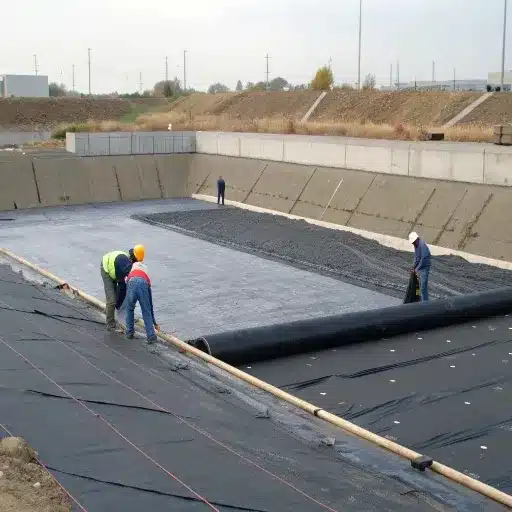
Textured HDPE geomembrane provides significantly higher interface friction than smooth HDPE, making it essential for steep slopes, landfill side liners, and mining heap leach pads where sliding is a design risk. Smooth HDPE remains the standard for flat or gently sloping containment applications where installation speed, welding efficiency, and material cost are the governing factors.
In 1990, the Kettleman Hills landfill in California experienced a catastrophic slope failure. A smooth HDPE geomembrane had been installed on a steep incline as part of a composite liner system. When the overlying waste created enough normal stress, the entire cover system began to slide. The interface friction angle between smooth HDPE and the adjacent geosynthetic layer was measured afterward at roughly 8 degrees. That is barely enough to hold a stack of books on a desk. The liner was displaced laterally by meters, the containment system failed, and the remediation cost ran into the tens of millions.
The root cause was not poor material quality. The HDPE itself met every specification. The cause was a surface selection decision that ignored the fundamental engineering reality: smooth HDPE is an excellent barrier but a poor anchor.
In this guide, you will learn exactly how to choose between textured and smooth HDPE geomembrane based on slope angle, normal stress, and installation constraints. You will get friction coefficient data, GRI-GM13 specification differences, welding requirements, and copy-paste language for project specifications.
Key Takeaways
- Textured HDPE achieves interface friction angles of 25–42 degrees against soil and geotextiles, while smooth HDPE typically reaches only 8–25 degrees.
- GRI-GM13 requires smooth HDPE to achieve at least 700% elongation at break, but textured HDPE is only required to reach 250% because surface treatment changes failure mechanics.
- Textured geomembrane welding requires grinding the overlap zone (100–150 mm) before wedge welding; over-grinding can reduce effective seam thickness from 1.5 mm to 0.90–1.00 mm.
- Material cost premium for textured HDPE is 10–15% for single-sided and 20–30% for double-sided versus smooth sheet of the same base thickness.
- Slopes steeper than 10–15 degrees or subject to high normal stress (600–1000 kPa) should specify textured HDPE; flat containment applications should use smooth HDPE for economy and ease of welding.
What Is the Difference? Surface, Manufacturing, and Specification
Smooth HDPE Geomembrane
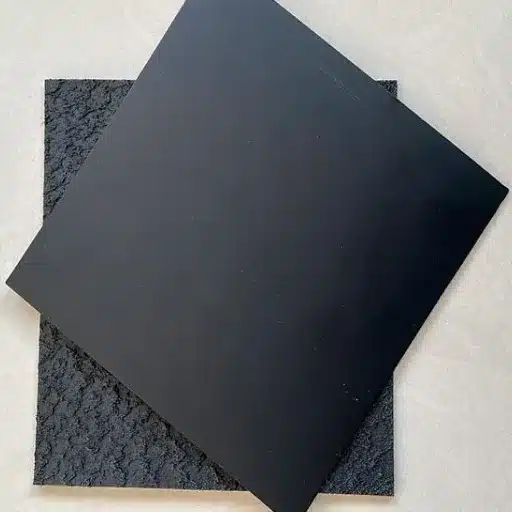
Smooth HDPE geomembrane is manufactured as a flat, uniform sheet through extrusion or calendering. The surface design maintains complete flatness because it provides maximum protection against water penetration while decreasing the likelihood of stress buildup, which supports efficient welding procedures. For a detailed overview of HDPE geomembrane types and material fundamentals, see our complete HDPE geomembrane technical guide.
The smooth surface is ideal when the primary design requirement is fluid containment on flat or low-slope terrain. The default specification gets used in about 70% of HDPE geomembrane applications worldwide, which include landfill base liners and reservoir floors, canal bottoms, and aquaculture ponds.
Textured HDPE Geomembrane
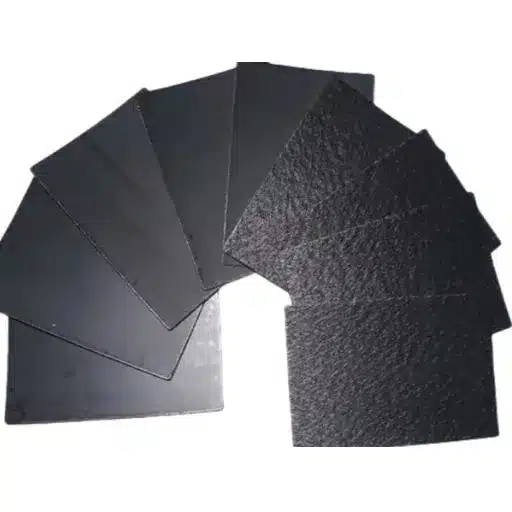
Textured HDPE geomembrane is manufactured with a roughened surface on one or both sides to increase interface friction. The texture is not applied as a coating. It is integral to the sheet, formed during or immediately after the extrusion process. Engineers distinguish three primary manufacturing methods:
Co-extruded (nitrogen-blow) texture. Molten HDPE is extruded through a die while nitrogen gas is injected into the melt. The gas expands at the die exit, creating irregular, sharp asperities across the surface. This method produces a sandpaper-like texture with high initial friction but variable geometry. The random orientation of asperities can create significant post-peak strength loss under strain.
Spray texture. Molten HDPE filaments are sprayed onto the surface of an already-formed smooth sheet. This creates a highly aggressive, rough surface with deep valleys and peaks. Spray-textured geomembranes achieve the highest friction coefficients but can make welding preparation more complex because the texture depth is less uniform.
Structured (flat-die embossed) texture. A smooth base sheet is passed through rollers bearing a precise pattern of studs, cones, or columns. This method produces a uniform texture height and spacing. According to research from Atarfil on structured textured flat-die HDPE geomembranes, structured textures tend to sustain higher residual shear strength after peak loading compared with co-extruded random textures. The predictable geometry also makes grinding for welding more consistent.
GRI-GM13 Specification Differences
The Geosynthetic Institute’s GRI-GM13 specification sets different minimum values for smooth and textured HDPE geomembrane because surface treatment affects mechanical behavior. The most significant difference is elongation at break.
Under GRI-GM13, smooth HDPE must achieve a minimum elongation at break of 700%. Textured HDPE is only required to achieve 250%. The reason is straightforward: the surface texture creates stress concentrators. When the sheet is pulled in tension, the sharp asperities initiate micro-cracks earlier than a smooth surface would. The material still meets strength requirements, but it deforms differently. This does not mean textured HDPE is inferior. It means textured HDPE is engineered for a different failure mode: friction and stability rather than uniform tensile ductility.
Think of it this way: smooth HDPE is a high-performance seal. Textured HDPE is a high-performance seal with grip tape.
Friction and Slope Stability: The Engineering Criterion
Interface Friction Angles
The primary reason to specify textured HDPE is interface friction. In geotechnical design, the friction angle between two materials determines whether a slope will remain stable under load. When a geomembrane is too slippery, it becomes a failure plane.
| Interface | Smooth HDPE Friction Angle | Textured HDPE Friction Angle |
|---|---|---|
| Compacted clay liner | 8–18 degrees | 22–32 degrees |
| Nonwoven geotextile | 10–15 degrees | 28–38 degrees |
| Sandy soil (medium dense) | 15–25 degrees | 30–42 degrees |
| Geonet/drainage composite | 8–12 degrees | 20–30 degrees |
These values are approximate and depend on normal stress, moisture content, and material-specific texture structure. For critical projects, engineers should specify large-scale direct shear testing per ASTM D5321 on the actual materials that will be used.
When a design engineer in Chile specified a 2.0 mm textured HDPE geomembrane for a copper mine heap leach pad in 2019, she based her slope design on an interface friction angle of 32 degrees measured between the textured liner and the overlying nonwoven geotextile. The pad slope was 3:1 (approximately 18.4 degrees). With a friction angle of 32 degrees, the factor of safety against sliding exceeded 1.5. Had she used smooth HDPE with a friction angle of 12 degrees against the same geotextile, the factor of safety would have dropped below 1.0, meaning sliding was inevitable under operational loading.
Post-Peak Behavior and Texture Type
Not all textures perform equally after peak loading. Co-extruded random textures can exhibit significant post-peak strength loss. As shear displacement increases, sharp asperities bend, fold, or fracture. Geotextile fibers can tear out of the nonwoven fabric. The residual friction angle may drop to 60–70% of the peak value.
Structured embossed textures generally maintain higher residual strength. The uniform stud pattern distributes stress more evenly. The base sheet beneath each stud remains intact, preventing catastrophic asperity collapse. For applications where long-term creep or seismic loading is a concern, structured textures offer more stable interface behavior.
Slope Design Thresholds
Engineers typically use these thresholds as starting points for surface selection:
- Flat to gentle slopes (less than 10 degrees): Smooth HDPE is generally acceptable. The factor of safety against sliding is adequate for most containment applications without special anchoring.
- Moderate slopes (10–18 degrees): Textured HDPE is recommended. This range covers many landfill side slopes, reservoir embankments, and canal banks.
- Steep slopes (greater than 18 degrees): Textured HDPE is required. This includes heap leach pads, tailings dam faces, and steep landfill caps. Consider structured textures for added residual strength.
When normal stresses exceed 600 kPa, such as beneath deep waste fills or ore stockpiles, textured HDPE should be specified regardless of slope angle. High normal stress amplifies the driving force for sliding. A smooth liner that might be stable at 200 kPa can fail catastrophically at 800 kPa.
Mechanical Properties Comparison
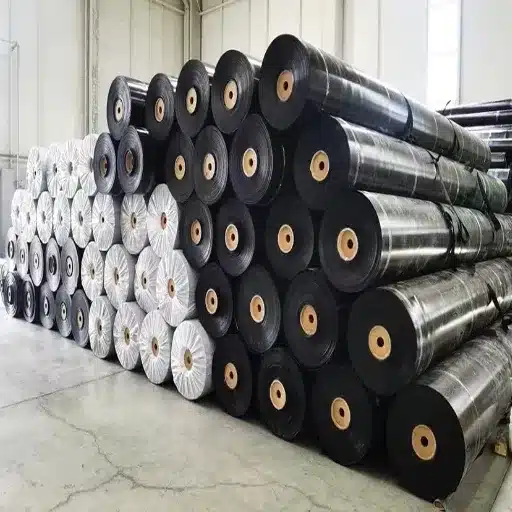
Beyond surface friction, engineers need to understand how texture affects the core mechanical properties of the sheet.
| Property | Smooth HDPE (GRI-GM13) | Textured HDPE (GRI-GM13) |
|---|---|---|
| Tensile strength at yield | 22 kN/m (1.5 mm) | 22 kN/m (1.5 mm) |
| Tensile strength at break | 40 kN/m (1.5 mm) | 40 kN/m (1.5 mm) |
| Elongation at break | greater than or equal to 700% | greater than or equal to 250% |
| Puncture resistance | greater than or equal to 500 N (1.5 mm) | Often higher due to surface mass |
| Thickness range | 0.5–3.0 mm | 1.0–3.0 mm |
Tensile strength at yield and break is comparable between smooth and textured HDPE of the same base thickness because the core material is identical. The carbon black content, resin density, and molecular weight remain unchanged.
Puncture resistance is often slightly higher for textured geomembranes because the additional surface material adds mass and distributes point loads across a larger area. However, this advantage is secondary to the friction benefit in most design decisions.
Thickness selection follows the same engineering logic for both types. For guidance on matching thickness to project requirements, see our HDPE geomembrane thickness guide.
Installation, Welding, and Quality Control
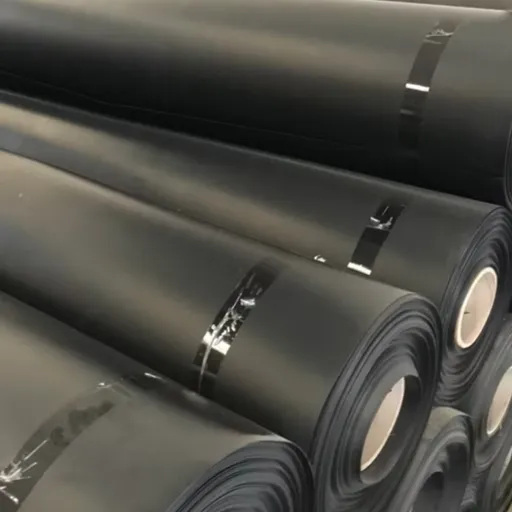
Smooth HDPE Installation
Smooth HDPE is faster and simpler to install. Panels slide easily into position, align quickly, and require minimal surface preparation before welding. A certified welder using dual-track wedge welding can achieve consistent fusion across the overlap with standard parameters.
Quality control for a smooth sheet is straightforward. Air-pressure testing of the channel between weld tracks reliably detects incomplete fusion. Electrical leak detection surveys are simple because the flat surface creates uniform contact with the detection medium.
Textured HDPE Installation
Textured HDPE needs special methods for its transportation and its preparation process. The rough surface makes panels harder to slide into the final position. The texture keeps its position on sloped surfaces because it prevents sliding, which benefits the situation during strong winds and during controlled construction activities.
Grinding before welding. The texture must be removed from the overlap zone before wedge or extrusion welding. Standard practice requires grinding a strip 100–150 mm wide along the edge that will be welded. The grinding process must eliminate all texture from the surface until it reaches the underlying smooth base sheet, while keeping core thickness intact, which should not exceed 10 percent of its original size
This is where installations often fail quality control. A 1.5 mm textured sheet with a texture depth of 0.40–0.60 mm leaves roughly 0.90–1.10 mm of base material beneath the peaks. When a welder applies excessive grinding, the seam thickness becomes 0.90–1.00 mm. The seam serves as a permanent weak structural part. The installation passes a peel test on its installation day, but it will not match the performance level of the surrounding 1.5 mm sheet throughout its lifespan.
The CQA inspector from Turkey rejected 340 meters of wedge welds because excessive grinding. The specification required a minimum weld thickness of 1.35 mm (90% of the 1.5 mm sheet). The average weld thickness according to caliper measurements was 0.95 mm. The entire seam line had to be cut out and re-welded, which extended the installation process by three days while triggering liquidated damages clauses in the construction contract.
Welding speed. The welding process for textured geomembrane material operates at 70- 80 percent speed when compared to smooth sheet welding. The welder needs to change temperature and pressure settings because the surface condition keeps changing, while the operator must check if fusion has happened over the whole overlap area. The process needs additional time because of essential changes that maintain the seam’s safety.
Cost Analysis and Total Cost of Ownership
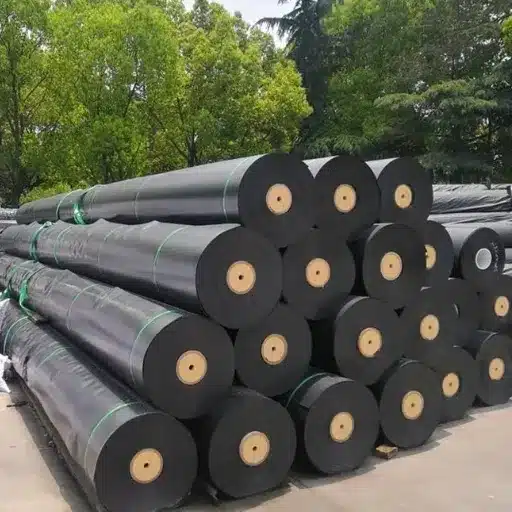
Material cost is only one component of the total cost equation.
Material cost premium. Textured HDPE costs approximately 10 – 15% more than smooth HDPE for single-sided texture, and 20 – 30% more for double-sided texture. The premium reflects additional manufacturing steps and lower production line speeds.
Installation labor. Textured sheets take longer to position and weld. Grinding adds a preparation step that smooth sheets do not require. For large projects, these labor increments can add 5–15% to the installation budget.
Failure cost. Using smooth HDPE on a slope that requires texture can trigger catastrophic liner displacement. Re-excavation, liner replacement, environmental remediation, and project delays routinely cost 10 – 50 times the initial material premium for textured sheet. For landfill and mining applications, the cost of failure is measured in millions.
The correct economic analysis is not “textured costs more.” It is “textured costs more upfront, but smooth on the wrong slope costs infinitely more downstream.”
Application Guide: When to Specify Which
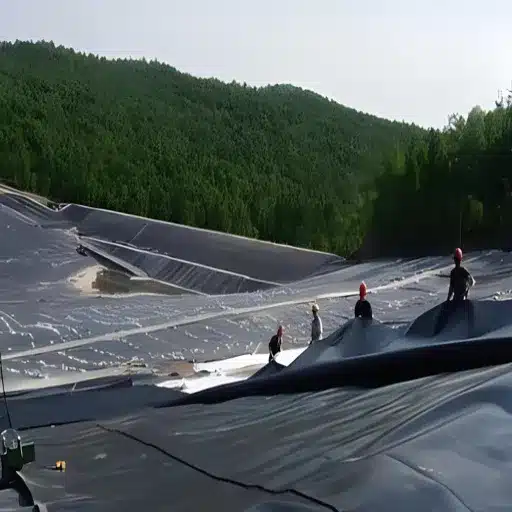
Choose Smooth HDPE When
- The project terrain is flat or gently sloping (less than 10 degrees)
- The application is a base liner, pond bottom, reservoir floor, or canal
- Budget constraints are significant and slope failure is not a design risk
- Maximum welding speed and efficiency are priorities for large-area installation
- The liner is beneath a liquid drainage layer where hydraulic flow is important
Choose Textured HDPE When
- Slopes exceed 10–15 degrees or are steeper than 3:1
- The application involves landfill side slopes, final covers, or caps
- The project is a mining heap leach pad or tailings storage facility
- Normal stresses exceed 600 kPa
- The liner is part of a composite system where inter-layer sliding must be prevented
- Long-term slope stability is critical to preventing catastrophic failure
Decision Matrix
| Project Condition | Recommended Surface | Reason |
|---|---|---|
| Flat pond or canal bottom | Smooth | Cost-effective, easy weld |
| Landfill base liner | Smooth | Efficient installation, proven performance |
| Landfill side slope or cap | Textured | Prevents soil from sliding |
| Heap leach pad (mining) | Textured | Locks stack under high stress |
| Steep embankment (greater than 18 degrees) | Textured | High friction angle required |
| Budget-sensitive, low slope | Smooth | Lower material and labor cost |
Specifying Surface Type in Project Documents
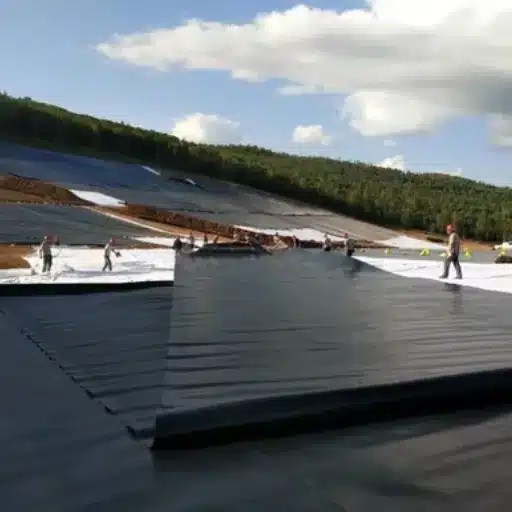
The language in tenders and specifications determines what the contractor delivers. Vague phrasing invites substitutions. Precise phrasing protects project quality.
Recommended Specification Language
For flat containment applications:
HDPE geomembrane shall be smooth-surface, manufactured from virgin high-density polyethylene resin, and shall comply with GRI-GM13. Thickness and mechanical properties shall meet or exceed GRI-GM13 minimum average roll values for smooth HDPE geomembrane.
For slope applications:
The HDPE geomembrane must have a textured surface, which exists on one side or both sides, according to the specifications shown in the drawings. The material needs to meet GRI-GM13 standards because it uses virgin high-density polyethylene resin for its production. The texture must be created through a structured design that uses flat-die embossing or through co-extrusion methods that the engineer has approved.
Language to Avoid
- “Textured or smooth, contractor’s option” (removes engineering control)
- “Textured where required” (vague; no objective criterion)
- “Manufacturer’s standard texture” (does not define type or performance)
For a complete breakdown of test methods and certification requirements, see our HDPE geomembrane testing standards guide.
Conclusion
The choice between textured and smooth HDPE geomembrane is not a matter of preference, brand, or price. It is a matter of slope geometry and interface shear stress. Smooth HDPE delivers excellent containment performance on flat terrain with the added benefits of faster installation and lower material cost. Textured HDPE delivers the friction required to keep containment systems stable on steep slopes and under high loads.
Engineers who understand the difference make better specifications. Procurement teams that verify surface type against the design requirements avoid costly rejections. And project owners who invest in the right surface type for the terrain protect themselves from the kind of failure that destroyed the Kettleman Hills liner.
When you write your next specification, start with the slope angle. Then check the normal stress. Then choose the surface. The answer will be clear.
Frequently Asked Questions
What is the main difference between textured and smooth HDPE geomembrane?
The primary difference is interface friction. The smooth HDPE material operates with a flat surface, which serves two purposes: it provides containment capabilities and facilitates welding tasks. The rough surface of textured HDPE creates a substantial increase in friction, which establishes essential requirements for use in steep slope applications.
Which is better for landfill slopes?
Textured HDPE functions as the industry standard material that engineers use to construct landfill side slopes and caps. The material prevents liner slippage on steep terrain because it achieves interface friction angles that exceed 25- 42 degrees compared to smooth HDPE, which has an interface friction range of 8 – 25 degrees.
Does textured HDPE geomembrane cost more than smooth?
Yes. The price of single-sided textured HDPE exceeds smooth HDPE by 10 to 15 percent, while double-sided textured HDPE costs 20 to 30 percent more. The use of smooth HDPE on slopes that require texture results in catastrophic failures, which require expensive remediation processes that exceed material costs.
Is textured HDPE harder to weld than smooth HDPE?
The welding process for textured HDPE requires the removal of surface material from the overlap areas. The welding process operates at 70 to 80 percent of the standard speed for smooth sheet materials. Certified welders can create strong seams on textured geomembrane material after preparing the material with grinding work, which needs monitoring to prevent excessive grinding.
What thickness of textured HDPE geomembrane should I specify?
Thickness selection follows the same principles as smooth HDPE. The typical range of textured HDPE thickness used in landfill applications operates between 1.5 mm and 2.0 mm for slope sections. The primary liners in mining heap leach pads are specified at 1.5 mm to 2.0 mm thickness.
Can I use smooth HDPE on a slope?
The installation of smooth HDPE works for gentle slopes that have a pitch below 10 degrees when proper anchoring systems exist. Textured HDPE serves as the recommended solution for slopes exceeding 10 to 15 degrees because it protects against sliding failure when normal stress levels are high.
What are the different types of textured geomembrane?
The manufacturing process includes three primary techniques, which produce three different texture types through co-extruded nitrogen-blow random texture, spray texture, and structured flat-die embossed texture methods. Structured textures deliver more predictable friction results, together with superior strength maintenance after material failure when compared to random co-extruded textures.
What tests should I require for textured HDPE geomembrane?
The mechanical properties must meet GRI-GM13 standards, and the project needs to use ASTM D5321 for interface friction angle testing and ASTM D6392 for seam peel strength testing.