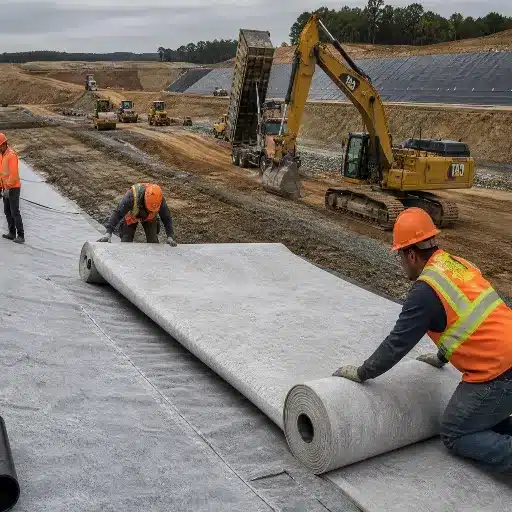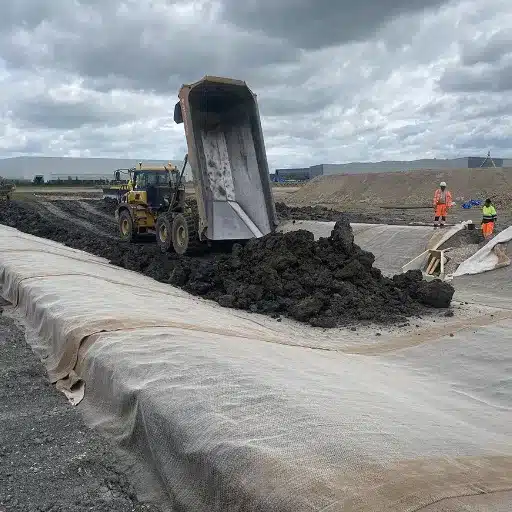
Geotextile soil stabilization is the practice of placing a high-strength geotextile layer between a weak subgrade and a granular road base to separate fines, reinforce the section, and accelerate construction over soils with a California Bearing Ratio (CBR) below 3. When specified and installed correctly, it can improve subgrade bearing capacity by 20% to 300% and extend pavement service life for years.
In 2023, a civil contractor in Nigeria paved a 12 km access road over expansive clay without geotextile soil stabilization. The subgrade CBR was 2.1. To save roughly $0.40 per square meter, the team placed the aggregate base directly on the clay. One rainy season later, pore water pressure pumped clay fines upward into the base course. The road rutted 150 mm deep over 40% of its length. The repair bill reached four times the original construction cost, and the mine it served lost three weeks of haulage.
Weak subgrades are not a rarity. They are the norm in coastal plains, river deltas, reclaimed land, and regions with high-plasticity clays. Engineers have two choices: excavate and replace the soil, or stabilize it in place. Geotextile soil stabilization is the faster, lower-carbon, and often cheaper in-place option.
This guide explains how geotextile stabilization works, when to specify woven versus nonwoven fabric, how to select the correct AASHTO M288 survivability class, and the installation sequence that turns a soft subgrade into a stable working platform.
Key Takeaways
- Geotextile soil stabilization uses separation, filtration, drainage, and reinforcement to protect weak subgrades and aggregate bases.
- Woven geotextiles are preferred for road-base reinforcement because of high tensile strength and low elongation; nonwovens are used when drainage and filtration dominate.
- AASHTO M288 defaults to Class 1 for stabilization; ASTM D4595 wide-width tensile data should drive selection, not grab tensile alone.
- Recent studies show CBR improvements from 20% to over 300%, with high-performance woven geotextiles outperforming biaxial geogrids in some DOT road-base tests.
- Installation quality, including subgrade compaction, overlap, anchorage, and rapid cover, determines whether the geotextile survives its first day under construction traffic.
What Is Geotextile Soil Stabilization?
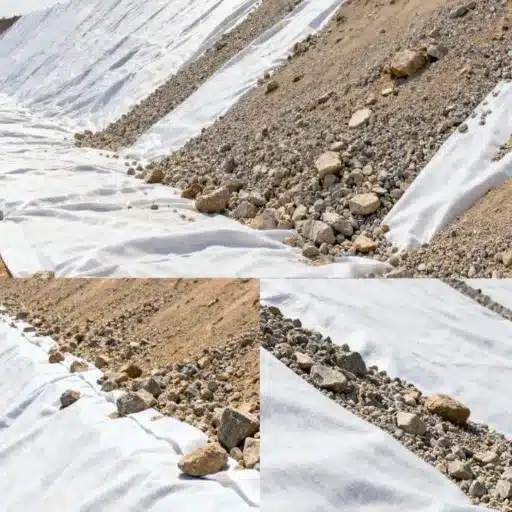
Geotextile soil stabilization is the engineered placement of a permeable polypropylene or polyester fabric within or at the base of a soil mass to improve its load-bearing behavior, control water movement, and maintain the integrity of overlying structural layers. In road construction, the fabric is typically installed at the interface between the native subgrade and the aggregate base course.
The stabilization effect comes from four interrelated functions:
- Separation. The fabric prevents fine subgrade particles from mixing with coarse base aggregate under cyclic traffic loads.
- Filtration. It allows water to escape while retaining soil particles, preventing pumping and loss of fines.
- Drainage. It provides a thin drainage plane that dissipates pore water pressure.
- Reinforcement. It adds tensile resistance, distributes wheel loads, and reduces vertical stress on the subgrade.
These functions are not theoretical. They are the reason agencies such as FHWA, AASHTO, and state DOTs include geotextile stabilization in standard roadway specifications.
For a broader view of how geotextiles fit into civil engineering, see our complete geotextile fabric engineering guide.
How Geotextile Stabilizes Weak Subgrades
Weak subgrades fail in three ways: shear deformation under load, pumping of fines into the base, and progressive saturation that reduces bearing capacity. Geotextile soil stabilization counters all three.
Separation and Fines Migration Control
Without a separator, every passage of a heavy truck forces subgrade fines upward into the aggregate voids. Over time, the base course becomes contaminated. It loses drainage capacity, stiffens in the wrong way, and begins to rut. A properly specified geotextile blocks this migration while remaining permeable enough to let excess water pass through.
Reinforcement and Membrane Support
A woven geotextile with high tensile strength acts as a flexible tension member. Under wheel loading, it restrains lateral deformation of the subgrade and redistributes vertical stress. The effect is sometimes called membrane support: the fabric deforms slightly into the subgrade, generating tensile forces that counteract the applied load.
Research summarized by the Geosynthetics Society indicates that geotextile reinforcement can increase the composite compression modulus of a subgrade-base system by 30% to 50%.
Drainage and Pore Pressure Relief
In saturated or seasonally wet subgrades, water trapped beneath the base creates hydrostatic pressure. A nonwoven or composite geotextile with adequate permittivity provides a preferential drainage path, shortening the time needed for pore pressure to dissipate after rainfall or groundwater rise.
Protection Against Construction Damage
During aggregate placement and compaction, a heavy dump truck can punch ruts into a soft subgrade. The geotextile distributes the contact pressure from tires and dozer tracks, allowing construction equipment to operate where bare subgrade would fail.
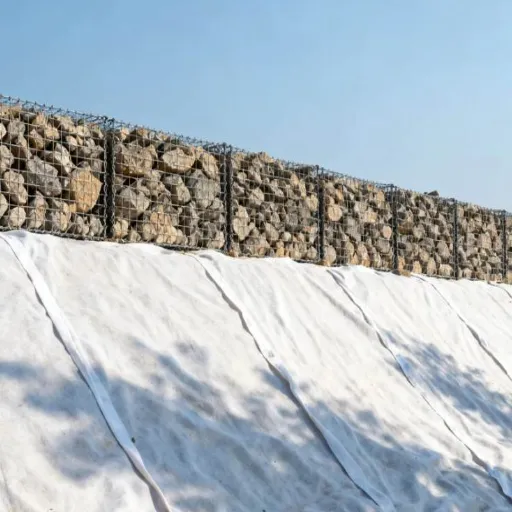
The same separation-reinforcement principles apply behind retaining walls, where geotextile reduces lateral earth pressure and protects drainage layers. For those applications, see our geotextile retaining wall guide.
Woven vs Nonwoven Geotextile for Soil Stabilization
Not every geotextile can stabilize soil. The choice between woven and nonwoven depends on which function dominates the design.
| Property | Woven Geotextile | Nonwoven Geotextile |
|---|---|---|
| Primary function | Reinforcement and separation | Filtration and drainage |
| Tensile strength | High (often 20–100 kN/m) | Moderate |
| Elongation at break | Low (<25%) | High (>50%) |
| AOS (opening size) | Larger, more regular | Smaller, gradient pore structure |
| Permittivity | Lower | Higher |
| Best for | Road bases, embankments, and steep slopes | Drainage layers, French drains, and filtration |
For road-base stabilization over weak but relatively dry subgrades, woven geotextile is the standard. Its high tensile modulus provides the lateral restraint needed to reduce rutting. For subgrades with high groundwater, a composite system may be specified: a nonwoven layer against the soil for filtration and drainage, capped by a woven layer for reinforcement.
If your project requires high-strength separation and load distribution, specify a woven geotextile fabric for soil stabilization. Our woven geotextile applications guide covers railways, embankments, and steep slopes in more detail.
Geotextile Stabilization Design: Subgrade CBR, Tensile Strength, and AASHTO M288
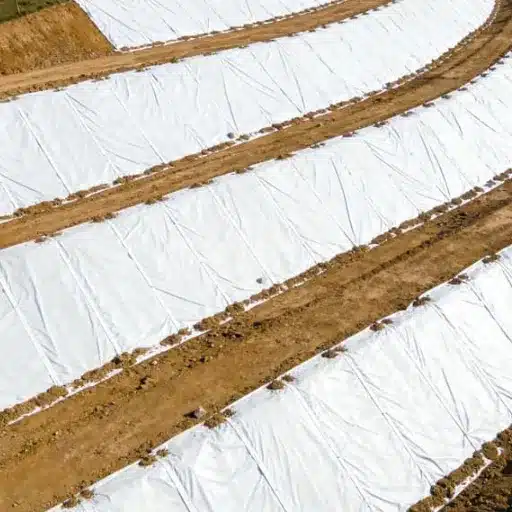
Design begins with the subgrade CBR, a simple but powerful indicator of soil strength under repeated loading.
Subgrade CBR Categories
| CBR Range | Soil Condition | Typical Geotextile Role |
|---|---|---|
| < 1 | Very soft (peat, organic silt) | Stabilization is often combined with a surcharge or a geogrid |
| 1–3 | Soft clay, silty sand | Primary stabilization target for woven geotextile |
| 3–5 | Fair to moderate | Separation and minor reinforcement |
| > 5 | Good | Separation only; lighter fabric may suffice |
Most geotextile soil stabilization projects target CBR values between 1 and 3. Below CBR 1, the soil may be too weak for fabric alone, and a geogrid or surcharge preload may be required.
AASHTO M288 Survivability Classes
AASHTO M288 is the standard specification for geosynthetics in highway applications. For stabilization, the default survivability class is Class 1, because installation over soft subgrade exposes the fabric to severe puncture, tear, and abrasion.
| Property | Class 1 Woven (min.) | Class 1 Nonwoven (min.) | Test Method |
|---|---|---|---|
| Grab strength | 1,400 N (315 lb) | 900 N (200 lb) | ASTM D4632 |
| Sewn seam strength | 1,260 N (285 lb) | 810 N (180 lb) | ASTM D4632 |
| Tear strength | 500 N (110 lb) | 350 N (80 lb) | ASTM D4533 |
| Puncture strength | 500 N (110 lb) | 350 N (80 lb) | ASTM D4833 |
| Burst strength | 3,500 kPa | 1,700 kPa | ASTM D3786 |
Class 2 or 3 may be acceptable only when supported by field experience or test-section data showing the lower class will survive installation.
Why ASTM D4595 Matters
Grab tensile strength (ASTM D4632) is useful for quality control, but it does not represent in-service behavior. Wide-width tensile testing per ASTM D4595 uses a 200 mm specimen and measures tensile strength, elongation, and secant modulus under conditions closer to plane-strain loading. For road-base reinforcement, ASTM D4595 values should be the basis of design.
The North Carolina Department of Transportation requires a minimum wide-width tensile strength at 5% strain of 1,900 lb/ft and an ultimate tensile strength of 4,800 lb/ft for geotextile used in pavement stabilization. These values are reported as Minimum Average Roll Values (MARV) per ASTM D4439 terminology.
For a complete reference on geotextile testing standards, see our geotextile ASTM standards guide.
Step-by-Step Installation for Road Subgrade Stabilization
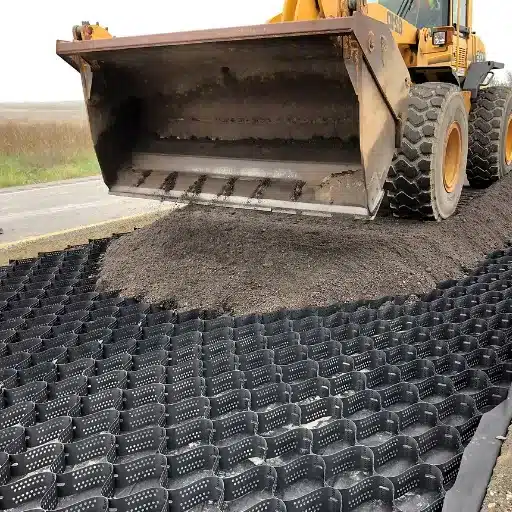
Design is only half the equation. A Class 1 woven geotextile can fail on the first day if it is installed over a poorly prepared surface or left exposed to UV for a week.
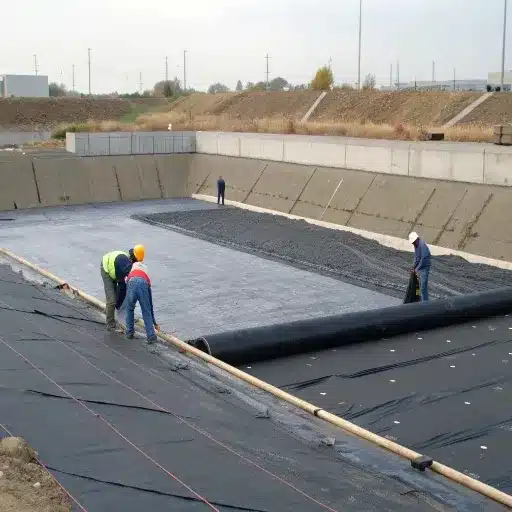
1. Subgrade Preparation
Clear vegetation, topsoil, and debris. Remove stones larger than 50 mm and any sharp objects. Shape the subgrade to a cross-slope of 4–5% so water drains laterally rather than ponding. Compact the surface to at least 95% of standard Proctor density where possible. On very soft subgrades, excessive compaction may not be feasible; in those cases, the geotextile provides the working platform needed to place and compact the first lift of aggregate.
2. Fabric Placement
Roll the geotextile directly onto the prepared subgrade in the direction of primary traffic. Keep the fabric moderately taut, but do not stretch it more than 5%. Wrinkles larger than 0.5 m² should be removed because they create stress concentrations and poor contact with the base course. Overlap adjacent rolls so the upper sheet shingles the lower sheet in the direction of water flow or slope.
3. Overlap and Seaming
| Base Condition | Minimum Overlap |
|---|---|
| Firm, level horizontal subgrade | 300–500 mm |
| Soft or uneven subgrade | 600–900 mm |
| High-load or stitched seams | Bonded/sewn joint ≥ 100 mm |
For machine-sewn seams, the seam strength should be at least 80% of the base material strength. For hand-sewn or overlapped seams in soft subgrade, use the upper end of the overlap range.
4. Anchorage
At shoulders, toes of slopes, and transitions, place the fabric into an anchorage trench at least 300 mm deep, then backfill and compact. This prevents the fabric from pulling out under traffic or during aggregate spreading.
5. Aggregate Placement and Compaction
Place the first lift of aggregate immediately after fabric installation. Limit UV exposure to less than 24 hours; some manufacturers note strength losses exceeding 15% after 48 hours of direct sunlight. Use a minimum 150 mm thick initial lift of granular material to protect the fabric from heavy equipment. Compact in 150–200 mm lifts to the specified density.
For universal installation protocols beyond road-base work, see our geotextile installation best practices.
Performance Data: CBR Improvement and Aggregate Reduction
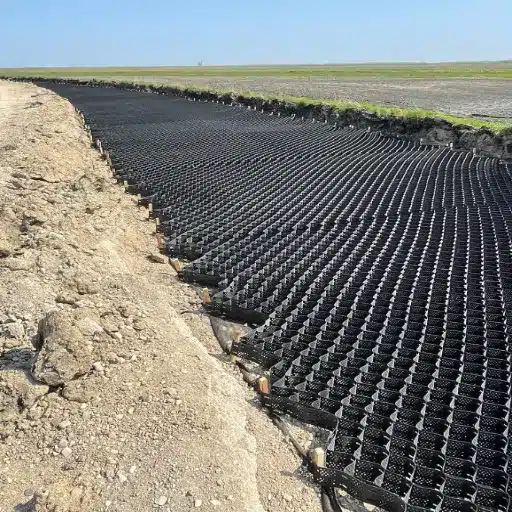
Quantified performance is what separates engineering specifications from marketing claims.
A 2024–2025 review of geotextile reinforcement studies found CBR improvements ranging from 20% to over 300%, depending on soil type, geotextile placement depth, and whether the soil was soaked or unsoaked. Typical strong improvements fall between 50% and 300%.
In Mali, a road project over lateritic clay placed a single layer of woven geotextile at one-fifth of the subgrade thickness. Laboratory CBR rose from 12 to 76. In Turkey, a similar treatment on a sandy clay subgrade raised CBR from 45 to 75. These are project-specific results, but they show the potential when placement depth and fabric strength are matched to the soil.
The 9-state DOT subgrade stabilization study produced even more striking field-level data:
| Material | Base Course Reduction (BCR) | Traffic Benefit Ratio (TBR) |
|---|---|---|
| High-performance woven geotextile | 26.9% | 14.8 |
| Biaxial geogrid | 23.8% | 10.4 |
| Geogrid/geotextile composite | 21.9% | 8.4 |
| Nonwoven geotextile | 21.3% | 7.9 |
BCR measures how much aggregate thickness can be reduced while maintaining performance. TBR measures how many more load cycles a reinforced section withstands compared to an unreinforced one. In this study, the high-performance woven geotextile outperformed the biaxial geogrid on both metrics.
A 2025 TRB/ASCE study on expansive subgrades found that geotextile reinforcement reduced surface heave by approximately 38% compared to unreinforced sections.
For projects needing higher structural capacity than geotextile alone can provide, our geogrid vs geotextile comparison explains when to add geogrid or specify it instead.
Common Soil Stabilization Mistakes
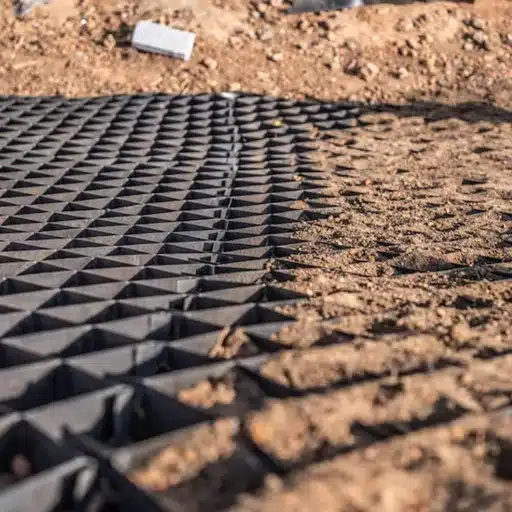
Even good specifications fail when these errors appear in the field:
Mistake 1: Selecting the wrong fabric type. Using a nonwoven geotextile as the primary reinforcement layer under heavy haul roads. Nonwovens elongate too much to provide effective lateral restraint.
Mistake 2: Relying on grab tensile for design. Grab strength (ASTM D4632) is a quality-control index. Design should use wide-width tensile data per ASTM D4595.
Mistake 3: Inadequate overlap. A 100 mm overlap on a soft subgrade pulls apart under the first aggregate truck. Use 600–900 mm overlaps in poor ground.
Mistake 4: Excessive UV exposure. Leaving fabric exposed for more than a few days causes polymer degradation. Cover within 24 hours.
Mistake 5: Poor subgrade prep. Stones, roots, and standing water left under the fabric become puncture points and failure zones.
Mistake 6: Confusing stabilization with reinforcement. Geotextile stabilization improves a working platform and reduces aggregate thickness. Structural retaining walls and steep embankments often need geogrid.
When to Use Geogrid Instead of Geotextile
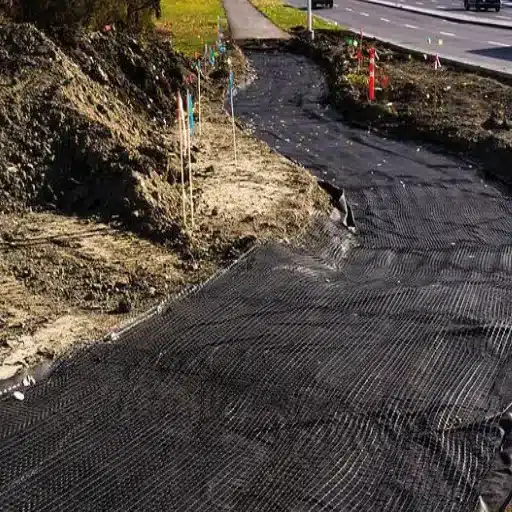
Geotextile soil stabilization works best where the primary problem is a weak subgrade beneath a road, yard, or embankment. Geogrid becomes the better choice when the design requires high tensile stiffness over large deformations, such as:
- Reinforced soil retaining walls
- Steepened embankment slopes steeper than 1H:1V
- Heavy industrial yards and container terminals
- Railway track beds
- Aggregate reduction programs where long-term modulus gain is critical
In many projects, the two materials work together. A geotextile placed directly on the subgrade provides separation and filtration, while a geogrid placed within the base course provides structural reinforcement. For a decision framework, see our geogrid vs geotextile comparison.
Frequently Asked Questions
How does geotextile soil stabilization work?
It works by placing a strong, permeable fabric between a weak subgrade and a granular base. The fabric separates fine soil from aggregate, reinforces the section through tensile resistance, and allows excess water to drain.
What strength geotextile do I need for subgrade stabilization?
For road-base stabilization, specify AASHTO M288 Class 1 as a minimum. Use wide-width tensile data per ASTM D4595; agency specs such as NCDOT require ≥1,900 lb/ft at 5% strain and ≥4,800 lb/ft ultimate strength (MARV).
Can I use nonwoven geotextile for soil stabilization?
Nonwoven geotextiles are better suited to filtration and drainage. For load-bearing stabilization under traffic, woven geotextile is the standard. Nonwovens may be used in composite systems or in very wet subgrades where drainage is the primary concern.
How much does geotextile soil stabilization improve CBR?
Reported CBR improvements range from 20% to over 300%, depending on soil type, fabric strength, placement depth, and environmental conditions. Typical strong improvements are 50% to 300%.
When should I use geogrid instead of geotextile?
Use geogrid for structural reinforcement of retaining walls, steep slopes, heavy industrial yards, and railway track beds where high tensile stiffness and low elongation are required.
Conclusion
Geotextile soil stabilization is not a shortcut. It is a disciplined engineering solution that matches fabric properties to subgrade conditions, installation quality, and long-term traffic loading. The four functions, separation, filtration, drainage, and reinforcement, work together to turn marginal soils into stable working platforms.
Start with the subgrade CBR. Specify AASHTO M288 Class 1 for stabilization applications. Base tensile selection on ASTM D4595 wide-width data, not grab tensile alone. Install with proper overlap, anchorage, and rapid cover. And verify that the fabric type matches the design function.
If you are planning a road, haul road, or industrial yard over weak subgrade, our engineering team can review your CBR data and recommend a woven geotextile specification matched to your project. We supply woven geotextiles for road projects worldwide, with ISO9001 quality systems, retained test samples, and flexible order quantities. Request a technical consultation today →
Return to the complete geotextile fabric engineering guide for an overview of all geotextile functions, or explore our woven geotextile applications guide for project-specific selection guidance.