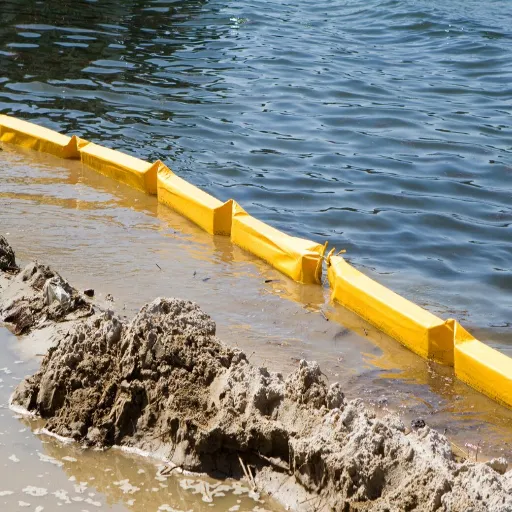
Choose silt curtain depth from the project requirements, bed shape, water levels and expected conditions. The stated skirt length alone doesn’t tell you the gap above the bed or how far the skirt will reach in moving water.
A curtain can clear the bed during one inspection and drag when the tide falls. Buying a longer skirt may look like the cautious choice, yet it can introduce a different problem. The useful question is which depth works across the conditions the project must manage.
This guide separates the measurements, compares published clearance advice and gives you a worksheet for discussing dimensions. Start with the floating silt curtain overview if you need the wider system context before assembling those inputs.
Key Takeaways
- Skirt fabric length and effective vertical depth are different measurements.
- Compare bed and water elevations using one stated reference and consistent units.
- A clearance value needs its source, water-level reference and exposure conditions.
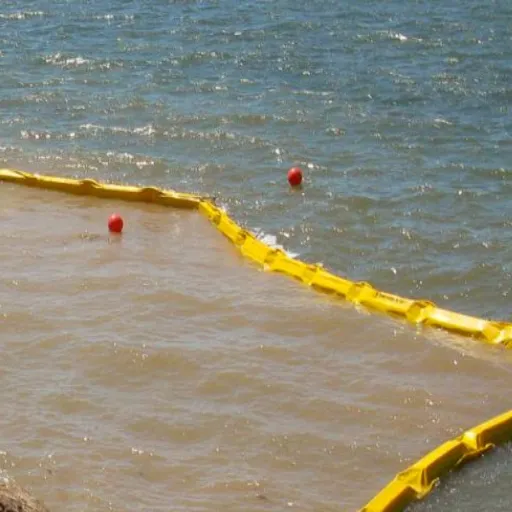
- Verify the underwater arrangement; a photograph of floating sections cannot establish clearance.
Use the worksheet to document a proposed choice for review, rather than treating a catalogue dimension as the design basis.
What Silt Curtain Depth Measures
Skirt length versus effective vertical depth
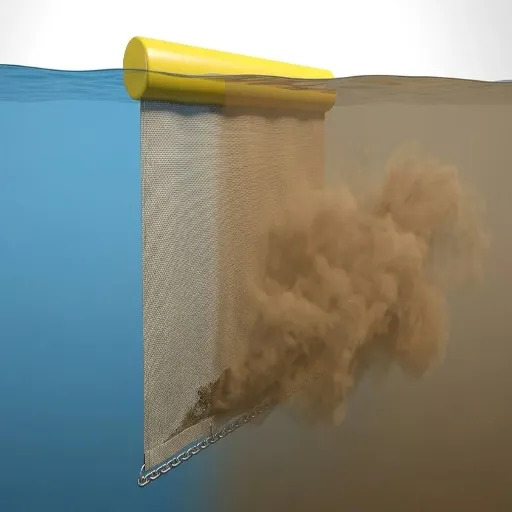
Skirt length is the fabric length stated for the curtain. Effective vertical depth is how far it reaches down once in use. Ask the supplier to mark the exact measurement points on its drawing. Check how the floats, fabric and weighted lower edge relate.
These dimensions can differ when flow pushes the skirt sideways. Parker Systems’ Turbidity Curtain Info Booklet discusses this billowing effect in moving water. A longer piece of fabric does not necessarily give an equal increase in vertical coverage.
A flat drawing doesn’t show the shape under flow. Neither does the length of fabric on a roll.
Illustrative scenario: A buyer compares two nominal skirt lengths for the same exposed location. The longer option appears to reach farther down on paper, but the team has no evidence of its shape under the expected current. The next task is to review the proposed assembly and operating conditions, rather than assuming the extra fabric solves coverage.
Clearance is a local measurement
Bottom clearance is the gap between the lower edge and the bed. State where and when it is checked. On an uneven bed, that gap can differ along one curtain run. A shoal may govern contact risk even where the nearby channel is much deeper.
For a simple vertical sketch, water depth minus effective skirt depth describes the gap. That relationship is only a geometric aid. It doesn’t predict billowing or loads on the system. Waves and sediment buildup also need review.
The skirt is also only one component. A geotextile fabric description can help explain material terminology, but a fabric datasheet cannot establish the suitability of floats, seams, connectors, ballast and moorings as a complete curtain. Keep the material specification separate from the proposed deployed depth.
Build a Water-Level and Bed-Profile Worksheet
Put every elevation on a common reference
Check the reference for the bed survey and for each water level. Do this before comparing dimensions. A datum is the base level used to measure heights or depths.
NOAA’s tidal datum definitions explain the terms. Mean low water, mean lower low water and Lowest Astronomical Tide are different references. You can’t treat them as the same level.
Ask the surveyor or project reviewer to confirm any change of reference. Don’t guess the offset. Do not borrow an offset from another port or subtract values that use different references.
Record the source and units of each value. Keep the original survey reference visible. If the conversion is unresolved, leave the proposed dimension open.
Illustrative scenario: The survey drawing names one reference, while a procurement note says only “low tide.” Both documents may contain useful information, but the team cannot yet compare them. The reviewer first identifies the intended water-level reference and reconciles it with the survey. Guessing a conversion would hide the uncertainty inside the skirt order.
Describe the full operating range
Use a station or segment schedule along the proposed alignment. Include shallow points, deeper sections and shoreline transitions. One depth from the work area’s centre cannot describe the whole route.
Map each change in the bed. Ask whether the bed information still represents the site after excavation, deposition or a change in alignment.
The following blank worksheet is a planning template, not a set of acceptance values:
| Input | Entry to record | Check needed |
|---|---|---|
| Segment or station | Location and drawing reference | Same alignment as the proposal |
| Bed elevation | Survey value, units and date | Common datum and survey limitations |
| Minimum water level | Value, reference and source | Applicable to the operating period |
| Maximum water level | Value, reference and source | Coverage basis identified |
| Exposure | Current, reversal, waves and vessel effects | Conditions supplied to assembly reviewer |
| Uncertainty | Survey gaps and unresolved assumptions | Owner and resolution action |
| Review | Name, role and revision | Basis accepted before ordering |
Treat predicted tides and the project’s full water-level range as separate inputs until the reviewer confirms their relationship. The chosen reference doesn’t cover every weather or river effect. Ask which other changes matter at this site. Record the operating period so a later team can see what conditions the proposal considered.
Take this input sheet to the responsible reviewer before discussing a final skirt dimension. A missing reference is a reason to resolve the data, not a reason to add an arbitrary allowance.
Compare Bottom-Clearance Rules in Their Named Conditions
Moving-water guidance needs its reference level
Published advice can appear inconsistent because it describes different arrangements. Read the condition alongside the number. Neither the largest gap nor the longest skirt is automatically the safer choice for an unknown project.
Ecocoast’s depth guidance, published in December 2016, recommends a minimum 0.5 m gap at Lowest Astronomical Tide. That is a named manufacturer’s recommendation, rather than a worldwide clearance rule. Parker’s booklet instead discusses a minimum 1 ft gap at mean low water where tidal, wind or wave action is present.
Those recommendations cannot be compared by converting units alone: their water-level references differ. Do not average them or select the smaller figure without checking the governing requirement. The useful comparison is the source’s complete basis against the project’s actual conditions.
When reviewing a quoted clearance:
- Identify the document required by the contract or permit.
- Find the condition attached to its depth provision.
- Match its water-level reference to the survey.
- Record any conflict for the responsible reviewer.
Keep the complete provision with the worksheet. A screenshot of the number alone leaves the next reader without the condition that made it relevant.
Bottom-resting details use a different basis
The Illinois Urban Manual practice standard, Code 917, illustrates why an absolute “always touch bottom” or “never touch bottom” answer is misleading. On printed page 917-2, its Type I and Type II provisions call for a skirt 10% longer than anticipated high-water depth to rest on the bed. It gives a different arrangement for significant wind or wave exposure.
| Published source | Stated condition | Water-level basis | Dimension in that source | Limitation |
|---|---|---|---|---|
| Ecocoast depth article | Guidance allowing flow beneath the skirt | Lowest Astronomical Tide | Minimum 0.5 m gap | Manufacturer guidance, not a global rule |
| Parker booklet | Tidal, wind or wave action | Mean low water | Minimum 1 ft gap | Different reference from LAT |
| Illinois Code 917 | Type I and Type II applications | Anticipated high water | Skirt 10% longer than water depth | Intended bottom-resting detail |
| Illinois Code 917 | Significant wind and/or wave action, over 1 ft, for most of the project | Mean low water | 1 ft bed clearance; maximum skirt depth 12 ft below surface | Specific exposed-condition provision |
Use the Illinois figures only within that practice standard’s scope and conditions. Their inclusion here does not establish that the standard governs your site. Check for conflicts between the contract, permit and proposed arrangement. Ask the project reviewer to resolve them before ordering.
Fabric selection remains a separate question. The site’s woven geotextile overview provides material context; it does not identify an approved skirt for this assembly. A fabric name alone establishes neither required permeability nor clearance. Keep both decisions visible in the specification so a material substitution does not silently change the reviewed system.
Check Silt Curtain Depth Through the Tidal Cycle
Low water: bed contact and trapped ballast
For an arrangement intended to remain off the bed, examine clearance at the relevant low-water conditions along the full alignment. Include the shallowest surveyed sections and transitions. A check at the deepest station will not reveal contact over a nearby shoal.
Chatoyer’s Silt Curtain Design Guide, printed page 13, discusses the risks of excessive depth, slack fabric and sediment collecting over the ballast. Its guidance supports reviewing the whole assembly rather than simply extending a skirt to the bottom. Ecocoast likewise explains how burial of the lower edge can affect flotation as water rises.
Record the intended relationship to the bed explicitly. A specified bottom-resting arrangement needs its own review basis; it should not be treated as a failed clearance arrangement, or vice versa. The earlier source comparison helps identify which question the designer is answering.
High water and moving water: effective coverage
Then check what happens as the water column deepens and the current changes. A fixed skirt dimension does not track every change in water depth. The project must define the coverage it needs. The reviewer must check when the proposed system can provide it.
Current can push the skirt out of shape and change how far it reaches down. Parker’s billowing discussion and Chatoyer’s load guidance explain this problem. Forces act through the skirt, floats, connectors and moorings.
Ask how the proposed system will behave under the expected flow. Don’t choose ballast from fabric length alone.
Illustrative scenario: A proposed skirt clears a shoal at the reviewed low-water level. At another operating water level, the team still has to establish whether it provides the agreed vertical coverage. Passing the first check does not answer the second. The appropriate response is to revisit the basis and assembly, rather than invent a longer dimension on site.
Does flow reverse at the site? If so, check both directions. Keep water level, current and wave notes together.
That way, the field record describes the conditions behind the depth reading. Do not assume the lowest water level coincides with the strongest current.
If required coverage and bed separation cannot both be supported, return the proposal for project-specific review. Possible changes belong in the approved arrangement and operating plan. More fabric or more ballast should not become an undocumented field remedy.
Turn the Depth Choice Into a Reviewable Field Record
Specify each segment and its assumptions
Tie each proposed skirt length to a place on the drawing. Where does that segment start and end? Which survey and water levels support it?
Ask the reviewer to confirm:
- The points used to measure the skirt.
- The location of each change in length.
- The survey and water-level sources.
- Who will resolve each open assumption.
Keep those answers with the order.
Do not describe the entire run with its deepest nominal skirt if other segments differ. Keep the drawing revision with the order. Buyers and the field team need the same proposal. Changes to alignment or operating conditions should return to that record for review.
Use a short segment record with fields for proposed skirt length, required deployed depth, intended bed relationship and the conditions being checked. Include the observation method and any limitations. Leave unverified entries open rather than copying catalogue values into a column meant for field observations.
Verify what is below the floats
An above-water photograph can document the alignment and visible flotation. It cannot establish the skirt’s underwater shape or bed clearance. Agree on a way to check the skirt before work starts. Plan safe access and decide how the team will handle unclear findings.
Record the segment, time, water-level reference, observed conditions and actual finding. Distinguish “specified” from “observed.” If you can’t confirm the lower edge, say so in the record. Normal-looking floats don’t prove it is correct.
Set project-specific action triggers before work begins. These might address an observed bed interaction, a changed alignment or conditions outside the reviewed range. The trigger needs an owner and response route, not an invented universal tolerance. Detailed inspection, anchoring and turbidity-monitoring plans remain separate work items.
For the wider system discussion, return to the floating silt curtain planning overview. Keep this depth record alongside that discussion so the nominal skirt dimension remains tied to the conditions and evidence behind it.
Frequently Asked Questions
The answer to each question depends on the arrangement being reviewed. Use these distinctions to complete the worksheet, then check the applicable project documents. They are not substitute dimensions for a purchase order, and none establishes the performance of an unreviewed assembly.
Should a silt curtain touch the bottom?
It depends on the governing arrangement and exposure. Illinois Code 917 includes bottom-resting Type I and II details, while its exposed-condition provision requires clearance. Other manufacturer guidance also calls for a gap. Identify the applicable requirement first; do not turn either approach into a rule for every water body.
Which tide should control skirt length?
Use the water-level reference required by the project’s design basis, then assess the full operating range. Lowest Astronomical Tide and mean low water are different references. Confirm how the bed survey relates to the selected level, and review coverage at higher water as well as contact risk at lower water.
Can a deeper skirt solve a strong-current problem?
Not by itself. Moving water can push the skirt sideways, reducing effective vertical coverage while loading the assembly. Review the expected current and proposed system together. A longer nominal skirt is not evidence that the curtain will reach the required depth or remain suitable under those operating conditions.
Is a 0.5 m bottom gap always required?
No. That figure appears in Ecocoast’s manufacturer guidance with Lowest Astronomical Tide as its reference. Other documents use different conditions, dimensions or bottom-resting arrangements.
Retain the source and reference with any quoted gap. The responsible project reviewer must establish which requirement applies to the proposed installation and operating period.
Can extra ballast force the skirt to the required depth?
Do not add ballast as an unreviewed remedy. Ballast acts within an assembly that also depends on flotation, fabric, connectors and moorings. A depth problem needs review of the conditions and deployed shape. Refer any proposed change to the assembly reviewer rather than assuming extra weight makes it acceptable.
Confirm the Basis Before Ordering
A useful depth decision starts with the governing requirement, then brings the bed survey and water levels onto one reference. Check the proposed skirt against both the intended bed relationship and required coverage. Keep the operating conditions with those checks so the selected dimension has a traceable basis.
The field record should show what was proposed, what was observed and what remains unresolved. A stated length or a float photo doesn’t prove what happens below water. Keep the limits of that evidence clear.
That makes later changes easier to review. The team can still see the basis of the first choice.
Before ordering, assemble the segment schedule, water-level sources, survey limitations and proposed drawing. Use the floating silt curtain overview to frame the wider selection discussion. A curtain that looks right at one tide still needs a documented basis for the other conditions it will face.