Geomembrane leak survey reports should name the tested liner and show the area checked. They should also state the test limits, findings and linked repair/retest records. Request those records together: a conclusion without its scope drawing leaves you unable to see what was assessed.
You may have a signed PDF and still lack the evidence needed for handover. Electrical leak location (ELL) results describe one survey and its field conditions. The review task is to connect that result to the right area and work stage, then track the remaining questions.
This guide helps owners and project teams check their records. It also supports the construction quality assurance (CQA) review. Use it alongside the project specification and the qualified provider’s explanation.
Use it to ask clear questions. It does not replace a test procedure or serve as an ASTM approval form.
Compare your supplied report pack with the checks below before the next handover meeting. For method selection, start with our geomembrane electrical leak location guide.
Key Takeaways
- Match the conclusion to a named liner, drawing revision and construction state.
- Separate tested coverage from exclusions and missing paperwork.
- Read capability evidence alongside the conditions that could limit detection.
- Trace each finding through repair and the stated recheck before closing its record.
Define the Scope of Geomembrane Leak Survey Reports
Identify the barrier and work stage
Which liner does the report describe? Start with the project, cell or basin, liner layer and survey date. Does the system have more than one liner? A result for one layer does not prove the state of another.
Ask for the cross-section or drawing reference that identifies the barrier assessed.
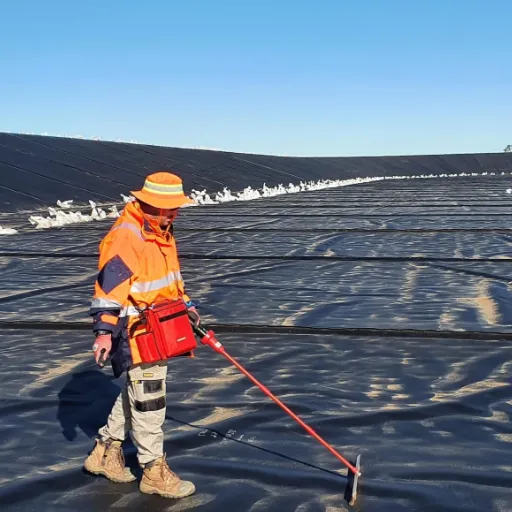
Next, check whether the liner was exposed, water-covered or soil-covered. Record the condition at testing, rather than the condition visible during your review. A test done before cover placement cannot reveal damage caused by that later work. The distinction matters even when the project name and cell number remain unchanged.
Request the method name and its stated scope. Don’t infer a test method from a photograph of equipment. Find the drawing named in the report. Does its revision match the boundary and liner described in the text?
Align dates, revisions and decisions
Keep the survey date, repair dates, recheck dates and report issue date separate. A new report issue may explain earlier work. It does not always mean a new field visit took place. Ask what changed between versions and retain the superseded issue in the project record, clearly marked as such.
Illustrative scenario A: An owner receives a report with a favorable conclusion but no coverage drawing. The first follow-up is to request the referenced drawing and its revision. Until it arrives, the reviewer logs a missing scope record. They don’t assume that the whole cell passed or that the liner failed.
Build a short identity block containing the project zone, barrier, drawing reference, test state and dates. Link it to the report number. Use the same names in the repair register. If the contractor calls an area “Lagoon East” and the surveyor uses a cell code, ask for a cross-reference.
What decision does the team need to make? It might be release for the next work stage, closure of a repair, or final handover of the records. Those are different decisions.
The named project reviewer uses the survey result as evidence. The result alone does not release the work.
Keep the identity block with the construction sequence. Our geomembrane installation guide provides background for relating field records to installation and handover stages.
Reconcile Coverage Maps, Exclusions and Site Conditions
Separate offered, reached and assessed areas
An area offered for testing may not have been fully checked. Ask what work the team did under its stated procedure. Compare the scope text, field coverage drawing and exclusions list.
Look for a clear boundary, orientation, location references and an explanation of gaps. Ask how the provider established coverage for the method used.
Review slopes, tie-ins, penetrations, edges and interrupted work zones explicitly. Their presence on a general arrangement drawing does not establish that they were surveyed.
A missing label may also be a drawing error. It does not always mean the zone was left untested. Ask the provider to distinguish the two.
Use a reconciliation table like this; the entries are review prompts, not project results:
| Zone or feature | Evidence to locate | Question to resolve |
|---|---|---|
| Base and slopes | Survey boundary and field coverage record | Are the named surfaces included? |
| Tie-in or edge | Local detail and exclusion reference | Where does assessed coverage end? |
| Penetration | Location reference and method explanation | What was assessed around the feature? |
| Interrupted work area | Visit dates and resumed-work record | Was the remaining area completed? |
| Restricted zone | Exclusion and follow-up action | What decision remains open? |
Don’t turn a shaded plan into a coverage percentage unless you can verify the area basis. If the report uses an area total, ask how it relates to the drawing and whether exclusions were deducted. A precise-looking number does not resolve an unclear boundary.
Request coverage evidence suited to the method
Not every survey produces a contour plot. The historical Dublin Port report used an exposed-liner method with an audible alarm. It explains why that method did not produce contour plots.
Read its records on that basis. A plot used for another technique may not be the right evidence to request.
Illustrative scenario B: A tie-in appears on the construction plan but falls outside the marked survey boundary. The reviewer records its reference and asks whether it was excluded, assessed separately or omitted from the drawing. None of those possibilities proves a leak. The answer guides the next request for records or field review.
Read the limitations beside the coverage drawing. The public scope of ASTM D8265-26 addresses covered-liner electrical methods and documentation of site-condition issues. A boundary alone cannot explain whether conditions limited the result within it.
If text and drawings disagree, request a corrected, cross-referenced issue. Keep the original and the response together so the reason for the change remains visible to the next reviewer.
Read Capability Checks and Limitations Together
Establish the basis of the field result
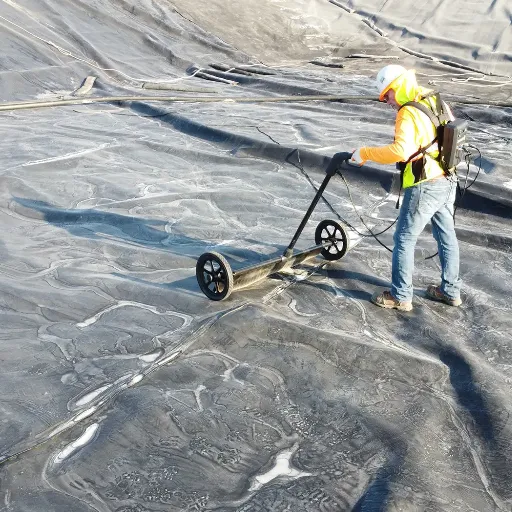
A capability check asks whether the survey could detect the agreed test feature under the relevant conditions. Ask where it was, what type it was and what result it gave. How does that check relate to the area surveyed?
Ask who did the work, with what equipment and procedure. Note any changed settings or conditions that the provider says affected the result.
The public guidance in ASTM D7909-21a(2025) explains that detection depends on both the survey and local site conditions. It also addresses agreed intentional leaks and their documentation. Where these were used, request their identification and repair records. Do not create a hole yourself to check a contractor’s work.
Record the standard and edition cited by the contract and report. D8265-26 is the current mapping-practice edition reviewed here; an existing contract may name a different edition. If they differ, ask the reviewer to resolve the gap. Don’t silently replace the cited basis.
The public scope of ASTM D7007-24 also links covered-survey work to demonstrated equipment, procedures and parameters. These public pages explain why those records matter. They do not give the full licensed procedures or all the project requirements.
Interpret non-detection within its limits
“No leaks detected” needs a defined area, time and test basis. Ask whether the provider recorded problems with electrical contact, moisture, isolation or access, where relevant to the method. A good check result at one point does not resolve a different field condition elsewhere.
In Abigail Gilson’s conference paper, The Capabilities and Limitations of Electrical Leak Location, a covered-liner case illustrates masking and difficult tie-in conditions. Saved locations helped the team return for later checks. Use the case to ask about limits and follow-up scope. It cannot tell you what size of leak a team can find at your site.
If a check was unsuccessful, ask what the provider concluded, what changed and which results remain supportable. Don’t guess the cause from the desk. A missed feature can raise questions about conditions, survey performance or both. The response should name the consequence for the affected survey scope.
Keep the qualification close to the result it limits. A broad caveat at the end of a PDF can be hard to act on. Ask for a note tied to the affected zone on the drawing. This makes the report more useful without turning uncertainty into either a blanket pass or a blanket failure.
Connect Defects, Repairs and Retests in One Register
Follow the record chain
Keep the stages separate: a signal, a confirmed defect, a repair and its recheck. Each needs its own record. Ask how the provider labels each stage. Then use one stable ID to link them.
A photo filename alone may not be enough. Can the next team find that point on the drawing?
The historical Dublin Port submission, Appendix C gives a useful classification example. Its survey on 2 August 2019 listed eight defects, including the intentional test hole as defect 1. That distinction prevents the total from being misread as eight incidental defects. It is one external project record, not an industry defect rate.
Use the following register fields to request a traceable chain. They are proposed review fields rather than mandatory wording from a standard.
| Record group | Fields to connect |
|---|---|
| Finding | Stable ID; indication or confirmed defect; detection date |
| Location | Coordinates or local grid; drawing revision; liner layer |
| Investigation | Physical observation; photo reference; intentional-test-feature flag |
| Repair | Repair reference, date and responsible team |
| Seam verification | Applicable weld/seam check record and result |
| Electrical recheck | Date, method, tested state, scope and result |
| Closure | Remaining exception, reviewer and supporting document reference |
If the team checks a signal but finds no breach, keep that result. Do not silently delete the original signal. Also mark intentional test features clearly. Keep their purpose and closure easy to find.
Check what “retested” actually describes
A repair ticket records work performed; it does not itself identify the electrical recheck. Our geomembrane welding and seam checks guide provides related workmanship context. Keep seam-test records linked, while asking separately what electrical verification was completed.
Trace one finding from its map reference through repair and recheck before treating the register as complete. Check whether the follow-up covered the repaired point, its adjacent area or a larger zone. Was cover replaced before or after the recheck? Ask how that sequence affects the result.
Illustrative scenario C: A repair sheet is signed, but the register has no electrical recheck reference. The reviewer asks for the missing record. What state was the liner in when it was checked? If no recheck occurred, that becomes a question for the responsible project team; a signature cannot fill the empty evidence field.
Gilson’s case describes later findings near repair locations and tie-ins. That supports asking about adjacent-area follow-up and retained coordinates. It does not establish a universal recheck distance, and it does not mean that every repair requires an identical survey sequence.
If teams use different IDs, keep a cross-reference. A new reviewer should be able to follow closure without piecing together the whole email trail.
Use an Evidence Request and Exception Sheet
Turn uncertainty into a named action
Keep one open-item sheet alongside the signed report. For each request, record the zone, requested document, received reference and revision, missing detail, action owner, due date and reviewer disposition. This is an original review worksheet; adapt it to the project roles and contract.
Copy this blank row for each open item. Use the same zone reference as the coverage plan.
| Zone | Requested record | Received reference/revision | Missing detail | Action owner | Due date | Reviewer decision |
|---|---|---|---|---|---|---|
| To complete | To complete | To complete | To complete | To assign | To agree | Open |
Classify the issue before assigning the action:
- Document gap: A drawing or record is missing, but field completion has not yet been established either way.
- Survey exclusion: A stated zone lies outside the reported assessment and needs a defined project response.
- Unresolved indication: A finding lacks a documented investigation or closure path.
- Changed state: Later work differs from the condition described by the survey and needs review.
These labels make the task clear. Is it a request for a missing PDF or for more field work? They also keep untested areas visible when the team closes its document list.
For scenario A, assign the report issuer the drawing request. For scenario B, request a boundary explanation from the survey provider and refer the consequence to the project reviewer. For scenario C, ask the repair team and provider to connect the repair and recheck records. None of these documentary actions assumes a successful field outcome.
Keep the decision separate from the filing task
Ask the owner or CQA reviewer what decision each open item holds up. “Need more information” is less useful than “cannot establish whether the tie-in is within the reported survey scope.” Keep the response and decision with the item. Later readers need to see the reasoning.
Before another work stage restricts access, review the unresolved items with the responsible team. This follows a planning lesson from Solmax’s 18 August 2026 mining discussion: plan leak checks while choices about the liner system remain open. It is not a new acceptance rule or a deadline applying to every project.
The reviewer named for the project decides acceptance against its requirements. A complete folder helps that decision; it cannot make it. Keep open questions about scope and field limits on the list. Filing the records does not resolve them.
Questions About Geomembrane Leak Survey Reports
What should a geomembrane leak survey report include?
Request the project and liner identity, test date and state, method, coverage evidence, exclusions, capability checks and limitations. Findings should connect to locations, repairs and stated rechecks. Use the project specification to determine the required deliverables; this checklist helps you spot questions rather than certify that every contractual requirement has been met.
Does “no leaks found” mean the liner is leak-free?
It describes a result within the reported test scope and conditions, not a promise of future containment. Read the boundary and limitations before relying on the phrase. Later work, different site conditions or an excluded area may need separate consideration by the qualified survey provider and responsible project reviewer.
Are contour plots always required?
No. The useful evidence depends on the method and the project requirements. The Dublin Port exposed-liner report explains why its method did not produce contour plots. Ask how coverage and findings were documented for the actual technique, rather than assuming that one plot format is necessary for every survey.
Are intentional test holes counted as defects?
They can appear in a report’s defect list, so check the classification before comparing totals. The Dublin Port example included its test hole in the listed defects. Request clear identification, location and repair/recheck records for intentional features, and keep them distinguishable from incidental damage in your review register.
Does electrical leak location replace seam tests?
Treat them as distinct evidence streams. Seam checks concern the applicable weld-verification procedure; the ELL report records its electrical survey scope and findings. Link both to the repair where relevant, then check the specification. Do not assume that completing one automatically satisfies the requirements for the other.
When is a repair recheck record incomplete?
It is incomplete for review when you cannot connect its result to the repair location, date, method, tested state and stated scope. A missing reference may be a filing gap or may reflect unperformed work. Ask the provider to clarify which, and refer the unresolved consequence to the designated reviewer.
Bring a defined evidence pack to the review
Bring the open-item sheet and supporting records to the owner/CQA/provider review before the next release decision. Gather the signed report, coverage drawing, limitations, repair register and recheck evidence as one pack. For missing material identity, use our geomembrane material information as background and obtain the actual installed-product documents.
Geomembrane leak survey reports are most useful when their conclusions can be traced to a defined barrier, boundary and construction state. In scenario C, the next action is to obtain the recheck record or a clear statement that it was not performed. That gives the project team a concrete issue to resolve, without guessing the repair outcome or promising future performance.