If you have typed “what geogrid for a driveway” into a search bar, you’re probably holding two quotes and wondering why one roll costs twice as much as the other. The short answer: most residential driveways need a biaxial polypropylene geogrid rated 20-20 kN/m. Use 15-15 for light garden parking, 30-30 for soft clay or shared drives with heavier vehicles, and 40-40 or above only for commercial traffic.
The label is where the confusion starts. Two rolls can both say “20-20” and still test differently.
One may reach 20 kN/m in both directions. Another may test 12.4 by 19.0. The grade name is a bracket, not a guarantee.
This guide decodes the label, maps each grade to a real driveway, and shows you how to verify the roll before it disappears under stone. It follows the same design logic as our guide to geogrid for road base, but stays at the buying decision.
If you are weighing which geogrid for a driveway to order, the tables below answer it in one line.
Key Takeaways
- Most residential driveways need a biaxial polypropylene geogrid rated 20-20 kN/m; 15-15 suits light use and 30-30 suits soft ground or heavier vehicles.
- “20-20” means 20 kN/m ultimate tensile strength in both directions, not 20 kN/m at working load. A published TGSG2020 sheet gives 7 kN/m at 2% strain.
- Grade labels vary between suppliers. A SKAPS BX1100, often grouped with 15-15 grids, tests 12.4 by 19.0 kN/m ultimate.
- Check strength at 2% strain, junction efficiency of 90% or higher, aperture size and MARV test reports, not the headline number alone.
- The strongest grid is usually the wrong buy. Over-specifying adds cost without fixing drainage, stone quality or base depth.
What Geogrid for a Driveway? Quick Answer
If you are comparing geogrid grades for a driveway, the short answer is a biaxial polypropylene grid rated 20-20 kN/m for a standard home. A 15-15 suits occasional cars on firm ground. A 30-30 suits clay, shared drives or regular delivery vans. Match the aperture to your stone and confirm the 2% strain value on the datasheet.
| Your driveway | Grade | Why |
|---|---|---|
| Garden parking, footpath, occasional car | 15-15 | Light loads on firm ground |
| Standard home driveway, cars and occasional van | 20-20 | Best balance of stiffness and cost |
| Shared or long drive, clay, RV pad | 30-30 | More stiffness at low strain |
| Commercial parking, light trucks | 40-40 | Repeated heavier loads |
| Industrial yard, fire lane, HGV | 50-50 | Heavy daily traffic |
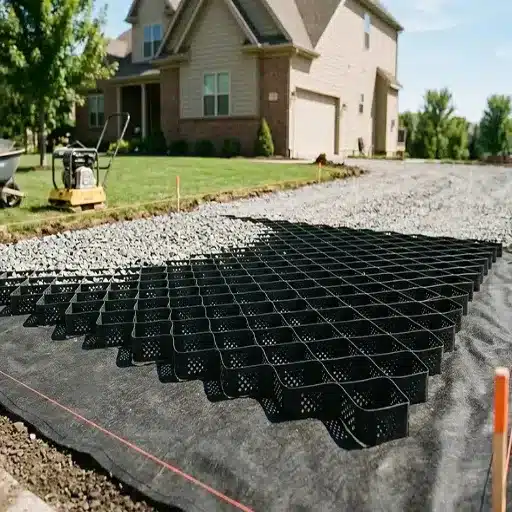
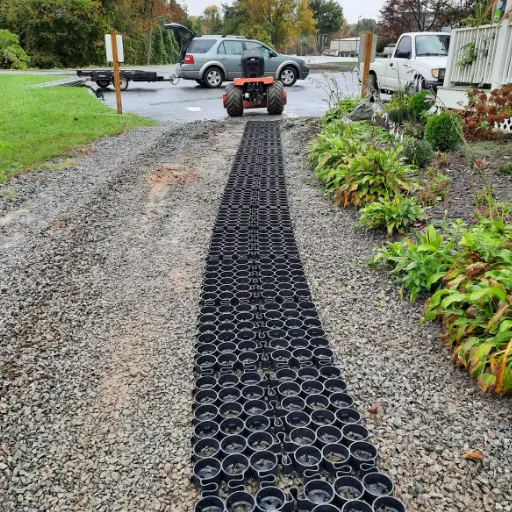
A geogrid is not the same as a honeycomb gravel paver or a geocell. Those products confine the surface layer; a geogrid reinforces the base.
Grade is one input. Subgrade strength, traffic and base thickness decide whether the grid works. If the driveway is already failing, start with our guide to geogrid for gravel driveway to confirm that reinforcement is the right fix.
Request a technical quote with your driveway dimensions, soil description and traffic type. We will confirm the grade and aperture before you order.
What Does 15-15, 20-20 or 30-30 Actually Mean?
A grade label such as 20-20 reports ultimate tensile strength in kilonewtons per metre (kN/m). The first number is machine direction. The second is cross-machine direction.
Biaxial grades have equal values. Uniaxial grades, such as 120-20, don’t.
The values come from ASTM D6637, the single- or multi-rib tensile test. They describe the load at which the grid breaks, not the load at which it works.
That distinction matters on a driveway. A grid stabilises aggregate by interlocking with stone at small deformations. The number that predicts that behaviour is strength at 2% strain, not ultimate strength.
That is why the question “what strength geogrid for a driveway?” can’t be answered from the headline label alone.
| Grade | Ultimate (kN/m) | Typical at 2% | Typical at 5% | Typical use |
|---|---|---|---|---|
| 15-15 | 15 / 15 | ~5 | ~10 | Garden parking, footpath |
| 20-20 | 20 / 20 | 7 (verified) | 14 (verified) | Standard driveway |
| 30-30 | 30 / 30 | 10.5 (verified) | 21 (verified) | Clay, shared drive, RV |
| 40-40 | 40 / 40 | ~14 | ~28 | Commercial parking |
| 50-50 | 50 / 50 | ~17.5 | ~35 | Industrial, HGV |
Values marked verified come from published TGSG datasheets. The others are typical estimates and should be confirmed against the supplier’s MARV sheet.
Here’s an illustrative comparison. A homeowner outside Ottawa compared two rolls both sold as “20-20” for a 90 m² drive. One quote was $80 cheaper.
The cheaper roll’s datasheet showed 12.4 by 19.0 kN/m ultimate and 4.1 by 6.6 at 2% strain. The other showed 20 by 20 and 7 by 7. They paid the extra $80.
The lesson isn’t that cheap grid is bad. It’s that the label alone can’t tell you what you’re buying. Ask for the BX1100 datasheet or the equivalent for the roll on the pallet, and compare the 2% column.
Which Geogrid Grade for Your Driveway?
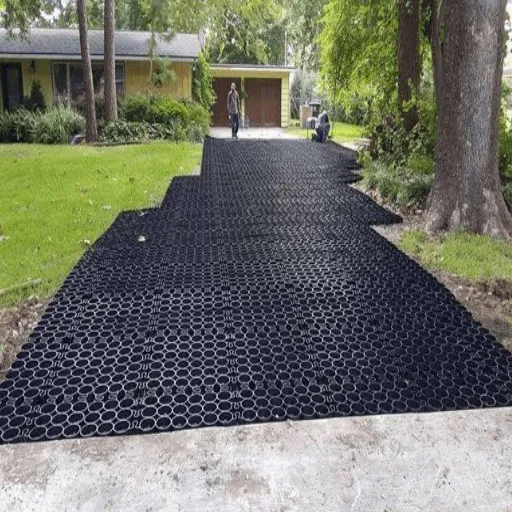
Three inputs decide the grade: subgrade strength, traffic, and base thickness. Start with the soil. A firm sandy gravel and a wet clay are different problems, even under the same car.
Subgrade strength is usually described by California Bearing Ratio (CBR). Firm ground is roughly CBR 8 or higher. Medium is 4 to 8.
Soft clay is 2 to 4. Very soft ground is below 2. These bands are indicative; a geotechnical test is the only way to confirm them.
| Grade | Best for | Subgrade (CBR) | Traffic | Typical aperture |
|---|---|---|---|---|
| 15-15 | Garden parking, footpath | Firm (8+) | Light, under 5 vehicles/day | 25–40 mm |
| 20-20 | Standard residential driveway | Medium to firm (4–8) | Cars and occasional van | 30–41 mm |
| 30-30 | Shared or long drive, clay, RV pad | Soft (2–4) | Vans, RVs, light truck | 35–41 mm |
| 40-40 | Commercial parking, light trucks | Very soft to soft (1–3) | Regular trucks | 35–50 mm |
| 50-50 | Industrial yard, fire lane, HGV | Very soft (below 2) | Heavy, daily | 40–50 mm |
Two worked examples show how the table behaves in practice.
Example 1: a standard suburban drive. A 60 m² drive, two cars, firm sandy gravel, 150 mm compacted base and good fall to the street. A 20-20 is the sensible buy. A 15-15 would probably hold, but the 20-20 gives margin for a delivery van without a meaningful cost jump.
Example 2: a shared drive on clay. One household shares a 150 m drive with a neighbour. The soil is clay, a delivery van arrives three times a week, and the base is 225 mm with a nonwoven separator.
The first quote specified 15-15. Ruts returned within two wet seasons. The rebuild used 30-30 over the same separator, and the surface has held.
The difference wasn’t the brand. It was the stiffness at low strain and the separation layer that stopped fines pumping into the stone.
For parking pads and heavier standing loads, the same logic applies with a higher grade; see geogrid for parking lot for load-class guidance. Whatever grade you choose, the stone must match the aperture; aggregate for geogrid base course explains the gradation.
Biaxial, Triaxial or Uniaxial?
For driveway stabilization, a biaxial geogrid is the default. It carries load in two directions, which matches a surface where vehicles travel along and across.
Triaxial adds a third axis and costs more. It earns its place on soft, variable ground or heavy multi-directional traffic, not on a firm suburban drive. Uniaxial is for walls and slopes, where the main load runs one way. It’s the wrong tool for a driveway.
For the full comparison, see biaxial vs triaxial geogrid.
Why the Strongest Geogrid Is Usually the Wrong Buy
Grade and price rise together. A 40-40 or 50-50 can cost two to three times a 20-20 for the same area. On firm ground, that extra stiffness is never mobilised, because the subgrade barely deforms.
Most driveway failures trace back to drainage, fines contamination, rounded stone or too little cover. A stronger grid doesn’t fix any of those. It can even make them worse by encouraging a false sense of security.
Under-specifying is the opposite failure. A 15-15 on soft clay with regular delivery trucks can tear at the junctions or pull out. The answer isn’t “always buy the strongest.” It’s “buy the grade that matches the ground and the traffic.”
Consider a landlord in a dry, gravelly region who specified 50-50 for a 120 m² driveway to “do it once.” The material cost was about 2.4 times the 20-20 quote. The surface held, but the blocked side drain that actually caused problems was never fixed. They paid for strength the site couldn’t use.
If you are comparing quotes, geogrid driveway cost breaks down where the money goes and when the grid pays for itself.
Not sure which grade your quote is really offering? Send us the datasheet and we will compare the 2% strain, junction efficiency and aperture line by line.
The Specs Behind the Grade: What Else to Check
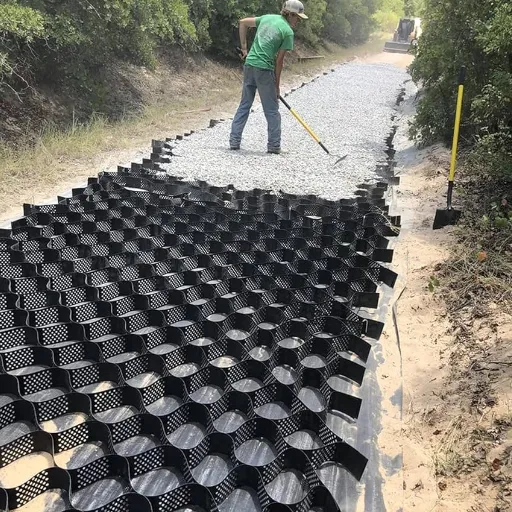
The grade label is one line on a datasheet. Six other properties decide whether the roll performs, which is why geogrid strength for a driveway can’t be judged from the label alone.
| Property | Why it matters | Target for a driveway |
|---|---|---|
| Strength at 2% strain | Stiffness at working load | 7 kN/m or more for 20-20; 10.5 for 30-30 |
| Strength at 5% strain | Strength at larger deformation | 14 kN/m or more for 20-20 |
| Junction efficiency | Load transfer from rib to node | 90% or higher (ASTM D7737) |
| Aperture | Aggregate interlock | 25–45 mm for 0–32 mm stone |
| Polymer and carbon black | Durability and UV resistance | PP standard; about 2% carbon black |
| MARV vs typical | Conservative specification | Require MARV values (ASTM D4759) |
Aperture is the most common mismatch. The median stone size should be roughly half the aperture. Too small, and the stone falls through. Too large, and it bridges across the opening without locking.
The published TGSG sheets show the pattern clearly: 20-20 and 30-30 both use a 41 mm aperture, with 7 and 10.5 kN/m at 2% strain respectively. Those are published typical values, not marketing peaks. The Geofabrics datasheet is a useful benchmark when a supplier’s sheet looks too good.
For design context, the FHWA geosynthetics guidance and FHWA NHI-07-092 describe how reinforcement changes required base thickness. Treat vendor claims of “up to 50%” as a ceiling, not an average.
For the test methods behind these numbers, our geogrid specifications guide explains UTS, LTDS and junction efficiency in plain language.
How to Buy: Five Questions Before You Order
Ask these five questions before you approve a quote. A supplier who can’t answer them is asking you to take the grade on trust.
- What is the MARV ultimate strength, and the strength at 2% and 5% strain, tested to ASTM D6637?
- What is the junction efficiency (ASTM D7737) and aperture stability (ASTM D7864)?
- What polymer is used, what is the carbon black content, and what UV data do you have?
- What is the aperture size, and what aggregate gradation does it suit?
- Can you send third-party test reports, an ISO 9001 certificate and retained samples?
Red flags are easy to spot once you know them:
- “Strongest” with no 2% data.
- A price per roll with no square-metre coverage.
- A “geogrid” that is actually a honeycomb gravel paver.
- A grade label with no polymer or aperture.
Any of these should slow the purchase down.
Frequently Asked Questions
What geogrid do I need for a gravel driveway?
Most residential gravel driveways need a biaxial polypropylene geogrid rated 20-20 kN/m. Choose 15-15 for occasional cars on firm ground, and 30-30 for clay, shared drives or regular vans. Confirm the 2% strain value and match the aperture to your stone.
Is 20-20 geogrid strong enough for a driveway?
Yes, for cars and occasional vans on firm to medium subgrade with an adequate base. It isn’t enough for daily HGVs or very soft clay, where a 30-30 or 40-40 is more appropriate. The base depth and drainage matter as much as the grade.
What is the difference between 15-15 and 20-20 geogrid?
A 15-15 has 15 kN/m ultimate strength in both directions; a 20-20 has 20 kN/m. The practical difference is stiffness: a published 20-20 gives about 7 kN/m at 2% strain, while a 15-15 typically gives about 5. The 20-20 is the safer choice for a standard driveway.
Do I need biaxial or triaxial geogrid for a driveway?
Biaxial is enough for almost every driveway. Triaxial costs more and suits soft, variable ground or heavy multi-directional traffic. Uniaxial is designed for walls and slopes and shouldn’t be used as a driveway stabiliser.
Does a higher grade mean less gravel?
Not directly. Base reduction depends on subgrade strength, traffic and the grid’s stiffness, and typically falls in the 20–40% range on soft ground. A higher grade doesn’t guarantee a proportional cut in stone. Design the base depth first, then choose the grade.
Can I use 30-30 geogrid on a residential driveway?
Yes. It’s a sensible choice for a shared drive, a long drive, clay soil or regular delivery vans. On a firm suburban drive with two cars, it’s usually more than you need, and a 20-20 will do the same job for less.
Conclusion
The right geogrid for most driveways is a biaxial polypropylene 20-20. Move to 15-15 only for light use on firm ground, and to 30-30 when the soil is soft or the traffic is heavier. Above 30-30, you are usually buying for a commercial site, not a home.
Three things matter more than the label. The 2% strain value tells you how the grid behaves under working load. The junction efficiency tells you whether the ribs stay connected to the nodes. The test report tells you whether the number is a minimum average or a best-case sample.
Get those three right, match the aperture to your stone, and the grade becomes a straightforward choice rather than a guess. The question “what geogrid for a driveway” has a short answer, but the test report is what makes it safe to act on.
Request a technical quote with your driveway size, soil description, traffic type and base depth. We will recommend a grade, an aperture and a test-report pack for your project.