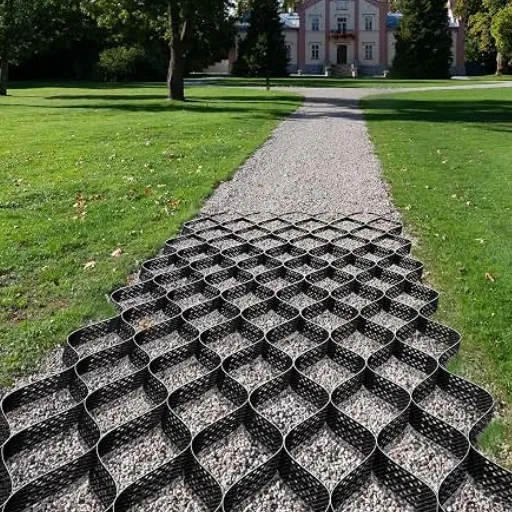
If you are searching for geogrid for driveway clay soil, the short answer is this: geogrid helps, but it’s rarely the whole fix. On soft, wet clay you need a nonwoven separator below the grid, 200 to 250 mm of compacted angular stone above it, and drainage that carries water away from the subgrade.
A clay driveway can carry a car all summer and swallow one in February. If you have already spread more gravel and watched it disappear, you know the pattern. The stone is not the problem. The ground underneath is.
This guide shows you which of four clay problems you actually have, the fix in the right order, and the cases where geogrid is the wrong purchase. For the full design method behind these numbers, see the complete guide to geogrid for road bases and driveways.
Key Takeaways
- Geogrid is a reinforcement layer, not a drainage or separation fix. On clay it usually needs a nonwoven separator beneath it.
- Match the fix to the failure: weak wet clay needs reinforcement, fines pumping needs separation, standing water needs drainage, and expansive clay may need stabilization or excavation.
- For car traffic on soft clay, use 200 to 250 mm of compacted angular stone over separator and grid. Very soft ground needs 300 to 400 mm in two lifts.
- A 20-20 biaxial geogrid suits most clay driveways. Move to 30-30 for light trucks and heavier use.
- Geogrid doesn’t stop expansive clay from swelling and shrinking. If the subgrade moves with the seasons, fix the moisture problem first.
Why a Clay Driveway Fails When a Gravel One Doesn’t
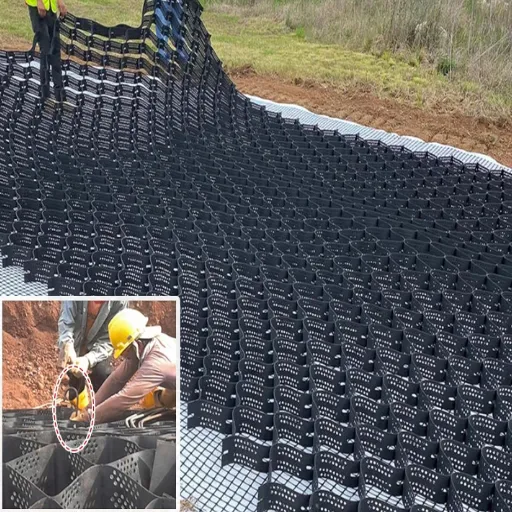
A gravel driveway on clay soil behaves nothing like one on sand or crushed rock. Clay is strong when dry and weak when wet. Its load-bearing capacity, measured by the California Bearing Ratio (CBR), can fall by half between a dry September and a wet March.
That matters because the base depth that worked in summer may be undersized by spring. A driveway designed for CBR 4 can be sitting on CBR 2 ground after a wet winter.
Three things follow. The stone punches into the softened subgrade. Fine particles migrate upward into the base. And the clay itself swells or shrinks as moisture changes.
Consider a homeowner we will call Daniel. His 90 m driveway on clay looked fine for two summers. Each spring he ordered another 10 tons of gravel, and each winter the ruts came back in the same two places.
By the third year he had added roughly 30 tons of stone and still had a soft section at the gate. The gravel was never the missing layer. Separation and drainage were.
If you already know the subgrade is soft, request a technical quote with your driveway dimensions and a short soil description. We will tell you whether the site needs a separator, a grid, or both.
Which Driveway Clay Soil Problem Do You Have?
Most clay driveway advice fails because it treats every wet driveway the same. In practice, four different problems produce similar symptoms, and each needs a different fix.
Use this table to identify the pattern you see.
| What you see | Likely cause | Primary fix | Geogrid’s role |
|---|---|---|---|
| Ruts return every wet season, ground feels soft underfoot | Weak saturated clay, typically CBR 2 to 4 | Separator, grid, and drainage | High: reinforcement |
| Stone turns muddy, base looks contaminated from below | Fines pumping and soil migration | Nonwoven separator | Secondary: holds the stone layer |
| Cracks, heave, movement between summer and winter | Expansive clay, high plasticity index | Moisture control, lime or cement stabilization, or excavation | Limited: confines the base only |
| Water stands on the drive, one area stays boggy | Drainage failure, no fall or blocked ditch | Regrade, cut a ditch, add an underdrain | None until water is controlled |
| One deep soft spot, sometimes a spring | Organic pocket or groundwater | Excavate and backfill with granular material | None until the pocket is removed |
Most clay driveways have two of these at once. The common pair is weak clay plus fines pumping, which is why a grid on its own often disappoints.
If your driveway is gravel over clay but the surface is firm and well drained, the general decision guide for geogrid for a gravel driveway is a better starting point. The clay-specific treatment below is for ground that fails repeatedly.
The Three-Layer Fix, in the Right Order
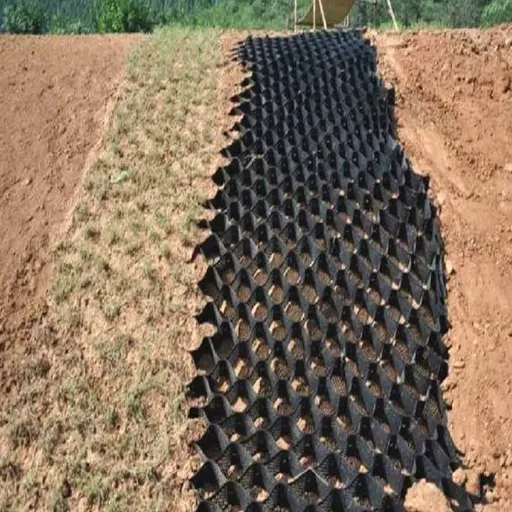
Most people reach for a clay driveway mud fix that starts and ends with more stone. The sequence matters more than the product. Placing a grid directly on wet clay, without separation or drainage, is the most common expensive mistake in this application.
- Fix the water first. Shape a crown of 2% to 4% so water leaves the surface. Cut or clear a side ditch. If the drive sits in a hollow, add an underdrain or a shallow French drain along the low edge.
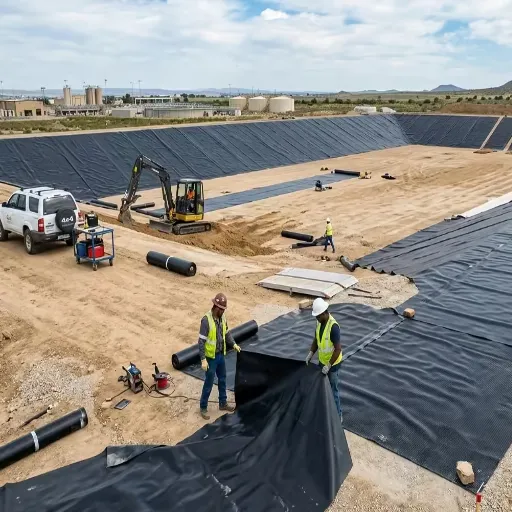
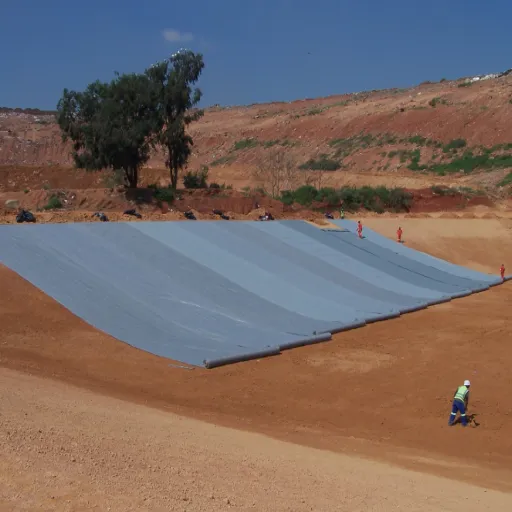
- Lay a nonwoven separator. Use a needle-punched nonwoven geotextile specified to AASHTO M 288 Class 2 for separation and stabilization. Overlap rolls by at least 300 mm and pin them so they do not move during stone placement.
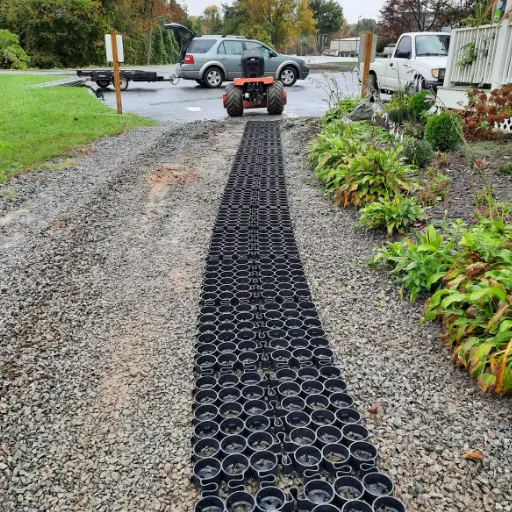
- Lay a biaxial geogrid on top. A polypropylene biaxial grid in the 20-20 kN/m range suits most clay driveways. Use 30-30 for light trucks or repeated heavy loads. Overlap 300 mm on firm ground and 600 to 900 mm on soft ground.
- Place angular crushed stone. Use a well-graded 0/32 or 0/45 crushed rock, not rounded pea gravel. The first lift should be about 150 mm, placed from the edge so plant does not drag or fold the grid.
- Compact in lifts and restrain the edges. Compact to at least 95% Standard Proctor in 150 mm layers. Add an edge restraint so the base cannot spread sideways.
Why this order? A grid on bare clay doesn’t stop fine particles from pumping into the stone. A separator without a grid adds filtration but little stiffness. And either layer without drainage will still fail in a wet spring, because the subgrade loses strength faster than the geosynthetic can compensate.
For the material comparison behind step two, see geogrid vs geotextile for driveway applications. The short version: separation problem, use fabric. Strength problem, use grid. Soft clay usually needs both.
Not sure whether you need the separator, the grid, or both? Send a photo of the failed section and request a technical quote. A description of what the stone looks like when you dig into it is often enough to tell.
How Deep Should Gravel Be on Driveway Clay Soil?
Depth is set by the subgrade and the traffic, not by the grid. The grid can earn a reduction in stone thickness, but it cannot make an undersized base behave like a heavy-duty pavement.
These are practical starting points for a clay driveway.
| Traffic | Compacted depth on soft clay (CBR 2 to 4) | Notes |
|---|---|---|
| Cars and light vans | 200 to 250 mm (8 to 10 in) | Plus separator and a 20-20 biaxial grid |
| Light trucks and trailers | 250 to 300 mm (10 to 12 in) | Plus separator and a 30-30 grid |
| Very soft clay, CBR below 2 | 300 to 400 mm (12 to 16 in) | Place in two lifts; get geotechnical advice first |
Three rules sit above the table. Never place less than 100 to 150 mm of compacted cover over the grid. Make the first lift about 150 mm so the grid stays flat and supported. And order roughly 1.3 times the compacted volume to allow for loose placement and compaction.
For a full breakdown of loose versus compacted volume, tonnage, and worked examples for 50 m², 120 m², and 200 m² driveways, see how much gravel goes over geogrid.
Geogrid for Driveway Clay Soil: What It Can and Cannot Fix
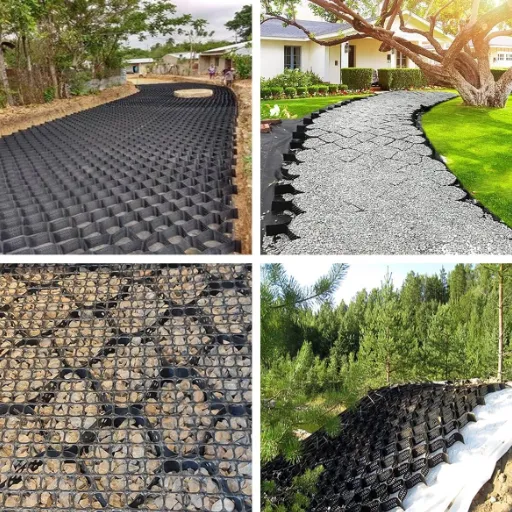
Geogrid earns its cost on soft clay, but only for the job it was designed to do. Being clear about the boundary protects both your budget and the performance of the drive.
What it does well
Geogrid on clay soil works by confining the angular stone and spreading wheel loads over a wider area. That reduces the depth of ruts and the rate at which stone is lost into the subgrade.
It also raises bearing capacity. In the Giroud and Han method for unpaved roads, the bearing capacity factor for a reinforced layer is 5.71, compared with 3.14 for an unreinforced one. In practice, that is why a reinforced section can carry the same traffic with less stone.
Published reductions on weak subgrades range from 20% to 50%, with 20% to 40% the most common. The saving shrinks as the subgrade improves. Above roughly CBR 4 to 8, the thickness credit is small and the grid often is not worth buying.
What it does not do
Geogrid doesn’t drain water. If the drive has no fall, a blocked ditch, or a high water table, the subgrade will stay wet and weak no matter how strong the grid is.
It doesn’t stop fines from pumping. That is a separation job, and it belongs to the nonwoven fabric below the grid.
It doesn’t stop expansive clay from swelling and shrinking. This is the limit most often ignored. A grid confines the granular layer above the clay, but the clay beneath it still moves with moisture.
It also doesn’t fix a contaminated base or an organic pocket. Those materials have to come out.
When the real fix is not geogrid
Expansive clay is the clearest example. In the Shadow Creek subdivision case in Buda, Texas, clay with a plasticity index of 30 to 60 caused lime-stabilized road sections to fail within the first years of use. The project team moved to a TriAx geogrid section for later phases.
The case shows that geogrid can help on expansive clay, but it also shows that the problem was bigger than a single layer. Tensar does not publish the base thickness or measured performance figures on that page, so treat it as evidence of approach, not a design recipe.
If your drive heaves and cracks each season, get the clay identified before you buy a grid. Lime or cement stabilization, moisture control, or excavation and replacement may be the real answer.
For the bearing capacity theory behind these numbers, see bearing capacity on soft clay subgrades. For cold-climate movement, geogrid frost heave explains how frost-susceptible subgrades change the design.
Five Rules That Decide Whether It Works
On clay, installation quality matters more than the brand on the roll. These five rules separate a fix that lasts from one that fails in the first spring.
- Never traffic or overwork saturated clay. Wet clay remolds and loses strength. If the ground is pumping under your boots, wait or dig out the soft area.
- Proof roll and dig out soft spots first. A proof roll with a loaded vehicle reveals the weak pockets. Remove them and backfill with compacted granular material before any fabric goes down.
- Separator first, grid second. The fabric goes directly on the prepared clay. The grid sits on top of the fabric, not underneath it.
- Keep the grid taut, pinned, and covered. Wrinkles become weak points. Never drive on exposed grid, and place the first lift from the edge.
- Restrain the edges. An unreinforced edge lets the base spread sideways, which loosens the grid and undoes the confinement.
A landscaper we will call Priya learned rule one the expensive way. She rebuilt a 150 m² drive on saturated clay in early spring, working the subgrade with a mini-excavator to get the levels right. The clay turned to a greasy paste.
The section failed within a month, and the rebuild cost more than the original job. The second attempt waited for drier ground, removed the disturbed layer, and used a separator and grid. It held.
What It Costs and What to Expect Afterwards
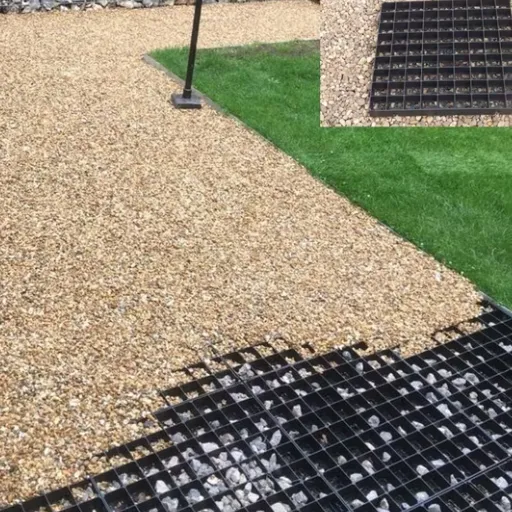
The grid is rarely the biggest line item. On a clay driveway, stone, excavation, and haulage usually dominate the budget. Expect the grid to cost a few dollars per square meter and the separator less, with the base course several times that.
For a full budget model, including three worked driveway budgets and the DIY versus contractor comparison, see geogrid driveway cost.
After installation, expect the first year to settle. One top-up of stone is normal. After that, the drive should need less frequent topping than before.
Keep the ditch clear. The most common reason a repaired clay driveway fails again is that the drainage was never maintained. Do not top up with clay-contaminated fines or screened soil. Use clean angular stone.
The grid itself is designed to last decades. The surface still needs inspection and occasional maintenance.
Frequently Asked Questions
Will geogrid stop my clay driveway turning to mud?
It can reduce rutting and stone loss on soft clay, but only as part of a system. You need drainage, a nonwoven separator, and enough angular stone. A grid alone on bare clay will not stop mud.
Do I need geotextile as well as geogrid on clay?
Yes, in most soft clay cases. The right geotextile for clay driveway use is a needle-punched nonwoven, not a woven silt fence fabric. The nonwoven separator stops fines from pumping into the stone, while the grid adds reinforcement. On firm, well-drained clay the separator may be optional, but it is cheap insurance.
How deep should gravel be on a clay driveway?
For cars on soft clay, use 200 to 250 mm of compacted angular stone over separator and grid. Light trucks need 250 to 300 mm. Very soft clay may need 300 to 400 mm in two lifts.
What geogrid grade should I use on clay?
A biaxial polypropylene grid in the 20-20 kN/m range suits most residential driveways. Use 30-30 for light trucks or repeated heavy loads. Higher strength is not automatically better if the base depth and drainage are wrong.
Can I put geogrid over existing gravel on clay?
Only after you strip and rebuild. Laying grid on loose, contaminated stone does nothing. Remove the old base, correct the subgrade and drainage, then place separator, grid, and fresh angular stone.
Will geogrid fix expansive clay?
No, not on its own. An expansive clay driveway moves with moisture, and a grid cannot stop that movement. Geogrid confines the base layer, but it doesn’t stop the clay beneath from swelling and shrinking. Expansive clay needs moisture control, stabilization, or excavation before a grid can help.
The Bottom Line
A clay driveway fails for reasons that a bag of gravel cannot fix. Diagnose the problem first: weak wet clay, fines pumping, expansive clay, or drainage. Then build the fix in the right order.
Separation comes before reinforcement, and drainage comes before both. Geogrid is a strong layer in that system, not a substitute for it.
If you want a specification rather than a guess, send us the driveway dimensions, the clay description, the traffic type, and a photo of the failed section. Request a technical quote and we will recommend the separator, grid grade, and base depth for your site.