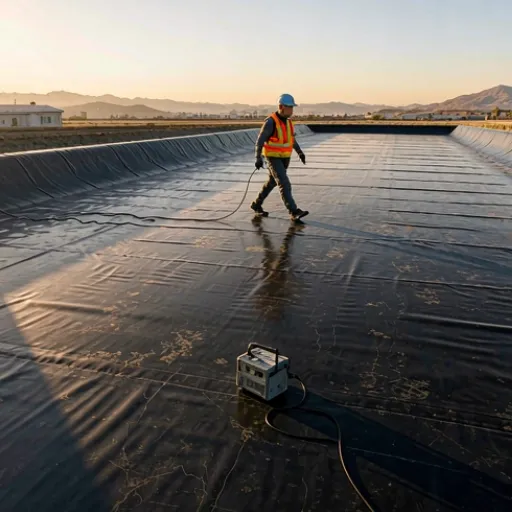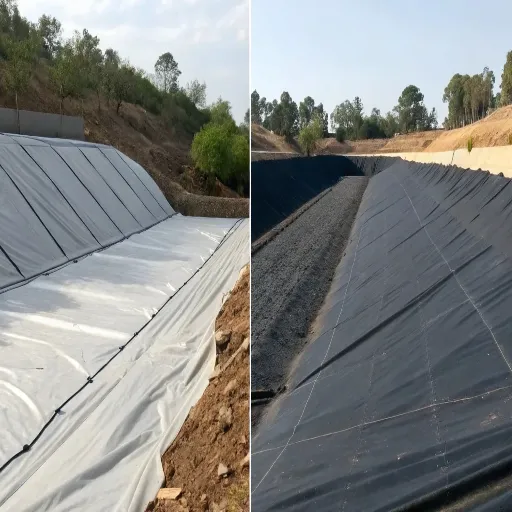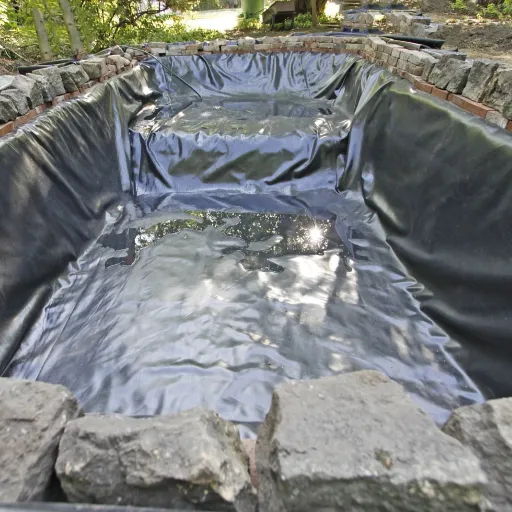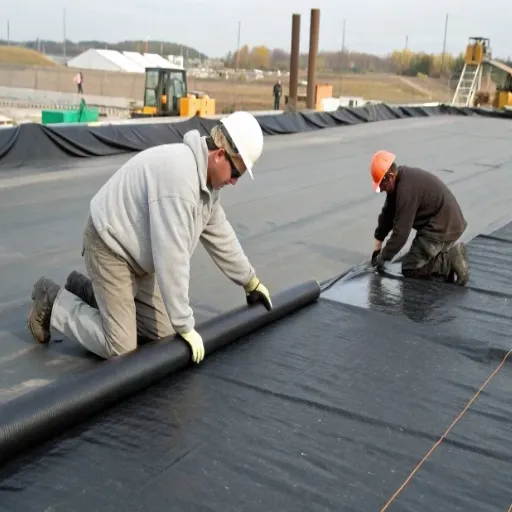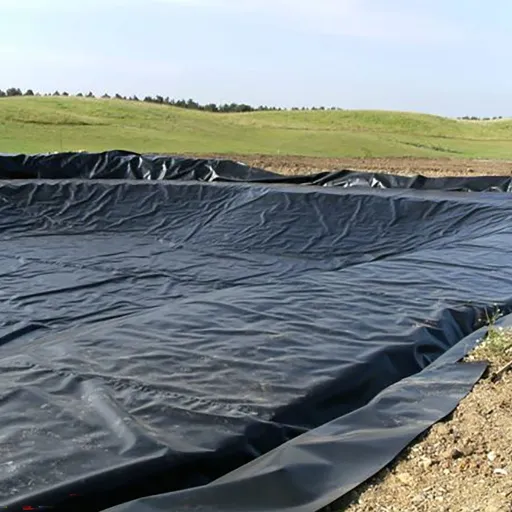
Geosynthetic cementitious composite mats (GCCMs) combine cementitious material with geosynthetic layers in a factory-produced composite. They are flexible before hydration and harden after water is applied, forming a protective lining. Their uses include erosion protection on slopes and in drainage channels. The 2019 ECSMGE technical paper on GCCM characteristics explains this construction and its material properties.
Selection starts with the required function: protecting soil from surface erosion, reducing seepage, or containing liquid. These functions require different evidence. A suitable material grade also needs compatible joints, anchors, substrate preparation, and hydration procedures. This guide explains what to compare before specifying or ordering a system.
What GCCMs do in erosion control and channel lining
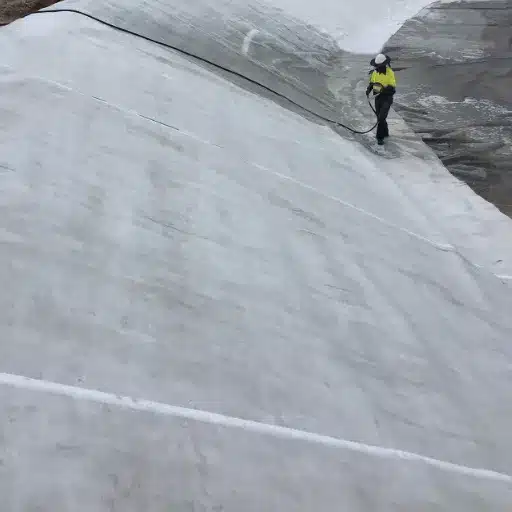
Flexible placement followed by hydration
A GCCM contains a cementitious layer within geosynthetic material. Before hydration, the roll format allows deployment over a prepared profile. Once hydrated, the cementitious component hardens. The backing construction and the way adjacent panels connect are separate selection questions; a hardened surface alone does not establish the leakage performance of an entire installation.
Concrete Canvas is a branded product family within this field. For its applications, see our overview of Concrete Canvas products and uses. When comparing suppliers, identify the actual product and grade rather than treating a brand name as a specification for all GCCMs.
Channels, slopes, and rehabilitation
The public scope of ASTM D8173-23 identifies applications including ditch and canal protection, slope protection, culvert lining, scour protection, and rehabilitation of existing concrete channels. This establishes a range of uses, rather than approval of every product for every site.
For channel lining, ask the designer to evaluate the flow conditions, substrate support, transitions, joints, and terminations together. For slope protection, distinguish the exposed protective facing from the earthwork that supports it. Channel lining also needs to fit the wider drainage design. Where runoff storage is required, stormwater storage systems address a separate design function.
Select the lining system for the required function
Use the following table to frame a technical inquiry. It identifies evidence to request; it does not assign a universal grade, allowable velocity, or slope angle.
| Project need | Evidence to request | Decision to avoid |
|---|---|---|
| Surface erosion protection | Grade-specific material reports and project details for support, anchoring, and exposed edges | Assuming a protective facing establishes overall slope stability |
| Channel protection under flowing water | Relevant hydraulic and abrasion evidence, plus drawings for joints, inlets, outlets, and transitions | Selecting solely by thickness or a flexural strength number |
| Reduced seepage | Backing properties and leakage evidence relevant to the proposed joints and installation | Treating the material sheet’s properties as whole-channel performance |
| Fluid containment | Specified barrier system, compatible seams and penetrations, and acceptance requirements | Assuming an ordinary overlap creates a containment barrier |
| Restricted access or difficult handling | Roll dimensions and mass, lifting plan, storage requirements, and water access | Assuming every roll can be handled manually |
| Repair of an existing channel | Substrate assessment, repair details, and connections to the existing structure | Using a new lining to conceal unresolved defects |
These questions follow the separation between material properties and installation covered by ASTM D8364/D8364M and ASTM D8173. Match the final requirements to the project specification.
Surface erosion protection and slope stability
A facing intended to resist surface erosion does not demonstrate that an embankment is stable against deeper movement. Ask the geotechnical designer to assess the soil, groundwater, geometry, and reinforcement requirements separately. Our reinforced soil design guide covers the related earthwork design topic.
A published experiment used a particular sloping embankment to investigate erosion protection. Its slope geometry should not be converted into a maximum installation angle for all GCCMs. Any proposed slope needs its own design and product-specific installation details. The study is discussed below in the comparison with vegetative protection.
Seepage reduction and fluid containment
ASTM D8173 distinguishes GCCMs used for erosion protection from a special barrier category, geosynthetic cementitious composite barriers (GCCBs), intended to reduce or prevent fluid flow through the construction. Backing, seams, penetrations, and terminations therefore belong in the specification when leakage matters.
For a manufacturer-specific example, the Concrete Canvas product overview separates erosion-control products, canal seepage applications, and a thermally welded containment solution. These are different product roles within that manufacturer’s range, rather than interchangeable capabilities of all cementitious mats. Compare the required barrier function with geomembrane lining options before deciding on the complete system.
Compare GCCM specifications and project requirements
Understand what each standard establishes
Three references answer different questions:
- ASTM D8364/D8364M-21(2026) is a material specification. Its public scope recognizes that different applications require different physical properties. The official catalog, last updated August 19, 2026, lists this reapproved designation. The designation alone does not establish a new design threshold or a supplier’s compliance.
- ASTM D8058-25 covers three-point bending of cured GCCMs. The official catalog, last updated December 9, 2025, describes it as an index test useful for material characterization and manufacturing quality control. A reported flexural result is not a channel’s hydraulic rating or structural design approval.
- ASTM D8173-23 provides installation guidance. Its public scope states that project-specific requirements take precedence over the general guide.
When comparing test reports, check the product grade, test method, units, conditioning, and specimen age. Ask whether apparently similar values were measured under comparable conditions. The ECSMGE characteristics paper discusses flexure, abrasion, puncture, and durability as distinct characterization topics. It is a manufacturer-affiliated technical account; use the current ASTM catalogs for current standard designations.
Compare with poured concrete and vegetative protection
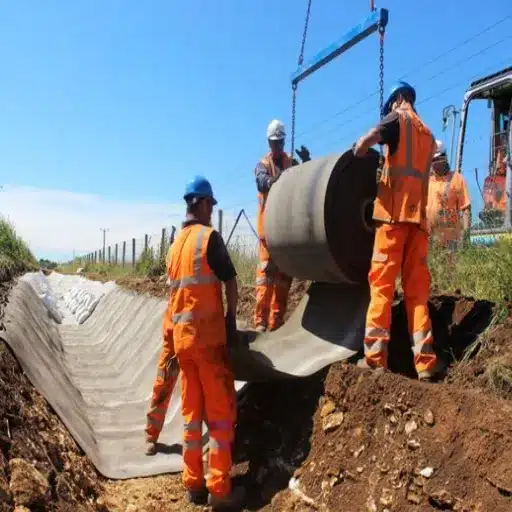
Build a project comparison around the work actually required. For poured concrete, include concrete delivery, formwork where needed, placing, finishing, and curing. For a GCCM option, include roll delivery and lifting, substrate preparation, cutting, joining, anchoring, hydration, and acceptance checks. The Concrete Canvas channel-lining FAQ illustrates why water supply, lifting equipment, and joint construction still need planning for a rolled system.
Vegetative protection answers a different set of site needs. Our guide to coir erosion-control blankets provides related background where vegetation establishment is part of the design.
A 2020 Journal of Mountain Science field study compared GCCM, vetiver grass, and combined cover on an experimental embankment. Its abstract reports the strongest immediate erosion control from GCCM, while vetiver also performed well after establishment. This supports considering the timing of protection; it does not establish a universal erosion-reduction percentage or make vegetation unsuitable for every project.
Request a whole-project cost comparison rather than applying a generic saving percentage. Include access, labour, equipment, water, offcuts, joints, and maintenance. If carbon performance affects procurement, request a product-specific environmental declaration or lifecycle assessment and compare equivalent functions and service assumptions.
Plan installation before ordering
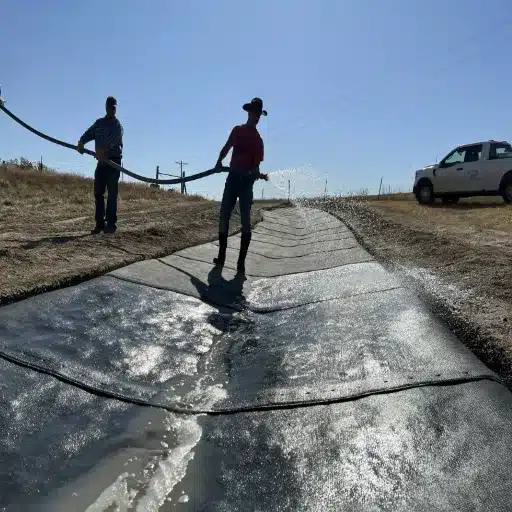
The following are planning checkpoints. Use the approved product instructions and project drawings to determine the detailed sequence and acceptance criteria.
Prepare and assess the substrate
Confirm the channel profile or slope geometry, remove unsuitable protrusions and debris, and address voids or unstable areas as specified. Ask whether the design requires drainage beneath the lining or preparation of an existing concrete surface. For an operating channel, include the arrangements needed to control water during the work.
The manufacturer’s channel-lining FAQ addresses profile preparation, substrate checks, and water diversion for its own system. Its numerical details should not become generic requirements for other GCCMs.
Resolve layout, joints, anchors, and terminations
Prepare a panel layout that includes overlaps, cutting allowances, edges, transitions, and connections to structures. Identify the specified joining method and the evidence needed where seepage or containment is part of the design. Confirm how the installation will be secured before hydration.
Do not assume all joints follow the same sequence. For example, Concrete Canvas’s FAQ describes hydrating material beneath an overlap during joint formation. The selected product’s instructions must resolve those details before the crew starts work. Anchor dimensions, fixing intervals, and seam methods need to come from the approved design.
Confirm hydration, curing, and access
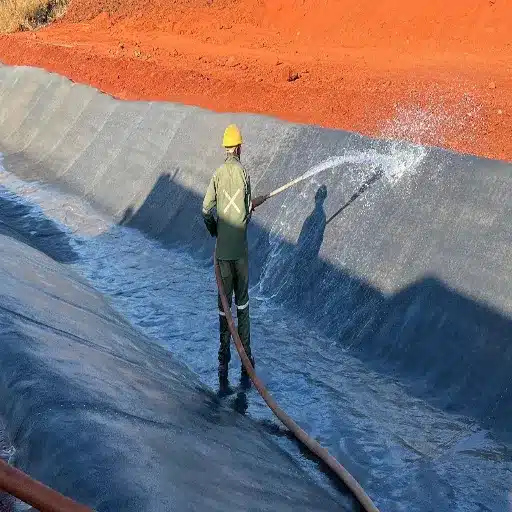
Establish the required water quantity, supply method, weather precautions, and checks for adequate hydration. Include protected curing conditions and the project’s criteria for returning the channel to service. A general statement that GCCMs harden after wetting is not a substitute for these instructions, and it does not establish a universal ready-for-service time.
Before ordering, have the supplier and installer confirm that the proposed handling and hydration arrangements match the selected grade and site access.
Inspection and maintenance considerations
Include an inspection and repair plan in the project handover. Useful checks to discuss with the designer include damaged areas, loose terminations, deteriorated joints, loss of support beneath the lining, sediment blockages, and changes in flow paths. Consider inspections after significant flow or weather events alongside the project’s routine schedule.
These are planning recommendations, rather than a universal inspection interval. Set inspection frequency and repair methods around the installation, exposure, accessibility, and consequences of failure. Ask for the product’s repair instructions and record the completed joint and termination details so maintenance staff know what was installed.
A service-life claim should identify the relevant product, exposure conditions, evidence, and maintenance assumptions. Do not use one lifespan for every GCCM grade or climate.
Procurement checklist for a GCCM inquiry
Send the project function and site conditions with the inquiry. Request:
- The exact product and grade, current technical data sheet, and applicable material specification.
- Relevant test reports identifying methods, units, conditioning, and specimen age.
- Hydraulic, abrasion, and durability evidence relevant to the proposed exposure.
- Backing, joint, seam, penetration, and termination details appropriate to the leakage requirement.
- Roll dimensions and mass, lifting arrangements, storage conditions, and cutting allowances.
- Hydration instructions, water requirements, weather precautions, and curing provisions.
- Installation drawings, inspection points, acceptance criteria, and repair guidance.
- Confirmation of availability, delivery terms, and responsibility for design and installation.
This checklist brings together the material and installation questions above. Ask the designer to review the proposed system against the project specification before accepting a substitution based on thickness, price, or a single test value.
Frequently asked questions
Is every GCCM waterproof?
Do not infer whole-system leakage performance from the category name. Check the specified backing and how seams, penetrations, and terminations are formed. Where fluid containment is required, evaluate an appropriate barrier system and its acceptance requirements.
Does a GCCM stabilize a slope?
It can serve as a surface-protection component, but the facing does not establish global slope stability. Soil, groundwater, geometry, and reinforcement require separate geotechnical assessment.
What determines the appropriate grade?
Start with the required function and site conditions. Compare relevant material reports, hydraulic and abrasion evidence, backing and joint details, installation constraints, and project acceptance requirements. Thickness alone does not answer all of those questions.
How is a GCCM installed and maintained?
Installation involves preparation, deployment, joining, securing, and hydration under the selected product’s instructions. Some operations overlap or require a specific order. Maintenance should follow the project’s inspection and repair plan, including attention to edges, joints, support, and flow obstructions.
Can GCCMs be used in extreme weather or chemical exposure?
Request evidence for the actual grade and anticipated exposure, including installation conditions. A broad claim of weather or chemical resistance does not define suitable conditions for every product or joint system.
Are GCCMs always cheaper or lower carbon than conventional concrete?
Neither conclusion follows from the material category alone. Compare equivalent installed systems, including preparation, transport, lifting, water, joints, maintenance, and service assumptions. Require relevant product evidence for a carbon comparison.