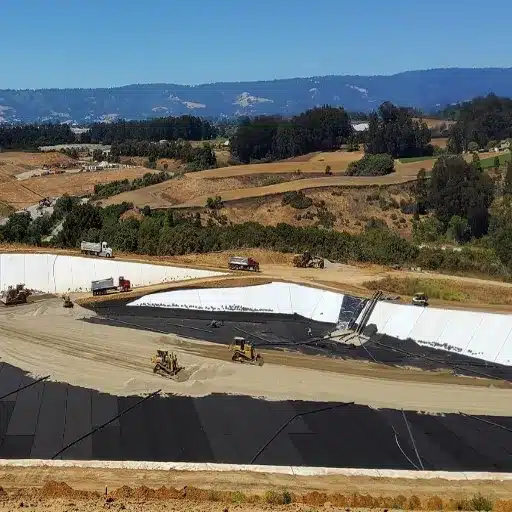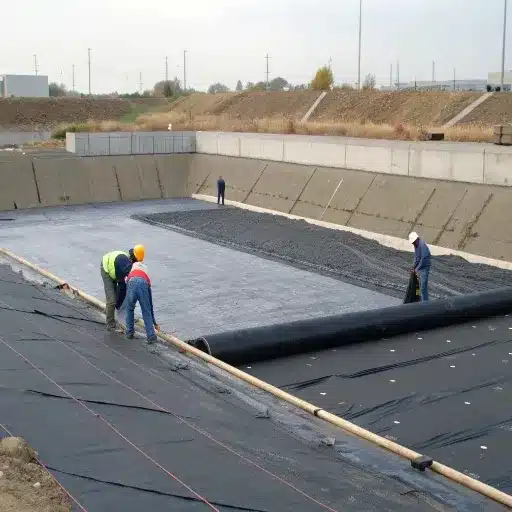
Isolated construction workers in Bangladesh were hopeful when working towards establishing a 12-kilometer road through a soggy ground, for that has never been an exclusive case. Convention dictates digging meters worth of buffer soil and absorbing literal thousands of tons of material, which might make the project advance at least several months and 40% above the expenditure level. They rather utilized high tensile and stretched geotextile fabric. The new road was completed over a month ahead of time, and costs were reduced by thirty percent.
The example explains precisely why the geotextile fabric industry worldwide has reached $7.68 billion and is still growing at 6.64% per year. Engineers are finding out around the world that for a given project with the specification of geotextile, it could affect its economics radically and its performance positively, in practical terms.
This detailed article provides readers with precise information on Geotextile Fabric, how to differentiate and choose between woven and non-woven types, as well as the specification of a suitable product for the intended application. It doesn’t matter whether you want to stabilize roads, build drainage systems, or control erosion. This article contains the technical data as well as the practical advice relevant to such work.
What Is Geotextile Fabric?
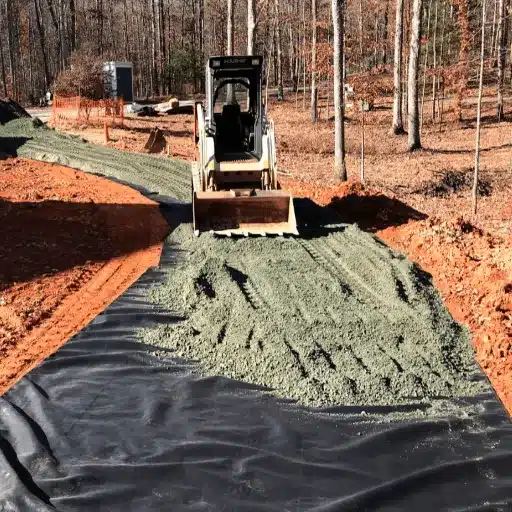
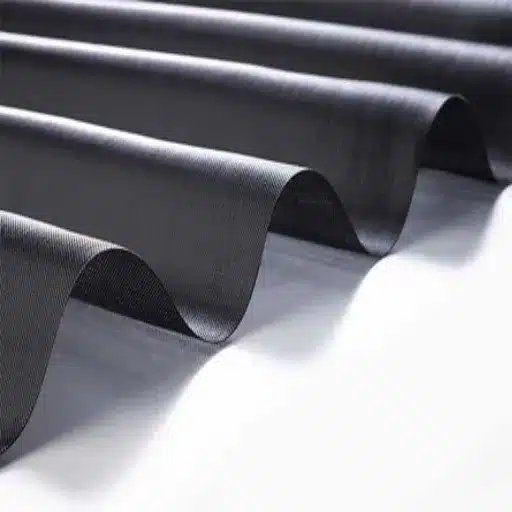
Geotextile Fabric is a synthetic clothing material with porosity characteristics and made out of polypropylene or polyester plastic polymers. Civil engineering and environmental applications are designed for geosynthetic material in people applies them five main functions – stabilization, separation, filtration, drainage, and soil erosion. Geotextile material when designated rightly and proper installation is followed, lasts over two decades.
Composition and Material Properties
Geotextile Fabric is made of modern synthetic fibres, for example, 60-80% of the used fibres are polypropylene and 15% polyester to provide the acceptable physical properties required in the product. Polypropylene is a cost-effective material with excellent resistance to chemicals and especially UV rays. On its part, polyester offers a tensile strength of up to 100 kN/m which is suitable especially in moist places.
The construction process is determined mainly by the elements of suitability for use. In wovens, the disjointed yarns are woven together in a grid to form a usable, low-elongation, high-strength fabric. Non-wovens’ tightly packed webs of fibers are jetted or heat-treated to create felts having high porosity. This structural variation makes two types applicable for diverse engineering requirements.
Types of Geotextile Fabric
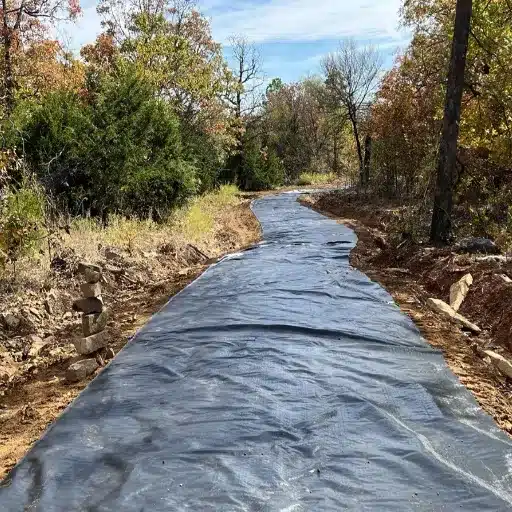
Selecting the correct geotextile type determines project success. Understanding the manufacturing methods and performance profiles of each category ensures optimal specification.
Woven Geotextile Fabric
Woven geotextiles are products of intricate intertwining of polypropylene or polyester yarns perpendicular to each other in a lattice work pattern, which is similar to traditional weaving. This kind of construction results in better tensile properties (grab tensile strength 20-1,000+ lbs) with a very minimal elongation upon loading. It is seen from the closeness of the weave that the permeability is extraordinarily low when compared to its nonwoven counterparts.
Main features:
- Grab strength: 200-1,000+ lbs, (ASTM D4632)
- Wide width tensile: 20-200 kN/m (ASTM D4595)
- Elongation at rupture: 10-25%
- Mass per unit area: 140-800 g/m²
Primary applications: road base reinforcement, embankment stabilization, retaining wall construction, and load distribution over soft soils. Woven fabrics are actualized in those areas where structural support supersedes the demand for draining.
Non-Woven Geotextile Fabric
Nonwovens geotextile fabric is made through needle-punching, calendering, or bonding of staple or winding fibers. In this way, the three-dimensional, felt-like structure is formed that has high permeability and excellent filtration capabilities. It has the most material properties in its isotropic mechanical properties that provide the strength in the random orientation of fibers.
Important specifications:
- Grab tensile: 80-300 lbs (ASTM D4632)
- Permittivity: 0.5-5.0 sec⁻¹ (ASTM D4491)
- Apparent opening size: 70-600 microns (ASTM D4751)
- Area mass: 100-600 g/m²
Primary applications: Underground drainage systems, filtration behind retaining walls, erosion control, and separation layers where water movement is involved.
Knitted Geotextiles
Knit geotextile is the turf knit from yarns closely coupled in a looped structure. It is relatively small in market share. They exhibit high flexibility and adaptability for rough surfaces. The application includes slope protection, tree root barriers, and animated structural reinforcement.
Woven vs Non-Woven Geotextile: Detailed Comparison
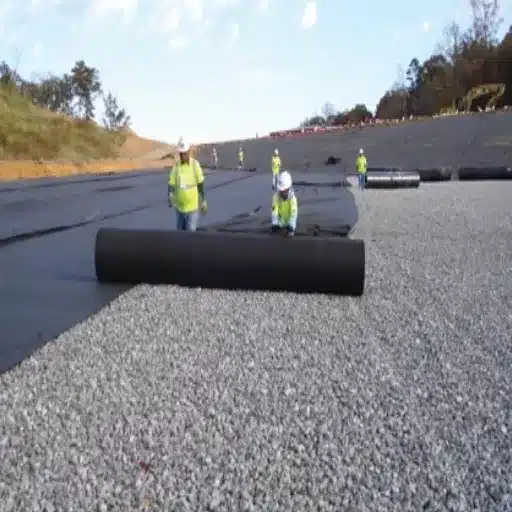
The choice between woven and non-woven geotextile fabric fundamentally depends on project requirements. Each type offers distinct performance advantages that engineers must balance.
Performance Comparison
| Property | Woven Geotextile | Non-Woven Geotextile | Typical Winner |
|---|---|---|---|
| Tensile strength | High (200-1,000+ lbs) | Moderate (80-300 lbs) | Woven |
| Elongation | Low (10-25%) | Higher (30-80%) | Non-woven |
| Permeability | Low to moderate | High | Non-woven |
| Filtration efficiency | Poor | Excellent | Non-woven |
| Puncture resistance | High | Moderate | Woven |
| Unit cost | 3.00−3.00−32.40/m² | 1.30−1.30−11.80/m² | Non-woven |
Selection Guide by Application
Choose woven geotextile when:
- Load-bearing capacity is critical (roads, railways):
- Soil reinforcement is the primary function
- Puncture resistance from aggregate is the need for that
- Long-term creep resistance matters
Choose non-woven geotextile when:
- Drainage functions and the advancement of water
- Filtration is essential
- Conformability for irregular surfaces is necessary
- Cost is the driver for the selection
The idea was drilled into Chen Wei, a civil engineer in Singapore, through personal experience. His team mentioned woven fabric at the beginning of a sub-surface drainage project, assuming that more strength would be more performance. The all-permeable had water backup and system failures. With a matching soil gradation plus a non-woven geotextile, the problem was solved immediately. It involved a correction cost of 8,000, but preventing the original specification mistake saved the project from a redesign cost of at least 200,000.
Key Applications for Geotextile Fabric
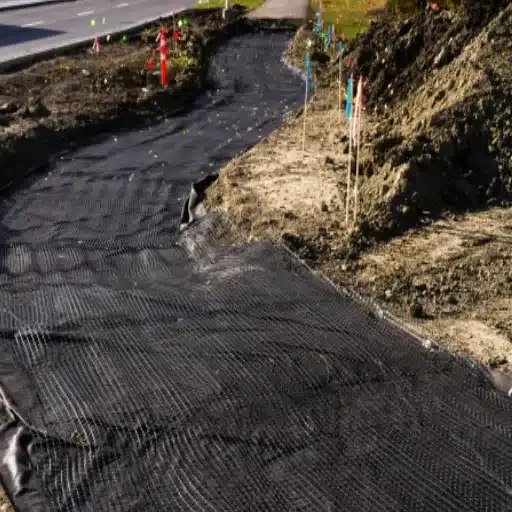
Geotextile fabric serves diverse functions across civil engineering and environmental projects. Understanding these applications enables proper specification and installation.
Soil Stabilization and Reinforcement
By distributing loads across wider areas, geotextiles reinforce weak soil to prevent localized bearing capacity failure, whereas in road construction, geotextiles applied between a soft subgrade and an aggregate base will prevent pumping or rutting and even reduce the thickness of the required aggregates by 20-25%.
Technical requirements: Woven geotextiles 200+ kN/m high strength tensile force in a wide width, low elongation. ASTM D4595 testing confirms reinforcement capacity under a sustained load.
Standard specifications:
- Road construction-200-400 g/m² woven fabric
- Railway stabilization-300-600 g/m² high-strength woven
- Embankment support-200-400 g/m², with appropriate creep resistance.
Separation
Dirt courses made of completely dissimilar soils interfere, thereby keeping the structure intact for a longer time. Fine-grained subgrade soil will mix into the aggregate bases without separation, leading to minimized drainage capacity and earlier pavement collapse.
Applications include:
- Subgrade-aggregate separation in parking lots
- Old pavement-new pavement interfaces
- Soft soil-riprap interfaces in coastal protection
- Stabilizing that area for building a foundation.
Filtration
A geotextile filter allows water to pass through freely yet contains soil particles. It resembles graded aggregate filters but achieves this by a much reduced thickness. The geotextile should allow a minimum of ten times the permeability of the native soil for proper filtration design.
Critical design parameters:
- Apparent opening size (AOS) must match soil gradation
- Permittivity must exceed flow requirements
- Placement must be in the order of less-permeable to more-permeable sequence
Applications: For installation in French drains, under-drain, landfill leachate collection, and retaining wall drainage.
Drainage
Geotextiles assist in the movement of water towards or away from soil structures. Furthermore, high ASTM D4491 non-woven fabrics create highly efficient preferential saturation flow paths in soil.
Applications:
- Subsurface drainage behind basement walls
- Bridge abutment drainage
- Landfill leachate management
- Green roof drainage layers
- Sports field drainage systems
Erosion Control
Geotextiles are used to prevent surface erosion from snow and wind. Such applications vary from the use of temporary silt screens to shore up permanent erosion control in the form of riprap or gabions.
Case Study: The aftermath of wildfires that struck Napa Valley in the year 2017 was hence significant usage of biodegradable matting that was combined with the deployment of geosynthetic reinforcements on burned hillsides by the engineers. That particular combination resulted in an impressive 80% reduction in soil displacement under winter rains and hence stopped mismatch and deposition of soil into the waterways, which then protected structures located downstream.
Ready to specify geotextile fabric for your stabilization or drainage project? Contact our engineering team for technical consultation on product selection and specifications tailored to your site conditions.
Technical Specifications and Standards
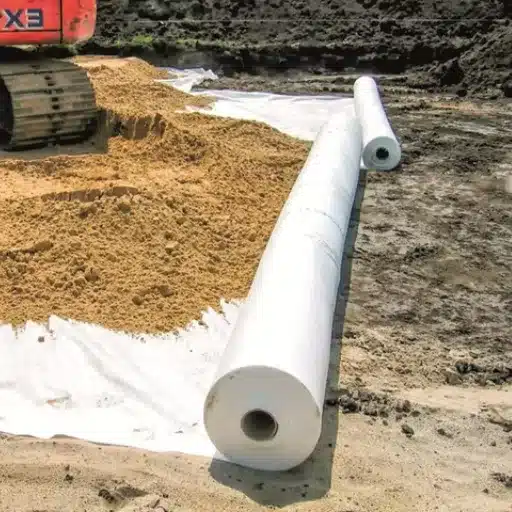
Professional geotextile specification requires understanding standardized test methods and performance criteria. These standards ensure predictable performance across manufacturers and applications.
Critical Performance Properties
Grab Tensile Strength (ASTM D4632): It is the resistance of a geotextile to rupture upon exposure to a grab load. It is a survival in installation, and it should carry the load while in service. Road construction uses over 200 pounds, while applications, for instance, heavy-duty, go above 600 pounds.
Wide Width Tensile (ASTM D4595): It determines the biaxial behavior in load-strain. The modulus values for engineering calculations are given by it, pertinent to reinforcement design.
Puncture Resistance (ASTM D6241): It is significant to check the resistance with aggregate under sharppuncture. It is critical for construction phase protection and long-lasting durability under loaded conditions.
Permittivity (ASTM D4491): In this case, the flow of water at 90°to the horizontal plane of the fabric must be measured. A good drainage will have large values, right up to and over 1.0 sec⁻¹, but in stabilization applications, this can be more modest.
Apparent Opening Size – AOS (ASTM D4751): This is an approximate size of the largest particle that passes through the fabric. This may be matched with the soil gradation, and generally, AOS ≤ 0.6 × D85 soil would call for filtration design.
Mass Per Unit Area (ASTM D5261): Wt. of a fabric in gm/sq.m or oz/sq.yd indicates thickness, strength, and durability. Most standard weights range from 100 g/sq.m for light-duty fabrics to 600 g/sq.m for the heaviest of the heavy-duty fabrics.
UV Resistance (ASTM D4355): After damage, it describes the retention of strength following UV exposure. Ideal for temporary exposure applications encountered in construction applications.
AASHTO M288 Standards
The M 288 geotextile specification by the American Association of State Highway and Transportation Officials (AASHTO) provides a classification system for geotextiles for highway applications. It classifies the geotextiles into three classes of survivability based on the rigors of construction:
- Class 1: Highly survivable (most severe conditions using heavy equipment)
- Class 2: Survivable with moderate difficulty (essentially most typical road construction)
- Class 3: Relatively low survivability (maximum use of light equipment, some hand placement)
Each class of geotextiles gives minimum property requirements for grab strength, puncture resistance, and tear strength, so they survive installation to do its work as-intended design.
Material Specifications
Polypropylene geotextiles dominate the market due to:
- Excellent chemical resistance
- Superior UV stability
- Lightweight handling
- Cost efficiency
- Resistance to microbial degradation
Polyester geotextiles excel in:
- Higher tensile strength (30-100 kN/m)
- Better performance in wet environments
- Lower creep under sustained loads
- Applications requiring dimensional stability
Specification Selection Guide
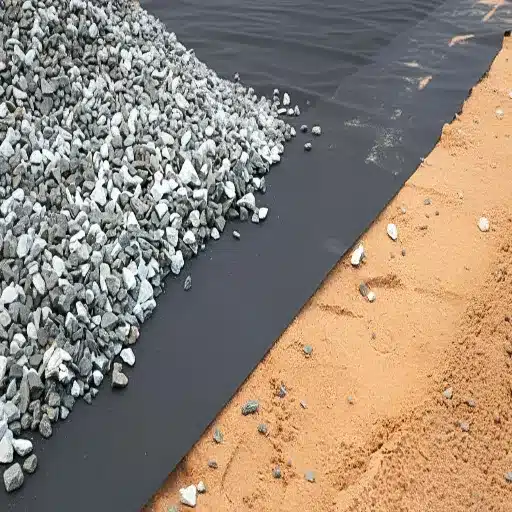
Selecting the appropriate geotextile requires matching product properties to application requirements. This guide provides starting points for common applications.
By Application Type
| Application | Recommended Type | Weight (g/m²) | Key Specification |
|---|---|---|---|
| Residential driveways | Non-woven | 135-200 | Moderate strength, high permeability |
| Commercial parking lots | Woven | 200-300 | High puncture resistance |
| Road construction | Woven | 200-400 | High tensile, low elongation |
| French drains | Non-woven | 150-250 | High permittivity, matched AOS |
| Retaining wall drainage | Non-woven | 200-300 | Filtration efficiency |
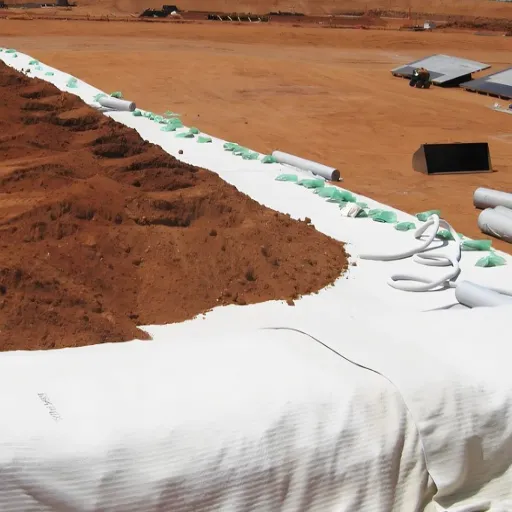
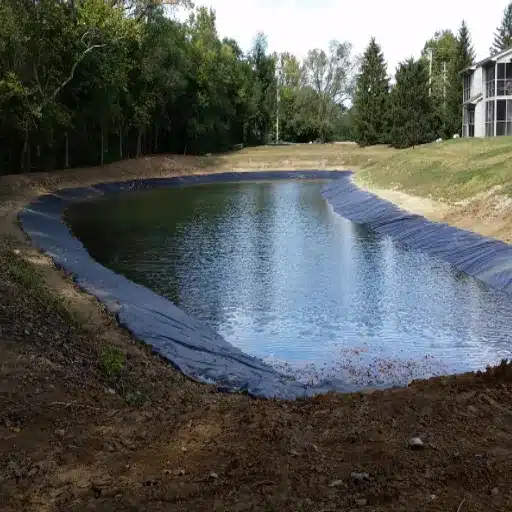
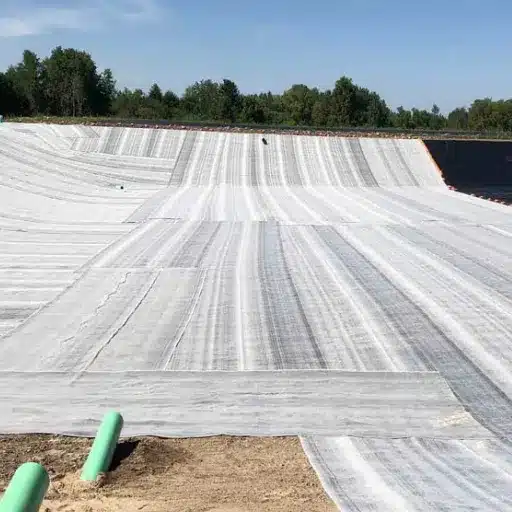
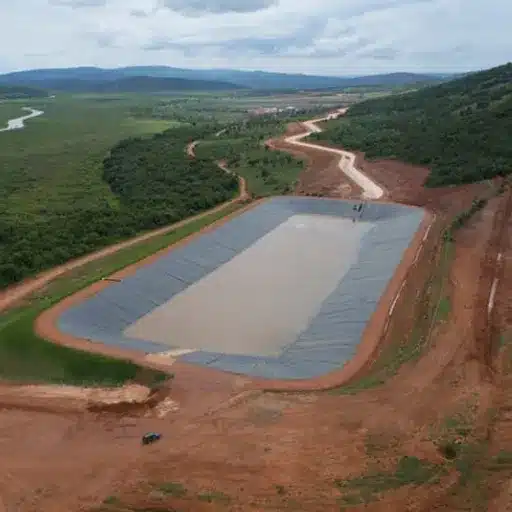
| Landfill lining | Woven | 200+ | High puncture, chemical resistance |
| Erosion control | Non-woven | 200-400 | UV-resistant, high-flow |
| Railway stabilization | Woven | 300-600 | Very high strength |
Weight Selection Criteria
Light duty (under 100-150 g/m²):
- Residential Landscaping
- Sediment Control Fences
- Temporary Site Access Roads
- Weed Barriers
Medium duty (up to 150-250 g/m²):
- Driveways and parking lots
- French Drains and Drainage
- Light Commercial Uses
- Erosion Control Mats
Most durable (250-400+ g/m²):
- Highway Construction
- Railway Stabilization
- Landfill Applications
- Heavy Industrial Uses
Cost Considerations (2025 Pricing)
Shifting the lower bound limit to a real budgeting range:
Nonwoven geotextiles range:
- 100-135 g/m²: $1.30−1.30−3.00/m² (bulk)
- 150-180 g/m²: $2.40−2.40−5.15/m²
- 200-250 g/m²: $3.75−3.75−8.05/m²
- 300-350 g/m²: $5.90−5.90−11.80/m²
Woven geotextiles range:
- Slit-film (Standard): $3.00−3.00−7.00/m²
- Monofilament: $4.85−4.85−11.85/m²
- High-strength: $5.90−5.90−15.05/m²
- Heavy-duty: $16.15−16.15−32.40/m²
Ultimately, prices are drastically affected by volume. Buying in such quantities would get buyers a discount of about 20 to 30% off of standard retail prices since the order’s size easily tops the 50,000 m² mark.
Installation Best Practices
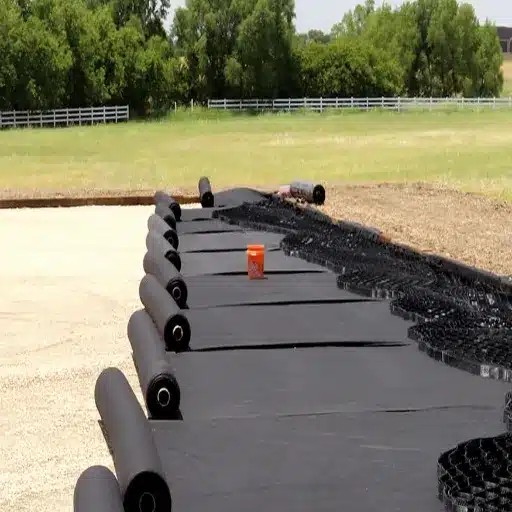
Proper installation determines whether the geotextile fabric performs as designed. Following established protocols prevents costly repairs and ensures design life achievement.
Site Preparation
As it is difficult to handle during service, deposition of the site is done by scraping off the vegetation, rocks, and other sharp objects, causing damage. Spread the substrate apart to the required elevations and compact loose, paying attention to the water soaks on materials.
Deployment Techniques
Place the geotextile directly on the prepared surface and make it as roll-out and flat as possible. By rolling your geotextile parallel to the leading edge flow direction, overlaps of 12 to 18 inches are typical in drainage applications, but a higher span is needed in slopes or critical areas.
Overlap requirements by application:
- Flat drainage applications: 12 inches minimum
- Slopes under 3:1: 18 inches
- Slopes steeper than 3:1: 24+ inches or sewn seams
- High-flow areas: Sewn seams recommended
Seaming and Joining
Overlap is typical to most applications. Stitch Seamed is constructed through a high-performance, high-strength, Polypropylene thread, providing undue superiority in critical applications or steep slopes. Heat bonding is effective when using particular chemically-bonded non-woven materials, but it is driven by specialized equipment.
Protection Requirements
Cover immediately with geotextile 4-8 inches of specified aggregate or soil to prevent ultraviolet deterioration; prevent construction damage. Fabric is degraded very fast under intense sunlight; do not leave without covering for construction unless a stable component grade has been indicated for long-term exposure, because of the fluctuations in the releases.
The sequence of the installation is: Place the cover material points from the toe of the slopes and upwards to ensure the position of the fabric. Do not tread – drive your heavy equipment directly to exposed material.
Cost Analysis and Economic Benefits
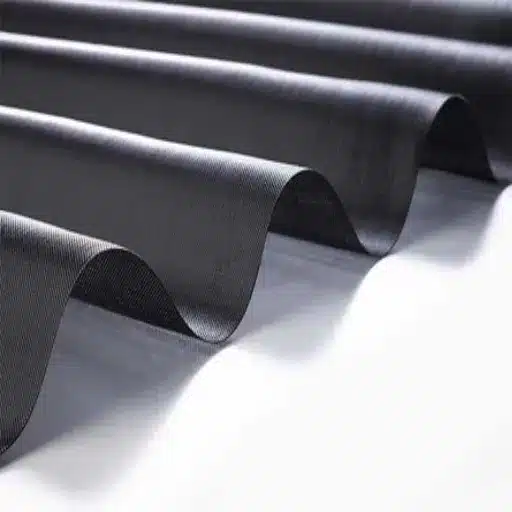
Geotextile fabric delivers economic advantages beyond material costs through reduced construction requirements and extended service life.
Material Cost vs System Savings
Geotextiles are usually more expensive than upfront material costs, but typically reduce the total project cost. The application of this principle is demonstrated in road construction:
Traditional construction (without geotextile):
- Excavation of soft soil: 15−15−25/m²
- Import select fill: 20−20−35/m²
- Aggregate base: 25−25−40/m²
- Total: 60−60−100/m²
Geotextile-stabilized construction:
- Geotextile (200 g/m² woven): 4−4−8/m²
- Associated reductions on aggregate base: 18−18−28/m²
- Total: 22−22−36/m²
Net savings: 38−38−64/m² (63-64% reduced) and with great performance in the long term.
Total Project Economics
Consider these factors in economic analysis:
Direct cost factors:
- Fabric material: 1.30−1.30−32.40/m² depending on type and weight
- Freight/shipping: 0.54−0.54−1.94/m² domestic
- Installation labor: 1.08−1.08−5.38/m²
- Accessories (pins, tape): +5-10%
- Overlap waste factor: +10-15%
Economic benefits:
- Reduced aggregate thickness: 20-25% savings
- Extended pavement life: 25-50% longer service
- Reduced maintenance: Fewer potholes and failures
- Construction speed: Faster installation than soil removal/replacement
ROI Analysis
A typical 10,000 m² parking lot project illustrates return on investment:
Investment:
- Geotextil (200 g/m²): $50,000
- Installation: $20,000
- Total: $70,000
Savings:
- Reduced aggregate: $80,000
- Extended pavement life (5 years): $150,000
- Total savings: $230,000
Net ROI: $160,000 (229% return) over pavement life
Quality Assurance and Supplier Selection
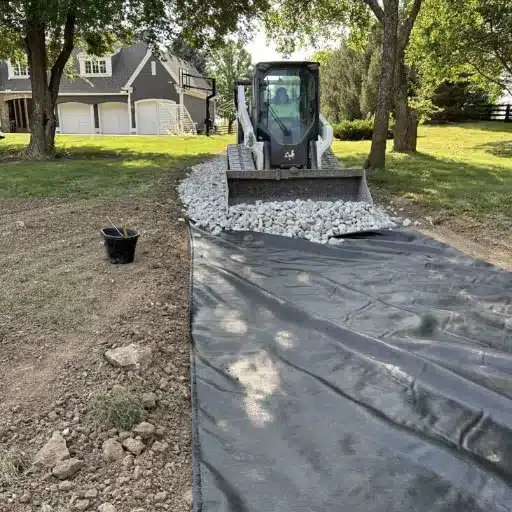
Specifying geotextile from qualified suppliers ensures material performance and project success.
Factory Quality Control Indicators
Evaluate suppliers based on documented quality systems. ISO9001 certification indicates established quality management procedures. Request factory test reports showing conformance to ASTM or AASHTO specifications for each production lot.
Key quality indicators:
- Consistent mass per unit area (±5% tolerance)
- Minimum property values exceeding specification
- UV stabilization for exposed applications
- Chemical resistance testing for aggressive environments
Sample Retention Policies
Leading manufacturers retain production samples for extended periods. This practice enables future testing if questions arise about material performance. Sample retention demonstrates confidence in product consistency and supports warranty claims.
Technical Support Capabilities
Complex projects benefit from supplier engineering support. Pre-installation consultation, specification review, and installation guidance add value beyond material supply. Select suppliers with demonstrated experience in your specific application type.
Ready to specify geotextile fabric for your next project? Request a customized quote with technical specifications tailored to your engineering requirements and project timeline.
Conclusion
Geotextile fabric is a mature technology that has demonstrated its effectiveness for soil stabilization, drainage, and environmental protection across widely used applications in civil engineering. It brings about performance-oriented engineering, faster product application, and becomes more competitive when used due to the cost.
Key takeaways for your next project:
- Woven geotextiles give a high tensile strength for load-bearing applications, whereas non-woven geotextiles ensure an increased permeability used in drainage and filtration purposes.
- Depending on the needed cases, it can be designed according to the fabric properties as per the ASTM and AASHTO standards.
- Geotextiles reduce project costs by 20-30% while extending the service life and even improving the long-term performance.
- The success of the installation is directly affected by the quality of installation; it requires acceptance of the best practices in regard to overlaps, protection, and coverage.
- The selection of the supplier becomes substantial due to factors like ISO9001 certification and technical backup capabilities that can definitely make a project successful.
This is what global engineering skill level is shown through geotextiles, reflecting a $7.68 billion market. Regardless of your project, be it in the realm of road construction, drainage systems, or erosion control, or landfill containment, there is a need to get into the design, the notion that geotextile fabric may equally be essential.