Geotextile fabric cost per square meter typically ranges from $0.20 to $2.50 for standard nonwoven grades and $0.50 to $3.00 for standard woven grades, with heavy-duty or specialty fabrics reaching $5.00 to $7.50 per m². Installed costs usually add another 20–50% on top of the material price. However, the real challenge is not finding a number — it is comparing quotes that use different units, GSM weights, and specifications.
Maria, a procurement manager for a West African road contractor, learned this the hard way. She received three quotes for a stabilization project. One supplier priced by square meter, another by kilogram, and the third by roll. The cheapest quote used a lighter GSM than the specification required. By the time the discrepancy surfaced, the project had already ordered the wrong grade, and replacement fabric added three weeks to the schedule.
This guide gives you a transparent framework for geotextile fabric cost per square meter. You will see material-only and installed price ranges by fabric type and GSM, understand the seven factors that move price, and learn how to compare quotes on equal terms. Whether you are budgeting a drainage trench, a road subgrade, or a landfill liner, the numbers below will help you avoid surprises.
For a broader technical foundation before you budget, see our complete geotextile fabric engineering guide.
Key Takeaways
- Standard nonwoven geotextile costs $0.20–$2.50/m² material-only; woven costs $0.50–$3.00/m².
- Heavier GSM, woven construction, polyester (PET), and certifications all increase unit price.
- Installation adds 20–50% to material cost; freight and region can shift delivered price significantly.
- Bulk orders above 10,000 m² often reduce unit cost by 10–30%.
- The lowest material quote is not always the lowest project cost if specs are wrong.
What Is the Typical Geotextile Fabric Cost Per Square Meter?
For most civil engineering and landscaping projects in 2026, the geotextile fabric cost per square meter falls between $0.20 and $3.00 for the material alone. Specialty grades, such as high-strength woven reinforcement or UV-stabilized coastal tubes, can range from $3.00 to $7.50 per m² or more.
The table below summarizes typical material-only prices by fabric type and weight. Use it as a starting point, then adjust for polymer, roll size, order volume, and delivery terms.
| Geotextile Type | GSM Range | Typical Price (USD/m²) | Common Applications |
|---|---|---|---|
| Nonwoven staple fiber | 100–200 | $0.20–$0.50 | Landscaping, light drainage |
| Nonwoven continuous filament | 200–400 | $0.40–$0.90 | Road construction, drainage |
| Nonwoven heavy-duty | 400–800 | $0.80–$2.00 | Landfill liners, erosion control |
| Woven standard | 100–250 | $0.30–$1.00 | Separation, road base |
| Woven high-strength | 250–600 | $1.50–$3.00 | Soil stabilization, railways |
| Woven heavy-duty reinforcement | 600+ | $3.00–$7.50+ | Embankments, steep slopes |
| Knitted / specialty | Variable | $1.00–$5.00+ | Coastal protection, dewatering |
Sources: Tinhy Geosynthetics
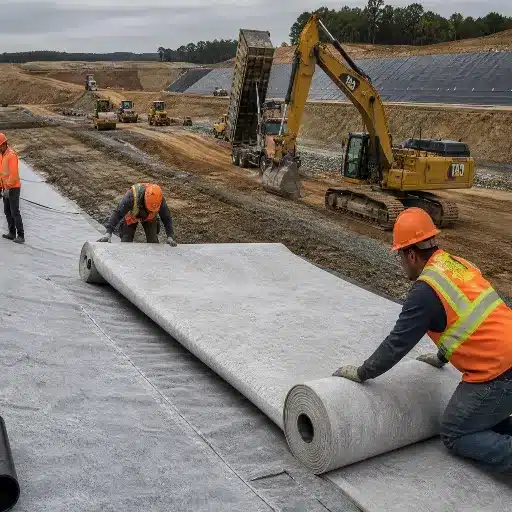
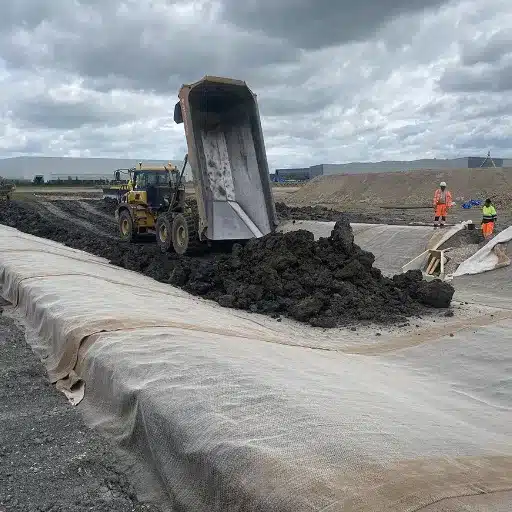
Installed cost is a separate number. On simple flat-ground work, labor and basic equipment may add $0.50–$1.50/m². On slopes, road subgrades, or landfill installations that need anchoring and careful overlap, the total installed cost can reach $1.50–$3.00/m² above the fabric itself.
Geotextile Price by Fabric Type
Nonwoven Geotextile Cost
Nonwoven geotextiles account for roughly 59–67% of global geotextile consumption. They are made by needle-punching or thermally bonding polypropylene (PP) or polyester (PET) fibers. Because the manufacturing process is faster and uses less specialized equipment than weaving, nonwovens are usually the lower-cost option per square meter.
For drainage, filtration, separation, and landscaping, expect to pay:
- Lightweight 100–200 GSM: $0.20–$0.50/m²
- Medium 200–400 GSM: $0.40–$0.90/m²
- Heavy 400–800 GSM: $0.80–$2.00/m²
Continuous-filament nonwovens cost 20–50% more than staple-fiber versions because they offer better uniformity, higher tensile strength, and improved long-term durability. For a French drain or road subgrade that must last decades, the extra cost often pays for itself in reduced maintenance. For installation and design guidance, see our nonwoven drainage geotextile fabric guide.
Woven Geotextile Cost
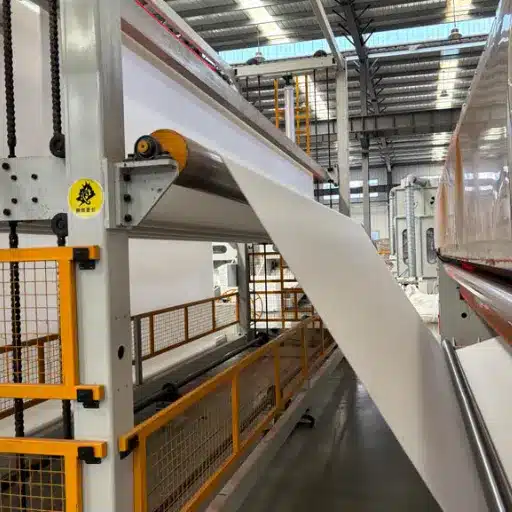
Woven geotextiles are produced on industrial looms using high-tenacity tapes or yarns. They are designed for reinforcement, stabilization, and load distribution, which means they need higher tensile strength and puncture resistance than most nonwovens. That performance comes at a premium.
Typical woven geotextile fabric cost per square meter:
- Standard 100–250 GSM: $0.30–$1.00/m²
- High-strength 250–600 GSM: $1.50–$3.00/m²
- Heavy-duty reinforcement 600+ GSM: $3.00–$7.50+/m²
Woven fabrics are the standard choice for road base stabilization, railway embankments, and any application where the fabric must carry tensile load. For a deeper comparison, see our woven vs nonwoven geotextile comparison.
Knitted and Specialty Geotextiles
Knitted geotextiles and geotextile tubes sit at the top of the price range. These products are engineered for specific loads, such as coastal erosion control or dewatering sludge. Prices often start around $1.00/m² and can exceed $5.00–$10.00/m² depending on the filling material, tube diameter, and installation complexity.
7 Factors That Affect Geotextile Fabric Cost
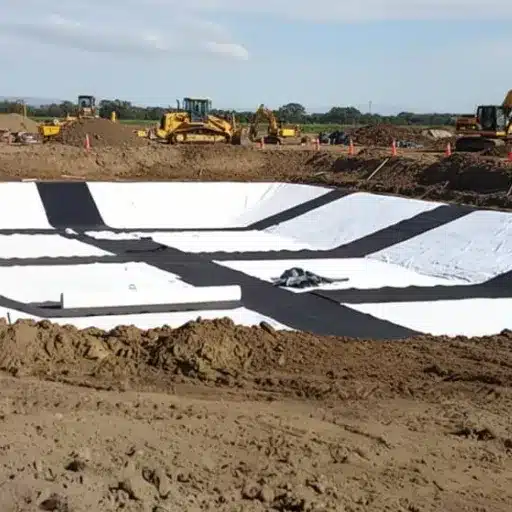
The difference between a 0.30/m2quoteanda0.30/m2quoteanda3.00/m² quote is not arbitrary. It is the result of seven technical and commercial variables.
1. Fabric Type
Woven geotextiles generally cost 15–40% more than nonwoven fabrics of similar weight because weaving is slower and requires high-tenacity yarns. Knitted or composite structures cost more still.
2. GSM / Weight
GSM stands for grams per square meter. It measures fabric mass and correlates closely with thickness and strength. Each 100 GSM increase typically raises material cost by $0.10–$0.50/m². A 400 GSM road-stabilization fabric will cost substantially more than a 150 GSM landscaping fabric.
3. Polymer Material
Polypropylene (PP) is the most common and economical base polymer. Polyester (PET) generally costs 15–35% more because of higher raw material and processing costs. PET offers better creep resistance and higher tensile strength, so it is often specified for long-term reinforcement.
4. Tensile Strength and Puncture Resistance
Higher grab tensile, wide-width tensile, and puncture resistance values require stronger yarns, denser weaving, or thicker needle-punched mats. These upgrades add cost but are essential for roads, landfills, and heavy-load areas.
5. Roll Size and Custom Dimensions
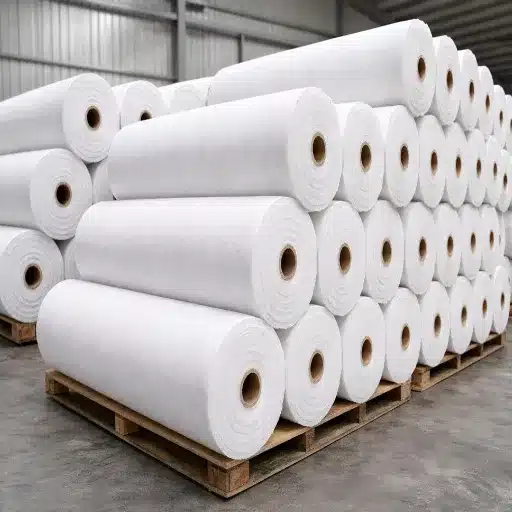
Standard rolls — commonly 3–6 meters wide and 50–300 meters long — are the most economical. Custom widths, shorter roll lengths, or pre-cut panels can add 5–20% to the unit price because of waste and handling. Conversely, wider rolls can reduce installation seams and labor by 10–15%.
6. Order Volume and Lead Time
Small orders under 5,000 m² carry higher per-unit costs. Orders above 10,000–50,000 m² often qualify for 10–30% volume discounts. Rush orders or small pilot batches typically lose those economies of scale.
7. Additives, Certifications, and Logistics
UV stabilizers, chemical-resistant coatings, and fire-retardant treatments add $0.05–$0.30/ft² but extend service life. ASTM or AASHTO certification can add a 10–15% premium because of testing and quality documentation. Finally, freight, import duties, and regional labor rates can swing delivered cost by 20–35% between Asia, North America, and Europe.
Mini-story: The 18% saving from standard rolls
A road contractor in Southeast Asia originally requested 1,000 custom-cut pieces 3 m × 5 m for a series of access roads. The supplier quoted a 12% premium for cutting and handling. After a short design review, the contractor switched to standard 5.8 m × 200 m rolls and adjusted the overlap layout. The change cut the per-square-meter price by 18% and reduced field seaming by half.
Material-Only Cost vs. Installed Cost
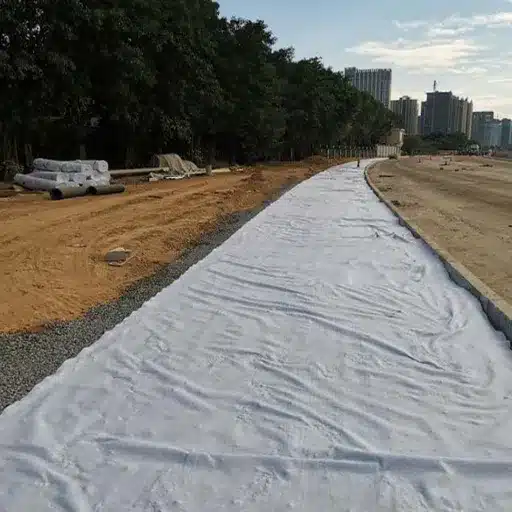
When you ask, “How much does geotextile fabric cost?” the answer depends on whether you mean the roll price or the full project price.
Material-only cost is the fabric delivered to the site, before labor or equipment. It is the number most suppliers quote first.
Installed cost includes:
- Site preparation and grading
- Labor for deployment, overlap, and anchoring
- Equipment such as rollers or loaders
- Fasteners, staples, or anchor trenches
- Waste and overlap allowance (usually 5–10%)
For simple flat-ground installation, the installed cost may be only 20–30% above material cost. For complex work on slopes or in landfills, installation can add 50% or more.
| Installation Scenario | Material Cost (USD/m²) | Installed Cost (USD/m²) |
|---|---|---|
| Flat landscape fabric | $0.30–$1.00 | $0.60–$2.00 |
| Road subgrade stabilization | $0.80–$2.50 | $1.50–$4.00 |
| Landfill liner protection | $1.50–$3.00 | $3.00–$6.00 |
| Slope erosion control with anchoring | $1.00–$3.00 | $2.50–$6.00 |
Regional labor rates also matter. Installation labor in North America or Western Europe may run $0.80–$1.50/m², while in parts of Asia or Africa it may be $0.30–$0.80/m². These differences make it important to budget using local rates rather than generic online figures.
How to Reduce Geotextile Costs Without Sacrificing Performance
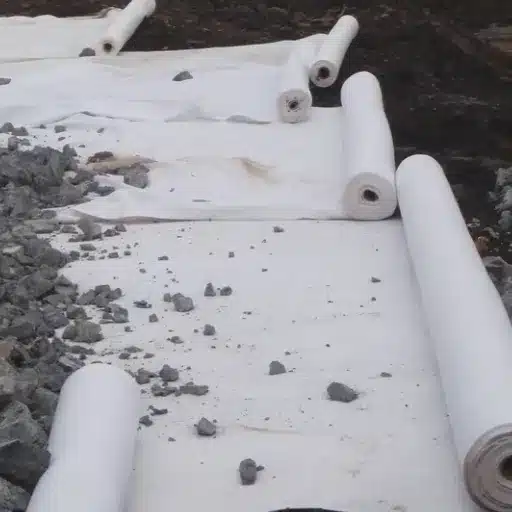
Lower cost does not have to mean lower quality. The following strategies help procurement teams and engineers reduce total project cost while keeping performance intact.
Specify by application and performance, not by brand name. A specification that calls out GSM, tensile strength, puncture resistance, and AOS/permittivity lets suppliers compete on equal terms. Brand names often carry a 20–50% premium without adding measurable performance for routine applications.
Use standard roll widths and lengths. As the Southeast Asia case showed, custom cutting can add 10–20%. Standard rolls also reduce waste and field seams.
Consolidate orders for volume discounts. Combining multiple phases of a project into one order, or coordinating orders across nearby sites, can push the total above 10,000 m² and unlock tiered pricing.
Plan delivery to reduce freight. Ocean freight for full container loads is far cheaper per square meter than air freight or less-than-container loads. Coordinating delivery with the construction schedule avoids expedited shipping.
Match certification level to project requirements. Not every drainage trench needs AASHTO M288 Class 1 certification. Specifying the right survivability class avoids paying for performance the project will never use.
For a deeper look at where woven geotextile delivers the best return, see our woven geotextile applications guide.
When the Cheapest Geotextile Costs More in the Long Run
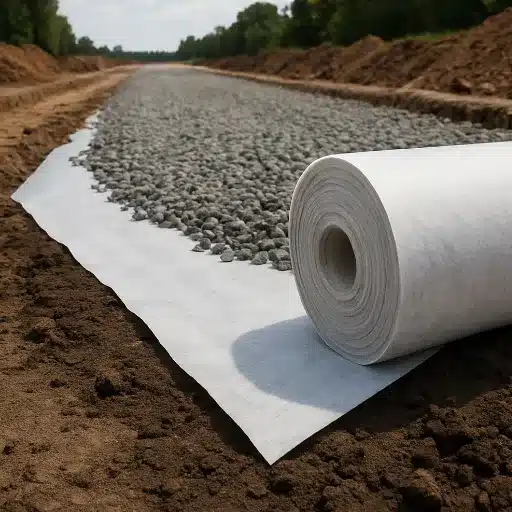
A low unit price can be expensive if the fabric fails before the project reaches its design life.
In 2022, a Nigerian road project selected the lowest bid for a stabilization fabric. The supplier met the specified GSM but omitted UV stabilization to cut costs. The rolls sat on site for six weeks during rainy-season delays. When installation finally started, sections of the fabric had begun to degrade from sun exposure. The contractor had to remove and replace the damaged material, re-profile the subgrade, and bring in new aggregate. The rework cost roughly four times the original material savings.
The lesson is clear: the geotextile fabric cost per square meter is only one line in the budget. The real cost includes performance over time. For projects with exposed storage, high UV, or aggressive soils, paying slightly more for UV stabilization, chemical resistance, or certified quality is usually the cheaper choice.
Frequently Asked Questions
How much does geotextile fabric cost per square meter?
Standard nonwoven geotextile costs $0.20–$2.50/m², and standard woven geotextile costs $0.50–$3.00/m². Heavy-duty or specialty grades can reach $3.00–$7.50/m² or higher.
Is a woven or a nonwoven geotextile more expensive?
Woven geotextile is generally 15–40% more expensive than nonwoven fabric of similar weight because it uses high-tenacity yarns and weaving equipment. Woven fabrics are specified when tensile strength and reinforcement are required.
Does installation cost more than the fabric?
Installation usually costs 20–50% of the material cost, not more. On complex sites with anchoring or steep slopes, installed cost can equal or exceed material cost. Simple flat-ground work is at the lower end of the range.
Why do geotextile prices vary so much between suppliers?
Prices vary because of differences in GSM, polymer type, manufacturing process, roll dimensions, order volume, certifications, and freight. Always compare quotes on the same technical specification, not just the headline price.
How much can I save with a bulk order?
Orders above 10,000 m² often reduce per-square-meter cost by 10–30%. Very large projects above 50,000 m² may see additional discounts depending on roll configuration and delivery terms.
What GSM geotextile do I need for a driveway or road?
For residential driveways, 150–200 GSM nonwoven is often sufficient. For road subgrades and heavy loads, 200–400 GSM woven or nonwoven is more common. Always confirm with the project engineer or the geotechnical report.
Conclusion
The cost per square meter is not a single number. It is a range driven by fabric type, GSM, polymer, strength, roll size, order volume, and logistics. For most projects in 2026, expect $0.20–$3.00/m² for material only, with installation adding another 20–50%.
The best procurement strategy is to specify performance clearly, compare quotes on equal specifications, and budget for the full installed cost — not just the roll price. Cheap fabric that fails before its design life is almost always more expensive than the right fabric specified correctly.
If you are budgeting a drainage, stabilization, or containment project, send us your GSM, tensile, and application requirements. Our engineering team can provide a tailored quote and help you choose the grade that balances cost and performance.